



All Resources
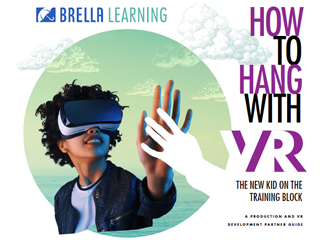
How to Hang with VR - The New Kid on the Training Block
So you know you want to incorporate virtual reality into your training. Everybody wants to bring in the new kid and have virtual reality (VR) on their team because the tech is innovative and memorable.
VR training experiences have a proven higher retention rate, with retention gains reaching 75% in comparison to standard video, eLearning, or textbook training. VR simulated training has made its way into retail stores, car assembly factories, police academies, all the way to Olympic athlete training.
The possibilities are endless. But how do you turn your VR training idea into reality, and who do you turn to? This new kid isn’t like any training you’ve worked with in the past. VR is not a one-size-fits-all delivery method, nor is it built for quick turnarounds. But here’s the real reality. It’s an investment, and investing in something implies longevity and appreciation in value. Choosing to incorporate VR into your training curriculum or course is not a choice made lightly, nor should it be.
This guide is designed to help you set realistic expectations for the VR production process, know what to look for in a great VR development partner, and understand the process of production planning for your next VR training module.
Click below to download this White Paper.
Grovo - What is Innovation?
If you think of creativity as the ability to produce a new idea, an initial spark, you can think of innovation as the process that turns that spark into fire. In other words, innovation picks up where creativity leaves off. Check out this resource to learn more about innovation.

Unbundling Content
Download eBook "Unbundling Content"
Examples, Demo Micro-Learning Ray Jimenez, PhD
VignettesLearning.com


Making eLearning Stick
The e-learning or live virtual class is animated and interactive, but are participants applying what they learn? This webinar will show you the latest research on e-learning and live virtual design practices - what works and what doesn’t work to make the e-learning stick. Based on Barbara’s new book Making Elearning Stick, you will learn research-tested techniques you can begin using immediately, with any training topic, to increase transfer to the job.
2018 New Year's Training Resolutions
Making resolutions can be a practical way to reflect on and determine goals that are important to you in the upcoming year. To see results for resolutions in your employee training program, it’s a good idea to focus in on one or two at a time.
Your goals may be anything from figuring out how to fit employee training into your organization’s budget, to giving your program’s ROI a boost with post-training reinforcement.
There is always room for improvement, and the new year is the perfect time to set new goals for your training program.
In this guide, you'll find:
7 different employee training resolutions
Key data to understand each one
First steps toward the results you’re looking for
Click below to download this White Paper.

The Basics of Microlearning
Microlearning is a method of training that takes place in short, bite-sized units. It aims to teach content in the most efficient and effective manner possible. Learn the ways in which microlearning differs from traditional learning.
Micro-Learning by Ray Jimenez, PhD

.png?1783359082)
Learning that Gets Results in a Complex World: A Toolbox for Agile Thinking
Do you have the nimble mindset to keep pace with today’s rapidly evolving environment? Learn how to build your thinking agility to break through the noise, make sense of shifting requirements, quickly adjust your approaches, and put together the best solutions for your learning challenges.

The Science of Microlearning
MICROLEARNING
Important Trend, or Flashy Fad? What the Science Says
And How to Spot Vendors Selling You with Junk Science
Microlearning as an idea has been around for a while. Now that the term has been made popular, vendors are falling over each other to convince companies that they have the best microlearning. But few vendors actually understand the science justifying the use of microlearning, let alone how it bears on instructional design. We present some of that objective research here, making the argument that microlearning is extremely effective, if it is done correctly.
Click below to download this White Paper.

Grovo - What is Holistic Training
Holistic training is a method that prepares learners to succeed in real performance situations. It is an immersive learning experience that weaves together training from multiple angles and in multiple formats. Check this video out and learn more about Grovo's holistic training approach.

eLearnChat 151: Dr. Ray Jimenez on Micro-learning
In this video Dr. Ray Jimenez provides some provocative ideas on what micro-learning is and how it may change the face of learning completely in the future.


Game-Based eLearning How Does its Effectiveness and ROI Compare to Traditional eLearning?
There is lots of buzz about "gamification" and game-based learning over the last year. Why should your organization consider adding it to your talent development strategy? This webinar may provide the key to igniting the performance of your workforce in 2013!
Most Effective Tips for Successful LMS Implementation
What Are The Most Effective Tips For Successful Learning Management System Implementation?
By Tridib Roy Chowdhury
I've had the opportunity to work with numerous clients over the years. Each had their own unique requirements, budgets, and list of must-have features. Regardless of their differences, I always share the same LMS implementation tricks to ensure a smooth and stress-free LMS implementation process.
Click below to download this White Paper.

Edison - Who Should Do That?
The lesson is designed to provide you with tools to successfully delegate and helps you reflect and discover best practices. By Ray Jimenez, Ph.D. 2014


New Research: Top 5 Keys to Employee Engagement through Supervisor Development
In a new Training Magazine webinar, Dale Carnegie Training reveals results of its cross industry, in-depth study of 1,500 employees to explore engagement in the workplace. The research reveals several surprises and five practical approaches managers can use to increase employee enthusiasm, empowerment, confidence and value to their organization.
Making Leadership Happen
Making Leadership Happen
More than ever, in a fast-changing and interconnected world, organizations feel the need for leadership. As a result, managers get a lot of advice on how to be more effective leaders. Articulate a clear vision, engage your employees, develop talent, have a global mindset, think strategically, create win-win solutions, leverage diversity, communicate effectively, hold people accountable, be an agile learner.
On one level, all of this advice makes great sense. Who could argue with it? At another level, it can be overwhelming.
We think it’s time to step back and take a different approach.
Click below to download this White Paper.


The 350,000 Year Daily Talent Cliff
Today, 10,000 Baby Boomers retired in the U.S. On average, they have 35 years of experience each, across every type of job in your organization. Tomorrow, it happens again. And the day after, until 2030. That means every day, 350,000 years of experience just left the workforce, an unprecedented departure in business history.
Retrieval Practice & Continuous Learning
What is the #1 problem with every training event? People forget.
Research shows that the natural process of forgetting can have a materially negative effect on productivity, budgets, and time. Why? Because decades of research show that people can forget up to 80% of training information in a mere 30 days after a training event takes place.
But the fix is here, and it’s easy.
Download this white paper to learn:
1) Download this white paper to learn: How to augment your training programs so forgetting is minimized
2) What format of learning has the most impact across any learning demographic
3) How the techniques of Retrieval Practice can quickly increase knowledge retention by 90%+
Click below to download this White Paper.

Bank of America - HR Compliance
The lesson depicts how a person’s comment may or may not be viewed as a form of sexual harassment by a co-employee. By Ray Jimenez, Ph.D. 2014


ENGAGE the Virtual Learner: 10 Interactivity Strategies that Drive Retention
This session will focus on how to keep your learners actively involved and engaged in the virtual classroom. You will learn 10 distinct strategies to drive interactivity and focus learner attention in order to deepen their retention.

2018 Learning Trends Report
Use this report to help you consider the best tools and technologies for helping workers (aka "learners") get stuff done and get it done well. Identify tools you want to keep using, stop using, start using, or improve how you use them.
Here’s what you’ll find:
Information about what L&D professionals actually did in 2017, and what they plan to do in 2018.
Emerging trends for 2018 and beyond.
Top roadblocks to delivering effective training and how those have changed over time.
The training topics L&D professionals view as most important in 2018.
Our insights into the data.

Checklist for Instructor-Led Training Management
ILT represents 70% of training today. Efficiently managing it is crucial, but it is fundamentally different from e-learning: it involves more complex back-office processes and a wider range of resources, and as such cannot be managed with the same tools.
This checklist will guide you through the elements needed to improve the efficiency of your Instructor-Led Training activity. It will help you assess the performance of your current technology in each domain.

PG & E - Advanced Pumping Efficiency Program
This course uses stories to help farmers understand the need for better water pump performance. Look for the Success Stories. By Ray Jimenez, Ph.D. 2014


Virtual Learning Environments: Redefining the Training Experience
As organizations continue to expand globally and training budgets continue to decrease, developing effective learning programs has become a significant challenge. Learning management systems and basic online learning tools have fallen short in providing an engaging learning experience, resulting in a need for more effective training programs.

