Blogs
|
As Quincy Jones once remarked, "I’ve always thought that a big laugh is a really loud noise from the soul saying, "Ain’t that the truth."
That said, Edu-fun Friday is a series devoted to adding some humor to the lives of teachers who visit this blog. After all, there’s nothing better than ending the week on a positive note! Plus, do we have the best topics to provide us with some comic relief or what?
Um—yeah… I’m afraid this is really what it’s coming to! In fact, I even frustrated myself the other day when I repeatedly tried to zoom in on the details of a magazine ad. Then I cracked up when I realized it was an actual print copy and not my iPad. Help me!
Thanks to artist Randy Glasbergen for the TGIF edtech humor!
Edutech for Teachers team
.
Blog
.
<span class='date ' tip=''><i class='icon-time'></i> Jul 15, 2015 02:03pm</span>
|
|
Understanding the Teen Brain Infographic
Ready to crack the code and solve the mystery behind why teens act the way they do? There are no instruction manuals for raising teens, but the Understanding the Teen Brain Infographic will take you through the science of the teen brain and help you determine the dangers and recognize the potential for the teens in your life.
The Science of the Teen Brain
The teen brain’s frontal lobes, used for decision making and problem solving, are not yet fully insulated so signals move slowly to the rest of the brain. This lack of full insulation leads to impulsive decisions.
Determine the Dangers
Because their brains are still maturing, teenagers are more prone to addiction than adults. Kids who drink alcohol before the age of 15 are five times more likely to develop alcoholism or dependence than those who begin drinking after the age of 21.
Beware of Driving Distractions
Teens are four times more likely to crash their cars than adults. According to AAA, distraction is a factor in more than half of teen car crashes.
Set Limits!
Kids average more than 10 hours of media time every day! That’s about 68% of the time they’re awake.
Get More Rest!
Sleep is essential for learning. Teens should get 8-10 hours of sleep. 9.25 hours is recommended.
The Science of Sleep
Most high school students are sleep deprived. Stay off the cell phone at night. Artificial light is a stimulus and decreases the chemicals that bring on sleep.
90% of Americans use some type of electronic device before bedtime. Monitor this activity!
68% of 15-to-I7-year-olds said they keep an electronic device on throughout the night.
20% fall asleep in class
Teens who get less than 6 hours of sleep are more likely to perform poorly on tests.
Promote the Possibilities
Teens have better memory! Incidental memory peaks at age 12 and then continues to decline through adulthood.
Use it or lose it!
As teens learn and experience new things, they will continue to make and build new brain connections. IQ scores can rise or fall 20 pts.
Recognize their potential
Since a teen’s brain is still changing, there’s high potential for increasing IQ. Once you understand the mysteries of your teen’s brain, you can protect them from bad behaviors and help them benefit from their amazing potential to learn and mature!
Via: www.learningliftoff.comThe post Understanding the Teen Brain Infographic appeared first on e-Learning Infographics.
eLearning Infographics
.
Blog
.
<span class='date ' tip=''><i class='icon-time'></i> Jul 15, 2015 02:02pm</span>
|
|
As a youth soccer coach for many years I have struggled to evaluate my own players and have seen how my soccer league evaluates players to place them on teams. As a professional learning-and-performance consultant who has focused extensively on measurement and evaluation, I think we can all do better, me included. To this end, I have spent the last two years creating a series of evaluation tools for use by coaches and youth soccer leagues. I’m sure these forms are not perfect, but I’m absolutely positive that they will be a huge improvement over the typical forms utilized by most youth soccer organizations. I have developed the forms so that they can be modified and they are made available for free to anyone who coaches youth soccer.
At the bottom of this post, I'll include a list of the most common mistakes that are made in youth-soccer evaluation. For my regular blog readers--those who come to me for research-based recommendations on workplace learning-and-performance--you'll see relevance to your own work in this list of evaluation mistakes.
I have developed four separate forms for evaluation. That may seem like a lot until you see how they will help you as a coach (and as a soccer league) meet varied goals you have. I will provide each form as a PDF (so you can see what the form is supposed to look like regardless of your computer configuration) and as a Word Document (so you can make changes if you like).
I've also provided a short set of instructions.
Instructions and Rationale
The Forms
1. Player Ranking Form: This form evaluates players on 26 soccer competencies and 4 player-comparison items, giving each player a numerical score based on these items AND an overall rating. This form is intended to provide leagues with ranking information so that they can better place players on teams for the upcoming season.
PDF---Will's_Youth-Soccer_PLAYER_RANKING_FORM_v2.0
WORD---Will's_Youth-Soccer_PLAYER_RANKING_FORM_v2.0
2. Player Development Form: This form evaluates players on the 26 soccer competencies. This form is intended for use by coaches to help support their players in development. Indeed, this form can be shared with players and parents to help players focus on their development needs.
PDF---Will's_Youth-Soccer_PLAYER_DEVELOPMENT_FORM_v2.0
WORD---Will's_Youth-Soccer_PLAYER_DEVELOPMENT_FORM_v2.0
3. Team Evaluation Form: This form helps coaches use practices and games to evaluate their players on the 26 key competencies. Specifically, it enables them to use one two-page form to evaluate every player on their team.
PDF---Will's_Youth-Soccer_TEAM_REVIEW_FORM_v2.0
WORD---Will's_Youth-Soccer_TEAM_REVIEW_FORM_v2.0
4. Field Evaluation Form: This form enables skilled evaluators to judge the performance of players during small-group scrimmages. Like the Player Ranking Form, it provides player-comparison information to leagues (or to soccer clubs).
PDF---Will's_Youth-Soccer_FIELD_EVALUATION_FORM_v2.0
WORD---Will's_Youth-Soccer_FIELD_EVALUATION_FORM_v2.0
The Most Common Mistakes in Youth-Soccer Evaluation
When skills evaluated are not clear to evaluators. So for example, having players rated on their "agility" will not provide good data because "agility" will likely mean different things to different people.
When skills are evaluated along too many dimensions. So for example, evaluating a player on their "ball-handling skills, speed, and stamina" covers too many dimensions at once—a player could have excellent ball-handling skills but have terrible stamina.
When the rating scales that evaluators are asked to use make it hard to select between different levels of competence. So for example, while "ball-handling" might reasonably be evaluated, it may be hard for an evaluator to determine whether a player is excellent, very good, average, fair, or poor in ball-handling. Generally, it is better to have clear criteria and ask whether or not a player meets those criteria. Four or Five-Point scales are not recommended.
When evaluators can’t assess skills because of the speed of action, the large number of players involved, or the difficulty of noticing the skills targeted. For example, evaluations of scrimmages that involve more than four players on a side make it extremely difficult for the evaluators to notice the contributions of each player.
When bias affects evaluators’ judgments. Because the human mind is always working subconsciously, biases can be easily introduced. So for example, it is bad practice to give evaluators the coaches’ ratings of players before those players take part in a scrimmage-based evaluation.
When bias leads to a generalized positive or negative evaluation. Because evaluation is difficult and is largely a subconscious process, a first impression can skew an evaluation away from what is valid. For example, when a player is seen as getting outplayed in the first few minutes of a scrimmage, his/her later excellent play may be ignored or downplayed. Similarly, when a player is intimidated early in the season, a coach may not fully notice his/her gritty determination later in the year.
When bias comes from too few observations. Because evaluation is an inexact process, evaluation results are likely to be more valid if the evaluation utilizes (a) more observations (b) by more evaluators (c) focusing on more varied soccer situations. Coaches who see their players over time and in many soccer situations are less likely to suffer from bias, although they too have to watch out that their first impressions don’t cloud their judgments. And of course, it is helpful to get assessments beyond one or two coaches.
When players are either paired with, or are playing against, players who are unrepresentative of realistic competition. For example, players who are paired against really weak players may look strong in comparison. Players who are paired as teammates with really good players may look strong because of their teammates’ strong play. Finally, players who only have experience playing weaker players may not play well when being evaluated against stronger players even though they might be expected to improve by moving up and gaining experience with those same players.
When the wrong things are evaluated. Obviously, it’s critical to evaluate the right soccer skills. So for example, evaluating a player on how well he/she can pass to a stationary player is not as valid as seeing whether good passes are made in realistic game-like situations when players are moving around. The more game-like the situations, the better the evaluation.
When evaluations are done by remembering, not observing. Many coaches fill out their evaluation forms back home late at night instead of evaluating their players while observing them. The problem with this memory-based approach is that introduces huge biases into the process. First, memory is not perfect, so evaluators may not remember correctly. Second, memory is selective. We remember some things and forget others. Players must be evaluated primarily through observation, not memory.
Encouraging players to compare themselves to others. As coaches, one of our main goals is to help our players learn to develop their skills as players, as teammates, as people, and as thinkers. Unfortunately, when players focus on how well they are doing in comparison to others, they are less likely to focus on their own skill development. It is generally a mistake to use evaluations to encourage players to compare themselves to others. While players may be inclined to compare themselves to others, coaches can limit the negative effects of this by having each player focus on their own key competencies to improve.
Encouraging players to focus on how good they are overall, instead of having them focus on what they are good at and what they still have to work on. For our players to get better, they have to put effort into getting better. If they believe their skills are fixed and not easily changed, they will have no motivation to put any effort into their own improvement. Evaluations should be designed NOT to put kids in categories (except when absolutely necessary for team assignments and the like), but rather to show them what they need to work on to get better. As coaches, we should teach the importance of giving effort to deliberate practice, encouraging our players to refine and speed their best skills and improve on their weakest skills.
Encouraging players to focus on too many improvements at once. To help our players (a) avoid frustration, (b) avoid thinking of themselves as poor players, and (c) avoid overwhelming their ability to focus, we ought to have them only focus on a few major self-improvement goals at one time.
Will Thalheimer
.
Blog
.
<span class='date ' tip=''><i class='icon-time'></i> Jul 15, 2015 02:02pm</span>
|
|
In a recent, NY Time Article, GRETCHEN MORGENSON cited a paper (Executive Superstars, Peer Groups and Over-‐Compensation -Cause, Effect and Solution) by Charles M. Elson and Craig K. Ferrere who compile research from others (see citations below) that basically shows that CEO's do NOT successfully transfer their skills from one company to another. CEO's who are hired from within tend to do a much better job than CEO's brought in from the outside.
We in the learning-and-performance field should take note. The reason this is true is because it takes real-world expertise, gained through long bouts of experience in a particular set of situations, to give people the tools they need to be experts.
This we should all know. If you want to be good in calculus as it applies to astronomy, you ought to get practice in applying calculus to astronomy. It is not enough to just learn calculus and learn astromony.
And certainly it is not helpful to learn Latin to learn math, or even to learn other languages. Anybody who has been to graduate school in learning should have learned about how unlikely it is for learning to transfer from one domain to the other. Thorndike anyone?
Donald Clark has a nice blog post on Thorndike and the uselessness of learning latin.
So, from both a training and on-the-job learning perspective, we should be giving our learners extensive opportunities to learn their areas of expertise.
This doesn't mean they should never dabble in other domains. In fact, creativity research shows that "domain-spanners" are more likely to be creative than those who only learn with a narrow focus. HOWEVER, people who are only domain-spanners (and don't know a field really well) tend to just be good at coming up with ideas--but not generally good ones. Expertise matters!
Those of you in the United States who are thinking about our election in terms of this lack of transfer from one job situation to another could have a field day...or a depression.
Some of Elson and Ferrere's citations showing that CEO's skills don't transfer well:
Richard A. Cazier and John M. McInnis, Do Firms Contract Efficiently on Past Performance When Hiring External CEOs? (Working Paper, 2010) (studying 192 external successions from 1993-2005 they find a negative correlation between excess compensation and future performance;; paradoxically the superstars underperformed).
Gregory L. Nagel, William G. Hardin III, The Transferability of CEO Skills, (Working Paper, 2007)
Mark R. Huson, Paul H. Malatesta and Robert Parrino, Managerial succession and firm performance, 74 J. FIN. ECON. 237, 237 (2004) (finding that "the appointment of outside successors [is] not significantly related to post-turnover performance changes in [their] regression analysis.")
Chuck Lucier, Steven Wheeler, and Rolf Habbel, The Era of the Inclusive Leader, 47 STRATEGY+BUSINESS (2007) (finding that "experienced CEOs", though hypothesized to bring experience in dealing with stakeholders and shareholders actually underperformed).
James S. Ang and Gregory L. Nagel, The Financial Outcome of Hiring a CEO from Outside the Firm, (Working Paper, 18, 34, 2011) (using a structural self-selection model to estimate counterfactual performance that would have been obtained if the firm hired an insider rather than an outsider and vice-versa, at all target levels of performance internal hires stochastically dominate outsiders).
Will Thalheimer
.
Blog
.
<span class='date ' tip=''><i class='icon-time'></i> Jul 15, 2015 02:01pm</span>
|
|
A few weeks ago I shared a post pertaining to using images—like the winning entries in the Smithsonian’s 11th Annual Photo Contest—to spark student writing. Since then I’ve discovered a really neat Pinterest board chock-full of ideas regarding the use of picture prompts in the classroom.
Check out Quick Write Picture Prompts, a collection of images and corresponding writing ideas, curated by a fourth grade teacher. An example of one of these story starters is shown below.
Suggested Use: Writer #1—Tell the story about what was happening when this picture was taken. Writer #2—Add to the first writer’s story. Writer #3—Share your thoughts or the life lesson. Writer #1: Read the story. Edit and revise it for clarity. Give the picture a title.
Even if none of the images in this collection apply to your grade level and/or curricular area, there are plenty of ideas that can be tweaked to suit your needs.
Classroom Connection:
Regardless of the resource utilized to obtain images, the use of picture prompts is an excellent way to motivate students to write essays, stories, poems, etc.
Edutech for Teachers team
.
Blog
.
<span class='date ' tip=''><i class='icon-time'></i> Jul 15, 2015 02:00pm</span>
|
|
A while back, I wrote an article for the eLearning Guild which was essentially about measuring social media as a learning tool. We called social media "Learning 2.0" but the issue is the same. Here is the article.
I'm reprising that here, because I just read Ettiene Wenger's (2011) article where he talks about measuring social media, and I am once again disappointed that opportunity costs and costs of bad-information are not recognized.
Will Thalheimer
.
Blog
.
<span class='date ' tip=''><i class='icon-time'></i> Jul 15, 2015 01:59pm</span>
|
|
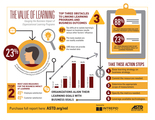
The Value of Organizational Learning Infographic
How do you gauge the business impact of organizational learning programs? What are the main obstacles encountered when linking learning programs and business outcomes? What steps do you need to take to move the needle? ASTD and the Institute for Corporate Productivity (i4cp) have released The Value of Learning: Gauging the Business Impact of Organizational Learning Programs research report focused on how organizations measure the effectiveness of the learning programs and products they design and implement. This report offers both a quantitative and qualitative perspective from leaders responsible for organizational learning. This study looks at responses of 431 learning professionals representing organizations across all sectors and of varying sizes and geographic locations that were collected in September and October of 2013. Interviews with 11 industry leaders, such as Yum! Brands, Caterpillar, and Walgreens, support and bring depth to the survey findings. While there’s no matching the analysis and recommendations found in the report, ASTD has compiled The Value of Organizational Learning Infographic to get you started.
Via: www.td.orgThe post The Value of Organizational Learning Infographic appeared first on e-Learning Infographics.
eLearning Infographics
.
Blog
.
<span class='date ' tip=''><i class='icon-time'></i> Jul 15, 2015 01:59pm</span>
|
|
If you’re a regular visitor to my blog, especially as of late, it’s no secret that I’ve been sharing tools and resources that could help teachers spark an interest in writing. And that’s because I am a huge proponent of teaching visual literacy skills. Considering the mass media, digital age we are immersed in, I feel it’s imperative that students have the ability to interpret, negotiate and make meaning from information presented in the form of an image, which extends the meaning of literacy beyond printed text.
Combine that notion with the super popular quote images that are now splashed all over the place—social media, the Internet, billboards, etc.—and what do you have? The opportunity to develop the perfect activity to integrate pop culture with the honing of skills students need to communicate in a highly complex world. Yep, I’m talking about the creation of a project that combines images, text, writing and even classroom discussions or debates. And the tool to get the job done? None other than QuotesCover.com.
It’s no secret that one way to make pictures more memorable is by making them pop off the page. But designing elements such as typography, shapes, color combinations and composition can be a complex process. Well, until now, that is.
QuotesCover.com has now become my favorite go-to web tool for taking one of my very own photos, adding text and generating an image to represent exactly what I am so totally thinking or feeling. Not only does it transform the ordinary into the extraordinary, this nifty application is pretty simple to use. Check out my refuse to give up example below. ♥
Want to make your own "eye candy"? Then check out QuotesCover.com and start your design by following three easy steps: Select your text by either adding your own or choose a famous quote, proverb or greeting from the online collection. Next, use the graphic editor to determine the type and size of image you would like to create. Lastly, experiment, tweak and play with the font and color combinations, drawing tools, effects and customizable background image to create your masterpiece.
Once you’re satisfied with the result, just download it for future use—on blogs and web or social media sites and/or in print projects such as newsletters or brochures.
Classroom Connection:
The use of quotes combined with images used to motivate and inspire students is not a new concept. As a classroom teacher, I personally incorporated both on a regular basis and can honestly say that this strategy was one of my most favorite ways to kickstart class, regardless of the content area.
That said, QuotesCover.com is a fabulous tool for teachers who are looking for a quick and easy yet powerful way to create their own quote images and/or who want their students to do the same.
As previously mentioned, we live in a world in which our students are constantly bombarded with images; thus, it is essential for them to have the skills to recognize, interpret and understand the context of these signs, pictures, graphics and symbols in order to make meaning of their environment.
So, if you’re going to use this particular visual literacy teaching strategy to generate writing and/or thought-provoking discussions, why not add a layer of technology to the process by having students create their own quote images with a tool like QuotesCover.com?
Finished products can be utilized for writing prompts, classroom conversations or both. For example, students can jot a thought and/or discuss in a small or whole group setting what the quotes actually means to them.
Edutech for Teachers team
.
Blog
.
<span class='date ' tip=''><i class='icon-time'></i> Jul 15, 2015 01:59pm</span>
|
|
I urge you to support Elliott Masie's war on frivolous LMS Trademarks. Here's what Elliott wrote in his newsletter:
Help! Defend Learning Field
from Patent Suit! The learning "patent trolls" are at it again. There
is a company called IPLearn that has unfortunately successfully sued over a
dozen learning management system - claiming they have invented many of the core
elements of technology delivered learning. Sure, they wrote several
clever patents that claim to have created much of the field - and, with an
understaffed patent office, it was approved - though there were many prior
learning and technology implementations. And, their strategy, which has
worked, is to sue a company - get the discovery and legal costs up and up, and
finally settle for a fee and stock shares. All, without having invented,
produced or created anything - other than a few patent apps.
I have worked, without fee,
against their efforts several times and now they are at it again. They
have brought suits against several major LMS companies - and I am asking
Learning TRENDS readers to help gather any manuals, documents or other
experiences you have had with these earlier corporate learning systems:
Registrar," by Silton-Bookman
Systems.
Learning Organization
Information System (LOIS)," by KnowledgeSoft, Inc.
Etude," by Gerald
Hollingsworth and GPU, Inc.
Continuous Learning System
(CLS)," by AT&T Global Information Solutions International, Inc.
The lawyers defending against
the IPLearn suit would love to see any samples of anything that describes the
operation or public availability of these systems. For example:
user manuals, help files, demonstration videos, brochures, press releases, and
actual program disks/CDs.
If you can help, would you send
a note to my office at emasie@masie.com
and we will contact you back. Many thanks!
While I'm not a trademark expert, and I support people and organizations who truly do create something new and unique, trademarks that aren't deserving hurt our industry and our learners.
Will Thalheimer
.
Blog
.
<span class='date ' tip=''><i class='icon-time'></i> Jul 15, 2015 01:59pm</span>
|
|
As Quincy Jones once remarked, "I’ve always thought that a big laugh is a really loud noise from the soul saying, "Ain’t that the truth."
That said, Edu-fun Friday is a series devoted to adding some humor to the lives of teachers who visit this blog. After all, there’s nothing better than ending the week on a positive note! Plus, do we have the best topics to provide us with some comic relief or what?
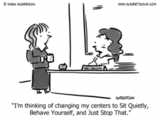
As for these centers, are there really any other options at this time of the year!
Thanks to artist Mark Anderson for the TGIF laugh!
Edutech for Teachers team
.
Blog
.
<span class='date ' tip=''><i class='icon-time'></i> Jul 15, 2015 01:59pm</span>
|