Blogs
|
How to Teach Children Organization Skills Infographic
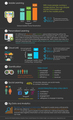
Organization and time management don’t always come easily for kids. Organizational skills are something you may have to teach your grade-schooler. The How to Teach Children Organization Skills Infographic presents some simple lessons to help your grade school child get organized.
Lesson 1: Recognize "wants" vs. "needs."
Goal: Sort out and prioritize what s/he wants to do vs. what s/he needs to do.
Example: Your child does homework first. Playing with friends comes later
Lesson 2: Take one out, put one in.
Goal: Keep messes from becoming overwhelming.
Example: Your child has to put away what’s already out when s/he wants to play with or use something new.
Lesson 3: Categorize, label and sort.
Goal: Keep things neat and orderly.
Example: Your child looks at toys, groceries or homework to figure out which things go together.
Lesson 4: Picture the day.
Goal: Know the order or events in the day.
Example: Your child plans out the day by drawing a picture of the day’s schedule as a comic book.
Lesson 5: Make daily checklists.
Goal: Keep track of what needs to be done.
Example: Your child lists out things to do, checks off what’s finished and transfers unfinished items to the next day’s list.
Lesson 6: Keep a family calendar.
Goal: Plan for the future.
Example: Your child future checks the calendar nightly to know what’s happening tomorrow.
Lesson 7: Break big projects into smaller steps.
Goal: Make big projects easier to manage
Example: Your child breaks a science project into steps-first coming up with an idea, then listing materials needed and gathering supplies before doing the experiment.
The post How to Teach Children Organization Skills Infographic appeared first on e-Learning Infographics.
eLearning Infographics
.
Blog
.
<span class='date ' tip=''><i class='icon-time'></i> Jul 15, 2015 03:42pm</span>
|
|
The European MOOCs Scoreboard Infographic
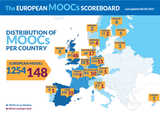
The world of MOOCs is dynamic and growing, and Open Education Europa aims to be the leading online resource for open education innovation. The aim of the European MOOCs Scoreboard Infographic is to highlight the huge potential that European institutions have in the world of OER and to help visualize this potential by compiling the existing European-provided MOOCs available on different open websites.
European MOOCs are those provided by European institutions, regardless of the platform that hosts them. All of the MOOCs accounted for in the scoreboard are also listed in the MOOC aggregator on the Open Education Europa website.
Another crucial point to note is that the scoreboard data is cumulative. That is, MOOCs are not deleted once they’re over. If a course is offered more than once, any subsequent session will be added as a new entry, i.e. Basic Economics (2nd Edition).
The courses have varying statuses: some are starting soon, some are ongoing, and others are listed as finished, but have made their resources available for self-study. While most of the information concerns MOOCs from European institutions, additional research on non-EU MOOCs was conducted to provide a reliable basis for comparison.
The scoreboard data is downloadable from the scoreboard page by clicking on the export symbol on the bottom of each of the scoreboard tabs.
European Sources
European Education Institutions at the Open Education Europa portal, Alison, First Business MOOC, FUN, FutureLearn,Iversity, Miriada X, Open Classrooms, Open Course World, openHPI, openSAP, Unow, UnX, Océan
Via: openeducationeuropa.euThe post The European MOOCs Scoreboard Infographic appeared first on e-Learning Infographics.
eLearning Infographics
.
Blog
.
<span class='date ' tip=''><i class='icon-time'></i> Jul 15, 2015 03:40pm</span>
|
|
How to Get Kids Excited about Reading Infographic
More and more parents realize that getting their kids to read becomes a real challenge. The How to Get Kids Excited about Reading Infographic presents the ways parents can facilitate the process of teaching children to read.
1. Read to your toddlers early and often.
Songs and nursery rhymes are a great way to attract kids’ interest. Make it a fun, interactive activity by teaching them to clap hands in time to the rhyming words and accented syllables. Talk about the meaning of short stories. Get kids involved in the plot and characters.
2. Use a multi-factorial approach.
Introduce kids to cloth books, colorful books, pop-up books, and other kinds where they can explore the story through several types of media. Play audio recorded stories and/or a DVD or video medium of a story being told or acted out.
3. Model reading for your children.
Let them see you read on a regular basis. Discuss the books you read, or even age-suitable news stories.
4. As children move into elementary school, encourage them to rewrite scenes from their favorite stories with a twist. Have them write their own short stories, keeping in mind their handwriting may be awkward, and the stories, very simple.
5. Ask kids in upper elementary grades to research a favorite author.
Discuss how they would envision the story differently if the child had written it, or was the main character.
View also:
Teaching Children the Value of Reading Infographic
Getting Your Kids to Love Reading Infographic
Via: www.cnkdigital.comThe post How to Get Kids Excited about Reading Infographic appeared first on e-Learning Infographics.
eLearning Infographics
.
Blog
.
<span class='date ' tip=''><i class='icon-time'></i> Jul 15, 2015 03:39pm</span>
|
|
Female Math Pioneers Infographic
Since Hypatia made her mark in ancient Alexandria, women have been changing the world with their contributions in mathematics. The Female Math Pioneers Infographic highlights the contributions of nine of the ground breaking women who did their work despite some incredible obstacles.
Hypatia (Approx 370- 415 CE )
This Greek mathematician, scholar, and teacher was a sensation with the public, and she paid the ultimate price. One of the leading philosophers of her time, she was murdered by those who opposed free thinking and scientific investigation— particularly by a woman.
Elena Cornaro Piscopia (1646-1684)
The first woman to earn a doctoral degree in mathematics. Scientists and royals from all over Europe traveled to Venice to meet her. She was a lecturer in mathematics at the University of Padua where she served until the end of her life. It wasn’t until the late twentieth century that another woman earned a doctorate from the University of Padua.
Maria Agnesi (1718-1799)
Maria wrote first mathematics book by a woman that still survives. The eldest of 21 children, this Italian woman wrote a mathematics textbook to teach her younger brothers math; in 1748 it was published as a book entitled Instituzioni Analitiche. She was the first woman appointed as a full mathematics professor at the University of Bologna.
Sophie Germain (1776-1831)
Barred from attending university because of her sex, this French woman went on to great success. She studied math using lecture notes and eventually gained a foothold with a professor who became her mentor. Her mathematical proof of Fermat’s Last Theorem was used as a foundation for work on the subject well into the twentieth century.
Ada Lovelace (1815-1852)
Considered the first computer programmer, she was a gifted mathematician at an early age. This English woman calculated the Bernoulli Numbers Sequence in the mid-1800s, and wrote the first algorithm designed for a machine—all before she died at the age of 36. She is honored in England every October 14th with Ada Lovelace Day.
Emmy Noether (1882-1935)
This German woman provided the foundation for Albert Einstein’s world-changing General Theory of Relativity. Of Jewish heritage, she immigrated to the United Sates in the 1930s, where she worked at Bryn Mawr and lectured at the Institute for Advanced Study in Princeton.
Euphemia Lofton Haynes (1890-1980)
Academic, social activist, and the first African-American woman to receive a PhD in mathematics. She was not only a mathematician, but an activist for school desegregation and a fellow of the Association for the Advancement of Science.
Joan Clarke (1917-1996)
This British woman saved countless lives though her work as a codebreaker during World War II. A cryptanalyst who graduated from Cambridge, her work with Alan Turing at Bletchley Park helped end the war and resulted in her appointment as a Member of the British Empire.
Maryam Mirzkhani (1977-Present)
This Iranian woman is the first woman to win the world’s highest math honor—the Fields Medal—which she did in 2014. Born in Iran, she resettled in the United States to pursue her passion: math. Her work is the next step in understanding of the universe.
Via: www.dreambox.comThe post Female Math Pioneers Infographic appeared first on e-Learning Infographics.
eLearning Infographics
.
Blog
.
<span class='date ' tip=''><i class='icon-time'></i> Jul 15, 2015 03:39pm</span>
|
|
Learning Conversations: Example Questions for Managers Infographic
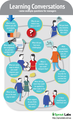
The Learning Conversations: Example Questions for Managers Infographic displays some example questions that could be useful in learning conversations:
• What do you believe you did particularly well?
• Why do you think it was done so well?
• Did you have any concerns when doing this task?
• What did you find most challenging?
• What aspects of the assignment are you less satisfied with? Why?
• What are some ways in which you could improve your approach?
• What is another way you could interpret that?
• What assumptions do you think you are making?
• Can you describe for me how you reached this conclusion?
• What did you learn that could be applied to other tasks in the future?
• What do you see as the next step to take?
• What support do you think you need in this area?
• Is there anything you need from me?
Via: sproutlabs.com.auThe post Learning Conversations: Example Questions for Managers Infographic appeared first on e-Learning Infographics.
eLearning Infographics
.
Blog
.
<span class='date ' tip=''><i class='icon-time'></i> Jul 15, 2015 03:38pm</span>
|
|
Modern Artificial Intelligence Infographic
The history of Artificial Intelligence isn’t a long one, around 60-70 years, but the advances in recent years has been huge. The Modern Artificial Intelligence Infographic shows how technology coupled with studies of the human brain have aided in making AI a reality, and a reality we can use everyday.
Machines are already intelligent, but we fail to recognise it. When a machine demonstrates intelligence we counter it by saying ‘it’s not real intelligence’. Therefore Al becomes whatever has not been accomplished so far by a machine.
Artificial Intelligence and General Artificial Intelligence
Artificial Intelligence and General Artificial Intelligence are distinct areas of research.
Artificial Intelligence refers to intelligence exhibited by machines, and can be broken down into reasoning, knowledge, planning, learning, communication, perception and the ability to move and manipulate objects.
General Artificial Intelligence refers to replication of natural intelligence (i.e. the ability of a machine to successfully complete any human intellectual task it is confronted with). Most researchers agree that such an accomplishment lies far in the future, however a subset of credible scientists believe that GAI could be achieved by the year 2045.
Modern Applications of Artificial Intelligence
1. Learning / Knowledge / Planning
Deep Blue
In 1997, the IBM developed Deep Blue computer programme beat world chess master Gary Kasparov. The machine was seen to be acting intelligently.
TOPIO
2007 saw the introduction of TOPIO, a robot designed to play table tennis against human opponents. It used advanced Al systems to continually learn and improve its overall game.
2. Communication
Speech Recognition
Online telephone systems use speech recognition, which is a component of human communication. Siri also uses natural language to accept commands from users.
The Vocaloid
Released in 2000, Vocaloid is capable of singing any song. Users input the melody and lyrics and Vocaloid will sing the song, changing stresses in pronunciation and deploying vocal effects (such as vibrato).
3. Combination of abilities
ASIMO
Honda’s ASIMO can walk, run, kick a ball and climb stairs, using predicted movement control. It has been called an autonomous machine, with decision-making capability. ASIMO utilises postural balancing, external recognition capability (like sight) and the ability to predict movement within its environment. Thus ASIMO combines movement with perception, planning, learning and knowledge.
REEM Robot
The REEM robot was developed between 2006 and 2010. The robot is capable of perceiving its environment and moving around it. It can also recognise faces and understand speech. It can accept voice commands, explore its surroundings and guide people around the environment. Thus the REEM robot combines movement with perception, planning, learning and knowledge.
4. Artificial body organs
Smell
Artificial noses are capable of replicating the human olfaction process on a significantly more powerful scale. They have a detection system that reacts to volatile molecules.
Sight
Neuron-stimulating electrode implants have been used in over 70 blind patients to restore partial sight. The implants receive data from a camera integrated into a pair of glasses worn by the patient.
Brain
It has been argued by some scientist that it would be possible to simulate an intelligent human brain. Ray Kurzweil argues that it should be possible to copy the human brain into hardware, producing a simulation that would be identical to the original and produce the same thought processes.
Hearing
Cochlear implants are used to partially restore hearing. They bypass the hair cells that would normally process sound frequencies and instead stimulate the cochlear nerve cells directly - the brain interprets this as sound.
Taste
In 2014, researchers working with ‘artificial tongues’ found that they were far more capable of judging the quality of wines from around the world than human wine critics.
Limbs
Modern science is capable of producing artificial limbs that can be controlled by the mind and possess a sense of touch. In 2014 a pioneering artificial arm used 19 sensors in order to send signals directly to the nerves in the body and then to the brain. The arm replicated touch, and could be controlled by thought.
How Close Are We To Hollywood Artificial Intelligence?
The vision of Al delivered by Hollywood - think HAL from 2001: A Space Odyssey, the machines from The Matrix, the personal assistant from Her and Ava from Ex Machina for good examples - portrays machines as having incredible intellect, resourcefulness and cunning, often striving to wipe out or usurp mankind in one form or another.
But how close to reality are the machines we often see in film and television? Are we likely to see a Skynet-esque situation anytime in the near future?
It’s hard to come up with a definitive answer, given the range of predictions made by scientists, but looking at how far individual elements of artificial intelligence and robotics have come, Hollywood-style artificial intelligence may not be as far away as you might think…
Via: www.buddyloans.comThe post Modern Artificial Intelligence Infographic appeared first on e-Learning Infographics.
eLearning Infographics
.
Blog
.
<span class='date ' tip=''><i class='icon-time'></i> Jul 15, 2015 03:38pm</span>
|
|
Tablets for Teaching Kids Infographic
The tablet has changed the landscape of classrooms around the world, from flipped learning to augmented reality. A much needed balance between function and affordability, tablets of all shapes and sizes are being embraced by teachers in millions of different ways. The Tablets for Teaching Kids Infographic provides an overview of how this shift is taking place.
Teachers and kids are increasingly tech savvy
Types of interactive tech teachers use:
93% use Laptops/Desktops,
55% use Interactive Whiteboards,
34% use Tablets/iPads,
34% use handheld devices and
5% use multi-touch tables/surfaces.
More than 50% of teachers as well as administrators said children use technology 5 days a week in their classroom and less than 10% of them said children use technology less than once a week.
iPads and tablets are already widely used in the classroom
In elementary school:
1/3 of students surveyed (32 percent) said they use small tablets versus 21 percent using larger tablets.
26 percent use basic ebook readers
5 percent netbooks
a full 35 percent use smartphones
In middle school, the numbers skew slightly more toward smart phones and laptops:
25 percent use small tablets
23 percent use larger tablets
17 percent use basic e-book readers
12 percent still use netbooks.
70 percent of middle school students use laptops for learning
66 percent use desktops
47 percent use smart phones
And in high school:
19 percent use full-size tablets for educational purposes;
17 percent use small tablets;
16 percent use basic e-book readers; and
10 percent use netbooks.
75 % use laptops
65% desktops
60% smartphones
Why should technology be used in the classroom?
80% of teachers and 69% of administrators said, "The children enjoy it".
54% of teachers and 48% of administrators said, "Technology helps children meet the goals of the program".
60% of teachers and 54% of administrators said, "To support dual language learners".
65% of teachers and 69% of administrators said, "To support children who have special needs"
And less than 10% of them said that they used technology only for teacher-controlled activities.
Ways students use tablets/iPads in school
70% for research
70% for homework
55% check assignments
47% take notes in class
46% read digital textbooks
39% check class schedules
33% take exams
8 million: number of iPads in classrooms in first four years after introduction
94%: Apple’s share of tablets in education [see pros and cons below]
107,844: number of education apps in Apple’s App store
97,000: number of educational apps in Android’s Google Play store
Pros…and cons of iPads in k-12
iPads, Pros:
Students love them - iPads in the classroom will get even the most stubborn students excited and engaged.
Good battery life.
Apps galore.
Platform for e-textbooks.
Communication tool - Have any shy students not willing to speak out in class? Using iPads in the classroom can help fix that.
Great content viewer.
User-friendly to students with disabilities- There are many apps for students with cognitive disabilities.
Lightweight and portable.
Fast and easy to use.
Cons:
Doesn’t support flash- one of the biggest criticisms of the iPad is its lack of ability to work with Adobe Flash and JavaScript.
No USB port.
Lack of multi-tasking- multiple windows and files can’t be kept open side by side. Expensive.
Potential to be distracting.
Lack of production capabilities- a great content viewer, but not as great for content creation.
Typing is sometimes frustrating.
Not good for sharing. With the incapability to enter logins, each student needs his/her own. Personal information can’t be stored if students are sharing iPads.
Via: www.early-childhood-education-degrees.comThe post Tablets for Teaching Kids Infographic appeared first on e-Learning Infographics.
eLearning Infographics
.
Blog
.
<span class='date ' tip=''><i class='icon-time'></i> Jul 15, 2015 03:38pm</span>
|
|
Developing Pre-Writing Skills in Early Childhood Infographic
Most research on early writing has focused on lower primary-aged children which means studies on younger children (from 2-5 years) are a little thin. One of the causes of this was the long-held philosophy that very young children would learn what they needed by merely playing within a print-rich environment. However, research has since shown that this is not enough. The print-rich environment is still a great idea, but children also need explicit instruction.
Learning and skill development is a process and usually a long one. According to recent studies the foundations for writing start well before Kindergarten and play a major role in a child’s long-term writing success. The Developing Pre-Writing Skills in Early Childhood Infographic presents what research says about early writing skills and how you can help kids acquiring them!
The Prefrontal Cortex
Getting the brain working in this area sounds like a good idea since it’s responsible for self-regulation and executive functioning (attention, impulse control and working memory).
This has led researchers to suggest that:
early writing difficulties (if associated with executive functioning) may be an early indicator of broader cognitive concerns
handwriting, or handwriting readiness, may improve executive functioning
The Building Blocks for Writing Readiness
Hand and finger strength: Try using play dough, squeezing tweezers and pegs.
Crossing the midline: Try dance moves where arms and legs cross the body or painting at an easel using only one hand.
Pencil grasp: If you do a google search you’ll find plenty of videos and suggestions to encourage proper pencil grasp.
Hand eye coordination: where your eyes and hands work together to accomplish a task such as catching a ball or jumping to touch bubbles that are being blown.
Bilateral integration: using two hands together where one hand is the lead and the other helps.
Upper body strength and postural control: A child’s neck and trunk need to be stable to support the other limbs and prevent fatigue.
Object manipulation: Children need to be able to effectively use their toothbrush, hair brush, crayons, spoon and fork. Encouraging independence will give kids a lot more practice at using their hands with growing efficiency.
Visual perception: the brain needs to interpret what our eyes see.
Hand dominance: the development of a preferred hand for most activities such as drawing or cutting.
Hand division: Try sorting marbles, buttons or small shells into groups by colour or size. This is clearly a precursor to learning to hold a pencil!
Spacial and temporal vocabulary: words that are often used when children are learning to write letters, such as top, go up to, go down to, around…
Via: www.lizs-early-learning-spot.comThe post Developing Pre-Writing Skills in Early Childhood Infographic appeared first on e-Learning Infographics.
eLearning Infographics
.
Blog
.
<span class='date ' tip=''><i class='icon-time'></i> Jul 15, 2015 03:37pm</span>
|
|
2015 Business eLearning Trends Infographic
Learning has moved away from the conventional classroom training. In the business world, the focus of learning has moved from a learner-centric approach to a business-centric approach that focuses on strategic alignment. This change in focus has transformed the way learning is designed and delivered.
Keeping this in mind, the 2015 Business eLearning Trends Infographic presents 6 trends that will be setting the stage for the business world in 2015. These trends actually show that how fast eLearning trends are changing and evolving. Technically speaking, earlier the classroom training was considered as most relevant training methods but with changing times the learning trends have also changed.
1. Mobile Learning
With more people owning a mobile phone, the way people access information will shift to the mobile phone.
2. Personalized Learning
An offshoot of big data and analytics, personalized learning will be the nucleus of all learning experiences in 2015. Experience API - a web service that collects employee’s learning data will collect self-driven or informal learning, as well as formal learning experiences. With a bird’s eye view of learner’s learning style, trainers will be able to personalize learning to fit the needs of individual learners.
3. Cloud LMS
4. Gamification
Helps boast
knowledge
workflow
satisfaction
retention
performance
loyalty
efficiency
revenue
5. Social Learning
Social interactions play a key role in
confidence
motivation
engagement
willingness to engage in teaming
6. Big Data and Analytics
Big data - the mounds of information that used to waste away until recently, will now be utilized to measure, collect, analyze and report data related to learning. It can be used to predict human behavior, individual learning styles and provide insightful information on how learners learn and what works/does not work.
Via: www.24x7learning.comThe post 2015 Business eLearning Trends Infographic appeared first on e-Learning Infographics.
eLearning Infographics
.
Blog
.
<span class='date ' tip=''><i class='icon-time'></i> Jul 15, 2015 03:37pm</span>
|
|
Master’s Degree in Political Management Opportunities Infographic
A Master’s Degree in Political Management can bring about a variety of career opportunities. It gives recipients the chance to explore fields with focuses ranging from interpersonal charity work to global leadership. The Master’s Degree in Political Management Opportunities Infographic discusses some of the options available with this degree.
These opportunities fall into two major categories: advocacy work and electoral positions. Advocacy jobs work to promote change in policy through public and governmental awareness of issues. These positions include association executive directors, political action committee executives, events managers, and issue advocates. Electoral positions work on and manage elections for candidates or issues appearing on the ballot, as well as including those elected to office themselves. These positions include elected officials, campaign managers, fundraising consultants, press secretaries, and field directors.
Though political management might not be a widely known field within political science, it is one that can open many doors. By exploring possible career options, it is clear that a degree in political management is potentially a great option for anyone interested in these fields.
Via: politicalmanagementmasters.online.gwu.eduThe post Master’s Degree in Political Management Opportunities Infographic appeared first on e-Learning Infographics.
eLearning Infographics
.
Blog
.
<span class='date ' tip=''><i class='icon-time'></i> Jul 15, 2015 03:37pm</span>
|