Blogs
|
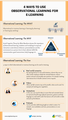
4 Ways to Use Observational Learning for eLearning Infographic
Knowledge and skills like how to complete a process or accomplish tangible tasks can be learnt by experimentation or reading. However, soft skills may not be so easy to teach. Vicarious or observational learning is learning by watching, since certain behaviors or skills simply cannot be learnt by attending a lecture about them or reading an eLearning module.The 4 Ways to Use Observational Learning for eLearning Infographic presents instances of how you can merge vicarious learning design with your existing training or eLearning strategy.
Observational Learning: The WHY
Social Cognitive Theory by Albert Bandura stresses the importance of observational learning, imitation and modeling.A reciprocal interaction exists between behavior, personal factors and the environment as a person tries to learn abstract skills like communication, good mannerisms, body language etc.
Observational Learning: The HOW
1. Real world scenarios
By exposing learners to real world situations, wherein they can see other similar employees exhibit the intended behavior, observe positive outcomes and possibly raise questions. For example, teaching sales trainees how to handle customer service requests.
2. Videos
Where real-life scenarios may not be possible, videos can be used. For example, for teaching price negotiation.
3. Animations
In this case, care must be taken to ensure that each animated character represents the full range of facial expressions, gestures and body language as a real model would. Else learners will not be able to relate and pick up the behavior.
4. Podcasts
Can be used when skills being taught are verbal in nature. For example, voice modulation and tome, pronunciations or a new language.
Via: blog.originlearning.comThe post 4 Ways to Use Observational Learning for eLearning Infographic appeared first on e-Learning Infographics.
eLearning Infographics
.
Blog
.
<span class='date ' tip=''><i class='icon-time'></i> Jul 15, 2015 04:21pm</span>
|
|
5 Reasons Why Staff Training is a Winning Strategy Infographic
There is obviously an upfront cost involved in training. However, many will argue that the positives outweigh these costs. Training can come in many different forms and can be very beneficial to your business, helping staff develop their skills and knowledge. Implementing a successful staff training program is recognised by managers and executives as a powerful contributor to business success. Your employees are your most valuable asset, so an investment in their skills is an investment in the productivity of the organisation. The 5 Reasons Why Staff Training is a Winning Strategy Infographic demonstrates that the stereotypical view of staff training as an unnecessary luxury is wrong, and that it is truly an integral piece of the puzzle for managers and business owners. Nonetheless, it is important to select and implement staff training programs carefully, as its contributions to project and team success are likely to be impacted by the quality and the specificity of the module which is chosen.
Via: www.saxonslearningsolutions.com.auThe post 5 Reasons Why Staff Training is a Winning Strategy Infographic appeared first on e-Learning Infographics.
eLearning Infographics
.
Blog
.
<span class='date ' tip=''><i class='icon-time'></i> Jul 15, 2015 04:19pm</span>
|
|
The Missing Piece to the Skills Gap Puzzle Infographic
More than half of employers nationwide have an open job for which they cannot find qualified candidates, and 8 in 10 have difficulty filling positions altogether. The Missing Piece to the Skills Gap Puzzle Infographic clears up misconceptions about the skills gap and reveals ways in which every one of us can work together to bridge it.
The skills gap is a real and growing issue affecting many aspects of many industries. Employers, job seekers and academia are all aware of its existence and, to some degree, their role in its formation. Employers cannot find skilled candidates to fill their open jobs, but show resistance to investing in training for new employees. Most job seekers are saddled with debt from an excellent education that has nevertheless left them without the crucial, job-specific skills employers desire. Academia understand this problem as well, but struggle to institute change quickly enough to solve the problem.
Although the skills gap looms large, a concerted effort by all parties will be the strongest avenue to turning the situation around. If the skills gap continues to widen, the consequences could be dire. Employers will not be able to replace skilled workers who retire or move on, unemployment rates will rise, and the value of college education may decrease. Employers must embrace change and invest creatively in the skills of their workforce, and they must also begin to consider more competitive compensation. Job seekers should actively strive to add marketable skills to their résumés, and academia must dedicate themselves to communicating to employers the top qualities they look for in a new hire. When each group begins to shift their efforts in these directions, they will lay the foundation of a lasting solution.
Read also: The Shocking Truth About The Skills Gap Report
Via: www.skilledup.comThe post The Missing Piece to the Skills Gap Puzzle Infographic appeared first on e-Learning Infographics.
eLearning Infographics
.
Blog
.
<span class='date ' tip=''><i class='icon-time'></i> Jul 15, 2015 04:19pm</span>
|
|
The Evolution of Classroom Technology: The Journey from Pen to Keyboard Infographic
Education and technology has always been in perfect harmony. Right from the days when chalkboards were invented during the 18th century till the interactive whiteboards started revolutionizing classroom learning, when magic lanterns paved the way to overhead projectors, and came pencil and paper, education has gone hand-in-hand with technology. The Evolution of Classroom Technology: The Journey from Pen to Keyboard Infographic tracks the evolution of technology in classrooms; for it’s not just important to know where the future is heading to in education, the past also matters!
Ancient technology in classroom
1650: Horn Books, wooden paddles with printed lesson was popular during the colonial era, to help students learn verses.
1870: Magic Lantern, the predecessor to slide machines, projected images printed on glass plates in 1870. Public school systems in Chicago started using more than 8000 lanterns by 1915.
1890: Chalkboards and school slates came into use by 1890 followed by pencils in 1900. Wide availability of pencil and paper made school slates obsolete.
1920: A new form of learning evolved with radio on-air classes for students within listening range in the 1920s. Board of Education, New York City broadcasted lessons to schools via a radio station.
1930: 1930 and 1940 saw the introduction of overhead projector and ballpoint pen in classroom education.
1972: In 1972 came the Scantron system of testing which allowed teachers and educators to grade exams more effectively and efficiently.
The age of personal computers
1981: Computers came to daily use in the 80’s with the first portable computer was introduced in 1981. During 1984, public schools in U.S had one computer in average for every 92 students.
1985: Hand held graphing calculators were introduced in 1985 and it became a great sensation in the field of maths. Year 1985 also saw the CD-ROM Drive coming to use. A single disc could store a whole lot of things like an entire encyclopedia along with video and audio.
1996: The internet, which was by then considered a computer network used mostly by NASA physicists and academics, slowly entered into homes and educational institutions by 1996.
1999: Technology in the classroom reached new heights with interactive whiteboards which blended handwritten notes with interactive technology in 1999. Earlier versions of these whiteboards were connected to desktop computers through wires, whilst the latest ones are compatible with smartphones and tablets.
2007: 2007-2010 was the age for smartphones and tablets. The concept of classroom slates got a revamp with iPads which is taking classroom education to new heights.
Classroom technology in the future
Biometrics: Biometrics, the science that recognizes people on behavioral or physical qualities, is surely the answer to student disposition in the classroom and develop teaching materials accordingly.
Wearable-glass: Wearable devices in education is the next big thing to watch out. Virtual reality headgears, wristbands, smart watches will take education to the next level.
Multi-touch: Multi-touch surfaces like desks or workstations can work wonder for students to collaborate with their peers around the world. Videos, online resources and other virtual tools available in the single swipe of the desk.
Via: blog.fedena.comThe post The Evolution of Classroom Technology: The Journey from Pen to Keyboard Infographic appeared first on e-Learning Infographics.
eLearning Infographics
.
Blog
.
<span class='date ' tip=''><i class='icon-time'></i> Jul 15, 2015 04:18pm</span>
|
|
8 Reasons Why Open Badges Are Awesome Infographic
Are you looking for a fresh approach to recognising your learners skills? Open Badges is a program by Mozilla that issues digital badges to recognize skills and achievements. The 8 Reasons Why Open Badges Are Awesome Infographic presents the usefulness of badges as digital indicators of skills learned inside or outside the classroom.
1. Verify your skills
Employers, organizations & schools can explore the data behind every badge issued to verify individuals’ skills and competencies.
2. Free & Open Source
Badges are free and open to anyone to use as part of Mozilla’s non-profit mission. This means that improvements made by one partner can benefit everyone, from bug fixes to new features.
3. No restrictions
Using free software and an open technical standard means that any organization can create, issue and verify digital badges, and any user can earn, manage and display these badges all across the web.
4. Knit your skills together
Badges can build upon each other, joining together to tell the full story of your skills and achievements.
5. Store important information
Each badge links back to the issuer, the criteria it was issued under and evidence verifying the credential.
6. Take your badges everywhere
Users now have an easy and comprehensive ‘way to collect their badges in a single backpack, and display their skills and achievements on web, social media and job sites.
7. Earn badges online & offline
Earn badges from many different places, both online and offline. Then manage and share them using the Open Badges backpack.
8. Create learning pathways
Learners can pledge to follow a similar path linked with their skills, or can design their own customized career pathway from scratch.
Via: www.learningpool.comThe post 8 Reasons Why Open Badges Are Awesome Infographic appeared first on e-Learning Infographics.
eLearning Infographics
.
Blog
.
<span class='date ' tip=''><i class='icon-time'></i> Jul 15, 2015 04:18pm</span>
|
|
10 Core Principles of Entrepreneurship Infographic
What skills do you need to be a successful entrepreneur? The 10 Core Principles of Entrepreneurship Infographic presents10 things you can start working on now!
1. Know Thyself
Your startup is an embodiment of your whole and a reflection of your beliefs. Prior to creating a startup, it’s important that you know yourself well; understand your strengths, weaknesses, and find out about your blind spots. Find your passion, search for ideas that set your imagination soaring. You must learn to capitalize on your strengths and continue learning new skills which will be relevant to your prospective venture. Surround yourself with people that will give you a true picture of things. Blind spots created by lack of self-awareness hurt your performance and prevent you from getting to the next level. Once you become aware of different facets of your own personality, you will become a much more effective leader. Being a good listener and having emotional stability goes a long way in achieving this.
2. Choose the Right Business
As an entrepreneur you will be investing years of your life building your venture. So it helps to know that not all industries are created equal; some are more profitable than others, some are hyper competitive while some offer a sustainable advantage. Make sure you allocate your energy, time and resources to a business which is likely to generate good returns. It’s advisable to do a lot of research, gather facts and talk to experts before you make a move. Have clarity with respect to the competition, understand the market size and the share you can acquire over time. Understand the profit potential of your business before taking the plunge.
3. You Are Only as Good as the People Around You
Although your venture is an embodiment of your idea, but it is the people who eventually run and sustain it. Business is like sports, the best teams usually win. You should not only focus on hiring the right person for the right job but also give them room to grow in order to retain them. Providing high-frequency feedback is essential for making continuous performance improvements. If you internally lack a specific expertise, hire external consultants to fill the gap. Make a map of the people around you (both within and outside the company such as customers, suppliers, and other third parties), review it frequently and identify the parts that need a stronger link. Remember, it is all about people, people and you guessed it right, people.
4. Build a Winning Culture
A lot of aspiring entrepreneurs underestimate the benefits of building the right organizational culture. This is a mistake which can have dire consequences. The DC2RS approach consists of five steps to create and sustain the right culture. Define-Communicate-Reinforce-Repeat-Shape. It is a human need to figure out how to behave and interact with others in an organization. Therefore it’s wiser to define your organization culture, make it explicit and constantly reinforce it by repeating the same consistent message. If you don’t, culture can morph into behaviors that are damaging and undesirable. Culture is a living organism that requires constant monitoring and shaping. Once you come to this realization and start managing expectations, you will discover a formidable lever to inspire and motivate your team to achieving goals that may initially have been perceived as impossible.
5. Define the Key Metric That Matters the Most
Hard work diluted over multiple directions is not likely to yield great results. Energy and resources need to be channeled in the right direction to maximize the odds of success. To win, an organization must define the game it wants to play and specify the right ways to measure performance. Although multiple performance indicators need to be tracked; it’s imperative to choose one primary metric to enable the entire organization to focus on one dimension of performance. This metric can be updated as the organization moves through different stages of its maturity cycle. For example a retail start-up might initially focus more on growing the number of stores, then grow revenues, and then shift to maximizing profits. As another example Facebook’s primary metric is the number of its active monthly users.
6. Accurately Assess Capital Requirements
The reason for why companies go bankrupt is because they run out of cash. A lot of businesses make optimistic financial assumptions before starting their venture. However, it is wise to accurately assess how much capital will be required by running multiple scenarios including a pessimistic and very pessimistic one. The key is to assess capital requirements as realistically as possible. By nature some businesses are more capital intensive than others, so know what type of business you’re getting into. If you want to get investors, understand the risk of losing the money and how it may affect your future relationship. If you raise money from friends and family, be realistic about how you communicate risks, and understand the implications it can have on the relationship if you don’t deliver the numbers in your plan.
7. Use the Right Incentives
Incentives are a great mechanism to encourage particular behaviors and align goals between stakeholders. However, every incentive comes with a downside. There is no perfect incentive scheme; you need to aim for the right balance based on the behaviors you would like to encourage. To complicate matters different people are motivated by different incentives. Incentives can be monetary as well as non-monetary; they can be in the form of recognition, authority, conducive work environment etc. It’s really important to use them wisely as incentives can create or destroy value. For example, if you provide sales people with a commission on sales, they might increase discounts to get more contracts or sell products regardless of their gross margin; which in turn might hurt your profitability. So before you put an incentive scheme in place think of all the possible often unforeseen downsides it can generate, and make sure the positives are greater than the potential negatives. If unsure, introduce your plan for a limited period of time to assess results.
8. Have Deep Empathy
In today’s world where customers are more empowered more than ever, you can’t build a profitable and sustainable business unless you can empathize with the people you interact with. Understand the world as it is, and not according to how you would like it to be. Listen to people, understand your customers by putting yourself in their shoes. Every entrepreneur provides solutions to an existing problem/need in the industry. The ability to empathize with others not just makes you a better person but also better at business.
9. Experiment in Stages
Experimentation and adaptation are two incredible tools to forge an innovative enterprise. The following four steps will enable you to experiment successfully as well as profitably:
Experiment: Come up with a hypothesis which will differentiate you from competitors and add value to your customers.
Learn: Understand the impact of your hypothesis and evaluate it objectively.
Adjust: Refine your hypothesis based on the learning.
Scale: Grow what works, and prune out what doesn’t.
10. What Next?
A successful entrepreneur has his or her feet on the ground and his or her eyes on the future. Every morning when you get to work, think about where to make improvements based on where you are in the contextual present. Ensure that you make the right decisions along the way while keeping in mind your long-term vision. Write a journal to introspect and gain perspective on how you are progressing and dealing with the challenges you face. Build an advisory board to provide you with additional external perspective. Also regularly think of your exit strategy. Do you plan to sell the company, pass it on to next generation or go public? Thinking about exit options forces to evaluate your company, and as such figure how to increase its value. Remember the first step in creating the future is anticipating it.
Entrepreneurship is beautiful. "In life it’s better to have tried achieving your dreams, even if you fail, rather than regret not having tried at all. You will always get richer in experience."
Stay hungry, be courageous and keep on making wise decisions.
Via: blog.taskworld.comThe post 10 Core Principles of Entrepreneurship Infographic appeared first on e-Learning Infographics.
eLearning Infographics
.
Blog
.
<span class='date ' tip=''><i class='icon-time'></i> Jul 15, 2015 04:17pm</span>
|
|
20 Facts about eLearning Infographic
The 20 Facts about eLearning Infographic demonstrates how eLearning has dominated the economy and the status quo of learning and teaching.
The term "eLearning" has only been in existence since 1999, when the word was first utilized at a CBT systems seminar.
eLeaming is one of the fastest growing industries in the world today, and it will continue to grow fast.
In 2013, the US accounted for 57% of global revenues for Self-paced eLearning. By 2018, the US will account for 51% of worldwide eLearning revenues.
25% of all employees leave their jobs mainly due to lack of training and learning opportunities.
On the other hand, companies who do provide eLearning opportunities, generate about 26% more revenue per employee.
The growth rate for eLearning products and services in Latin America is 14.6% and revenues will nearly double from $1.168 to $2.298 by 2016.
Internet is widely and increasingly used for self-directed learning. In 2010 32 % of the total population in the EU has consulted Internet for the purpose of self-directed learning. This is an increase by 9% compared to 2007.
There are currently more than 3 million online-only stundents in the US. This is more than the total number of college students in France.
By 2019, 50% of all college students will be engaged in eLearning. eLearning is $56 billion industry and grows fast. Today, almost 4.6 million students are studying at least one of their courses online. Corporations are using eLearning as their second-most important method of training staff for the simple reason that it cuts operational costs by 50 to 70 percent. Not only does eLearning save money, it also saves time. Online classes tend to be around 25 to 60 percent shorter than traditional, instructor-led classes.
According to IBM Top learning organizations have used learning technologies to deliver the following improvements:
- 12% reduction in time to competence
- 14% increased productivity through learning interventions
- 17% in customer satisfaction
- 19% in staff satisfaction/engagement
- 22% reduction in delivery time
- 24% in ability to change procedures or products
A gamified approach to safety training can lead to up to 45% reduction in safety incidents and claim counts.
By 2020, the global mobile learning a eLearning is good for the market is projected to be $37.8 bilion.
eLearning is good for the environment. Britain’s Open University’s study found that producing and providing eLearning courses consumes an average of 90% less energy and produces 85% fewer Co2 emissions per student than conventional face-to-face.
Learning technology is boosting agility.
77% of U.S. corporations report using online learning to enhance their employees training and educational programs.
52% of people using m-learning use it in bed after waking up and 46% in bed before they go to sleep.
900% - this is how much the eLearning market has grown by, since the year 2000.
Today, it’s estimated that about 46% college students are taking at least one course online. However by 2019 roughly half of all college classes will be eLearning-based.
At Fortune 500 firms, 73.6 percent of technology-delivered training comes through networked, online methods.
Malaysia and Vietnam are the world’s most rapidly growing eLearning markets. Estimated annual growth rate for the Asian eLearning market is 17,3%
Networked devices will grow from 15B today to 21B by 2018. Out of them 57% will be mobile devices. eLearning will be benefited by faster internet access from everywhere and any device.
The post 20 Facts about eLearning Infographic appeared first on e-Learning Infographics.
eLearning Infographics
.
Blog
.
<span class='date ' tip=''><i class='icon-time'></i> Jul 15, 2015 04:15pm</span>
|
|
Top 7 Benefits of Scenario-Based Training Infographic
Scenario or task-based learning is a training approach designed with the participants in mind and aligns with the job performance learners are expected to achieve once the training is complete. New tasks or procedures are simulated during the training, immersing learners into situations where they are allowed to practice skills, safely learn from their mistakes and acquire valuable experience. Because this type of training is more relevant to the learner, participants are often more motivated to learn which accelerates their expertise. The Top 7 Benefits of Scenario-Based Training Infographic presents the top seven benefits your learners get when you incorporate scenarios and storytelling into your instructional mix!
1. Scenarios Enable "Failing Forward":
Providing a safe place to fail helps build the capacity to fix mistakes as you would in real-life.
2. Scenarios Accelerate Time:
Allowing us to make a decision, implement it and experience its consequences all within the same exercise.
3.Scenarios Trigger Our Memories:
Creating powerful linkages in the brain
4. Scenarios are a Form of Storytelling:
Making the story relatable improves our retention
5. Scenarios Promote Critical Thinking:
Providng a context to implement our best judgment
6. Scenarios Engage Our Emotions:
Triggering our long and short term memory.
7. Scenarios Provide Shared Context:
Accelerating community building or bonding between people and improving morale
View also:
How to Build an Effective Scenario-Based Course Infographic
Read also:
Why You Should be Using Scenarios in e-Learning
The Basics of Scenario-Based e-Learning
Tips To Write Effective eLearning Course Scenario Questions
Top 10 Branching Scenario Techniques
Via: mnalearning.comThe post Top 7 Benefits of Scenario-Based Training Infographic appeared first on e-Learning Infographics.
eLearning Infographics
.
Blog
.
<span class='date ' tip=''><i class='icon-time'></i> Jul 15, 2015 04:11pm</span>
|
|
Learning to Make Better Labs Infographic
Traditional record keeping suffers from a number of drawbacks such as:
Manual entry, recording and tracking clinical information of patient data is prone to error
Delivering or faxing reports is time consuming and costly
Manually looking up past results can increase inefficiency and decrease reliability
Errors of negligence can have serious consequences
THE RESULT: High turnaround time and dissatisfied patients
The Learning to Make Better Labs Infographic summarizes the role played by a Lab Information System when a patient enters the lab facility.
How can a Lab Information System help?
A LIS gets to work as soon as a patient enters the lab and continues well after the time he leaves. It tracks and stores each and every detail about patients on the cloud, making data safe and readily available.
Receptionist welcomes the patient and registers him/her for the test. Patient feels happy with the flexible pricing & discounting in multiple currencies and modes. The receptionist assigns a unique ID to the patient, connecting it with the patient’s EHR/EMR if one exists
Patient goes to the technician who takes the sample and barcodes it. Integration of devices with the LIS minimizes the risk of human error in feeding data.
The patient is given a time and date by when the test report will be ready. The patient comes home and the sample is sent for processing after the LIS decision support system determines which batch to put it under.
Multiple checks, quality control and testing on the sample is done. Meanwhile, the LIS allows lab personnel to track all these activities.
Report is published and the patient is automatically alerted via e-mail/SMS for collecting the report. Patient’s EHR/EMR also gets updated with the generated report, in which case the patient directly goes to the consulting doctor who logs on to his computer and accesses the laboratory findings.
Via: attunelive.comThe post Learning to Make Better Labs Infographic appeared first on e-Learning Infographics.
eLearning Infographics
.
Blog
.
<span class='date ' tip=''><i class='icon-time'></i> Jul 15, 2015 04:09pm</span>
|
|
Bloom’s Revised Taxonomy Action Verbs infographic
Bloom’s Taxonomy was created in 1956 under the leadership of educational psychologist Dr Benjamin Bloom in order to promote higher forms of thinking in education, such as analyzing and evaluating concepts, processes, procedures, and principles, rather than just remembering facts (rote learning). It is most often used when designing educational, training, and learning processes.
Bloom saw the original Taxonomy as more than a measurement tool. He believed it could serve as a:
common language about learning goals to facilitate communication across persons, subject matter, and grade levels;
basis for determining for a particular course or curriculum the specific meaning of broad educational goals, such as those found in the currently prevalent national, state, and local standards;
means for determining the congruence of educational objectives, activities, and assessments in a unit, course, or curriculum; and
panorama of the range of educational possibilities against which the limited breadth and depth of any particular educational course or curriculum could be contrasted.
The original Taxonomy provided carefully developed definitions for each of the six major categories in the cognitive domain. The categories were Knowledge, Comprehension, Application, Analysis, Synthesis, and Evaluation. With the exception of Application, each of these was broken into subcategories. The categories were ordered from simple to complex and from concrete to abstract. Further, it was assumed that the original Taxonomy represented a cumulative hierarchy; that is, mastery of each simpler category was prerequisite to mastery of the next more complex one.
Lorin Anderson, a former student of Bloom, and David Krathwohl revisited the cognitive domain in the mid-nineties and made some changes. This new taxonomy reflects a more active form of thinking and is perhaps more accurate. Bloom’s Revised Taxonomy improved the usability of it by using action words. The Bloom’s Revised Taxonomy Action Verbs infographic includes some action words that are useful in writing learning objectives.
View also:
The 6 Levels of Bloom’s Taxonomy Infographic
How To Use Pinterest With Bloom’s Taxonomy Infographic
Preparing Learning Objectives Infographic
How to Present the Learning Objectives Infographic
Read also:
The 60-Second guide to Bloom’s Taxonomy
How to Write Multiple-Choice Questions Based on The Revised Bloom’s Taxonomy
How To Write Aims and Objectives for eLearning Courses
Via: anethicalisland.wordpress.comThe post Bloom’s Revised Taxonomy Action Verbs infographic appeared first on e-Learning Infographics.
eLearning Infographics
.
Blog
.
<span class='date ' tip=''><i class='icon-time'></i> Jul 15, 2015 04:09pm</span>
|