Blogs
|
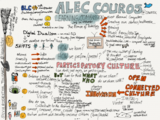
Alan November‘s Building Learning Communities in Boston is one of my favorite conference. The sheer stimulation to my thinking and creativity, the networking with so many brilliant minds, the sharing of successes and failure and meeting so many new interesting educators is unparallelled.
I am sharing my notes in the spirit of enticing readers to dig further into the thoughts and material shared by keynoters and presenters. Show your information literacy by researching the #BLC14 Hashtag, scouting the presenters’ individual blogs, Twitter and slideshare accounts, explore some of the links, or using keywords from my sketchnotes (ex. "participatory culture", "making learning visible", "Digital Dualism", etc.) to google further information.
Silvia Rosenthal Tolisano
.
Blog
.
<span class='date ' tip=''><i class='icon-time'></i> Jul 16, 2015 06:48am</span>
|
|
I am honored to be one of the keynote speakers at the Teachers Matter Conferences 2015 in Sydney, Australia and Rotorua, NZ.Although still a few months away, this is a great time, if you are located in Australia or New Zealand to plan to attend.
If you are interested in having me speak, consult or facilitate a workshop with you and your school for other professional development services during my time in Australia and New Zealand, please contact me to take advantage of my traveling.
Teachers Matter Conferences 2015
TWO VENUES to choose from…
Sydney 21/22 January
Rotorua 27/28 January
An inspirational conference for teachers with practical ideas to engage, motivate, educate and prepare students for the future…
Start your year with inspiration, practical ideas and great team building.
Leading International Speakers
Practical Focused Workshops
Collective Wisdom Forum
Speakers’ Smorgasbord Session
Presenters include…
Topics covered include: Global connected learning, Technology integration, 21st Century skills and literacies, Teaching with dispositions, Building resilience, Authentic Learning, Developing life long learners, Curriculum mapping, Health & wellbeing, Establishing modern learning spaces, Drama in education, Making learning visible, Brain compatible learning, Rock n Roll classroom… and so much more…
PLUS - participate in our Collective Wisdom Forum and Speakers Smorgasbord Session …
Who Should Attend…
?Primary Teachers
?School Senior Leaders
?Secondary Teachers
?Early Childhood Teachers
?Support Staff
?Administration staff
Why You Will Want YOUR TEAM To Attend…
?Hear the latest in education from top international presenters
?Whole team Professional Development which creates a shared vision across the school
?Replaces teacher only or pupil free days at the beginning of the school year
?Great team building
vGain practical ideas you can use in your classroom the next day
?Provides professional and personal development
?Motivating, exciting and inspiring start to the school year
?Get to meet mind like-minded people
?Your students will benefit from your team attending this conference
NZ Phone 0800 37 33 77 or +644 5289969
Fax +644 5280 969
Australia phone 1800 063 272 or Fax1800 068 977
Email: info@spectrumeducation.com
Silvia Rosenthal Tolisano
.
Blog
.
<span class='date ' tip=''><i class='icon-time'></i> Jul 16, 2015 06:47am</span>
|
|
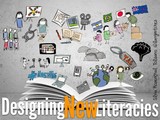
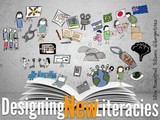
I am co-presenting with Michael Fisher a keynote at the Wildly Exciting Education Conference in Grand Rapids, Michigan. For now here is the slide deck. I will be blogging more in detail about Leading the New Literacies in the upcoming weeks.
Three new 21st century literacies need focused integration in curriculum and teaching: digital, media, and global. Do you wish to engage your school into DIGITAL LITERACY upgrades? How do we help our students critique and create MEDIA that prepares them for future careers and college? Do you want to GLOBALIZE your classroom? These questions will be addressed in this lively and hands-on session Michael Fisher and Silvia Tolisano will share Dr. Heidi Hayes Jacobs’ newest model that provides practical steps in identifying each literacy in classroom practice as they intersect in dynamic projects for our learners K-12.
Leading the new Literacies: Digital, Media, Global Project Based Learning from Silvia Rosenthal Tolisano
Silvia Rosenthal Tolisano
.
Blog
.
<span class='date ' tip=''><i class='icon-time'></i> Jul 16, 2015 06:47am</span>
|
|
In Mike FIsher and my keynote/workshop last week at the Wildly Excited Conference at the Grand Rapids State University in Michigan, I shared the following blended sketchnote (blended= self-drawn doodles/sketches combined with a photograph). Participants were asked to take a look at the image and use the Visible Thinking Routine I see, I think, I wonder from Project Zero. They shared their thinking in a backchannel in a Today’s Meet room.
Before looking at my image annotations and reading the examples/ excerpt of the backchannel below with teachers’ responses, consider going through the exercise yourself. Take a few minutes to intensely look at the image above and follow the thinking routine: I see…, I think…, I wonder… Share your responses in the comment section below, adding your thoughts…sharing and making your thinking visible to others.
How could you use these techniques shown or demonstrated in your own classroom:
sketchnoting
visual prompts
I see, I think, I wonder routine
Backchanneling
annotated sketchnoting (or other visuals?)
Teacher Visible Thinking Routine responses
One of the difficulties of education our students learn differently than we do, by Joel
I see an interest in connecting internationally. by Ted
I wonder what amazing things could happen in classrooms if we all started being more techie and digital in our classrooms? by Kristi Vugteveen
I think it is about the new age of learners by Kristi Vugteveen
I see people handing boxes up to a person standing on them. To me this means building a learning network. by grace
I think this is where the digital learning age is headed. I wonder if I’m ready for it by Jan
Artwork: its Silva. Her family, life. Moving, lectures, author, etc. by margo
Are books of no value anymore?by Sally
how do I use this when I can only get computers once every two weeks by Joy
Fast paced graphic learning like they are used to. Keep things moving! by Holly
I think today’s kids brains are wired differently than most teachers over the age of 30. by Amy
The drawing is busy a lot going on and represents changes in technology and many options of technology by Jamie
I see various ways of gaining/sharing knowledge. I think it represents the current work. I wonder how available for kids in poverty. by Sarah
I think my processing speed needs to incease! by Simeon
I see what students are bombarded with on a daily basis by Jeri
I know this is a worldwide reality and it is exciting, but no wonder our kids are ADHD. by Helena
I see lots of possibilities!!!! by Debra v.
collaboration by Jenn
We need to change our way of teaching. We need to teach more about accessing information. by Monica
I wonder: when do we allow our brains to have a break from all of those distractions by KC
I think this is an accurate picture of our society today- lots of different ways to interact and connect with a variety of people by Kelly
students now have the ability to visit other places and interact with others virtually, without leaving their bedroom or the classroom by TAV
Global learning and global appreciation is more easily obtainable.by Jennifer
Students can use various ways to present their thoughts. by Diane
We can connect with everyone across the world. We no longer need to be in our own classroom. by Gavinator
new literacies: apps, threads, global literacy, digital collaboration, graphics, imagery and film, multiple languages, software and programs by Emily
I see a variety of media. by Ted
I see the ink connecting with classes across the district or within our building could be a small start by Michele
A bunch of disconnected images by Debra
The power of learning in different ways. by Courtney
Having the luxury of so many ways/strategies to help students in their learning. Looking at learning as evolving. by Nancy
Open a book to learn new things! by Kris T
I wonder how I can use these strategies with classroom with young ones who have special needs. by BettyJo
I see a selfie being taken. by Jess
There are a variety of items that are connected, but if I don’t have a way to connect them they float out in space. by Judy
I see connections between teacher facilitation and individual work. by Ted
#world wild learning! by Rob The Drummer
when I look at the movie projector I think that many young kids don’t even know what it is! by Brooke
Holy overwhelmed Batman… by Deb
The tough part is when the students start text talking. I see that a lot in our chats in the online classroom. by Lori
So many ways available for us to teach and learn. by Shannon
I see flags and think I know those countries and I wonder why are those there, is that where she has been?by Teresa
It’s like going on vacation to other places without leaving your room. by Ann
Global learning can take place when using technology and connects students with much more information than ever before! by JFunk
Students have so much in their minds! by Meaghan
Constant scrolling messages distract ability to sort out my own thoughts! by Becky
Globalization-speaking multiple languages is important to connect-by plane and/or virtually!by Stephanie
Students are learning so much each day through so many mediums. How do we help them prioritize so it changes them?by Thelma
Students learning in the classroom is constantly changing to the digital world. by Fran
Represents the many ways people are connected.by Erin
I don’t get the rain clouds in the middleby Nicole
Students can communicate all around the world by Diane
I see what someone brings to the classroom by Kim
I see a lot of experiences. I think this looks like a great way to describes oneself through visuals. I wonder who drew this ago by Amy
Connecting the world through digital learning and accessing new ideas. A bit overwhelming by Rose
I think technology can pave a path toward global awareness. by Hallo
Learning is global and there are infinite ways to share by Jenn
I think the drawing is overwhelming by Eazy
It’s the brain of most of our students by whistling dixie
That image looks like the information overload that most of our kids are living with on a daily basis. by Fisher
Many options! by Jen
Reminds me of the book the Lexus and the olive tree by Rachel
It helps us link or connect our learning to others by Ann
This is a lot to take in, but this is the way our kids learn now. Very different from what I am use to by Joel
Great for discussion! Visuals can say so much by Sandy
I think: multitasking and information overload by KC
I see literacy becoming more technology based and global. I wonder how it will impact students’ ability to communicate in person. by Danee
I see learning 2.0 by Simeon
Our small learning community is focusing on global cultural and we could reach out to other countries by Shelley
I see interaction in person and remotely by Katie
Linking ideas together globally by Mark
There r endless ways to teach and communicate w students by Suzanne
The image seems busy to my list-making mind. I’d love the pictures to be in a row. by Jill Steffens
I Think about educational chances by Annmari
to me it represents learning and the different possible ways to learn by Chris
This picture reminds me of my brain right now! And many of my students! by Jayne
I see interesting artwork that is very symbolic by KC
Links to what is already known in the students’ lives, multiple ways of learning and multiple ways of achieving literacy. by JTrain
I see students connected to the whole world. I think I want to do this! I wonder how I can adapt it for my third graders. by Rebecca2
World traveler who is equipped with technology, family and friends by Rochelle
I think this represents our ability to gather knowledge from all over the world using technology by Mel
Helps all types of learners by Ann
I see the ways the world is connected by Michele
Sensory/information overload by Duane
the power of tapping expertise worldwide by Shalom
Connecting multiculturally. by Pam
merging the old with the new in innovative ways by Brooke
Digital media brings it all together by Kathleen
Very global…learning around the world by Rachel
I see lots of ways to communicate
Silvia Rosenthal Tolisano
.
Blog
.
<span class='date ' tip=''><i class='icon-time'></i> Jul 16, 2015 06:47am</span>
|
|
Teachers and administrators struggle to find time to work together in a meaningful way. There are plenty of meetings scheduled. Many teachers leave these meetings though with the feeling of "could have spent my time doing more important things".
How do we squeeze in one more meeting to help teachers grow as professionals? How do we add one more opportunity for teachers to learn important new skills, listen to one more educational consultant, one more expert on a new initiative? How do we give teachers the time to learn with and from their own colleagues? How can teachers learn from what is going on in the classroom next door?
I am a strong advocate for educators experiencing the type of learning they want to expose, inspire, support in their students’ learning.
If education for the "now" and for the future demands that schools and educators prepare our citizens
to be avid (digital) readers or writers, they should be modeling being a (digital) reader and writer
to learn to collaborate and work on a (global) team, their teachers should have the skills to work on a (global) team
to be online learners, their teachers need to be comfortable learning online
to share their learning with peers, their teachers should be openly sharing their own learning with colleagues
to become network literate , teachers need experiences with "a basic understanding of network technology, crafting a network identity, understanding of network intelligence and network capabilities"
to leverage the power of a learning network to solve problems and answer beyond "googleable" questions, then their teachers should be connected to a learning network
to own their own learning by actively participating and contributing, then their teachers need to be doing the same and modeling life long learning
Building an online professional development hub/community for your school as a platform will give your faculty the opportunity to experience exactly this type of learning.
I will explore this topic in a series of blog posts:
Building a Professional Development Hub for your School- Part 1: Why?
Building a Professional Development Hub for your School- Part 2: Characteristics
Building a Professional Development Hub for your School- Part 3: Challenges
Building a Professional Development Hub for your School- Part 4: Steps
An online PD Hub moves teacher learning into the "Now", away from one-size-fits all professional development, away from Tuesday’s faculty meeting at 3 pm, away from sitting through professional development workshops that are not relevant to one’s students or subject areas.
Why would you want to invest time and resources into building an online professional development hub for your school?
Anytime
Professional development can happen in your pajamas on a Sunday morning or (if you are a night person) at 10 pm at night. Teachers can learn in small chunks of time… 5 minutes here, 5 minutes there… without having to sit through an extended period of time at the end of a long day of work or on a scheduled workshop at 8 am on a weekend.
Anywhere
Learning happens not only in the faculty lounge, media center, at a workshop venue or in a conference room. It can happen at home, in your car (listening to a podcast), waiting at a doctor’s office or at your children’s swim practice or dance lessons. Professional development also does not only happen locally, but teachers can connect to colleagues and learning opportunities around the world.
Sharing
Ewan McIntosh said " Sharing and sharing online specifically is not in addition to the work of an educator, it is THE work". Educators are inherently people who share their knowledge. Technology enables us to share at a larger scale, beyond students who are physically in the same place at the same time. Web 2.0 tools give us the ability to create, publish and disseminate what we want to share with a world wide audience. Personal Learning Networks (PLN) are built on the fact that educators will share and contribute to the network as much as they are "taking" from it.
Curating
The word "curation" was taken from the context of a museum curator, who selects, organizes, and presents artifacts to the public using his/her professional knowledge. The school’s PD hub becomes the place ("museum") for curated information, especially selected, organized and presented by professional educators for each other.
Crowdsource
Crowdsourcing is defined as obtaining information or input into a particular task or project by enlisting the services of a number of people. David Weinberger said: "The smartest person in the room is…. the room". Harvesting the collective experience of teaching and learning in your school community is worth enlisting all members of your school. It is about taking advantage of a platform that supports and encourages contributions and collaboration through experiences, perspectives and educational data.
Engage in conversation
Many teachers are completely isolated in their classrooms. There is seldom time to chat with colleagues, conversations are cut short by the bell ringing, the next meeting, car pool duty or students needing additional help after class. Meetings are taken up with administrative issues and endless paperwork to be completed. A hub, designed to foster and support conversation among administration and faculty, allows educators to engage in a conversation in their own time, their own space, their interests and at their own level. It also fosters an important modern skill of being able to " engage colleagues through the use of technology. It’s vital that we educators explore the use of digital PLC’s and the learning that can come from the connections".
Making learning visible
A PD hub, is a platform to house a myriad of media (text, images, slide decks, videos, audio files, etc.) that showcases and makes the learning taking place at the school visible. Teachers share student learning as well as their own learning by making it visible for others to read, view or listen to.
Take a look at the other sections of the series of Building an online Professional Development Hub for your School
Building a Professional Development Hub for your School- Part 1: Why?
Building a Professional Development Hub for your School- Part 2: Characteristics
Building a Professional Development Hub for your School- Part 3: Challenges
Building a Professional Development Hub for your School- Part 4: Steps
Silvia Rosenthal Tolisano
.
Blog
.
<span class='date ' tip=''><i class='icon-time'></i> Jul 16, 2015 06:47am</span>
|
|
This is part 3 in a series of posts: Building a Professional Development Hub for your School:
Building a Professional Development Hub for your School- Part 1: Why?
Building a Professional Development Hub for your School- Part 2: Characteristics
Building a Professional Development Hub for your School- Part 3: Challenges
Building a Professional Development Hub for your School- Part 4: Steps
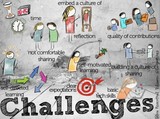
Time
There is never enough time in the life of an educator. Building a Professional Development Hub for your school will raise hairs on the backs (and resistance) of many just by thinking that it is one more thing to add to their plate. It is imperative to make it clear to members of your school community, that the time invested is of importance and will replace time spent on a different task. It is also important to clarify that in the beginning, a learning curve when reading, sharing, reflecting on the the hub is to be expected. The time invested now will pay off later.
Basic Tech Skills
Building an online Professional Development hub for your school is challenging if the majority of your faculty lacks basic technology skills. With basic skills, such as password and login management, typing skills, a certain fluency in reading and writing on a digital platform, etc. The lack of these skills seem to make the transition to a digital environment for learning filled with high obstacles and too far to reach.
I have been wrestling with the issue "It is NOT about technology"/ It IS about Technology for a while ( Never Was About Technology?- Time to Focus on Learning?, Take the Technology out of the Equation) and of course, it is not about the technology (it is about learning), but I am observing more and more educators , who are not comfortable with nor technology literate, are being left out of/ behind LEARNING opportunities. It is a subtle change, one that can be masked by surrounding yourself with colleagues and administrators who do not value nor take advantage of the transformational opportunities in teaching and learning through technology.
Embed Culture of Reflection
If a school does not value reflection as part of the learning process or educators are not used to sharing their reflection, embedding reflection in your online PD hub will be a challenge. Teachers and administrators need to see the value and benefits for their own learning and growth. This does not happen overnight, nor by writing 1 reflective post. Learning about the value of a reflection over time to demonstrate growth TAKES time.
According to Carol Rodgers in Defining Reflection :Another Look at John Dewey and Reflective Thinking, four criteria emerge from Dewey’s work that characterize reflection:
Reflection is a meaning making process that moves a learner from one experience into the next with deeper understanding of its relationships with and its connections to other experiences and ideas. Reflection is a systematic, rigorous way of thinking, with its roots in scientific inquiry.
Reflection needs to happen in community, in interaction with others
Reflection requires attitudes that value the personal and intellectual growth of oneself and others.(further reading: Reflection in the learning process, not as a an add-on, Reflect…Reflecting… Reflection, The Reflective School by Peter Pappas)
Not comfortable with sharing
While sharing has always come natural to me, this might not be the case for all your teachers at your school. Some educators are not comfortable in sharing their success or failures. Reasons behind these feelings have been "I don’t want to brag", "There is nothing I could share that has not been shared before", "There is noting I can think of", or " I am a perfectionist, I could not possibly write down what I do", "I am worried/afraid people will judge me/my writing/my spelling/my opinions/my teaching/etc."
The fact of potentially receiving feedback, embeds a different mindset when authoring and sharing material and documentation. Many are not used to that kind of open and transparent feedback.
Building a Culture of Sharing
How do we move from "never having thought about sharing my work, my reflections, my successes and failures, to a culture where sharing is deeply embedded how we work, learn and teach together. Not an easy task to build that culture, to make the act of sharing part of the fabric of our school?
(further reading: Sharing and Amplification Ripple Effect, The Power and Amplified Reach of Sharing, Sharing in Education- Is it Changing?, There is a responsibility of sharing among Educators, It’s All About Sharing & Collaborating)
Self- Directed Learning
Schools, universities and continued education opportunities of pre-internet days as students have groomed us to sign up, show up, listen and receive credit as proof that we were present. With the growth of the Internet, social media platforms, MOOCs (Massive Open Online Courses), personal learning networks (PLN) blogs, wikis, etc, the learner is in charge WHAT, WHEN, WHERE and HOW to learn. Materials are not pre-chosen, resoures are not stagnant or quickly outdated, a myriad of media is available to match one’s learning style. It is a challenge and struggle for educators and schools to transition to a new mind shift, where professional development is NOT chosen for them, but self-directed. Self-directed also requires the increasingly important skill of staying focused and the capability to select and filter an increasingly overwhelming information landscape.
Self-Motivated Learning
Closely related to self-directed learning is being self-motivated. The opportunity to learn anytime, anywhere and anyhow brings with it the challenge of intrinsic motivation. What happens when there is no roll-call, not physical presence required and a certain anonymity of what has been read, how much time was spent in working through resources and conversation threads? How much participation of the individual contributed to the overall connected learning of the group?
Quality Contributions
Having a professional development hub for your school and having your teachers contribute to the hub with resources, blog posts, images and videos does not necessarily equal quality contributions. It is imperative to clarify for teachers what is considered "quality" for your school community. Does a comment " I like what you shared" constitute "quality"? Does it contribute to the value of the original post? Does complaining about students or parents enrich learning for your school community? What contributions enrich the school’s learning community and what might teachers add that distract from learning, are unprofessional in nature or contribute to a culture of bullying, passive aggressiveness and negativism?
Clear Expectations
Taking all the above mentioned challenges in consideration, it becomes important for administrators to set clear expectations for their faculty, if an online PD hub is to be successful. Will it be mandatory to participate? How much participation is expected? What happens, if a teacher chooses to not participate? What are consequences? Will there be consequences? What basic technology skills are expected/ required of faculty to be able to participate as a full member of the online community? What is the expectation of professionalism? Who will moderate, re-enforce these expectations? How will you set and communicate expectations of quality contributions?
Take a look at the other sections of the series: Building an online Professional Development Hub for your School
Building a Professional Development Hub for your School- Part 1: Why?
Building a Professional Development Hub for your School- Part 2: Characteristics
Building a Professional Development Hub for your School- Part 3: Challenges
Building a Professional Development Hub for your School- Part 4: Steps
Silvia Rosenthal Tolisano
.
Blog
.
<span class='date ' tip=''><i class='icon-time'></i> Jul 16, 2015 06:47am</span>
|
|
This is part 4 in the series of Building an online Professional Development Hub for your School
Building a Professional Development Hub for your School- Part 1: Why?
Building a Professional Development Hub for your School- Part 2: Characteristics
Building a Professional Development Hub for your School- Part 3: Challenges
Building a Professional Development Hub for your School- Part 4: Steps
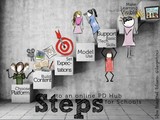
Choose a Platform
There are many platforms to choose from for your online PD hub for your school. There is no right or wrong decision which one you will choose. I would suggest you choosing the same platform, that you are or will be using for your students. It makes all the sense in the world to have your teachers experiences and work with the same platform your students will be working with. Questions to ask when choosing the platform (to make sure the platform has the capability to accommodate your requirements): Will it be an open to the world or a closed to only members of a specific (school) community platform? Does the platform have potential for future growth? How much technology know-how do you need to set up and maintain the platform? How much will it cost?
(Examples of PD platforms: WordPress Multi-user site (self hosted), Edmodo, edublogs, Eduplanet21, Ning,Google Plus)
Build Content
It is essential, especially in the beginning, to start building content on your community. It is hard for beginners, with little or no experience in online learning to envision the potential of the hub when nothing has been shared, no conversation has taken place and no visible evidence of a return investment to the time you are asking them to spend on the platform. It is worth the effort to invest in starting to populate resource areas, share downloadable and demonstrate how quality contributions might look like. You might also want to strategically ask specific members (more experienced ones with online learning) of your community to contribute in order to make "how it could look like "visible for others.
Set Expectations
Expectations can represent a challenge (see above). The clearer the expectations are for your school’s online professional development hub, the more successful the hub might become. Without set and communicated expectations, many hubs have fizzled out and did not fulfill the learning needs of the community. Once these expectations are communicated to members, revisit them often, embed them in conversations, in faculty meetings and faculty communications. If a pedagogical success, not only the mere existence of such online hub has become a priority and is to be part of the fabric of professional development at your school, expectations cannot disappear as yet another momentary initiative allowing members to fly under a radar.
Model Use
Administrators, especially a principal or head of school, are lead learners of a school community. In order to model good practices, their presence, participation and involvement is crucial on your online PD hub. Administrators model quality contribution, feedback and sharing, important characteristics of a flourishing online community. The mere presence and involvement of administrators, not only models, but also communicates clearly the shift of self-directed and motivated learning in digital places. Outside the digital learning platform, every opportunity should be taken to "demonstrate the value found with your digital [learning hub]" and strategically identify learning taking place as a result of connections made through the PD hub.
Support Basic Tech Skills
Different levels of comfort and fluency in regards to basic technology skills will be among your faculty. Make sure you have a system in place to support various levels. Walk in tech support, available step-by-step tutorials in paper form or for download, video tutorials of basic support involved in consuming, producing and contributing via the online hub. There is also the possibility of establishing a buddy system to connect less savvy teachers with mentors/coaches to support and guide the in becoming participating and active members of the school PD hub.
Make Learning Visible
What could you share on your online professional development hub? Resources, links to articles, book reviews, etc.? What makes YOUR SCHOOL’S hub unique, if members start sharing the learning that is taking place in their classroom with their students and in their own learning as educators. It is natural step to start Documenting FOR Learning and to share that learning in a visible way in a variety of media platforms (text, images, audio, video, etc.)
Take a look at the other sections of the series: Building an online Professional Development Hub for your School
Building a Professional Development Hub for your School- Part 1: Why?
Building a Professional Development Hub for your School- Part 2: Characteristics
Building a Professional Development Hub for your School- Part 3: Challenges
Building a Professional Development Hub for your School- Part 4: Steps
Silvia Rosenthal Tolisano
.
Blog
.
<span class='date ' tip=''><i class='icon-time'></i> Jul 16, 2015 06:47am</span>
|
|
Description of Project:
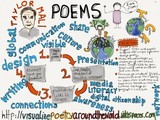
Based on Taylor Mali’s visit to The American School of Sao Paulo, Meryl Zeidenberg and I were inspired to amplify students’ poetry writing by adding a visual and audio layer as well as connect them globally to other students’ poems.
We are launching the Visualize Poetry Around The World project and are looking forward to connecting teachers and students, bringing global awareness and encouraging them to look beyond their own backyard and their own perspective.
Objective:
Encourage students’ global awareness and their ability to share their traditions and experiences based on their cultural heritage or geographic locations
Support Third Culture Kids and expats to express their unique experiences through poetry and make the advantages and challenges of International living accessible to geographically rooted children and vice-versa
Process:
Become a member of the project by joining the wiki. Questions? Contact me
Become familiar with or already have familiarity with Taylor Mali’s lessons/poems/workshops.
Become familiar with project objectives, expectations, timeline & mini-lessons
Complete task
[ There is no specific beginning or ending date for this project. Each teacher contributes his/her students video poems on their own time to the wiki platform. All we ask is that part of the commitment is to share, connect and give quality feedback to other students' contributions ]
Task Breakdown:
create poem
find/create images & record voice
publish on project wiki
connect and give feedback
Expectations:
expect quality student work using poetic devices
students create poem based on one or more of the provided prompts
students visualize poem with quality images and overlaying poem text with author’s voice
strict observance of copyright conventions and citations.
contribution of final student work to collaborative platform
participate in feedback of student work.
Time Commitment:
up to 80 minutes- write poem
80 minute class: Students present their poems to class (teacher and peer feedback). Students re-edit after feedback.
up to 2 -80 minutes class periods digital production
Third Culture Kid Poem Example
I am from…
I am from Germany, Argentina, USA and Brazil
I am from Germany. From the warm Bretzel with melted butter and the sound my shoes make when going for a walk in the dense forest.
I am from Argentina. From the crowds on Florida and Lavalle and the smell of a Bife de Chorizo at a friend’s asado. I am from the smell of Jasmine as I step off the colectivo on a warm Spring day in early December.
I am from the United States. From the smell of salty and buttery popcorn at the movie theaters. The wide streets and gigantic parking lots that fill up to capacity after Thanksgiving.
I am from Brazil. From the language that is almost understandable, but different as if listening under water or with glasses of the wrong prescription strength. I am from feeling almost close, but through the fog so far away.
I am also from lighting Hanukkah candles as I am smelling Christmas in the air and buying Charlie Brown Christmas trees on the 24th day of December.
I speak German, Spanish and English. Ich bin from Argentina y el vos. I am from speaking in all the 3 languages in one sentence without having to be held hostage by staying in one alone.
I am from leaving on a gray, cold and rainy day in October in autumn. Racing along the runway, up up into the sky towards spring air and towards a country far away and forever closer to me.
I am from arriving after a 24 hour journey to a tiny village, at the foot of the Katzenbuckel- The Cat’s Arched Back" where my grandmother anxiously awaits at the door, welcoming the return of the world travelers.
I am from changes, the differences, the friends made along the way. I am from the opportunities to see wonders of the world, tasting, smelling different ways of life. I am from the different faces of the world and history.
I am neither from here nor there or even there. I am destined to be torn forever between Fernweh and Heimweh, from always being far from.
Geographically Rooted Poem Sample
I am from the United States - New Haven, CT- where the imposing, old, stone, university architecture validated my fairy tale-laden child mind.
I am from the warm, loving scent of Aunt Martha’s cookies baking in the flat below.
I am from the one mile, all weather walk, to and from elementary school, where urban flora stubbornly persisted through sidewalk cracks.
I am from the grassy field of the local schoolyards where the kids from my street gathered and grew up, after school, until the street lights flicked on.
I am from the marvel and curiosity of tales from the old country spun out in a mixture of Yiddish and English around my grandmother’s kitchen table with the men drinking schnapps, the women tea.
I am from learning French because it is a "romance" language.
I am from learning Portuguese because of a Brazilian romance.
I am from the security of knowing my way around and where everything is.
I am from the frustration of not knowing the the colors, smells and sounds of everywhere else except from books and movies.
Ready to participate? Head over to the project wiki to sign up.
Silvia Rosenthal Tolisano
.
Blog
.
<span class='date ' tip=''><i class='icon-time'></i> Jul 16, 2015 06:46am</span>
|
|
My brilliant colleague from Brazil, Silvana Meneghini, was wrapping her mind around group research at the high school level. In a FaceTime call she expressed her frustration of traditional assessment methods, Assessing a final product, a group presentation, or via a peer evaluation of "how much did your classmate contribute?" did not do the necessary skills of modern research collaboration via social bookmarking, network or other web2.0/3.0 tools justice. In her guest post below, you will not only find a great documentation of her process, but she also shares an infographic making different levels of student participation visible from cooperation to collaboration and makes her own collaborative research process (search, share, feedback, revision) visible.
I would highly suggest adding Silvana’s blog Comundo to your RSS reader.
Rethink How We Assess Group Research
A guest post by Dr. Silvana Meneghini.
Cross posted from Comundo
Group work is typically very difficult for students. It is time for us to really open up the group research "black box" and assess the "process" of individual participation in group research. That will help students learn how to collaborate and grow with others.
Below you will see the results of students’ feedback on group research in a small Grade 10 classroom. You can say that half of the groups relied on a single student to do the research, either because that was the hard working student, the smart student or because others were working only on technical details like finding images and creating a nice looking presentation. There were groups that seem to have split the research work to get organised and others that seemed to have a more organic type of work. You can also see below, students’ suggestions on how to improve individual participation in group research.In order to help students self-assess their contribution to group research, I created the following rubric. This rubric is based on my experience on Sophomore research projects. As part of my own collaborative work, as I created this first draft of the rubric, I shared on my Twitter for feedback and also met with the Librarians in my school so we could align language. In fact, the rubric below already has modifications in language from this meeting with the Librarians, as in our school the research process involves steps like Think, Create, Share, Grow. You will see some of our comments on the side of the Google Doc. You can click on the image to see it better.
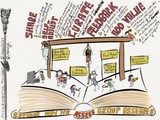
As part of collaborative work on this rubric, I had a Facetime conversation with Silvia Tolisano (@langwitches). As always, Silvia was able to synthesise what I was saying and not only provide feedback but also come up with some really good terminology to capture the main ideas. She then created the awesome sketchnote below with those terms, for which I just added the idea of "self-adjusting". Thank you Silvia for the amazing feedback! WE CANNOT MOVE FAR IF WE WORK ALONE!
So based on Silvia’s sketchnote, I revised my Rubric, so it became a description of the terminology: Curate, Share, Sel-Adjust, Feedback, Add Value.
The following Infographic provides a visual for the different Levels of individual participation in group research, and how students can move from "cooperation" to true "collaboration".
Silvia Rosenthal Tolisano
.
Blog
.
<span class='date ' tip=''><i class='icon-time'></i> Jul 16, 2015 06:46am</span>
|
|
I am thrilled to be part of Miami Device this upcoming November (Thank you Felix Jacomino for making this possible) If you are in the Miami area, or need a tropical getaway in November, consider joining an incredible line up of educational leaders!
I am especially thrilled to be sharing, for the first time, my journey of learning about and with Sketchnoting.
My Session Description:
The term sketchnoting describes a style of visual note-taking recently gaining popularity among conference attendees. Contrary to popular belief, you do not have to be an artist to sketchnote and to take advantage of a different type of learning and making content connections beyond conference keynotes . Sketchnoting is helping make your thinking visible and shareable as you are reading a professional book, watching a movie clip, reading an educational blog post or article or listening to a lecture of conference keynote.
This workshop is for educators who want to hone their abilities to listen more intently, summarize and organize their notes in a visual way and learn how to do this with their students. NO artistic talent required.
We will look at structures of a sketchnote, typography, connectors, containers and work on your own visual library. Please bring a paper and a pencil/pen or your iPad with a drawing app (ex. Paper by fiftythree).
Read more about Miami Device and plan on joining what looks like an incredible learning and networking opportunity.
Miami Device is about learning. Its goal is for more students to be authentically engaged as a result of passionate, well-trained educators who want to be masters of their craft. These teachers are willing to explore and embrace best practices for today and tomorrow and understand the importance of student-centered learning. Project/Problem/Challenge Based Learning, 21st Century Skills, Common Core Standards, Classroom Flipping, and Game Based Learning, with the support of Mobile Devices, is the "curriculum" of Miami Device.
Please join us November 6 & 7, 2014 for an unforgettable learning experience featuring the best of the best in the EdTech world!
What to expect
The very best speakers, teachers, and clinicians who implement educational technology in innovative ways
Diversity of topics across all curricular subjects and levels
The best professional development experience
A newfound passion for empowering students and the ability to authentically engage them in the learning process
Location, Culture, and FUN!
For a full description, read; 5 Experiences to Expect at Miami Device!
Who should come?
Teachers, administrators, technology & STEM coordinators
who desire to learn how to best integrate technology in their school’s classrooms
Educators of elementary, middle school, and high school
College students currently studying Education
Teachers of any and all subjects
Educators and administrators
looking to network with local, national, and international speakers and attendees
Have a look through the schedule of sessions and list of speakers:
List of all Speakers
EdTechTeacher Sessions
Featured Speaker Sessions
Keynotes
Keynote Speaker Sessions
Concurrent Sessions
Panel Discussions
Silvia Rosenthal Tolisano
.
Blog
.
<span class='date ' tip=''><i class='icon-time'></i> Jul 16, 2015 06:46am</span>
|