Blogs
|
I love creating writing tasks and writing exercises. Those tasks are especially great for teachers who are looking for more challenges and inspiration for their learners. And I have recently learnt a great new website/web tool from my dear colleague Berna Aslan to promote creative writing in and outside the classroom.
Writing Exercises provides free writing prompts and exercises to help you get started with creative writing and break through writing blocks for your students. You can generate story ideas, plots, subjects, scenarios, characters, first lines for stories and many more inspiring things.
You can get a random first line to write a story such as ‘It was the trip of a lifetime, yet …’ ,you can get three nouns for your story; ‘honesty spider computer’, you can get a story title such as ‘The Secret Holiday’, you can character traits; ‘stubborn, considerate, idealistic’, you can get a random picture for a film plot, you can get random names for your stories as well. Also, there are many other generators that you can check once you get in the website. They also have a Children’s Writing Exercise website that is specially designed for children to use.
This tool can be used in class to create a story as a whole class or in groups; or we can also assign our students with this web tool who would like to do more in English at home. This is also another website that we can recommend our parents who are asking for ideas to do with their children at home.
Picture Source: ShutterStock
Ozge Karaoglu
.
Blog
.
<span class='date ' tip=''><i class='icon-time'></i> Jul 16, 2015 07:37am</span>
|
|
In a previous post, Learning in the Modern Classroom, I started highlighting our school’s attention to not only providing amplified learning opportunities, but also the creation of new forms of assessment to go along with these learning opportunities. I see a growing AND urgent need to develop new forms of assessment to support our pioneering teachers, as well our students.
Learning in the 21st century modern classroom is changing. Many teachers are frustrated as the required or available assessments have not caught up yet with their efforts of upgrading to new forms of learning. How can we assess new forms of teaching with old traditional forms of evaluations? Teachers feel trapped between wanting to upgrade and prepare students with skills for their life outside of school, but are dumbfounded how to assess the learning in terms that parents, colleagues (other subject areas), teachers (as their students rise to the next grade) administrators (& school policy makers), feeder schools, other stakeholders or universities understand, value and accept.
Ex. A school is pioneering blogfolios in the K-8 classrooms and using student created content as formative assessment. The primary feeder school is not interested in even looking at these assessments for admissions purposes (possibly for placement purposes once accepted into their school).
We are in dire need of wrapping our minds around new forms of assessment, conceptualizing and developing these assessment tools, using them, advocating for them, sharing them and making them acceptable EVIDENCE OF LEARNING!
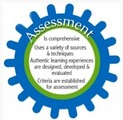
As a school, MJGDS is working on a Learning Target. Andrea Hernandez and Jon Mitzmacher have already written about it on their respective blogs. We used the Evidence of Learning in the 21st Century Classroom by Galileo Educational Network as a basis to specifically look at the assessment part of the Learning Target
So, I am taking a closer look at the part of "Criteria are established for Assessment". Teachers can’t/won’t be able to find a balance when blogging, tweeting, skyping, digital storytelling, building a learning network with and for their students, IF they continue to ASSESS in ADDITION to traditional forms.
I want to share how we are starting to look at ways to UPGRADE & REPLACE traditional assessment forms.
The classroom learning scenario (4th & 5th Grade) was a Skype call with Mike Fisher, I described in a previous post. Students were in charge of different jobs (true to the Digital Learning Farm concept from Alan November’s latest book "Who Owns the Learning?")
I want to share our upgrade of assessment using tools such as Twitter, Skype and the Classroom Blog.
One of the jobs was to be in charge of the classroom Twitter account during the Skype call. Students were to document the Skype call through 140 characters or less, using Twitter Grammar, Lingo & Twitter Shorthand, which we had made them familiar with over the last months by paper tweeting, class tweeting, etc. I had developed the following guideline (as part of a Twitter Routine in the Classroom) of Lower Order to Higher Order Thinking Skills to classify different types of tweets.
Using the above criteria, we were able to assess our classroom Twitter feed/ Twitter job holder.
Our 9/10 year old students:
are doing well in listening to conversation taking place via video conference
are summarizing/taking notes in 140 characters or less.
have a pretty good understanding of the Twitter lingo and grammar
are starting to get a feel for a what a learning network means
are reading and responding to others joining the conversation via Twitter
are starting to apply notions of digital citizenship by citing and adding links
are starting to add their own contribution
I can see that we need to work on:
moving beyond documentation to adding learning connections
asking questions
distinguishing between open and closed ended questions.
add hashtags when apporpriate
Our school’s Learning Target goes further into detail in regards to assessment:
Assessment is integral to the learning and woven into authentic tasks, projects, and/or investigations. Assessment is ongoing and used by students to obtain feedback from a variety of people both inside and outside the classroom to improve their learning.
Teachers have been including peer review for a while now as a valuable assessment for individual students. New forms of assessment though call for "obtaining feedback from a variety of people both inside and OUTSIDE OF THE CLASSROOM".
It is an active decision and action from the teacher’s part to reach beyond (amplify) their assessment of student work/learning and give feedback to students beyond themselves or their peers.
To solicit outside feedback from experts (in addition to a few live comments and responses), I published several screenshots of the 4th and 5th graders’ tweets on my blog Learning in the Modern Classroom. For me, there is no better way to solicit this kind of "outside help" than to ask the people on my Twitter network .
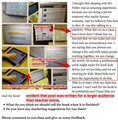
Steve Anderson, aka web20classroom, an educator with over 57,000 Twitter followers and over 68,000 tweets to his credit ( giving him a certain degree of credibility in the social networking arena), left a comment on the blog addressing the students directly :
Taking a look at your Twitter feeds, it is clear you have a grasp of communicating and collaborating using social media as a tool. You were able to summarize your call with Mike in a way that worked for 140 characters each time. And believe me, that is sometimes a tough task! You captured the essence of each part of your conversation with Mike and helped those not able to be there feel like they were.
Cheers to you all on a job well done!
Please feel free to continue leaving feedback for our students on the blog post.
Silvia Rosenthal Tolisano
.
Blog
.
<span class='date ' tip=''><i class='icon-time'></i> Jul 16, 2015 07:36am</span>
|
|
If you like MadLibs kind of activities in which you write words to substitute for blanks in a story, before reading; you and your students will love Wacky Web Tales.
The website gives you more than 50 titles that you can choose from. Later, you ask your students to fill in the missing words and parts of the speech. When you are done, the website generates the story with the prompts that you have written. It is sof un and easy to use. Here is one of the story that one of my students have created using this tool, enjoy!
Super Salad
To make the best book salad, you need fresh ingredients. The best time to buy a freshbook is from October to September. Go to your local market. Pick up one book and study it. The book should be happy and clean. These taste the best! Put six of them in your shopping cart. You will also need a pound each of carrots and pens.Next, you need to get the ingredients for the salad dressing. You might like appledressing, which tastes yummy on book salad, but you might also enjoy banana dressing. Pick out the five best fruits you can find. Take your ingredients home, and get ready to make your salad.Wash and dry each book thoroughly. Use your car to separate the parts of the book. Put the pieces in a large salad bowl. Next, chop the carrots and pens, and put those in the bowl. To make the dressing, mash the fruit in another bowl. Add a cup of oil and a hundred teaspoons of vinegar. Pour the dressing into the large salad bowl and mix the ingredients. Voilà! Enjoy your book salad.
Ozge Karaoglu
.
Blog
.
<span class='date ' tip=''><i class='icon-time'></i> Jul 16, 2015 07:36am</span>
|
|
This is Part Two of Assessment in the Modern Classroom. Read Part One here.
Assessing students’ writing, thinking level , understanding, learning connections via a Twitter stream, did not end the assessment upgrade for this particular learning opportunity.
During the same Skype call, we paid special attention to how students interacted with their conversation partner (Mike in this case) . We were watching their body language, paying attention to their vocabulary, ability to articulate an idea, their conversation etiquette and ability to follow a conversation and interaction.
If working (and communicating beyond face to face interaction) on a global team is/will be a crucial skill for our students to posses, how can we assess the skills, support, coach and guide students?
I am looking for ways to UPGRADE & REPLACE traditional assessment forms. Heidi Hayes Jacobs suggests in her book Curriculum21 to use an upgrade model which
begins with consideration of assessment types, moves to content reviews and replacement, and then links both of these to upgraded skills and proficiencies (Jacobs, 2010, p.20)
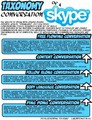
I started by taking a look at Andrew Churches Skype Rubric (pdf), but wanted to focus more on the actual communication skills during the Skype call and developed the following Taxonomy of a Skype Conversation as a guide.
Download the Taxonomy of a Skype Conversation as a pdf file.
I believe we are on our way. We took the Twitter feed (Part One) , looked at skills students exhibited during the Skype conversation (Part Two) and now are moving on to looking at "blog post writing" as assessment (Part Three).
Silvia Rosenthal Tolisano
.
Blog
.
<span class='date ' tip=''><i class='icon-time'></i> Jul 16, 2015 07:36am</span>
|
|
I love storytelling and how they can promote creativity, imagination and inspiration in the classroom! If you would like to create and write your own stories with your students, here is a nice tool that you can use and suggest students to try at home as well!
Scholastic Story Starters is an online machine that randomly generates a story starter for you. You choose your theme, write your name and grade. Then spin the wheel to get story prompts. Your story starter can be ‘Write three wishes of a giant milkmaid whose tears turn things to stone.’ or ‘Write a mysterious message to a pleasant lion that has a jet pack.’ If you can like, you spin smaller wheels to change different parts of your story starter.
The tool, then, lead you to start writing your story. You can choose to write a letter, a notebook, newspaper or a postcard. You can download or print your story when you are done.
If you have time to inspire your students today, spin the wheel in class and get your story starter. Your learners are sure to come up with many creative stories using these prompts.
Picture Sourse: ShutterStock
Ozge Karaoglu
.
Blog
.
<span class='date ' tip=''><i class='icon-time'></i> Jul 16, 2015 07:36am</span>
|
|
I believe we are on our way of taking a modern classroom learning opportunity and upgrading assessment forms to match new skills and new literacies while not forgetting traditionally assessed ones.
We took a classroom Twitter feed (Part One) , looked at the conversation skills students exhibited during the Skype call (Part Two) and now are moving on to looking at "blog post writing" as assessment.
Keeping a previously created blogging rubric in mind, we took a closer look at the blog posts written by the 4th and 5th graders during the actual skype call and edited and formatted after the call had ended.
(If you have a minute, take the time to give the 4th and 5th graders ("outside of the classroom") feedback).
There is not enough time to allow students to write the blog post, but still require them to write, in addition, in their paper journal. The "new form" of assessment has to replace the traditional one….
[Sidenote: not all the time... students don't have to only write on their blog, just as they should not only write in physical paper journals.]
There are still more components to our learning experience. We have videographers in the process of editing the recorded Skype call. Yet another opportunity for an upgraded assessment.
How will we give feedback?
How do we assess these students’ artifact for evidence of learning.
How well did they edit?
Were they able to summarize important parts of the video clip?
Were they able to tell a new story (showing understanding) from the clip?
Is there evidence of growth in their fluency/literacy/ skills such as digital communication, connection, collaboration and critical thinking?
Do we need a hub to collect these new types of assessment. Who is sharing? Who is curating? Who is disseminating?
Silvia Rosenthal Tolisano
.
Blog
.
<span class='date ' tip=''><i class='icon-time'></i> Jul 16, 2015 07:35am</span>
|
|
Here is a super cool and easy tool to create printable bingo cards for your students. Just go to this bingo card creator tool and then write the words that you want to see on your bingo cards. You csn write as many words as you want, you can also add a free space and even add a text there. You can decide on the number of the squares and how many different bingo cards that you want to create. When you are done, you can download and print your cards!
Instead of words, you can also write questions and students can ask these questions to each other as well. Enjoy!
Picture Source: Shutterstock
Ozge Karaoglu
.
Blog
.
<span class='date ' tip=''><i class='icon-time'></i> Jul 16, 2015 07:35am</span>
|
|
I have been following the "Where the Hell is Matt" videos since 2006. I always thought the video is a great hook for students into geography. There are three versions available with a clear evolution of Matt growing as he travels around the world.
From dancing in isolation in different locations around the world in 2006. Matt is doing "his thing".
In 2008, he starts our dancing "his way" alone to then be joined by locals who are imitating his dance moves.
Finally in 2012, Matt is embracing the locals, by dancing WITH them, learning their cultural dances and being part of the World.
Silvia Rosenthal Tolisano
.
Blog
.
<span class='date ' tip=''><i class='icon-time'></i> Jul 16, 2015 07:34am</span>
|
|
"Amplification" in education is a concept, I am deeply committed to. In a recent post, Upgrade & Amplification Exercise and Checklist, I try to break down the process of amplification and make it more transparent for educators. What I did not explicitly include was the component of another language to amplify one’s work, learning opportunities, reach, voice and ability to reach a global audience.
Last October, I published the post Sharing- Creative Commons- Collaboration- Amplification, which in turn refers to
It’s All About Sharing and Collaborating, a post I wrote about a Russian educator who had translated material from Langwitches into his language in order to SHARE the content with his colleagues who spoke no English. Alec Couros, told the Amazing Story of Openness and his diagram of the Networked Teacher as it has been translated into many languages now.
It am tremendously honored, when my work gets AMPLIFIED into other languages, reaching educators, I would not have reached otherwise. Dico Krommenhoek contacted me a few days ago via Twitter. I was thrilled to give permission, without hesitation, when he asked to translate the iPad App Evaluation checklist into Dutch. It gives me a sense of COLLABORATION across time, space and language, when I can "teach" via my work and materials without ever speaking the same language or meeting these teachers face to face.
This is a beauty of CREATIVE COMMONS and an amazing story of openness (as Alec Couros puts it).
Since then I have received several requests and permission to amplify into other languages. I would like to share the work of the educators who took the time to amplify into their language. This is how collaboration and amplification looks like
Marlon offered to translate the iPad App Evaluation for the Classroom into Chinese (pdf)
Carrie Antoniazzi, as a conseillère pédagogique" with a french school board in British Colombia, Canada, translated and adapted the Are u Ready 4 Twitter into French (pdf) for her teachers.
Silvia Rosenthal Tolisano
.
Blog
.
<span class='date ' tip=''><i class='icon-time'></i> Jul 16, 2015 07:34am</span>
|
|
I have been intrigued with the relationship of being skilled, literate and fluent in the Digital World for a while. We are focusing at school to look through the lens of fluency using technology as tools (e.g. using the iPad as the device and apps as the tool to achieve fluency), not as the end. I am wondering if the word "fluency" in the digital world, sparks the same thoughts or activates the background definition in other educators? I have heard others in the edubloggersphere use the word "workflow" instead of "fluency".
Workflow is defined by Wikipedia as:
The sequence of industrial, administrative, or other processes through which a piece of work passes from initiation to completion.
The world "workflow" c-o-u-l-d work, but still does not sound right. What about a LEARNflow? The goal in education is for our students to learn, to become life long learners and do do so unconsciously, smoothly and [as] effortlessly [as possible]… I am still mulling over the semantics here… Your input is appreciated…
fluency- workflow?- learnflow?
Looking back at my train of thought, I started by looking at the flow between the skills needed to become literate in order to move on to become fluent.
Then I moved along the lines of remembering what it felt like to NOT be fluent in a language. Words like cumbersome, painstaking, tedious, with effort and drudgingly come to mind. What feels so effortless to the fluent, is broken down in so many steps for the beginner… vocabulary words, grammar rules, exceptions, idioms…
Most monolingual people might relate how it feels to TRY to learn another language, but they cannot relate to the feeling of being fluent in that other language. Most people might find a way to understand the analogy though when looking back at learning or teaching someone else how to drive a car. So many steps, from looking around you, to keeping your distance from other cars, observing and "feeling" the speed of the vehicle, breaking, shifting, merging, side & back mirrors, etc. As "fluent" drivers we don’t have to think about each step, it just happens naturally as opposed to the novice driver.
Sports also allow for a good analogy by comparing the learning of skills, to knowing how to perform them and practice until movements become unconscious and seem effortless.
Moving back from analogies to what being fluent in a digital world means, I stumbled across a post by Christian Briggs titled "The Difference Between Digital Literacy and Digital Fluency". He pointed out:
Note that a literate person is perfectly capable of using the tools. They know how to use them and what to do with them, but the outcome is less likely to match their intention. It is not until that person reaches a level of fluency, however, that they are comfortable with when to use the tools to achieve the desired outcome, and even why the tools they are using are likely to have the desired outcome at all.
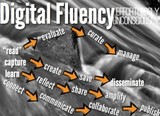
Ian Jukes and Andrew Churches even wrote an entire book titled "Literacy is NOT enough: 21st Century Fluencies for the Digital Age". A presentation by Alec Couros titled Towards Digital Fluency, inspired me to visualize the following "flow" of what digital fluency [currently] looks like to me.
The following is the slide deck that puts my train of thought together and documents my understanding of being skilled, literate and fluent in the digital world at this moment in time.
Digital Fluency from Silvia Rosenthal Tolisano
Silvia Rosenthal Tolisano
.
Blog
.
<span class='date ' tip=''><i class='icon-time'></i> Jul 16, 2015 07:33am</span>
|