Blogs
|
I’m Wendy Tackett, the president of iEval, part-time faculty at Western Michigan University, and a blogger at Carpe Diem: Make Your Evaluations Useful. I want to share about a fun way we get our evaluation clients engaged in evaluation…we call it Camp iEval!
The purpose of Camp iEval is to bring evaluation clients together who are working on similar programs and provide 1) training about understanding and using data, 2) analyses of current local data, 3) research on best practice strategies aligned to needs identified through data analyses, and 4) networking among colleagues.
Lessons Learned:
Location, location, location! We’ve hosted Camp iEval several times a year since 2010 in various formats - at my house, a client’s office, a hotel, and via Skype. We’ve found that the best location, by far, was my house! When people are comfortable, they’re much more receptive to open, honest discussions around data and sharing ideas for program improvements. We encourage informal attire and do a potluck lunch, making it a very relaxed atmosphere.
Variety is the spice of life! While we stick closely to the four components of the day, we change it up each time so people don’t get bored. We’ve done things like incorporated hands-on science experiments because the data showed science integration as a weakness, put on skits to illustrate the benefits of using evaluation, and solicited programs to give mini-presentations.
Have fun! Having fun while doing evaluation is one of the key tenets of our work. We have created silly awards (e.g., Miss Interpretation), gifted iEval blankets (it’s a running joke because I keep my house so cold), sang songs around a guitar, and eaten tons of homemade goodies.
Relationships are key! I’m sure you’ll agree that the most valuable time at any conference is the networking time, whether formal or informal. We plan formal networking time (i.e., specifically asking programs to share on strategies that have been successful based on our data analyses) and informal networking time (e.g., not a working lunch, general sharing at the end of the day). Because of the casual atmosphere of Camp iEval, the project staff feel comfortable sharing their own data with each other, asking deep questions, visiting each other’s programs, and knowing there are people they can go to for support.
Hot Tip: If you’re interested in finding out more about how to create your own evaluation camp, look for any of the iEval team members at Evaluation 2015 in Chicago. We’re submitting a demonstration proposal; but if we don’t end up presenting, we’d be happy to share more insight informally!
Do you have questions, concerns, kudos, or content to extend this aea365 contribution? Please add them in the comments section for this post on the aea365 webpage so that we may enrich our community of practice. Would you like to submit an aea365 Tip? Please send a note of interest to aea365@eval.org . aea365 is sponsored by the American Evaluation Association and provides a Tip-a-Day by and for evaluators.
Related posts:
LAWG Week: Patricia Moore Shaffer on STEM Evaluation in Informal Settings
Wendy Tackett and Joseph Trommater on Local Evaluation Capacity Building
Bloggers Week: Wendy L. Tackett on Carpe Diem
AEA365
.
Blog
.
<span class='date ' tip=''><i class='icon-time'></i> Jul 27, 2015 12:22pm</span>
|
|
I just had the opportunity, no privilege, to talk with Joe Gerstandt in the blogger’s lounge at the SHRM 2015 Annual Conference & Exposition in Las Vegas. His business card states: "illuminating the value of difference". In our conversation, he passionately and persuasively talked about the importance of valuing difference by more than just labels, but also by conscious activism. I asked Joe what propelled his passion. The...
SHRM
.
Blog
.
<span class='date ' tip=''><i class='icon-time'></i> Jul 27, 2015 12:21pm</span>
|
|
Objective
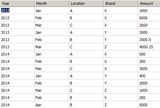
Suppose a manufacturing farm manufactures three products (Brand) say X,Y,Z and it has three sale points (Location) say A,B,C from where they sell those products. They keep a track of selling Amount of each product from each sale point on year basis in the following table that looks like below:
For the sake of simplicity I am keeping the schema very simple to understand. Each row in the diagram informs in which month of a year which Brand (product) got sold out from which Location and how much Amount is earned after selling that product.
Suppose it is required to find out how much amount of Product was sold out from each location on each Brand basis in the year of 2014 and on every month basis. So the matrix will look like as follows:
So we need to get the summation value of Amount sold for the intersection of Brand data points X, Y, Z to Location Data Points A, B, C and of Month Data points Jan, Feb etc.
So this is what pivoting means i.e. Intersection of data points to summarize the data.
Implementation
Pivot query basically has three parts. Considering the above table, let’s us understand this properly:
Part 1: It defines the actual data points of the table to be displayed as header. What data point is, has already been defined.
Part 2: This is the actual dataset from the table. Note that the column names of the table are given here to create the dataset as like usual simple query.
Part 3: This is the actual pivoting of the data.
After execution of the above query we are able to find out the total sale of Brand X, Y, Z for the locations A, B, C in the year of 2014 per month basis and that looks like as follows:
Conclusion
In this blog I’ve basically tried to make you understand how we can use the Pivoting in SQL Server that gives the insight of data by rotating rows and columns of a table from multidimensional perspective. Forming the interactive parameterized query we are able to consume/display the direct returned pivot dataset without having any manipulation in DOT Net application, SSRS etc.
Netwoven
.
Blog
.
<span class='date ' tip=''><i class='icon-time'></i> Jul 27, 2015 12:21pm</span>
|
|
Hi, Veronica Olazabal, with the Rockefeller Foundation here. Having worked in the international development sector for some time and driven by the belief that evaluation is a bridge to effective poverty solutions, assessment of integrated development programs is a passion of mine. At Nuru, a social venture that aims to eradicate poverty in remote rural areas in Africa, we use a combination of approaches to measure the breadth and depth of our programs’ impact. We measure the "parts"—impact of each program—and the "sum of the parts"—the composite programmatic impact on poverty. In operationalizing this strategy over the last few years, here’s what we’ve learned:
Be clear about your definition of poverty from the start. Is poverty based on income or something else? At Nuru, poverty is multidimensional and aligned with Amartya Sen’s definition on access to meaningful choices.
Find a tool that aligns with your definition of poverty. Rad Resources: For multidimensional poverty, try the Multidimensional Poverty Assessment Tool (MPAT) or Multidimensional Poverty Index (MPI). For income-based poverty, try the Progress out of Poverty Index (PPI).
Define your comparison. We have learned from others, and from our own trial and error, that we need a point of comparison. We use comparison farmer households to follow year-to-year changes, national data tools for broader regional comparisons, and comparison of new to returning Nuru farmer households over time.
Articulate clearly how the program will lead to poverty change. Define your theory of change: Is change a step-by-step process? Is it a graduation model? Is it driven by a vertical solution? At Nuru, our programming is sequentially layered. This intentional design allows us to isolate the impact of each program on the sum as each is operationally layered on.
Manage your stakeholder’s expectations. Many poverty experts believe that change takes many years and is too complicated to actually measure. Others believe that catalytic programs may drive marginal levels of change faster. Ensure that your stakeholders’ expectations are clear, both in commitment to programming and measurement.
Don’t forget costs. At Nuru, we are deliberate about cost-effectiveness and achieving financial sustainability. Thus, we are intentional about ensuring that every data point counts toward strategic decision-making (i.e., how to scale, iterate, etc.). If we can’t use it, we lose it.
We are still learning and expect to "calibrate" our programs and measurement strategy over time. If you have experience in this space, please reach out.
Rad Resources
Oxfam Blog: How can we improve the way we measure poverty? by Duncan Green
Macro-level Drivers of Multidimensional Poverty in Sub-Saharan Africa: Explaining Change in the Human Poverty Index by Heath Prince
Photo complements of Flickr, Grapes of Math by Mark Turnaukcas
Do you have questions, concerns, kudos, or content to extend this aea365 contribution? Please add them in the comments section for this post on the aea365 webpage so that we may enrich our community of practice. Would you like to submit an aea365 Tip? Please send a note of interest to aea365@eval.org . aea365 is sponsored by the American Evaluation Association and provides a Tip-a-Day by and for evaluators.
Related posts:
EPE TIG Week: Juha Uitto on Sustainability Evaluation and the Need to Keep an Eye on the Big Picture
EPE TIG Week: Anna Williams on A Welcome New Paradigm for Sustainable Development
Kristi Pettibone on Evaluating Environmental Change Strategies
AEA365
.
Blog
.
<span class='date ' tip=''><i class='icon-time'></i> Jul 27, 2015 12:20pm</span>
|
|
Introduction
We can create a multiple file upload tool with progress bar using jQuery. It is fully customizable and also helps us to update the metadata at the same time. Best part is that it is not involved in any page load and it helps to understand how long it will take to upload large files.
Prerequisites
1) Go to http://www.uploadify.com/ and download the free flash version. We can also use HTML5 version but it involves some license.
2) Visual Studio 2012
Detailed Method
1) Create a SharePoint 2013 Empty project and give it a proper name.
2) Add new item and add a visual webpart with a proper name.
3) Create a mapped "layout" folder for this project.
4) Now copy all the files downloaded from uploadify and paste it to our layout mapped folder.
5) Now in the user control page copy the below code with some modification of your project folder.
<link rel="stylesheet" type="text/css" href="/_layouts/15/{mapped_folder_name}/uploadify/uploadify-new.css">
<script type="text/javascript" src="https://code.jquery.com/jquery-1.10.2.min.js"></script>
<script type="text/javascript" src="/_layouts/15/{mapped_folder_name}/uploadify/jquery.uploadify.js"></script>
6) Now create the script for upladify functionality
<script type="text/javascript">
$(function () {
$("input[id*='fuMiltiFileUpload']").uploadify({
‘formData’: { ‘strSiteURL’: ", ‘strLibraryName’: ", ‘strMetadata’: " },
‘height’: 30,
‘swf’: ‘ /_layouts/15/{mapped_folder_name}/uploadify/uploadify.swf’,
‘uploader’: ‘/_vti_bin/anonsvc/{project_folder_name}/Upload.ashx’,
‘width’: 120,
‘onFallback’: function () {
//alert(‘Flash was not detected.’); if flash is not installed in the browser
},
‘onUploadError’: function (file, errorCode, errorMsg, errorString) {
alert(‘The file - ‘ + file.name + ‘ - could not be uploaded: ‘ + errorString);
},
‘onQueueComplete’: function (queueData) {
//Can do whatever we want to do after all the files uploaded successfully.
}
});
});
</script>
<asp:FileUpload ID="fuMiltiFileUpload" runat="server" />
7) Look into the "Uploader" path given into the above script.
8) Here we kept the code file under "anonSVC" . "/_vti_bin/anonsvc/{project_folder_name}/Upload.ashx". Because when the files are posted from a SharePoint page and trying to access our uploader script there is and authentication issue. So we will keep our uploader script under annosvc folder to access it anonymously.
9) This Upload.ashx is nothing but a generic handler which has all the codes to upload files on a specific "List/Library".
How to create a generic handler in SharePoint
1) Create a SharePoint mapped folder and under "ISAPI > annonsvc" create a folder for this project.
2) Add new item and create a general text file with ".txt" extension.
3) Now rename it and give it a name as "Upload.ashx".
4) Now open the Upload.ashx file and paste the below code
<%@ Assembly Name="Microsoft.SharePoint, Version=15.0.0.0, Culture=neutral, PublicKeyToken=71e9bce111e9429c" %>
<%@ WebHandler Language="C#" Class="Upload" %>
using System;
using System.Web;
using Microsoft.SharePoint;
publicclassUpload : IHttpHandler
{
///<summary>
/// You will need to configure this handler in the Web.config file of your
/// web and register it with IIS before being able to use it. For more information
/// see the following link: http://go.microsoft.com/?linkid=8101007
///</summary>
///
#region IHttpHandler Members
publicbool IsReusable
{
// Return false in case your Managed Handler cannot be reused for another request.
// Usually this would be false in case you have some state information preserved per request.
get { returntrue; }
}
publicvoid ProcessRequest(HttpContext context)
{
string strSiteUrl = context.Request["strSiteURL"];
SPSecurity.RunWithElevatedPrivileges(delegate()
{
using (SPSite site = newSPSite(strSiteUrl))
{
using (SPWeb web = site.OpenWeb())
{
}
}
});
}
#endregion
}
5) Under "ProcessRequest" method we can write our own upload code.
6) In the script we can pass our own data as a Jason format under ‘formData’ property and we can access those value in handler file under context.Request[""] parameter.
7) As we are accessing this handler file anonymously we are using SPSecurity.RunWithElevatedPrivileges(delegate() to open the web.
Deploy and add this webpart under project
1) Deploy the webpart using visual studio or PowerShell.
2) Open the site in SharePoint designer.
3) Create a normal aspx page under "SitePages" library. Open the page on Advance edit mode and add the specific webpart using SharePoint designer.
4) Run the page in browser and try to upload some files.
Debug the generic handler
1) Run the handler page in the browser with its full path and see if there is any error. http(s)://{site-url}/_vti_bin/annonsvc/{project_folder_name}/Upload.ashx
2) We can also attaché this file with "w3wp.exe" process to debug.
Note: If you are unable to see the flash upload button please add the MIMEtype to your SharePoint site using the below PowerShell command.
Write-Host"This script will check if a particular MIME Type is excluded from the AllowedInlineDownloadedMimeTypes list when STRICT Browser File Handling Permissions are set on the Web Application"-foregroundcolorDarkcyan
$webAppRequest= Read-Host"What is the name of your Web Application? i.e. http://<serverName>"
$webApp= Get-SPWebApplication$webAppRequest
$mimeType= Read-Host"Which MIME Type would you like to confirm is included in the AllowedInlineDownloadedMimeTypes list for $webApp ? i.e. application/pdf"
If($webApp.AllowedInlineDownloadedMimeTypes -notcontains"$mimeType")
{
write-host"$mimeType does not exist in the AllowedInlineDownloadedMimeTypes list"-foregroundcolorYellow
$addResponse= Read-Host"Would you like to add it? (Yes/No)"
if($addResponse-contains"Yes")
{
$webApp.AllowedInlineDownloadedMimeTypes.Add("$mimeType")
$webApp.Update()
Write-Host"The MIME Type ‘ $mimeType ‘ has now been added"-foregroundcolorGreen
$iisresponse= Read-Host"This change requires an IIS Restart to take affect, do you want to RESET IIS now (Yes/No)"
if($iisResponse-contains"Yes")
{
IISRESET
Write-Host"IIS has now been reset"-foregroundcolorGreen
}
else
{
Write-Host"IIS has not been reset, please execute the IISRESET command at a later time"-foregroundcolorYellow
}
}
else
{
Write-Host"The MIME Type ‘ $mimeType ‘ was not added"-foregroundcolorRed
}
}
else
{
Write-Host"The MIME Type ‘ $mimeType ‘ already exists in the AllowedInlineDownloadedMimeTypes list for this Web Application"-foregroundcolorYellow
}
To run the above script you will need to copy it into Notepad and then save it with a filename like strictMimeType.ps1. Once saved you can run it from a PowerShell window like so.
#Use the cd command to navigate to the folder it is in
cd C:\powerShellScripts
#Once you type in’.\’ you can press tab to cycle through files in this location
.\strictMimeType.ps1
MIMEType for flash is "application/x-shockwave-flash"
Netwoven
.
Blog
.
<span class='date ' tip=''><i class='icon-time'></i> Jul 27, 2015 12:20pm</span>
|
|
I had the distinct pleasure of seeing my friend Steve Browne speak this morning at SHRM. His session was intended to fire up the audience, and I’d say it was a smashing success. One of his comments was powerful, and I thought it deserved to be repeated here because I talk about certification quite a bit. If your certification is purely about getting recertification hours, having letters after your name, and trying to use that as a way to get credits, then you’re wasting your time and your organization’s time. Go ahead...
SHRM
.
Blog
.
<span class='date ' tip=''><i class='icon-time'></i> Jul 27, 2015 12:19pm</span>
|
|
Hi there, Liz Zadnik here, bringing you another Saturday post focused on practitioner experiences and approaches. Today I’m going to focus on a recent (and recurring) experience of getting others excited about evaluation and capturing information.
It is a source of pride that many of my colleagues have said, "Liz, you bring such an enthusiasm for evaluation - it really helps getting people engaged and interested." Now, I’m not the most knowledgeable or experienced person, but I do know that evaluation and assessment hold an important place in the present and future of the anti-sexual violence movement.
Hot Tip: During a recent webinar I was facilitating, I was talking about sharing data and building trust with community members. I was trying to think of how to explain it and used the analogy of constellations: we do not "own" the stars, but have drawn connections to tell stories about the past, present, and future.
Lesson Learned: Look up! Sometimes this could be literal or figurative. But getting some perspective and being creative can go a long way in engaging people in conversations about evaluation. In my experience, folks often see numbers and equations and statistics (which is fair and true), and this prevents them from seeing how evaluation can help tell a story. Their story.
Rad Resource: The Texas Association Against Sexual Assault released a new toolkit presenting activity-based assessment as a strategy for collecting evaluation data while also implementing a prevention and education program. I’ve found this to be a great way to broaden people’s minds to how evaluation can work for them.
I hope this post has helped illuminate the inner workings of a practitioner passionate about evaluation. My time with aea365 has been incredible so far - I have learned so much and look forward to hearing your thoughts and comments!
Do you have questions, concerns, kudos, or content to extend this aea365 contribution? Please add them in the comments section for this post on the aea365 webpage so that we may enrich our community of practice. Would you like to submit an aea365 Tip? Please send a note of interest to aea365@eval.org . aea365 is sponsored by the American Evaluation Association and provides a Tip-a-Day by and for evaluators.
Related posts:
Jen Przewoznik on Conducting Research With and within LGBTQI+ Communities: We Don’t Know Exactly What Works, but We Have a Pretty Good Sense of What Doesn’t
Susan Eliot on a Code of Conduct
LGBT Week: Käri Greene on Issues of Gender and Sexuality in Evaluation
AEA365
.
Blog
.
<span class='date ' tip=''><i class='icon-time'></i> Jul 27, 2015 12:19pm</span>
|
|
Overview
This is Part II of the blog sequence that deals with small utilities for management of Office 365 sites. Part 1 of this series demonstrate use of C# CSOM to delete sub sites. The current article presents an alternate option of using powershell to delete sub sites of an Office 365 site.
SharePoint Online powershell commands are very limited as of yet. That leaves us to use CSOM using powershell to perform necessary management activities for Office 365. Important point to note here is that you need to make use of few SharePoint Client side DLLs to perform the activities from powershell. The below script is specifically designed to recursively delete all sub sites under a given site on Office 365 tenant. However the script can easily be updated to perform other activities with all sub sites as well. I will follow up this article with some other utilities in near future.
Solution
Use SharePoint Online Management Shell for executing the script. If you do not have the shell already you can download it from here http://www.microsoft.com/en-in/download/details.aspx?id=35588
Build the credential that you would use to connect to SharePoint Online. You must use the tenant admin credential for this. The tenant admin credential looks like adm.<userid>@<your tenant>.onmicrosoft.com
$credentials = Get-Credential
# This would prompt for admin userid and password. Fill in those details.
# Register SharePoint Client DLLs. If you have Visual Studio 2012 or 2013 installed you might look up for these DLLs by searching in your system drive for "microsoft.sharepoint.Client*.dll"
# Alter the below DLL paths for your computer
Add-Type -Path "C:\<ClientDLLS>\Microsoft.SharePoint.Client.dll"
Add-Type -Path "C:\<ClientDLLS>\Microsoft.SharePoint.Client.Runtime.dll"
Add-Type -Path "C:\<ClientDLLS>\Microsoft.SharePoint.Client.Taxonomy.dll"
# connect/authenticate to SharePoint Online and get ClientContext object..
$clientContext = New-Object Microsoft.SharePoint.Client.ClientContext($url)
$clientContext.Credentials = $credentials
if (!$clientContext.ServerObjectIsNull.Value)
{
Write-Host "Connected to Office 365 site: ‘$Url’" -ForegroundColor Green
}
# Load the root site from the context
$rootWeb = $clientContext.Web
$clientContext.Load($rootWeb)
$clientContext.ExecuteQuery()
# Create a recursive delete function
function deleteWeb($web)
{
$clientContext.Load($web)
$clientContext.ExecuteQuery()
Write-Host "Web URL is" $web.Url
$subwebs = $web.Webs
$clientContext.Load($subwebs)
$clientContext.ExecuteQuery()
Write-Host "Child count: " $subwebs.Count
if ($web.Webs.Count -eq 0)
{
if ($web -ne $rootweb)
{
Write-Host "Deleting Site : " $web.Url
$web.DeleteObject()
$clientContext.ExecuteQuery()
}
}
else
{
foreach ($subweb in $subwebs)
{
Write-Host "SubWeb URL is" $subweb.Url
deleteWeb($subweb)
}
Write-Host "Deleting Site: " $web.Url
deleteWeb($web)
}
}
# Call the function
deleteWeb($rootWeb)
Netwoven
.
Blog
.
<span class='date ' tip=''><i class='icon-time'></i> Jul 27, 2015 12:19pm</span>
|
|
I’m Tom Chapel. My "day job" is Chief Evaluation Officer at the CDC where I help our programs/ partners with evaluation and strategic planning. I took on both roles because large organizations do strategic planning and evaluation in different silos, even though both silos start with "who are we?" "what are we trying to accomplish?" and "what does success look like?"
In response, we’ve crafted an approach to strategic planning which employs logic models, but in a different way than for evaluation. The key steps: Compose a simple logic model of activities and outcomes (or what some might call a "theory of change"). I want stakeholders to understand the "what" of their program (activities) and the "so what" (the sequence of outcomes/impacts). Usually, we add arrows to reflect the underlying logic/theory.
Choose/affirm an "accountable outcome". It’s great to include "reduced morbidity and mortality" in the model as a reminder of what we’re about. But be sure to explain that these are areas for "contribution" and not outcomes attributable solely to their efforts.
Have the "output talk". The model shows which activities drive which outcomes. Outputs are the chance to define how the activity MUST be implemented for those outcomes to occur. This discussion sets up creation of process measures for the evaluator later on but at this point provides clarity for planners and implementers on the levels of intensity/quality/quantity needed.
Help them identify "killer assumptions". There are dozens of inputs and moderating factors (context) over which a program has less or no control. Look for ones so serious that if that input or moderator is not dealt with the program really can’t achieve its intended outcomes. Depressing as this exercise can be, it spurs creative thinking— how might we work around/refine our activities to accommodate it?
Tie it all together with a (short) list of key strategic issues. Hit the high points —mission, vision, SWOT and move on to goals and objectives. This technique avoids the painful wordsmithing that often comes with traditional strategic planning.
Lessons Learned:
Use existing resources. The organization may have a mission and vision, an existing strategic plan, a business plan, or a set of performance measures. Extract the starter model from these resources so they see the logic model as a visual depiction of how they already think about their program and not something completely new.
Do the process in digestible bites and WITH the program. You want people to follow the storyline and that happens more often if they are part of the model construction.
If in return for minimal word-smithing we inflict endless arrow-smithing, fatigue will soon set in. Declare victory when the group is 85% in agreement with the picture.
Rad Resource: Phillips and Knowlton: The Logic Model Guidebook (2nd edition)
The American Evaluation Association is celebrating Logic Model Week. The contributions all this week to aea365 come from evaluators who have used logic models in their practice. Do you have questions, concerns, kudos, or content to extend this aea365 contribution? Please add them in the comments section for this post on the aea365 webpage so that we may enrich our community of practice. Would you like to submit an aea365 Tip? Please send a note of interest to aea365@eval.org. aea365 is sponsored by the American Evaluation Association and provides a Tip-a-Day by and for evaluators.
Related posts:
Logic Models Week: Debra Smith and Galen Ellis on How Logic Models Can Be Used to Develop Evaluation Systems
SIOP Week: Dale S. Rose on Organization Development: A Program Worth Evaluating (Logically)
Logic Models Week: Ian David Moss on Why Logic Models Don’t Have to Suck
AEA365
.
Blog
.
<span class='date ' tip=''><i class='icon-time'></i> Jul 27, 2015 12:19pm</span>
|
|
A poetry slam, swanky Marcus Buckingham sware' and an 80's jam couldn't keep me from waking up at 6am to hustle over to the HR Capital of the Universe. I step into the Vegas heat, my heart pumping pure mini-bar, then jump into a bus blasting a Rico Suave / Maria Maria mash up at 10,000 watts. It's Day 3 at the SHRM Annual Conference and there is no time for Tom Foolery... We've got knowledge to consume. What a better way to wake up than with HR's Global Ambassador of...
SHRM
.
Blog
.
<span class='date ' tip=''><i class='icon-time'></i> Jul 27, 2015 12:19pm</span>
|