Blogs
|
As a father of three kids 12- and under, a little league coach, a girls’ soccer coach, and a den leader for 25 seven-year old cub scouts, I’ve had no shortage of opportunities to manage the unmanageable -failing every time! You would think I’d learn but nope- here I am only days away from the largest HR gathering ever faced with the prospect of managing the most unmanageable group of all- Bloggers! But, the reality...
SHRM
.
Blog
.
<span class='date ' tip=''><i class='icon-time'></i> Jul 27, 2015 12:38pm</span>
|
|
I’m Kate McKegg, Director of The Knowledge Institute Ltd, member of the Kinnect Group, and co-editor of a forthcoming book on Developmental Evaluation Exemplars. I want to share what we have learned about readiness for developmental evaluation (DE) by reviewing the experiences of and lessons from DE practitioners.
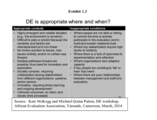
DE isn’t appropriate for every situation. So, when we suggest that a client or community undertakes a developmental evaluation, we begin by jointly assessing appropriateness and readiness.
Rad Resource: Differentiate appropriate from inappropriate DE situations.
Hot Tip: Readiness extends to evaluators. Developmental evaluators need a deep and diverse methodological toolkit and the ability to be methodologically agile.
Hot Tip: Be prepared to use multiple methods from different disciplines, contexts and cultures, and to be adept enough to develop and adapt methods and approaches to work better in different contexts.
Hot Tip: Know and practice the three DE dispositions.
Embrace unknowability so as to be comfortable about not knowing in advance a sure destination, or known pathway to tread; acknowledge risks and go anyway.
Develop an enquiring mindset, where the DE evaluator and others in the innovation team are open to possibilities, multiple perspectives, puzzles and learning.
Be ready to persevere, to begin an unknown journey and stick with it.
Hot Tip: DE is relational - alignment of values is essential
Alignment of values (the initiative and the DE evaluator) is essential for a DE journey; it’s shared values and trust that create the glue that holds people in relationship with each other.
Hot Tip: Readiness applies to both organizations engaged in innovation and developmental evaluators. Look for readiness alignment.
Rad Resource: Organizational readiness aligned with evaluator readiness
Cool Trick: Be honest that DE can be hard, is not appropriate for every situation, requires readiness and perseverance, and sometimes even courage.
The American Evaluation Association is celebrating Developmental Evaluation Week. The contributions all this week to aea365 come from evaluators who do developmental evaluation. Do you have questions, concerns, kudos, or content to extend this aea365 contribution? Please add them in the comments section for this post on the aea365 webpage so that we may enrich our community of practice. Would you like to submit an aea365 Tip? Please send a note of interest to aea365@eval.org. aea365 is sponsored by the American Evaluation Association and provides a Tip-a-Day by and for evaluators.
Related posts:
Developmental Eval Week: Michael Quinn Patton on Developmental Evaluation Principles
DE Week: Kate McKegg and Nan Wehipeihana on Talking to Clients and Communities about Developmental Evaluation
DE Week: Homeless Youth Collaborative on Developmental Evaluation
AEA365
.
Blog
.
<span class='date ' tip=''><i class='icon-time'></i> Jul 27, 2015 12:38pm</span>
|
|
Recently my colleagues and I were discussing the ‘old days’. Several memories came back to us. They included having only 2-3 channels on the TV, and for some of us old enough to remember color vs. black & white screens. At the time there was no remote control, progressing to today where we have too many on the coffee table. Now we have access to any show, any time, streaming anywhere we want.
Banking was more difficult than today. Back then the only way to conduct business was with a human at a branch. Then came the ATM which revolutionized self service. Now we have on-line capabilities to pay on demand and schedule payments on a recurring basis, eliminating the requirement to involve human activities.
Letters turned to faxes, faxes turned to emails, emails are now being taken over by texts, Skype and other IM software.
We’ve come along way since those days, and technology continues to improve our lives. The same can be done for automating your operations. The back office of Health Plans has volumes of repetitive work to be completed in Claims and Enrollment. In most cases today, this work is all manual. With the increasing volume due to ACA many plans are being forced to pay significant overtime or outsource more work. Due to this demand new people make mistakes and those easy tasks turn into more rework events. It is time to evolve in the back office much like the TV and banking.
Robotic Process Automation (RPA) has improved the first pass rates of insurance companies in astounding numbers. One customer saw their auto adjudication increased from 77% to 92.4% in just a few years. They are saving millions annually by controlling labor costs. Because robots work 24 hours they are processing more claims per day. Large or small firms producing repetitive work can benefit from RPA by augmenting with Robots. Imagine what that could mean in your organization.
When you think about all that technology has done for us in our personal lives, why not improve our corporate lives too? It’s worth looking into automation, analysis and overall improvement of your organization.
http://workiq.com/wiq_automation.jsp
The post We’ve come a long way appeared first on WorkiQ Blog.
WORKIQ
.
Blog
.
<span class='date ' tip=''><i class='icon-time'></i> Jul 27, 2015 12:38pm</span>
|
|
Overview
You are developing a user interface for SharePoint 2007/2010/2013 (Tested against 2013). You have radio button options in your interface such as below and want to show some indicator when selected such as highlight with the color selected.
Implementation:
Using jQuery UI library and by applying "buttonset()" and "button()" functions, you can transform the radio buttons like described in the overview above.
In your page you may have below HTML or ASP.NET Control:
<div id="jQUIRadioSet">
<input type="radio" id="jQUIRadio1″ name="jQUIRadio" value="Red" /><label for="jQUIRadio1″>Red</label>
<input type="radio" id="jQUIRadio2″ name="jQUIRadio" value="Green" checked="checked" /><label for="jQUIRadio2″>Green</label>
<input type="radio" id="jQUIRadio3″ name="jQUIRadio" value="Yellow" /><label for="jQUIRadio3″>Yellow</label>
</div>
<div id="jQUIRadioSet">
<asp:RadioButtonList ID="jQUIRadio" runat="server" RepeatColumns="3″ RepeatDirection="Horizontal">
<asp:ListItem Text="Red" Value="Red"></asp:ListItem>
<asp:ListItem Text="Yellow" Value="Yellow"></asp:ListItem>
<asp:ListItem Text="Green" Value="Green"></asp:ListItem>
</asp:RadioButtonList>
</div>
Add jQuery UI Script and CSS Reference:
<link type="text/css" rel="stylesheet" href="http://code.jquery.com/ui/1.10.4/themes/start/jquery-ui.css" />
<script type="text/javascript" src="http://code.jquery.com/jquery-1.9.1.js"></script>
<script type="text/javascript" src="http://code.jquery.com/ui/1.10.4/jquery-ui.js"></script>
Include below Custom Script to your page:
<script type="text/javascript">
$(function () {
/***Radio Set***/
$("#jQUIRadioSet").buttonset();
jQUIRadioFormat();
$("input[id*='jQUIRadio']").click(function (e) {
jQUIRadioFormat();
});
function jQUIRadioFormat() {
var radioOffIcon = { primary: ‘ui-icon-radio-off’, secondary: null };
var radioOnIcon = { primary: ‘ui-icon-circle-check’, secondary: null };
$("input[id*='jQUIRadio']").each(function (index) {
if ($(this).is(‘:checked’)) {
$(this).button({ icons: radioOnIcon });
$("label[for='" + $(this).attr("id") + "']").css(‘background’, $(this).val());
}
else {
$(this).button({ icons: radioOffIcon });
$("label[for='" + $(this).attr("id") + "']").removeAttr("style");
}
});
}
/***End of Radio Set***/
});
</script>
That’s it! Hope this helps.
Netwoven
.
Blog
.
<span class='date ' tip=''><i class='icon-time'></i> Jul 27, 2015 12:37pm</span>
|
|
OpenConnect has introduced new advanced training packages that enable our customers to maximize the value of their WorkiQ investments.
WorkiQ, the first desktop analytics suite designed specifically to measure back office operational intelligence, is fast becoming a standard in claims, enrollment, and membership in the largest Health Plans in North America. Our customers are seeing, on average, a 3-5 month payback in savings and productivity efficiencies.
The new advanced training programs are designed to support growth into new teams or business units, enhancing the usage of the data through new reports and dashboards. The training is provided either on-site at a customer location or it can be delivered virtually for remote teams. Below is a brief description of the new courses.
WorkiQ Advanced IT Training (1 day)
The Advanced IT Training provides more in-depth server maintenance and troubleshooting tips including database queries and health checks.
WorkiQ Advanced Admin Training (1 day)
The Advanced Administration Training goes deeper into employee management and trouble-shooting, covering license management, Gatherer status checks and using Gatherer Groups to separate Gatherers for troubleshooting or testing new features.
WorkiQ Advanced Report Training (1 day)
The Advanced Report Training takes WorkiQ reporting to a new level, with instructions on how to add external reports and build custom web pages that can be displayed through WorkiQ, as well as tips on using the Chart Wizard and Datasets.
WorkiQ Mentoring (1 day)
WorkiQ Mentoring can be used for more personalized, one-on-one training on any topic or area of WorkiQ.
WorkiQ Process Training (1 day)
Process Training teaches WorkiQ Administrators how to define and implement Processes and view the results of the Process Data through WorkiQ reports. Process Training includes use of the Desktop Designer - WorkiQ’s tool for designing panels for Processes.
If your organization is ready to enhance your usage and knowledge of WorkiQ, please contact your Account Executive for pricing and availability.
The post Advanced WorkiQ Training appeared first on WorkiQ Blog.
WORKIQ
.
Blog
.
<span class='date ' tip=''><i class='icon-time'></i> Jul 27, 2015 12:37pm</span>
|
|
As everyone knows, SCOTUS ruled 5 to 4 that same sex couples have a constitutional right to marry. The full case is cited below. The opinion is consistent with the growing support for (or at least acceptance of) same sex marriage. I spent Friday reading social media postings, including tweets. There were strongly felt emotions expressed on both sides of the issue. These conversations will not end on social media this weekend. They will spill into workplaces next week and for the indefinite future. It is not practical nor desirable to prohibit such discussions. Indeed, because of the connection...
SHRM
.
Blog
.
<span class='date ' tip=''><i class='icon-time'></i> Jul 27, 2015 12:37pm</span>
|
|
I’m Nan Wehipeihana, a member of the Kinnect Group in New Zealand and co-editor of a forthcoming book on Developmental Evaluation Exemplars. I want to share what we have learned about roles and responsibilities in Developmental Evaluation (DE) by reviewing the reflective practice experiences of DE practitioners.
Hot Tip: Understand the implications of DE being embedded in innovative and complex situations. This means:
Evaluative advice is ongoing, iterative, rapid and adaptive.
The evaluator can expect to work closely and collaboratively on the development of the innovation as well as the evaluation.
The DE evaluator will play a number of roles and innovators will become evaluators.
The tools and approaches the DE evaluator will draw on will come from many fields and disciplines.
Hot Tip: Because DE is collaborative, it is fundamentally relationship-based. This makes clarity about roles and responsibilities essential.
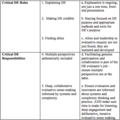
Rad Resource: Know and practice 5 critical DE roles and responsibilities:
Hot Tip: Four practice-based ways of building the credibility and utility of DE
Identify, develop, and use an inquiry organizing framework.
Layer and align data with the organizing framework.
Time data collection, reporting and sense making to meet the needs of key stakeholders
Engage in values based collaborative sense making
Cool Tricks: Effective and experienced DE practitioners do the following:
Place priority on deep understanding of the context
Appreciate the varying needs of different stakeholders in relation to the innovation
Build and nurture relational trust between the evaluator and the social innovators and funders
Build a deep well of evaluation and methodological experience
Maintain clarity of purpose - supporting innovation development and adaptation
The American Evaluation Association is celebrating Developmental Evaluation Week. The contributions all this week to aea365 come from evaluators who do developmental evaluation. Do you have questions, concerns, kudos, or content to extend this aea365 contribution? Please add them in the comments section for this post on the aea365 webpage so that we may enrich our community of practice. Would you like to submit an aea365 Tip? Please send a note of interest to aea365@eval.org. aea365 is sponsored by the American Evaluation Association and provides a Tip-a-Day by and for evaluators.
Related posts:
Developmental Eval Week: Michael Quinn Patton on Developmental Evaluation Principles
Michael Quinn Patton on Developmental Evaluation
Kirk Knestis on How Evaluators can Help Clients with Proposals in an Innovation Research and Development (R&D) Paradigm
AEA365
.
Blog
.
<span class='date ' tip=''><i class='icon-time'></i> Jul 27, 2015 12:36pm</span>
|
|
This blog is part of the following series:
Installing and configuring the Lotus Domino Server - Part 1
Search Lotus Notes Documents from SharePoint 2013 - Part 2
Search Lotus Notes Documents from SharePoint 2013 - Part 3
Overview
Recently I was installing the latest Lotus Domino Server 9 for my development work and wanted to share the steps here. I have used a Windows 2008 Server R2.
You can download the trial version of Domino Server 9 before starting the installation.
Steps
Step 1: Start by installing the Lotus Domino server on server1.
This is the executable file we are now going to install. Double click and start
Step 2: Accept the defaults and click Next. The files are now being extracted for installation.
Step 3: The install wizard has now started. Click Next to advance to the following screen.
Step 4: Click Next to Continue
Step 5: Enter the Domino server program files File path. I am changing it to another folder.
Step 6: The path where the data files get installed is now directing the new path. Accept and continue.
Step 7: Choose the Enterprise server from the options given.
Step 8: A screen is now displayed that shows the choices made. After this the actual installation starts.
Step 9: Now we wait for the installation to finish.
Step 10: Lotus Domino server is now installed.
Step 11: We now see 2 icons after the installation is complete on the Desktop of the server. First one is Domino console. 2nd one is the Actual Domino Server. Now we are going to start the Domino Server.
Click the server icon and continue.
Step 12: Start Domino Server configuration
The next screen provides 2 options:
Setup the first server or a standalone server
Setup an additional server
This is our first time installation, so we are choosing "Setup the first server or a standalone server". Click next to continue.
Click Next to continue
Enter the server name as "Domino2". So this server is going to be named Domino2/<name>. The <name> part will be filled in later. Click next to continue.
This screen is one of the most important screens in configuring a Notes/Domino environment. This will also give a file (cert.id) and the password.
Enter Domino Domain Name. We are giving the Organization name here, but it can be random.
Click Next to continue
In this screen we’ll register an administrator account. Here I am going to enter my name, but it can be any user, just make sure that it is a "unique" name
We’ll also save a local copy of this ID file, as we will use that later on. Click Next to continue.
The next screen allows us to enable/disable various services we want to load on our server. We’ll uncheck all for now and click Customize.
Click Cancel, and continue with Next in the previous screen.
We can configure the network settings from this screen. Make sure the hostname listed is ping-able on both the server and all clients in the network. Click on customize to configure this.
Enter the hostname in both highlighted fields and click on Ok to close the dialog.
Click Next to advance to the next screen.
Accept the defaults in this screen, as it increases the standard security level.
Review your settings and click Setup to continue the configuration setup.
Wait until this process completes.
Congratulations, the installation has now been completed.
We now have 3 very important files that are the base of a Lotus Domino environment.
The Certifier ID (cert.id)
The Server ID (server.id)
The Administrator ID (admin.id)
These files should be kept safe at all times, as they will allow you to do all the interesting things.
Start Domino Server. Double click the Lotus Domino server icon on the Desktop.
When you click that, you’ll get the following prompt.
The following screen display’s:
We choose "Start Domino as a Windows service" and we check both checkboxes at "Always start Domino as a service at system startup" and "don’t ask me again" before clicking OK.
The server now started in the background, so we double click the "Lotus Domino Console" icon on the desktop. When you click that, you’ll get the following prompt :
The Lotus Domino Console application lets you view the Lotus Domino server console, and here we are allowed type in commands directly on the server.
Now your Domino server is ready. Next step is to install a Lotus note Client.
Note: if you want to run your Domino server as a web server, type the command "load http" and send in the Domino Console.
Looking forward to your comments and questions!
Netwoven
.
Blog
.
<span class='date ' tip=''><i class='icon-time'></i> Jul 27, 2015 12:36pm</span>
|
|
Hi, I’m Nora F. Murphy, a developmental evaluator and co-founder of TerraLuna Collaborative. Qualitative Methods have been a critical component of every developmental evaluation I have been a part of. Over the years I’ve learned a few tricks about making qualitative methods work in a developmental evaluation context.
Hot Tip: Apply systems thinking. When using developmental evaluation to support systems change it’s important to apply systems thinking. When thinking about the evaluation’s design and methods I am always asking: Where are we drawing the boundaries in this system? Whose perspectives are we seeking to understand? What are the important inter-relationships to explain? And who benefits or is excluded by the methods that I choose? Qualitative methods can be time and resource intensive and we can’t understand everything about systems change. But it’s important, from a methodological and ethical perspective to be intentional about where we draw the boundaries, whose perspectives we include, and which inter-relationships we explore.
Hot Tip: Practice flexible budgeting. I typically budget for qualitative inquiry but create the space to negotiate the details of that inquiry. In one project I budgeted for qualitative inquiry that would commence six months after the contract was finalized. It was too early to know how strategy would develop and what qualitative method would best for learning about the developing strategy. In the end we applied systems thinking and conducted case studies that looked at the developing strategy in three ways: from the perspective of individual educators’ transformation, from the perspective educators participating in school change, and from the perspective of school leaders leading school change. It would have been impossible to predict that this was the right inquiry for the project at the time the budget was developed.
Hot Tip: Think in layers. The pace of developmental evaluations can be quick and there is a need for timely data and spotting patterns as they emerge. But often there is a need for a deeper look at what is developing using a method that takes more time. So I think in layers. With the case studies, for example, we structured the post-interview memos so they can be used with program developer to spot emergent patterns by framing memos around pattern surfacing questions such as: "I was surprised… A new concept for me was… This reinforced for me… I’m wondering…" The second layer was sharing individual case studies. The third layer was the cross-analysis that surfaced deeper themes. Throughout we engaged various groups of stakeholders in the meaning making and pattern spotting.
Rad Resources:
Patton, M.Q. (2015) Qualitative Research and Evaluation methods, 4th Sage Publications.
An upcoming book Developmental Evaluation Exemplars edited by Michael Quinn Patton, Kate McKegg and Nan Wehipeihana. (The book will be out in September.)
Hargreaves, M. (2010). Evaluating System Change: A Planning Guide
AEA 356 Systems Week: Bob Williams on A Systems Practitioner’s Journey
The American Evaluation Association is celebrating Developmental Evaluation Week. The contributions all this week to aea365 come from evaluators who do developmental evaluation. Do you have questions, concerns, kudos, or content to extend this aea365 contribution? Please add them in the comments section for this post on the aea365 webpage so that we may enrich our community of practice. Would you like to submit an aea365 Tip? Please send a note of interest to aea365@eval.org. aea365 is sponsored by the American Evaluation Association and provides a Tip-a-Day by and for evaluators.
Related posts:
Wilder Research Week: Caryn Mohr on Case Studies
EdEval Week: Krista Collins and Chad Green on Designing Evaluations with the Whole Child in Mind
QUAL Eval Week: Leslie Goodyear, Jennifer Jewiss, Janet Usinger, and Eric Barela on The Role of Context in Qualitative Evaluation
AEA365
.
Blog
.
<span class='date ' tip=''><i class='icon-time'></i> Jul 27, 2015 12:36pm</span>
|
|
Yesterday, we kicked off our 2015 Annual Conference and Exposition. More than 15,000 HR professionals are in Las Vegas this week to focus on how our careers, our organizations and our profession can thrive. I shared my belief that we are in the decade of human capital, a time when talent is seen as the real power behind business and organizations draw clear, straighter lines between the success of their people strategies and their business success. Many...
SHRM
.
Blog
.
<span class='date ' tip=''><i class='icon-time'></i> Jul 27, 2015 12:35pm</span>
|