Blogs
|
3 Simple Strategies To Integrate Technology Into Any Lesson
by Sandra L. Love, Ed.D., mentoringminds.com
In today’s classroom, we have moved beyond teaching reading, writing and mathematics through rote memorization.
We must push students to dig deeper and ask clear, thoughtful questions so they build the critical thinking skills essential for success in school, college and life. Technology has played a huge role in the development of the modern classroom, progressing from something that’s "cool" or "different" to a key piece of the critical thinking puzzle.
While technology is an important part of the education equation, it doesn’t tell the whole story. Teachers play a bigger role than ever in developing an engaging well-rounded curriculum, though integrating technology into the mix presents its own unique set of challenges. Many teachers have been reluctant to replace their print materials due to cost and dissatisfaction with the available digital options. According to the MDR 2014 State of the K-12 Market Report, there’s a growing demand for solutions that improve teaching and personalized learning and educators are willing to consider new instructional models.
So, how do we build an engaging curriculum based on the components of critical thinking, while incorporating technology into the mix - without sacrificing the basics? Here are a few simple tips to integrate technology into almost any lesson.
3 Strategies To Integrate Technology Into Any Lesson
1. Think Visually-Or Help Students To Do So
There is a wealth of free programs that allow students to incorporate visuals into their class work.
For example, programs like Easel.ly can be used to create infographics to enhance history papers or scientific experiments. Animoto, a video program that turns your pictures into video, can be used to create book reviews or book trailers, which can transform an ordinary book report, essay, math project, or art portfolio pice into a fun and engaging multimedia experience. Technology is nothing is not visual.
2. Blog All About It-Before, During, & After Learning
Journaling is a classic critical thinking instructional strategy that helps students independently deliberate on a teacher-prompted topic.
Developing a class blog takes the practice of journaling one step further by fostering collaboration and teamwork. It allows students to think critically about their own learning process, while encouraging interpersonal, group learning and communications skills. Taking pictures during field trips and blogging about the experience, or documenting an in-class or school wide project such as a science or an art fair are authentic experiences that excite students about the process and spur them to examine these projects in a different light.
Whether a writing piece is used to make predictions, assess background knowledge, create the "gradeable" product of the lesson, used to reflect on the learning process, or even a metacognitive survey of their own thinking throughout the activity/lesson/unit, blogging is a simple way to inject technology into any lesson. Tumblr is an extremely versatile tool for student blogging. Other options include WordPress and Blogger.
(If you’re interested in the neurological benefit of "basic" cognitive actions like prediction and reflection, see 5 Teaching Strategies To Keep Students From Turning Off Their Brains.)
3. Integrate Social Media-For Focused Student Interacting Or To Publish Student Work
Facebook, Twitter, Instagram, Pinterest - there is an abundance of social media options available and students seem to be interacting with all of them.
Social media can be used to publish student work, promote peer-to-peer interactions, or anchor project-based learning activities in "closed-circuit" or public digital spaces.
The exciting thing about social media is that it can be adapted into a fun and unique learning tool as well. Create photo contests using Instagram and Facebook. Utilize Twitter to play word games or scavenger hunts and to create newsfeeds on particular subjects like political elections or breaking news stories. Allow multiple students to collaborate and create research boards where they pin articles and other ideas through Pinterest. The possibilities are infinite.
Dr. Sandra Love is Director of Education Insight and Research at Mentoring Minds, a national publisher of K-12 critical thinking educational resources. The company recently launched Total Motivation™, a standards-aligned, supplemental curriculum, delivered in a groundbreaking combined print-and-online solution, meaning "You Get Both" for the same price. This new instructional solution ensures teachers and students have access to high-quality content to help students meet rigorous standards and effectively build individual critical thinking skills. For more information about Mentoring Minds and its educational resources, call 800-585-5258 or visit mentoringminds.com; image attribution flickr user flickeringbrad
The post 3 Simple Strategies To Integrate Technology Into Any Lesson appeared first on TeachThought.
TeachThought Blog
.
Blog
.
<span class='date ' tip=''><i class='icon-time'></i> Aug 05, 2015 09:02am</span>
|
|
There’s Value In A Non-Traditional Path To College
by Dawn Casey-Rowe, Teacher & Holder of Student Loan Debt
It’s that time of year again-college time.
You go to the mailbox. It’s the moment you’ve been waiting for your whole life. The one that parents and teachers tell you will determine the course of your very existence. You reach into the box. The thick letter means you got in, the thin number-ten business envelope is a sure sign of rejection. Your hand feels around in the dark. Bill, bill, junk mail…then, you see it. The thin envelope.
"We are sorry to inform you that…"
"After careful consideration…"
"Unfortunately…"
You’re eighteen, too old to cry. Your whole life is flashing before your eyes on one piece of recycled paper. Don’t despair! Let’s flip this equation, shall we? Could it be that rejection isn’t that bad? That there is a fate far worse than rejection? "What’s worse than rejection?" you ask. After all, you’re the one holding the rejection letter-it’s all very well and good for some old teacher to say it’s not so bad.
I’ll tell you what’s worse than rejection. Acceptance in the wrong place or by the wrong crowd is far worse than rejection. Just like the wrong crowd can get you into trouble, the wrong college can get you into a lifetime of unforgivable, unrecoverable debt.
Trust me on this-I see your financial aid packages. Some are fantastic, but others-not so much. Getting rejected feels terrible. Getting into a school you can’t afford is far worse. Getting into a school you think you can afford then trying to pay for it when you can’t is the financial kiss of death.
My high school teacher urged us not to pay overpay for college when we could get an equivalent education for close to free choice local universities. I hope you’ll listen better than me. I went to an expensive undergraduate school then switched careers and paid for 1.5 graduate degrees so I could teach.
I’m still paying off my last $15K. Will you be paying college loans at my age?
What does that financial aid package really mean?
Loans vs. grants. Grants are good. Loans must be paid back. An easy way to remember it is "g" grants equals "g" good. However, not all loans are created equal. Some are the key to affording a good quality education. Others are predatory in nature, meaning they suck the very life out of you, no different than a tapeworm or flea.
All loans carry interest. A good loan is a reasonable amount with a low rate of interest that is deferred until after you graduate. A bad loan is a ticking time bomb.
Many loans have interest that starts to accrue right away-hiding and compounding so that when you graduate, you owe a ton more than you borrowed. Some loans even need to be paid back as you attend college. That comes out of your ramen noodle fund-what student has money for that?
Parent loans. Many parents take parent loans and have students agree to pay the loans after graduation. These stay in the parent’s name and can ruin their chances of retiring to a tropical island if you can’t pay them back. Don’t bankrupt your parents-that’s not nice.
Work study. That guarantees you a job with a salary paid by the university. All my work study jobs were minimum wage on campus-things like the cafeteria, where I was the Sunday morning carver. I also worked in the bookstore. The advantage is that they’re close and they understand things like final exams. You can probably make more money off campus. I made three times the money waitressing.
Work is an opportunity cost-you have to look at time you spend working in terms of what other opportunities are out there if you hustle. Work study may not be to your benefit, but it’s listed on your financial aid package.
Live off campus: I looked at one girl’s loan package and noticed she had a scholarship for tuition, but not room and board. Everyone wants the college "experience," but room and board is really expensive. Would you be willing to give up some "experience" to get a solid education and keep yourself out of debt? This might be the difference between being able to afford college and really struggling after graduation to make those minimum loan payments-which can exceed a thousand dollars a month for expensive colleges.
What can you do about this?
Appeal. Sometimes your circumstances change or a college really wants you. It doesn’t hurt to call a financial aid counselor and say your family needs more assistance. There may be additional sources of funding they can award.
Go part time. I spoke with a girl looking at a high-priced technical institute for a specialty career. She had an internship during high school and wanted to stay with her company pretty much forever. My suggestion was to continuously take two courses at night and one each summer semester while working. Tons of people do this. You’ll sacrifice your social life, but graduating without debt will be worth it.
Ask your boss to pay. I had a job that paid for graduate school for employees-just not me. Nearly everyone got a law degree or an MBA. I wanted to a teaching degree.
"Sorry, Casey," said my boss. "That’s not related to this job. You’ll take it and leave." I pointed out everyone else was taking their law degrees and MBAs and leaving, and maybe I wanted to go into corporate training.
That didn’t work out for me-I should’ve taken the free MBA. A great many of my friends got to be lawyers and MBAs and go on to lucrative careers on the company dime. I got more college debt, which, as we discussed, is not wise.
A lot of companies have education benefits. Ask.
Consider the military. I recommend the military to my most motivated students-the ones who need expensive college for rocket science and medicine. If you qualify, the military will pay for your education and give you a cool job.
The Reserve Officers Training Corps is a program that accepts students on a four-year scholarship. You go to college as usual and fulfill your military requirements during the year. You’ll have a class, drill, activities, and usually a summer requirement. For this, you’ll be paid a stipend and your tuition is paid. Upon graduation, you are commissioned as an officer and serve a certain number of years depending on the job you take in the military. You can stay in or leave after your term is up. You leave college debt free, with a job and the chance to serve your country.
The National Guard also has education opportunities as does the active-duty military should you decide to enlist right after high school. You accrue money for your education or you can take classes while on active duty. The key is this-if they offer free classes, take them and knock them out of the park.
Log onto your computer and learn. There is literally nothing you cannot learn online. You can follow and connect with experts in your chosen online with places such as Twitter. You can take online courses at some of the best universities in the world.
There are so many careers out there that do not require a college degree-they require the ability to produce. Learn, do, then learn more. Surround yourself with a crowd inspires you and pushes you to learn more. You can be successful without college if you’re continuously learning and pushing yourself to be great.
So, what do I do now?
Go to Plan B. Take classes at a local school or start project "Log In and Learn." Get a job doing something you think you’ll love and evaluate it for a few years. Look at all the other possibilities around you. Research other cities you might like to experience and get a job somewhere you’ve never been before. Volunteer for six months doing something you feel passionate about. Write about everything you can write about in your pause to find your new path. Make a video diary. Put it up on YouTube. Do anything! Everything good that you do now adds to your future, which will be great, I promise you.
It might be even better than you imagined. Take that rejection letter and write, "I am going to rule the world," right there on the back. Write a list of dreams you hope to accomplish. Put the letter away for four years.
Go tackle #1 on the list. Come back to the letter and see if you are just a little bit happier than you would have been getting a bill for $250,000. Have you grown, progressed, and become a better person? Are you still on the positive path? Chances are you are and you have. And you have just a little bit more money in your pocket than your friends to show for it.
You have not suffered a fate far worse than rejection. You have traveled four years on the road to amazing.
Congratulations. That’s a job well done.
Adapted image attribution flickr user tulanepublicrelations; There’s Value In A Non-Traditional Path To College
The post There’s Value In A Non-Traditional Path To College appeared first on TeachThought.
TeachThought Blog
.
Blog
.
<span class='date ' tip=''><i class='icon-time'></i> Aug 05, 2015 09:01am</span>
|
|
An Index Of Online Courses For Teachers: Summer 2015
by Class Central
EDUCATION & TEACHING (29)
Powerful Tools for Teaching and Learning: Web 2.0 Tools
University of Houston System via Coursera
Go To Class | Next Session : 3rd May, 2015
Foundations of Teaching for Learning 5: Planning for Teaching and Learning
Commonwealth Education Trust via Coursera
Go To Class | Next Session : 4th May, 2015
A Beginner’s Guide to Writing in English for University Study
University of Reading via FutureLearn
Go To Class | ★★★★★ (3 ratings) | Next Session : 4th May, 2015
Instructional Design for Mobile Learning
via Canvas.net
Go To Class | Next Session : 4th May, 2015
Erasmus+ Funding Opportunities for Youth
SALTO-Youth via Canvas.net
Go To Class | Next Session : 4th May, 2015
Prior Learning Assessment for Educators and Industry
Colorado Community College System via Canvas.net
Go To Class | Next Session : 11th May, 2015
Foundations of Teaching for Learning 8: Developing Relationships
Commonwealth Education Trust via Coursera
Go To Class | Next Session : 11th May, 2015
Understanding IELTS: Techniques for English Language Tests
British Council via FutureLearn
Go To Class | Next Session : 11th May, 2015
Shaping the Way We Teach English, 2: Paths to Success in ELT
University of Oregon via Coursera
Go To Class | Next Session : 11th May, 2015
GSE3x: Introduction to Data Wise: A Collaborative Process to Improve Learning & Teaching
Harvard University via edX
Go To Class | Next Session : 12th May, 2015
CS.1x: Preparing for the AP* Computer Science A Exam — Part 1
Cooper Union via edX
Go To Class | Next Session : 13th May, 2015
Chem.1x: Preparing for the AP* Chemistry Exam - Part 1
Cooper Union via edX
Go To Class | Next Session : 13th May, 2015
Performance Assessment in the Virtual Classroom
University of California, Irvine via Coursera
Go To Class | Next Session : 18th May, 2015
ICT in Primary Education: Transforming children’s learning across the curriculum
University of London International Programmes via Coursera
Go To Class | Next Session : 26th May, 2015
TESS101x: Enhancing Teacher Education Through OER
Open Education Consortium (OEC) via edX
Go To Class | Next Session : 27th May, 2015
Instructional Methods in Health Professions Education
University of Michigan via Coursera
Go To Class | Next Session : 1st Jun, 2015
Foundations of Teaching for Learning 3: Learners and Learning
Commonwealth Education Trust via Coursera
Go To Class | Next Session : 8th Jun, 2015
Preparing for Uni
University of East Anglia via FutureLearn
Go To Class | ★★★★★ (2 ratings) | Next Session : 15th Jun, 2015
FLOW Education: Facilitating Learning through Outdoor Watershed Education
National Geographic Society via Coursera
Go To Class | Next Session : 17th Jun, 2015
Foundations of Teaching for Learning 6: Introduction to Student Assessment
Commonwealth Education Trust via Coursera
Go To Class | Next Session : 22nd Jun, 2015
Developing Your Research Project
University of Southampton via FutureLearn
Go To Class | Next Session : 22nd Jun, 2015
MechC101x: On-Ramp to AP* Physics C: Mechanics
Weston High School via edX
Go To Class | Next Session : 1st Jul, 2015
PFLC1x: On-Ramp to AP* French Language and Culture
Weston High School via edX
Go To Class | Next Session : 1st Jul, 2015
INQ101x: Teaching With Technology and Inquiry: An Open Course For Teachers
University of Toronto via edX
Go To Class | Next Session : 1st Jul, 2015
Foundations of Virtual Instruction
University of California, Irvine via Coursera
Go To Class | Next Session : 6th Jul, 2015
CS.2x: Preparing for the AP* Computer Science A Exam — Part 2
Cooper Union via edX
Go To Class | Next Session : 15th Jul, 2015
Chem.2x: Preparing for the AP* Chemistry Exam - Part 2
Cooper Union via edX
Go To Class | Next Session : 15th Jul, 2015
Tinkering Fundamentals: A Constructionist Approach to STEM Learning
Exploratorium via Coursera
Go To Class | Next Session : 22nd Jul, 2015
Emerging Trends & Technologies in the Virtual K-12 Classroom
University of California, Irvine via Coursera
Go To Class | Next Session : 17th Aug, 2015
Self-Paced Online Courses For Teacher
Designing an Exemplary Course
via CourseSites
Go To Class | Next Session : Self Paced
Instructional Ideas and Technology Tools for Online Success
via CourseSites
Go To Class | Next Session : Self Paced
Locating, Creating, Licensing and Utilizing OERs
State University of New York via CourseSites
Go To Class | Next Session : Self Paced
Universal Design and Accessibility for Online Learning
via CourseSites
Go To Class | Next Session : Self Paced
Knowledge Is Golden
IOC Athlete MOOC via Independent
Go To Class | Next Session : Self Paced
College Readiness Math MOOC
University of Wisconsin-La Crosse via Desire2Learn
Go To Class | Next Session : Self Paced
iTDI Summer School MOOC For English Teachers
International Teacher Development Institute via Independent
Go To Class | Next Session : Self Paced
Learn How to Play Chess
Chesscademy via Independent
Go To Class | Next Session : Self Paced
College Student Success
Tennessee Board of Regents via Desire2Learn
Go To Class | Next Session : Self Paced
Digital Badge: Rockets to the Rescue!
via Canvas.net
Go To Class | Next Session : Self Paced
Managing Behaviour for Learning
National Science Learning Centre via Canvas.net
Go To Class | Next Session : Self Paced
BlendedX: Blended Learning with edX
via edX
Go To Class | Next Session : Self Paced
Get Organized: How to be a Together Teacher
Relay Graduate School of Education via Coursera
Go To Class | Next Session : Self Paced
Applying to U.S. Universities
University of Pennsylvania via Coursera
Go To Class | ★★★☆☆ (2 ratings) | Next Session : Self Paced
Surviving Your Rookie Year of Teaching: 3 Key Ideas & High Leverage Techniques
Match Teacher Residency via Coursera
Go To Class | ★★★★★ (1 rating) | Next Session : Self Paced
Math Refresher Course
Utah Valley University via Canvas.net
Go To Class | Next Session : Self Paced
Art and Inquiry: Museum Teaching Strategies For Your Classroom
The Museum of Modern Art via Coursera
Go To Class | Next Session : Self Paced
The post An Index Of Online Courses For Teachers: Summer 2015 appeared first on TeachThought.
TeachThought Blog
.
Blog
.
<span class='date ' tip=''><i class='icon-time'></i> Aug 05, 2015 09:00am</span>
|
|
H&R Block Budget Challenge Awards Grand Prize Winner $120,000 in Scholarships
Properly managing personal finances is critical to success in adulthood, and yet teenagers are woefully under-educated and under-informed when it comes to money matters. In response to this nationwide shortcoming, H&R Block founded Dollars & Sense to provide teens with financial management skills that will last throughout adulthood.
Why the H&R Block Budget Challenge?
High schoolers are graduating without basic financial skills. As young adults, their first exposure to real-life situations can result in costly mistakes, overwhelming debt and an unstable financial future.
A recent study by H&R Block Dollars & Sense found that 57% of teens make purchases using their own money but only 17% maintain a budget. The H&R Block Budget Challenge is like a road test for financial management. Players learn how to time their student and auto loan payments, the consequences of being late on rent, how to stay under their credit limit and more, all through a 9-week online simulation.
"America’s teenagers need to learn and practice budgeting skills now so they can manage their personal finances later. The H&R Block Budget Challenge is unique because it allows students to learn by doing. But unlike the real world, all they have to lose is points - not their credit or hard-earned money," said Bill Cobb, president and chief executive officer of H&R Block.
How Did It Work?
Each student was given a job and salary. Then, each student set up accounts with a number of vendors from cell phone companies to cable providers. Throughout the simulation, bills arrived and students were challenged to figure out how to balance their paycheck and pay their bills, as well as contribute to their 401k plans. Scores were determined based on the amount in a student’s 401k, the ability to pay bills on time (fees detract from the score) and performance on short finance quizzes offered every few days.
Teachers were also given lesson plans and classroom materials to help educate and guide their class through the simulation.
The 2015 Winner: A Future Chemical Engineer
Sean Lawrence, a St. Clair, Michigan, high school senior, has won $120,000 in college scholarships as grand-prize winner of the H&R Block Budget Challenge — a teen financial literacy program that simulates an adult’s financial life and rewards students for mastering real-world financial decision-making.
Lawrence earned the $100,000 scholarship for having the most "real world ready" financial skills out of 93,980 high school students in 5,621 classrooms nationwide after participating in the 2014-2015 Budget Challenge program. He received an additional $20,000 scholarship for placing in the top 22 of his simulation, earning a total of $120,000 to apply toward his education.
Lawrence plans to study chemical engineering at Macomb Community College, Charter Township of Clinton, Michigan, for two years and then transfer to Western Michigan University. His future goals include working hard at a well-paying job, while investing in retirement and saving for a house and a car.
Reflecting on the knowledge that he and other teens have gained through the Budget Challenge, Lawrence said, "Learning about money management before going into the real world allows teens to make the right choices, or have the correct knowledge so they don’t end up as the typical American with mountains of debt."
Learning by doing approach
The H&R Block Budget Challenge uses a learn-by-doing educational approach that allows students to experience personal finance activities in the safety of a classroom, before heading out into the real world on their own. Participants play classroom against classroom and student against student, competing for $3 million in grants, scholarships and cash prizes.
"Our goal with The Budget Challenge is to arm teens with the personal finance skills and confidence they need to succeed when they’re out on their own. It’s an investment in American teens," said Cobb.
H&R Block awarded more than $3 million in grants, scholarships and prizes through the Budget Challenge in the 2014-2015 school year. Teachers who are interested in registering for the program can find details this August at www.hrblockdollarsandsense.com. For additional background on the program prior to open registration, please read this post for an introduction to the program.
The post H&R Block Budget Challenge Awards Grand Prize Winner $120,000 in Scholarships appeared first on TeachThought.
TeachThought Blog
.
Blog
.
<span class='date ' tip=''><i class='icon-time'></i> Aug 05, 2015 08:59am</span>
|
|
A Quick Summary Of The Theory Of Learning Curves
by Steve Wheeler, Associate Professor, Plymouth Institute of Education
This is number 9 in my series on learning theories. My intention is to work through the alphabet of psychologists and provide a brief overview of each theory, and how it can be applied in education. In the last post we examined Yrjö Engeström’s Second Generation Activity Theory and its applications to education. In this post, we explore the work of Hermann Ebbinghaus on memory and learning. This is a simplified interpretation of the theory, so if you wish to learn more, please read the associated literature.
The Theory Of Learning Curves
It should be noted that the work of Ebbinghaus is not regarded as a ‘theory’ of learning, but borrows quite heavily from behaviourist theory, as evidenced through the ‘drill and practice’ and reinforcement schedules he recommends. His studies can be considered to represent a ‘model’ or explanation of how memory functions.
We often hear people say they are ‘on a steep learning curve’. What they usually mean is that they have a lot to learn, not enough time to learn it in, or that they are finding it difficult. The term ‘learning curve‘ actually derives from the work of German psychologist Hermann Ebbinghaus, who studied memory and recall. In fact, he was probably the first psychologist to conduct experimental research into human memory. Ebbinghaus was interested in discovering why when we learn new information, it tends to fade away over a period of time. He referred to this as the forgetting curve and mapped it using graphs.
What he also discovered was that over time, if learning is rehearsed and repeated at regular intervals, we actually forget less. He also found that there is a spacing effect that influences how much we can recall over a period of time. The frequency of repetition and rehearsal, if spaced at intervals, promotes better recall of memory than if the information is presented in one long burst. When expressed statistically, the learning curve, if steep, represents a quick accumulation of knowledge, and rapid progress in learning expressed through recall from memory.
How It Can Be Applied To Education
Teachers know that content can be presented in a variety of sequences, but that some sequences are more effective than others. The reason for this is that some kinds of content are easier to remember than others, depending on their difficulty levels as well as their juxtaposition. Teachers should know that primacy recency effects are often present in the forgetting curve. This means that the first content that is presented in a lesson (primacy) and the most recent content that is presented (recency) are the most readily recalled by learners.
According to Ebbinghaus, difficult concepts should thus be presented first and then reiterated at the end of the lesson. For the more difficult content, regular revision over time can be more effective than a single mass delivery. What is even more effective is when the content is applied in authentic contexts, and where learners have the chance to rehearse and stregthen their recall. These opportunities can be built into a scheme of work, and applied during lessons.
When it comes to revising for an exam, the spacing effect comes into play. It is better to revise content over a longer period of time in the run up to an exam, than it is to do last minute ‘cramming’. Memory of information is more resilient if it is made meaningful by the learner.
Reference
Cherry, K. (2014) Forgetting: When memory fails. About.com Psychology. Available online at this link.
Previous posts in this series:
Anderson ACT-R Cognitive Architecture
Argyris Double Loop Learning
Bandura Social Learning Theory
Bruner Scaffolding Theory
Craik and Lockhart Levels of Processing
Csíkszentmihályi Flow Theory
Dewey Experiential Learning
Engeström Activity Theory
A Quick Summary Of The Theory Of Learning Curves by Steve Wheeler is licensed under a Creative Commons Attribution-NonCommercial-ShareAlike 3.0 Unported License.
This post first appeared on Steve’s personal blog; A Quick Summary Of The Theory Of Learning Curves
The post A Quick Summary Of The Theory Of Learning Curves appeared first on TeachThought.
TeachThought Blog
.
Blog
.
<span class='date ' tip=''><i class='icon-time'></i> Aug 05, 2015 08:59am</span>
|
|
TeachThought Is Looking For Interns. (Again.)
by TeachThought Staff
Every 6 months or so, we send out a call for interns.
These are unpaid positions where you get to do a mix of things-some fun and self-directed and open-ended; some small, some large. Some clerical. Mostly writing content.
It’s all fluid and sometimes rudderless and very millennial.
Each time, we receive more applications than we actually need, respond to a few that "feel" in our wheelhouse, and off we go. Three weeks later, most of the interns drop out because either they don’t have the time they hoped they might, or the experience is just not what they thought it would be. Which we get. You’re not paid, so it’s up to you to create your own "value"-not unlike a student in a self-directed learning environment.
But if you can? That’s where the good news comes in. The interns that stick with it find themselves with, at worst, strong resume fodder, and, at best, with job opportunities from connections or visibility from their internship. This means that, like clockwork, 6 months after we call for internships, they’re all gone-either back to the craziness of their normal lives, or enjoying a new opportunity that came (at least partly) as a result of their time here.
Ultimately, the idea of unpaid internships is polarizing-you’re either fine with it and want to learn and connect and do and see what’s what, or you wonder if "internship" isn’t a synonym for "free labor for some huge-and cheap-media conglomerate." This experience, like any other, you get out what you put in, which is why we’ve spent several paragraphs here contextualizing it all.
Requirements
At least some experience in education
A growth mindset
It’d be nice if…
Extensive experience in education
Strong writing and communication skills
An interest in technology
At least some graphic design experience
Benefits
Experience working with diverse projects
Opportunity to see how you do in a (mostly) self-directed professional environment
Chance to write on assigned topics, and/or topics you choose
Increased visibility (author boxes, social accounts, etc.)
Representative Tasks
Here are some examples of tasks you may encounter. Note, you don’t have to do all of these things. You may want to focus on writing, or research, or simply organizing local events. Or you may do some research, but mostly writing and graphic design. Not only is that acceptable, that’s ideal.
Write a post on personalized learning in digital spaces
Host a twitter chat
Edit content
Create a visual for teachers
Survey pertinent research
Write a post on blended learning in a mobile classroom
Organize a mini meet-up
Write a post collecting awesome digital literacy tools
Present at a conference
Write an eBook
Graphic design something (if you can do this, we have a honey-do list for you)
This position can be any of the above, or other ideas you bring to the table. Writing. Social Media. Writing. Graphic Design. Writing. Project planning. Writing. Conference presentations. Writing.
The Commitment
None. If you love it and find your groove, keep at it. If you don’t, stop. Life’s too short. Ideally, you’ll do awesome, and eventually find your dream job in education and 6 months from now, we’ll be putting out another call for interns. Which is awesome.
If this sounds like something you might be interested in, send us an email explaining why.
The post TeachThought Is Looking For Interns. (Again.) appeared first on TeachThought.
TeachThought Blog
.
Blog
.
<span class='date ' tip=''><i class='icon-time'></i> Aug 05, 2015 08:59am</span>
|
|
Simplifying Our Increasingly Complex Social Interactions
by Terry Heick
Preventing bullying is just as likely as preventing poverty, racism, or violence.
If we can start from this kind of humility, we may be able to improve our efficiency in dealing with and responding to it as a problem.
Of course, there is no "it." Bullying is an output and a symptom—the result of a variety of factors that manifest themselves well beyond the school. Celebration of aggressiveness and violence, pack mentalities, peer pressure, lack of empathy, violence at home, insecurity, social media, a lack of role models, and more all combine with scores of other factors to produce the ugliness that is bullying.
Technology has a way of amplifying our best and worst characteristics as people, and that is true with bullying—or cyberbullying—as well. Cyberbullying is just a digital layer added to what’s gone on for years in schools, on playgrounds, in workplaces, and even with professional athletes. In fact, there is now impressive nuance available when bullying through technology.
For one, there is the visibility and scale of it all. Make one comment on an Instagram thread, and every single person afterwards sees that comment, as well as any reply. Same with facebook, tumblr, and twitter if you dig a little. The snide comment in the hallway that was only heard by four of five people has been replaced by the snarky subtweet that has everybody taking screenshots.
Which brings us to the relative permanence of digital fare. Once it’s emailed, posted, liked, tagged, texted, or otherwise flung out into the digital ether, it’s "loose." Gone. No longer under the sender’s control. Social media is designed to make people seen and heard, which means it captures—and amplifies-everything. In fact, certain apps, like Snapchat, are built around this very idea of permanence vs impermanence as some kind of escape of accountability.
The New-Bullying: Passive Aggressive Social Media Behavior
And then there’s the nuance I mentioned, starting with passive-aggressive behavior that so many social media platforms seem designed for. The aforementioned subtweets, "sliding in and out of people’s ‘mentions’" on twitter, tagging—and more acutely, failing to tag people that very well "should’ve" been tagged, failing to respond to tags in a timely fashion, following and unfollowing, friending and defriending, and more all create an ecology that breeds bullying. Which brings up an interesting point: What does it mean to bully?
And more broadly, what kind of response makes sense to get closer to the roots of the problem?
Bully education should probably be a big part of it, in large part built around a clear, modern definition for bullying and all of its degrees.
Stopbullying.gov defines bullying as "unwanted, aggressive behavior among school aged children that involves a real or perceived power imbalance. The behavior is repeated, or has the potential to be repeated, over time." That’s not a very kid-friendly definition, so that’d be a good start—a definition for bullying that the people who have trouble understanding it can use. "Being mean to people that can’t or won’t defend themselves" may be too flimsy-sounding, but it’s clear.
Maybe some compelling and authentic examples, include passive-aggressive bullying? The iconic bully takes lunch money, grabbing pint-sized kids by their ankles, turning them upside down, and shaking out their change. Certainly this still happens, and it’d be a stretch to say "21st century bullying" is always digital. But updating how we define bullying, what it looks like, where it happens, and some basic strategies for response may be a good first step.
If nothing else, we might work to remove the stigma from being bullied. Everyone, at some point, has been bullied. There is no reason for shame. Which brings us to a key takeaway here—transparency. We can’t prevent bullying, but we can make it crystal clear that it:
Happens to everyone
Has varying degrees, behaviors, and host environments
Is not okay
Is correctable
Takes a village to correct
Highlighting the behaviors instead of demonizing the bullies themselves could be one strategy.
While there is some kind of justice in calling out and ridiculing bullies, that’s a lot like spanking kids for hitting, or sending lifelong criminals back to jail. Your reaction to any of this is a matter of personal philosophy and politics, but the big idea is to address the ecology that produces the problem, rather than playing whack-a-mole every time it surfaces. It’s not easy, but neither is spending two hours every morning responding to the previous evening’s middle school facebook blow-up.
The tone and terms of our social interactions are new, and require newly simplified thinking to understand.
Conclusion
Educators have taken many approaches to solving the problem of bullying, from making it "uncool" to bully, to scary punishments, to teaching tolerance. Tolerance is part of the issue, but even that starts with highlighting differences between people, and suggests that one "tolerate" the other.
"Stopping bullying"-and racism and sexism and dozens of other examples of how humans can be cruel to one another consistently enough to require a word for it-is impossible. It’s ambitious to try, but ambition is one of education’s biggest sins. As the frequency and anonymity of our interactions increase through digital tools, so does our capacity to bully in more subtle, passive-aggressive ways than ever before. This is not limited to children, either-you’ve probably felt it yourself on twitter or facebook or instagram or the comment’s section of a blog.
Digital citizenship first depends on citizenship-being a human being, then carrying that tone to digital spaces. We could do worse than helping students to reflect on these interactions (which would have the side-effect of slowing them down). Before each interaction, thinking about a few simple questions would change everything.
Who is this person?
What is their history?
How do we connect-how do our similarities and differences affect our feelings towards one another? How do our differences potentially strengthen our interaction?
How can I help them grow?
What do they need from me, and I from them?
This is digital citizenship in question form. As long as this kind of thinking is absurd, our capacity to hurt one another will be as well. The new thinking here, then, isn’t new at all, but rather reflects a need to return to that which is simple in the face of circumstances which seem complex.
A version of this post was written by Terry Heick for Edutopia; adapted image attribution flickr user vancouverfilmschool and usarmycoropofengineerssavannahdistrict; The Simple Terms To Manage Increasingly Complex Social Interactions
The post Simplifying Our Increasingly Complex Social Interactions appeared first on TeachThought.
TeachThought Blog
.
Blog
.
<span class='date ' tip=''><i class='icon-time'></i> Aug 05, 2015 08:59am</span>
|
|
A Universal Framework For Modern Literacy Pedagogy
by Terry Heick
Why do we need a framework?
Literacy instruction has done a relatively poor job of keeping up with the urgent pace of change in the ways people read and write.
What’s the big idea?
Media evolves. New modalities emerge. All media are connected. Scaffolding the analysis of these relationships can promote critical literacy of critical texts and related media forms. This can serve as a foundation for modern literacy.
Quick Background
The forms most commonly used to communicate (texts, emails, music, articles, video, and film) have increased the quantity of communication. (The cost to quality is subjective, but worth examining further.)
This may be creating a delineation between the "old" (e.g., a novel or poem or essay) and the "new" (e.g., an interactive graphic novel or tweet or video stream). Further, this obscures the connection that exists between all media forms-they all represent the need for humans to communicate-to hear others, and be heard themselves. As technology increases the tools available to meet this need, the communicate patterns may continue to become more nuanced and distinct. This risks cultural devaluation of that which is seen as "old" and unfamiliar.
A Definition for Modern Literacy: The ability to both create and extract communication through prevailing local media forms
A Definition for Modern Literacy Pedagogy: Helping students create and extract communication through prevailing local media forms
Media (plural form of medium): The forms we use as a culture to communicate ideas
Examples of "media forms": novels. video. social streams. blogs. books. poems. letters. essays. editorial cartoons. sketches. video games. music. paintings.
What about the simple…complex part?
The idea of the simple thinking about simple media->complex thinking about complex media spectrum is to first and foremost, make the analysis of any media form accessible in some way, shape, or form. Students needn’t be pushed to "think critically" about media forms-or their inherent themes-without being given strategies and practice to do so.
What are modalities?
The "things" that act as symbols in a given media.
A play? Stage presence, dialogue patterns, language, music, scenery, etc.
A poem? Line breaks, imagery, figurative language, etc.
A video game? Music, a digital avatar, light, a clear narrative, a character’s interactions with a hostile environment, etc.
The media form-in terms of its structure and modalities-is decentered in this framework.The focus is on the interpretation of the symbols-modalities of light and color and sound and text and moving image, for example-to clarify an author’s message, and then taking a tiered approach to extracting any complexity within.
In short, this is about seeing literacy as symbol decoding, seeing those symbols as modalities, and scaffolding the analysis of it all as a matter of medium/media design.
Stage 1: Simple think about simple media design
Example: In Looney Tunes, why does Wile E. Coyote chase the Road Runner?
Stage 2: Simple thinking about complex media design
Example: How do characters communicate in Shakespearean plays?
Stage 3: Complex thinking about simple media design
Example: What might we infer about Wile E. Coyote’s own interpretation of cultural norms? How does he adapt-or refuse to adapt-those norms through his observable behavior?
Stage 4: Complex thinking about complex media design
Example: How does Shakespeare use diction to establish a unique tone within each individual scene, and how do those scenes collectively establish a theme for the plays themselves?
A Handful of Underpinning Ideas
Literacy is a matter of decoding, comprehension, and transfer.
The traditional media forms of books, poems, letters, and speeches is increasingly supplemented by diverse and technology-based media.
There is a clear and direct relationship between a poem, an essay, a tweet, and a video game.
Understanding that relationship can help leverage modern digital technology and forms to interpret classical structures, and vice-versa.
Scaffolding the analysis of these forms and structures can make anything more approachable.
It can also provide opportunities for differentiation, self-directed learning, and extended critical thinking about critical media.
A Universal Framework For Modern Literacy Pedagogy
The post A Universal Framework For Modern Literacy Pedagogy appeared first on TeachThought.
TeachThought Blog
.
Blog
.
<span class='date ' tip=''><i class='icon-time'></i> Aug 05, 2015 08:58am</span>
|
|
4 Strategies To Recharge Your Teaching
by Paul Moss
The last month of teaching was quite hard for me.
I found myself becoming increasingly frustrated in the classroom, less tolerant, less friendly, and worst of all, sarcastic. As a result, I became utterly exhausted. Something needed to change. I needed to take a step back and reflect on what was happening. Why had things changed? Where had the love gone?
Had the students changed, or was it me? It was of course me. And it all came down to planning. My lessons were boring, and so students were naturally disconnected more often. Their attention waned easily, and inevitably, their behavior deteriorated. As I looked back over my planning, I saw a lot of attention given to addressing outcomes, but a distinct lack of focus on deep learning.
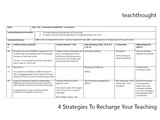
I decided to invest some time into designing a new lesson plan template, forcing me to explicitly incorporate into my planning elements that I know work, which engage students, and satisfy epistemology inherent in me, which is reflected in the image above. Each lesson must incorporate several strategies that I’ve used to recharge my teaching:
Constructivism
Movement
Collaboration
Differentiation
Constructivism: Who’s Making Meaning?
Does the learning activity encourage independent learning? Does it allow students to find the knowledge themselves, or am I giving it to them? Does it let them build upon existing knowledge by making connections? Does it involve some sort of inquiry, or problem where questions naturally and continually emerge, which leads to learning?
For me, constructivism is key to a successful learning environment. Students have a natural disposition to inquire, and lessons need to provide such opportunities. My teaching of late was lacking this. Rather, students were going through the motions, receiving information and being expected to apply it. The depth in the learning was missing because the students hadn’t fought for it themselves. They hadn’t discovered it for themselves; and so their connection to it was superficial.
In my planning now I ensure I am not only designing activities that promote independent thought, but that I also ask pertinent questions that initiate deep thinking. I also allow space for the likelihood of the lesson diverging from the track, realizing that that is the nature of constructivism. I think this is incredibly important: to honour that students’ interests will demand some veering from the path.
This doesn’t mean that the intended outcome can’t be reached. It just means that more time must be factored in, and the teacher must be skilled in promoting connections to bring it back to the original intention. The result is a deeper learning experience, as students have been engaged, and will have more ownership of their progress.
It’s about quality rather than quantity.
Interactivity: Do Students Move? Interact? With What, And Why?
To get students inquisitive, there needs to be suitable stimulus.
Interactivity is characterized by several elements, from the delivery method of the information, to the relevance of the learning. Explicitly planning for a variety of delivery is imperative. Everybody knows VAK, but so often I under-rate the importance of kineasthetic elements to an activity. And I don’t believe that writing is a sufficient kineasthetic activity. Students need to be physically active at some point in the lesson, whether it be moving around the room consulting other tables’ work, or adding ideas to a common board.
Even better is if students can learn about something through the body. For example, the other day in the Frankenstein unit I am teaching, to explore the idea of superficiality I had the students create and act out a short scene exploring the consequences of superficiality in a teen’s life. Yes it was messier than if I had just given them information, but every student now deeply understands the theme, as they learnt from their own and then their peers’ performances. This has now facilitated a deeper engagement in the text. Of course it’s a lot easier, and manageable, to ignore kineasthetic learning, but for so many students, it it is at the expense of engagement.
The learning at some point also needs to be relevant to the students. This can be achieved either through a thematic EQ (emotional intelligence) activity, a task based on interests, or a connection to a real world skill or application. I don’t care what anybody says: present students with boring resources, and the lesson will be poor.
Cooperation: Is There Collaboration?
Learning from peers is powerful, and helps strengthen constructivist experiences.
Often, students will seek their partner’s help to know what to do in a task, or to check if their learning is actually what was asked of them. Viewing a lesson back via video shows just how often this actually happens in a lesson, albeit surreptitiously, and rather than it being quashed, citing disruption as the rationale, let it flourish. Often, teachers try to quell such instances, demanding quiet, and individual learning, but by insisting on this at all times, valuable opportunities are foregone.
Students having opportunities to view others’ work from around the room is also effective. It’s one thing to know what the teacher is thinking, but knowing what their peers are thinking will spark greater stimulus as they relate, compete, challenge, and reshape their thinking - and deepen the learning experience. Social media is so pervasive in students’ lives because it satisfies these very elements. The massively untapped power of learning via social media will soon become a thing of the past, as teachers will begin to gain further access to existing platforms, and as new platforms aimed specifically at addressing safety for students and schools emerge.
Also, it is important to be aware of participation in class discussions. Lately, while some excellent conversations have occurred in my class, only the 5 or 6 participating in the discussion were engaged. The rest were not, and thus not learning. Asking questions and then getting students to discuss their thoughts with their partners, and then the table, encourages everyone to think, before the findings are offered to the class discussion. Kagan presents some very useful thinking and strategies in this area.
Differentiation: Just Enough, Just In Time, Just For Me
I focus on two aspects of this. Firstly, and obviously, is there a range of expectations in the task? Am I catering for all abilities, scaffolding certain tasks and providing increased challenge on demand? Have I consciously placed students on tables to maximize cooperative learning and to both push and support each other? Secondly, am I allowing and prompting variation in how students demonstrate their knowledge and understanding, or is everything written?
As an English teacher it can seem an overwhelming task to get students’ writing skills to the level required for exam success. However, when we only focus on such output, we deny students chances to deepen their engagement in the learning, and ironically, impede the development of the writing as students lose interest and connection with the subject. It takes a brave teacher to swim against the tide of teaching to the test, to trust that deeper engagement and a more well-rounded student will pay off in the long run (or swim).
But like you, in the name of progressive education, I will continue to do so.
Reflecting On My Own Journey
In hindsight, this last point was actually a significant reason for my disconnection over the last month.
I lost my spark for teaching momentarily. I lost sight of why I bother to spend 50 odd hours a week doing it. The learning was becoming prescriptive, narrow, sterile and shallow. My new lesson plan template however forces me to be more conscious of the things I value in my teaching. The template encourages deeper learning, deeper engagement, and inevitably, deeper satisfaction. Even in the last few lessons where I’ve been using it, I feel re-energized, and refreshed. I am indeed back in business.
The post 4 Strategies To Recharge Your Teaching appeared first on TeachThought.
TeachThought Blog
.
Blog
.
<span class='date ' tip=''><i class='icon-time'></i> Aug 05, 2015 08:58am</span>
|
|
12 Rules Of Great Teaching
by Terry Heick
Recently, I’ve been thinking of the universal truths in teaching. Students should be first. Don’t always start planning with a standard. Questions matter more than answers. Trust is a currency of a human classroom.
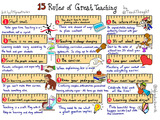
So I thought I’d gather twelve of them to start with. The idea of "good teaching" is an idea we get at a variety of different ways, So then, here are some rules we might consider when making sense of this idea of what makes a teacher great. Thanks to Sylvia Duckworth for the great illustration, who went all out and added all 15.
1. Start small.
This is how great things are built. Curriculum. Relationships. Portfolios. Take your time-this is a marathon, not a sprint.
2. Embrace that there is no one way.
Learning models, for example, are the new teaching strategy.
Traditionally, teachers focus on "strategies" to "teach." Reciprocal teaching. Lit circles. Accountable talk. Of course, these have value.
But the modern approach should have as much to do with what students access, when, how, and why as it does with "what students do in the lesson." Self-directed learning. Scenario-based learning. Project-based learning. Inquiry-based learning. Game-based learning. These are the strategies that matter first.
3. Trust the people around you.
Your students, first and foremost. But this goes for parents, and colleagues as well. It may not always work out the way you want, but if you’re the only one in control, there will be a net loss of capacity for the ecology of learning you participate in and serve.
4. In learning, curiosity is everything.
If you can’t make them curious, teach something else. I’ve theorized that there are stages to curiosity-and even things that make students curious. as well.
Taskmasters seek compliance. Good teachers seek engaged students. Great teachers-somehow, some way-find out what makes students click, and use it.
5. Experiment. Experiment. Experiment.
Teaching is a craft. Play with it. A little more of this, a little less of that. This new tool. Start here instead of there. Try this instead. Throw this out. Welcome this in.
Not only does this keep things fresh for students, but it keeps you sharp and relevant as an educator as this big world keeps on turning.
6. Don’t always start planning with a standard.
Know that it’s okay to think technology-first. Or curriculum first. Or standards. Or data. Or (ideally) student-first. There are dozens of ways to plan content. What matters is the power and sustainability of the learning as it manifests in the classroom.
7. Teaching is always changing.
Technology. Curriculum. Assessment. The value systems of students. Since these are always changing, your teaching be should as well.
8. Be concise.
When explaining, less is more.
9. Know your pedagogy.
Know the difference between confusing and complex. Between differentiation and personalized learning. Between project-based learning, and learning through projects. Between difficulty and rigor.
Between standards and curriculum. Between teaching and inquiry.
10. Help students ask great questions.
This can happen by modeling them, celebrating them, assigning points for them, curating and publishing them-whatever you can do to help students see what a great question implies. Here are 8 strategies to help students ask great questions, for starters.
11. Be interesting.
Be unpredictable. Challenge authority. Connect with students both through your teaching and in lieu of your teaching. Begin class with a bang-a crazy idea, interesting story, great song, funny joke. That said…
12. It’s not about you.
So don’t be the center of attention. Charismatic teachers are great-everybody loves them-but if your voice and personality dominate the classroom on a daily basis, things are out of balance.
Bonus
Here are 3 more to consider.
13. Love your content.
Stay up-to-date on changes. Be aware of the tricks, shortcuts, and interesting quirks of the content you teach. While teaching isn’t about content, mastery here can make everything else easier.
14. Be your students’ biggest cheerleader.
The be-tough-for-their-own-good bit may work for some, but celebrating kids works for everybody.
15. Know that learning should disrupt. (Read more here.)
Knowledge gained should result in personal change rather than mere academic progress. It should result in personal change for each student-and thus social change for all of us as a society.
If we build great schools and fill them with great technology and great teachers, but still send students home with no hope for the future-home to communities full of poverty, racism, intolerance, greed, waste, and apathy toward local ecologies, with no sense of place, historical legacy, or local and digital citizenship, then we know we have an institutionally-centered system.
When beautiful things happen-things we never could’ve imagined-both inside and outside the classroom, we’ll know we’re headed in the right direction.
12 Rules Of Great Teaching; image attribution flickr user flickeringbrad
The post 12 Rules Of Great Teaching appeared first on TeachThought.
TeachThought Blog
.
Blog
.
<span class='date ' tip=''><i class='icon-time'></i> Aug 05, 2015 08:58am</span>
|