Blogs
|
No Student Is Unreachable
by Jeffrey Benson
As an educational elder with a lot of experience working with challenging students, I am often asked to consult to school teams.
Recently a dedicated school counselor discussed with me Garrett, an 8th graders, saying, "He’s really depressed, completely shut-down. He does no work. His dad doesn’t follow through on getting him to therapy, or to try medication. Garrett gets nothing done and doesn’t seem to care at all."
We chatted about ways to support Garrett’s father, and the difficulty of hanging in while witnessing a student who is so shut-down. "It’s hard to see him fail each day. All he wants to do is work with Mr. B, the teacher in the robotics lab."
Whoa, that’s not a completely shut-down kid!
Our conversation then pivoted to the fact that Garrett had an interest (!) and a person at school whom he wanted to be with. We brainstormed ways the school could alter Garrett’s schedule so that he had more contact with Mr. B. The contact wouldn’t have to be earned, because kids shouldn’t have to earn something that they really need; Garrett needed time with Mr. B and robotics as much as a typical student needed to be in social studies.
Being with Mr. B in the robotics lab wasn’t a cure—it was a way to get traction with Garrett and for Garrett to construct a more positive image of himself in a world which he could barely abide. This is not an uncommon scenario: teachers describe, often with great compassion, all the ways a student struggles, all the things the student cannot do that age-typical peers are doing.
"Spend as much time describing what the child can do as what the child can’t do."
When I hear these stories I too become shut-down; I am disabled by all the disabilities. It is as if I have been handed a trash bag filled with broken tools and smashed up parts and told to get to work.
Then I remember to request: Please tell me anything and everything this child can do.
The struggles of children who are challenging (often victims of exploited communities, neglect, and abuse) are so heart-breaking and extreme. As professionals we need to share our stories and vent our feelings. Equally important, as teaching professionals, we need to build, and for that we need every possible tool and working part in the child.
No Student Is Unreachable: 4 Strategies To Reach Students That Don’t (Seem To) Want To Be Reached
To counter our inclination to get overwhelmed by the disabilities and short-comings, I recommend the following steps for establishing a consistent framework anytime your school focuses on challenging students, whether in a case conference, child-study team, IEP meeting, or more informal conversation.
1. Spend as much time describing what the child can do as what the child can’t do.
I suggest literally using a timer. The disability concerns tend to come with troubling stories; the ability side of the ledger tends to be a less-emotional list; e.g. "She likes to draw." What does she draw? When does she draw? Has anyone talked to her about her drawing? What sort of skills does her drawing demonstrate? Does anyone see anything else the child likes to do or shows an interest in?
2. Get everyone who works with the student into the conversation.
There have been innumerable times when the physical education teacher, or the wood shop teacher, describes a very different child—an engaged child- than the core academic teachers see. This is not a criticism of those teachers; it is more a window into the complexity of human development.
As with the story of Garrett, one of the other teachers may provide an "island of competence" that needs to be expanded, at least temporarily. These are the times we are protecting a child through a very hard time in life, when schools have to do their best to inflict no further harm. The time spent with those other teachers can insure that challenging students don’t experience each day in school as a continual reminder of their failures to thrive.
3. Analyze the student through specific skills embedded in all the multiple intelligences, but not necessarily evoked in the core curriculum.
While there is much discussion about the "debunking" of the "myth" of multiple intelligences, the fact of the matter is that multiple intelligences can provide a kind of framework to diversify and differentiate instruction for all students. For struggling and hesitant learners, differentiation and personalization can make all the difference.
Examples?
Linguistic—does the child understand puns and word play?
Logical/mathematical—does the child show ability playing board games?
Visual—does the child dress with any personal style?
Physical—does the child move gracefully across the room?
Musical—does the child know popular songs?
Interpersonal—does the child have friends, and if so, how is that initiated? Intrapersonal—does the child have ways to self-soothe?
Natural—how does the child talk about her pet?
The answer to all of these questions can allow the team to see the child through a richer set of lenses, and can lead to: a) very specific choices for engagement: "Tonya, we’ve got some new colorful markers you can use on the book report drawing;" b) opportunities to affirm the child and build connections through very simple observations: "Garrett, you wear the coolest hats. Tell me about them."
4. Swallow Your Pride
The quicker you can make it about them and not about you or content or grades, the quicker you’ll gain their trust and be able to reach them.
For this to work, however, it has to be authentic-not "I want your trust so you can get good grades and master standards," or even even "I care about your future." Rather, start with "I care about you, right here, right now, for no other reason than who you are."
Conclusion
Students who are challenging-i.e. victims of disruptive childhoods-do not change overnight. They grow. For many of them, that growth is dependent on grasping onto an extremely diminished set of possibilities, interests, and strengths. Ultimately they’ll have the best shot at a stable life by working from the things they are good at and the things they enjoy. We serve them best by spending as much time seeking and discussing their often fragile and submerged interests and capacities as we do their significant needs and disabilities.
In addition to TeachThought content on personalized learning, you can also visit ascd.org to find more resources for creating inclusive learning experiences.
Jeffrey Benson has worked in almost every school context in his 35 years as an educator, from elementary school through graduate programs. Benson’s book, Hanging In: Strategies for Teaching the Students Who Challenge Us Most (ASCD, 2014), shows educators the value of tenacity and building connections when teaching the students who most need our help. Connect with him on Twitter; edited by Terry Heick; No Student Is Unreachable: 4 Strategies To Reach Students That Don’t Seem To Want To Be Reached; image attribution flickr user vancouverfilmschool and usarmycorpofengineers
The post No Student Is Unreachable appeared first on TeachThought.
TeachThought Blog
.
Blog
.
<span class='date ' tip=''><i class='icon-time'></i> Aug 05, 2015 09:12am</span>
|
|
Acetaminophen Reduces Social Pain? The Physiology Of Bullying
by David Palank, Principal at San Miguel School in Washington D.C.
Study Abstract Summary
Pain, whether caused by physical injury or social rejection, is an inevitable part of life. These two types of pain-physical and social-may rely on some of the same behavioral and neural mechanisms that register pain-related affect. To the extent that these pain processes overlap, acetaminophen, a physical pain suppressant that acts through central (rather than peripheral) neural mechanisms, may also reduce behavioral and neural responses to social rejection. In two experiments, participants took acetaminophen or placebo daily for 3 weeks. Doses of acetaminophen reduced reports of social pain on a daily basis (Experiment 1). We used functional magnetic resonance imaging to measure participants’ brain activity (Experiment 2), and found that acetaminophen reduced neural responses to social rejection in brain regions previously associated with distress caused by social pain and the affective component of physical pain (dorsal anterior cingulate cortex, anterior insula). Thus, acetaminophen reduces behavioral and neural responses associated with the pain of social rejection, demonstrating substantial overlap between social and physical pain.
The Physiology Of Bullying
A student’s social status faces no bigger threat in schools than bullying.
In research, schools with a higher bullying rate, subsequently had lower scores on algebra, geography, earth science, biology, and world history. At first glance, bullying and academic achievement should not be related because one is academic and one is behavioral. This is not a coincidence. While bullying has taken the mainstream media by storm in recent years, the neuroscience behind what truly happens to students is usually absent from these reports.
Bullying is most detrimental to students when others stand by and do nothing while the harassment occurs. The brain perceives the bystanders as participating in the action because their lack of action is processed as a tacit endorsement of the bullying. On a psychological level, we think that bullies speak for everyone. We are wired to believe that if this person has socially rejected us, then the masses have rejected us.
Bullying is dangerous because social pain actually activates the same neural circuitry as physical pain. This means that the system in the brain that sends pain signals is hijacked when one is in social pain or is exposed to a social threat.
When you stub your toe, the pain is pretty much all you can think about for a few seconds. Pain may be considered a purely physiologically effect by some, but that would not explain the fact that we can use meditation and hypnosis to deter some of the effects of pain.
A 2011 study found that "After 4 days of mindfulness meditation training, meditating in the presence of noxious stimulation significantly reduced pain unpleasantness by 57% and pain intensity ratings by 40% when compared to rest." Therefore, pain must also be a psychological process. Banging your funny bone, elbow, toe, or other body part will decrease your ability to concentrate on anything else but that pain.
Pain and emotion are experienced at the same time in the brain. If we are in pain it invokes an emotional response (remember that our brains are wired to seek pleasure and avoid pain). The same concept applies to social pain Unfortunately, social pain can last a lot longer. Students, who were bullied on regular basis in middle school, had a much higher rate of suicide years later. Those who were bullied at age 8, were six times more likely to commit suicide by age 25.
The part of the brain that processes social pain is the Dorsal Anterior Cingulate Cortex (dACC). "Studies have suggested that the dorsal anterior cingulate cortex (dACC) is a key brain region involved in the detection of social exclusion." Removal of this part of the brain in rats resulted in the survival of only about 20% of their pups. This is due to the fact that they did not feel enough attachment to their pups to help them survive.
When part of the dACC was removed in patients with chronic pain, anxiety, and depression those in chronic pain still had pain. However, they claimed that the pain "didn’t bother them anymore." Using this logic, scientists wanted to see if painkillers would dampen social pain as well.
Social Rejection-And Tylenol?
Cyberball is a game designed by scientists to make the player (the research subject) feel rejected. One subject believes he or she is playing against two other players in a virtual video game. However, the subject is only playing against a computer. At first, all three players toss the ball to each other in turn. But at a certain point, the computer controlled players cut the poor research participant out of the game. They toss the ball just to each other.
Even though this is a silly game in a research study and has no bearing on real life, the research subjects reported (and brain scans showed) that they were really distressed, hurt and rejected. Even when then scientists told him it was not a human, but just a computer, his brain reacted the same way. This social rejection is so ingrained that even when we are told that it’s a not human, we feel the pain.
The most interesting part of the study is how their brains processed the social rejection. To the brain, social pain feels a lot like physical pain. The more rejected the participant said he or she felt, the more activity there was in the part of the brain that processes the distress of physical pain.
In a follow-up study, participants were called into the lab and, like last time, played Cyberball in the brain scanner. But this time, the researchers added a new variable. Before they came into the lab, half of them had taken Tylenol every day for three weeks while the other half had taken a placebo. What the researchers found in this study was remarkable: the placebo group felt just as rejected and pained as those in the initial study, but the people in the Tylenol group were immune to the social pain of feeling left out.
Social rejection is so central to our well-being that evolution decided that social pain is processed the same way as physical pain.
Social Pain, Rewards, and Consequences
Evolutionarily, the better we understand our social environment the better our lives became. Therefore, in students, social interest is no distraction, but it is actually the most important thing they can learn well. A person in pain has fewer cognitive and attentional resources at their disposal, and this is no different when it comes to social pain. This social pain can lead to a dramatic reduction not only in a student’s sense of well-being, but in their ability to learn, which creates a destructive cycle.
Teachers that do not allow social interaction are actively contributing to this pain. Disallowing social interaction is like telling someone that hasn’t eaten to turn off his or her desire to eat. The more that you allow for positive social interaction, the likelihood of social hunger being a distraction will inevitably decline.
It becomes a distraction to students because our bodies realize that social interaction is critical to survival.
You can visit David’s blog and look for his upcoming book, "Class Hacker."; Acetaminophen Reduces Social Pain? The Physiology Of Bullying; image attribution flickr user twentyfourstudents and cheriejoyful
1 Lieberman, M. (2013). Educating the Social Brain. In Social: Why our brains are wired to connect (p. 277). Broadway Books.
2 Zeidan, F., Martucci, K., Kraft, R., Gordon, N., Mchaffie, J., & Coghill, R. (2011). Brain Mechanisms Supporting the Modulation of
Pain by Mindfulness Meditation. Journal of Neuroscience, 31(36), 5540-5548.
3 Lieberman, M. (2013). Social: Why our brains are wired to connect (p. 69). Broadway Books
4 Kawamoto, T., Onoda, K., Nakashima, K., Nittono, H., Yamaguchi, S., & Ura, M. (2012). Is dorsal anterior cingulate cortex
activation in response to social exclusion due to expectancy violation? An fMRI study. Frontiers in Evolutionary Neuroscience.
5 Lieberman, M. (2013).Broken Hearts and Broken Legs. In Social: Why our brains are wired to connect (p. 53). Broadway
Books
6 Eisenberger, N. (2003). Does Rejection Hurt? An FMRI Study Of Social Exclusion. Science, 290-292
7 Lieberman, M. (2013). Educating the Social Brain. In Social: Why our brains are wired to connect (p. 282-283). Broadway
Books
8 Lieberman, M. (2013). Educating the Social Brain. In Social: Why our brains are wired to connect (p. 270). Broadway Books.
9 Ibid.
10 Ibid. p.283
11 Ibid. p.283
The post The Physiology Of Bullying appeared first on TeachThought.
TeachThought Blog
.
Blog
.
<span class='date ' tip=''><i class='icon-time'></i> Aug 05, 2015 09:12am</span>
|
|
Lessen Plans: A Call For Teachers That Reach
by Cory Gomez
Five years ago, on the cusp on entering college, I was cautioned by numerous adults about the dangers of the educational field.
I would hear: "You’re crazy," "It is a horrible time to be a teacher," "You don’t know what you are getting yourself into," and other discouraging cliche advice. At the time, it meant nothing to me: I was an untainted, eager, "read-to-change-the-world" 18-year-old.
All I wanted to do was follow my heart and enjoy a few years of college with my friends. The first years of college flew by as I conquered my required general education courses, but when junior year came, and I was thrown into the teacher candidate program, I realized how right those adults were years prior.
It was an absolute mess. Professors struggled to adapt instruction to reflect the needs of the ever-changing education landscape. The punishing policies being cast down from the state and federal government were crippling. There was inadequate professional development, materials, and most importantly, time. I was the victim of poor governing and law-making, and all I wanted to do was teach.
The courses were convoluted with professors’ desperate attempts to prepare us for the changes while still keeping the integrity of the original course content. The result was an extremely confused, discouraged, and resentful man moments away from employment opportunities.
This is the exact perpetuating problem I want to tackle. Educators are doomed from the start; hope is eliminated as soon as an adolescent declares they want to teach. There is such a negative connotation with teaching that is impossible to persuade pre-service teachers that they are doing the right thing.
The way media is currently portraying education is like a battlefield, but instead of recruiting soldiers to help fight, we are tell them to retreat and go home. That is why I wrote "Lessen Plans." It is a call-to-arms. It is designed to be inspirational, appeal to the senses, and to invigorate a generation of doubtful young teachers. We need them more than ever.
"Lessen Plans" implies that now is the time more than ever to enter education and be apart of the reform. It humanizes and contextualizes the profession, demanding leaders to step forward and do their duty: teach with everything they’ve got.
Lessen Plans
Our creation’s a nation too obsessed with testing and dissections.
A generation of multiple choices questions,
And not enough reflection or progressions.
We lessen our lessons.
As we head in the wrong direction,
I’m just trying to make some connections
Because between education and oppression there’s a fine line.
Guessin’ the time’s mine
Cause the blind’s still leading the blind.
I’m becoming bitter,
Intellectual rigor withers,
The lights dim as serpents of shadows slither
Into our perception and hinder.
System’s just a business trying to grow bigger, ha, go figure.
Enough of the trickery,
About time we reconsider.
Take it from history; literacy has turned misery into liberty and victory.
Ironic that we are trying to leave no child left behind, while we race to the top.
If being dumb is the new cool, then we got to make it stop.
We got teachers who aren’t teaching,
And preachers who aren’t preaching
Students struggling, reaching,
Not finding the meaning
Cause they’re not doing their readings.
But if you can’t join ‘em, then beat ‘em.
‘Bout time we put the "read" back into freedom.
No student is a number, what happened to the humanity?
A classroom without relationships is just a damn tragedy.
So sad to see, students going unnoticed
When after all, children are our main focus.
So let’s rethink the way we teach and learn,
Give the underdogs and freaks a turn,
Go out side the box, and break the mold.
You can have a degree, but real teaching takes a soul.
Sobriety’s over, we’re drunk off ignorance.
Society’s soldier, I’m just trying to make a difference.
Lessen Plans: A Call For Teachers That Reach
Lessen Plans: A Poem About Teaching; Lessen Plans: A Call For Teachers That Reach
The post Lessen Plans: A Call For Teachers That Reach appeared first on TeachThought.
TeachThought Blog
.
Blog
.
<span class='date ' tip=''><i class='icon-time'></i> Aug 05, 2015 09:12am</span>
|
|
18 Simple Ways To Make Your iPad Faster
by TeachThought Staff
You bought your iPad new three years ago, and now it’s getting a bit long in the tooth.
Opening apps can take forever. Sometimes they crash, stop responding, or won’t open to begin with. If you want to extend the life of your little glass rectangle-and make your iPad faster in general-the following tips can help. And all of these tips are simple(ish)-nothing crazy like jail-breaking or changing hardware.
Let us know in the comments if we missed something you’ve found useful.
18 Simple Ways To Make Your iPad Faster
1. Temper your expectations
This one may be the most important. If your iPad is old, it’s never going to run like new.
Part of this is planned obsolescence from Apple-consumerism trumps wisdom, unfortunately. They’re not designed to fail, but they are designed with a short window of use in mind (anything past 36-48 months is pushing it in the mobile hardware world). Before you make any changes, realize that "fast" is a relative word. If you want fastest, you should buy a new iPad.
2. Reset it
First things first, reset it by powering on and off. Press the power button, then slide the button "Off," then power back on after it’s finished shutting down. If the iPad is working properly, there is no need to hard reboot it.
3. Hard reboot
But if it’s not working properly, a hard reboot may help. Hold down your Power and Home button until you see the white Apple logo showing that it is rebooting. This is different than simple powering on and off, and could square up any issues you were having.
4. Verify WiFi speed isn’t causing your problems
Hanging WiFi signals. WiFi signals that claim you’re logged in but you have to spawn the browser to actually sign in on a public signal. WiFi signals that lie. Fluctuating WiFi signals. All of these can slow your iPad down even if you’re not browsing the web. Many apps are trying to connect to the cloud in the background, and if they can’t, things can get slow.
5. Turn off animations
Settings > General > Accessibility > Reduce Motion > Switch ON
6. Monitor memory usage
Apps like Battery Doctor (not linking to it here because we’ve only recently started using it and can’t vouch for its quality just yet-search the store and use reviews for better suggestions) can monitor memory usage and help you "boost" your memory by closing memory hogs, hanging apps, battery drains, and more. Just be careful not to download a memory app that’s a memory parasite, and does more harm than good.
7. Use quality apps
This one sounds generic, but if you find Google Chrome snappier than Safari-or vice-versa-use the app that’s faster. Bad coding produces bad apps that produce a bad iPad.
8. Back it up
Use your cloud service of choice-iCloud, Google+, OneDrive, Google Drive, etc-and know which does what. iCloud is the only of these services that can take a snapshot of your iPad and restore it from that snapshot, while Google+ is great for photos. OneDrive and GoogleDrive are great for files (Google recently added "Photos" to Google Drive as well as they dismantle Google+). iCloud does it all, but it’s slow and in many ways (at least according to this TeachThought writer) unintuitive.
9. Consider workflow
Launch Center Pro and Workflow are two apps that can streamline what you do and how many button pushes it takes to do so. Fewer button pushes and opened apps can yield a faster iPad.
10. Separate wants and needs
You can’t have it all. As your iPad ages it can still do plenty, but you need to create a sense of priority. Be honest with yourself about what you actually use. Also, delete buggy apps developers can’t get right, or apps that were long ago abandoned and gum up the way your iPad works. (See #7.)
11. Turn Off Background Services
Sometimes your iPad is sharing info in the background that can cause it to hang. You can experiment to see if turning off one or more of them might help. A few places to start?
Settings > Privacy…
Location Services OFF
Location-Based Ads OFF
Share my Location OFF
Frequent Locations OFF
Fitness Tracking OFF
Diagnostics and Usage DON’T SEND
Popular Near Me OFF
12. Minimize or delete graphic-intensive apps
Asking an old iPad to play a brand-new, demanding, Unreal-engine’d first-person video game is the way of the slow. Don’t.
13. Clean it-and keep it clean
The TeachThought Office iPad (a 2013 iPad Mini Retina) has a sticky volume button that requires force to operate. At some point, something’s gotten stuck in there, and a recent Q-tip-and-alcohol did not help because, well, we’re not sure-it’s been like that for 8 months. Sticky volume buttons, home buttons, clogged headphone ports and more happen. Clean them before while the debris is fresh, and try to keep them that way.
14. Use a case
Another painfully obvious one, but dropping your iPad will eventually damage it, and a damaged iPad is a slow iPad.
15. Start from scratch
Most people don’t want to reset everything because they’d have to download everything all over again, but that’s kind of the point here-starting fresh with new expectations about your slower iPad.
Provided it’s backed up (iCloud, Google+, OneDrive, Google Drive, etc.), your only inconvenience is some extra legwork. This could extend the life of your iPad considerably if you’re more selective about what you put back on it.
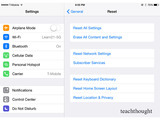
Settings > General > About > Reset.
This will take you to this screen:
From here you can decide what to reset-settings, content and settings, Network Settings, Subscriber Services, etc.
16. Narrow its use
You used to use your iPad for Netflix and email and eBay while grading papers via Google Classroom and taking notes using Zoom Notes. Now that it’s slower and you want to use it as a frisbee, it may seem hopeless, but if you simply adapt its use to its speed, you can extend its life. Only use it for web browsing and as an eBook reader. Or only use it for "Newsstand" as a magazine reader, or for comic books. Maybe use it for podcasting, or iTunesU, or digital portfolios.
Narrow its use, limiting it to something it does well, and you may not want to throw it (as often).
17. Make sure it’s updated
In truth, this is part of what slows down your iPad. As Apple builds a busier, more robust, or even buggier, overly-ambitious OS that adds in support for thermostats, watches, car audio, and a dozen other things you have no concern for, your iPad will become even more divergent from the operating system it depends on.
But failing to update-or even downgrading your operating system-is a losing game. There is no future where you have a blazing fast iPad running on a dated OS running non-updated apps. It just doesn’t work that way.
18. Close what you don’t use
Double Press Home and swipe away whatever you’re not going to use again in the near future.
18 Simple Ways To Make Your iPad Faster
The post 18 Simple Ways To Make Your iPad Faster appeared first on TeachThought.
TeachThought Blog
.
Blog
.
<span class='date ' tip=''><i class='icon-time'></i> Aug 05, 2015 09:11am</span>
|
|
The Precious First Few Minutes Of Class
by Suzy Pepper Rollins
Students file into class.
"Your warm-up is on the board," we announce. Two students fish for pencils in backpacks, one begs to get water, another needs to see the nurse, and attendance needs to be entered into the computer. "Ok, so let’s go over the warm-up now," we call, "and then we’ll look at last night’s homework."
More minutes pass, as students dump out backpacks and empty pockets in a panicked search for a scrap of paper they swear was secured last night. Others, who quickly knocked out the homework on the bus ride home, wait patiently for classmates to catch up. It is perhaps time to rethink our expectations for the opening minutes of class. Warm-ups or bell-ringers largely serve a classroom management purpose during hectic opening minutes. By getting students quickly occupied and in their seats, administrative tasks can be handled.
But the opening minutes are also the time when students’ brains are their freshest and they tend to remember more of what’s been taught during this period than any other time of the learning episode. In addition, student motivation can increase if they realize that the concept being taught today connects to their lives and has value.
These precious minutes can quickly establish a prior knowledge connection, vital to maximizing learning. Even the "best" lesson is worthless if students aren’t engaged, or don’t believe they will be able to complete the work. At the beginning of each lesson, students need some kind of foothold.
Rather than begin class with a passive warm-up, success starters have the power to get every student motivated about the lesson and successful right from the bell. Starting off on the right academic foot in the opening minutes can pay dividends throughout the lesson by sparking intellectual curiosity about today’s concept. Students get the message early that, "Hey, I think I can do this!"
We’ve shared 12 Interesting Ways To Start Class Tomorrow before. Here are a few more strategies that get students involved in new learning right away.
4 Easy Teaching Warm-Ups To Start Class Tomorrow
1. Facts and Fibs
Create facts and fibs about the upcoming topic on strips of paper. In groups, students discuss each of these and separate into piles. For example, if students will be learning about the desert, one strip might say, "Deserts are always hot." Another: "Desert animals often have long periods of dormancy to survive." As students learn about deserts, they rethink their facts and fibs, repositioning the strips. Were the group’s answers correct?
In math, fact and fib strips might say, ".61 is greater than 0.064" or "There is not a number between 5.4 and 5.5." Facts and fibs facilitate talking about math.
2. Survey
It’s hard to beat surveys to answer the question, "What’s this got to do with me?" About to embark on a government unit? A short survey in which students respond to questions about driver’s licenses, voting, marriage requirements, etc. can get every student involved.
Tackling a piece of text about a character in a tough predicament? Survey questions inquire about ways in which students might handle these situations. Students are more likely to be motivated to read when there is a personal connection to the text. They are now wondering, "Hmmm, I wonder how the character will get out of this mess?" (Before the survey, students were likely thinking about lunch.)
3. Question Cards
Pass out index cards to groups with "What? Who? When? How? and Where?" written on the cards. Students "play" their cards by creating questions about the topic.For example, if the upcoming lesson is on snails, a student might inquire, "Why are snails so slimy?"
The next student’s query might be, "Where do snails live?" During the lesson or reading, students answer the questions they have created during the opener. Question cards facilitate questioning by every student, not just the few in the front. Plus, it’s much for engaging to seek answers to questions students have developed themselves rather than those from a publisher.
4. Alpha Brainstorming
On a chart from A-Z, groups brainstorm everything they know about a topic. For example, "Write everything you know about electricity." This process taps into prior knowledge and gets everyone on topic in just a few minutes. After the lesson, students can revisit their list, "Now, what can be added to what you know about electricity?" (A math example might be, "List everything with a perimeter from A-Z.")
A Quick Checklist for Successful Warmup Activities
Success starters have the power to get students intellectually engaged and successful right at the bell. By tweaking our instruction in those critical minutes, teachers can set-up today’s learning goals beautifully in just a few minutes. With these strategies, students become authentically engaged right away, and teachers can still quickly handle critical administrative tasks.
A checklist for success starters:
Is intellectual curiosity about today’s learning goals piqued?
Does the activity tap into real-world or personal connections?
Does the task foster success in ALL students for today’s learning goal?
The opening minutes can be so valuable in getting student excited about today’s lesson. Success starters have the power to get every student open to new learning right at the bell, not many minutes later.
For more information on success starters and other next-day implementation strategies, see Suzy’s book, Learning in the Fast Lane: 8 Ways to Put ALL Students on the Road to Academic Success (ASCD, 2014). You can also find more ASCD resources for Creating Inclusive Learning Experiences.
Suzy Pepper is a passionate life-long educator whose mission is to create academic success in all learners by instilling instructional practices that provide widespread accessibility to academic rigor. She consults and trains in districts across the country. She can be reached via her website www.mathinfastlane.com or suzypepp@yahoo.com; image attribution flickr users woodleywonderworks and skokinorthshoresculpturepark; The Precious First Few Minutes: 4 Easy Teaching Warm-Ups To Start Class Tomorrow;
The post The Precious First Few Minutes Of Class appeared first on TeachThought.
TeachThought Blog
.
Blog
.
<span class='date ' tip=''><i class='icon-time'></i> Aug 05, 2015 09:10am</span>
|
|
A Guide to Questioning in the Classroom
by TeachThought Staff
This post was promoted by Noet Scholarly Tools who are offering TeachThought readers 20% off their entire order at Noet.com with coupon code TEACHTHOUGHT (enter the coupon code after you’ve signed in)! Get started with their Harvard Fiction Classics or introductory packages on Greek and Latin classics. Noet asked us to write about inquiry because they believe it’s important, and relates to their free research app for the classics.
This is part 1 of a 2-part series on questioning in the classroom. Part 1 focuses on questions in general-their function, purpose, forms, their relationship with cognitive dissonance, as well as a quick overview of essential questions. Part 2 of the Guide To Questioning In The Classroom (publishing 4/14/2015) will focus on question strategies, especially those that help students learn to ask their own questions in an inquiry-process.
Something we’ve become known for is our focus on thought, inquiry, and understanding, and questions are a big part of that. We’ve done questions that students should ask, parents should ask, students should and shouldn’t answer, questions that promote and stifle inquiry, question that reveal self-knowledge and wisdom, and more.
If the ultimate goal of education is for students to be able to effectively answer questions, then focusing on content and response strategies makes sense. If the ultimate goal of education is to teach students to think, then focusing on how we can help students ask better questions themselves might make sense, no?
Why Questions Are More Important Than Answers
The ability to ask the right question at the right time is a powerful indicator of authentic understanding. Asking a question that pierces the veil in any given situation is itself an artifact of the critical thinking teachers so desperately seek in students, if for no other reason than it shows what the student know, and then implies the desire to know more.
Asking a question is a sign of understanding, not ignorance; it requires both knowledge and then-critically-the ability to see what else you’re missing.
Questions are more important than answers because they reflect both understanding and curiosity in equal portions. To ask a question is to see both backward and forward-to make sense of a thing and what you know about it, and then extend outward in space and time to imagine what else can be known, or what others might know. To ask a great question is to see the conceptual ecology of the thing.
In a classroom, a student can see a drop of water, a literary device, a historical figure, or a math theorem, but these are just fragments that are worthless in and of themselves. A student in biology studying a drop of water must see the water as infinitely plural-as something that holds life and something that gives life.
As a marker of life, and an icon of health.
It is a tool, a miracle, a symbol, and a matter of science.
They must know what’s potentially inside of a drop of water, and then how to find out what’s actually inside that drop of water.
They must know what others have found studying water, as well as what that drop of water means within the field of science, and beyond it.
They must know that water is never really just water.
Teacher Questions vs Student Questions
When teachers try to untangle this cognitive mess, they sacrifice personalization for efficiency. There are simply too many students, and too much content to cover, so they cut to the chase.
Which means then tend towards the universal over the individual-broad, sweeping questions intermingling with sharper, more concise questions that hopefully shed some light and cause some curiosity. In a class of 30 with an aggressively-paced curriculum map and the expectation that every student master the content regardless of background knowledge, literacy level, or interest in the material, this is the best most teachers can do.
This only a bottleneck, though, when the teacher asks the questions. When the student asks the question, the pattern is reversed. The individual student has little regard for the welfare of the class, especially when they’re forming questions. They’re on the clock to say something, anything. Which is great, because questions-when they’re authentic-are automatically personal because they came up with them. They’re not tricks, or guess-what-the-teacher’s-thinking.
A student couldn’t possibly capture the scale of confusion or curiosity of 30 other people; instead, they survey their own thinking, spot both gaps and fascinations, and form a question. This is the spring-loading of a Venus flytrap. The topic crawls around in the mind of the student innocently enough, and when the time is right-and the student is confident-the flower snaps shut. Once a student starts asking questions, that magic of learning can begin.
And the best part for a teacher? Questions reveal far more than answers ever might.
The Purpose of Questions
Thought of roughly as a kind of spectrum, four purposes of questions might stand out, from more "traditional" to more "progressive."
(More Traditional) Academic View
In a traditional academic setting, the purpose of a question is to elicit a response that can be assessed (i.e., answer this question so I can see what you know).
(Less Traditional) Curriculum-Centered View
Here, a "good question" matters more than a good answer, as it demonstrates the complexity of student understanding of a given curriculum.
(More Progressive) Inquiry View
As confusion or curiosity markers that suggest a path forward for inquiry, and then are iterated and improved based on learning. (Also known as question-based learning.)
(More Progressive Still) Self-Directed View
In a student-centered circumstance, a question illuminates possible learning pathways forward irrespective of curriculum demands. The student’s own knowledge demands-and their uncovering-center and catalyze the learning experience.
The Relative Strengths of Questions
Good questions can reveal subtle shades of understanding-what this student knows about this topic in this context
Questions promote inquiry and learning how to learn over proving what you know
Questions fit in well with the modern "Google" mindset
Used well, questions can promote personalized learning as teachers can change question on fly to meet student needs
The Relative Weaknesses of Questions
Questions depend on language, which means literacy, jargon, confusing syntax, academic diction, and more can all obscure the learning process
Questions can imply answers, which imply stopping points and "finishing" over inquiry and wisdom (See questions that promote inquiry-based learning.)
Accuracy of answers can be overvalued, which makes the confidence of the answerer impact the quality of the response significantly
"Bad questions" are easy to write and deeply confusing, which can accumulate to harm a student’s sense of self-efficacy, as well as their own tendency to ask them on their own
7 Common Written Assessment Question Forms
Questions as written assessment (as opposed to questions as inquiry, questions to guide self-directed learning, or questions to demonstrate understanding) most commonly take the following forms in writing:
Matching
True/False
Multiple Choice
Short Answer
Diagramming
Essay
Open-Ended
Questioning & Self-Directed Learning
For years in classrooms, questions have guided teachers in the design of units and lessons, often through the development of essential questions that all students should be able to reasonably respond to, and that can guide their learning of existing and pre-mapped content.
In the TeachThought Self-Directed Learning Model, learners are required to create their own curriculum through a series of questions that emphasize self-knowledge, citizenship, and communal and human interdependence. In this model, existing questions act as a template to uncover potential learning pathways.
Cognitive Dissonance
Cognitive Dissonance is the cognitively-uncomfortable act of holding two seemingly competing beliefs at the same time. If you believe that Freedom of Speech is the foundation of democracy, but then are presented with a perspective (through Socratic-style questioning from the teacher, for example), you arrive (or the student does) at a crossroads where they have to adjust something-either their belief, or their judgment about the validity of the question itself.
In this way, questions can promote Cognitive Dissonance-which means a good question can change a student’s mind, beliefs, or tendency to examine their own beliefs. Questions, cognitive, and self-reflection go hand-in-hand.
Role of "Lower-Level" Questions
Lower-level questions are questions that inquire at "lower levels" of various learning taxonomies.
These are often "recall," questions that are based in fact—definitions, dates, names, biographical details, etc. Education is thought to have focused (without having been there, who knows for sure?) on these lower levels, and "low" is bad in academics, right? "Lower-level" thinking implies a lack of "higher level" thinking, so instead of analyzing, interpreting, evaluating, and creating, students are defining, recalling, and memorizing, the former of which make for artists and designers and innovators, and the latter of which make for factory workers.
And that part, at least, is (mostly) true. Recall and memorization aren’t the stuff of understanding, much less creativity and wisdom, except that they are. Bloom’s Taxonomy was not created to segregate "good thinking" from "bad thinking." In their words, "Our attempt to arrange educational behaviors from simple to complex was based on the idea that a particular simple behavior may become integrated with other equally simple behaviors to form a more complex behavior." In this way, the taxonomy is simply one way of separating the strands of thinking like different colored yarn-a kind of visual scheme to see the pattern, contrasts, and even sequence of cognitive actions.
Nowhere does it say that definitions and names and labels and categories are bad-and if it did, we’d have to wonder about the taxonomy rather than assuming that they were. It doesn’t take much imagination to see that if a student doesn’t know there was a war, and that it was fought in the United States in the 1800s, and that it was purportedly over states’ rights, and that both culture, industry, and agriculture all impacted the hows, whens, and whys of the war, that "higher-level thinking strategies" aren’t going to be very useful.
In short, lower-level questions can both illuminate and establish foundational knowledge on which to build more complex and nuanced understanding of content. They provide a foothold for thinking. To further the point, in 5 Common Misconceptions About Bloom’s Taxonomy, Grant Wiggins explains that the phrases "higher-order" and "lower-order" don’t appear anywhere in the taxonomy.
Essential Questions
On his website, Grant Wiggins defines an essential questions as those that are "broad in scope and timeless by nature. They are perpetually arguable."
Examples of Essential Questions
What is justice?
Is art a matter of taste or principles?
How far should we tamper with our own biology and chemistry?
Is science compatible with religion?
Is an author’s view privileged in determining the meaning of a text?
A question is essential when it:
causes genuine and relevant inquiry into the big ideas and core content;
provokes deep thought, lively discussion, sustained inquiry, and new understanding as well as more questions;
requires students to consider alternatives, weigh evidence, support their ideas, and justify their answers;
stimulates vital, on-going rethinking of big ideas, assumptions, and prior lessons;
sparks meaningful connections with prior learning and personal experiences;
naturally recurs, creating opportunities for transfer to other situations and subjects.
You can see more examples of essential questions here.
On Tuesday, we’ll help you take this background information and channel into specific question strategies that you can use to help students learn to create their own questions.
A Guide To Questioning In The Classroom; image attribution flickr user flickeringbrad
The post A Guide To Questioning In The Classroom appeared first on TeachThought.
TeachThought Blog
.
Blog
.
<span class='date ' tip=''><i class='icon-time'></i> Aug 05, 2015 09:09am</span>
|
|
On April 20 For Earth Week, Classrooms Can Connect with Dr. Jane Goodall During Interactive Webinar
by TeachThought Staff
In celebration of Earth Week, teachers and students are invited to participate in a free webinar with renowned chimpanzee researcher and conservationist Dr. Jane Goodall.
New York City, NY (April 7, 2015) - On April 20, TIME for Kids (TFK) is hosting a unique opportunity for teachers and students from around the world to hear from famous primatologist and United Nations Messenger of Peace, Dr. Jane Goodall, through a live, interactive webinar presentation.
To kickoff Earth Week (April 20-24), the free webinar will focus on introducing K-6 students to important subjects such as conservation, environmentalism and humanitarianism. During the presentation, Dr. Goodall will answer questions from students about her work and why it’s critical to protect the planet we share. Teachers are encouraged to submit a question from their class on the registration form. Questions can also be sent to: tfkasks4you@timeforkids.com.
"As education technology becomes more widely accessible in classrooms, it’s never been easier and more fun to connect students with the world they live in," said Nellie Gonzalez Cutler, managing editor of TFK. "These once-in-a-lifetime learning opportunities allow children to engage with experts and their peers from around the world, fostering global knowledge and connectivity, while encouraging the next generation to help make the planet a better place for its inhabitants."
As an additional learning component, TFK will provide classrooms with background materials on Dr. Goodall’s work, and the African country of Tanzania, where she spent 25 years studying chimpanzees in their natural habitat. The content-rich TFK supplement, Around the World: Tanzania is available for free, on the TFK website http://bit.ly/1IbwUoW. During the webinar, TFK will also share printable worksheets and graphic organizers to help teachers extend the lesson after the event.
The webinar will take place from 1:00 - 2:00pm ET, on Monday, April 20, 2015. For more information and to register, please visit: http://bit.ly/1y5wZaD.
ABOUT TIME FOR KIDS
With nearly 20 years of classroom experience, TIME For Kids is a trusted leader in education resources for teachers, students and parents. TIME For Kids delivers authentic content that covers a wide range of real-world topics through nonfiction text and multimedia tools that align with the Common Core State Standards. A powerful teaching tool, TIME For Kids builds reading and writing skills and is easily integrated across many curriculums, including social studies, science and math, creating lifelong readers and informed citizens. TIME For Kids is a division of Time Inc. For more information, visit http://www.timeforkids.com.
About Jane Goodall
When Jane Goodall was a child growing up in England, she dreamed of one day living among wild animals. At the age of 26, she got her chance. The respected scientist Louis S.B. Leakey asked her to study a group of chimpanzees in Tanzania. Goodall moved to the African country and spent the next 25 years studying the primates in their natural habitat. What she learned about chimpanzees fascinated people all over the world.
In 1977, Goodall established the Jane Goodall Institute, which is a global leader in the effort to protect chimpanzees and their habitats. The institute is widely recognized for innovative, community-centered conservation and development programs in Africa. In 1991, Goodall founded Roots & Shoots, a program that encourages young people to volunteer in their communities and work to protect the Earth.
Goodall is also an author. Her book for children, The Chimpanzees I Love: Saving Their World and Ours, shares her experiences studying and living with chimps for more than 41 years. Her observations have given the world insight into similarities between humans and chimpanzees, ranging from how chimps raise their children to the way they use tools and solve problems. She also wrote Hope for Animals and Their World, a collection of conservation success stories.
Goodall continues to be a passionate fighter for primates, spending about 300 days a year traveling the world to speak about her work and encourage people to protect our planet.
The post On April 20 Classrooms Can Connect With Dr. Jane Goodall appeared first on TeachThought.
TeachThought Blog
.
Blog
.
<span class='date ' tip=''><i class='icon-time'></i> Aug 05, 2015 09:09am</span>
|
|
‘The Want Of Peace’ By Wendell Berry
by Terry Heick
There can’t be higher recreation than contentment.
This is at odds with our natural pattern to constantly seek new and more. Thus is born our daily struggle. Poet, farmer, essayist, and teacher Wendell Berry laments his own "lack of simple things" in ‘The Want of Peace,’ asking about our collective trade-"selling the world to buy fire."
The structure of the poem is straightforward, which furthers the theme-2 stanzas, 8 lines per stanza, unrhymed. The imagery is elemental and simple without being simpleminded, while the diction (excess, silence, musing, fire, burning, bent, darkness, dumb) hint at the implicit lessons available with closer reading.
Berry’s poetry style is reminiscent of Robert Frost’s, even if he lacks Frost’s square neatness and affection for scheme, meter, and structure.
The Want of Peace
by Wendell Berry
All goes back to the earth,
and so I do not desire
pride of excess or power,
but the contentments made
by men who have had little:
the fisherman’s silence
receiving the river’s grace,
the gardener’s musing on rows.
I lack the peace of simple things.
I am never wholly in place.
I find no peace or grace.
We sell the world to buy fire,
our way lighted by burning men,
and that has bent my mind
and made me think of darkness
and wish for the dumb life of roots.
"The Want of Peace" by Wendell Berry from New Collected Poems. © Counterpoint Press, 2012. (buy now)
‘The Want Of Peace’ By Wendell Berry; adapted image attribution flickr user stevegarry; ‘The Want Of Peace’ By Wendell Berry
The post ‘The Want Of Peace’ By Wendell Berry appeared first on TeachThought.
TeachThought Blog
.
Blog
.
<span class='date ' tip=''><i class='icon-time'></i> Aug 05, 2015 09:09am</span>
|
|
The Assessment Range: Using Data In The Classroom To Meaningfully Affect Learning
by Terry Heick
If you don’t already have a plan for the data before giving the assessment, you’re already behind.
Among the challenges of assessment, this concept-as it applies to formal academic classrooms designed to promote mastery of Common Core or similar standards-is near the top. Without a direct input into your instructional design embedded within a dynamic curriculum map, an assessment is just a hurdle for the student-one they might clear, or one that might trip them up.
And let’s talk about how much we, as teachers, like to jump hurdles for others.
This is the third time in as many weeks that I’ve written about assessment, which usually means there’s something that’s bothering me and I can’t figure out what. In Evolving How We Plan, I pointed contentiously at the "unit" and "lesson" as impediments to personalized learning.
Simply put, most planning templates in most schools used by most teachers on most days don’t allow for data to be easily absorbed. They’re not designed for students, they’re designed for curriculum. Their audience isn’t students or communities, but rather administrators and colleagues.
These are industrial documents.
Depending on what grade level and content area you teach, and how your curriculum is packaged, what you should and are reasonably able to do with data might be different. But pit roughly, teachers administer quizzes and exams, and do their best to "re-teach." Even in high-functioning professional learning communities, teachers are behind before they give their first test.
Their teaching just isn’t ready for the data.
What Should Assessments "Do"?
In The Most Important Question Every Assessment Should Answer, I outlined one of the biggest of the many big ideas that revolve around tests, quizzes, and other snapshots of understanding-information. In short (depending on the assessment form, purpose, context, type, etc.), the primary function of assessment in a dynamic learning environment is to provide data to revise planned instruction. It tells you where to go next, like a bat’s echo location.
Unfortunately, they’re not always used this way, even when they are. Instead, they’re high drama that students "pass" or "fail." They’re matters of professional learning communities and artifacts for "data teams." They’re designed to function, but instead they just parade about and make a spectacle of themselves.
Within PLCs and data teams, the goal is to establish a standardized process to incrementally improve teaching and learning, but the minutiae and processes within these teaching improvement tools can center themselves over the job they’re supposed to be doing. We learn to "get good" at PLCs and data teams the same way students "get good" at taking tests. Which is crazy and backwards and no wonder education hates innovation.
To teach a student, you have to know what they do and don’t know. What they can or can’t do. "They" doesn’t refer to the class either, but the student. That student-what do they seem to know? How did you measure, and how much do you trust that measurement? This is fundamental, and in an academic institution, more or less "true."
Yet, "the ‘constructivist’ paradigm…is not compatible with the ‘conventional’ paradigm of external examinations" (Galbraith’s 1993). Constructivism, depending as it does on the learners own knowledge creation over time through reflection and iteration-seems to resist modern assessment forms that seek to pop in, take a snapshot, and pop back out. These snapshots are taken with no "frames" waiting for them within the lesson or unit.
They’re just grades and measurements, with little hope of substantively changing how and when students learn what.
Teachers As Learning Designers
There is the matter of teaching practice working behind the scenes here. What teachers believe, and how those beliefs inform their practice, including assessment design and data management.
In 2003 in Classroom Assessment Practices and Teachers’ Self-Perceived Assessment Skills, Zhicheng Zhang and Judith A. Burry-Stock separate "assessment practices and assessment skills," explaining that they "are related but have different constructs. Whereas the former pertains to assessment activities, the latter reflects an individual’s perception of his or her skill level in conducting those activities. This may explain why teachers rated their assessment skills as good even though they were found inadequately prepared to conduct classroom assessment in several areas."
Assessment design can’t exist independently from instructional design or curriculum design. A "fantastic test" is as useful as a "brilliant telescope."
Applied how?
In The Inconvenient Truths of Assessment, I said that "It’s an extraordinary amount of work to design precise and personalized assessments that illuminate pathways forward for individual students-likely too much for one teacher to do so consistently for every student." This is such a challenge not because personalizing learning is hard, but personalizing learning is hard when you use traditional units (e.g., genre-based units in English-Language Arts) and basic learning models (e.g., direct instruction, basic grouping, maybe some tiering, etc.)
Change the tools, and you can change the machine; change the machine, and you can change the tools. The question then can be asked: How can we design learning along chronological (time) and conceptual (content) boundaries so that that learning requires that data to create itself? Adaptive learning algorithms within certain #edtech products are coded along these lines. So how do we do this face-to-face, nose-to-book, pen-to-hand?
If we insist on using a data-based and researched-grounded ed reform model, this is crucial, no?
Backwards Planning Of A Different Kind
Assessments are data creation tools. Why collect the data if it’s not going to be used? This is all very simple: Don’t give an assessment unless the data is actually going to change future learning for *that* student.
Think about what an assessment can do. Give the student a chance to show what they know. Act as a microscope for you to examine what they seem to understand. Make the student feel good or bad. Motivate or demotivate the student. De-authenticate an otherwise authentic learning experience.
Think about what you can do with assessment data as a teacher. Report it to others. Assign an arbitrary alphanumeric symbol in hopes that it symbolizes-student-achievement-but-can-we-really-agree-what-that-means-anyway? Spin it to colleagues or parents or students. Overreact to it. Misunderstand it. Ignore it. Use it to make you feel good or bad about your own teaching-like you’re "holding students accountable" with the "bar high," or like no matter what you do, it’s still not enough.
Grant Wiggins (whose work I often gush over) and colleague Jay McTighe are known for their Understanding by Design template, a model that depends on the idea of backwards design. That is, when we design learning, we begin with the end in mind. These "ends" are usually matters of understanding-I want students to know this, be able to write or solve this, etc.
What if, however, we designed backwards from data points? Here, the data wouldn’t necessarily be the "end" (gross), but somewhere closer to the middle, serving more noble causes. And around this middle, we’d build in mechanisms to accept and react to that information.
We’d have a system that expected a certain amount of "proficiency" and "non-proficiency." Two weeks into the "unit" (if we insist on using units), we’re waiting on the very crucial data from a small series of diverse assessments (maybe non-threatening assessments?) so that we know what to do and where to go next. We already have a plan for it before we even start. We’re ready to use data to substantively, elegantly, and humanly revise what we had planned. We can’t move on without this data, or else we’re just being ridiculous.
We keep the conveyors running while the bottles crash off the belts all around us.
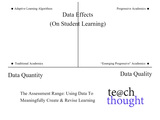
The Assessment Range: Using Data In The Classroom Meaningfully ;The Assessment Range: Using Data To Meaningfully Affect Learning; adapted image attribution flickr user vancouverfilmschool
The post The Assessment Range: Using Data To Meaningfully Affect Learning appeared first on TeachThought.
TeachThought Blog
.
Blog
.
<span class='date ' tip=''><i class='icon-time'></i> Aug 05, 2015 09:09am</span>
|
|
8 Strategies To Help Students Ask Great Questions
by Terry Heick
Questions can be extraordinary learning tools.
A good question can open minds, shift paradigms, and force the uncomfortable but transformational cognitive dissonance that can help create thinkers. In education, we tend to value a student’s ability to answer our questions. But what might be more important is their ability to ask their own great questions-and more critically, their willingness to do so.
The latter is a topic for another day, but the former is why we’re here. This is part 2 of a short series (can two articles be considered a series?) built around the idea of questions as learning tools. Part 1 "A Guide For Questioning In The Classroom."
8 Strategies To Help Students Ask Great Questions
1. TeachThought Learning Taxonomy
The TeachThought Learning Taxonomy is a template for critical thinking that frames cognition across six categories.
It imagines any learning product, goal, or objective as a "thing," then suggests different ways to think about said "thing"-mitosis, a math formula, an historical figure, a poem, a poet, a computer coding language, a political concept, a literary device, etc. It’s designed to promote "whole" thinking about otherwise discrete or disconnected ideas.
1. Function-thinking critically about how a "thing" works
2. Self-Making sense of how the thinker relates to the "thing"
3. Abstraction-Thinking about the "thing" creatively, or in non-traditional ways
4. Parts-Seeing the individual parts of the "thing"
5. Interdependence-Examining how the "thing" relates to other (similar and non-similar) "things"
6. Whole-See the "thing" fully and within context
A literary device-a metaphor example, is usually studied in isolation. This writer uses this metaphor in this way to this effect. Using the TeachThought Learning Taxonomy, a learner would be forced to confront that metaphor in much more diverse cognitive terrain-to think about something in multiple ways for a more complete picture and advanced understanding.
Function-Communicate the metaphor’s most ideal utility (how it can and should be used, and why).
Self--Identity what you do and don’t understand about the metaphor
Abstraction-Design a "sequel" of the metaphor (not a simile-an extended metaphor would be a good start)
This framework can be used not only as a planning or assessment tool, but to promote students in self-directed learning and self-created questioning and examination. In short, they can use this framework (or a simplified version of it) to create their own questions. Some examples?
Prompt: Parts-Give examples and non-examples
Questions: What are 3 examples and non-examples of mammals? What are 5 examples of push-pull factors? What are 3 non-examples of mixed fractions?
Prompt: Interdependence-Direct others in using it
Questions: How do-or might-others use alternative fuel sources to help create fresh water sources?
Prompt: Explain it differently to a novice or an expert
Questions: How would explain the Pythagorean Theorem differently to a 2nd grader and a college freshman? What would the main difference be?
The downside to using the TeachThought Learning Taxonomy to help students ask their own questions is the relative complexity of the framework, and the extra step of converting prompts to questions. Therefore, it’s better suited to late middle school-university settings.
The upside? It can be used in any content area to think deeply about almost anything.
2. Socratic Discussion
A Socratic Discussion, which is also referred to as a Socratic Seminar, is a group learning strategy designed to support students in open-ended examination and extended critical thinking through dialogic terms. In short, students learn together by talking together in an open and student-centered format. These discussions are not teacher-led, but student-led-students talk to one another.
It is a dialectal method of learning inspired by Socrates’ iconic teaching methods that depend on a pattern of theory formation, revision, and elimination to arrive at loosely-held "truths." Used strategically, this approach should promote inquiry as learning, and the close examination of one’s own beliefs as primary catalysts for learning.
The Teaching Channel video above models the Socratic Discussion/Socratic Seminar process.
3. Paideia Seminar
A Paideia Seminar is similar to the Socratic Seminar-in fact, it uses Socratic Discussions on the part of the students, combined with a minor but clear role for teachers, to facilitate verbal and critical examination of ideas. From the (a?) Paideia Seminar website, "The Paideia Seminar is an integrated literacy event built around formal whole class dialogue. The purpose for doing Paideia Seminar is to support students’ ability to think conceptually and communicate collaboratively."
One of the key differences between a Paideia Seminar and a Socratic Seminar is that within the Paideia format, teachers are "allowed" a role, provided that that role doesn’t exceed 10% of the total discussion.
4. The Question Game
5. The Question Game
The Question Game focuses on "teaching children a kind of thinking which is particularly useful in creative problem-solving-a focused approach to get from a problem to the most effective solution. It is most effective when combined with regular repetition, which solidifies the thought pattern, and with groups, which encourages contributory exploration of alternative responses and creativity."
Its dice-form not only offers a whiz-bang manipulative, but also introduces a level of gamification and playful uncertainty into the process, and its open-ended and universal stems make it practical for a wide variety of classroom applications.
6. Bloom’s Taxonomy
Similar to the TeachThought Taxonomy, Bloom’s Taxonomy can act as a framework or pattern to funnel content, inquiry, or other learning processes. These use of the taxonomy to create universal stems is one approach as modeled in the following graphic from flickr user enokson.
7. Question Formation Technique
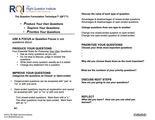
We’ll have more on this soon but in short, the Question Formation Technique (QFT) is a kind of question brainstorming process based around a topic as a kind of kernel.
In their words of the Right Question Institute, QFT is "straightforward, rigorous process that helps all students learn how to produce their own questions, improve their questions, and strategize on how to use their questions. In the process, they develop divergent, convergent and metacognitive thinking abilities."
For now, you can read more about the QFT here.
8. Universal Question Stems
As seen in the Bloom’s graphic, sentence stems and question stems are wonderful tools that can empower students to ask questions by giving them a head-start in doing so.
By using a "stem," a teacher has set the ball on the proverbial tee for the student to smash. Yes, ideally the student asks their own great questions, but what if they can’t-or don’t think they can? What if they don’t? What if they’re still learning how? What if they lack the background knowledge in some narrow sect of science or math or whatever, and need a push in the back? Stems can help. (See also 26 Sentence Stems For Higher-Level Conversation In The Classroom.)
Question stems are a more elementary questioning strategy than the Question Formation Technique (see above), but not necessarily less effective. They can be used for younger students, students struggling with a concept, or even "advanced learners" (not a huge fan of this term) as they narrow an open-ended learning experience, or to be used as "bread crumbs" in the case that the teacher is trying to help them arrive at a pre-determined destination. Some examples?
8 Basic Question Stem Examples
Which differences between ____ and ____ stand out to you?
Why does____never seem to____?
How does_____impact____?
How does _____ work?
What’s most important about?
What’s most simple/complex about ______?
How could you classify____? (And ‘Why would you classify____?’)
When____, why does____?
8 Strategies To Help Students Ask Great Questions; image attribution flickr user enokson
The post 8 Strategies To Help Students Ask Great Questions appeared first on TeachThought.
TeachThought Blog
.
Blog
.
<span class='date ' tip=''><i class='icon-time'></i> Aug 05, 2015 09:08am</span>
|