Blogs
|
"It’s vital your Makerspace reflects the culture of your school."
by Britten Follett
"What is the most unique item your students have created in their Makerspaces?" I asked our SXSWedu panel charged with sharing details about their Schools’ Vortex: Innovative Library Makerspaces.
A giggling Darcy Coffta, Upper School Librarian and Innovation Director at Berwick Academy in Maine, explained the most memorable creation she’s stumbled upon was a nuclear reactor. We laughed too. But she was serious! One of Coffta’s high school students literally built a nuclear reactor.
Much like that student’s creation, Makerspaces are sparking a transformation in the nuclei of a school—the library. Librarians, like Coffta and our other SXSWedu Makerspace panelists, are tearing out their circulation desks; building work tables; designing Lego walls; and soliciting parents and visiting yard sales for treasures and donations like sewing machines, drills, and hot glue guns.
After 43 years as a librarian, Dottie Smay decided she wanted a space where her students could focus on innovation and creativity. Smay, whose creativity and dedication to inspiring her students at Shorecrest Preparatory School in Florida is evident in everything she does, wasn’t going to wait around to make it happen. She decided the Follett Challenge—a contest designed to reward innovation in schools—and the fact that her superintendent was on vacation, was the perfect excuse! With a saw, a gallon of paint, and Dottie’s signature determination, she transformed her library into a vibrant Makerspace with minimal expense.
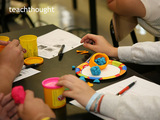
Smay used her 3D printer to make gingerbread men to introduce the new Makerspace to her elementary school students. And a giant pumpkin forced the little ones to "Make" ways to transport it from the school sidewalk to inside the library. The students’ initially thought they needed a dad or even Superman to move the pumpkin. But through the process of research and design (and adorable collaboration and critical thinking among five-year-olds) they managed to move the pumpkin successfully! The learning didn’t stop once the pumpkin made it inside the library. Using cardboard and duct tape, the students made prototypes of their pumpkin-moving devices.
Smay says, "Even the tiny kids learn problem solving and critical thinking skills because the pumpkin seeds helped teach counting and basic science." At SXSWedu, Smay challenged conference attendees to, "Just do it! One person’s trash is another’s Makerspace! Don’t wait for funding. You don’t need a 3D printer. Look around at what you already have for resources and space."
One School’s Approach
The panelists’ libraries are proof: if you build it, resources follow. Follett Challenge Grand Prize-Winning Service Learning Teacher Patrice Bryan says the transformation at Maplewood Richmond Heights wouldn’t have been possible without the support and drive of her administration. Bryan says, "It’s vital your Makerspace reflects the culture of your school."
Ten years ago, Bryan’s district was failing by all measures. Today, at the urban St. Louis school district, you’ll find engaged and productive students running a chicken farm, fish hatchery, garden, food pantry, and much more. The Makerspace at Maplewood is weaved throughout the district, from Kindergarten through high school, in all aspects of the curriculum. Math students study volume by calculating how far the compost pile will spread across the garden, while science students study biology in the kitchen while teaching nutrition to pregnant teens. But it all began in the library, which is truly the vortex and remains the center of district’s transformation. The hub of innovation. Bryan told SXSWedu session attendees, "The library is where everything happens." And despite all of the other activities available to students, library circulation has gone up, because students rely on library resources to discover the next step in "Making."
A true Makerspace is a marriage between imagination, discovery, creation, and education. It helps a student turn a thought into a learning experience, driven by curiosity and experimentation, failure and success. It requires research and exploration, and it gives students new drive to use the books and other resources in the library. When I look out into the endless sea of books in our warehouse at Follett, I can only imagine the next creation they will inspire in the minds of our country’s little "Makers".
In coming years, I expect to see a lot more "Making" happening in our schools. At the SXSWedu conference, there were at least five sessions dedicated to the concept of Makerspaces. As the moderator of our Makerspace panel, my goal was to make sure all of the attendees left the session with something tangible they could take back to their school and begin implementing on Monday. But in a way, libraries have always been about "Making." Now it just has a name.
As for that nuclear reactor, its "Maker" is using his creation in his application to M.I.T. One day all of us may benefit from his creations.
Visit www.makerspacesxsw.com for free resources to start creating your Makerspace.
"It’s vital your Makerspace reflects the culture of your school."
The post "It’s vital your Makerspace reflects the culture of your school." appeared first on TeachThought.
TeachThought Blog
.
Blog
.
<span class='date ' tip=''><i class='icon-time'></i> Aug 05, 2015 09:15am</span>
|
|
40 Viewing Comprehension Strategies: Watching Videos Like You Read A Book
by Terry Heick
You can’t watch a video like you read a book; the modalities couldn’t be much more different.
On the surface level a video uses light, color, sound, and moving images, with the potential for adding text and shape and color and light filters as overlays to communicate ideas, while the most basic text structures use alphanumeric symbols, paragraph and sentence structure, and an assortment of text features (e.g., white space, headings and subheadings, fonts, etc.) to convey their message.
There is much, much more to it than this. Videos are meant to be consumed in short bursts, while literature, for example, is meant to be "sat with." Videos are (often manic) sprints, while texts are (often meandering) walks. Because of this very different tone and purpose as a matter of design, it’s unfair to criticize videos as "less rigorous" than texts, just as it would be misleading to say that video is universally "more engaging" than text (something I may or may not have said in the past). It’s more complex than that.
The Interaction Between Video & Text
Studies of the effectiveness of video in formal learning environments have yielded some confusing ideas, namely that content acquired via video consumption doesn’t easily transfer to the medium of text (Fisch 2002; Koran, Snow & McDonald 1971). This doesn’t mean students aren’t learning from the video (or the text for that matter), but it rather suggests that the design of each medium may impact how the brain processes and stores the "lessons" from said medium, disrupting seamless transfer from one form to another.
This suggests that video consumption would more readily transfer to video production, or even video as a means of assessment. Similarly, the reading of a text naturally transitions to text production and text-based assessment-or so some research suggests. How this works in your classroom is ideally a matter of your own experimentation, and a matter of voice and choice for the students. In lieu of these data, inter and intra-media interaction from texts, images, voice, video, and other existing and emerging digital and non-digital forms represents a significant opportunity for innovation and creativity. Books, twitter, YouTube, poems, text messages, Meerkat, tweets, and other physical and digital aesthetics all matter less in form than they do in function-all represent and enable nuanced idea expression.
Like reading a text, video comprehension is a matter of decoding, but with different symbols based on unique modalities. Light, sound effects, scene cuts, dialogue, voice-overs, video speed, music, and more. How should students approach a video? How should they watch one? What should they do when they’re done? More largely, what viewing comprehension strategies should students use to promote close viewing? What can they do to increase comprehension and retention of video content so that they are able to repackage meaning into other media forms?
Due to diverse content, mobile access, credibility with students, and temptingly passive consumption, video is a pedagogical goldmine. In fact, the YouTube model of content distribution has been so successful, we took lessons from it last year and applied them to academic content distribution in How To YouTube Your Classroom.
Below are a few possibilities, many of which you’ll notice apply to non-digital media as well.
A Note About Student-Centering
Reading strategies, viewing strategies, thinking strategies-any "strategy" should be student-centered. One way to interpret this is to say that it should only be used if necessary, should be accessible and meaningful to the student, and ideally would be selected by the student without prompting. See Readicide for a powerful argument of how we as teachers, while well-intentioned, can "schoolify" reading and viewing and learning to the point that it’s unrecognizable to anyone anywhere on the planet outside of the classroom, and make students think they hate what they’re doing in the process. This doesn’t mean we can’t support students to use said strategies, but blind force-feeding will likely be self-defeating in the long run.
How The Viewing Comprehension Strategies Are Structured
The viewing comprehension strategies are organized in a Before-During-After structure, much like traditional reading strategies are. As with reading strategies, there is overlap from one part (e.g., Before Viewing) to another (e.g., After Viewing). That is, some strategies can be used at different times, but we had to place them somewhere.
Each category has four anchor strategies. These are "thinking templates" that can be used in multiple contexts and combinations. For example, "Predict’ can be used in countless ways-predict the tone, predict the audience, predict the narrative, etc.)
These anchor strategies are the most universal, and thus the most flexible for use with different kinds of videos, in different content areas, and at different grade levels.
40 Viewing Comprehension Strategies That Help Students View Videos Like They Read Books
Before Viewing
Before viewing comprehension strategies that promote understanding of video and streaming content.
Anchor Strategies: Viewing Purpose, Preview, Predict, Connect
1. Set a viewing purpose
2. Predict (e.g., sequence of events, video creator’s position on a given topic, etc.)
3. Preview video (editing conventions, length, title)
4. Identify media connections (e.g., I read a book on a related topic recently; I saw a tweet that described this same idea but in sarcastic terms, etc.)
5. Make True/False statements about general video topic
6. Begin KWL chart
7. Roughly summarize (e.g., what they know about topic. video creator, channel, etc.)
8. Concept map the video topic in a given or self-selected context
9. Complete Anticipation Guide
10. Create self-produced guiding questions
During Viewing
During viewing comprehension strategies that promote understanding of video and streaming content.
Anchor Strategies: Stop, Clarify, Question, Infer
11. Stop (or pause) the video while viewing based on viewer preference and monitoring of own understanding
12. Rewind to clarify understanding or uncover subtle data/events
13. Rewatch video with new purpose and perspective
14. Form relevant questions based on viewing
15. Clarify (e.g., information, bias, fact/opinion, "author" position, etc.)
16. Monitor & Repair Understanding
17. Evaluate use of primary and secondary modalities
18. Make meaningful and personalized inferences (e.g., primary and secondary audiences)
19. Infer underlying assumptions of video
20. Adjust viewing speed (i.e., use slow-motion) if available (e.g., physics videos)
After Viewing
After viewing comprehension strategies that promote understanding of video and streaming content.
Anchor Strategies: Summarize, Analyze, Create, Socialize
21. Retell what happened; Paraphrase "standout" ideas
22. Summarize main idea and key supporting details
23. Recall own thinking and/or emotions during video (metacognition)
24. Modality Analysis (e.g., identify and analyze prevailing modalities and their effect)
25. Metric Analysis (e.g., to infer social context with respect to total views, currently watching, social shares, etc.)
26. Analyze idea organization of video
27. Create a word cloud (e.g., that reflects diction, tone, theme, etc.); Tweet, comment on, blog, or otherwise socialize initial impressions in a way that reflects digital citizenship
28. Socialize extended responses (e.g., in writing, on social media, etc.)
29. Categorize information and perspectives
30. Separate explicit and implicit ideas
Extended
Extended comprehension strategies are meant to provide extended learning around video and streaming content, as well as opportunities for more complex thinking about that content.
Anchor Strategies: Reflect, Create, Critique, Design
31. Reflect on "fit" of video with regards to Viewing Purpose
32. Compare & contrast video with similar video content
33. Create Anticipation Guide (for viewers that haven’t seen video)
34. Identify "big idea" of video
35. Critique video for which modalities supported video purpose and theme, and which seemed to distract
36. Roughly determine history of topic in similar and dissimilar media
37. RAFT thinking & extension (Role, Audience, Format, Topic/Theme)
38. Prioritize ideas & information from least to most important
39. Distinguish between tone and mood of video
40. Design follow-up medium that extends and deepens purpose of video
40 Viewing Comprehension Strategies: Watching Videos Like You Read A Book
The post Viewing Comprehension Strategies: Watching Videos Like You Read A Book appeared first on TeachThought.
TeachThought Blog
.
Blog
.
<span class='date ' tip=''><i class='icon-time'></i> Aug 05, 2015 09:14am</span>
|
|
How I Use Seesaw To Create A Learning Journal in My Classroom
by Kelli Ohms, Special Education Functional Life Skills Teacher
Being a functional life skills teacher, my class is not set up like a typical classroom. Students do a lot of individual and small group work. All students spend time on academic subjects like basic reading skills, money skills, and social skills. We also spend time on life skills activities. We’ll take trips out into the community to work on life skills needed in the community, and each Friday we cook a full course meal for lunch to work on cooking a variety of foods and following directions.
We started using Seesaw last November as a way to document and share the work my students were doing in the community and record evidence of the key academic skills they’re working towards. Due to the nature of my class, students pick and choose most of the items they post in their Seesaw journals, with some additional items which they are told to add.
At first, my biggest challenge was teaching my students to add items independently, but now they enjoy adding new items to their journals, and even request to post unprompted! I also give students option to "write about it" or "talk about it" so there is commentary from the student along with the photo or video. They pick based on what they’re most comfortable with doing, and I allow that because it is their journal.
The biggest way Seesaw has helped my classroom is with parent communication. Prior to Seesaw, I was writing notes home each day with a brief summary of what the student covered during their day. This took up a lot of my time at the end of my day, and parents only received detailed information about their child on progress reports every 9 weeks.
Now that I use Seesaw, Parents have loved getting real-time updates on what their students are working on in class and how they are making progress. Seesaw has helped parents to see first hand how their child is performing a variety of skills, including math, reading, and life skills.
For instance, I had a parent who did not think their child could count money. Through a video on Seesaw, the parent saw their child in the beginning stages of counting money. The parent has now started giving part of the child’s allowance in coins so they can continue to practice at home. Since this change at home, I have also seen increased accuracy and improvement in this skill at school!
Increasing My Students’ Motivation
Because of Seesaw I’ve also seen an increase in student motivation for work because students can independently see their own progress. Now that they have several months of posts in Seesaw, they can look back and see how they are improving; they say, "Look how I did today! It’s better!".
Students are also excited to post to Seesaw to show their parents the work they are doing at school. Knowing that their parents look at their journal is especially motivating. They are very proud, and enjoy it when they get a comment from their parents during the day even before they head home on the bus.
Simplifying Documentation and Data Collection
As a teacher, Seesaw has helped me improve my data keeping and documentation, and makes it easier to see over the course of a couple of months how students are doing. Now I have easy visuals to access as I am going through data to document for progress. This has also improved my teaching because I can replay how students are making errors, and see how to teach skills in another way. I have also found it beneficial to pull up pictures and videos during annual case conferences with parents to show student progress, which I wasn’t able to do very easily before.
I would suggest Seesaw to everyone! It’s quick and easy to set up, and it’s user friendly for teachers, students, and parents. Seeaw has simplified many aspects of my classroom, makes parents feel more involved and up to date on student progress, and increased student motivation.
Learn more about Seesaw - The Learning Journal at http://seesaw.me or tweet @SeesawEdu; Kelli Ohms is a Special Education Functional Life Skills Teacher working with students from 6th grade to 22 years in Albion, Indiana. Follow Kelli on Twitter @KelliOhms. Kelli has been using Seesaw in her classroom since November 2014; How I Use Seesaw To Create A Learning Journal In My Classroom
The post How I Use Seesaw To Create A Learning Journal in My Classroom appeared first on TeachThought.
TeachThought Blog
.
Blog
.
<span class='date ' tip=''><i class='icon-time'></i> Aug 05, 2015 09:14am</span>
|
|
44 Diverse Tools To Publish Student Work
by TeachThought Staff
Educators are often admonished to design work that "leaves the classroom."
This is partly a push for authenticity. Work that is "real world" will naturally be more engaging to students because it has more chance to have credibility in their eyes, and usefulness in their daily lives. This kind of work has value beyond the current grading period and culminating report card.
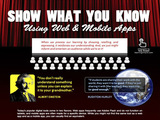
But work that is made public has other benefits as well. If someone besides the teacher is actually going to read it, students may be more willing to engage their hearts and minds in their work. This kind of work is also often iterative-done in stages, with drafts, revisions, collaboration, and rethinking. It’s design work, and as design work, it gives students a chance to show what they know. This is one of the gifts of digital and social media, and an idea we’ve approached before with 7 Creative Apps That Allow Students To Show What They Know.
Tony Vincent from learninginhand.com revisited that idea with the following graphic that clarifies another talent of education technology-shared thinking.
Publishing Student Work vs Assessment
In lieu of its perceived art and science, assessment is a murky practice.
Anything a student "does" can be used as a kind of assessment. What the say, write, draw, diagram, create, or otherwise manifest that is then shared with someone else is evidence of thinking. This can be taken as a snapshot-create a video that clarifies the cause-effect relationship of pollution and the water cycle-or something more project-based and done over time, such as a storyboarding, creating, drawing, and publishing a comic book character over a 8 part series that explores the issue of bullying over social media. Either way, because the work is mobile and digital and easily shared, its ripe for both assessment and sharing with authentic audiences in the real world.
When students publish their thinking with their right audience or collaborators at the right time, the tone and purpose of the work are able to shift dramatically. The following tools either allow you to publish student work online (e.g., YouTube, Prezi, wevideo), or create something digital that can then be published in relevant contexts (e.g., Story Me, Book Creator, Puppet Pals HD).
The tools to publish student work are separated into 11 varied categories that run the spectrum of digital publishing, a list that’s nearly as useful as the graphic itself. You can find the list, graphic, and tools below.
11 Categories Of Digital Tools To Publish Student Work
Audio Recordings
Collages
Comic Books
Posters
Slide Presentations
Digital Books
Narrated Slideshows
Movies
Animations
Screencasts
Study Aids
44 Diverse Tools To Publish Student Work
The post 44 Diverse Tools To Publish Student Work appeared first on TeachThought.
TeachThought Blog
.
Blog
.
<span class='date ' tip=''><i class='icon-time'></i> Aug 05, 2015 09:14am</span>
|
|
Research-Based? When A Lab Is Not A Classroom
by Judy Willis M.D., M.Ed., radteach.com
Neuroscience research about the learning brain has guided development of powerful, individualized learning tools.
The challenge lies in selecting the best edtech tools when commercial interests use invalid scientific claims to support their products. My previous blog addressed the available "consumer report" sources to guide you to effective edtech tools. Since there are many products not yet evaluated, this post is intended to offer thinking to help recognize deceitful claims and unreliable experts.
As an educator, you can be alert for several tip offs to probable false claims or false "authorities." Three of the more common examples of misleading neuroscience research of edtech products are summarized below.
A Lab Is Not A Classroom
This is one of the more pervasive fallacies-of logic and marketing. As with teaching and learning, transfer is everything.
If promoters claim that the product or program is "proven by brain research," their assertions are simply not true. Laboratory neuroscience research cannot be proof of what will happen in a classroom or with any one student. Lab research can only be suggestive beyond the lab, as lab research is done in very controlled conditions with only one changing variable. The outcomes of these controlled lab studies cannot promise the same outcome outside the lab walls.
The variables in the real world, such as student age, socioeconomics, class size, time of day, background knowledge, years of teaching experience, and so on, are not evaluated in the lab. Lab research, therefore, reports results in the very controlled subject group and testing system. These results can be very useful in guiding strategies and products designed to produce similar benefits as found in the lab research, but those results cannot be promised.
Valid claims do not state that the product is proven by lab research. They appropriately acknowledge that the product design is guided by interpretations of the laboratory research outcome.
Fun To Believe
Some of the myths persist because they’re compelling; they sound credible and can be fun to believe in.
Consider the financial and socioeconomic costs resulting from commercial products falsely claiming neuroscience proof that all learners need what they offer. An example was the bogus, but widely-commercialized, left/right brain neuromyth. Considerable sums were spent by individuals and school districts for programs claiming to provide "critical activation of both sides of the brain to overcome the deficiencies of weak right or left brains holding back student intelligence or success."
There was never any neuroscience research supporting these claims. Evaluations of these products revealed that activities such as crossing the right hand over to tap their left shoulder in order to send brain signals to strengthen the "weak" side of the brain did nothing at all. Neuroscience has demonstrated for decades that all brain activities requiring cognition transmit neural signals across the two sides of the brain so that physical left/right activities are not only completely unnecessary, but also useless wastes of time compared to the benefits of physical education with aerobic activities using games for exercise and social emotional skill-building.
The sad outcome of beliefs in neuromyths, such as these, goes beyond the economic drain. The falsehoods they perpetuate undermine valid neuroscience research and make educators skeptical of using valuable products that really are supported by good research. The "next big thing" is often no thing at all, which has a boy-who-cried-wolf effect when truly useful and well-designed platforms, tools, and thinking emerge.
‘Spurious Correlation’
Just because two measurements are highly correlated, it does not confirm is a cause and effect relationship.
According to US Census and USDA data there was consistent correlation of over 99% between the yearly divorce rate in Maine and the per capita consumption of margarine. Just because these two variables tracked each other closely over time, it did not mean that one caused the other. In other words, correlation does not equal causation. (A great website to explain that statistic and lots more examples to build student critical analysis is "Spurious Correlations.")
Even if the controlled studies in the lab show learning outcome measurement benefits in the group using a learning product, that research cannot prove that use of the product will engender learning outcome improvement in any individual student in a real school. There are too many variables, as noted above, that come into play once research findings are diluted into claims beyond the highly controlled lab in the ivy tower.
Awareness of these patterns can help you avoid the frustration of valueless products and prepare you for making good choices from the increasingly available and truly effective edtech (and non-edtech) products, curriculum, and programs.
Research-Based? When A Lab Is Not A Classroom; adapted image attribution flickr user nwabr
The post Research-Based? When A Lab Is Not A Classroom appeared first on TeachThought.
TeachThought Blog
.
Blog
.
<span class='date ' tip=''><i class='icon-time'></i> Aug 05, 2015 09:14am</span>
|
|
Introducing Encyclopedia Britannica Noet Edition: A Researcher’s Best Friend
by Encyclopedia Britannica Noet Edition Staff
This is a sponsored post from Britannica Noet Edition
One of the biggest hurdles in student research is empowering them to dig into primary and secondary resources. But jumping from an online database of original texts, to Wikipedia, to an article, to a dictionary, to their paper convolutes the process (to say the least). And when most students think research should only be as difficult as Googling the answer, it can be incredibly challenging getting them away from untrustworthy search results and into credible resources.
Fortunately for you (and Wikipedia-dependent students everywhere), there’s a new tool that makes it easy for students and teachers to do impressive academic research in less time.
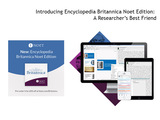
Encyclopedia Britannica Noet Edition (EBNE) combines one of the world’s most trusted sources of information with primary sources and research tools—making it the new gold standard for research tools. Plus, it’s available for pre-order for 60% off and you don’t pay until it’s released.
This edition—available exclusively through Noet, makers of humanities software and a free research app for the classics—offers advanced tagging and integration with primary resources, dictionaries, and classic literature. Researchers can jump from an encyclopedia article on Plato, to the Greek version of Republic, then to the English translation in seconds. Searches also reveal relevant media, dictionary links, and related content across your digital library.
Greek and Latin tools help students explore original language nuance and meaning, and dates in Encyclopedia Britannica link to Noet’s timeline tool—you can go from the date of Socrates’ birth in your encyclopedia to a timeline of other key events during Classical Greece in seconds. Automatic citations don’t hurt either—just copy and paste from any resource, and Noet automatically cites your sources for you.
According to Michael Ross, senior vice president and general manager of education at Encyclopaedia Britannica, "The Noet edition is unlike anything we’ve ever done before and represents a massive step forward for Encyclopaedia Britannica."
The EBNE comes with 20,000 photos, 2,000 art images, 1,567 maps, 279 flags, and 689 videos—all fully searchable and shareable; with a click, you can add an image to your next presentation. EBNE also syncs across your devices, so you can start studying on your tablet on the bus ride home, then pick up right where you left off on your desktop computer.
For a limited time, you can pre-order Encyclopedia Britannica Noet Edition for 60% off. Reserve your copy at Noet.com/Britannica.
The post Introducing Encyclopedia Britannica Noet Edition: A Researcher’s Best Friend appeared first on TeachThought.
TeachThought Blog
.
Blog
.
<span class='date ' tip=''><i class='icon-time'></i> Aug 05, 2015 09:13am</span>
|
|
7 Reasons Why Teaching Is Still The Best Job In The World
by Paul Moss
Sometimes, good teachers quit. Teaching is an increasingly demanding job with divergent influences, dynamic sources of innovation, and aging dogma that makes it all a struggle. It can be emotionally draining, and at times, impossible.
But in lieu of that-and in an age where start-ups are glorified, entertainment is endlessly emphasized, and tech is kind, teaching continues to be the best job in the world. Or at least I think so anyway. Here are 7 reasons why.
7 Reasons Why Teaching Is The Best Job In The World
1. The potential to transform lives - ask any teacher who has helped a student in any number of ways, from academic to welfare and emotional learning, and they will tell you that life is not only good, but amazing.
2. It gives you the chance to be continuously creative - of course there are increasing levels of accountability in teaching, but teachers are allowed to be creative in every lesson. Even in observations, in fact most of all in observations, lessons are encouraged to be creative and interesting to engage the students. Teachers have so many opportunities to try new ideas, and indulge in iterative process to ensure the optimum learning environment is created.
3. It offers you a chance to continuously get better - teachers are not only encouraged to seek continuous professional development, but can ask for observation on a regular basis, to provide opportunities to grow and learn from masters or more experienced practitioners. In so few professions is there such support, and considering that as a minimum, contracts are for a year, teachers have so much time to demonstrate improvement. A growth mindset is part of the foundation of teaching.
4. It is a grounding, humbling profession - the amount of work teachers do compared to remuneration is shockingly disproportionate, in 2 senses: firstly, in terms of how many paid vs non paid hours of work they receive, and secondly, in relation to other similarly creative and important (and not so important) vocations in our society. But that is not why teachers teach. So few teachers go into the vocation for the salary - it’s a calling before anything else.
5. There is always satisfaction somewhere - teaching is a calling, and no one enters it without his or her inner voice telling him or her that. Of course there are always some imposters, but the massive majority have their hearts in the right place. How cool is that for the students?
Having said that, teaching can be and is incredibly demanding, and often we can lose sight of that calling, bogged down in aspects of the profession that don’t seem to be connected to it. But on closer inspection, most of the extra demands are actually central to the job itself: explaining to parents where you are coming from; being observed; collaborating with others; marking.
Take this last aspect, crucial to understanding whether students are learning what you believe you are teaching. Yes, it is very time consuming, but perhaps one of the most important and fundamental weapons in a teacher’s arsenal; any good school will understand this and the other cited demands, and create an environment where they become part of directed time.
It is when these aspects are not acknowledged in directed time that the conditions for burnout are rife.
6. It’s a chance to truly to lead the world in the 21st century - introducing students to new technologies and ways of presenting, curating, and collaborating with others with what they know is truly exciting and truly invigorating. Modern teachers are actually pioneering pedagogy, and can and will be able to hold their heads up high in the future when we look back and see how learning in this day and age took a radical but enormously beneficial turn for the better.
Engaging students in greater collaboration, and instilling initiative in curation and the promotion of information leads to truly independent learning, and setting up such learning environments is an opportunity that all teachers now have before them. There are few more gratifying feelings that being needed.
7. The children.
Conclusion
Of course, so much of the technological addition to teaching has all been achieved mostly through our own initiative, having to source and implement the enterprising learning strategies. But this only provides another string to our bow, and in the context of how important 21st century skills are, another example of why teaching is such an amazing thing to do. Sometimes teaching is exhausting, but friends, always come back to the core of what we are doing.
We are change makers, and that is something to be proud of. Long live teaching, still the best job in the world!
Adapted image attribution flickr user alexandersaprykin; 6 Reasons Why Teaching Is The Best Job In The World
The post Why Teaching Is Still The Best Job In The World appeared first on TeachThought.
TeachThought Blog
.
Blog
.
<span class='date ' tip=''><i class='icon-time'></i> Aug 05, 2015 09:13am</span>
|
|
Hip-Hop University: Tennessee By Arrested Development
by TeachThought Staff
Hip-Hop University: Tennessee By Arrested Development Lyrics
Lord I’ve really been real stressed
Down and out, losin’ ground
Although I am black and proud
Problems got me pessimistic
Brothers and sisters keep messin’ up
Why does it have to be so damn tough?
I don’t know where I can go
To let these ghosts out of my skull
My grandma’s past, my brother’s gone
I never at once felt so alone
I know you’re supposed to be my steering wheel
Not just my spare tire (Home)
But Lord I ask you (Home)
To be my guiding force and truth (Home)
For some strange reason it had to be (Home)
He guided me to Tennessee (Home)
Take me to another place
Take me to another land
Make me forget all that hurts me
Let me understand your plan
Lord it’s obvious we got a relationship
Talkin’ to each other every night and day
Although you’re superior over me
We talk to each other in a friendship way
Then outta nowhere you tell me to break
Outta the country and into more country
Past Dyes burg into Ripley
Where the ghost of childhood haunts me
Walk the roads my forefathers walked
Climbed the trees my forefathers hung from
Ask those trees for all their wisdom
They tell me my ears are so young
(Home)
Go back to from where you came (Home)
My family tree my family name (home)
For some strange reason it had to be (Home)
He guided me to Tennessee (Home)
Take me to another place
Take me to another land
Make me forget all that hurts me
Let me understand your plan
Now I see the importance of history
Why people be in the mess that they be
Many journeys to freedom made in vain
By brothers on the corner playin’ ghetto games
I ask you Lord, why you enlightened me
Without the enlightenment of all my folks
He said ’cause I set myself on a quest for truth
And he was there to quench my thirst. But I am still thirsty
The Lord allowed me to drink some more
He said what I am searchin’ for are
The answers to all which are in front of me
The ultimate truth started to get blurry
For some strange reason it had to be
It was all a dream about Tennessee
Take me to another place
Take me to another land
Make me forget all that hurts me
Let me understand your plan
Hip-Hop University: Tennessee By Arrested Development
The post Hip-Hop University: Tennessee By Arrested Development appeared first on TeachThought.
TeachThought Blog
.
Blog
.
<span class='date ' tip=''><i class='icon-time'></i> Aug 05, 2015 09:13am</span>
|
|
Why Students Don’t Always Transfer What They Seem To Understand
by Grant Wiggins, Authentic Education
As a follow up on my series on reading, most recently yesterday’s post on reading comprehension with respect to the gradual release of responsibility model, let’s take a look at transfer.
What is transfer, and what does it demand? Let’s go back to two seminal papers from 1983 (Paris, Lipson & Wixon) and Palinscar & Brown (1983) on Reciprocal Teaching that foreshadow the problem of transfer of individual lessons in strategy:
Palinscar & Brown:
"We turn now to the instructional mode, how to teach the activities. One main concern was to try to avoid a common problem with traditional training studies, the outcomes of which have been somewhat discouraging. Although improvement on a particular skill in isolation has been reported, this improvement is often slight and fleeting, and there is very little evidence of transfer. Maintenance over time, generalization across settings, and transfer within conceptual domains are rarely found."
Paris, Lipson & Wixon:
"[D]eclarative and procedural knowledge alone are not sufficient to ensure that children read strategically. They only emphasize the knowledge and skills required for performance and do not address the conditions under which one might wish to select or execute actions… We want to introduce a new term, conditional knowledge, to capture this dimension of learning to be strategic. Conditional knowledge includes knowing when and why to apply various actions. For example, skimming is a procedure that is only appropriate for some tasks and situations. The procedure needs to be applied selectively to particular goals in order to be a strategy.
Reading only some of the words and sentences in text is not a strategy by itself; such skimming could be the result of skipping difficult words, poor visual tracking or laziness. The systematic employment of skimming to accomplish goals of speeded reading or previewing, however, would be strategic reading.
Conditional knowledge describes the circumstances of application of procedures. An expert with full procedural knowledge could not adjust behavior to changing task demands without conditional knowledge…"
Here are other relevant summaries of research on transfer in reading strategically for comprehension. Most come from the Handbook on Research in Reading Comprehension that I have cited in previous posts:
Explicit instruction generates the immediate use of comprehension strategies, but there is less evidence that students continue to use the strategies in the classroom and outside of school after instruction ends (Keeny, Cannizzo & Flavell, 1967; Ringel & Springer, 1980) or that they transfer the strategies to new situations.
The lack of evidence [about when and to what extent strategy instruction transfers] stems from the heavy reliance on smaller sample sizes and shorter-term intervention designs as well as limited attention to a "gold standard" of transfer of training to autonomous use.
Teaching students in grades 3-6 to identify and represent story structure improves their comprehension of the story they have read. In the case of this strategy, there was no evidence that the strategy transferred to the reading of new stories and improvement was more marked for low- achieving readers.
Skilled comprehenders use metacognitive strategies significantly more often than less skilled readers. Less skilled comprehenders were significantly less likely to make inferences from text even with equal background knowledge.
Spiro and colleagues suggested traditional educational techniques often oversimplify the presentation of knowledge in ways that hinder subsequent ability to use knowledge flexibly, and argued that instruction must present information in multiple ways to foster flexible thinking, a method they called "criss-crossing the landscape"(Spiro 2004.)
Work in cognitive development shows children must develop the ability to consider multiple aspects of stimuli. Children are predisposed to derive a single interpretation from a text. Even when faced with inconsistent text information, children’s inability to consider multiple features of texts leads them to select one interpretation over others - rather than considering and comparing alternative perspectives and then choosing the most appropriate one, resulting in poor text comprehension.
Oakhill, Youwill and Parking 1986 compared inference making abilities of skilled and less skilled 7 to 8-year-old comprehenders who did not differ on decoding skills or working memory, finding the less skilled comprehenders were significantly less likely to make inferences from text. Cain and Oakhill 1999 reported similar findings, even when skilled and less skilled comprehenders possessed the requisite prior knowledge to support inference generation.
From Beck Questioning the Author:
Building understanding… is what a reader needs to do to read successfully. Building understanding is not the same as extracting information from the page. Rather, building understanding involves actively figuring out what information we need to pay attention to and connecting that to other information.
Toward Successful Transfer Of Learning
How then is such flexible self-regulation in building meaning of text more likely to happen? How can teachers more likely facilitate transfer of learning vis a vis the comprehension and metacognitive strategies?
Here are a few key passages from How People Learn (2001) that summarize what we know about effective use of conditional knowledge in new situations - i.e. successful transfer of learning:
"A major goal of schooling is to prepare students for flexible adaptation to new problems and settings. Students’ abilities to transfer what they have learned to new situations provides an important index of adaptive, flexible learning; seeing how well they do this can help educators evaluate and improve their instruction…
People’s ability to transfer what they have learned depends upon a number of factors:
Spending a lot of time ("time on task") in and of itself is not sufficient to ensure effective learning…. [It is vital to] emphasize the importance of helping students monitor their learning so that they seek feedback and actively evaluate their strategies and current levels of understanding. Such activities are very different from simply reading and rereading a text.
Knowledge that is taught in a variety of contexts is more likely to support flexible transfer than knowledge that is taught in a single context. Information can become "context-bound" when taught with context-specific examples…. One frequently used teaching technique is to get learners to elaborate on the examples used during learning in order to facilitate retrieval at a later time. The practice, however, has the potential of actually making it more difficult to retrieve the lesson material in other contexts, because knowledge tends to be especially context-bound when learners elaborate the new material with details of the context in which the material is learned (Eich, 1985).
When a subject is taught in multiple contexts, however, and includes examples that demonstrate wide application of what is being taught, people are more likely to abstract the relevant features of concepts and to develop a flexible representation of knowledge (Gick and Holyoak, 1983).
Students develop flexible understanding of when, where, why, and how to use their knowledge to solve new problems if they learn how to extract underlying themes and principles from their learning exercises. Understanding how and when to put knowledge to use—known as conditions of applicability—is an important characteristic of expertise. Learning in multiple contexts most likely affects this aspect of transfer."
These are all helpful points, for sure, but probably not concrete enough or supported by relevant English/ELA examples enough for most teachers to apply directly. In my final posts I will offer a tentative set of practical implications of all this research for teachers in grades 6 - 12 who are trying to improve comprehension and achieve self-regulated transfer of learning in students.
I will also share some excerpts from books written for teachers of English that provide the most helpful tools and tactics reflective of this research. And I’ll return to a classic text that I have recommended before. Its wisdom holds up 75 years later.
This article was excerpted from a post that first appeared on Grant’s personal blog; Grant can be found on twitter here; Why Students Don’t Always Transfer What They Seem To Understand; adapted image attribution flickr user johmorgan
The post Why Students Don’t Always Transfer What They Seem To Understand appeared first on TeachThought.
TeachThought Blog
.
Blog
.
<span class='date ' tip=''><i class='icon-time'></i> Aug 05, 2015 09:13am</span>
|
|
Misunderstanding The Gradual Release Of Responsibility Framework
by Grant Wiggins, Authentic Education
Yes, reading strategies-and explicit teaching of them-make a considerable difference, as my previous four blog posts here, here, here, and here make clear. And there is much to like about the idea of the gradual release of (teacher) responsibility in the teaching of those strategies for reading - or anything else where we want skillfulness. The approach is interactive, empowering for kids, easy for most teachers to grasp and implement, and grounded in research.
Here is the original graphic of the Gradual Release idea from the 1983 paper by Pearson & Gallagher:
Here is a more recent graphic version from Duke & Pearson (2002):
Here is a more recent version still, in the 2011 article on comprehension strategies by Duke, Pearson, Strachan & Billman, their chapter in a newer edition of What Research Has to Say About Reading Instruction (IRA, 2011):
Here is the text description accompanying the most recent graphic:
The model we recommend for teaching any comprehension strategy is the gradual release of responsibility (Pearson & Gallagher, 1983). In this model (see Figure 3.1), responsibility for the use of a strategy gradually transfers from the teacher to the student through five stages (Duke & Pearson, 2002, pp. 208-210):
An explicit description of the strategy and when and how it should be used. "Predicting is making guesses about what will come next in the text you are reading. You should make predictions a lot when you read. For now, you should stop every two pages that you read and make some predictions."
Teacher and/or student modeling of the strategy in action. "I am going to make predictions while I read this book. I will start with just the cover here. Hmm…I see a picture of an owl. It looks like he—I think it is a he—is wearing pajamas, and he is carrying a candle. I predict that this is going to be a make-believe story because owls do not really wear pajamas and carry candles. I predict it is going to be about this owl, and it is going to take place at nighttime…."
Collaborative use of the strategy in action. "I have made some good predictions so far in the book. From this part on I want you to make predictions with me. Each of us should stop and think about what might happen next…. Okay, now let’s hear what you think and why…."
Guided practice using the strategy with gradual release of responsibility. Early on… "I have called the three of you together to work on making predictions while you read this and other books. After every few pages I will ask each of you to stop and make a prediction. We will talk about your predictions and then read on to see if they come true." Later on… "Each of you has a chart that lists different pages in your book. When you finish reading a page on the list, stop and make a prediction. Write the prediction in the column that says ‘Prediction.’ When you get to the next page on the list, check off whether your prediction ‘Happened,’ ‘Will not happen,’ or ‘Still might happen.’ Then make another prediction and write it down."…
Independent use of the strategy. "It is time for silent reading. As you read today, remember what we have been working on—making predictions while we read. Be sure to make predictions every two or three pages. Ask yourself why you made the prediction you did—what made you think that. Check as you read to see whether your prediction came true. Jamal is passing out Predictions! bookmarks to remind you."
Great-a proven guide to teaching each strategy! What’s not to like?
The Real Last Step
Well, a key step towards the goal of the strategies is missing. In light of our discussion so far, do you see the critical mistake that users of this approach might easily make by relying only on these graphics and the explanatory text?
Look at the so-called last step: independent practice. That is surely not the last step in developing self-regulated meaning-making. The last step is arguably fluent, flexible, and self-regulated selection and use from a repertoire of strategies - namely, successful transfer of learning for comprehension.
The authors understood the issue, as made clear in another section of their chapter:
Effective teachers of reading comprehension help their students develop into strategic, active readers, in part, by teaching them why, how, and when to apply certain strategies shown to be used by effective readers (e.g., Duke & Pearson, 2002). Although many teachers teach comprehension strategies one at a time, spending several weeks focused on each strategy … this may not be the best way to organize strategy instruction (Reutzel, Smith, & Fawson, 2005)…. Studies and reviews of various integrated approaches to strategy instruction, such as reciprocal teaching (e.g., Palincsar & Brown, 1984), have suggested that teaching students comprehension routines that include developing facility with a repertoire of strategies from which to draw during independent reading tasks can lead to increased understanding (e.g., Brown, 2008; Guthrie, Wigfield, Barbosa, et al., 2004; Spörer, Brunstein, & Kieschke, 2009).
Alas, no practical guidance is offered here on how to accomplish such an integrated approach.
(Oddly, the authors dropped a paragraph from their earlier 2002 version of this article that offers some guidance:
"Ongoing assessment. Finally, as with any good instruction, comprehension instruction should be accompanied by ongoing assessment. Teachers should monitor students’ use of comprehension strategies and their success at understanding what they read. Results of this monitoring should, in turn, inform the teacher’s instruction. When a particular strategy continues to be used ineffectively, or not at all, the teacher should respond with additional instruction or a modified instructional approach. At the same time, students should be monitoring their own use of comprehension strategies, aware of their strengths as well as their weaknesses as developing comprehenders.)"
The Unintended Consequence
Because of the well-known graphic, it becomes ironically far too easy for a teacher to incorrectly think that gradual release on each strategy, in the way laid out in the graphics, should somehow culminate in a self-regulated repertoire that transfers. Alas, that cannot cause transfer - as common sense and the research reveal. Recall Pressley’s blunt comment from an earlier post:
"Rather than teaching students how to become self-regulated learners, teachers seem to expect behaviors would naturally develop through prompted questions. There is of course no evidence that such prompting leads to anything like active self-regulated use of comprehension strategies."
Yet, despite these warnings in the literature, I have seen this problem first-hand time after time in classrooms: teachers follow this graphic in organizing the teaching of all the strategies-and, worse, rarely assessing the extent to which students, unprompted, use the strategies when reading new text.
Tomorrow, we’ll look at transfer, and how we can think of it differently for more effective teaching.
This post is excerpted from a post that first appeared on Grant’s personal blog; Grant can be found on twitter here; Misunderstanding The Gradual Release Of Responsibility Framework
The post Misunderstanding The Gradual Release Of Responsibility Framework appeared first on TeachThought.
TeachThought Blog
.
Blog
.
<span class='date ' tip=''><i class='icon-time'></i> Aug 05, 2015 09:12am</span>
|