Blogs
|
How Empowerment Fosters Creativity
by creativist.io
Everyone has at least one story where they have witnessed the silencing of creativity.
It might be a story where a teacher or a district policy confused joy with disruption. It might be a story where a child whose inner fire was lit by music and movement was forced to sit in a desk quietly to abide by curriculum standards and antiquated rules. It might be a story where a student who loves computer programming is told they cannot develop a new game that highlights their content knowledge as an alternative to an assignment. The ending is usually the same. The light for that person goes out. Sometimes the light goes out for a small period of time, sometimes the light is extinguished forever.
New teachers vow to do things differently. They declare that their classroom will be shining beacons of creativity, joy, and engagement. And then something happens. They step into the system and the system forces them to change too. The light goes out and the cycle is perpetuated.
But for all those teachers where the light goes out, there are a few who remain symbols of hope. These are the teachers who despite their circumstances in a broken system, somehow remain to connect with students on a human level, and draw out what is best in their students. These are the teachers who encourage students to pursue their interests and seem to intuitively know different creative strategies to unlock learning in different types of children. These are the teachers students remember 40 years later, when being asked in an interview, "Who influenced you?" The question becomes, what makes these teacher different? How do they remain steadfast and unshaken while the education system around them seems to spin in insanity?
The difference is empowerment.
Empowerment is one of those words that gets thrown around quite often. So what then, does it mean to be empowered and how does that relate to creativity and change?
First off, empowerment cannot be bestowed upon someone. Although leadership and environment can create conditions for empowerment, true empowerment must come from within. Being empowered means creating feelings of autonomy, confidence, meaningfulness, and impact. Too often teachers have these feelings stripped away from them. New ideas are met with jealousy and criticism. Parents question strategies and tactics that are unfamiliar to them. Policy and curriculum constrict creative strategies. It is death by a thousand cuts.
While the call for creativity in schools resonates clear and true, the implementation of creativity in schools requires relentless courage and empowerment. There will be questions. There will be skepticism. There may even be some laughter or jealousy. Creativity is not measurable by a single test score. In a culture that is fixated upon data, attempting to cultivate creativity is an uphill battle that only the bravest are willing to take on.
Luckily, there is a tribe of seasoned creative teacher warriors who have blazed the trail and are waiting in the wings. What these creative teacher warriors know is that exploratory learning, creative problem solving, and connecting to students as unique human beings unlocks gifts that ultimately lead to better test scores, innovative thinking, and yes, creativity. It takes some guts to fly that creativity flag when the world nods in agreement but turns its back when policy and administration say, "Yes, but not now. We have more important things to focus on."
But those willing to do the work to put creativity back in schools know that the results are worth it. Empowerment is the first step to unlocking and cultivating creativity.
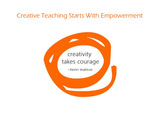
So how does a teacher get empowered to be creative in an environment that doesn’t encourage things like failure, autonomy, and messiness? Quite simple. One chooses to take it. Choosing empowerment and reconnecting with the fire that burns within provides scaffolding for more creative acts. Empowerment makes way for awareness and awareness makes way for daily practice. As Henri Matisse once said, "Creativity takes courage." That courage comes from an empowerment. It means integrating the work from the head and the heart and the hands.
It’s time to get empowered. It’s time to be the change. Your tribe is waiting for you.
Creative Teaching Starts With Empowerment
The post Creative Teaching Starts With Empowerment appeared first on TeachThought.
TeachThought Blog
.
Blog
.
<span class='date ' tip=''><i class='icon-time'></i> Aug 05, 2015 09:22am</span>
|
|
Statistics Outgrows All Other STEM Fields From 2010-2013
From a press release
ALEXANDRIA, VA Statistics—the science of learning from data—is the fastest-growing science, technology, engineering and math (STEM) undergraduate degree in the United States over the last four years, an analysis of federal government education data conducted by the American Statistical Association (ASA) revealed.
The ASA analyzed data compiled by the National Center for Education Statistics (NCES) on 160 STEM bachelor’s degree categories granted by U.S. public and nonprofit colleges and universities. Degree categories with a minimum of 200 completions in 2013 were included in the analysis.
The ASA analysis showed undergraduate statistics degrees nearly doubled (95% growth rate) during the period spanning 2010 to 2013. The significant growth of statistics outpaced that of all computer-related disciplines, environment and psychology (see following table for complete list).
FASTEST-GROWING STEM UNDERGRADUATE DEGREES 2010-2013
% Increase # of 2013
Field from 2010 Degrees
Statistics 95.1 1,656
Computer Info Tech Admin. & Mgmt. 92.0 1,985
Environmental/Environmental
Health Engineering 86.4 1,195
Mathematics & Statistics, Other 80.0 216
Computer Programming 77.2 466
Sociology & Anthropology 76.7 454
Science Technologies/Technicians, Other 74.1 484
Computer Software and Media Apps 68.4 1,160
Research & Experimental Psychology 66.1 4,723
Source: Data from the National Center for Education Statistics; Analysis by the American Statistical Association
This news may be a surprise to many higher-education experts and business leaders who might expect a computer science-related area to be the fastest-growing STEM field. But the news did not come as a surprise to the ASA.
"The analysis confirms what the ASA has known for some time: Statistics is a hot career field that more and more students are choosing to enter," said ASA President David R. Morganstein, vice president and director of the statistical staff for Westat, Inc., a statistical-services company based in Rockville, Maryland. "It’s also important to note that this growth is not a passing fad. Across the country, universities and colleges are dedicating new resources so their respective statistics departments can expand to meet this growing demand."
The University of Minnesota-Twin Cities (UMTC) is a prime example of this phenomenon. Enrollment in its undergraduate statistics program grew from just 34 majors in 2004 to 224 currently. Overall, the number of statistics bachelor’s degrees has grown from 526 in 2003 to 1,678 in 2013.
This significant growth and interest in statistics can be attributed to factors such as a more quantitative society, emphasis on data analytics, the advent of Big Data and the corollary growth of the Advanced Placement Statistics program. However, the primary influencer is the job market and the resulting demand for workers with statistical and analytical skills, which LinkedIn ranked as the most important job skills in 2014 (link).
The Occupational Outlook Handbook, published by the Bureau of Labor Statistics, finds that the number of statisticians will grow by 27% between 2012 and 2022, far outpacing the projected 11% growth rate for all other career fields. Separately, McKinsey Global Institute, a global management consulting firm that serves leading businesses, governments, nongovernmental organizations and not-for-profits, predicted in a report on Big Data that the country will face a shortage of up to 190,000 people with deep analytics skills, such as statisticians, who are needed to manage Big Data-related projects and run data analytics and business intelligence operations in the private and public sectors.
"The main driver is the job market," said Frederic P. Schoenberg from his frontline position as chair of the University of California, Los Angeles (UCLA) statistics department. "Our graduates are getting excellent jobs in industry with a statistics degree. Businesses throughout the country are forming analytics groups and seeing the value of data analysis. They are, therefore, hiring statisticians at a high rate and that is fueling our majors."
Schoenberg and other leaders of college/university statistics departments said undergraduates of their programs are securing good-paying jobs at Internet, software and technology companies; finance and banking firms; analytics and consulting agencies; management and marketing organizations; biopharmaceutical and medical sciences companies; and government agencies.
To further meet this burgeoning demand, many colleges and universities are offering new undergraduate degree statistics programs. For instance, since 2003, the number of schools granting undergraduate statistics degrees has increased from 74 to more than 110 in 2013. Amherst College in Massachusetts, Arizona State University and the University of Chicago are just three of the 20 schools that recently unveiled new undergraduate degree programs in statistics (see the complete list). Additional new programs are in the works.
Another interesting finding from the ASA analysis of the NCES data is that more than 45% of undergraduate statistics degrees during the four-year timespan studied were awarded to women. Over the past four decades, women have earned more than 40% of math and statistics bachelor’s degrees. For comparison, in 2013, the share of women who graduated with an undergraduate degree in computer science was 18%; in engineering, it was 23%; and, in physics, it was 19% (see data here).
An article relaying the growth experiences of four institutions—UMTC, UCLA, Grand Valley State University, and Carnegie Mellon University—is published in the February issue of Amstat News, the ASA’s member magazine.
The American Statistical Association is the world’s largest community of statisticians and the second-oldest continuously operating professional society in the United States. Its members serve in industry, government and academia in more than 90 countries, advancing research and promoting sound statistical practice to inform public policy and improve human welfare. For additional information about the American Statistical Association, please visit the ASA website at www.amstat.org; image attribution flickr user chaseelliot; Statistics Outgrowing Other STEM Fields
The post A New Social Science? Statistics Outgrowing Other STEM Fields appeared first on TeachThought.
TeachThought Blog
.
Blog
.
<span class='date ' tip=''><i class='icon-time'></i> Aug 05, 2015 09:22am</span>
|
|
Using Iteration To Build Great Schools
by Grant Wiggins, Authentic Education
Ed note: This post was originally longer, but we’ve broken it up into two separate posts to highlight Grant’s thoughts on making reform last, which can be seen here.
Readers will know that I promised a thoughtful follow-up to my previous post in which I criticized DeLisle’s recent Ed Week rant on differentiated instruction.
However, after pondering the subject intensely for a week, I find myself facing a somewhat different and broader question - the baby and bathwater question: Why do we constantly fail to distinguish a good idea from confused and ineffective implementations of good ideas, and throw out the idea - instead of refining the policies and practices?
For, surely, this is the issue with Differentiated Instruction. The idea could not be more pedagogically and morally correct: design learning to make it most likely that all the varied learners in front of you will learn and be engaged in their learning. Even DeLisle acknowledges the core idea as sound. Indeed, almost every elementary teacher has long differentiated in ELA due to reading level differences (something apparently unknown to other critics).
But once the going gets rough (e.g. classes are far too diverse; planning becomes more time-consuming), we rise up against "differentiated instruction" instead of tinkering with the way the idea is being implemented.
On "Pushback"
Raise your hand if there has been pushback against UbD, curriculum mapping, block scheduling, authentic assessment, standards-based grading, and problem-based learning in your school. Ok, everyone put their hands down now.
You don’t even have to like these initiatives to see that the implementation problems are rife: failure to think through training and feedback; failure to allocate enough time to experiment with the ideas before full implementation; failure to think through the likely rough spots and misunderstandings of those ideas.
At the implementation level of school reform, it’s one big game of Lucy holding the new-initiative football, and Charlie Brown thinking "THIS time it will work!"
Schools simply do not know how to change themselves. They are status quo machines of the highest order - on par with churches. Worse, administrators - in their naïve enthusiasm and stubbornness to bring change - too often fail to listen to critics or build in self-correcting mechanisms to ensure that implementation can be tweaked all along the way of the reform - as if admitting mistakes in early implementation would discredit the whole idea (and their leadership).
I can speak to this problem with lots of firsthand knowledge related to Understanding by Design over a 15 year period. Let me list a few horrible ways that UbD has been implemented in schools, districts and other countries - without either our blessing or consultation/feedback of any kind:
In each unit there must be 4 essential questions
In Year One, every teacher will design and implement all their units in UbD
Every LESSON will be planned in the UbD Unit Template
There has to be at least 1 performance task for every lesson
In Year One, every UbD unit will be placed in the Atlas Rubicon software, with limited PD on either initiative
Requiring SEPARATE UbD units for each subject at the elementary level in which the one teacher plans and teaches ALL the units.
I could go on, alas, but you get the point.
Launch, Fail, Grow: Building An Iterative Reform System
What tends to happen when leaders fail to (build sustainable reform)? We throw out the baby with the bathwater. i.e. we toss the good idea along with Implementation version 1. (Imagine if software creators gave up after Version 1, and you have some idea of how little we would now value software.)
Resisters/opponents of change get most of their power from the failure of implementation, not sound arguments against the core idea: "See? I told you it wouldn’t work; I told you it was a bad idea." I think most of the big reform ideas mentioned above are sound, addressing fairly obvious needs for greater personalization, coherence, and accountability. Alas, even "reform" now is a bad word in many quarters (cf. Diane Ravitch) because the implementation of many of good ideas has been so poor.
Nor should we despair over the enormity of the task. We don’t need to be geniuses to change things for the better. We just need to want, solicit, and act on feedback when we initiate any change. That is the key to all modern improvements, from hardware to software to services. Change of any kind, to lead to progress and to llast, involves a robust feedback system.
Yet, school-people - be they admins or teachers, be it large-scale school reform or individual experiments in teaching - are prone to charge ahead without an adequate plan, then give up on an idea that doesn’t work out of the box. That’s why it is essential in reform to provide structures and opportunities that send the message: Implementation Version 1.0 is LIKELY to fail. We won’t get this right, most likely until Version 3.5.
So, let’s fail early and often (as they say at IDEO) and work to get it right as quickly as possible, based on feedback and advice.
Otherwise, like Charlie Brown, we’ll just be wishin’ and hopin’.
This article was excerpted from a post that first appeared on Grant’s personal blog; Grant can be found on twitter here; Using Iteration To Build Great Schools; adapted image attribution flickr user globalpartnershipsforeducation
The post Launch, Fail, Grow: Using Iteration To Build Great Schools appeared first on TeachThought.
TeachThought Blog
.
Blog
.
<span class='date ' tip=''><i class='icon-time'></i> Aug 05, 2015 09:22am</span>
|
|
Quantified Learners: Moving Beyond Assessment
By Andrew Smith Lewis
New applications and technologies are now embedded into practically every aspect of the learning experience. Schools are organizing databases around students that look at multiple performance indicators, and now, more than ever, learning is informed and registered through collections of data points and not just a grade.
As assessment becomes more data-driven, however, it’s important that we remember what the real goal of this data should be. It’s not simply about better assessment; it’s about empowering better learning. Right now, both the technologies and the educators valiantly deploying these new methods are falling short of supporting the quantified learner.
The first step is, of course, designing and building better systems to capture this sort of data, which really isn’t being done at scale. More importantly though, as we build these systems, we need to keep the end-goal in mind — better learning, and constructive and actionable feedback for students. If we focus data-driven efforts solely on assessment, without developing student-empowering technologies that give learners insights into their progress, then we are failing the real goal as well as our students.
As Annie Murphy Paul notes, "the most profound and lasting effect of sharing students’ data with them is to develop their awareness of their own learning." Paul’s notion of data helping build students’ metacognitive skills is a valuable one, and one that we need to keep incorporating into data-driven approaches to both teaching and learning.
Paul asserts that "having access to information about their performance creates opportunities for students to recognize when they’ve made mistakes and figure out what to do to fix them." That’s an admirable goal, but it still falls short of what quantified learners could potentially do with that wealth of information. Data shouldn’t just look back; it needs to point forward.
Learning data is valuable in remediating where students have been, but what about using that data to fuel their futures? Looking beyond mere assessment, this data can help students define goals and work towards them, operating as a recommendation driver to identify new areas where they might excel, mapping what they know and what they need to know, and even providing validation along the way in the form of micro-credentials or other forms of recognition and verification.
Our quantified efforts should strive to achieve this level of empowerment for students right now. More importantly, and more concerningly, most edtech companies are not considering these capabilities in the data-collection systems they are developing and using.
We’re seeing important shifts in the interplay of technology and education, but they are well off from what’s required to enable and empower quantified learning. In fact, they don’t seem too concerned with providing insights to learners at this point, which is a shame.
MOOCs, for example, have provided some of the most exciting and worthwhile developments within education technology in the past couple decades. Yet, in order to improve something, you need to be able to measure it — to quantify it. When the only data coming from engagement with a MOOC is how much video someone has watched, we are a far cry from truly adding value to the learning side of the equation.
As we build out these systems and more data enters the classroom (physical and/or virtual), we need to focus on the real goals and opportunities for empowering learners. If we relegate the role and insights of data to mere assessment, we are doing a disservice to our students and the capabilities of the technologies we’re employing. As the Quantified Self movement has suggested, data aggregation and data accessibly can be a non-trivial motivator. And improved student outcomes are still every educators’ goal.
Developing more robust data systems that scale is the first step, but they also need to provide feedback and help predict and guide students’ learning. If we can achieve that vision, then assessment will be as empowering to learners as it is to educators.
Andrew Smith Lewis is co-founder and executive chairman of Cerego, a leading provider of adaptive learning solutions for publishers, educators, and students. Follow him @aslives; Empowering The Quantified Learner: Why EdTech Needs To Move Beyond Assessment; image attribution flickr user larryjohnson
The post Quantified Learners: Moving Beyond Assessment appeared first on TeachThought.
TeachThought Blog
.
Blog
.
<span class='date ' tip=''><i class='icon-time'></i> Aug 05, 2015 09:21am</span>
|
|
60 Non-Threatening Formative Assessment Techniques
by TeachThought Staff
As frequently as a chef needs to check a sauce for taste, teachers should check for understanding.
These can be formal-formative or summative assessment, multiple choice, short answer, essay, matching, and related iconic "test" forms. But they can also be informal-conversations, gallery walks, sketches, and more.
We recently shared the Inconvenient Truths of Assessment, and one of the takeaways from that post by Terry Heick could be that rather focusing on the design of assessment, we could instead focus on a climate of assessment.-a classroom where snapshots of understanding are taken frequently and naturally, without the stress of performance for the student, or the burden of huge, unmanageable data results for the teachers.
So what about assessment as a matter of tone and purpose? If an assessment is non-traditional and non-threatening (or even less traditional and less threatening), how might that impact what it reveals? Does the tone of an assessment matter?
Is informal assessment a "lesser" form altogether?
The Primary Benefit Of Informal Assessment
More than anything else, non-threatening, informal assessment can disarm the process of checking for understanding. The less formal the form, the less guarded or anxious the student might become. Stress and worry can quickly shut down the student’s ability to think, which yields misleading results-a poor "grade" which implies that a student understands a lot less than they actually do.
In that way, Levy County Schools in Florida’s Kim Lambert compilation of 60 Tools for Formative Assessment and Processing Activities can be useful to you as you collect data from all students, from the polished little academics, to students for whom the classroom might be a less-than-comfortable place.
If you have trouble viewing the embed below, you can find the original document from LCS here.
60 Non-Threatening Formative Assessment Techniques by K Lambert, OCPS Curriculum Services, 4/201;
The post 60 Non-Threatening Formative Assessment Techniques appeared first on TeachThought.
TeachThought Blog
.
Blog
.
<span class='date ' tip=''><i class='icon-time'></i> Aug 05, 2015 09:19am</span>
|
|
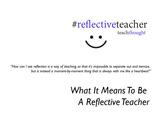
What It Means To Be A Reflective Teacher
by Terry Heick
Reflection is a fundamental tenet of learning; it is also, therefore, a fundamental part of teaching.
Why it happens is a matter of humility. But how and when it happens-and with whom-is less clear. This is partly because there are multiple sides to reflection-length, width, and depth. A Z-axis.
It is whole.
As a kind of definition, to reflect means to look back at how something "went," and see it for all of its available parts and patterns: Causes and effects; comparisons and contrast; strengths and weakness; its characteristics; how close it came to what you were expecting; your emotions.
I planned this, and it went like this, and now I think this.
Reflection sounds like an abstract idea-something unspecific, and even a little mystical. Something we do in the shower on the drive home when no one’s around and we’re free to roam in our own minds. It’s definitely true that reflection comes most effortlessly, and in its purest and rawest forms, in those circumstances when we-that is, our minds-are not otherwise engaged.
Reflection isn’t a single thing-a box to check in some elliptical cycle of learning. It’s as much a matter of self-awareness, humility, and affection as it is timing, sequence, and procedure.
I can see the craft of teaching as both a sequence of steps and the fulfillment of design. It’s both parts, and whole. Science and art. Professional and people.
I know nothing is ever perfect, so I seek to improve. I also know what’s improvable within my means, and what pathways there are to get there.
I believe in the endurance of knowledge and understanding, and will bring everything I know to bear on my craft.
With this kind of examination laid out, there practice of reflection is more fruitful, a kind of tilling of the ground to harvest crops. Which is where the non-abstractions come in-the tangible tools, processes, and partners of reflection that allow us to socialize ourselves and our teaching, and benefit from concrete practice of reflection.
When I use twitter, I do so both as a matter of practice and thought. There are mechanical actions that lead to thought, and the other way around. I bring out my tablet or sit down at my PC, log on to twitter, skim my twitter feed, check mentions and messages, respond to tweets if I feel like it. These are inputs. The output, if I get it just right, is reflection.
If I read a tweet, interpret what I believe to be its meaning, find relevance in its message, and think-even briefly-about how I relate to it and it to me, I’m approaching reflection.
Tweet: 10 Assessment Tools For The Flipped Classroom
My reaction: What are the strengths and weaknesses of assessment in a flipped classrooms? What tools am I aware of that could work here? Do I need a tool-is this worth clicking on? Should I save to Pocket without clicking? Click and read? RT without reading? Read, then RT? Favorite with or without reading? How am I spending my time right now on social media? Am I bumming around, or should I be more intentional-this tool or idea for this need I have tomorrow.
If reflection happens on twitter-and it does-then it is both a matter of practice and habit-a tendency towards the kind of thought that promotes change in your teaching. But this really has nothing to do with twitter; this is just an easy example that many of you can relate to. It’s about the dimensions of reflection: The How, the When, and the Who.
How Does Reflection Happen?
We recently did a Teacher Blogging Challenge, which amounted to a series of prompts that teachers were encouraged to use daily as writing prompts. Daily, these were about looking at the ins and outs of teaching; more broadly, they were about teachers building both a capacity and a tendency to reflect on their own.
There is also a #reflectiveteacher hashtag that is used to carry that conversation from beyond your blog out into a larger space, where it has a chance for more visibility. But more importantly, the tweeting and hashtagging is about extending and socializing the practice of reflection. It’s not about the post, but about the vulnerability that comes with reflection.
Being honest, transparent, and then standing on your own.
The reflection actually starts much earlier, alone, in your own mind after something happens. Then, it often happens with someone-a friend, colleague, or loved on. Maybe even a student. Then, you’re likely to reflect again, alone, now pushed further in your thinking by the "together" part. Writing about it again, and then sharing that with others, makes the reflection more complex, and more personal.
Sequence: Alone->Together->Alone
Reflection, among other patterns, often happens Alone (which is slow and passive), Together (which is more immediate, and active) and then Alone Again (once more, slow and passive).
Sequence: While Teaching->After Teaching->After School
Reflection is also a matter of timing. Reflection can happen at any time, but no sooner than the event begins taking place: The lesson, the assessment, the meeting, the Socrative Discussion.
While teaching, how is it going really? What adjustments seem necessary? What’s most important here? Then immediately after, in a Habits of Mind sense, how did it go (evaluation), and how do I know (data)? After school, now that I’ve had a chance to "get away" from the event some, what do I think now? What’s lingering? What should I do differently next time? What would students say if they were right here next to me?
Sequence: Students->Colleagues->PLN
And then, with whom should I reflect? Students? Colleagues? Professional Learning Networks? My spouse? How is each episode different? What’s worth talking about and worth forgetting?
How can I see reflection is a way of teaching, so that it’s impossible to separate out and itemize, but is instead a moment-by-moment thing that is always with me like a heartbeat?
What It Means To Be A Reflective Teacher; image attribution flickr user Frits Ahlefeldt-Laurvig
The post What It Means To Be A Reflective Teacher appeared first on TeachThought.
TeachThought Blog
.
Blog
.
<span class='date ' tip=''><i class='icon-time'></i> Aug 05, 2015 09:19am</span>
|
|
At One Point An Abacus Was Considered ‘Education Technology’
By: Tess Pajaron, Open Colleges
When you think of Edtech, mobile devices and learning apps are probably some of the first things that spring to mind. But although technology has brought major changes to education over the past decade, humans have been looking for ways to advance collective knowledge since long before the Internet or even computers existed.
Imagining future possibilities for technology in education is something we do all the time, but what about where it all started? Here are ten of the earliest innovations, shown on this interactive infographic, that have helped pave the way for the Edtech of today, from the abacus way back in 480 BC to the very first tablet in 1989.
10 Examples Of ‘Old’ Education Technology
1. Hieroglyphics
Before we had the ABCs, there were Egyptian hieroglyphs. Hieroglyphs are believed to be the earliest form of writing and can be traced back to 3300 BC. With more than 800 basic symbols called glyphs, the writing form was difficult to learn, and only a select few like royalty and priests actually used them. The concept of written hieroglyphs, however, was revolutionary and paved the way for the development of other written languages.
2. The abacus
Counting and calculating may seem like an impossible task without numbers, but before they existed, counting was done with the help of things like pebbles and twigs. The invention of the abacus made more complicated calculations like addition, subtraction, multiplication and division possible. It was first used by the Greeks around 300 BC, although the abacus we know today comes from China.
3. First analogue computer
Believe it or not, the first analogue computer appeared before pens and pencils were invented. The Antikythera mechanism is the oldest analog computer and was designed by the Greeks around 150 BC to predict astronomical positions and eclipses. Although knowledge of this technology was lost some time in Antiquity, the device played an important role in helping humans gain an understanding of time and space.
4. Quill pen and pencil
Before pens and pencils were invented, writing had to be done by carving letters into thin sheets of wax. The very first quill pen was introduced around 700 AD and used feathers from live birds like crows, eagles, geese and turkeys. Eventually this evolved into the more efficient metal-nibbed pen, followed by the fountain pen, and finally the ballpoint pen. Pencils weren’t invented until 1795, when an officer in Napoleon’s army discovered that when powdered graphite was mixed with clay and formed into rods it made a very handy writing tool.
5. Printing press
The printing press, invented in China in 1041 and eventually fine-tuned by a German named Johannes Gutenberg in 1450, made copying documents easier than ever before and enabled the mass production of books. This led to the rapid dissemination of knowledge throughout Europe and resulted in a more literate population and stronger economy.
6. First correspondence school
Correspondence courses were the predecessors of online learning, and the very first correspondence school was started in Boston, Massachusetts in 1873 by Anna Eliot Ticknor. She founded it as a way of encouraging women to devote their spare time to studying. Although students were charged a small fee to use the lending library, the instructors offered their services completely free of charge.
7. The calculator
The first mechanical calculator was patented in Japan in 1903. With its single cylinder and 22 gears, it was quite different from the electronic calculators that today’s students are familiar with. In 1948 a miniature hand-cranked calculator named the "Curta" was introduced. Although it was pricey, it went on to become the most popular portable calculator until it was eventually replaced in the 1970s, when electronic calculators were introduced.
8. First stored program computer
Despite the fact that it took up an entire room, the very first stored program computer was affectionately named ‘Baby.’ Officially, it was called the Manchester Small-Scale Experimental Machine (SSEM), and ran its first program in June of 1948. With a memory of just 32 words, it demonstrated the potential of modern electronic computers and was eventually developed into the world’s first commercially available computer.
9. The concept of mobile learning
Although mobile learning is still relatively new, the concept for it originated in 1968, when an American computer scientist named Alan Kay came up with the idea of the KiddiComp or Dynabook; a portable, battery-operated educational computer. His hope was to create a personal computer for children of all ages and even though his device was never actually created, the concept has inspired countless innovations.
10. First tablet
Tablets are typically thought of as a 21st century invention, but they’ve actually been around since 1989. The first tablet was called the GriDPAD and came complete with a touch-sensitive on-screen keyboard, handwriting recognition technology, and Internet capability. Aside from inspiring today’s tablet computers, the device was also the predecessor of the popular ‘90s Palm Pilot.
At One Point, These Were Considered Education Technology
The post 10 Examples Of ‘Old’ Education Technology appeared first on TeachThought.
TeachThought Blog
.
Blog
.
<span class='date ' tip=''><i class='icon-time'></i> Aug 05, 2015 09:19am</span>
|
|
An Identity Crisis: When Students See Themselves As Digital
by Terry Heick
Students that have more control than ever over their own identity have, unsurprisingly, lost control of that identity.
Coldly, and as a matter of "settings," they are able to dictate when, how, where, and by whom they are seen. Connectivity has closed the walls of the world around them-or at least made them transparent-until they have zero room to wiggle and squirm. And that’s a real problem in an era of big data, digital branding, and always-on expression. More than any other time in human history, students have an identity problem.
The Quantification Of A Person
If you tweet something, and no one RTs or favorites, did you really say anything at all? Is your value-and the value of your voice as an educator-dependent on how many followers you have? The prideful answer is "no," but if you’re not seen or heard or engaged with or responded to, you’re forced to recalibrate your goals and ideas. For an adult, that’s accessible; for teenagers, it’s a problem.
Students define themselves through rejection and assimilation, just like adults. What we refuse to be a part of matters just as much as what groups and memberships we choose to disappear into. We refuse political party X or ed reform agenda Y while quietly slipping into a kind of tech avante garde. If we loathe Bill Maher or Rush Limbaugh passionately enough, that becomes more important than who we do listen to.
In lieu of the little wiggling and well-endowed app icons, students today are in a rough place. When the internet first allowed social media, and social media allowed a digital and social identity, the presence of a student was primarily physical. That is, a student, seen mostly and interfaced with mostly in person, created a facsimile of themselves online. Through minor features, such as avatars, bios, status updates, and carefully-and-actively-curated-pseudo-human-digital-networks, students used a communication and sharing tool, which directly and indirectly etched out a kind of "identity."
Before the normalization of technology-addiction and the fetishization of being "connected," that identity was more of a novel function or complementary tool than living space. But for students that rabidly send and receive versions of themselves and others through facebook, Instagram, Vine, tumblr, snapchat, and other emerging social channels, they’re (unwittingly?) coding an identity that not only is not within their control, but never was by design. The images and words-the social templates-have had the power all long.
By the quantification and commodification of a student’s "identity," that identity becomes other. Over there. Not self. It’s not an identity anyone from even 20 years ago would recognize.
Digital Identity Is Packaged Identity
How students see themselves is the starting point for learning.
More narrowly (the illusion goes), how they see themselves as learners is increasingly up for simple reconfiguration. What you post, who you tag, your avatar, you emojis, spelling, syntax, all digital expressions of self. The non-social internet is gone; social transactions are the single greatest currency of connected, digital spaces. It’s not purely social, nor is it merely media. It’s certainly more than commerce or media consumption, but it’s strangely none of this. It’s the careful packaging of consumable spectacle.
Social media is one of the few places sharing is anything but-as much of an opportunity to distribute some artifact that expresses you as you see yourself, each link or video or message an opportunity to further stain yourself into the social glass of the world. Leaning heavily on Donna Haraway’s Cyborg Manifesto, Susan Cox wrote recently on Salon:
"It may not be as cool as we imagined it in sleek ’90s sci-fi, but we really are creatures existing in multiple dimensions, transcending space and time with our cybernetic reach. And who controls where your body ends and begins as this unholy fusion of man and machine? Those technologies through which you interface, of course, offering you the shape of your digital self, such as the Facebook profile. Sometimes the reduction of your person to Facebook’s arbitrary determinations can be uncomfortable and insulting. Facebook has redefined the standard of what information should be immediately known about you as a person."
Identity, in learning, is like breathing. It’s not a cause of learning, like curiosity. Nor is it purely an effect of learning, like understanding. Nor is it something strangely both, like literacy. It’s simultaneously a symptom and a catalyst.
Identity is the learner insofar as they see themselves and are seen by others. It’s a fluid and ongoing transaction. Identity itself is an effect of self-knowledge, but they’re not the same thing. Identity is insecure and visual and terrifying and orchestrated and familial and emotional, accepted and created in equal amounts.
And, increasingly, it’s a digital-first sequence.
A Digital-First Pattern Of Identity
If identity is "the distinguishing personality or personality of an individual," then that which is most able to distinguish one student from another will be seen as valuable, and will be a proving ground for the testing, forging, and struggle with identity. Though all students exist first and foremost in a physical space-a home, classroom, etc., they simultaneously exist online, a much broader and more carefully orchestrated scale.
Students’ torsos, arms, legs, and heads are sometimes here and sometimes there, but they’re always online. Facebook doesn’t fade in and out based on user need, but rather justifies itself and creates its own rules and needs for being. This means that users that seek to create an identity through such a social channel-twitter, for example-necessarily do so first through an existing pattern of followers, likes, avatar, and retweets.
In 2015, digital identity precedes and proceeds physical identity. In A Cyborg Manifesto, Haraway writes:
"The cyborg (ed note: think digitally-connected students today) is resolutely committed to partiality, irony, intimacy, and perversity. It is oppositional, utopian, and completely without innocence. No longer structured by the polarity of public and private, the cyborg defines a technological polls based partly on a revolution of social relations in the oikos, the household. Nature and culture are reworked; the one can no longer be the resource for appropriation or incorporation by the other. The relationships for forming wholes from parts, including those of polarity and hierarchical domination, are at issue in the cyborg world."
The problem with Haraway’s theory is one of context. Claiming, in a theory, that essentialist theories are inadequate to describe a world where nature fuses with the artificial is broken for what it assumes-that nature and the artificial have fused, which of course isn’t possible even in metaphorical terms. If it’s artificial, it can’t be natural. The only place where natural and artificial identities even seem to merge is within artificial (and digital) spaces.
"The crux of the issue boils down to this: Is Facebook’s normalization of hyper-transparency and information-oriented mode of self-definition conditioning young people to be submissive toward institutionalized forms of subject formation? Does it quell unrest in response to those power structures invested in telling you who and what you are? Will the young people of the future question social values if they are trained from a young age by technological demands to express their person in a corporately constructed template?"
Aha! This is where it starts to get interesting-is it not just social frameworks, or tech-driven identity, but corporate-breathing purpose manifest through social and tech that children believe define them? That’s a grotesque intersection.
Students that, for example, prefer their digital identity to their physical identity necessitate a compelling response to rethink that pattern. The challenge for teachers becomes, then, helping students forge an identity that’s whole. The complexity of the human experience is reflected in the nuance of digital identity, but the source of that reflection is something that you can reach out and hold.
Identity may be digital, but people never are.
An Identity Crisis: When Students See Themselves As Digital; adapted image attribution flickr users flickeringbrad and tulanepublicrelations
The post When Students See Themselves As Digital appeared first on TeachThought.
TeachThought Blog
.
Blog
.
<span class='date ' tip=''><i class='icon-time'></i> Aug 05, 2015 09:19am</span>
|
|
Preventing Youth Suicide Through Lessons Of Hope
by TeachThought Staff
CHICAGO, IL — Schools for Hope is a new, free educational curriculum that was developed by The International Foundation for Research and Education on Depression (iFred) to prevent youth suicide by giving students, educators and parents the necessary learning tools to find and maintain hope. According to a recent study published in the Journal of Adolescent Health, 1 out of 9 children self-reported a suicide attempt before graduating high school; with forty percent of those children in grade school. Schools for Hope provides free life-saving skills to children, teachers and parents with the goal of reversing those staggering statistics
"Teaching children the importance of caring for their mental health is crucial to their emotional well-being and quality of life," said Penny Tate, Schools for Hope Project Manager. "By giving children tools to have hope, we not only aid in their ability to handle life’s challenges and save lives, but we empower them to become their most vital selves. As a mother of two young girls, and as a survivor of suicide loss, I’ve seen firsthand the importance and critical need that exists to have an open dialogue with our children and give them hope."
Schools for Hope is a free program that is available to any interested school, community group, after school program or nonprofit in the U.S. and overseas. It has comprehensive instructions and can be easily self-led, so the costs associated with implementation are low. The curriculum is based on research that suggests hope is a teachable skill—a vitally important aptitude because hopelessness is the leading symptom of depression and predictor of suicide.
The curriculum is made up of ten core lessons and additional workshops on Heroes for Hope, Movies for Hope and Artwork for Hope. It is currently being tested among 5th graders because of the significant rise in suicide attempts in sixth grade, and educates students on the importance of emotional health and well-being, how to get their brain into a hopeful state, and meditation and deep breathing techniques. The program also teaches children how to define hope, explore and define the meaning of ‘success’, and practice emotional self-regulation techniques. They will also learn about the biology of the brain and how to connect their passion and purpose in life.
iFred launched Schools for Hope in Fall 2014 in two Chicago-area school districts (Woodland Intermediate School in Gurnee, IL and Oakland School in Antioch, IL) with the goal of expanding nationally and internationally. The program is expanding to South America and Nepal this year, and is available for translation and in cobranded partnerships with other nonprofits interested in teaching the curriculum to their members.
"I enjoyed teaching the lessons because I think that our students aren’t really in touch with their emotions," said April Cooksey, a 5th grade teacher at Woodland School. "I believe that this project created a safe place for my students to express their thoughts and feelings."
Amy Werner, also a teacher at Woodland School added, "My students looked forward to the hope lessons every day. They couldn’t wait to learn and often still ask when we will do more lessons. It’s not often students ask to be educated!"
For interest in testing or implementing the 5th grade curriculum, please email Schools for Hope at schoolsforhope@ifred.org or visit the website to download the free lesson plans. There are also tools and support items for teachers and educators, as well as research to date on the program and information on how the curriculum fits with current social and emotional learning standards mandated in several states. More information is available at http://schoolsforhope.org.
Fall Curriculum
(Fall) Lesson 1: Define Hope
(Fall) Lesson 2: Hopeful people live more fulfilling and successful lives
(Fall) Lesson 3: Hope happens in the ‘upstairs’ brain
(Fall) Lesson 4: Self-regulation
(Fall) Lesson 5: Sacredness
Spring Curriculum
(Spring) Lesson 6: Hope revisited
(Spring) Lesson 7: Setting goals and creating action steps to those goals
(Spring) Lesson 8: Anticipating and planning for obstacles
(Spring) Lesson 9: Using hope tools to cope with unexpected events; finding someone to support you
(Spring) Lesson 10: Giving back
About iFred: International Foundation for Research and Education on Depression’s mission is to shine a positive light on depression and eliminate the stigma associated with the disease through prevention, research and education. Its goal is to ensure 100% of the 350 million people affected by depression seek and receive treatment.
iFred is creating a shift in society’s negative perception of the disease through positive imagery and branding-establishing the sunflower and the color yellow as the international symbols of hope for depression. To further its mission, iFred engages with individuals and organizations to execute high impact and effective campaigns that educate the public about support and treatment for depression.
Website: http://www.ifred.org Twitter: @iFredorg Facebook: https://www.facebook.com/ifredorg
The post Preventing Youth Suicide Through Lessons Of Hope appeared first on TeachThought.
TeachThought Blog
.
Blog
.
<span class='date ' tip=''><i class='icon-time'></i> Aug 05, 2015 09:19am</span>
|
|
50 Of The Best Video Games For Learning in 2015
by TeachThought Staff
We’ve discussed the merits and utility of video games in the classroom before, so we won’t beleaguer the point. If you’re interested in the possibility of video games for learning-that is, teaching and learning with video games to master both academic and non-academic content-than the following collection may be of interest to you.
We’ve discussed before the logistics of how to teach with video games (especially for non-mobile games). What exactly this looks like on a daily basis in your classroom depends on the reality of your classroom: Available technology, WiFi access and bandwidth, grade level, content area, your comfort level with games, and so on.
But if this an area you’re interested in learning more about, we thought a collection of the best video games for learning-that is, those we’d want our own children playing for their varied utility in teaching and/or learning-might be useful.
Criteria
To select each of these games, we focused on 3 basic criteria:
1. Playability
This has to do with the quality of the game. There isn’t one, clear definition for what a "good" video game should be. Pong is universally-accepted as "good," but is a simple game of digital ricochet. Other games are multi-million dollar projects with a myriad of brilliant ideas, but that come together all wrong.
The most basic test of playability is this: A well-designed game should not confuse or frustrate the player. It may challenge them, but it should promote a sense of agency and I can in the player to problem-solve, overcome obstacles, and implement strategy to accomplish either game-created or player-created goals.
2. Cognitive Load
To qualify for this list, each of these games must impose an appropriate-but-significant cognitive load on the student. That is, they must require sustained creative, strategic, or knowledge demands for the player to be successful (however that success is define).
This cognitive load may also be a matter of creativity-open-world sandbox games, for example, reward the player that is able to create their own meaning, reasons for playing, and factors for quality and "end game" scenarios. That is, they decide when they’re "playing it right," a powerful variation on classic design.
3. Innovation
We’ve also tried to reward innovative games that push the boundaries of what a video game is as a narrative form and interactive medium. Innovation isn’t necessarily a sign of quality, but considering it helps see games not simple as toys, but a nuanced digital experience. They can be innovative in terms of their gameplay mechanics (i.e., Portal 2), topic (e.g., Type Rider), or scale (e.g., Civilization V).
Another factor of innovation is collaboration. Increasingly, video game designers are looking for ways to get players playing together meaningfully. In some games, certain levels can’t be completed without teamwork and strategy that depends on each player’s unique gifts independently. Pretty cool, huh?
With that in mind, 50 of the best video games for learning are listed below.
Some Prefaces
Note 1: Some of the links are to videos of the game, while others are to app download links. Videos are probably a more effective way to introduce you to a game than some kind of app overview page with nebulous, consumer-driven ratings.
Note 2: We haven’t linked to any "buy this here" landing pages outside of Apple and Google Play app stores, but a quick Google search should yield what you’re looking for.
Note 3: Also, though we’ve tended towards mobile games because those are simply more accessible to most players, the collection below represents a wide variety of video games for learning.
Note 4: Some of the games have violence/language (though we’ve tried to shy away from these, for obvious reasons; that said, try to have a non-violent game about the Revolutionary War). We also have a post on non-violent video games that don’t suck as well.
Note 5: The list isn’t ranked in any particular order. 51 great video games for learning, unranked.
Update: We’ve added one we missed, so now we’re at 51.
50 Of The Best Video Games For Learning
︾
2.19k
views
51
items
50 Of The Best Video Games For Learning
Listly by Terry Heick
A list of the most innovative games that have teaching and/or learning potential, for mobile (iPad & Android), console, or PC.
Follow List
Embed List
1
80 Days
Choose your own route around a 3D globe, travelling by airship, submarine, mechanical camel, steam-train and more, racing other players and a clock that never stops.
0 likes
Relist
Share
2
Amazing Alex
AN AMAZING NEW PHYSICS PUZZLE GAME FROM THE CREATORS OF ANGRY BIRDS!Meet Amazing Alex! This whiz kid has a boundless imagination and a houseful of fun toys that can tu...
0 likes
Relist
Share
3
Animate Me! 3D Animation For Kids
Create 3D animations of cartoons in a simple and intuitive manner on your tablet or phone.
0 likes
Relist
Share
4
Armadillo Run
Armadillo Run.
0 likes
Relist
Share
5
Assassin's Creed 3
More content on http://www.assassinscreed.com You are Connor, warrior son of a Native American mother and British father. As the colonies draw closer to revolution, you will become the spark that ignites the revolution into a full blaze. Your crusade will lead you through blood-soaked battlefields. You will not only witness history...you will make it.
0 likes
Relist
Share
6
Banner Saga
Embark on your own epic journey in this critically acclaimed tactical RPG, where your strategic choices directly affect your personal story, as well as the outcome of conflicts encountered during your struggle for survival in this Viking inspired tale.
A 2D fantasy realm inspired by Norse mythology - immerse yourself in beautifully hand drawn combat sequences and animations, accompanied by an evocative score from Grammy-nominated composer Austin Wintory.
Player choice that drives your own narrative - every decision you make in travel, conversation and combat has a meaningful effect on the outcome as your story unfolds.
Over 25 playable characters each with unique personalities - embark on your journey with a variety of characters from 7 different classes, each with unique abilities and upgrade options to fit your play style.
Strategic combat with consequences - victory or defeat and even the permanent loss of a character depends on which characters you choose to take into battle and what decisions you make afterwards.
0 likes
Relist
Share
7
Bastion
Bastion for iOS features all the highly acclaimed artwork, music, and narration that Bastion is known for, along with intuitive touch controls. Explore more than 40 lush hand-painted environments as you discover the secrets of the Calamity, a surreal catastrophe that shattered the world to pieces. Wield a huge arsenal of upgradeable weapons and battle savage beasts adapted to their new habitat. Finish the main story to unlock New Game Plus mode and continue your journey!
0 likes
Relist
Share
8
Bio Inc.
Bio Inc is a biomedical strategy simulator in which you determine the ultimate fate of a victim by developing the most lethal illness possible. ---- ▶ "Fascinatin...
0 likes
Relist
Share
9
Blox 3D
Blox 3D is a fun and easy way for kids to learn 3D modelling.Create beautiful objects in a simple and intuitive manner using tap and pull.
0 likes
Relist
Share
10
Bridge Constructor
+++ Now over 30 million players worldwide +++
+++ Number 1 in the games charts for iPad & iPhone in 33 countries +++
+++ SlopeMania add-on with 24 brand new levels and sloping roads +++
Now Available: SlopeMania!
In the SlopeMania add-on you find yourself on the Tiltin Islands, home to three brand new islands where you'll even be building your bridges inside colorful grottoes! The 24 tricky, never-before-seen levels will have you using sloping lanes to overcome the massive height differences. The "Crazy Levels" are the real brainteasers and require out-of-the-box thinking and unusual solutions.
SlopeMania is now available as a low-price In-App Purchase!
In Bridge Constructor you have to prove yourself as an accomplished master bridge builder. Play 40 different levels, and build bridges over deep valleys, canals, and rivers. Stress tests reveal whether the bridge you build can withstand the daily stress of continual use from cars, trucks and, more recently, super-heavy tank trucks.
You can choose between a range of materials for each individual bridge, such as wood, steel, cables, or concrete pillars. Use the appropriate materials and stay within budget to build the perfect bridge. The choice of different materials means that there are numerous solutions and approaches and you can build each bridge in any number of ways - your budget is the only limit. The refined grid system allows you to realize your idea of the perfect bridge with even more precision. Let your imagination and creativity run free! And if you happen to run into a dead end, you can pick up valuable tips from the brand new help system!
FEATURES:
• 40 Levels on the island nation of Camatuga
• Free build mode and help system
• 5 Settings: city, canyon, beach, mountains, hills
• Improved grid system
• Map with unlocked worlds/levels
• 4 different building materials: wood, steel, cables, concrete pillars
• Color coded load indicator for different building materials
• Three different load bearing levels: car, truck and tank truck
• High score per level
• Facebook connection (upload screenshots and bridge scores)
FEATURES SlopeMania Add-On
• Completely new Tiltin Islands
• Option to build sloping roads - even for Camatuga
• Additional "Grotto" setting
• 24 "sloping" levels inc. especially tricky "Crazy Levels"
0 likes
Relist
Share
11
Chess Pro - with coach
How does it work? It's really simple: you just play! The coach shows you the moves a Grandmaster would pick. Not just one move, but the 4 best moves.
0 likes
Relist
Share
12
Child of Light
0 likes
Relist
Share
13
Civilization: Beyond Earth
0 likes
Relist
Share
14
Civilization Revolution
Build. Discover. Conquer. Rule the World! Lead your civilization from the dawn of man to the modern age and beyond in Sid Meier’s Civilization Revolution. Go head to head with history’s greatest leaders as you wage war, conduct diplomacy, discover new technologies, inspire your nation and build the most powerful empire the world has ever known.
0 likes
Relist
Share
15
Civilization V
How to play Civilization V! For more gaming videos, please check out my channel at http://www.youtube.com/blamerobvideos.
0 likes
Relist
Share
16
DEVICE 6
A surreal thriller in which the written word is your map, as well as your narrator
0 likes
Relist
Share
17
Empire Total War
Want more? Visit: http://dateyourgame.com/empire-total-war/ This video shows Empire Total War gameplay of the Land battle you can play in the Empire Total War demo. This video show Attila's superior tactics at winning this battle with the least casualties possible turning this fight into a decisive Empire Total War victory.
0 likes
Relist
Share
18
Fallout 3
Latest trailer for Bethesda's Fallout 3 shown at this year's E3 2008
0 likes
Relist
Share
19
Farming Simulator 2012
Play your favorite technical-simulation on your mobile!
Discover a wide, agricultural scenery with fields, roads, your farm as well as a small village. Cultivate your fields with various three dimensional vehicles found in your generous fleet- modeled after original machines and vehicles by prestigious manufacturers. Take a seat at the wheel of authentic farm machines by DEUTZ-FAHR, KRONE, KRAMPE, AMAZONE, LEMKEN and KOTTE and start your own agricultural enterprise: plow and cultivate your fields, choose the seeds of your field crops out of three plants (corn, canola and wheat) and fertilize them to accelerate their growth. Sell the harvest and invest it into new equipment.
As known from previous installments of the „Farming Simulator"-series, you will be supported by digital assistants, who take over the work you assign them to. That way you will be able to efficiently organize your farm and maximize your profit.
Explore an open world with a dynamic day-night-cycle and become a successful farmer in the challenging free-play mode.
Features:
• Put your favorite simulator into your pocket and play wherever and whenever you want.
• Huge vehicle fleet with authentic machines by renowned manufacturers like DEUTZ-FAHR, KRONE, KRAMPE, AMAZONE, LEMKEN and KOTTE
• Use a variety of detailed equipment and trailers
• Computer-steered assistants help you with your work
• Career-mode with management-part
• Three different plants: corn, canola and wheat
• Freely accessible world with dynamic day-night-cycle
0 likes
Relist
Share
20
Game Dev Story
Manage your own game company and try to create a million-selling game in this unique simulation. Features the ability to develop your company's own game console, plus a system for changing your staff members' professions.
0 likes
Relist
Share
21
Garry's Mod
A sandbox game for the PC and Mac
0 likes
Relist
Share
22
Godus
YOU are about to PLAY GOD. Rule over a living, breathing world. It is as SIMPLE to play with as it is AWE-INSPIRING to behold. Feel truly powerful in the most delightf...
0 likes
Relist
Share
23
Kahoot!
Kahoot! is a classroom response system which creates an engaging learning space, through a game-based digital pedagogy. Kahoot! is an easy-to-use blended learning platform which works on any device, making the classroom interactive, encouraging both educators and learners to ask great questions.
0 likes
Relist
Share
24
Kentucky Route Zero
0 likes
Relist
Share
25
Let's Play Democracy 3 - United States - Part 1
150% Difficulty. Beta playlist: https://www.youtube.com/playlist?list=PLAuY2KOtiACP4dZToOuVytZV_KQ6IF3kN
0 likes
Relist
Share
View more lists from
Terry Heick
50 Of The Best Video Games For Learning in 2015
The post 50 Of The Best Video Games For Learning appeared first on TeachThought.
TeachThought Blog
.
Blog
.
<span class='date ' tip=''><i class='icon-time'></i> Aug 05, 2015 09:18am</span>
|