Blogs
|
How I Learned Differentiation
by Jessica Hocket
As middle and high school student, I had few choices in learning and few opportunities for work I would have called "fun" or even worthwhile.
As a teacher, I pledged to make better use of adolescents’ time and let them choose from meaningful tasks whenever possible. Looking back through old computer files of things I actually did, I see that I was somewhat "successful" in designing activities that were more engaging than what I had experienced myself. But many of these efforts—which I thought of as "differentiated"—also fell far short of what Carol Ann Tomlinson calls "respectful" differentiation. One instance from my second year of teaching stands out in particular.
I was scouring the Internet for activities related to an upcoming novel when I found a ready-made learning menu of tasks related to that very book. It used grades as motivational organizer for differentiation. Students could "choose" their own grade by doing a certain number of activities. If they wanted a C, they would do one list of tasks. If they wanted a B, they had to do the C tasks, plus the B tasks, and so on.
Within each group of activities, there were also some choices and a range of product options. I gave them several weeks to complete the tasks, allowing them to work on it in-class periodically. At the time, this approach seemed to satisfy my goals for giving students autonomy and chances to be creative.
My students seemed to appreciate the ownership that the menu gave, and for the most part completed the work on time and according to the directions. I didn’t use it again (mostly because I thought it created too much work for me to grade!). Time, experience, and the work and wisdom of others helped me see the real problems in my approach to differentiation. In hindsight, there are three guidelines that I would give to my novice self.
"Different" isn’t the same as "differentiated."
The menu I adapted and used offered students an array of tasks loosely bound together by their connection to the same story. If my goal was for students to simply read the book and do some activities around it, then I achieved it. But my learning goals should have been more focused, specific, and measureable. Without common goals, tasks like those I offered are simply different from one another, but not truly differentiated. Some of the options were related to character motive, others to settings, others to themes, and others to making comparisons with other literature.
Still others weren’t connected to any discernible goals—they were just fun. I didn’t have all students working toward the same goals via varied routes; I had different routes to destinations that were miles apart. I later realized that I didn’t need to offer a laundry list of choices. A few (or even two) carefully designed, authentic tasks tightly aligned to the same learning goals are what it takes to differentiate well.
Qualitative differentiation is more effective than quantitative differentiation.
I now know that my "Do these if you want this grade…" set-up represented a "quantitative" approach to differentiation. I figured that the higher-readiness (and/or more motivated) students would "self-differentiate" by doing more and better work. I also hoped that the connection to grades would spur some students to do more and better work than they usually did. My predictions came true, but only for some students. In practice, students who were not motivated by grades or the prospect of simply doing more did the bare minimum. I neglected to focus on the quality of the work in favor of the quantity of it and (worse) valued whether students had completed a task rather than what they had learned.
Differentiation means sometimes students choose and sometimes the teacher chooses.
In my zeal to incorporate choice, I came to equate choice with differentiation. I believed that anytime I offered students choices, I was practicing differentiation and, conversely, that I couldn’t truly differentiate without giving students a choice. The quality or nature of the choices mattered less to me than not telling students what they had to do or that there was only one way to do something. This was certainly the case with my menu.
I later came to understand that differentiation does not require student choice in all things. When I differentiated tasks for student interest and student learning preferences, I was most likely looking to motivate students and make learning more efficient. So, students choosing made sense. But when I differentiated tasks for student readiness—in effect creating parallel tasks based on evidence of differences in students academic skills—then it would’ve made sense to strongly guide the choice or assign tasks to students to ensure a proper "match."
The bottom line: Students can have choices about how to grow, but should not have the choice of whether to grow.
In retrospect, this example of my early attempts to differentiate by giving students interesting choices wasn’t a botched experiment but an invaluable starting point. I know more about differentiation now than I did then and less than I will tomorrow.
About The Author
On the journey toward differentiating their classrooms, teachers are bound to take missteps along the way. In this post, Jessica Hockett, co-author of the forthcoming book Differentiation in Middle and High School: Strategies that Engage All Learners (ASCD, 2015), shares lessons she learned through a specific situation in her teaching career. To hear more on this topic, listen to this recent podcast episode featuring Hockett, her co-author Kristina Doubet, and Carol Ann Tomlinson.
Jessica Hockett is an education consultant in differentiation, curriculum design, and lesson study, and a member of the ASCD Professional Learning Services faculty. Hockett and Kristina Doubet are co-authors of the forthcoming book Differentiation in Middle and High School: Strategies that Engage All Learners (ASCD, due spring 2015); adapted image attribution flickr user woodleywonderworks; How I Learned Differentiation
The post How I Learned Differentiation appeared first on TeachThought.
TeachThought Blog
.
Blog
.
<span class='date ' tip=''><i class='icon-time'></i> Aug 05, 2015 09:33am</span>
|
|
Why Social Interaction Is Essential To Learning Math
by Robert Sun
Not long ago, while visiting Israel, I had the opportunity to sit in on a fourth grade class at a progressive school in that country’s North District. The young teacher that day was leading her group of 19 students as they learned English. Over the 40 minute session, as the students were introduced to 20 new English vocabulary words, speaking them aloud and using them in sentences, I suddenly realized how important active, verbal and reciprocal exchange is to learning any new language.
And math, most definitely, is a language.
I know first-hand how difficult the task of learning a new language can be because, like those Israeli students, I had to learn English as a fourth-grade immigrant from Shanghai. Speaking English day after day, my new home in Philadelphia slowly became a much more inviting place—for me, a city of promise.
Fluency in English requires the mastery of 4,000 to 5,000 new and unfamiliar words. That’s a long process. By contrast, learning math should be much easier. After all, with math you don’t have to know what a "9" means; you only need to understand how a 9 can relate to a 3 or a 27, because math focuses on relationships and how numbers connect.
One reason I believe math is challenging for so many young people, is because it is so rarely spoken. In school, math instruction focuses on the written component: the constant litany of textbooks, board work and worksheets. At best, students listen to the teacher talk about math—but rarely do they speak it at length themselves.
Each of us, from the moment we hear our parents speak our name for the first time, gained our fluency for language through verbal interaction. The constant give-and-take, as we sharpened our pronunciations and built our vocabulary, became essential in our transformation from inarticulate toddler to fully functioning adult. The process of learning math would benefit from just such a dynamic. But it’s something we’re sorely missing.
All too often we forget that language acquisition demands a verbal component. You can focus on all the writing you want, from grammar to composition to reading—but without receiving the constant interaction, feedback and encouragement from people through conversation, your progress in mastering any new language will be limited.
Developing a working vocabulary is an exercise that can take many years. Until we build a foundation of competency, we are reluctant to speak because speaking is public—and in that public act we reveal ourselves.
Our education system seeks fluency in the language of math, yet it does not encourage students to use it in a social way, producing many who are anxious about math. If they don’t have to speak math, few people really know the extent of their math proficiency. It becomes easy to keep the "secret" of how weak they may be. Like all secrets, anxiety builds the longer the secret is maintained.
Over the last several decades, in fact, being "bad at math" has become socially acceptable. Admitting you are not proficient enables you to divert the subject and protect your deficiency. Unfortunately, so many people publically make this admission that it has become a culturally accepted way to avoid getting good at math. We need to change this dynamic.
I believe that as educators and as a society, we need to develop the idea of "social math": the use of spoken math to inspire the human interactions that provide the feedback and motivation to master fluency. We can start to develop social math by encouraging our children, from a very early age, to speak as well as write the language of mathematics.
Just as the students in that Israeli classroom learned English by speaking words out loud, we can do the same when teaching math. Teachers can encourage their students to express themselves verbally using mathematical terms; even in the early grades, children can be asked to explain what they want or mean using numbers, or relationships between numbers. Anything that encourages them to talk about math and mathematical concepts is beneficial.
5 Math Teaching Strategies That Work
Today we understand how to remove the traditional stumbling blocks that prevent many from acquiring math proficiency:
Provide immediate feedback; i.e., social engagement.
Offer engaging and comprehensive content at hundreds of entry points, ensuring that no matter the skill level of a child, he or she can find an entry point to experience success and move progressively to advance their skills.
Give children a sense of control and ownership over the learning process.
Allow students the freedom to make mistakes, so they will push their skills right to the edge. That’s where the real active learning occurs.
Encourage our children to speak and write about math so they will be truly "math fluent."
Technology has enabled us to develop tools that are designed to incorporate these features. Schools using these innovative tools discover that their students are eager to speak and practice mathematics.
Whenever children in a school are struggling to learn English, we invest considerably more resources into building their competence in that subject than we do when a comparable deficiency exists with math literacy. If our children are not expected to speak the language of math, they do not reveal their weakness and it becomes easier to ignore.
On the other hand, when we speak the common language of math with vibrancy and passion, we inspire our children to explore and pursue the rich opportunities offered in this essential and universal form of communication. This will benefit our next generation of thinkers immensely, providing them with the foundation to support careers in the STEM professions and every part of life.
ROBERT SUN is the CEO of Suntex International and inventor of First In Math, an online program designed for deep practice in mathematics; Why Social Interaction Is Essential To Learning Math
The post Why Social Interaction Is Essential To Learning Math appeared first on TeachThought.
TeachThought Blog
.
Blog
.
<span class='date ' tip=''><i class='icon-time'></i> Aug 05, 2015 09:32am</span>
|
|
YouTube Is Releasing An App For Kids
by TeachThought Staff
Both USA Today and The Verge are reporting that YouTube will be releasing a first-party app for kids at the Kidscreen Summit event on February 23.
And at least at the beginning, it’s spurning rival-iOS and going Android-only.
It’s not surprising that Google-owned YouTube is releasing an app designed for engagement by those still developing their decision-making skills and capacity for self-restraint. Among the features are removal of comments, safer search, a way to control viewing time, and even original content for children.
We’ve long held that YouTube is one of the best-kept secrets in teaching and learning-in lieu of its ample underbelly. There is so much stunning content on YouTube-channels like Tested, Periodic Videos, Veritasium. Numberphile, Minute Physics times a billion.
If we loved Smarter Every Day, we’d explode.
In fact, there’s so much great content that it’s easy to miss, especially if you already have your mind made up about the "garbage" on YouTube. (Or more likely, your district blocks it.) Which is what made us so excited about Brainfeed, which we included in our 50 Apps That Clarify New Ways To Learn, and our Best Educational Apps For 2014. Brainfeed curates some of the better, edu-centered content into channels by content area or topic so you don’t have to bother, which makes it a perfect fit for self-directed learning, problem-based learning, and grab-and-go mini-lessons for your classroom.
The continued evolution of YouTube as an API (versus simple a website) is great to see, but about two years late. There is so much buzz around apps like Zaption and Seesaw that support flipped classrooms and allow teachers to create their own content, all the while neglecting the extraordinary (and often expert-sourced) content already there. YouTube hasn’t limited itself to an easy way to upload videos or embed video content on blogs.
Perhaps this is a sign that Google is finally realizing the extraordinary potential YouTube has above and beyond how it’s been used for the last decade.
We’d guess iOS users can expect a version later this summer.
YouTube Is Releasing An App For Kids; screenshot attribution theverge
The post YouTube Is Releasing An App For Kids appeared first on TeachThought.
TeachThought Blog
.
Blog
.
<span class='date ' tip=''><i class='icon-time'></i> Aug 05, 2015 09:32am</span>
|
|
If We Treated Teachers Like Football Stars
by TeachThought Staff
What if we treated star teachers the way we treated star athletes?
This is, of course, a cultural question; our idols reflect our priorities, and in the United States we tend to celebrate spectacle: athletic performance, musicians, actors, and even "non-celebrity" celebrities. (See reality television.) If you ever pause live television during a close or particularly charged athletic event and study the faces of the fans, you might lose faith in our collective humanity. Prophets nor peace makers nor civil rights heroes or military veterans nor community leaders combined receive the adoration of athletes.
Whether this is a matter of human instinct (to over-value things we’re incapable of ourselves-the way we celebrate all hackers as geniuses, for example), or a product of the potency of marketing by Nike, The NFL, ESPN, and more, the end result is awkward to say the least.
So this video from Buzzfeed-yes, Buzzfeed-might make you smile. It answers the question, "What if we treated star teachers like we treated star athletes?" It covers press conferences, financial endorsements, big contracts, forgiving failure, and more. It’s already received 3 million+ views, so you may have already seen it. If not, it’s worth two minutes.
See? Buzzfeed isn’t all bad.
If We Treated Star Teachers Like Star Athletes; What if we treated teachers like football stars?
The post If We Treated Star Teachers Like Star Athletes appeared first on TeachThought.
TeachThought Blog
.
Blog
.
<span class='date ' tip=''><i class='icon-time'></i> Aug 05, 2015 09:30am</span>
|
|
Where Does A Freed Mind Go?
by Terry Heick
I. Education is a system, but teaching and learning are not systems. This presents a challenge.
II. First, education. As a system, it is made up of parts, and these parts can be conceived in any number of ways. That is to say, they are subjective because we, as individuals are subjective.
III. We only become objective under strained scrutiny from others, and even then that objectivity is temporary. Once we move from an object of study to something familiar-from a being to a person-the objectivity is lost. (To the biologist, the species becomes a primate becomes a monkey becomes a friend.)
IV. It is through this loss that human connectivity is gained; it is through human connectivity that we then discover our own interdependence. That is, by how we connect with the people and spaces and ideas around us, we begin to make sense of ourselves. One changes the other.
V. Education, as a system, doesn’t have a way of responding to or planning for this nuanced and entirely human process. This leaves a key actuator of education-teachers-to "handle" that part. And when this doesn’t happen, the marrow of learning is gone. It is a shell. (This is when academics move from a worthy body of knowledge worthy of study to a mechanical and thoughtless process that belies its own wisdom.)
VI. Systems don’t plan for people. The language of systems is binary and mechanical; the language of people is musical and irrational. Education can’t communicate with teachers; teachers can’t communicate with curriculum; curriculum can’t speak to communities; communities can’t speak to families or students. Of these parts, only the teachers and families and students are real-capable of speaking and being spoken to. Of responding and creating and resisting and laughing and running amok.
VII. How we see ourselves changes how we view "reality," and how what we believe about "reality" affects how we see ourselves. We construct and co-construct a reality that provides an always-on feedback loop where we constantly calibrate our sense of self, and based on what we "see," either adapt that view of reality, or iterate our sense of self. (Consider how you think of yourself as an adult versus how you viewed yourself as a teenager; then think not only of that difference, but the events that caused that change-what we call "maturity" or "growing up.")
VIII. This is a ceaseless process that education, by design, seeks to interrupt because it never bothers to learn the language of the individual student-this child with this story sitting in this chair. Teachers are the great translators of learning-mediators that speak in binary code for the system, and in human tongue for the children. This both emphasizes and overburdens teachers.
IX. Secondarily, this reduces knowledge and wisdom to matters of performance, which is further reduced to letter grades and certificates. This sequence represents the complete dehumanization of the learning process, done so not out of malice, but by an entirely predictable pattern: systems-level thinking rather than personal-level affection. We continuously seek to make that which is subjective, objective.
X. In response, education technology has recently been turned to in hopes of easing this burden, but without clear and human and careful communication between teachers and curriculum and communities and families and students, "edtech" merely energizes the system itself, illuminating all of its parts in jagged and purple and thrumming arcs. And here, the best we can hope for is disruption.
XI. If we can accept knowledge, wisdom, literacy, and critical thinking as goals of education (if that continues to be our choice of, for lack of a better term, educating), we might study the characteristics of someone that excels in these four areas to see what it looks like. We might think backwards not from standards, but from people in their native and chosen places.
XII. Put another way, we could do worse than to begin with a question: If knowledge emancipates the mind, once freed, where does it go?
Where Does A Freed Mind Go?; image attribution flickr user thericks
The post Where Does A Freed Mind Go? appeared first on TeachThought.
TeachThought Blog
.
Blog
.
<span class='date ' tip=''><i class='icon-time'></i> Aug 05, 2015 09:29am</span>
|
|
The Daily Routine Of Creativity
by TeachThought Staff
What sort of habits lead to creativity? Well, we first have to imagine these kinds of habits as causal-that is, the habits cause the creativity, rather than the reverse. If we can do that, there may be some useful takeaways for teachers.
Podio recently put together an interesting graphic that has some relevance for educators (if we can see teaching as a creative process). One general takeaway? The most creative go to bed early, and do their most creative work earlier in the day. In general, the routine for creativity-at least in its most general terms-is simple:
1. Get plenty of rest
2. Create whatever it is that you create
3. Exercise
4. Go to bed.
You can see the full results-and where the data came from-below.
"The brain functions differently at various times of day. Studies show that early risers tend to be good at making plans, while those that work into the night enjoy more divergent thinking. Resting the mind helps generate novel ideas. At least 12 hours away from work is recommended, preferably involving some sleep. Naps can also boost the mind’s ability to solve creative problems.
Disclaimer: The above info doesn’t characterize the entire life of each person but a specific period of time as recorded in diaries, letters and other documentation.
Sources: Daily Rituals: How Artists Work by Mason Currey, Daily Routines blog and other academic studies."
The Daily Routine Of Creativity
Want to develop a better work routine? Discover how some of the world’s greatest minds organized their days; click image to see the interactive version (via Podio); The Daily Routine Of Creativity
The post The Daily Routine Of Creativity appeared first on TeachThought.
TeachThought Blog
.
Blog
.
<span class='date ' tip=''><i class='icon-time'></i> Aug 05, 2015 09:29am</span>
|
|
50 Free Online Courses For Teachers: Spring 2015
by Class Central
Below is a list of 50 free online courses for teachers for Spring 2015, aggregated by Class Central.
Education & Teaching (50)
Learning How to Learn: Powerful mental tools to help you master tough subjects
University of California, San Diego via Coursera
Go To Class | Next Session : 2nd Jan, 2015
Foundations of Teaching for Learning 3: Learners and Learning
Commonwealth Education Trust via Coursera
Go To Class | Next Session : 5th Jan, 2015
1368.3x: Saving Schools: History, Politics, and Policy in U.S. Education, Mini-Course III: Accountability and National Standards
Harvard University via edX
Go To Class | Next Session : 5th Jan, 2015
Shaping the Way We Teach English, 1: The Landscape of English Language Teaching
University of Oregon via Coursera
Go To Class | Next Session : 5th Jan, 2015
Becoming a Confident Trainer
TAFE SA via Open2Study
Go To Class | Next Session : 5th Jan, 2015
Early Childhood Education
Gowrie Victoria via Open2Study
Go To Class | Next Session : 5th Jan, 2015
Education in a Changing World
via Open2Study
Go To Class | Next Session : 5th Jan, 2015
Teaching Adult Learners
Central Institute of Technology via Open2Study
Go To Class | Next Session : 5th Jan, 2015
Teaching with Moodle: An introduction
Moodle via Independent
Go To Class | Next Session : 11th Jan, 2015
Foundations of Virtual Instruction
University of California, Irvine via Coursera
Go To Class | Next Session : 12th Jan, 2015
Administration of adult and higher education
The University of Oklahoma via Janux
Go To Class | Next Session : 12th Jan, 2015
Introduction to Learning Technologies
University of Saskatchewan via Canvas.net
Go To Class | Next Session : 12th Jan, 2015
30 Days of TED
Canyons School District via Canvas.net
Go To Class | Next Session : 12th Jan, 2015
Teaching Flipped
University of Utah via Canvas.net
Go To Class | Next Session : 12th Jan, 2015
Discover Your Value
Bellevue University via Canvas.net
Go To Class | Next Session : 12th Jan, 2015
Helping History Teachers Become Writing Teachers
Canvas Network via Canvas.net
Go To Class | Next Session : 12th Jan, 2015
COL101x: The Road to Selective College Admissions
St. Margaret’s Episcopal School via edX
Go To Class | Next Session : 13th Jan, 2015
K-12 Blended & Online Learning
University System of Georgia via Coursera
Go To Class | Next Session : 13th Jan, 2015
Seven Essential Practices for Developing Academic Oral Language and Literacy in Every Subject
Stanford University via NovoED
Go To Class | Next Session : 14th Jan, 2015
What is Character? Virtue Ethics in Education
University of Birmingham via FutureLearn
Go To Class | Next Session : 19th Jan, 2015
A beginners’ guide to writing in English for university study
University of Reading via FutureLearn
Go To Class | Next Session : 19th Jan, 2015
e-Learning Ecologies
University of Illinois at Urbana-Champaign via Coursera
Go To Class | Next Session : 19th Jan, 2015
Digital Literacies II
San Diego County Office of Education via Canvas.net
Go To Class | Next Session : 26th Jan, 2015
Minecraft for Educators
University of Hull via Canvas.net
Go To Class | Next Session : 26th Jan, 2015
Teaching Library Research Strategies
via Canvas.net
Go To Class | Next Session : 26th Jan, 2015
Foundations of Teaching for Learning 6: Introduction to Student Assessment
Commonwealth Education Trust via Coursera
Go To Class | Next Session : 26th Jan, 2015
Reading for Understanding: Literacy for Learning in the 21st Century
WestEd via Canvas.net
Go To Class | Next Session : 26th Jan, 2015
Supporting eLearners
London South Bank University via Canvas.net
Go To Class | Next Session : 26th Jan, 2015
American Education Reform: History, Policy, Practice
University of Pennsylvania via Coursera
Go To Class | Next Session : 26th Jan, 2015
IndEdu200x: Reconciliation Through Indigenous Education
The University of British Columbia via edX
Go To Class | Next Session : 27th Jan, 2015
How to Succeed in College
University of Kentucky via Coursera
Go To Class | Next Session : 27th Jan, 2015
GE001x: The Art of Teaching
GEMS Education via edX
Go To Class | Next Session : 30th Jan, 2015
Academic Integrity: Values, Skills, Action
University Of Auckland via FutureLearn
Go To Class | Next Session : 2nd Feb, 2015
Instructional Methods in Health Professions Education
University of Michigan via Coursera
Go To Class | Next Session : 2nd Feb, 2015
LA101x: Library Advocacy Unshushed
University of Toronto via edX
Go To Class | Next Session : 2nd Feb, 2015
Genetics and Society: A Course for Educators
American Museum of Natural History via Coursera
Go To Class | Next Session : 2nd Feb, 2015
English for teaching purposes
Universitat Autònoma de Barcelona (Autonomous University of Barcelona) via Coursera
Go To Class | Next Session : 2nd Feb, 2015
1368.4x: Saving Schools: History, Politics, and Policy in U.S. Education, Mini-Course IV: School Choice
Harvard University via edX
Go To Class | Next Session : 9th Feb, 2015
الإشراف التربوي
via Rwaq (رواق)
Go To Class | Next Session : 15th Feb, 2015
ASLCx: Advanced Spanish Language and Culture
St. Margaret’s Episcopal School via edX
Go To Class | Next Session : 19th Feb, 2015
Foundations of Teaching for Learning 4: Curriculum
Commonwealth Education Trust via Coursera
Go To Class | Next Session : 23rd Feb, 2015
Emerging Trends & Technologies in the Virtual K-12 Classroom
University of California, Irvine via Coursera
Go To Class | Next Session : 23rd Feb, 2015
Ed179x: Critical Issues in Urban Education
The University of Chicago via edX
Go To Class | Next Session : 23rd Feb, 2015
HGA.1x: Educación para una sociedad del conocimiento
Universidad Carlos iii de Madrid via edX
Go To Class | Next Session : 24th Feb, 2015
Foundations of Teaching for Learning 7: Being a Professional
Commonwealth Education Trust via Coursera
Go To Class | Next Session : 16th Mar, 2015
Common Core in Action: Math Classroom Challenges- Using Formative Assessment to Guide Instruction
New Teacher Center via Coursera
Go To Class | Next Session : 30th Mar, 2015
Common Core in Action II: Exploring Literacy Design Collaborative Tools
New Teacher Center via Coursera
Go To Class | Next Session : 30th Mar, 2015
Advanced Instructional Strategies in the Virtual Classroom
University of California, Irvine via Coursera
Go To Class | Next Session : 13th Apr, 2015
Assessment and Teaching of 21st Century Skills
University of Melbourne via Coursera
Go To Class | Next Session : 20th Apr, 2015
TE201x: Tecnologías para la educación
Universitat Politècnica de València via edX
Go To Class | Next Session : 28th Apr, 2015
50 Free Online Courses For Teachers: Spring 2015
The post 50 Free Online Courses For Educators: Spring 2015 appeared first on TeachThought.
TeachThought Blog
.
Blog
.
<span class='date ' tip=''><i class='icon-time'></i> Aug 05, 2015 09:29am</span>
|
|
What You Should Know About the ‘New-School’ Edsby Learning Management System
by edsby.com
Ed note: This is a sponsored post from Edsby
Ask five educators what an LMS is, and you’ll likely get five different answers. Viewed by some as an effective tool for teaching and learning and by others as a necessary evil, the LMS is ingrained in K-12 education. But the LMS, as we’ve come to know it, is changing.
Modern systems, such as Edsby, are improving user-interfaces with social features that mimic platforms teachers and students are familiar with outside the school environment, such as Facebook. This merges the functionality and capabilities of traditional systems with the collaborative, engaging elements students and educators need to succeed, fundamentally changing how school districts operate on a daily basis.
Let’s take a look at how a "new-school" LMS works.
What exactly is Edsby?
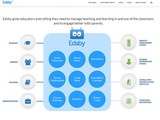
Put simply, Edsby uses modern technologies to connect learning communities. It’s a cloud-based software application that blends social networking with class and student management. Edsby’s intention is to increase engagement between K-12 students, teachers, parents and administrators. It features tightly integrated capabilities like social learning, school news, group collaboration, assessment management, timetables and calendars, course planning, report cards, and attendance.
Sounds good enough, but how does it work?
Many LMSes were originally developed for higher education and later adapted for K-12, but Edsby is designed specifically for the unique needs of a K-12 school district, integrating with legacy systems like the district’s SIS and leveraging existing data and security policies. By plugging into previously installed systems, Edsby uses single-sign-on functionality to simplify access. Additionally, the platform allows for deep customization based on a district’s needs.
How does it help teachers?
Too often, teachers are left to make their own technology decisions and fend for themselves without support from their school or district.
Edsby has been designed to be deployed district-wide to every teacher and student and quickly streamline many tedious administrative tasks, like attendance and grading, while allowing for classroom collaboration and resource sharing. The net effect is making teachers’ lives easier, so they can spend less time finding and maintaining ad-hoc applications like Edmodo and Moodle, and more time engaging with students.
Most importantly, teachers have increased ability to connect with students and parents by facilitating online conversations, sharing class information and asking questions. Think of it as a Facebook timeline for every class.
What about for administrators?
With Edsby, the administrator becomes the eyes and ears of the school and is given a 360-degree view of what teachers, students and parents are doing.
Based on the analytics Edsby provides, administrators can be confident in answering parents’ specific questions about their children’s progress, view student achievement or workloads, and follow up with teachers based on their observations. This sort of academic dashboard is a real strength of Edsby’s. Real-time insights like these are only available when you deploy a system this sophisticated district-wide.
What’s in it for students?
Edsby helps students organize every aspect of their day at school. Students manage their activities in and out of the classroom, collaborate with peers and communicate with their teachers. It’s a central location for teachers to upload important class documents and serves as a main meeting point for students to get what they need, whenever they need it.
School districts often see an increase in student participation as teachers leverage the LMS’s social learning features. Students are taking advantage of Edsby’s accessibility on multiple devices and constantly login from their phones, iPods, tablets and laptops as districts embrace BYOD policies. At one of Edsby’s largest districts, student posts in Edsby classrooms and groups are up 186 percent this year over the previous year, according to the company.
Parents in the LMS
Parents get their own Edsby logins to view student progress, important news from the school or district, and an easy to way communicate with teachers and administrators without having to pick up a phone or send a note. Even better, when a whole district uses Edsby, parents only have to learn and use one application, instead of the bewildering array parents are faced with when teachers pick their own technology class to class, teacher to teacher. The problem multiplies for parents with multiple kids in different classes.
Restoring Faith
By connecting disparate education tools into one platform, Edsby brings administrators, teachers, students and parents together to create a productive and well-informed educational community. While traditional systems have raised skepticism about the usefulness of the LMS, Edsby and its modern approach restore the promise of connected teaching and learning. Learn more at www.edsby.com.
The post What You Should Know About the ‘New-School’ Edsby Learning Management System appeared first on TeachThought.
TeachThought Blog
.
Blog
.
<span class='date ' tip=''><i class='icon-time'></i> Aug 05, 2015 09:29am</span>
|
|
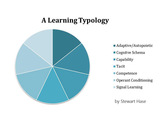
A Learning Typology: 7 Ways We Come To Understand
by Stewart Hase, Heutagogy of Community Practice
This typology is an attempt to redefine how we think of learning in the 21st century context. Current definitions of learning focus on performance rather than holistic growth, and on what the learner can do after a learning experience. Gagne is perhaps the most notable exception.
General dictionary definitions of learning refer to learning as the acquisition of knowledge. (Also, see TeachThought’s 21st Century Learning Dictionary.) The prevailing psychological definition is that learning is a change in behavior resulting from experience. Both these definitions seem inadequate given recent advances in neuroscience that shows us how complex a process is learning.
We are much more able now to examine directly how people learn rather than indirectly by studying what techniques work, which tends to be anecdotal and qualitative. It seems now to make more sense to design learning experiences around how learning takes place and blends with learner interest rather than to produce a particular outcome.
The typology described below concerns what is happening in the mind of the learner during the experience of learning. Using this as a base we are able to then jump into outcomes and the educational or learning experience itself.
Each type of learning implies that different learning experiences can be designed to either help people learn or are aimed at people already operating at that level.
The worthiness test is not meant to be applied. This is a typology not a taxonomy. For example, conditioned behaviors, habits and competencies are critical to survival and to the efficient use of resources. They don’t need to be seen as less vital or subservient to say adaptive learning, although they could perhaps be said to be more primitive.
A Learning Typology: 7 Ways We Come To Understand
1. Autopoietic and Adaptive
This involves what one could call deep learning. Complex connections are made between previous learning in the face of the need to adapt. Bifurcation enables shifts in perspective, the confident ability to attempt something new, to experiment.
Autopoiesis involves self-organization and adaptive behavior in highly complex and perhaps chaotic environment. Learning is applied in novel ways, reflexivity, double loop learning and triple loop learning are used as normal practice to evaluate behavior and outcomes that then facilitate more change in a continuous, adaptive, feedback loop. Knowledge becomes wisdom.
All learning involves pathways being established in the brain that are then retrieved in the form of memory. In adaptive learning, however, we see connections being made between different pathways that create new insights, new ways of seeing the world, new hypotheses to be tested. This is the world of creativity and innovation, and, ultimately, survival in the face of the need to adapt.
You can imagine this sort of learning occurring in the face of very complex problems or when survival is threatened. We are forced to look at the world in a different way, to challenge existing dogmas that clearly are not working. Thus, motivation is high either by design or by rising stress. In the case of the former, one thinks of Edison’s laboratory in Menlo Park or perhaps Google and Apple, hot houses of innovation and creativity.
The latter may involve a more spontaneous rethinking of a theory, a new way of interpreting our experience (data or events), a new insight into a phenomenon, perhaps a reinventing of self.
2. Shifts in Cognitive Schema
Cognitive schema are our values, attitudes and beliefs, that are transcribed into thoughts and actions. In normal day-to-day life they are relatively resistant to change. They are learned early in life and drive much of our behavior. With strong links to the emotional parts of our brains cognitive schema will often override even very convincing evidence to the contrary.
So, a shift in our cognitive schema is a very high order learning experience. It often takes a very emotionally charged event, a powerful experience to change them. This was something that constructivism and one of its sequela, experiential learning, understood very well, as does much of psychotherapy.
As in adaptive learning, a new complex web of pathways is developed, and the old are broken down. So powerful is this shift from old to new that we may later never even recall having held a particular belief or attitude.
With a shift in cognitive schema comes a new set of behaviors. I may, for example, be involved in a cleverly designed experiential learning activity in a workshop that causes me to become aware that I have some very controlling behaviours as a leader. The insight is so powerful that I decide to combat this strong personality trait, delegate more and to trust others rather than micro-manage them.
3. Capability Development
Capable people (Cairns, Stephenson) are able to apply learning in novel situations as well as the familiar. They also have a high level of self-efficacy, collaborate well with others and have the capacity to learn.
Here context is the key to new learning. Changing context provides an opportunity to experiment with our competencies and perhaps find novel and authentic ways of problem finding and solving.
To develop capability I am required to apply my competencies in a range of novel situations, to stay calm in the face of complexity, to think analytically about how to use my skills, to learn new skills, and to seek out a mentor or learn vicariously. I am aware of the importance of relational learning, and of the potential of the learning commons. As I become more adept my self-efficacy increases and becomes more generalized.
4. Tacit Learning
High-level competencies are internalized so effectively that highly skilled tasks can be undertaken without observable/overt thought. Thoughts may be actualized through external questioning. Tacit learning is mostly seen in expert practitioners and occurs quite unconsciously.
I am placed in situations where my competencies are refined in the face of increasingly complex tasks.
5. Competence
Competencies consist of knowledge and skills. We acquire these through direct experience or vicariously, informally and in formal education. Most formal education is concerned with competence attainment and its reproduction.
In today’s networked world obtaining competencies is easier than ever before. We acquire competence through formal education experiences or, more likely, through informal process, when and if we require them.
6. Operant Conditioning
Unconscious, conditioned responses to stimuli in the environment, is also known as operant conditioning. This is a very common form of learning in formal and informal settings and is responsible for us learning many physical and social life skills essential for survival.
We perform a behavior and we are rewarded for it by some form of recognition, reward or positive outcome. The reward conditions the response and we are more likely to reproduce the behaviour in the future. The conditioning of more complex behaviors become habits and are unconsciously repeated.
This sort of learning (conditioning) can also be vicarious as we watch others experience positive outcomes when they do something.
7. Signal Learning
The simplest form of learning also known as classical conditioning. Again, this is a very common form of learning and is unconscious.
When I was a child my mother once gave me honey on bread when I was very sick with Scarlet Fever. It made me feel nauseous. Since then I have had a mild aversion to honey and never eat it. This was an unintended response (nausea) to the stimulus (honey).
Advertisers use classical conditioning techniques to make us buy things. An attractive person driving a particular car or using an appliance is used as a stimulus to elicit a response. A close friend who you always have a great time with when you go out wears a particular perfume. The smell of the perfume on other people makes you feel really good-without you being aware of it.
A Learning Typology: 7 Ways We Come To Understand; image attribution stewarthase and nasagoddard
The post A Learning Typology: 7 Ways We Come To Understand appeared first on TeachThought.
TeachThought Blog
.
Blog
.
<span class='date ' tip=''><i class='icon-time'></i> Aug 05, 2015 09:28am</span>
|
|
Failing Forward: 21 Ideas To Help Students Keep Their Momentum
by Terry Heick
"Failing Forward" is a relatively recent entry into our cultural lexicon-at least as far has headlines go anyway-that has utility for students and teachers.
Popularized from the book of the same name, the idea behind failing forward is to see failing as a part of success rather than its opposite. Provided we keep moving and pushing and trying and reflecting, failure should, assuming we’re thinking clearly, lead to progress, So rather than failing and falling back, we fail forward. Tidy little metaphor.
So what might this look like in your classroom?
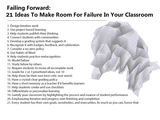
Failing Forward In The Classroom: 21 Ideas To Help Students Keep Their Momentum
1. Design iterative work (i.e., work that deserves and is conducive to revision and iteration)
How does this promote failing forward? If there’s no stopping point, then mistakes are simply opportunities.
Say: "Your design work on the app blueprint is coming along nicely. Awesome job using the feedback from the subreddit you got the idea from."
2. Use project-based learning
How does this promote failing forward? Not only does PBL encourage iteration, but it also reduces the snapshot effect of academic assessment, where stakes are high, errors are costly, and there is almost always a right and wrong answer.
Say: "Your first two drafts didn’t work so well, huh? What can you take from each of them-what’s salvageable and what’s not?"
3. Help students publish their thinking
How does this promote failing forward? This helps mistakes become a matter of transaction between the student and their audience, i.e., the writer and the reader.
Say: "How did your audience respond to your ideas? Based on that, as data, how might you respond?"
4. Connect students with communities
How does this promote failing forward? In the classroom, students are motivated by performance and image; in a community-assuming it’s one the student cares about-they are motivated by the effect of the work and an identity that’s crafted over time. Or they should be anyway, depending on the nature of the connection with the community.
5. Develop a grading system that suggests it
How does this promote failing forward? Good old-fashioned extrinsic motivation. So give them points for correcting mistakes instead of not making them to begin with.
Say: "This essay was well-conceived; loved the clear purpose here, so you got full points for your initial execution. For the remaining points, you’ll now need to go back and revise this and edit that and that."
6. Recognize it with badges, feedback, and celebration
How does this promote failing forward? As with #5, you don’t just claim to embrace mistakes, you provide instant feedback for it as a good thing with some kind of gamification, or merely a genuine one-on-one conversation with the student.
Say: "I was especially proud of the way you revisited this problem and found a better solution; you’ve now unlocked this achievement."
7. Consider a no-zero policy (i.e., don’t "allow" zeroes as a team, grade level, or department)
How does this promote failing forward? When you insist that every assignment has to be completed by every student regardless of circumstance, you send a powerful message that all work is important. So A) Make sure the work they do is, in fact, worth their time, but B) Let them know through a well thought-out no-zero policy that failing to turn in an assignment isn’t the end of anything, nor will it simply become a mathematical effect on their grade.
8. Use Habits of Mind
How does this promote failing forward? Habits of Mind promote non-academic priorities that are hugely personal, and, once internalized by the student, valuable in and out of the classroom.
9. Help students practice metacognition
How does this promote failing forward? The more than can monitor their own thinking and performance, the more flexible they have a chance to be in real-time while doing the work to begin with, especially when you’re not around.
Say: "When you got to this point in the design process, what was your main focus?"
10. Model failure
How does this promote failing forward? You, as a professional, are modeling the humility and perseverance it takes to fail forward.
Say: "I created this test to help me understand what you understand, but I messed up; it doesn’t do that very well. In fact, it’s confused both you and me, and now I have to figure out how to respond."
11. Study failure (often by those with "street cred" for students)
How does this promote failing forward? See #10, only this time it’s someone outside the classroom, so it has a chance for a different kind of credibility.
Say: "In 1895 when Nikola Tesla’s lab burned and he lost many of his notes and much of his equipment, he could’ve rested on his reputation and gotten a cushy job working for someone else. Instead…"
12. Require students to revise all incomplete work (and it’s "Incomplete" if it’s not proficient)
How does this promote failing forward? This is a similar to a no-zero policy-all work needs to demonstrate a certain level of quality, or it needs to be improved.
Say: "This is so close to representing what you’re able to do. How can we take this and use it to push further?"
13. Grade for 2 or 3 prioritized ideas, not 10
How does this promote failing forward? Oftentimes, those students in need of the most help have the most to improve upon/recover from after feedback and grading. Keep it simply. Grade in stages, or better yet, personalize the grading for that student.
14. Help them be their own best critic (not worst)
How does this promote failing forward? If you can help them, in fact, become their own best critic, they’ll hold themselves to a higher standard than you ever could. but from a position of possibility, not judgment.
15. Have a crystal-clear grading policy that is knowledge and experimentation-friendly, rather than closed and risk-averse
How does this promote failing forward? By studying your grading system, you can be more certain what it "encourages." By sharing it with others, you can get their feedback, revise it until it encourages what you’d like it to, and then make sure students understand how they’re being graded and why.
16. Have a short memory as a teacher if it benefits learners
How does this promote failing forward? Mistakes should be temporary; students can’t have a growth mindset if their learning leader holds grudges.
17. Help students create and use checklists
How does this promote failing forward? This one more protects the student from that initial failure than helps them respond after they do.
Say: "This checklist should help you as you begin planning your project. If it doesn’t, let’s revise it until it does."
18. This one isn’t simple, but differentiate or personalize learning
How does this promote failing forward? The more just enough, just in time, just for me it is, the more it can suggest true ownership by students-and ownership can lead to pride, pride to grit and affection and improvement.
19. Gamify your classroom by highlighting the process and nuance of student performance
How does this promote failing forward? The more visible the process of failure and recovery are, the more "failure literature" students can be, and the better they’ll be able to duplicate the failure-recovery process on their own.
20. Emphasizing iteration and progress over finishing and completion
How does this promote failing forward? Like #1, this focuses on learning as a process; unlike #1, this has less to do with how you design the work, and more with how students see the work you’ve already planned and how they approach it. (#19 can come in handy here as well.)
21. Every student has their own goals, sensitivities, and insecurities. As much as you can, honor that
How does this promote failing forward?
Say: "You’re one of the most creative students I’ve ever met with extraordinary potential. With that in mind, I’ve developed a unique grading system for you this 9 weeks to see if we can’t use all that talent."
Failing Forward: 21 Ideas To Help Students Keep Their Momentum
The post Failing Forward: 21 Ideas To Help Students Keep Their Momentum appeared first on TeachThought.
TeachThought Blog
.
Blog
.
<span class='date ' tip=''><i class='icon-time'></i> Aug 05, 2015 09:28am</span>
|