Blogs
|
A Very, Very Powerful Motivational Video For Teens
by TeachThought Staff
Motivation is one of the great mysteries of humankind. Why do we want what we want?
We even study it in literature-character motivation. What does this character want, and what do they have to overcome to get it?
The answer is never simple. Even a reductionist take says that there are primary and secondary motivations-and thus often primary and secondary conflicts in any story.
Student motivation goes into even deeper waters: What motivates this student to "succeed" in school? Is it intrinsic motivation or extrinsic motivation? Does it ebb and flow? Is it perishable altogether?
And does success mean different things for different students? Good grades? Reaching a new personal best? Reconfiguring their self-identity as a learner and as a student? Simply showing up every day for a week?
The video above distills the idea of motivation into something elemental. If you’re motivated by things or events or glory, you’re not motivated at all because that’s not motivation. You’re not really motivated to achieve something until you want it as bad as you want your next breath. And every decision you make directly impacts that achievement-whatever that achievement is for that student. When you say you want something, and then act in a way that indicates otherwise, that’s revealing.
That’s not even "bad" necessarily. It clarifies things for you, because it’s clear you don’t really want it. You just want to say you want it. You just like to talk about goals. You like the way it feels to feign ambition. If you can’t make progress, you find things to blame.
But the truth is something simpler: Until you can’t be deterred, you don’t really want it.
Note, there is a whole bunch of shirtless-dude in this video, so consider your audience accordingly. It uses a football player training as a backdrop for the message, so it probably wouldn’t appeal much to younger children, or maybe even to you as a teacher.
But for teens-especially males-it may just get their attention.
A Very, Very Powerful Motivational Video For Teens
The post A Very, Very Powerful Motivational Video For Teens appeared first on TeachThought.
TeachThought Blog
.
Blog
.
<span class='date ' tip=''><i class='icon-time'></i> Aug 05, 2015 09:28am</span>
|
|
Outernet: One Device, Free Data From Space Forever
by Thane Richard
While the title may sound like science fiction, it is actually a momentous step towards truly universal education that is already happening.
Currently, Outernet is broadcasting news, ebooks, Wikipedia, and academic articles on four continents. But we can do more. One of the most significant steps we can make in education is by giving people the tools they need to become their own teachers. That is our mantra at Outernet.
First, it is important to understand what Outernet is and how it works. Outernet is like FM radio, but instead of music we broadcast information. Instead of radio towers, we use satellites so we can cover more area. Outernet uses radio waves like FM radio, just at a different frequency.
These waves are picked up by a receiver - the equivalent of a radio in this analogy - and are turned into files that the receiver stores on its drive. Then, instead of playing music for your ears, the receiver emits a Wi-Fi signal that is heard by a phone, tablet, computer, or any other Wi-Fi capable device. Imagine a FM radio that saves all the songs it receives, but instead of songs it saves news, all of Wikipedia, educational material, disaster alerts, books, and more.
To connect to Outernet, you need a receiver. We publish plans on our website to let anyone build a receiver, which requires a satellite dish to receive our broadcast. However, for the next three days, our first dish-less receiver called "Lantern" has been funded. Lantern has built-in solar panels so that it can work off the grid and it can be used to charge your phone or other device. We raised our goal of $200,000 in just five days and now, and reached our goal of $500,000 January 11th, 2015. This let us increase our broadcast bandwidth from 2 MB/day to 10 MB/day. Right now these receivers are external, but we have the capability to eventually install an antenna the size of a computer chip into a phone or tablet, giving it built-in free data.
When it comes to education, the application is immediate and powerful. One of the categories of content we have included in our broadcast is teacher training material, currently from Teachers Without Borders (though we welcome other suggestions). For existing teachers, an enormous burden for physical resources is lifted. The cost of a smartphone has dropped dramatically (as low as $25), which can now be a passport to an endless library of humanity’s best content.
For example, we broadcast an offline version of Khan Academy, turning any device into a classroom. But the possibilities of Outernet are truly limitless because a large part of our library is built on user-requests; if there is something you want that is not currently being broadcast by Outernet, reach out to us and we will broadcast it. To go back to the FM analogy, we are democratic DJ’s taking song requests for content. The value of having a library as part of a school is intuitive. Now, that library has been made digital and universally available.
How Outernet Works
But Outernet goes beyond a purely educational application. Right now, 4.3 billion people on Earth cannot access the Internet. Said another way, two thirds of humanity cannot enter the largest library ever constructed. Think of everything we have accomplished while operating at ⅓ our capacity (or less for most of history). Now think about how much more we could accomplish if every human being on Earth were able to contribute to the global marketplace of ideas. What would we discover? What advances would we make as a species?
Fundamentally, this is the role of teachers. Teachers are the guardians of humanity’s future because it is the teacher’s job to cultivate our most valuable asset: the human mind. One of my favorite examples of Outernet’s potential is Jack Andraka. Andraka used Wikipedia and academic journal articles to develop a brand new early detection method for pancreatic cancer. He was only 17 when he did this. He received nearly 200 rejection emails before a Johns Hopkins researcher responded.
Our conventions for how we access information and how that information manifests itself in advancements needs to be radically altered. If he had not had access to those materials, he would have never made such a discovery. History is replete with stories like this. The sad question we are left to ask is: how many Jack Andrakas have come and gone without ever making their discovery? Fortunately, we can stop this waste of talent forever.
Outernet is a quantum leap for education and, thus, a quantum leap for humanity. I hope you will consider supporting our work and spreading word of Outernet to your colleagues and friends. Help us build this great library in the sky.
Outernet: One Device, Free Data From Space Forever
The post Outernet: One Device, Free Data From Space Forever appeared first on TeachThought.
TeachThought Blog
.
Blog
.
<span class='date ' tip=''><i class='icon-time'></i> Aug 05, 2015 09:28am</span>
|
|
Launching A New Idea In Your School? Some Thoughts For Your Success
by Grant Wiggins, Authentic Education
Ed note: This is a slightly-edited excerpt from a post by Grant on differentiation and the implementation of policy.
Looking for a process to avoid bad implementation of what very well might be a good idea? A new literacy program, curriculum framework, technology, or schedule? A solution seems straightforward, based on our sad history in making this mistake. Below are 13 thoughts-a kind of sequence-to consider.
intense study of local needs - identification of gaps between Mission and reality
intense study of possible initiatives, given a need/problem statement
a process and set of criteria for weighing the pros and cons of possible initiatives/approaches/programs
a Purpose statement for the new initiative decided on - the idea and ideal to be safeguarded throughout the work, why the idea suits our needs at this moment in time, and why this is the most promising initiative
intense study of past initiatives locally: which succeeded, which failed, and why?
policies and criteria for vetting whether a proposed initiative is Mission-appropriate, and whether or not a strategic plan exists that is likely to make the initiative succeed
incentives for pioneers to try it out and report back
incentives and opportunities for rank-and-file teachers to try out some manageable aspects of the initiative - thus, some choice for teachers
models of exactly what teachers are supposed to do, in their grade/subjects, of the initiative
a strategic plan that anticipates and adjusts based on the most likely misunderstandings, concerns, rough spots, and logistical impediments to success. ("This initiative will fail unless we deal with such likely roadblocks as…"
a system for ensuring lots of feedback to teachers and sharing by teachers in all scheduled staff meetings, as they try things out
a steering committee charged with gathering constant and timely feedback about the initiative and acting on it in a timely way
the steering committee recommending key structural changes needed to optimize the long-term success of the initiative, so that all the work is not on the back of individual isolated teachers
The first three points deserve special attention in light of common criticisms of DI - namely, that it is difficult to manage as an individual teacher (True). DI is one possible solution to excessive i.e. unmanageable heterogeneity in the typical classroom. So, if the problem statement is: too many learners of great difference in ability in certain classes, limiting engagement and achievement for all, then there are additional reforms, beyond DI, that should be considered, too.
Maybe we need to reconsider birth-year related grade levels; maybe we need to group more homogeneously (as we happily do in Spanish and upper-level math classes) throughout the period or day. Yes, tracking is bad; that doesn’t mean that intelligent and flexible grouping in classes - especially in a standards-based world where we are accountable for the achievement of all learners - is a bad idea. Then, any proposed solutions might tackle both DI and structural solutions - and be really "owned" by staff since the initiative was a logical response to need rather than a mysterious mandate.
In short, we tend to mandate "solutions" before the problem statement is fully explored, established, and used to consider alternative solutions.
This article was excerpted from a post that first appeared on Grant’s personal blog; Grant can be found on twitter here; Itemizing Sustainable School Improvement: A Sequence; Launching A New Idea In Your School? Some Thoughts For Your Success
The post Launching A New Idea In Your School? Some Thoughts For Your Success appeared first on TeachThought.
TeachThought Blog
.
Blog
.
<span class='date ' tip=''><i class='icon-time'></i> Aug 05, 2015 09:27am</span>
|
|
Punk Rock Preschool: Our Classroom’s Venture into Entrepreneurship
by Jarred Geller, Punk Rock Preschool
In our Pre K class, the only standard we try to meet is developing a love of learning, and once we feel this way about knowledge, everything else falls into place.
So how do you get Pre K kids loving learning? Well it doesn’t involve teaching them that pigs go oink and cows go moo. And neither does it involve singing The Wheels on the Bus and The Itsy Bitsy Spider every morning. Pre K kids love learning the same way adults love learning. Respect them. Challenge them. Make it relevant. Make it fun.What do you envision when you think of a Pre K curriculum? Is the day littered with finger painting, nursery rhymes, and clarifying questions regarding what sounds various farm animals make? Some people truly believe that this is Pre K and this is what Pre K should be and must be, but in our class, we don’t subscribe to such fallacies.
And respecting them doesn’t just mean I respect their capacity to learn. I respect their capacity to rock. I don’t know where it was stated that little kids like boring, hardly educational music that drags along and puts you to sleep but its not true. We say that educational music shouldn’t have to be for squares. It should be for trapezoids and parallelograms and whatever other shapes you wish to be. We take the rhymes out of the nursery.
The music started last year when I wrote a song about shapes to help the kids learn more obscure forms like trapezoids and parallelograms. That song has since evolved into an entire catalog of catchy, pop punk music that teaches concepts from world geography to elements of a story to stopping pollution. And because the music rocks, the kids love the process and love the learning. Everything else comes easy.
Already this year we have learned about geography, geology, zoology, pollution, environmentalism, and now we’re diving into our economics and entrepreneurship unit. With the previous units, the class loved seeing how all living things are connected and as such, they were inspired to save the environment. After all, the kids want to live on a clean planet where none of their favorite animals go extinct.
Now that we’re jumping into a more business-focused unit, I knew we had to do something innovative for the kids to find the same meaning and relevance in business as they so easily saw when learning about the environment.
Salaries, bonuses, and incentives started replacing stickers as the currency for doing an excellent job. We printed out monopoly dollars and created our own economy in which learning means earning (helping others , working hard and doing your best always earn you money too!) We’re learning how trade works and how it only happens when both parties are better off.
And if we expect little kids to know how to share, we should definitely expect them to understand the idea of trade, considering they will be trading every day once they have some money. We’re also learning that we can vote with our money and help entrepreneurs that are meeting our demands while leaving the bad entrepreneurs to change their practices or lose their business.
And now we are learning about entrepreneurship, and we’ve learned that entrepreneurs solve problems. So we’re solving a problem no one is talking about:
Educational music is boring.
Our music started as a vehicle to learn difficult material and now we are taking that concept and expanding on it. Big time. We are using our music as a vehicle to become entrepreneurs. And that is how Punk Rock Preschool was born.
Since then, we’ve discussed that if we are going to be entrepreneurs, we are going to be socially conscious. When we outlined our goals, we focused on investing in our community, our world, and ourselves. To that end, the class came up with these five ambitious and admirable goals.
5 Goals Of Punk Rock Preschool
We Want to Help a lot of People Learn
Plant a Garden in our Community
Recycle at our School
Save the Endangered Species
Go to California and be Rock Stars
From there we created a YouTube video explaining what Punk Rock Preschool is all about, we launched our website (www.punkrockpreschool.com), and we’ve gone over the ideas of networking, branding, and marketing as a class and now we are putting it all to the test.
I guess the only thing left to do is be entrepreneurs. So today is the big day! We are happy to launch our KickStarter where you can see our first music video all about learning shapes and see the full scale of our class’ entrepreneurial venture.
Our music will always be free, but we hope people will pay what they feel it is worth to them. In this regard, we will use KickStarter to help us learn how value is derived and how effective we are at making educational music rock a little harder. When it comes down to it, it is all about the learning in Punk Rock Preschool and we feel we are on the cusp of making a big difference in not only the lives of the students in our class but in the lives of all Pre K students around the country.
Punk Rock Preschool is a testament to the amazing capacity of young children. We hope that it will be an inspiration that Pre K is capable of learning and doing so much if we just believe in them. When we make learning relevant, rigorous, and fun that’s how passions are developed.
That’s how lives are changed.
Punk Rock Preschool: Our Classroom’s Venture into Entrepreneurship
The post Punk Rock Preschool: Our Classroom’s Venture into Entrepreneurship appeared first on TeachThought.
TeachThought Blog
.
Blog
.
<span class='date ' tip=''><i class='icon-time'></i> Aug 05, 2015 09:27am</span>
|
|
Teacher Reader Responses, Vol. 1: On Literacy
by TeachThought Staff
In an effort to increase the visibility of increasingly insightful, detailed, emotional, or otherwise compelling reader comments, we’re going to give a shot sharing these thoughts in a semi-regular post of some intermittent pattern. A few of some of the better recent comments appear below, in a "Volume 1″ form.
We’ll be expanding this "teacher voices" effort in other ways soon.
First, for our top comment of the week. In "When Students Read But Don’t Understand," Annette Ong left a fantastic summary of Grant’s post on literacy while offering counter-research that supported another view.
"Wiggins’ argues that educators can improve reading comprehension by understanding the strategies that unsuccessful readers employ and by generating personalized strategies based on that information. According to Willingham and Lovette (2014), text comprehension is all about connecting sentences and content. Reading comprehension strategies (RCS) are simply a "bag of tricks" that although are useful to teach because they are quick and easy to learn, do not provide specific guidelines on how to connect sentences. As a result, Wiggins’ proposed solution of using RCS does not directly result in improved understanding of text.
Wiggins also suggests that teachers should administer more ungraded self-reporting and comprehension assessments in order to provide the students with more useful and applicable feedback. A prominent weakness in Wiggins’ suggestion is that student introspection, especially in the lower grades, can be highly inaccurate, and many students experience difficulty in articulating
the challenges of reading. Younger students also have limited metacognition and often incorrectly assess their understanding.
While Wiggins’ suggestions on reading comprehension improvements are tenuous and unlikely to result in much progress, researchers Verhoeven and Leeuwe (2008) have generated more concrete techniques that can be employed in the classroom. In the Verhoeven and Leeuwe (2008) study, the researchers investigated the validity of two possible hypotheses regarding reading comprehension. The lexical quality hypothesis states that vocabulary knowledge and word decoding largely determine reading comprehension, while the simple reading view states that word decoding and listening comprehension are the determinants of understanding text. Word decoding is the retrieval of the phonological code, while listening comprehension is defined as the linguistic processes that allow individuals to form connections between sentences. Vocabulary decoding is the knowledge of word meanings, and studies have reliably demonstrated that there is a positive correlation between vocabulary skill and reading comprehension.
In the experiment, the researchers tested 2384 elementary school children on word decoding, listening comprehension, vocabulary, and reading comprehension. Verhoeven and Leeuwe (2008) found that the results supported both the lexical quality hypothesis and the simple reading view. The former hypothesis was supported by the data because limited knowledge on word meanings restricted the student’s ability to understand the text. The researchers also found that there was a two-way relationship between vocabulary knowledge and reading comprehension because increased reading results in improved word meaning deduction, and greater vocabulary knowledge improves understanding of text. Moreover, while listening comprehension predicted reading comprehension in the lower grades, in higher grades, the two factors were reciprocal, such that the improvement in one leads to the progress of the other.
Due to the reciprocal relationships between vocabulary knowledge/listening comprehension and reading comprehension, respectively, Verhoeven and Leeuwe (2008) suggest that teachers should be aware that some children do not share equal knowledge about the content of the text, and should account for this disparity by enhancing the students’ understanding of the topic-specific
vocabulary. Educators should use pre-reading activities to provide background information and discuss the topic of study. Additionally, educators and administrators should begin vocabulary training early in education. The researchers also advise teachers to select texts that are well organized to facilitate the students’ understanding of the reading.
Rather than employing self-assessments and comprehension tests to generate strategies for reading comprehension, educators should not only engage the students in generative word exercises to enhance vocabulary knowledge, but teachers should also employ activities that allows students to make inferences by integrating information from different sentences."
Sources:
Verhoeven, Ludo, and Jan Van Leeuwe. "Prediction of the Development of Reading Comprehension: A Longitudinal Study." Applied Cognitive Psychology 22.3 (2008): 407-23. Web.
Willingham, Daniel T., and Gail Lovette. "Can Reading Comprehension Be Taught?" Teachers College Record, 26 Sept. 2014. Web. 14 Feb. 2015.
Juliana Meehan commented on the same post:
"Thank you…these points you make about struggling readers and questions you ask are the ones I struggle with daily. I absolutely agree that taking away the stress of grades by giving formative assessments helps students get on board. I’ve explained what "formative" is to my sixth graders, and I try to get them involved in the process… Generally, anecdotally, they see the logic of it (as far as that goes with sixth graders!).
We also need to ask questions and really listen. Last week, I assigned an article on different species of penguins to my sixth graders, and their assignment was to write a response comparing/contrasting Antarctic penguins with penguins that live in temperate regions. I pre-taught the vocabulary; I gave them a "tophat" graphic organizer and showed them how to use it; and then I set them loose to read, take notes, and write a response. On day 2 (they ran out of time on day 1), we reviewed what we were doing in order to continue, and I elicited questions. One student raised her hand and said, "I can’t find anything on ‘Antarctic’ penguins, only on ‘penguins who live in the Antarctic.'" I took a deep breath and kept my expression under control and asked whether anyone else had the same problem. Four out of fifteen hands went up… I had not the remotest idea that that would be a stumbling block to them. How many more misconceptions are swirling around in kids’ brains and we have no idea? Without a climate of trust, freedom from fear of grades, and inquiry on the part of teachers, we won’t get at the problems, I fear. Incidentally, this particular class is pass/fail, so on day 1 I tell them, "You all pass. Now, let’s get down to work." I like to think that makes a difference.
The first question I asked when I started my reading masters degree was, "How to people learn to read?" I have never gotten an answer…and as your post shows, we still all do not know. I am grateful for the work you-and all reading teachers-are doing. Hopefully, we will learn how to help our struggling readers.
In Homeschool 2.0, Leah Stewart lamented the lack of autonomy for many teachers, but sees light at the end of the tunnel.
"I went through the normal schooling and the whole time thought; this can’t be the best thing for us, don’t they understand? The saddest part was when I realized that many teachers do understand, but they’re tied to the syllabus and their job contract so can’t really do much for us. They can’t risk their jobs by being too ‘real’ because they have a mortgage to pay and a family to support. So they must register us at 8.45am, they must check our uniforms, they must set a certain level of homework, they must prepare us for exams in the subject they teach, and on and on. So much is wasted within normal schooling because teachers and students aren’t trusted by the system. I’m excited for the future because I’m certain this situation can’t hold forever."
Learning Models, Theories, and Technology: A Dictionary For 21st Century Teachers, Amy Burns applauds the idea of a "common language" to improve our craft. "If we can all speak the same 21st Century language, we would have to increase understanding."
The post Teacher Reader Responses, Vol. 1: On Literacy appeared first on TeachThought.
TeachThought Blog
.
Blog
.
<span class='date ' tip=''><i class='icon-time'></i> Aug 05, 2015 09:27am</span>
|
|
50 Of The Best Google Chrome Extensions For Teachers
by TeachThought Staff
Google Chrome is, increasingly, where it’s at.
As of April 2014, Google Chrome become the de facto internet browser, passing Internet Explorer for the first time after a five-year free-fall from Microsoft’s out-of-favor software. Fast forward to today, and StatCounter paints an even bleaker picture for Google Chrome competition, with Safari, Firefox, and IE combined still below Chrome’s nearly-50% market share.
While the real story is more complicated, with Microsoft bundling IE with windows giving it a huge built-in user-base, the rise of Google Chromebooks, Apple’s elegant-but-iOS-only Safari, and overall a subtle shift in mobile away from browsers to apps muddling the picture even further, what’s truly "the best" or "most popular" browser isn’t cut-and-dry.
But for the here and now, as far as browsers are concerned, Google Chrome is king, and part of what makes it great are Google Chrome Extensions.
What Are Google Chrome Extensions?
As explained by Google themselves, Google Chrome Extensions are "applications that run inside the Chrome browser and provide additional functionality, integration with third party websites or services, and customized browsing experiences." While there is some grey area between Google apps, extensions, and simply shortcuts to websites, the right extensions can turn your browser into a Swiss-army knife of utility and efficiency.
What Is The Benefit Of An Extension For Teachers?
They can make things simple, more accessible, more visible, more compelling, more convenient-there are dozens of potential benefits to you in your classroom. Clip a web page to Evernote with a single button push. Look up a reference. Model for students how to add a citation. Send a link to colleagues without opening another tab. Find a useful resource for a lesson? Scoop it. Tweet it. Pin It. Find a post you want to read? Don’t email it to yourself-use Pocket.
The criteria we used to choose each extension? The extension had to increase your efficiency, provide a benefit to content/curriculum, allow you to connect with other teachers/parents/students, or enhance your workflow as an educator. If it has the potential to meet one of these four criteria, it was included.
Too Many Extensions?
Before skimming through these and installing 25 of your favorites, note that too many extensions can slow your browser down, and speed is one of Chrome’s other talents. Don’t rob Peter to pay Paul.
There is no standard for how many extensions you should use-your mileage may vary here. The speed of your PC, your available memory, your WiFi speed, how many tabs you keep open, and more can all impact your browser’s apparent speed, so add and remove extensions (it’s as simple as a few clicks-see the video above) to optimize your setup so that Chrome remains snappy and useful to you as a teacher.
50 Of The Best Google Chrome Extensions For Teachers
︾
5.06k
views
50
items
50 Of The Best Google Chrome Extensions For Teachers
Listly by Terry Heick
50 Of The Best Google Chrome Extensions For Teachers
Follow List
Embed List
1
Google Translate for Google+
Translate your Google+ stream using integrated, inline, Google Translate support.
3 likes
Comments
Relist
Share
2
Google Calendar Checker
Tells me when my next meeting is without having have to look to far or click anything.
2 likes
Comments
Relist
Share
3
Clip to Evernote
Use the Evernote extension to save things you see on the web into your Evernote account. It even lets you search through your notes.
2 likes
Comments
Relist
Share
4
Lastpass
This was the extension I was waiting for before completely switching away from Firefox!
2 likes
Comments
Relist
Share
5
Pocket (formerly Read It Later)
Pocket Extension for Google Chrome - The best way to save articles, videos and more
2 likes
Comments
Relist
Share
6
Feedly
The easiest way to launch cloud.feedly.com
2 likes
Comments
Relist
Share
7
Evernote Web Clipper
Use the Evernote extension to save things you see on the web into your Evernote account.
2 likes
Comments
Relist
Share
8
Save to Google Drive
Save web content or screen capture directly to Google Drive.
2 likes
Comments
Relist
Share
9
Docs PDF/PowerPoint Viewer (by Google)
Automatically previews pdfs, powerpoint presentations, and other documents in Google Docs Viewer.
1 likes
Comments
Relist
Share
10
Docs PDF/PowerPoint Viewer (by Google)
Turns stuff into Google Docs
1 likes
Comments
Relist
Share
11
Readability
Readability is a simple tool that makes reading on the Web more enjoyable by removing the cluter around what you're reading
1 likes
Comments
Relist
Share
12
Buffer - A Smarter Way to Share on Social Media
Buffer makes it super easy to share any page you're reading. Keep your Buffer topped up and we automagically share them for you through the day.
1 likes
Comments
Relist
Share
13
Quizlet
Quizlet makes simple tools that let you study anything, for free
1 likes
Comments
Relist
Share
14
Movenote for Education
Present your documents with video.
1 likes
Comments
Relist
Share
15
Ancient History Encyclopedia
A non-profit community website that provides free peer-reviewed ancient history information.
1 likes
Comments
Relist
Share
16
Website at VideoNot.es
The easiest way to take notes from videos. Everything synchronized!
1 likes
Comments
Relist
Share
17
Pushbullet
Pushbullet saves you time by moving your notifications, links, and files wherever you go.
1 likes
Comments
Relist
Share
18
Adblock for Youtube™
Popular Adblock for Youtube™ Extension: Removes the video ads from Youtube™. Thanks to all AdBlock supporters!
1 likes
Comments
Relist
Share
19
TweetDeck by Twitter
Your personal browser for staying in touch with what's happening now
1 likes
Comments
Relist
Share
20
Google Similar Pages
Shows four similar pages to the one you are on now. An absolutely essential app for bloggers or just those looking for more of the same!
0 likes
Comments
Relist
Share
View more lists from
Terry Heick
50 Of The Best Google Chrome Extensions For Teachers
The post 50 Of The Best Google Chrome Extensions For Teachers appeared first on TeachThought.
TeachThought Blog
.
Blog
.
<span class='date ' tip=''><i class='icon-time'></i> Aug 05, 2015 09:27am</span>
|
|
3 Ways Personal Learning Networks Are Evolving
by Peps Mccrea, staffrm.io
The notion of a Personal Learning Network (PLN) is a familiar concept these days. Yet, the nature of Personal Learning Networks is evolving as the range of tools available to support them increases, and our rapport with those tools becomes more sophisticated.
The aim of this post is to outline the changes that appear to be taking shape, and to offer some practical strategies for teachers to supercharge their Personal Learning Networks.
Evolution 1: Sharing is becoming more agile
Agile is a concept that has had a significant impact on the software development community. At it’s core, it is about getting products and ideas out quickly, so that their potential value can tested and feedback gathered to improve them. The products and ideas are then iterated and the cycle continues.
A similar phenomenon is beginning to happen in Personal Learning Networks spheres. Educators are shipping their ideas before they are perfect, and encouraging others feedback and build upon those ideas. PLNs are exhibiting a hive mentality with a common purpose at their heart. Making your Personal Learning Networks more agile is a must.
3 Ways to make your PLN more authentic & agile
1. Write shorter posts or otherwise create more shareable content more often
2. Don’t hold back from sharing half-formed ideas; contextualized properly, this is where Personal Learning Networks can hit their sweet spot. It’s also a part of a growth mindset!
3. Build on other peoples ideas and take them in your own direction while communicating who influenced you and how.
Evolution 2: Learning is about challenging yourself
In the past people were content to have a Personal Learning Network that agreed with their views and understood their perspectives. Nowadays, we seeing people follow and interact with those who offer different perspectives and can challenge their viewpoints.
This requires courage, but extending you Personal Learning Network to incorporate people you disagree with will force you to develop a more open mind, and a more robust personal position. In short, it’s a stronger learning experience.
3 Ways to challenge yourself within your PLN
1. Follow people on Twitter who’s ideas you disagree with and don’t always understand
2. Engage in debate, but make sure to go for the ball, not the player
3. Challenge your own assumptions in public
Evolution 3: Personal is becoming professional
In the next few years we’re going to be talking much more about Professional Learning Networks. The differences are subtle yet powerful. One is that professional learning networks are more focussed on the purposes rather than the compositions of their communities. Collaboration is about making change happen at the societal rather than individual rather.
Personal leaning still happens, but as a by-product. Another difference is the role that identity plays in Professional Learning Networks. Educators are finding more sophisticated ways of representing themselves and their reputations online.
3 ways to professionalize your PLN
While a more familiar route may be to personalize your professional learning network, the reverse also applies. Here’s how you can begin to professionalize your Personal Learning Network.
1. Figure out your unique value offering, and build your Personal Learning Network around that
2. Collaborate with others to make change happen as well as share ideas
3. Use multiple platforms to build a richer and more distributed identity.
Pulling It All Together
Personal Learning Networks are here to stay, and they will continue to evolve. The most important thing is to muster to courage to jump it and experiment. Personal Learning Networking is as much about your mindset as it is about the action you take.
What changes have you noticed in Personal Learning Networks? Please share your ideas in the comments - I’d love to know what you think.
Peps Mccrea is a teacher educator, and the founder of http://staffrm.io - a new Professional Network for Teachers; 3 Ways Personal Learning Networks Are Evolving; adapted image attribution flickr user mkhmarketing
The post 3 Ways Personal Learning Networks Are Evolving appeared first on TeachThought.
TeachThought Blog
.
Blog
.
<span class='date ' tip=''><i class='icon-time'></i> Aug 05, 2015 09:26am</span>
|
|
The Opportunities For Creativity In Your Teaching
by Patricia Rose Upczak, The International Conference of Creativity, Thinking & Education April 18th & 19th, 2015.
Creativity is a process filled with paradox and deep emotion.
Imagine a teal green sea with gentle waves slapping the shoreline. That sea, much like creativity, has so many different moods and qualities depending on your perspective and the weather. The history of creative geniuses throughout civilization is vast and unpredictable in terms of any standard or set rules to produce them.
Often the idea of creativity is put in a special box that is limited to only certain kinds of people. This is one of our great myths. I am sure that Albert Einstein, Gandhi, David Bohn, Martha Graham, Wendell Berry, Aristotle, Pablo Picasso, Billie Holiday, Steve Jobs, Vincent Van Gogh, Mozart, Socrates, Leonardo Da Vinci, Martin Luther King, Beethoven, Charles Dickens, Carl Jung, Tesla, Galileo, Thomas Edison, Ben Franklin and Michelangelo all came from different backgrounds, cultures and ways of life. What they did have in common was the ability to see or feel the dynamic interconnectedness of the flow of life.
How they used their abilities is not really important for this discussion. What is important is that their creative nature was allowed to evolve and grow. When teachers allow themselves to use the kind of thinking that leads to new insights, approaches and fresh perspectives they open up a whole new world to themselves and their students.
The material for developing creativity in students is becoming more easily accessible for the classroom. Some of the ways to develop your students’ creativity are: model creativity, question assumptions, define and refine problems, encourage idea generation, allow time for creative thinking, reward creative ideas and the students’ products or work, allow mistakes.
Research has shown than an important characteristic of genius is immense productivity. All geniuses produce. Rembrandt produced 630 paintings and 2,000 drawings. Bach wrote a cantata every week, even when he was sick or exhausted. Thomas Edison held 1,093 patents. Another important aspect of creativity is fluent thinking, which means allowing quantities of idea to flow.
3 Principles For Creative Thinking In Teaching
So what are the principles for creative thinking in teaching? What matters? Three principles for creative fluent thinking (of many) might be:
1) Trust
Defer judgment while coming up with ideas during lesson, unit, project, or curriculum design. Creativity is a flow. Go with it, or work against it.
2) Quantity
Quantity matters in creativity. Generate as many ideas as possible, alone and collaboratively. (Ideally alone first, then together.)
3) Productivity
In terms of the planning process, write down your ideas when they happen in some way, shape, or form. The creative process should produce something, whether a product, or creative artifacts from the creative process as you go along.
In terms of product-that is, something you can actually see or use in the process of teaching and learning-well, that could be just about anything, couldn’t it? A grouping method, a literacy strategy, a unique #edtech integration, an idea for a project, a differentiation strategy that’s easy to use, etc.
The Opportunities For Creativity In Your Teaching
Teachers often feel overwhelmed by their circumstances, with little energy to develop strategies like possibility thinking to help them or their students develop their creativity in life or school. Consider the following questions to help you see the opportunities for creativity. Keep a journal, and in that journal have a section of problems that you find "interesting" that would be worthwhile to resolve. Another section for teaching or curriculum ideas you would like to work on, etc.
Use what works for you. Consider the following questions as you look for the opportunities for creativity in your teaching.
What would you like to have or accomplish? Write it down.
What do you wish would happen in your school or classroom?
What would you like to do better?
What do you wish you had more time to do?
What would you like to get out of your teaching job?
What are your unfulfilled goals?
What excites you as a teacher?
What angers you as a teacher?
What have you complained about?
What changes would you like to introduce?
What wears you out?
What as a teacher burns you out?
What would you like to organize better?
After you have worked on this for awhile, have your students keep their own private journal to write in.
How Creative Teachers Make Beauty Out Of Chaos
Teachers hold the children of this planet in the palms of their hands. Their jobs are multifaceted and vital for the children they teach.
There are very few routine days in the classroom. Teachers learn easily that plans go awry quickly for a million different reasons. The really extraordinary creative teachers learn to handle the chaos of the world, the educational system and their classrooms with the grace of a gifted dancer. They make teaching look easy. They are the ones who know at some level that great teaching is an art that takes timing, hard work, compassion, great observation and communication skills. They must use their creative talents as they engage their students at all levels.
The clear vision of what a child could be and what their hidden talents are is a vital component to authentic teaching and true education. Factory education does not meet the needs of children or teachers. In the classroom one size does not fit all. This dilemma has plagued education ever since we gave up the one-room schoolhouse. A creative teacher is much like a master director of an orchestra bringing many different instruments and musicians together in harmony. It takes wisdom, patience, kindness and vision.
Every day, the context changes. New technology, new priorities, new pressures. Somehow, creative teachers can squint a little, see what matters, and make it beautiful.
In 1975, Patricia Rose Upczak started a highly successful integrated program for learning disabled adolescents in Boulder, Colorado. She loved her job and taught for 23 years. She is now pursuing a full-time writing career, which includes teaching workshops at schools, conferences, and offering three to five day retreats for teachers and writers in the Rocky Mountains. Currently she is involved with an amazing conference, The International Conference of Creativity, Thinking & Education taking place April 18th & 19th, 2015. Please go to happyteacherhappystudents.com for all the details.
How Creative Teachers Make Beauty Out Of Chaos; adapted image attribution flickr user kittykat21; The Opportunities For Creativity In Your Teaching
The post The Opportunities For Creativity In Your Teaching appeared first on TeachThought.
TeachThought Blog
.
Blog
.
<span class='date ' tip=''><i class='icon-time'></i> Aug 05, 2015 09:26am</span>
|
|
Q&A: How Data Can Make You A Better Teacher
by TeachThought Staff
Students today are more industrious and connected than ever. They engage other students and professors in online forums; they autonomously seek and use personalized learning applications; and they leverage textbook supplements all in service of getting an edge, and trying to make the grade.
This Q&A seeks to answer what visibility instructors have into student engagement, and explore how they’re actively leveraging student data to become more effective teachers.
Andrew Smith Lewis is the Co-founder and Executive Chairman at Cerego. Barbara Illowsky is a Professor of Mathematics & Statistics at De Anza College. They are collaborating on a grant from the Bill and Melinda Gates Foundation to transform education for at-risk and underserved students. Below is a transcript of an interview between Andrew and Barbara.
Andrew Smith Lewis: What types of learning applications, tools, and services do students use these days and how do these tools impact student performance? What types of services and tools would you like to proliferate?
Barbara Illowsky: Students, especially lower-division undergraduate students, want fast, easy and self-directed learning. They expect immediate feedback, whether it is during a face-to-face (f2f) class or 3 o’clock in the morning. Gone are the days when a student learns three weeks after a due date or exam how well s/he performed. Gone are the days when a student waits for the next class or an office hour or tutoring center opening to get assistance or confirmation. Gone are the days when students sit for hours pondering the same content over and over again until they are convinced they have mastered it. And, in my opinion, good riddance to those former ways of teaching and learning!
Most importantly, students want many forms of online supplements available to them so that they can choose what fits their needs. Students use tools that they can access immediately. Most students carry a cell phone and/or tablet. Their devices are often the first place they access to find information such as the text, simulations, homework systems, and even counseling appointments. They want their instruction in small chunks with interactive formative assessment build in.
As soon as students are "stuck" on a problem, for example, they want to find a very similar example to review so that they can go back to the original problem. If they forget the steps they need they want to find that information on their devices. They use tools that verify their knowledge and fill in the gaps, when necessary. I give students the option of doing their homework online or with paper and pencil. Almost every student wants the online version so that they can get immediate feedback and similar problems to review.
ASL: How do you define and evaluate student success, "engagement," and overall course efficacy? What data points or signals do you consider? What has proven most valuable?
BI: The measurable student success is the student earning the grade that s/he has strived for via demonstrating to me sufficient knowledge of the content. From my perspective, success can be displayed via alternate ways. Statistics and mathematics are often challenging courses for students. When a student finally succeeds in a small task, I see student success, even if that student does not complete the course. When a student realizes that s/he needs assistance and accesses optional learning materials, that is a success, too.
I teach both online and f2f classes. Traditionally, faculty have measured or recorded engagement as mostly in-class participation, participation in online discussion threads, and completion of assignments. Yet, engagement, even in f2f classes has dramatically changed with the advancement of supplemental learning apps and devices. Students may be shy in class, but leaders online. Students might not verbally ask questions yet search for answers and participate in online activities, both learning and assessing, solo and with others. Savvy students are finding ways to direct their own learning and not rely solely on the instructor and traditional class. This process is even more widespread in online classes.
One of the ways I measure engagement is via analytics of the online student support built into my courses. However, I know that I am not truly getting the full picture of how my students learn. I need personalized data informing whether students have accessed the support that they need, not what I necessarily provide. I need to know what learning apps would help them and be able to provide that support, too.
What has proven most valuable for assisting me in increasing student learning has been the addition of the WebAssign learning system into my courses.
ASL: Knowing what you use, what types of data would you like to have? In other words, what untapped student data, or application "exhaust" data, would you find most valuable, and why?
BI: I would love to know how long a student actually spends with a learning application and/or working on problems and what they are doing during that time, such as switching between support sites, working on a calculator, reviewing the text. These data are different than how long the student was logged onto the site or how long a video was playing. I would like the dedicated time. I would find it useful to know what about certain concepts make them difficult to learn. Is it the concept or the foundational background needed that is the challenge?
When attempting assessment, whether graded or not, I would like to know whether they needed practice problems and supplemental resources, how useful those additional resources are and why, and what else they needed.
ASL: How, if at all, do you generate student feedback loops around new applications, tools, or services? How do we know it’s working? How much does student feedback weigh into your decision to continue (or cease) using these applications, tools, or services?
BI: One of the challenges that faculty and academic researchers have when studying "interventions" is in getting control versus experimental groups with limited outside variable interference. As a faculty member, if I am teaching two sections of the same course the same term, even with an intervention in one section but not the other, it is still difficult to make statistically accurate conclusions on the effectiveness of the intervention.
I survey my students and do short assessments about all applications. I also ask open-ended questions allowing students to provide feedback. For example, about a third and then two-thirds of the way through the term, I give students the following four questions, due a week later and worth points.
What is working well for you in this class?
What is NOT working well for you in this class?
What more can YOU do to help yourself succeed in this class?
What more can I do to help you succeed in this class? (Note: "extra credit" is not an option!)
Their answers to #1 or #2 almost always include a tool, service or application. I pay close attention and make adjustments based upon student responses. If a tool is not assisting students, then using that tool is wasted time and money. I need to find what works for them, in addition to what I find valuable.
ASL: You’re a statistician, so you may be a bit biased, but in your opinion, do most teachers utilize student data? Is there a comprehension problem? How do you think we can improve data literacy for the next generation of educators?
BI: In the community college system, nationally, adjunct faculty teach over half of the courses. They do not have the time, the funding, the training, nor the access to student data beyond their course assessments. Both full and part-time faculty teaching online have a bit more student data, depending upon the learning management system they are using. Still, this information is generally limited to online assessments and whether a student clicked on a particular page and possibly for how long that page remained opened.
In my experience, very few faculty, including in the STEM (science, technology, engineering and mathematics) disciplines, utilize student data aside from course assessments. Classroom assessment techniques for f2f classes (see Pat Cross’ work from UC Berkeley) have been studied and promoted for over two decades as very short and easy activities to provide immediate feedback to faculty so that they can address students’ needs in the very next class session. Only a small percentage of faculty regularly use even these techniques.
Since I am a statistician and "data junkie", I search for the data that will help ME to improve my teaching and support for students’ needs. I use those data to inform the follow-up discussions and revise my own lessons. I do believe that most faculty are not sure what data to utilize or how the data can lead to improvements in student learning. We need to offer short courses for current faculty on data literacy. We need to include data literacy in graduate programs, not just in computer science and statistics programs. The trend toward data literacy and analytics in academia is definitely increasing. We need to ensure that we properly gather and use the data to increase student learning and success.
ASL: What does the future of data-driven teaching look like to you? What changes and innovations would you like to see in the next 1, 5, or 10 years?
BI: Many people in higher education are realizing that high stakes exams are losing their validity as the measure of student knowledge. With the increased use of apps and interactive learning systems, faculty can gather data almost continuously throughout the term, adjusting our teaching to improve student learning. My experience has been that these small assessments with their immediate feedback encourage students to work harder and longer until they succeed. That "harder and longer" is just not in the traditional form that we are used to.
We are witnessing students studying in small chunks of time, fitting their learning in as they wait in line, in-between classes and work, and while their busy lives are continuing on. I expect that the delivery of content will also move into small chunks with more small stakes assessment. It is essential that we, as educators, adapt to the needs of our students.
We also need to find a way to consistently assess prior student learning and veterans’ experiences, so that we can offer modules to give full course credit once the student masters the remaining material. These modules must be individualized, computerized and adapt to various learning styles in order to serve older students’ needs.
Teaching Strategies Q&A: A Stats Professor’s Perspective On Data-Driven Teaching; image attribution flickr user nickwebb; Q&A: How Data Can Make You A Better Teacher
The post Q&A: How Data Can Make You A Better Teacher appeared first on TeachThought.
TeachThought Blog
.
Blog
.
<span class='date ' tip=''><i class='icon-time'></i> Aug 05, 2015 09:26am</span>
|
|
5 Anchors For Using Technology To Teach Reading
by Paul France, NBCT, InspirED
Teaching reading is an art filled with limiting factors: motivation, vocabulary, decoding, and comprehension are only a few of the comprehensive skills or traits that students need to be able to comprehend text, making the subject of literacy, in particular, difficult to teach.
video gameYes, there are ways to garner student interest, especially when it comes to interacting with text, but in a society that is becoming increasingly visual and dependent on instant gratification, the delayed gratification of interacting with text can be far less enticing to our little ones. And for this reason, it’s important to help them see that interacting with text can be just as gratifying as watching a movie or playing a game.
But this is not a simple task. Not simple at all.
Luckily, the teaching profession is one of innovation, and teachers are ceaselessly experimenting with ways to use innovative practice to help kids learn how to read. Recently, I’ve learned that some teachers are even using games to teach reading, arguing that these interactive video games provide the same skills that students need to be able to read. And they’re right, video games do help to teach critical thinking, creativity, making connections, and many other skills that can contribute to and support effective reading skills. Likewise, there are now texts on these games like how-to guides, and interesting projects where students create stories about the content within these games.
However, much to the our chagrin, this high-interest method still isn’t fully teaching the art of reading in and of itself because what you’ll see is that these games rarely mention the "text" at all, despite the fact that these games possess a great ability to foster creativity, imagination, and lateral thinking. At the end of the day, kids still need the basics — they still need the text — and many of these strategies, while supportive of the reading process, are only band aids unless we get to the root of a child’s issues with reading.
So where do we find the root? How do we help kids access these skills and traits?
While there is no one "correct" answer - as every child differs - removing text from our students and putting band-aids over the problem is not the way to go. Richard Allington, author of What Really Matters for Struggling Readers states that in order for struggling readers to catch up with grade-level peers, they need over double the amount of time with text than an average performing peer would need to make the necessary gains in reading. And as teachers, it is our job to give them that time and to help them thrive. Playing games, no matter how enriching they are for other skills, are not going to give most children this oh-so necessary time with text.
5 Anchors For Using Technology To Teach Reading
If games aren’t the solution, what are some of those ways to get to the root of the problem? Here are five "anchors," or ideas to get started.
1. Assessment
One of the biggest misconceptions about standardized assessments is that they are simply a way to label children through a rigid system of objectives and goals. This, however, is not true. Rigorous standardized assessments allow for rich data collection so that teachers can provide students with exactly what they need — and exactly at their level. Giving them materials that are within their respective zones of proximal development positively affects their perceptions of themselves, helping them to have a "can do" attitude when it comes to reading.
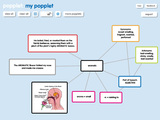
2. Vocabulary Popplet
A Vocabulary Popplet: Inspired by the Frayer Model.
3. Targeting vocabulary
One of the biggest limiting factors for reading comprehension and literate success is vocabulary. Vocabulary is like a series of interwoven puzzles, and when the puzzles are solved, students flourish in their own success. Kids, as a whole, are enticed by puzzles, and giving them targeted strategies that help them to unlock the code that vocabulary holds is one of the best ways to help them feel the success necessary to become resilient readers.
4. Fluency
Reading can become laborious because of processing speed. And that’s one reason why kids love videos so much. Kids think in images, and videos help kids process at a rate that gives them the instant gratification they so desire. If students have a low reading fluency, they’re likely to suffer the frustrations that may accompany reading. The more they read - and the more they read texts at their level - the more fluent they will become.
5. Structure
The structural components of text are often ignored, but these structural components, just like the puzzles that make up vocabulary, can help to support reading immensely when understood fully. A structural understanding of text can help provide a foundation for prediction and, in turn, metacognition. It gives kids something to expect; it gives them a reference point.
Just the other day, one of my readers said to the whole class, "I know that sometimes at the end of stories authors do this, and it makes me think I need to go back in the text," when referring to the odd conclusion of the Chris Van Allsburg book "The Garden of Abdul Gasazi." While rudimentary, her intuitive understanding of the structure of stories supported her comprehension and, ultimately, her success.
Conclusion
Innovation and creativity in what we do with our students is the driving force of education. Kids now are different than kids were even ten years ago. However, there are certain things that don’t change, and there are certain foundational skills that support reading in the same way it supported reading ten, twenty, or even one-hundred years ago. We can’t lose sight of that, and we can’t forget about the basics — no matter how fun and engaging they may seem.
While these tricks of the trade may give us some hope when working with students, tricks fade. True success resides in a student’s ability to feel good about themselves and conquer difficult skills in the right way. I fear, at times, that some of these modern methods only help children to avoid the beautiful struggle that comes with comprehending text. But the way to provide them the support them with this important struggle is by sticking to the basics, but building up the basics in a successful way.
Because the basics give our students a firm ground upon which they can plant their feet and succeed. And isn’t that what we want for our kiddos?
Paul France is a National Board Certified Teacher at AltSchool in San Francisco. He writes about best practices and classroom reflections on InspirED.
The post 5 Anchors For Using Technology To Teach Reading appeared first on TeachThought.
TeachThought Blog
.
Blog
.
<span class='date ' tip=''><i class='icon-time'></i> Aug 05, 2015 09:26am</span>
|