Blogs
|
Peace Posters: A Collection Of Visuals Designed by Students
by TeachThought Staff
The modern internet-memes, gif animations, and infographics for days, but of cats. What about peace? That’s (something in the universe of) what an educator thought for herself recently when she reflected on the power of the visual world wide web while lamenting the whimsy.
Teacher Doris Molero explains-and asks for some feedback for the students, so we thought we’d help them get noticed. Check out them out, and vote for your favorite.
"This was the final project for my English for Work students of the May- July 2014 Class. They designed a poster or an unfographic to promote peace. The posters were posted in their scoops and also in different social networks like Facebook, Twitter, Pinterest and also in the virtual world of Second Life. Please. Leave them a comment. Here you can see their work on their Facebook page."
Posters and infographics for Peace
︾
1.48k
views
11
items
Posters and infographics for Peace
Listly by Doris Molero
This was the final project for my English for Work students of the May- July 2014 Class. They designed a poster or an unfographic to promote peace. The posters were posted in their scoops and also in different social networks like Facebook, Twitter, Pinterest and also in the virtual world of Second Life. Please. Leave them a comment. Here you can see their work in Facebook: https://www.facebook.com/doris.molero/posts/10154549206825368
Follow List
Embed List
1
Mervis Carrizo
Mervis Carrizo Custodio's insight:This is a poster I made for promoting peace. It says "Let Peace Soar", so we help make the world a better place, it encourages you to do it.http://www.scoop.it/t/what-is-graphic-design-by-mervis-carrizo-custodio
7 likes
Comments
Relist
Share
2
Rossmely Leon
Rossmely León's insight:I wanted to use a song for my work, so I chose "We are The World" by Michael Jackson, that has to do with making a change, helping people, and peace. About the graphic style, I was inspired in popular design trends in these days, styles that you can see a lot in internet, like is the use of Typography combinations and beautiful backgrounds.I also used illustration to complement the text.I think this style was perfect to represent a song visually and to represent a subject about Peace.Rossmely Leónhttp://www.scoop.it/t/design-by-rossmely-leon
6 likes
Comments
Relist
Share
3
Daniela Morales
Daniela Morales's insight:
This is my final project for English for Work.
These are a pair of posters for peace, they were designed to promote words of peace to all people around the world. The idea is that if these posters were to be printed, they could be used together or apart, and people would still be able to recognize the similarity but not equality in the designs.
The posters are made with vectors of human hands, this resembles the human being and how we should be involved with promoting peace.
I believe that with peace, people can be able to achieve everything they want to. If there is no peace, there is no love, and if there is no love there is hate. Nobody wants hate, so let's have peace and love.
Remember to transmit these feelings to everybody around you, because as you treat others they will treat you.
Live your life with peace.
http://www.scoop.it/t/graphic-design-by-daniela-morales?fk
5 likes
Comments
Relist
Share
4
Daniela Morales
Daniela Morales's insight:
This is my final project for English for Work.
These are a pair of posters for peace, they were designed to promote words of peace to all people around the world. The idea is that if these posters were to be printed, they could be used together or apart, and people would still be able to recognize the similarity but not equality in the designs.
The posters are made with vectors of human hands, this resembles the human being and how we should be involved with promoting peace.
I believe that with peace, people can be able to achieve everything they want to. If there is no peace, there is no love, and if there is no love there is hate. Nobody wants hate, so let's have peace and love.
Remember to transmit these feelings to everybody around you, because as you treat others they will treat you.
Live your life with peace.
http://www.scoop.it/t/graphic-design-by-daniela-morales?fk
5 likes
Comments
Relist
Share
5
Joseph Ramirez , Greddis Martinez and Lenin Romero
This is an infography from kid to adults. It was designed to make people understand that we are in the same level, theres no one more important than others, so make peace; without race, color or age.Joseph Ramirezromero, Greddis Martinez and Lenin Romero http://www.scoop.it/t/a-by-joseph-ramirezromerohttp://www.scoop.it/t/designbygreddysm
5 likes
Comments
Relist
Share
6
Elliot Quintero
Peace is...
''I tried make the idea of turning the words into graphic, a creative way to read the poster and clearing the ideas, peace is that person who is locked but has the key inside his heart to set him free''
by Elliot Quintero
http://www.scoop.it/t/greening-your-life
4 likes
Comments
Relist
Share
7
Rosana Chechile
Rosana ChechileI made the illustration based in the song of Imagine Dragons It’s Time, I took a phrase of the song that says: "Now it’s time to build from the bottom of the pit, right to the top" and I start the idea from there. I represented the earth and the nature on the woman illustration and those little creatures are us, recovered her. I’m trying to say that if we all put a little grain to make the world a better place, we all together can make it.http://www.scoop.it/t/design-by-rosanna-chechilehttps://www.youtube.com/watch?v=BqVhd18Gpu4
4 likes
Comments
Relist
Share
8
Paola Verdú
4 likes
Comments
Relist
Share
9
Daiana Yauhari, Joseline Fernandez and Maria Fernanda Peñuela
For me peace is not a time that we need to wait for peace is something that we need to look and fight for. Peace is when there are fewer arguments, less conflict, fewer fights and less shame. It is when we finally find a way to educate ourselves about the world around us and realized we are more the same. I think it’s very important for everyone to live in peace or at least to try to have inner peace with ourselves... it’s like the quote we put in the image "NOTHING BRINGS YOU PEACE BUT YOURSELF" it is a very important quote cause what it’s trying to say is that if we don’t have peace with ourselves and we always live frustrated, stubborn, stressed or bitter everything is going to go wrong . In the infography we not only added some quotes we also wrote the definition of the word peace so that when people read it remind them the meaning of the word peace and try to make them see where we are wrong.
4 likes
Comments
Relist
Share
10
Liucelis Villegas
Luicelis Villegas's insight:
In this case I give some advices to have peace with everyone, those little things can help to get a better relationship with others. For the design I used the same scheme of the other poster, because I wanted to keep unity.
http://www.scoop.it/t/english-for-work-by-luicelis-villegas — with Liucelis Villegas.
3 likes
Comments
Relist
Share
11
Gal Ramirez
3 likes
Comments
Relist
Share
View more lists from
Doris Molero
Peace Posters: A Collection Of Visuals That Promote Togetherness; Peace Posters: A Collection Of Visuals Designed by Students
The post Peace Posters: A Collection Of Visuals Designed by Students appeared first on TeachThought.
TeachThought Blog
.
Blog
.
<span class='date ' tip=''><i class='icon-time'></i> Aug 05, 2015 09:39am</span>
|
|
Raising Our Teacher Voices: A Call For A New Generation Of Teacher Leadership
By Jen Orr
In 2015, what is the state of teacher leadership-its sources, its voices, and its new potential?
Last month I had the opportunity to participate in ASCD’s Whole Child Symposium on teacher leadership. It consisted of two panels, the first was a big picture focused on systemic models and issues and the second narrowed in on districts and schools. It was a fabulous experience and one that I have continued to think about. All seven participants, including the moderator, are educators in some way. At least six of us are or were classroom teachers.
When I consider what makes someone a teacher leader, I believe it is a teacher who impacts education beyond their own classroom. In that way, I am not so different from most people defining teacher leadership. But I believe I am defining teacher leadership a bit differently. Differently than most on the panels and differently than most folks talking about teacher leadership.
When teacher leadership is discussed it is typically focused on what that means in a school, how teacher leaders can work with administrators, how teachers can impact their school. The conversation focuses on teachers and principals and how they can work together and the benefits of doing so.
This is definitely a conversation worth having.
However, maybe because I’ve been lucky enough to always work in schools where I felt teacher voice was valued, I want to go far beyond that idea of teacher leadership. I want there to be teachers involved at all levels of decisions and policy. I want teachers to be writing about education for the general public. I want teachers to be sharing with other teachers what works in their classrooms. I want teachers to have a voice in education beyond their schools.
I believe this model of teacher leadership, one in which teachers are actively and meaningfully engaged in all parts of the world of education, is critical because teachers have a dog in this fight.
That dog isn’t money, like it can be for companies or consultants.
That dog isn’t power or prestige as it might be for principals, superintendents, or school board members.
That dog isn’t tenure as it can be for college professors.
Our dog in the fight, our only dog, is our students; when we raise our voices in conversations we are doing so with our students in our minds.
No one else in education comes to the table with the perspective teachers do. Teachers are doing the daily work of education. Every policy decision, every curriculum adopted, every new regulation, every change in boundaries, impacts that daily work. Teachers have a unique understanding of those impacts.
This isn’t to suggest that other voices aren’t valuable in this conversation. There are many who bring expertise to the table that is critical. However, the voices least heard are often teachers and students, ironically the voices closest to the issues.
Somehow, in some way, teachers need to raise their voices and engage in the wider work of education because no one else knows children as well as we do.
Jennifer Orr is an elementary school teacher in Fairfax County, Va. She was selected as a 2013 ASCD Emerging Leader and was a panelist at ASCD’s fall 2014 Whole Child Symposium on teacher leadership; Raising Our Teacher Voices: A Call For A New Generation Of Teacher Leadership; image attribution flickr user usdepartmentofeducation
The post Raising Our Teacher Voices: A Call For A New Generation Of Leadership appeared first on TeachThought.
TeachThought Blog
.
Blog
.
<span class='date ' tip=''><i class='icon-time'></i> Aug 05, 2015 09:38am</span>
|
|
Helping Students Fail: A Framework
by Terry Heick
Ed note: This post is promoted by bettermarks, an adaptive math platform built around the idea of learning through mistakes. You can visit their platform here.
As teachers, allowing students to see failure as a negative experience is one of the worst things we can do.
Granted, this isn’t unique to education. The idea of risk-taking, failing, looking, leaping, try-try-again is ingrained in our cultural DNA. But in education, we certainly have made it dramatic. In fact, we don’t even need the whole word anymore. Failure erodes to fail, which itself erodes to simply F.
Every bit of effort, every miscommunication, every missing skill or competency, every degree and layer of performance-academic and otherwise-is distilled down into a single character. And there isn’t a mark lower than an "F"-a hundred zeroes and missing assignments still say F, which means there is literally doing nothing at all would’ve yielded the same letter. That’s pretty brutal. (On a related note, here are 12 alternatives to letter grades.)
What Does It Mean To "Fail"?
You can fail a test or course, but the idea of failing to understand has a completely different connotation. The former could be as much about missing work or organizational habits or even literacy levels; the latter, while subjective, is something else entirely.
If understanding is about making meaning, then failure is always only temporary. Making meaning is a present participle that indicates an ongoing process. It’s indefinite, if for not other reason than we can never fully and completely understand anything.
Constructivism as a learning theory makes room for failure at its very core, describing learning as an active process and continuous process, stratified in layers of performance. Creating, making, constructing, building, designing and other related terms reflect the nature of both learning and knowledge as a cycle.
Some kind of feedback loop is crucial, especially in academic settings where the pace of the course is set before we even know the students’ names. So it’s easy to excuse interrupting this cycle to assess understanding, which we do in various forms. And provided we’re clear that even a perfect assessment is simply a snapshot that’s already dated by the time the feedback is given, there’s nothing wrong with that. Knowledge is both perishable and alive. If we can use grades and feedback and gamification and other processes to communicate that to learners and parents and communities, then all is well. (Gamification, properly used, is capable of uncovering the nuance of the learning process.)
But so far, we’ve got room to improve here. Which is where the idea of "failing forward" comes in. Helping students fail isn’t just a matter of making them feel better-it’s about thinking like a scientist, farmer, designer, or CEO-failing gives me the data I need to proceed. And knowledge? Those letter grades don’t mean much. An A doesn’t guarantee understanding, and an F doesn’t preclude it.
To "fail" could mean a thousand things. It’s also not that simple. Failure doesn’t give us much more than a starting point.
Which is exactly why students need help to understand it.
The Role Of Failure In Learning
Properly understood, failure can help students see learning as a personal journey rather than a matter of external performance. It emphasizes meaning as contextual, and distinguishes procedural knowledge from content knowledge. The primary value, then, might be in teaching students learning and knowledge rather than responsibility.
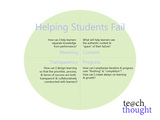
Helping Students Fail: A Framework
Where can I start as a teacher?
By Clarifying The Meaning
The Idea: Distinguishing knowledge from process so students can see failure not as one thing, but a hundred. (Or fewer, depending on grade level and situation.)
Guiding questions: How can I help students separate knowledge from performance? Considering their goals-and the goals of education-is it viable for them to value both?
By Providing Context
The Idea: Understanding the scale, impact, and nature of failure. The "fail" extends this* far, for example-this lesson, this test, this class, this project, this community, this goal, and so on. The impact is this broad, and is or is not correctable.
You might specify (guess?) what caused the failure-or help them learn to do it themselves, then celebrate that specification as a kind of triumph. We found the problem!
Guiding questions: What is the nature of this failure for this student? And as a result, how should I respond, and how should they respond?
By Designing Transparent Processes
The Idea: Illuminating learning as a systematic process that learners and families actually understand
Guiding questions: How can I design learning so that the priorities, process, and terms of success are both transparent and collaboratively constructed with learners?
By Illuminating Progress
The Idea: Emphasizing iteration & progress over "finishing" & completion
Guiding questions: How can I emphasize iteration & progress over "finishing" and "completion"? How can I create always-on learning & growth? How can I design work that students are both willing and interested in returning to to improve?
adapted image attribution flickr user tactom; Helping Students Fail: A Framework
The post Helping Students Fail: A Framework appeared first on TeachThought.
TeachThought Blog
.
Blog
.
<span class='date ' tip=''><i class='icon-time'></i> Aug 05, 2015 09:38am</span>
|
|
6 Types Of Assessment Of Learning
by TeachThought Staff
If curriculum is the what of teaching, and learning models are the how, assessment is the puzzled "Hmmmm"-as in, I assumed this and this about student learning, but after giving this assessment, well…."Hmmmmm."
So what are the different types of assessment of learning? This graphic below from McGraw Hill offers up six forms; the next time someone says "assessment,’ you can say "Which type, and what are we doing with the data?" like the TeachThought educator you are.
6 Types Of Assessment Of Learning
1. Diagnostic Assessment (as Pre-Assessment)
One way to think about it: Assesses a student’s strengths, weaknesses, knowledge, and skills prior to instruction.
Another way to think about it: A baseline to work from
2. Formative Assessment
One way to think about it: Assesses a student’s performance during instruction, and usually occurs regularly throughout the instruction process.
Another way to think about it: Like a doctor’s "check-up" to provide data to revise instruction
3. Summative Assessment
One way to think about it: Measures a student’s achievement at the end of instruction.
Another way to think about it: It’s macabre, but if formative assessment is the check-up, you might think of summative assessment as the autopsy. What happened? Now that it’s all over, what went right and what went wrong?
4. Norm-Referenced Assessment
One way to think about it: Compares a student’s performance against other students (a national group or other "norm")
Another way to think about it: Group or "Demographic" assessment
5. Criterion-Referenced Assessment
One way to think about it: Measures a student’s performance against a goal, specific objective, or standard.
Another way to think about it: a bar to measure all students against
6. Interim/Benchmark Assessment
One way to think about it: Evaluates student performance at periodic intervals, frequently at the end of a grading period. Can predict student performance on end-of-the-year summative assessments.
Another way to think about it: Bar graph growth through a year
6 Types Of Assessment Of Learning
The post 6 Types Of Assessment Of Learning appeared first on TeachThought.
TeachThought Blog
.
Blog
.
<span class='date ' tip=''><i class='icon-time'></i> Aug 05, 2015 09:38am</span>
|
|
Unplugging To Connect: A Tech Timeout For Schools?
by TeachThought Staff
From a press release: As part of a national movement called the Tech Timeout Academic Challenge, a San Francisco school will shut down their tech devices for three days beginning February 12.
SAN FRANCISCO What happens when over 1,100 students in grades K-12, at a school that prides itself on ubiquitous access to technology, power down their electronic devices for three straight days? That question will be answered on February 12-14 when students at Convent & Stuart Hall in San Francisco take The Tech Timeout Academic Challenge. It will be the first school in the greater Bay Area to take the challenge and just the third in California.
The Convent & Stuart Hall Tech Timeout is unique in that it includes students ranging in age from four to 18 and spans the divide between school-provided technology and personal devices such as cell phones. All students are encouraged to participate and will complete a pledge sheet where they list all of the technologies from which they agree to abstain. Parents can also participate and will be given a family kit that they can use to help them succeed.
"The opt-in is a critical piece," says Howard Levin, Director of Educational Innovation and Information Services.
The hope is that participating students and their families will walk away from the Tech Timeout with a better understanding of their dependence on technology. Following the challenge, students will discuss their experience of going "tech-free" and evaluate their personal practice of how to disconnect.
"In some ways the kid that fails has a better chance of being reflective," Howard says. "We want to create cognitive dissonance among those who join."
This is the first year that Convent & Stuart Hall has fully adopted an ePack program across all ages designed to provide daily access to a wide range of digital tools, including a 1-to-1 program with the Apple iPad, but encompassing much more than a single device. Howard says that at the heart of the program is a desire to change the ed-tech model from "learn to use" in computer labs to a "use to learn" model where technology can aid in any lesson.
To reflect this shift, the school recently designed new positions for its ed-tech faculty. Now a team of Educational Innovation Coordinators work full-time to support teachers in the use of digital tools and innovative spaces. The administration is in part facilitating the timeout to ensure that the school continues to use the provided devices in the most effective and mindful way.
"A school like ours that embraces a 1-to-1 program needs to find balance," Howard says. "We need to also help students not only learn how to use technology wisely, but how to recognize how devices can get in the way of having real conversations and relationships."
The Tech Timeout Academic Challenge sponsored by Foresters will launch on Feb 12 with an assembly where students will seal their phones inside envelopes.
To date, more than 16,000 students across North America have participated in the challenge.
Howard Levin and Ann Marie Krejcarek, President of Schools along with a Foresters spokesperson, are available for further comments. To learn more about the Tech Timeout Academic Challenge, visit: http://techtimeout.com/academicchallenge/; adapted flickr user flickeringbrad; Unplugging To Connect: A Tech Timeout For Schools?
The post Unplugging To Connect: A Tech Timeout For Schools? appeared first on TeachThought.
TeachThought Blog
.
Blog
.
<span class='date ' tip=''><i class='icon-time'></i> Aug 05, 2015 09:38am</span>
|
|
Xavier University Adds A Maker Innovation Center
by TeachThought Staff
From a press release
CINCINNATI Xavier University recently signed an agreement with MakerBot, a global leader in the desktop 3D printing industry, to bring a MakerBot® Innovation Center to the university’s campus.
Xavier University joins a growing number of universities throughout the country that offer MakerBot Innovation Centers, which are designed to empower organizations to innovate faster, collaborate better and compete more effectively. Xavier is the first university in the Midwest and the first private college in the United States to implement a MakerBot Innovation Center. MakerBot is providing the consulting, technical support and training required to implement the MakerBot Innovation Center and will work closely with Xavier’s faculty to develop a curriculum that introduces professors and students to the world of 3D printing and its real-time possibilities.
MakerBot is excited to join Xavier University for the grand opening of the MakerBot Innovation Center on February 4, 2015. Students, parents, business partners and community members are invited to take a tour of the new MakerBot Innovation Center during an open house from 2:00 p.m. to 4:00 p.m. The opening ceremony will start at 4:30 p.m. with a blessing by Xavier’s 34th president, Father Michael J. Graham, S.J., followed by speeches from University staff and MakerBot president Frank Alfano.
"We’re so excited to be the first private institution in the country and the first university in the Midwest region to partner with MakerBot," said Shawn Nason, chief innovation officer with Xavier University. "Our mission at Xavier University is to educate our students so that they are able to make the world a better place.
"We’re positioned to do just that with the unique 3D printing and prototyping technology of MakerBot! With these innovative MakerBot Replicator 3D Printers, we will transform how our students learn here at the Xavier Center for Innovation and beyond. With MakerBot, we’ll not only be ‘making’ 3D objects in our classrooms, but helping shape the leaders and innovators of future industries as well."
What Is A MakerBot Center?
The MakerBot Innovation Center at Xavier is a custom, centralized and scalable 3D printing solution that has been developed to meet the specific needs of the university. It is designed to create an environment in which entrepreneurialism, education and innovation can be cultivated and encouraged in the Cincinnati area and beyond. With the MakerBot Innovation Center, students, faculty and the community are provided opportunities to collaborate on Real-Time Prototyping™, model making and small-scale creative and manufacturing projects.
This provides a unique way to prepare students for the jobs of tomorrow by putting them at the forefront of technology and giving them access to a thriving community of innovators. With dedicated spaces for startups and networking, the MakerBot Innovation Center at Xavier is designed to attract local entrepreneurs, innovators and researchers. It will serve as a local innovation hub where students from different academic disciplines can gain invaluable hands-on experience by collaborating with entrepreneurs and researchers on real-world projects.
The MakerBot Innovation Center for Xavier includes 31 MakerBot® Replicator 3D Printers (25 MakerBot Replicator Desktop 3D Printers, three MakerBot Replicator Z18 3D Printers and three MakerBot Replicator Mini Compact 3D Printers), a large supply of MakerBot PLA Filament, several MakerBot Digitizer™ Desktop 3D Scanners and MakerBot MakerCare® Protection Plans. At the core of the MakerBot Innovation Center is the MakerBot Innovation Center Management Platform, a proprietary and innovative 3D printing software platform that links all 30+ MakerBot Replicator 3D Printers together, provides remote access, print queuing and mass production of 3D prints, and is designed to streamline productivity and staffing of the center. The scalable design of the MakerBot Innovation Center allows Xavier the option to easily add additional MakerBot 3D printing technology in the future.
"The MakerBot Innovation Center has garnered huge interest since we first introduced the concept last year, and we’re excited that Xavier University has decided to work with us to unleash the creative potential of 3D printing on its campus and in the Cincinnati area. The passion for innovation and 3D printing at Xavier is contagious and we can’t wait to see what comes out of their MakerBot Innovation Center," noted Jenny Lawton, CEO of MakerBot. "
We’re particularly thrilled to provide the team at Xavier with Consulting from MakerBot to help develop a curriculum that integrates 3D printing. This is an important step that will help introduce more students, community members, and entrepreneurs to the idea of 3D printing and how this technology can help them visualize and memorize complex theoretical concepts, gain hands-on experience and unleash their creativity."
Xavier University is a private university located in Cincinnati, Ohio, providing a liberal arts education in the Catholic, Jesuit tradition. Founded in 1831, the university is the sixth-oldest Catholic university in the nation. U.S. News & World Report ranks it No. 5 among 146 universities in the Midwest, and The Princeton Review names it as one of The Best 378 Colleges; Xavier University Adds A Maker Innovation Center
The post Xavier University Adds A MakerBot Innovation Center appeared first on TeachThought.
TeachThought Blog
.
Blog
.
<span class='date ' tip=''><i class='icon-time'></i> Aug 05, 2015 09:37am</span>
|
|
Looking Down Our Noses At The Community College Experience
by Dale Schlundt, M.A.
The question of "where do I go from here" can be a daunting challenge for many high school seniors getting ready to advance to the next stage of their life. The thought of "being on your own", even if that means living at home while attending college, can be a scary and uncertain time in a young adult’s life. When an individual asks my advice about the next step towards post-secondary education, I almost always advise community college first.
Whether one is speaking about a four year institution or a two year college, it opens up a whole new world to the potential student. To sum it up in one word, questions. Questions as simple as how do I get started, register, what classes to take, and more. Perhaps even the bigger question, which may have not be considered prior, what do I want to do with my life? The community college provides the relatively smooth transition from a life that has been completely structured for the student to one where they are advised, yet begin grasping those challenges of independence.
One of the most significant challenges students face when entering any post-secondary institution is time management. For some, they are working full time as well as taking a full load of courses. Therefore, finding the opportunity to focus on academics can be a hurdle to say the least. For others, they are solely working on college. However prior to this, have never been exposed to so much free time, while concurrently going to school. Absolutely contrary to the secondary school’s structured day with bells, making time management a new and perhaps costly learning curve.
This is where the community college lends an advantage. In comparison to the university’s student/ instructor ratio, the two year college offers much more one on one assistance. The use of student collaboration, where students are able to work together, forming friendships, and essentially giving each other support, is much more prominent in the two year institution. This simply being feasible due to the size of the class.
Not to be overlooked is the financial aspect of the decision on whether to begin their college life at a two year or four year institution. For those with limited funds or whom do not want such high student loans to pay off throughout their professional life, community colleges offer the relatively same classes that transfer to numerous major universities, at a substantial discount. I always advise students that unless there is a specific program that only the four year institution offers, why pay the higher tuition for less assistance?
I still remember working on my bachelor’s degree where there would be classes in which the professor never knew I existed. It should be said that this is at no fault of the professor, this simply being an aspect of the significantly larger class size. This is not to take away from the four year university, of which there are many wonderful benefits, in terms of pedagogical practices, student life, and the overall experience. It is simply a personal choice on the part of the future student and what will best suite them in their new stage of life.
The most reassuring aspect is there are typically many choices for your post-secondary institution, that being beneficial as well as the challenge in many young adults’ lives. Regardless, community colleges offer a smooth route to that transition from high school to the "new world" of college.
Dale Schlundt holds a Master’s Degree in Adult Education with a concentration in American History from the University of Texas at San Antonio. He is currently an Adjunct Professor for Palo Alto College and Northwest Vista College. Dale has written two books, Tracking Life’s Lessons: Through Experiences, History, and a Little Interpretation and Education Decoded (A Collection of My Writings); image attribution flickr user vancouverfilmschool
The post Looking Down Our Noses At The Community College Experience appeared first on TeachThought.
TeachThought Blog
.
Blog
.
<span class='date ' tip=''><i class='icon-time'></i> Aug 05, 2015 09:37am</span>
|
|
What’s The One Thing Will They Remember From Your Class?
by Terry Heick
Try as you might, your students aren’t going to remember everything from your class. In fact, they probably won’t remember much at all, no matter how good you are at what you do.
And this assumes that simply remembering—hazily recalling certain ideas, facts, or projects—is your goal. If you’re looking for something close to actually understanding—self-initiated transfer to new and unfamiliar situations—then that list will be even shorter. How about new behaviors and habits?
Personal change?
In all of the focus on process and improvement, it’s easy to forget that there is a function of knowledge-a human output derived from injected understandings, skills, and competencies. Put another way, there is a reason to learn. A purpose. Knowledge is the most modern of currencies that itself can be exchanged endlessly without diminishing itself. Without that reason, education becomes a self-justifying expression of policies and procedures.
It’s at this point that we could talk about critical abstractions—how you made them feel, discoveries they made about themselves, or networks and technologies that they discovered under your guidance. We could talk about power standards, big ideas, enduring understandings, the utility of modern curriculum, and how useful academic standards like those found in the Common Core really are, but I thought I’d turn it over to you this time to hear your ideas.
A concept? A rule? Some abstract lesson? A notable project? Or simply how you made them feel? You may want to read Applying The 40/40/40 Rule In Your Classroom as a decent primer to respond.
In short, 16 years from now when they see you in the supermarket, what do you want them to remember?
Would love to hear your ideas on twitter or in the comments below.
What Will They Remember From Your Class?; image attribution flickr user cheriejoyful; What’s The One Thing They’ll Remember From Their Time With You?
The post What’s The One Thing They’ll Remember From Their Time With You? appeared first on TeachThought.
TeachThought Blog
.
Blog
.
<span class='date ' tip=''><i class='icon-time'></i> Aug 05, 2015 09:37am</span>
|
|
Learning Models, Theories, and Technology: A Dictionary For 21st Century Teachers
by Terry Heick and TeachThought Staff
Purpose: Improving our chance for a common language in discussing existing and emerging learning trends, model, and technology in hopes of innovation in classrooms, and collectively, education at large.
Audience: K-12 & higher ed educators, researchers, institutions, and organizations globally.
Form: An index of learning models, theories, forms, terminology, technology, and research to help you keep up with the latest trends in 21st century learning. This page was created and is updated by Terry Heick and TeachThought Staff, who you can contact directly with suggestions for terms, improved citations, corrections, or additions to the index.
Revisions: Persistently updated. In addition to new definitions, models, and strategies, citations and references will also be added periodically, as will updates, corrections, edits, and revisions.
Ed note: As stated, this is an ambitious work in progress that we’re choosing to share as we proof, revise, iterate, and generally improve for wider dissemination. When you find typos, dead links, missing sentences, inconsistencies, or flat out lies, let us know. ; ^ )
Ed note 2: If you’d like to help update and improve this page, and have the background, curiosity, and/or expertise to contribute, email me. I’ve got 36 terms and 19 revisions that need adding already. I’m only one person. ; ^ )
A Dictionary For 21st Century Teachers: Learning Models & Technology
1:1
A description of a learning environment where there is one "screen" for each student (whether an iPad, laptop, etc.)
Activity-Based Learning
According to Harvard University, "in Activity-Based Learning courses, students do public service, fieldwork, community-based research and internships in conjunction with in-class work. ABL pedagogy aims to enrich students’ academic experience and learning outcomes by connecting theory with practice, and concepts with methods, using data and insight they obtain through engagement with the larger world." (1)
Andragogy
The study of teaching adults.
BYOD
An initialism that stands for "Bring Your Own Device." BYOD programs allow students to use their own technology (usually smartphone or tablet) in a classroom. BYOD is often seen as a way of solving budget concerns while increasing the authenticity of learning experiences, while critics point to the problems BYOD can cause for district IT, privacy concerns, and more.
Blended Learning
Blended learning is a learning model that combines digital and face-to-face learning experiences. The Christensen Institute for Disruptive Innovation defines Blended Learning "a formal education program in which a student learns: (1) at least in part through online learning, with some element of student control over time, place, path, and/or pace; (2) at least in part in a supervised brick-and-mortar location away from home; (3) and the modalities along each student’s learning path within a course or subject are connected to provide an integrated learning experience." It is generally accepted that there are four models of blended learning: Rotation, Flex, A La Carte, and Enriched Virtual. The Christensen Institute clarifies that "the Rotation model includes four sub-models: Station Rotation, Lab Rotation, Flipped Classroom, and Individual Rotation." (3)
There is some thought that a certain percentage of instruction must be digital to qualify as "blended learning," but there is no clear industry standard.
Challenge-Based Learning
Challenge-Based Learning is a learning model pushed by Apple that promotes the academic classroom as a think tank to solve authentic problems. It is similar to place-based education and project-based learning as a teaching tool.
Apple defines Challenge-Based Learning as "an engaging multidisciplinary approach to teaching and learning that encourages learners to leverage the technology they use in their daily lives to solve real-world problems. Challenge Based Learning is collaborative and hands-on, asking students to work with peers, teachers, and experts in their communities and around the world to ask good questions, develop deep subject area knowledge, identify and solve challenges, take action, and share their experience." (5)
Cognitive Apprenticeship
Cognitive apprenticeship focuses on "learning-through-guided-experience on cognitive and metacognitive skills and processes" (Collins, Brown, & Newman, 1989, p. 457), instead of the physically concrete craft or trade that is the focus of traditional apprenticeships.
"The method is aimed primarily at teaching the problem-solving processes that experts use to handle complex tasks. Cognitive apprenticeships are intended to enable apprentices to learn strategies and skills in the context of their application to realistic problems, within a culture focused on and defined by expert practice." (6)
Communal Constructivism
A learning theory "in which networked learners not only construct and assimilate their own knowledge from their own learning opportunities, but deliberately contribute their own learning to a community resource base."(Holmes & Gardner 2006). (7)
Connected Learning
A learning model by Digital Media & Learning that emphasizes the role of social interactions as a catalyst for learning. (See "Connected Learning: The Power Of Social Learning Models".) Characteristics of Connected Learning include: Interest-Powered, Production Centered, Peer-Supported, Shared Purpose, Academically-Oriented, and Openly-Networked. (15)
Constructionism
According to Seymour Papert, constructionism is, put roughly, learning by making.
That Papert is known to struggle with the idea of defining Constructionism by a "pipeline" of knowledge-giving hints at its nature-open-ended, learner-centered, playful, non-institutional, non-academis, and so difficult to describe in an academic context.
Papert explained that, while close in meaning and spelling as Constructivism, it is suitably unique:
"Constructionism-the N word as opposed to the V word-shares constructivism’s connotation of learning as "building knowledge structures" irrespective of the circumstances of the learning. It then adds the idea that this happens especially felicitously in a context where the learner is consciously engaged in constructing a public entity, whether it’s a sand castle on the beach or a theory of the universe."
Papert went on to describe Constructionism as a kind of learning which "allows full range of intellectual styles and preferences to each find a point of equilibrium. (Papert, Harel 1991) (16)
Constructivism
A learning theory that suggests that "people construct their own understanding and knowledge of the world through experiencing things and reflecting on those experiences" (Christie 2005). (14)
Differentiation
According to differentiation expert Dr. Carol Tomlinson, differentiation is not a teaching strategy, but rather a way of thinking about learning. In terms of application it is the specific design of "content, process, or product" according to a student’s readiness, interest, or learning profile. (Citation needed).
Tomlinson explains that "differentiation does not presume different tasks for each learner, but rather just enough flexibility in task complexity, working arrangements, and modes of learning expression that varied students find learning a good fit much of the time." (22)
In short, differentiation is the process of personalizing universal learning goals for groups of students. As such, it is closely related to (but different than) personalized learning and individualized learning.
Digital Citizenship
Karen Mossberger, Associate Professor at University of Illinois at Chicago, defines digital citizenship simply as "the ability to participate in society online." (9)
Terry Heick offers a definition of digital citizenship as "The quality of habits, actions, and consumption patterns that impact the ecology of digital content and communities." (10)
eLearning
Learning expressly through online courses and related digital resources.
Flipped Classroom
Stated simply, a flipped classroom is one where students are introduced to content at home through digital tools (usually video), and then practice it at school under the guidance of a teacher. This is the reverse of the traditional pattern, where students are introduced to content at school, and then practice it at home without the guidance of the teacher (i.e., More Knowledgeable Other).
Flow
A tenet of Eastern philosophy and thought for millenia, and more recently repopularized by Mihaly Csíkszentmihályi, flow is the complete merging of task and doer-a state of being where a body, mind, and task resonate effortlessly and result in improved performance and extraordinary satisfaction.
A useful example of flow from Diane Ackerman’s Deep Play:
"In Bone Games, climber Rob Schultheis recalls how he felt descending a mountain after a harrowing near-death fall: "The person I became on Neva was the best possible version of myself, the person I should have been throughout my life. No regrets, no hesitation; there were no false moves left in me. I really believe I could have hit a mosquito in the eye with a pine needle at thirty paces; I couldn’t miss because there was no such thing as a miss."
Game-Based Learning
Learning through games (from physical to digital).
Gamification
The application of game-like "encouragement" mechanics to non-game entities. Put another way, it is making a game out of something that’s not.
Genius Hour
The allotment of a specified amount of time in a formal learning environment for the purpose of self-directed learning. (23)
Google Apps for Education
A collection of software bundled by Google that is available on a subscription model for schools and classroom. Services include Google Drive, Google Docs, Gmail, and more.
Google Classroom
Google describes their Google Classroom as "designed to help teachers create and collect assignments paperlessly, including time-saving features like the ability to automatically make a copy of a Google Document for each student. It also creates Drive folders for each assignment and for each student to help keep everyone organized. Students can keep track of what’s due on the Assignments page and begin working with just a click. Teachers can quickly see who has or hasn’t completed the work, and provide direct, real-time feedback and grades right in Classroom.
Classroom is "available to anyone with Google Apps for Education, a free suite of productivity tools including Gmail, Drive and Docs."
Heautagogy
A term coined by Stewart Hase, heautogogy is the study of self-directed learning. (Citation needed)
Inside-Out Learning Model
A school model developed by Terry Heick and inspired by Wendell Berry designed to immerse student learning in local communities. Rather than an outcomes-based and standards-driven approach, it instead seeks local accountability, new knowledge types, and overtly "human" learning models.
Individualized Learning
The customizing of universal content (e.g., Common Core) for individual students.
See also Personalized Learning, Differentiated Learning, and Self-Directed Learning.
Informal Learning
Informal Learning has been defined as "any activity involving the pursuit of understanding, knowledge or skill which occurs without the presence of externally imposed curricular criteria. Informal learning may occur in any context outside the pre-established curricula of educative institutions. The basic terms of informal learning (e.g. objectives, content, means and processes of acquisition, duration, evaluation of outcomes, applications) are determined by the individuals and groups that choose to engage in it. Self-directed or collective informal learning is undertaken on our own. Informal education or training is distinguished from such self-directed informal learning only by the presence of some form of institutionally-recognized instructor. (Livingstone 2001). (13)
Learning Simulation
Often (not necessarily) digital, a learning simulation is a recreation of a context which allows a learner to bring strategy, tactics, and skills to experiment, play, or otherwise interact with that context’s manipulatives.
Learning Simulation Clark Aldrich defines a learning simulation as "an abstracted interactive environment (or) structure for education in which a learner can take actions and make decisions, and get ongoing feedback and consequences."
Learning Through Play
The process of acquiring knowledge, skills, or conceptual understandings through play.
According to Johan Huizinga is the critical anthropological text Homo Ludens, play is "an activity which proceeds within certain limits of time and space, in a visible order, according to rules freely accepted, and outside the sphere of necessity or material utility. The play-mood is one of rapture and enthusiasm, and is sacred or festive in accordance with the occasion. A feeling of exaltation and tension accompanies the action.
See also Flow & Play.
Learning Taxonomies
Any framework for thinking (and thus understanding), including Bloom’s Taxonomy, Heick’s Taxonomy, and Understanding by Design’s 6 Facets of Understanding. These taxonomies can be used to plan units, lessons, assessments, and other teaching and learning processes.
Mastery Learning
According to Vahid Motamedi of Tarbiat Moallem University, "Mastery learning is a method of instruction where the focus is on the role of feedback in learning. Furthermore, mastery learning refers to a category of instructional methods which establishes a level of performance that all students must "master" before moving on to the next unit (Slavin, 1987). Thus, through one or more trials, students have to achieve a specified level of content knowledge prior to progression on to a next unit of instruction."
"Mastery learning is used in order to advance an individual’s potential for learning. Compared to traditional learning models, sufficient time, attention, and help are afforded to each student." (11)
MOOC
An acronym for Massively Open Online Course, a digital course that allows asynchronous access to content.
Mobile Learning
The United Nations defines mobile learning as "Mobile learning involves the use of mobile technology, either alone or in combination with other information and communication technology (ICT), to enable learning anytime and anywhere. Learning can unfold in a variety of ways: people can use mobile devices to access educational resources, connect with others, or create content, both inside and outside classrooms. Mobile learning also encompasses efforts to support broad educational goals such as the effective administration of school systems and improved communication between schools and families." (12)
TeachThought is developing a mobile learning framework and definition that will be released in early 2015.
Model-Based Learning
A learning strategy by Terry Heick in which learners analyze an existing model of some kind, isolate one compelling idea, and then transfer that idea into a new circumstance.
Personalized Learning
The process of designing a learning experience for an individual learner, including content, learning model, assessment forms, and mode of knowledge application.
Personalized learning can arise from any learning experience that is self-initiated and self-directed in pursuit of outcomes that are first personal (e.g., curiosity-based, self-prioritized, etc.)
Place-Based Education
Place-Based Education "immerses students in local heritage, cultures, landscapes, opportunities and experiences, uses these as a foundation for the study of language arts, mathematics, social studies, science and other subjects across the curriculum, and emphasizes learning through participation in service projects for the local school and/or community." (citation needed) (24)
Play
Play can be described as a pattern of free and joyful experimentation with voluntary barriers.
Rather than a merely recreational activity, Terry Heick describes play as "a state of being" often "characterized by unencumbered, courageous, and joyful interactions with people, objects, interfaces, or circumstances." Heick goes on to say that play is more a matter of "tone and possibility than form or function." (citation needed) Through play, learners are able to develop a range of intellectual, moral, strategic, physical, or creative capacities.
In Deep Play, Diane Ackerman describes play as cultural and evolutionary.
"Our culture thrives on play. Courtship includes high theater, rituals, and ceremonies of play. Ideas are playful reverberations of the mind. Language is a playing with words until they can impersonate physical objects and abstract ideas….
For all we know, what we call intelligence may be a characteristic exclusively of primates. It may not be life’s pinnacle at all, but simply one mode of knowing, one we happen to master and cherish. Play is widespread among animals because it invites problem-solving, allowing a creature to test its limits and develop strategies. In a dangerous world, where dramas change daily, survival belongs to the agile not the idle. We may think of play as optional, a casual activity. But play is fundamental to evolution. Without play, humans and many other animals would perish." (17)
Problem-Based Learning
Similar to challenge-based learning, problem-based learning is a learning framework that uses (ideally authentic and highly personal) problems to frame learning experiences. Problem-based learning, then, uses the problem to necessitate a need to know in the student, which ideally would create a sense of both motivation and context for the learning experience.
Project-Based Learning
A method of framing curriculum that results in students learning through projects (rather than simply completing projects). (3)
ASCD explains that the "core idea of project-based learning is that real-world problems capture students’ interest and provoke serious thinking as the students acquire and apply new knowledge in a problem-solving context. The teacher plays the role of facilitator, working with students to frame worthwhile questions, structuring meaningful tasks, coaching both knowledge development and social skills, and carefully assessing what students have learned from the experience. Advocates assert that project-based learning helps prepare students for the thinking and collaboration skills required in the workplace." (4)
Question-Based Learning
A learning strategy developed by Terry Heick that encourages learners to form, reframe, and improve questions as they are gather information and adjust their thinking in response.
Scenario-Based Learning
Scenario-based learning is a mode of learning that functions as a social simulation, requiring students to use authentic contexts to solve problems. Sounds a lot like problem-based learning, doesn’t it? It is, but the scenario doesn’t have to be a "problem." Massey University explains.
"Scenario-based learning (SBL) uses interactive scenarios to support active learning strategies such as problem-based or case-based learning. It normally involves students working their way through a storyline, usually based around an ill-structured or complex problem, which they are required to solve. In the process students must apply their subject knowledge, and critical thinking and problem solving skills in a safe, real-world context. SBL is often non-linear, and can provide numerous feedback opportunities to students, based on the decisions they make at each stage in the process. Scenario-based learning may be self-contained, in that completing the scenario is the entire task, or it may be the first part of a larger assignment requiring the student to complete the scenario, and then provide a written or oral reflection and self-assessment on the process.
As for the research basis, Massey University goes on to offer that SBL "is based on the principles of situated learning theory (Lave & Wenger, 1991), which argues that learning best takes place in the context in which it is going to be used, and situated cognition, the idea that knowledge is best acquired and more fully understood when situated within its context (Kindley, 2002)"
Self-Directed Learning
Self-directed learning is a model of learning where the student designs learning goals, pathways, and application. It can be used both formally and informally, for learning both academic and non-academic, in classrooms, homeschool settings, and workplaces. (See Google’s 80/20 rule, or video game developer Valve for more on what this might look like in a professional setting.)
As a phrase, it is often used interchangeably with self-managed learning or independent learning, where students execute teacher-designed learning processes designed from institutional learning goals.
Note: While at TeachThought we think of self-directed learning as something "whole" and entirely personal, we recognize the subjectivity of language, and the relative obscurity, opaqueness, and ambiguity of much of educational terminology (thus this page). In that way, one person’s "SDL" may be another person’s "independent project," and we respect our own biases, and thus general impotence in the face of this problem.
See also Genius Hour and TeachThought’s self-directed learning model.
Situated Cognition
A learning theory that emphasizes the absolute and permanent relationship between knowledge and context, or "situation," situated cognition suggests a taut relationship between what one knows, and what one does with what one knows (i.e., knowledge and behavior).
This creates a problematic collision between "the different instructional goals of ‘knowing what’ and ‘know how’ result in different structures and practices of our education system," and harmfully "decontextualized learning resulted from separation between learning and doing." (Brown, Collins and Duguid (1989).
Clancey offers, "The theory of situated cognition…claims that every human thought is adapted to the environment, that is, situated, because what people perceive, how they conceive of their activity, and what they physically do develop together" (Clancey, 1997).
See also, Cognitive Apprenticeship. (19, 20)
Sync Teaching
A teaching strategy developed by Terry Heick that seeks to merge self-directed learning in an outcomes-based learning environment. Also known as Second-Screen Learning, the idea is to give students freedom to follow their curiosity (while adjusting for their own background knowledge) while still be requiring to "sync" with the teacher as the teacher sees fit (e.g., within a time frame, a learning target, etc.)
In this model, the teacher chooses what, when, and how the students "sync"-which would seem to suggest each student have their own screen, but doesn’t necessarily require it. Imagine a teacher is delivering "Content 1," and each student or group of students are then accessing 1A, 1B, 1C. The topic could be the causes and effects of war, which could also act as the "sync point." The students direct their own learning around that idea while the teacher facilitates, and chooses when (in terms of timing), where (in terms of space), and why (in terms of purpose) the "sync" occurs (i.e., students redirect attention from their screens to teacher as guide).
Whether this is done in 4 groups with 4 tablets, or 28 individual students in 1:1 or BYOD classrooms, the big idea is the same: students accessing (or creating) personalized content while the teacher guides and facilitates the core of the lesson. (8)
References & Citations
1. Harvard Education Center For Teaching & Learning
2. Clayton Christensen Institute For Disruptive Innovation
3. The Difference Between Projects & Project-Based Learning from TeachThought
4. What The Research Says About Project-Based Learning
5. Challenge-Based Learning by Apple
6. Cortland.edu
7. University of East London Research in Teacher Education
8. The Sync Teaching Method by TeachThought
9. MIT on Digital Citizenship
10. A Definition for Digital Citizenship (Heick 2012)
11. Mastery Learning: An Effective Teaching Strategy via New York University
12. United Nations ICT in Education
13. Adults’ informal learning: Definitions, finds, gaps, and future research
14. Presentation: Constructivism: A Holisitic Approach to Teaching & Learning
15. 6 Characteristics of Connected Learning
16. Situating Constructionism (Papert & Harel 1991)
17. How To Create Learning Through Play (Heick 2013)
18. Deep Play (Ackerman 1999)
19. Dr. Jennifer Brill at The University of Georgia
20. Brent G. Wilson and Karen Madsen Myers at the University of Denver
21. The Difference Between Personal Learning & Personalized Learning
22. (Understanding Differentiated Instruction: Building a Foundation for Leadership Tomlinson, 2000)
23. Six Principles of Genius Hour in the Classroom
24. promiseofplace.org/ and nrs.fs.fed.us/environmental_literacy/best_practices/
A Dictionary For 21st Century Teachers; A Dictionary For 21st Century Teachers: An ongoing index of emerging learning models and learning theories for progressive teaching.
The post A Dictionary For 21st Century Teachers: Learning Models & Technology appeared first on TeachThought.
TeachThought Blog
.
Blog
.
<span class='date ' tip=''><i class='icon-time'></i> Aug 05, 2015 09:37am</span>
|
|
9 Ways To Help Students Learn Through Mistakes
by bettermarks.com
Ed note: This post is promoted by bettermarks, a company looking for teachers to beta test their adaptive Math software. They contacted us and asked how they could get in touch with teachers to use their platform and give them feedback. They also wanted to share some thinking on the idea of mistakes in the learning process, an idea their platform is built on. The result of both goals is the post below.
We’ be really, really, really grateful if you could take a look at our adaptive math platform and give us feedback. It’s a free one-year trial with no strings. We want to make the best product we can, and need your help yo get it just right. It is built around the idea of learning through mistakes, which we discuss in more detail below.
9 Ways To Help Students Learn Through Mistakes
Most people have heard the sayings "You learn from your mistakes" or "Adversity is the school of wisdom". Meanwhile, it is a general consensus that making mistakes is an important part of the learning process. This is because if, instead of giving up in frustration after making a mistake, we work constructively to understand the mistake, the strategy to solve the problem stays with us better than if we just memorize the solution.
Despite this, in our educational system, mistakes are more often punished than seen as an opportunity to learn. What then can we do to help our students learn from their mistakes? First, let’s take a look at how mistakes can stimulate the learning process.
1. See mistakes as a source of understanding
When students are mindful of incorrect solution concepts while working on a problem, they are able to deal with the problem at a much deeper level than someone who is just presented with the correct solution and has to memorize it. Also, we should not just correct a mistake but make sure that students recognize and understand the reason for the mistake.
Only in this way can students arrive at a deeper understanding and correct solution method for the mistake
2. Improve motivation and self-esteem by responding to and overcoming mistakes
A student who successfully fixes something incorrect experiences a personal success. They experience directly how worthwhile their effort is and how their competence improves. Such an experience of success leads to the student being more persistent and putting in even more effort in the future when working on reaching a learning goal because they know that they can achieve it.
This is how to turn the motivation to learn into something intrinsic, which can be much more effective than incentivizing good grades for example.
3. Honor mistakes as guidance for the teacher, too
Wrong is just wrong? Wrong! Mistakes are multifaceted. They give the teacher information about the stand of the individual student and which incorrect ideas and knowledge deficits the student has which hinder learning. Mistakes also show you whether the student understands the required prerequisites and how you can optimally connect the previous topics to the current topic in the classroom.
Mistakes give you, as the teacher, an important foundation for the lesson structure and individual student development. If they’re learned from and responded to, mistakes are powerfully good! But which prerequisites have to be met so that mistakes lead to a learning success and not to a dead-end?
4. Allow mistakes through the learning atmosphere
So students can learn from their mistakes, they must be allowed to make them! It should be clear to students that in a learning situation mistakes will be handled in a different way than in a performance evaluation where every mistake has a negative consequence. Also, create a mistake-friendly learning atmosphere where students don’t feel ashamed of their mistakes. Motivate your students to not give up and to continue to work on the correct solution. In this way, the reward for learning remains the focus and a constructive way of dealing with mistakes is an important foundation of this.
5. Allow a variety of mistakes
Students should not only be allowed to make mistakes, but they need to be able to make them. Here the type of learning material plays a decisive role. Enable situations where your students can make a variety of interesting mistakes. In most cases, just asking for the answer or using multiple choice questions will not give you any insight into the reasons for your student’s mistakes.
6. Provide timely feedback so mistake can be responded to
If a problem with understanding is recognized late in the learning process and a lot of time has elapsed before the student discovers they must re-learn the topic, the incorrect thought processes may be firmly cemented in the student’s mind. The learning process usually follows these steps in this order: practice activities, make errors, get feedback, think over the feedback, and try again.
The less this process is interrupted the more efficient and effective the learning is. The earlier a problem is discovered the easier it is to fix it. In the ideal scenario, a student will receive feedback on how close they are in terms of correctness immediately after giving their solution.
7. Analyze root causes and sources
There are different kinds of mistakes. Careless mistakes, systematic mistakes, misconceptions - the root cause of mistakes can have many sources. It is not enough that students know that they have made a mistake; they also need to receive feedback on where the mistake lies. This root cause analysis in connection with targeted individual support is the best way to change thought patterns and prevent students from making the same mistake again.
8. Encourage independent mistake correction as a matter of habit
Giving students the opportunity to find and correct their mistakes on their own immediately after they are made has a positive impact on their motivation to learn. At the same time, learning to look for root causes and sources of mistakes develops conceptual understanding.
For example, in mathematics, students often just learn solution methods for problems by rote rather than actually understanding the concept. However, when students look for the source of mistakes on their own, they realize the cause and improve their understanding independently. Things learned in this way are retained longer and are more easily applied to other mathematical topics.
If you want to help your students turn their mistakes into learning success in the best possible way, there are a number of challenges:
How can you keep an eye on all students individually?
How much effort must be put into the mistake analysis?
How can you give all students individual feedback?
How do you provide timely feedback?
9. Use technology that supports mistakes and personalized mistake analysis
We quickly reach our limits when we try to do justice to all the mistakes of all our students. Educational software can give some relief if it is able to analyze everything the student enters and give them direct feedback on their answer. In turn, you as the teacher should automatically get analyses on the strengths and weaknesses of your students.
There are hundreds if not thousands of educational software and platforms to choose from. To assist you in evaluating whether a technology supports you and your students in learning from mistakes we have created this checklist of requirements:
Does the program allow any kind of answer to be entered, or is it just multiple choice - can a student make a variety of mistakes?
Are there interactive input tools that are modeled after analog learning materials, for example a compass or protractor?
Is feedback given immediately after entering an answer?
Does the student receive customized individual feedback with explanations?
Does the technology recognize recurring mistakes as knowledge gaps?
As a teacher, do you receive an analysis of the learning progress and mistakes of each of your students individually?
Our Platform
We’d be really, really, really grateful if you could take a look at our adaptive math platform and give us feedback. It’s a free one year trial with no strings. We want to make the best product we can, and need your help yo get it just right.
9 Ways To Help Students Learn Through Mistakes; adapted image attribution flickr user vancouverfilmschools
The post 9 Ways To Help Students Learn Through Their Mistakes appeared first on TeachThought.
TeachThought Blog
.
Blog
.
<span class='date ' tip=''><i class='icon-time'></i> Aug 05, 2015 09:36am</span>
|