Blogs
|
64 Varied And Essential iPad Apps For Teachers
by TeachThought Staff
What exactly makes an app "essential" is open to interpretation. For pure productivity, you could consider the direction of Google Drive, Skype, Zoom Notes, iAnnotate-maybe a gradebook app, Class Dojo, etc.
But what if your classroom if is full of open-ended projects and you need to constantly communicate with students, parents, and the community? Google+, Google Hangouts, Remind, DIY, and maybe Trello?
College-prepping seniors in high school? Need apps for struggling readers in elementary? It just depends.
Which is what made the list below by Craig Nansen so interesting-its diversity. Garage Band, notability, Wolfram Alpha, VoiceThread, Explain Everything-a variety of apps for a variety of needs for a variety of classrooms. There’s not much here for game-based learning or learning simulations, but the universal application for so many of the apps gives the list impressive utility for a lot of you out there-which is why we shared it here.
iPad Apps 4 Educators
1
iTunes U
Courses and lessons from educational institutions. World's largest library of free educational content.
0 likes
Relist
Share
2
Pages ($9.99)
Pages is the most beautiful word processor you’ve ever seen on a mobile device. This powerful app has been exclusively designed for the iPad, iPhone, and iPod touch.
0 likes
Relist
Share
3
Keynote ($9.99)
Keynote is the most powerful presentation app ever designed for a mobile device. Built from the ground up for iPad, iPhone, and iPod touch, it makes creating a world-class presentation — complete with animated charts and transitions — as simple as touching and tapping.
0 likes
Relist
Share
4
Notability - Take Notes & Annotate PDFs with Dropbox Sync By Ginger Labs
Notability is optimized for the new iPad! It powerfully integrates handwriting, PDF annotation, typing, recording, and organizing so you can take notes your way! Discover the freedom to capture ideas, share insights, and present information in one perfect place on iPad.
0 likes
Relist
Share
5
iPhoto ($4.99)
iPhoto is a universal app that runs on iPad 2 (and later), iPhone 4 (and later) and iPod touch (4th generation and later). With iPhoto for iOS, Apple brings Multi-Touch to photography in a breakthrough way. Browse, edit, and share your photos from your iPad, iPhone or iPod touch, like never before—all the powerful tools you need are at your fingertips.
0 likes
Relist
Share
6
Numbers ($9.99)
Numbers is the most innovative spreadsheet app ever designed for a mobile device. Built from the ground up for iPad, iPhone, and iPod touch, it lets you make compelling spreadsheets in minutes — with tables, charts, photos, and graphics — using just your fingers.
0 likes
Relist
Share
7
Teacher Clicker - Socrative By Socrative
Tablets, Smartphones & laptopsSocrative brings smart clickers, student response and ease of use to a whole new level. Engage the entire classroom with educational exercises and games while capturing student results in real-time.
0 likes
Relist
Share
8
Socrative Student Clicker
Student app for responding to class polls and quizzes
1 likes
Relist
Share
9
Nearpod By Panarea
Nearpod: "Best Collaboration Solution - EdTech Digest Awards 2012", "Audience Favorite - LAUNCH Edu & Kids 2012".Experience for yourself this magical educational app that has been downloaded more than 126,000 times in less than 4 months.Nearpod is a must have application for teachers and schools that have access to a set of iOS devices for their classes.
0 likes
Relist
Share
10
ScreenChomp
Create screencasts and tutorials
0 likes
Relist
Share
11
ShowMe Interactive Whiteboard By Easel
Turn your iPad into your personal interactive whiteboard!ShowMe allows you to record voice-over whiteboard tutorials and share them online. It’s a radically intuitive app that anyone will find extremely easy to use, regardless of age or background.
0 likes
Relist
Share
12
Snapseed By Nik Software, Inc.
** Best Mobile Photo App 2012 ** (TIPA)** iPad App of the Year!** Now available for both Macs and PCs! Check out Snapseed.com for more information.Snapseed is the only photo app you’ll want to use every day. It makes any photograph extraordinary with a fun, high-quality photo experience right at your fingertips.
0 likes
Relist
Share
13
NOOK (Free)
Get an incredible reading experience with NOOK for iPad and iPhone™ from Barnes & Noble. Choose from NOOK books, magazines, newspapers, and exclusive PagePerfect NOOK Books
0 likes
Relist
Share
View more lists from
Craig Nansen
64 Varied And Essential iPad Apps For Teachers
The post 64 Varied And Essential iPad Apps For Teachers appeared first on TeachThought.
TeachThought Blog
.
Blog
.
<span class='date ' tip=''><i class='icon-time'></i> Aug 05, 2015 09:43am</span>
|
|
Where’s The Innovation In Education Coming From?
by Terry Heick
Innovation matters because it reflects and causes adaptations to a changing world.
But while we stomp our feet for innovation in education and innovative teaching and innovative edtech and innovative innovation, it might be useful to clarify our thinking. First, how does education-as it exists-function as a sequence and model? What are its bits and pieces, and what is the thinking that underpins them?
Four (of the many) underlying questions of modern formal education (as it is) are:
1. Content: What do we want students to know?
2. Learning Models: How can they best learn what we want them to know?
3. Assessment: How will we know if they’ve learned it?
4. Responding to Assessment Data: How can we best respond if they don’t?
An Underlying Assumption Of Innovation
An underlying assumption of this thinking is that innovation is necessary, a thought suggested by our mediocrity as an industry in lieu of our considerable collective effort.
Innovation in and of itself is not only insufficient, but wasteful. Innovate what, and why? What are we trying to achieve? What are we trying to speed up or slow down? What inefficiencies are we trying to correct? What questions are we trying to answer? In which direction are we seeking to improve our progress?
It very well may be that the innovation that education so badly needs is first in this kind of macro thinking. If learning should result in personal and social change, then we can’t simply seek a more streamlined and digitized version of what we already have.
What Are People For?
Fundamentally, the question is "What are people for, and what kind of world can we have if that question is honored?"
Somehow, asking what a person should "do" and "be" in an industry of "person-improvement" is an alien idea. But if we work backwards from that point, rather than "How can kids learn academic content more quickly and retain it longer" provides us with a new handle for the "ed reform" argument. (See also, Wendell Berry on "What Are People For?")
So where is the innovation in education coming from? What are its current levels of innovation? What might possibly disrupt it in the future?
The Sources Of Innovation In Education
1. Content: What do we want students to know?
The knowledge demands of a modern student is an extraordinarily complex and subjective thing-and not scrutinized nearly enough as a result. While we focus, as a profession, on the technology and practices to distribute content to students, there is very little thinking about the content itself. We accept that academic standards are, in fact, "what students should know," and train our sights on distributing that knowledge.
For most public education classrooms in the United States, the question of "What we want students to know?" is answered (most broadly) by the Common Core-a mix of content knowledge and skills. This is further supplemented (or replaced) by competencies in competency-based learning environments.
From these standards, what we wants students to know and do is then clarified more precisely through curriculum maps and pacing guides, and then formatted by planning templates, and even ways of thinking about curriculum, from Understanding by Design and backwards design, to project-based learning, modules, packs, or any other number of ways of packaging content.
It is, then, useful to see the relationship between content and curriculum; one suggests the other, and when one isn’t designed with the other in mind, the results are less than ideal. For example, trying to wedge challenge-based learning into an AP curriculum creates loss from the incongruity between the two.
Content Innovation Level: Low
Content Innovation Trend: Stagnant
Content Innovation Sources: Competency-based learning, general "unbundling" of higher ed
Opportunities for Disruption of Content: Mobile learning; full transparency for schools; deep parental involvement in education; a new role for Common Core standards; new standards that compliment Common Core; innovative content packaging; personalized learning, maker movement, more effective use of open courseware and open-source curriculum
2. Learning Models: How can they best learn what we want them to know?
The question we are currently intrigued by is an useful one: How do students learn best? How can we change learning spaces, for example, to take create compelling learning for students? This is among the key questions that spawned the flipped classroom.
Education technology plays a central role here as well. How students will learn is illuminated and packaged by locally available technology (whether old or new).
Some innovation is happening here-e.g., flipped classrooms, eLearning, MOOCs, self-directed learning, etc. However, the real opportunity lies in rethinking learning in a connected world-connected learning models, for starters. This shifts what students need to know and how they go about learning it.
Among the four key questions in education, learning models likely enjoy the most significant innovations, but relative to what’s possible, extraordinary potential remains.
Learning Models Innovation Level: Medium
Learning Models Innovation Trend: Modest Rise
Learning Models Innovation Sources: technology, improved sharing of learning models across digital PLNs; broadband access; tablets; video streaming; minor innovation in learning app development
Opportunities for Disruption of Learning Models: Mobile learning, Self-Directed Learning, open APIs, Social & Connected Learning Models
3. Assessment: How will we know if they’ve learned it?
If education is intrigued by how students learn, it is utterly fascinated with assessment-not so much unique forms of assessment, but of the function assessment data can hypothetically play in the learning process.
Innovation in assessment-both what’s assessed, how it’s assessed, how that data is visualized, reported, and interpreted, and so on-exists, with recent developments in computer-based testing. But if we consider these kinds of minor innovations compared to what assessment is trying to do (clarify exactly what a person does and doesn’t know), it’s easy to see that significant "opportunities for growth" remain.
Assessment Innovation Level: Low
Assessment Innovation Trend: Slow Rise
Innovation Sources: performance-based assessment; adaptive learning algorithms, visual data, mobile technology, cloud technology
Opportunities for Disruption in Assessment: Strategic use of existing and emerging learning taxonomies; social media-not so much twitter and instagram, but rather media-writing, video, projects, etc.-that’s social; gamification, nanodegrees and other "new certificates"
4. Teaching: How can we best respond if they don’t?
While all of these questions are a part of "teaching," response to assessment data is increasingly on the shoulders of the classroom teacher, and, increasingly, characterizes teaching and dominates how teachers spend their time.
So while teachers are the prime actuators of the learning process in every area, the data-based efforts in school reform, combined with advances in education technology, have changed the landscape of a classroom.
Specifically, the strategies of professional learning communities, data teams, data committees, etc.-the modern tactics of school improvement-have highlighted data and data response as key drivers of education.
While this varies greatly on a local level, there are some patterns, including curriculum sharing. This is further enabled by national standards suggesting shared curriculum and curricula, and PLCs that emphasize teacher co-planning and collaboration. At least philosophically, this "frees" teachers to focus less on turning standards into curriculum and units, and more on how they respond when students don’t understand.
Responding to Non-Mastery Innovation Level: Low
Responding to Non-Mastery Innovation Trend: Stagnant
Responding to Non-Mastery Innovation Sources: Unclear
Opportunities for Disruption in Responding to Non-Mastery: Social Learning Networks, Smarter app development, challenge-based learning/project-based learning, cloud technology
Where’s The Innovation In Education Coming From?
The post Where’s The Innovation In Education Coming From? appeared first on TeachThought.
TeachThought Blog
.
Blog
.
<span class='date ' tip=''><i class='icon-time'></i> Aug 05, 2015 09:43am</span>
|
|
A New Priority: Teaching Mindfulness In Elementary School
From a press release
MADISON, Wis. — Over the course of 12 weeks, twice a week, the prekindergarten students learned their ABCs. Attention, breath and body, caring practice — clearly not the standard letters of the alphabet.
Rather, these 4- and 5-year-olds in the Madison Metropolitan School District were part of a study assessing a new curriculum meant to promote social, emotional and academic skills, conducted by the University of Wisconsin-Madison Center for Investigating Healthy Minds (CIHM) at the Waisman Center.
Researchers found that kids who had participated in the curriculum earned higher marks in academic performance measures and showed greater improvements in areas that predict future success than kids who had not. The results were recently published in the journal Developmental Psychology.
"This work started a number of years ago when we were looking at ways to possibly help children develop skills for school and academic success, as well as in their role as members of a global community," says study lead author Lisa Flook, a CIHM scientist. "There was a strong interest in looking at cultivating qualities of compassion and kindness."
While mindfulness-based approaches for children have become popular in recent years, few are backed by rigorous scientific evidence. The research team — graduate research assistant Simon Goldberg; outreach specialist Laura Pinger; and CIHM founder Richard Davidson, the UW-Madison William James and Vilas Professor of Psychology and Psychiatry — set out to change that.
The team developed a curriculum to help children between the ages of 4 and 6 years learn how to be more aware of themselves and others through practices that encourage them to bring mindful attention to present moment experience. These practices, the researchers hypothesized, could enhance the children’s self-regulation skills - such as emotional control and the capacity to pay attention — and influence the positive development of traits like impulse control and kindness.
Past studies show the ability to self-regulate in early childhood predicts better results later in life with health, educational attainment and financial stability. Flook says early childhood is an opportune time to equip children with these skills since their brains are rapidly developing. The skills may also help them cope with future life stress.
"Knowing how critical these skills are at an early age, if there are ways to promote them, it could help set kids on a more positive life trajectory," says Flook.
Throughout the study period, trained CIHM instructors taught the curriculum in diverse classrooms throughout the Madison area and worked with students through hands-on activities involving movement, music and books. Each lesson provided students and teachers the opportunity to participate in mindfulness practices, including activities focused on compassion and gratitude, and to take note of their experience.
For example, kids were encouraged to think about people who are helpful to them - sometimes those they may not know well, like the bus driver — and to reflect on the role these people play in their lives, Flook says.
Teachers reported one of the kids’ favorite activities was a practice called "Belly Buddies," in which they listened to music while lying on their backs, a small stone resting on their stomachs. They were asked to notice the sensation of the stone, and to feel it rising and falling as they breathed in and out.
"It’s something that’s so simple and it allows them to experience internal quietness and a sense of calm," says Flook.
They also each received alphabet bracelets to wear, to help them remember their kindness curriculum ABCs. The curriculum itself is rooted in long-standing adult mindfulness-based practices but was adapted to the children’s developmental ability.
The researchers measured the impact of the curriculum on sharing by using stickers the kids could choose to give to a variety of others or keep for themselves. They measured the kids’ ability to delay gratification by choosing one small reward to have immediately or waiting to receive a larger treat later.
The team looked at how well kids could switch from one mental task to another in a card sorting activity, where they were first asked to sort by shape, then by color, and finally, a mix of both. That’s a particularly challenging skill for young kids, Flook says. The research team also assessed the students’ ability to pay attention by measuring how well they identified particularly oriented arrows on a screen despite the presence of other on-screen distractions, and it examined the students’ academic performance in the months following the study.
In addition to improved academics, the 30 students who went through the curriculum showed less selfish behavior over time and greater mental flexibility than the 38 kids in the control group. Flook cautions that while the study was designed as a randomized control trial, additional, larger studies are needed to demonstrate the curriculum’s true power. However, the results demonstrate its potential.
Ultimately, the researchers would like to see mindfulness-based practices become "woven into" the school day, adapted to students across grade levels, becoming a foundation for how teachers teach and how students approach learning, Flook says.
"I think there’s increasing recognition of how social, emotional and cognitive functioning are intermingled; that kids may have difficulty in school when emotional challenges arise and that impacts learning," she adds. "Can you imagine how this could shift the climate of our schools, our community, our world, if cultivating these qualities was at the forefront of education?"
—Kelly April Tyrrell
Image attribution flickr user matseriksson
The post A New Priority? Teaching Mindfulness In Elementary School appeared first on TeachThought.
TeachThought Blog
.
Blog
.
<span class='date ' tip=''><i class='icon-time'></i> Aug 05, 2015 09:42am</span>
|
|
What Teachers Can Give
by Terry Heick
It’s better to give than to receive — that holds true for gift-giving and education. In fact, the act of giving isn’t just a matter of ultimately receiving more, or even an act of altruism and selflessness. It has more to do with seeing the big picture itself — a healthy, robust, functioning system of careful human performance — that becomes the goal.
It’s in this simple paradigm shift that we, as teachers, can find a new level of performance as professionals, contentment in our craft, and changed lives in the communities we serve.
So how might we focus on that service not as a characteristic of my job, but as the goal itself-the most macro product of all? For teachers, this would obviously be built around the idea of service-oriented teaching, where we gain strength and perspective from serving others. It would lead to "other growth," including, on a broader level, the formation of a personal and professional ecology than can sustain us through the challenges of teaching.
What would this look like?
Other teachers who need us, and who we need
Parents who need us, and who we need
Students who need us for something other than clarifying instructions, providing credit, and letter grades
The community of our school, including grade levels above and below ours, that needs us for our performance, collaboration, and ideas, just as we need that community.
In a word, this looks like interdependence. So what can I give to begin?
Give Myself
Teaching is martyrdom. So often, educators feel the need to give themselves up to be feasted upon until there’s nothing left. Giving yourself is a different kind of gift, though. Here, it means truly putting your self aside — your need to be the best, your insecurities, professional goals, need for affirmation, and so on — and instead give in to the act of teaching.
But more crucially, this giving of yourself implies that you give your whole self to the act of teaching — your creativity, affection, background knowledge, contacts, networks, dreams, hopes, and so on — in the whole merging of you and your work.
Give Others the Benefit of the Doubt
As a teacher, you’ll see a lot moving upstream and down — struggling readers that always seem to come from that school; that family that doesn’t seem to care; that co-worker who seems to challenge you at every chance; that administrator who always seems to find a way to poke holes in your teaching. That assessment. That law. That policy.
Never, ever stop questioning the things happening around you. Be a critical educator, and ask tough questions, and ring the bell when you’re concerned. Just do so from a position of positivity — give others the benefit of the doubt. Use positive presuppositions, such as: "We’ve always been strong supporters of literacy here, so I’m confused why. . . "
Give Myself an Opportunity to Learn New Things
Okay, perspective change to first-person: I’m going to give myself the gift of learning. As a teacher, it makes sense to learn endlessly, not just to model it for students, but to keep my own curiosity and tendency for play stirring and alive.
I may learn a new set of literacy strategies. Maybe it’ll be a variation on the Socratic Seminar, or I’ll mash Fish Bowls with Agree/Disagree. I may bring new education technology into my classroom, or reach for new learning models such as project-based learning, sync teaching, or self-directed learning. I may throw out my desk and go paperless, mobile, or completely back to basics.
But I’m never going to stop learning. That is my gift to myself.
Give Students a Chance to Surprise Themselves
I want to give the gift of inspiration. Who doesn’t? And what better way can we inspire than by designing learning experiences that let students do things they didn’t think they were capable of? My gift would be giving students opportunities to surprise themselves through their own skills, critical thinking, creativity, and deep understanding of important ideas.
Give Parents a Reason to Get Involved
It’s tempting to complain about parents that aren’t involved in their child’s schooling. Who on earth wants to be involved in schooling? Learning is a different matter — that’s something with a foothold allowing parents to engage meaningfully. This isn’t grades and homework, but rather understanding and the need to understand.
You may or may not get anything more from parents, but at least you’ve given them more tempting access than they’ve ever had in the past.
Give Myself New Measures of Success
Teaching — properly done and measured as we do today — is impossible. It can’t be done. You cannot bring every single child to proficiency in every single standard while, at the same time, meeting their needs as human beings and helping them both see and reach their full potential. If this is your goal, you’re only going to disappoint yourself endlessly until you either burn out or realize that you’re lying to yourself.
Teaching, though, with new metrics of success — well, that’s suddenly a whole lot easier.
Give Myself a Break
The preceding represents a lot of giving, and also a lot of complexity, interdependence, opportunity, work, and chances to fail. So above all, I’m going to give myself a break.
I will give all of myself. I will give the benefit of the doubt. I’ll learn new things, promote self-discovery, connect with communities, and establish new measures of success. And when things go wrong, I’ll have a short memory. I’ll give myself a break and push on, excited about what tomorrow might bring.
Image attribution flickr user denisekrebs and cloudboard; What Teachers Can Give
The post What Teachers Can Give appeared first on TeachThought.
TeachThought Blog
.
Blog
.
<span class='date ' tip=''><i class='icon-time'></i> Aug 05, 2015 09:42am</span>
|
|
A Quick Request As We Grow
by TeachThought Staff
As an organization that is most immediately digital, at TeachThought we are in a permanent growth mindset.
What started out just a couple of years ago as a blog to share English-Language Arts resources has grown into something larger. In November 2014, we went over a million pageviews per month; Our Google+ community is rushing towards 150,000. Twitter is approaching 50,000, facebook 25,000-and most importantly, the qualitative feedback we’re getting via email and social messaging is extraordinarily useful. Emails, phone calls, GHOs, Skypes, and "reach-outs" from all over the world: university professors, app developers, district superintendents, school designers, curriculum specialists, and most crucially, practicing teachers in classrooms worldwide.
So far, the most visible portion of TeachThought has been the site-or "blog" if you’re so inclined. Here, we share models, frameworks, resources, and thought leadership from Terry Heick, Grant Wiggins, and other contributors eager to join a global conversation around the very best in progressive teaching and learning. This makes us a content publisher.
But our mission at TeachThought isn’t to "publish content"; rather, that is a means to an end. That "end" has been in development quietly since we started, and shouldn’t stop if we’re on our game. We’ll share more on "TeachThought 2.0″ soon. For now, we’d love some feedback to help us clarify what that 2.0 might look like.
You may notice some changes here and there: more interactive and engagement on the site; new patterns of social sharing and engagement; a new mobile version of the site, content ideas, and more (some coming very soon). None of this is permanent-if it doesn’t "work," we’ll change it. If we don’t completely outgrow our digital space, we’ve missed an opportunity.
Which is where you come in.
A Request For Specific Feedback
Consider this is us begging for feedback. We’ll put up polls and surveys, which are incredibly useful to us as a staff, but we’re also happy to hear your individual stories and individual needs.
Please feel free to send us social messages or emails, whether one sentence or 1200 words, communicating to us what you’re interested in, and how we can help push your teaching-and indirectly, the thinking of your students. Models, editorials, resources, education technology, how-tos, definitions, clarifying images, etc-the more we know what you want and need, the better we can provide that.
A few guiding questions:
1. In a perfect world, what would we do for you on a daily basis?
2. What is your favorite thing about our content? What do you like least?
3. What would you like to see more of? Less of?
4. As far as the usability of the site, what are your thoughts on the new mobile version? Good or bad? What else does the site "not do" that you’d like to see?
5. What do we seem to "ignore" topic-wise that you’d like to read more about?
6. What would we have to do to be the best source of progressive education thinking on the internet?
7. Anything remotely related to any of the above!
We will read and respond to every single message we get. Thanks for being a part of one of the most fundamental of human crafts, and doing so on the very leading edge of teaching and learning.
TeachThought Contact Info
Email
Twitter
Facebook
Google+
LinkedIn
The post A Quick Request As We Grow appeared first on TeachThought.
TeachThought Blog
.
Blog
.
<span class='date ' tip=''><i class='icon-time'></i> Aug 05, 2015 09:42am</span>
|
|
The US-Again-Turns To Other Countries For Ed Reform
by TeachThought Staff
So the United States wants some more ed reform to add to the ed reform already in place, and to do so they’ve created a committee.
This committee-the The National Conference of State Legislatures-is seeking to "improve education."
That this is vague and does’t even begin to imply the nature and utility of knowledge and continues our pattern thinking of teaching and learning as a kind of industries is a challenge to overcome.
Another challenge? To make this happen, they are turning to other countries, continuing America’s fascination with the Finland’s and Singapore’s of the world.
Within these other countries, they are then talking to policymakers-policy and initiative and program and committee among the language that reflects the tone of this commendable but perhaps wrong-headed effort. The guiding questions they’re using as they spearhead the effort do seem broad enough to allow for room for this effort to justify all the globe-trotting.
You can read the press release below.
Denver, Colo. — State legislators play an integral role in improving education and they consistently strive to learn more about how to advance high student achievement in the United States.
But state legislators are also very aware that despite decades of reform, the United States does poorly on education achievement when compared to other countries. The National Conference of State Legislatures (NCSL) has undertaken an in-depth look at the education reform agendas and strategies of other countries to explore potential systematic ways education can be improved in the United States.
NCSL appointed a bipartisan study group of 28 legislators and six legislative staff members who have expertise, experience and interest in this topic. The study group held its first meeting in early September 2014 and a second meeting in December. The group has been studying with some of the top national and international experts, conducting research to better understand strategies and circumstances of the top performing countries, and discussing general themes emerging that can be important for states. The Study Group is working closely with Marc Tucker and staff at the National Center on Education and the Economy in this effort.
During this study, state legislators and legislative staff will identify strategies that have worked in other countries and that have the potential to also work in the states. Study group members recently returned from a two-week trip to China. During visits to Beijing and Shanghai, the group toured schools and met with scholars and Chinese officials to learn about education policy and initiatives in China.
"Many high-performing countries, especially Asian countries, have a long history of values and traditions rooted in education," said Senator Luther Olsen, Wisconsin Senate Education Committee Chair. "Although the United States has a different history and culture, there are common fundamental principles that top-performing countries have employed in their reform strategies, which may be relevant across our country and within individual states."
5 Guiding Questions
The study group plans to explore several questions, including:
What is working in other countries and why?
What can states learn from these experiences?
What is unique to these countries?
What fundamental principles support reform in successful countries and are relevant for states?
What are opportunities and roadblocks for states in pursuing education reform?
"In the high performing countries, the balance in the respective authorities of the central government and the local governments is an extremely important piece of the puzzle," said Rep. Sharon Tomiko Santos, the Washington State House Education Chair. "As Congress resumes consideration of the ESEA reauthorization, the Study Group hopes to share what we have learned about how our federal-state relationships can better support improved education outcomes for all students."
The NCSL Study Group is in the process of planning other educational trips and opportunities to meet with reformers and implementers of reform in countries such as Singapore, Finland, Canada and Poland.
For more information about the NCSL Study Group on International Education, please contact Julie Davis Bell, NCSL’s Education Group Director at Julie.Bell@ncsl.org; image attribution flickr user togawanderings
The post The US-Again-Turns To Other Countries For Ed Reform appeared first on TeachThought.
TeachThought Blog
.
Blog
.
<span class='date ' tip=''><i class='icon-time'></i> Aug 05, 2015 09:42am</span>
|
|
The SAMR Model In 120 Seconds
by TeachThought Staff
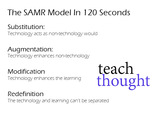
This is not a post about the SAMR model (a way of thinking about how to teach with technology that uses an acronym as a mnemonic device)-well, not in any way that’s going to further the conversation around it, or push your thinking about the ins and outs of using it.
In December, we shared a post that used Starbucks as an analogy to illustrate the SAMR model. We also shared a post about using the SAMR model for more effective teaching with apps. We’ve even offered a kind of alternative to the SAMR model with our Stages of #edtech Disruption.
So why share a simple video of the same model we’ve already covered in more detail elsewhere? Because, in lieu of the slightly murky analogy involing cheese and tennis balls, the video does a pretty good job of explaining the idea in less time than it takes to watch Apple make another $18-billion-of-profits-in-a-single-quarter announcement.
Share it with a teacher just getting started with the idea. Or not. We’ve done our part.
The SAMR Model In 120 Seconds
The post The SAMR Model In 120 Seconds appeared first on TeachThought.
TeachThought Blog
.
Blog
.
<span class='date ' tip=''><i class='icon-time'></i> Aug 05, 2015 09:41am</span>
|
|
The Ingredients Of A Creative Teacher
by Melissa Goodwin, creativist.io
There is a lot of talk about creativity these days.
Creativity drives innovation, it sparks new thinking, it enriches our lives, and it connects us to other human beings. While this is all wonderful and true, schools and educators find great difficulty in figuring out how to get more creative.
Since creativity is individualized and it expresses itself in each person differently, it becomes difficult for educational systems entrenched in testing and standards to figure out how to unlock creativity in students. Unfortunately, there is no ideal top down solution. Creative classrooms start and end with creative teachers. Luckily, creative teachers can be cultivated.
Here are three ingredients to cultivate creative teachers.
3 Seeds Of A Creative Classroom
1. Awareness
"If you don’t know where you’re going, the road’ll take you there." - the Cheshire Cat to Alice
Any math teacher worth their salt will exclaim, "math is everywhere!" They see geometry on a pool table, they see calculus as a car slows to a stop, they hear it in the toe tapping of the clarinet player, they see simple math in giving change at the store.
They know what math looks like in real time and in real life because they have spent the time studying, practicing, and becoming aware of the many ways math is relatable. Creativity is no different. A creative teacher is aware of what creativity looks like for themselves as well as how it might manifest itself in others. A creative teacher always keeps their radar up for "interestingness."
2. Empowerment
Empowerment is not a gift bestowed upon you; empowerment comes from within.
Every individual is filled with greatness and flaws. An empowered person has the courage to accept themselves for who they are and chooses a growth mindset. A growth mindset says creativity begets more creativity. A growth mindset says you can actually learn to be more creative. A growth mindset says you can create conditions in which creativity flourishes.
3. Practice
This is the kicker. It’s not enough to just read about creativity or to scour Pinterest for hours each day. Creativity requires getting in there. It gets messy. It requires some failing forward. That being said, there is real joy in creative practice. The act of making something, however small the act may be, changes something within. It lights a fire.
One way to start a creative practice is with a little copying. Children do this instinctively. They trace letters, they repeat movie lines (sometimes with perfect voice inflections) and song lyrics. Copying allows an individual to learn the ropes. Many great painters learned first as understudies, copying their masters.
The next step is a little something called remixing. The art of the remix is to take something that already exists and make it new. This might be a song, it might be blackout poetry, it might be improving on a coffee cup. Remixing is different than copying in that an individual is adding a little of themselves into the mix. It’s like an homage to the original artist, but with a little kick.
Remixing fuels creativity, and serves to spark others. This is evident in the viral videos that arise each day with parents, co-workers, and children dancing, lip syncing, and singing to remixed works.
The last way a teacher might practice their creativity is through combining. A great example of a combination is when Steve Jobs merged the idea of a graphical interface with the idea of a computer as a household appliance. The combination emerged as the wildly successful Macintosh computer.
Combinations are powerful forms of creativity. Unlikely pairings can often yield interesting results. It often takes many trials and failing forward to get the combination just right, but as the saying goes, "there is no glory in practice, but without practice, there is no glory."
It is said that we are all born creative, but it can get buried and trampled in this modern world. Creativity thrives in classrooms where there is courage, awareness, and a culture that supports creative practice. That courage, awareness and culture starts with the teacher. When teachers light their own internal fires, it serves as a beacon for others.
Today is a good day to begin.
The Challenge Starting February 2, 2015, 21 Days Committed to Practicing Creative Habits: Enroll now in the 21 Day Teacher Empowerment Challenge.
If you are looking for inspiration and some guidance to infuse these seeds of creativity into your teaching practice, your students — and your classroom — here’s your chance!
How It Works
Each day you will receive an email that encourages a creative way of thinking or acting.
Each day you are encouraged to share your experience in our online communities in the spirit of sharing, cooperation and collaboration.
At the end of the challenge you will be energized to continue to practice creative habits every day!
You Will Receive
Daily emails filled with tips on how to be creative, inspired and motivated.
Online Community to share your creativity with other teachers from around the world
A 21 Day Worksheet to keep track of your progress.
Enroll now!
Adapted image attribution flickr user denisekrebs
The post The Ingredients Of A Creative Teacher appeared first on TeachThought.
TeachThought Blog
.
Blog
.
<span class='date ' tip=''><i class='icon-time'></i> Aug 05, 2015 09:39am</span>
|
|
Prodigy: A Math Game For Elementary Skill Building
by Richie Saltzman, prodigygame.com
Ed note: This is a sponsored post from Prodigy Math, a free-to-play game with paid memberships available.
What Teachers Need To Know: Prodigy Math is a web-based (not app-based) math program aligned to the Common Core State Standards for Grades 1-6.
With more and more educators embracing game-based learning, it’s important to evaluate and choose the program that works best for you and your students. Game-based learning should not be a replacement for conventional classroom instruction, but rather used as a support tool to engage students and encourage practice, as well as develop "soft skills" that can promote the "whole child" while also improving academic achievement. This is where a math game we made comes in: Prodigy Math Game.
Prodigy is a free, adaptive math game that integrates common-core math (grades 1-7) into a fantasy style game that students love playing. Prodigy takes game-based learning a step further and provides teachers with a powerful set of reporting and assessment tools that allow them to easily identify trouble spots, differentiate instruction, and better manage classroom time. Prodigy has recently expanded its content offering to include skills that align to the Math Florida Standards (MAFS) and the Texas Essential Knowledge and Skills (TEKS).
And as a web-based game, Prodigy can be accessed at school and at home on virtually any device.
Teacher Endorsements
Over 1,000,000 students and 50,000 teachers use Prodigy for free math practice and it’s easy to see why. Here’s what teachers we spoke to had to say about the program.
Sarah Z, Grade 5 Ontario Public School
"As a 5th grade teacher, I have students working at various grade levels and Prodigy helps in differentiating my instruction to suit their individual needs. I really like using the assignments feature to asses each of my students for both diagnostic and formative purposes. One of the main reasons I choose Prodigy to supplement my students’ math learning is that I can choose and align the questions that are asked in the game with the specific strand and expectation that I am teaching in class. When I tell my students that we are having a quiz using Prodigy, they couldn’t be more excited to complete it! They absolutely love the game and ask to play it any time they have the chance."
Shoshanna Cohen, Grade 2 Seattle Public School
"I teach 2nd grade in a dual language classroom in Seattle. I have MANY extremely low and unmotivated students and math is by far their hardest subject. We practiced how to log on and how to begin and I let them soar from there. I have NEVER had such excited students. They love Prodigy Math Game and those who have computer access at home, are spending a great amount of time mastering skills outside of the classroom. I am able to differentiate lessons for my higher students and go back to the basics for my lower students. I am thrilled with the program and love the fact that it’s free!"
Other Features
Prodigy is designed to engage students using an adaptive technology to cater to each individual. Prodigy’s personalized approach identifies gaps in students’ understanding and works with them by pulling them back to prerequisite skills and then scaffolding them forward through more difficult concepts.
Prodigy has also built out tools like virtual manipulatives, which teachers can use to walk students through solving certain problems. It has a fantastic assessment feature as well, which allows teachers to customize content and align the game with what they are teaching in class. Assignment questions are integrated right into the game so students have no idea they are working on an "assignment"!
The program was designed to be user friendly and make teaching math easier, and learning foundational math skills more enjoyable for students.
You can Sign-up your class for free in less than 2 minutes, and see why teaching math will never be the same!
Prodigy: A Math Game For Elementary Skill Building
The post Prodigy: A Math Game For Elementary Skill Building appeared first on TeachThought.
TeachThought Blog
.
Blog
.
<span class='date ' tip=''><i class='icon-time'></i> Aug 05, 2015 09:39am</span>
|
|
Education Technology As A Matter Of Principle
by Terry Heick
iPads are the worst technology students will ever use.
This was a useful idea I saw hanging for a moment in my twitter feed a month or so ago from Jamie Casap-useful in that it helped me see education technology as a principle rather than a tactic.
Modern arguments around education technology tend towards binary positions-usually for or against; this "position taking" makes the design of education technology inaccessible because we’re not considering design, but rather positions. There are few compelling arguments against technology as learning tools, though even that depends on what students are learning and why. But if we’ll accept, if only for a moment, that:
A) "Technology" is a relative term, and
B) It allows previously impossible or unimaginable learning-in terms of process, product, pace, and content-to be possible
-then we’ve suitably altered the conversation from a matter of positions (check yes or no) to a matter of design (audience, purpose, and possibility).
We usually think of technology as a progressive thing, but any technology dates itself immediately through its form. Electricity, the wheel, paper, the printing press, metal working, mass transportation, masonry, and more are all forms of technology. Technology isn’t a leading edge, but a human practice.
And, as such, it can both extend our humanity or reduce it based on its application.
Design: Audience & Purpose
On a day to day basis, human processes are based on prevailing local technology. That is, we usually use what’s available to us to express our collective humanity (for better or for worse). To solve problems, reduce inefficiencies, or create opportunities, we turn to the technology that is accessible to us, usually in the form of tools and processes.
Philosophically, this is important because, by design technology is an artificial process or product intended to circumvent natural limits or defies natural processes. This creates spectacle that is addictive. Are Icarus and Prometheus and the Luddites heroes or cautionary tales?
Wikipedia defines technology as "the collection of tools, including machinery, modifications, arrangements and procedures used by humans." Oxford dictionary offers up a similar take, defining technology as "the application of scientific knowledge for practical purposes, especially in industry," going on to tell us that the word technology comes from the early 17th century from the Greek word tekhnologia-‘systematic treatment’, from tekhnē ‘art, craft’ + -logia.
Art. Craft. Design. Humanity. Somewhere between and across these ideas there are glimpses of where technology is taking us, specifically within the "fields" of teaching and learning. The iPad is the latest node in a constantly-expanding concept map of shared experience. New technology builds on old technology.
Properly paced and scaled, we’re in control of this hyper-cycle the whole time, but unfortunately the designers and producers of technology design produce in isolation from their applied use, which makes audience and purpose considerations-prime matters of design-impossible.
But if we zoom out some, this isn’t so much about how iPads can function in a classroom, but the iPad as a matter of sequence. Technology never peaks. As students in 2015 grow and read and write and learn, technology will continue forward at breakneck speed because it evolves in isolation by standards of its own.
The iPad sales have recently stagnated after a mercurial rise that began April 3, 2010-only four and a half years. Wearable technology is among the threats to iPads as successful consumer products, but in education, Google’s slick cloud-integration is making them a more streamlined choice for many classrooms.
Education Technology As A Principle
But more significantly, the life-cycle of the iPad in education emphasizes the incendiary, remorseless tone of technology.
Arguments for or against iPads in classrooms is a bit like arguing Romney/Obama. It’s over, and holding that argument dates the arguers. I get why some teachers are against technology in education. Powerful learning models can be designed without technology because knowledge is the ultimate technology.
But if we think in terms of learning design, the argument that technology is already there and we’re simply arguing for a certain technology level can be useful. It’s not binary edtech-yes-or-no, but do we want old tech or new?
If we think of technology as a matter of sequence, then technology isn’t so much a teaching strategy or educational tactic as it is a principle of learning.
When today’s elementary students are 40, they’ll remember iPads the way (many of us) remember cassette tapes. It will be funny that they used to hold large, heavy glass rectangles in their hands, and had to open up apps separately. And had to know which app did what. And had to "Google" information. And sometimes weren’t even connected to the internet because WiFi signals were unreliable.
iPads and other existing mobile technology will be remembered like symbols-markers for a time and a place in their lives. This usefully decenters education technology as some kind of spectacular edge, and frames it as a principle of learning-and a matter of pedagogical principle.
The question we are left with then: Are we willing to design learning models that understand how technology functions in the lives of modern students?
Education Technology As A Matter Of Principle; image attribution flickr user flickeringbrad
The post Education Technology As A Matter Of Principle appeared first on TeachThought.
TeachThought Blog
.
Blog
.
<span class='date ' tip=''><i class='icon-time'></i> Aug 05, 2015 09:39am</span>
|