Blogs
|
TEST 52 Of The Best Apps For Your Classroom In 2015
by TeachThought Staff
This post was sponsored by CK-12, a non-profit foundation that creates and aggregates high quality curated STEM content.
What are the best apps for your classroom? The best little bits of software to use tomorrow, in your school, to make your classroom go?
This is, strangely, not a frequent topic for us. We are more interested in helping you push your classroom towards something unrecognizable-something that reflects the extraordinary change the world has seen but many public schools have somehow resisted. Something that centers students, helps them learn what’s worth understanding, and then equips them-and you-to make that learning happen.
But what if that’s not your bag? What if you have a classroom and standards and tests and pressure and walkthroughs and parents and IEPs and 504s and classroom management issues and bandwidth problems and Draconian district filtering and that’s just the way it is? What then?
This is the reality that, if statistics don’t mislead, most of you face on a daily basis. The good news is, there is a lot you can do in a traditional, top-down, "high-pressure" school or classroom. The apps below represent 52 (which conveniently works out to about one per week if you want to try them that way) of the best apps for your classroom. There are apps that help teachers gather data, scan exams, contact parents, promote research, keep notes, share documents, or even flip your classroom in 2015.
Let us know in the comments any that were what-were-they-thinking-missing-that-one? examples.
52 Of The Best Apps For Your Classroom In 2015
52 Of The Best Apps For Your Classroom In 2015
︾
7.82kviews
52items
52 Of The Best Apps For Your Classroom In 2015
Listly by Terry Heick
52 Of The Best Apps For Your Classroom In 2015
Follow List
Embed List
Share
1
CK-12 studyNow!
studyNow is an intuitive app designed by CK-12 Foundation that helps students learn, do homework, and research for projects . The app helps students find and learn K-12 content in an easy and intuitive manner. Students can now learn at their own pace and in their own way (Video, Interactive Objects, Read, etc.). Teachers can use this app to help keep their kids engaged within the class room and find supplemental material for their class. The app can also be used as a companion tool to the CK-12 site (www.ck12.org).
0 likes
Comments
Relist
Share
2
WISE
W.I.S.E (Wireless Interactive Scanning Examinations) is an application that grades and stores multiple-choice quizes, tests, and exams, on your mobile device. It condenses a wealth of information and powerful processing technology into the palm of your hand. Cutting edge assessment has never been easier.
0 likes
Comments
Relist
Share
3
Questia Library - Scholarly Sources for Writing Research Papers, Essays and Homework
• Quickly find credible books, scholarly articles and topics for your research papers
• Read full-text books and articles within the app
• Save what you are reading for future access in a project folder
• Search and read fluidly and seamlessly with Questia’s easy-to-use display
0 likes
Comments
Relist
Share
4
Encyclopædia Britannica
The complete Encyclopaedia Britannica - the world’s most trusted reference source, enhanced for your iPad, iPhone, or iPod Touch.
1 likes
Comments
Relist
Share
5
Amazon Kindle - Android Apps on Google Play
The Kindle app puts over a million books at your fingertips. It's the app for every reader, whether you're a book reader, magazine reader, or newspaper reader-and you...
0 likes
Comments
Relist
Share
6
Doceri Interactive Whiteboard
Combining screencasting, desktop control, and an interactive whiteboard in one app, you’ll never have to turn your back to the class or audience again. Create a lesson or presentation, insert images, save and edit your project and record a screencast video you can easily save or share.
0 likes
Comments
Relist
Share
7
Evernote - Android Apps on Google Play
You're on the path to something big - Evernote is where you do the work to achieve it. Write notes of all types, from short lists to lengthy research, and access the...
0 likes
Comments
Relist
Share
8
TeacherKit - Class Organizer, Teacher Planner, Gradebook, Assignment List, Attendance and Student 's Grade Tracker
Over a million educators worldwide trust TeacherKit with managing their time and activities. TeacherKit helps you organize classes and students easily. Create a seating chart, record attendance, log behavior, and track grades all with few taps. TeacherKit lifts the headache of routine administration, allowing you to focus on what really matters to you - teaching.
0 likes
Comments
Relist
Share
9
ShowMe Interactive Whiteboard
ShowMe allows you to record voice-over whiteboard tutorials and share them online. It’s an amazingly simple app that anyone can use, no matter how young or old!
0 likes
Comments
Relist
Share
10
Schoology
Managing education is tough enough without also having to host your own website. Schoology hosts your website, your content, and your files. Best of all, it connects you with your students to help improve outcomes.
0 likes
Comments
Relist
Share
11
Khan Academy
We cover a massive number of topics, including K-12 math, science topics such as biology, chemistry, and physics, and even the humanities with playlists on art history, civics, and finance.
1 likes
Comments
Relist
Share
12
Nearpod
The Nearpod platform enables teachers to use their iPads to manage content on students' iPads, iPhones, iPods or Macs. It combines presentation, collaboration, and real-time assessment tools into one integrated solution.
0 likes
Comments
Relist
Share
13
School Circle
The one and only School Circle mobile browsing app makes checking all your favorite Marine Corps humor pages on Facebook easier than ever before! Simply open the app, tap on any icon, and instantly see the most recent posts from your favorite pages to include JTTOTS, PBF, Senior Lance Corporal and more!
0 likes
Comments
Relist
Share
14
Educreations Interactive Whiteboard
Educreations is a unique interactive whiteboard and screencasting tool that's simple, powerful, and fun to use. Annotate, animate, and narrate nearly any type of content as you explain any concept. Teachers can create short instructional videos and share them instantly with students, or ask students to show what they know and help friends learn something new.
0 likes
Comments
Relist
Share
15
Kahoot! - Android Apps on Google Play
Like a "Playstation for education", Kahoot! is a game-based educational platform that leaves your students begging for more. With a refreshingly new take on introducin...
1 likes
Comments
Relist
Share
16
One Call Now - Android Apps on Google Play
Now it's even easier for One Call Now clients to communicate with members of their school, business, religious or sports organizations. Quickly record and send mes...
0 likes
Comments
Relist
Share
17
YouTube
Get the official YouTube app for iPhone and iPad. Catch up with your favorite channels, enjoy the world’s largest music collection, and share easily with friends. Watch the latest videos and playlists on the couch or on the go.
0 likes
Comments
Relist
Share
18
Microsoft PowerPoint
The real Microsoft PowerPoint app designed for iPad, iPhone and iPod touch.
Now PowerPoint presentations look great on your tablet and phone. When you edit or create presentations, you can be confident that they will look exactly how you want across PC, Mac, tablet and phone. PowerPoint has the familiar Office look and feel along with an intuitive touch experience, so you’ll be up and running in no time.
0 likes
Comments
Relist
Share
19
OneDrive for iOS
• Automatically upload photos and videos to OneDrive using Camera Backup.
• Browse all your OneDrive files and files shared with you.
• Share files by sending a link in email or getting a link to copy and paste.
• Move, delete, and rename files, and create new folders.
• Open your OneDrive files in other apps, including Office apps.
• Quickly get to documents you've recently opened.
• Search for your files and folders.
0 likes
Comments
Relist
Share
20
Drawp for School - Create. Learn. Collaborate.
• Create rich mixed media content in-app.
• Swipe to share or collaborate.
• No need to worry - all your work is automatically saved.
• Cloud storage lets you access all your work at home or at school.
For more information refer to our privacy policy: http://www.drawpforschool.com/school/web/privacy/
0 likes
Comments
Relist
Share
21
Minecraft - Pocket Edition
Pocket Edition includes Survival and Creative modes, multiplayer over a local Wi-Fi network, infinite worlds, caves, new biomes, mobs, villages and lots more. Craft, create and explore anywhere in the world so long as you have hands spare and battery to burn.
0 likes
Comments
Relist
Share
22
iTooch 5th Grade Science - Android Apps on Google Play
With more than 1,652 activities, iTooch 5th Grade Science is a fun way of practicing and learning Science for fifth graders. It is, by far, the largest collection o...
0 likes
Comments
Relist
Share
23
The Sandbox EDU
The Sandbox EDU is the perfect educational game for the "Maker" in you and your child.
Specifically adapted for kids ages 6 to 12 and developed with classroom teachers as a complementary version of the popular game, The Sandbox (played by over 13 million people worldwide), The Sandbox EDU features original educative content supporting the experiential learning of science, technology, art and music!
0 likes
Comments
Relist
Share
24
Stick Around by Tony Vincent & MorrisCooke
Play, design, and share sorting and labeling puzzles! Stick Around comes with an assortment of puzzles, including ordering decimals and classifying rocks. It's the player's job to drag the stickers from the tray to their correct spots on the background before time runs out.
1 likes
Comments
Relist
Share
25
Prezi
Create and share beautiful presentations
• Create basic prezis from scratch using your iPad
• Create prezis online and finalize them using your iPad
• Zoom into any detail or pull out to show the big picture
• Follow your predefined path or move about the open canvas freely
1 likes
Comments
Relist
Share
View more lists from
Terry Heick
52 Of The Best Apps For Your Classroom In 2015
TESTThe post 52 Of The Best Apps For Your Classroom In 2015 appeared first on TeachThought.
TeachThought Blog
.
Blog
.
<span class='date ' tip=''><i class='icon-time'></i> Aug 05, 2015 09:53am</span>
|
|
5 Strategies For Better Teacher Professional Development
by Joel Zarrow
Just as a teacher has to create conditions that support and encourage student success, school districts have to support teachers’ professional development.
Today, professional development runs the gamut from one-shot workshops to more intensive job-embedded professional development, which has teachers learn in the day-to-day environment in which they work rather than getting pulled out to attend an outside training.
However, the National School Boards Association’s Center for Public Education report, "Teaching the Teachers," notes that most professional development today is ineffective because it neither changes teaching practices nor improves student learning.
Professional development for teachers can fall short in numerous ways, including:
Too many (and sometimes conflicting) goals and priorities competing for teachers’ time, energy, and attention.
Unrealistic expectations of how much time it will take schools and teachers to adopt and implement goals.
Professional development training events that are inappropriate in size, scope, or structure to support learning new ideas or skills. Gathering 100 teachers into one room for a training event will never give them the time they need to reflect on the material, ask questions, listen to their peers, or go through activities to enhance their comprehension.
Lack of support for teachers’ implementation of new instructional practices. Research shows there’s an implementation gap in teachers’ professional development. They may learn, understand, and agree with a new idea or technique presented in a workshop, but it’s hard for them to implement that idea without ongoing support.
Failure to provide teachers with feedback about how implementing new skills impacts student learning.
How Districts Can Turn Professional Development for Teachers Around
Just as every student learns differently, teachers have many different learning styles and face a variety of circumstances in the classroom. The CPE’s report asserts that any professional development initiative must recognize that "teaching is inherently complex and nuanced" and promote the empowerment of teachers via professional learning communities.
According to the report, effective professional development offers:
Ongoing instruction for a significant duration of time. Continual professional development gives teachers time to learn and implement new strategies. According to the report, studies have concluded that teachers may need as many as 50 hours of instruction, practice, and coaching before a new teaching strategy is mastered and implemented in class.
Support for teachers during the implementation stage. According to "Student Achievement Through Staff Development," teachers take an average of 20 separate instances of practice to master a new skill, and this number may increase if the skill is exceptionally complex. Providing support addresses the challenges associated with changing a classroom practice.
Active learning opportunities for teachers. These activities can include readings, role-play, open-ended discussions, live modeling, and classroom visits. While many forms of active learning help teachers decipher concepts, theories, and research-based practices in teaching, modeling the new practice has been shown to help teachers understand and apply a concept and remain open to adopting it.
5 Strategies For Better Teacher Professional Development
School districts can improve the effectiveness of their professional development for teachers by following these basic guidelines:
Keep it simple. Each year, identify and focus on one or two instructional priorities — effective instructional practices that the district wants teachers to learn, refine, or improve. Ideally, districts should select the priorities with input from the teachers themselves. They should clearly communicate these priorities and expectations throughout all levels of the organization.
Organize all available district support to help teachers implement these instructional priorities. Our organization believes that introducing teachers to a new way of teaching reading or writing without the proper follow-up support only confuses and frustrates the teacher.
School districts should make a deliberate effort to support teacher implementation of instructional priorities through training events, coaching, principal observation, staff and grade-level meetings, and evaluation systems. But ultimately, the best professional development comes from teachers teaching one another. If schools can establish a collaborative, intellectually stimulating environment for teachers, that’s a place where children will learn.
Create a feedback loop to help teachers monitor implementation. Once districts define the outcomes they want to achieve, they should use teacher observations and student data to provide teachers with information about whether changes are having an effect on student achievement. Teachers may need help learning how to conduct related assessments, analyze and interpret the data, and adapt their instruction in response to the data.
Realize that change takes time. Too often, districts work on something for a year, then revamp their priorities and launch a whole new set of goals for the next year. Administrators must realize that teachers will still need support when implementing changes the second year.
At the end of the day, teachers, districts, and parents all want the same thing: to improve student learning. But many teachers simply aren’t equipped with the professional development they need to make real changes in their classrooms. Districts can’t hope for sweeping improvements by sending teachers to workshops and seminars a few times a year; teachers need continual professional development with active learning opportunities, feedback, and support built right in.
Children’s Literacy Initiative is the premier national nonprofit working with teachers to transform instruction so children can become powerful readers, writers, and thinkers. CLI focuses on early literacy in urban schools and districts. Joel Zarrow is the executive director and can be reached at jzarrow@cli.org; image attribution flickr user globalpartnershipforeducation
The post 5 Strategies For Better Teacher Professional Development appeared first on TeachThought.
TeachThought Blog
.
Blog
.
<span class='date ' tip=''><i class='icon-time'></i> Aug 05, 2015 09:53am</span>
|
|
Dealing With A Difficult Parent
by Terry Heick
You’d heard about this parent from other teachers.
That this parent was a handful. Rude. Combative. Aggressive. Even litigious. In response, you worry, if just a little. You have enough to deal with, and butting heads with an angry parent-especially one angry just because-doesn’t sound like fun. You don’t get paid enough for that hot mess.
So you keep calm and hope to ride the year out. Maybe they won’t call. Maybe they’ll skip parent-teacher conferences. You’ve even considered grading their child a little easier just to avoid the hassle of it all.
We’ve all been there. Nothing can solve this problem, but there are ways to take the edge off so that you can open up the lines of communication and deal with the parent on equal terms so that they’re child has the best chance for success.
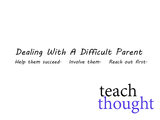
12 Ways To Deal With A Difficult Parents
1. Reach out first
Be pre-emptive. Reach out with a positive message to start off on the right foot.
2. Don’t patronize
And when you reach out, be authentic. Don’t pretend to be their best friend, nor should have that "nipping problems in the bud" tone. Don’t worry about "holding your ground" either. Just reach out as an educator to a member of your own community. You’re not selling them anything, and they’re not selling you anything. You’re both dutifully and beautifully involved on either side of a child.
3. See yourself
No matter how important the education of a child is, realize you’re simply a single cog in the life of that family, no more or less important than keeping the lights on, their job security, food and shelter, or any other reality of daily life.
4. Give them something
Not an object-a "handle" of some kind to make sense of the learning process. Something they can make sense of and understand and use when they speak to their child about education. Something less about the game of school and more about learning, curiosity, and personalization. (See here, for example-alternatives to "What’d you learn in school today?")
5. Involve them
Keep your friends close and your…difficult parents…closer. Ask them to take on an authentic role in the classroom. Ask their opinion. Allow them to have a voice or show leadership. Give them a role in what their child learns. The fact that a parent has approaching zero authentic role in the learning process of their children is part of our challenge as educators. Help them find one.
6. Put them in a position to succeed
Just like a student, put the parent in a position to succeed. They may not have had a good experience in school, either as students, with siblings of your student, etc. Give them a reason to believe that you have the best interest of the family at heart-and that includes them.
7. Don’t judge them, or "handle them."
Meet them on equal terms. For all of our overly-glorified differences, most people are fundamentally the same. We respond to pain and threats differently, and have unique ethical systems, but it’s easy to place yourself above someone even if you think you’re not doing exactly that.
8 Establish a common ground
An old sales technique. A favorite athletic team-or dislike for a rival team. A personal philosophy. Your own struggle as a person. Something to humanize yourself, and establish the overlap between yourself and the parent.
9. Focus on the work
This is the opposite of teaching and learning, where you focus on the human being (the student). In conferences and communication with parents, you can both see the child and what’s "best for them" very differently, but academic work has a chance to be more objective. Focus on the work and academic performance, and what you and the parent and siblings and other teachers, etc., can do to support the student in their growth.
Even in the midst of difficult conversations, always do your best to steer the focus back on the work, and the child themselves. The former is data/evidence, the latter the reason for the data/evidence.
10. Give them reason to see beyond the grade book
This is partly the problem with letter grades. So reductionist.
It’s easy to look at a grade book and both start and finish the conversation there. If that’s all they see, have a look at your curriculum and instruction, and see if you’ve given them ample opportunity to do otherwise. Talk less about missing work, and more about the promise and possibility of their child. Help them see that the school year is a marathon, not a series of sprints.
11. If all else fails…
If you have to, call for reinforcements, and document everything. Never feel bad about having another teacher in the room with you if you feel like a parent will be aggressive and you’re simply not comfortable with it. Better to depend on solidarity and hope than your own personal strength.
And document everything. Stay on top of grading, feedback, behavior management, missing assignments, your tone, sarcasm, etc. Document every call and email. Save exemplar work. Document differentiation, personalization, and other individual efforts in pursuit of the best interest of the student.
Whatever you do, no matter your analysis of the proximity between apples and trees, don’t hold the difficult parent "against" the child, even subconsciously.
12. Take it personally, then don’t
If you have a "difficult parent," and in spite of your best efforts it all falls apart, I’d say don’t take it personally but it’s hard not to. So fine-internalize it. Own it. Talk to colleagues (better than a spouse, whose emoptional reserves you may want to save for more pressing issues in education). Cry if you need to.
And then let it go.
Dealing With A Difficult Parent; 12 ways of dealing with a difficult parent.
The post Dealing With A Difficult Parent appeared first on TeachThought.
TeachThought Blog
.
Blog
.
<span class='date ' tip=''><i class='icon-time'></i> Aug 05, 2015 09:53am</span>
|
|
Clarifying Expectations With Clear Communication
by Molly Bruzewski, Ed.S.
Ed note: This is part 2 on strategies that promote a team approach to academic achievement and high-performance teaching. Part 1 was Every Classroom Is A Team And Every Teacher Is A Coach. Strategies 2 and 3 appear below.
In the same way that students appreciate teachers who articulate their expectations and model them consistently, our staff appreciates it from us.
The availability of data reports around student achievement is providing us with opportunities for success like never before. True, these reports often have us zero-in on deficiencies in student learning, but as the Head Coach, you take that data and rally your team. You ask, "Is there one specific thing we can do to raise student achievement across the curriculum; across our teams regardless of our classroom philosophies?"
If the ultimate goal for every student in your building - whether in elementary, middle or high school - is to become a contributing citizen and be fully employable, begin with this end in mind. Your data are showing that students have communication deficiencies. Rally your teams and begin to dig in.
As you scan the literature and websites for essential skills for employees, among the top skills is the ability to speak and write effectively. Research demonstrates that written language proficiency follows oral competencies. Would it benefit you to zero-in on developing a plan around speaking in complete sentences? To begin, get your Playbook out, identify some strategies that anyone could use in their classroom, and begin to model what that might look like.
Staff meetings are a great place to set the stage to launch this practice. If you choose to embark on this mission, is it possible to stir up controversy if you expect staff and students to speak in complete sentences? In 2012, President Obama was close to being called an elitist because he insisted on using complete sentences every time he spoke publicly.
Strategy 2: Complete Sentences Are Complete Thoughts
Children develop the ability to communicate in complete sentences between the ages of two and three. Developmentally they are ready. But in today’s hectic home life, and in our ever-increasing "texting" generation, many of our students are working from a deficit when it comes to their ability or their tendency to communicate verbally and construct complete sentences.
In her BLOG, The B.E.S.T. Literacy Connection, Sarah Whitt cites research done by Dr. Kathy Cooter of Bellarmine University around the "mean length of utterance (MLU)." The mean length of utterance by students is tied to their aptitude and ability to write and express themselves. In many schools, teachers are the "main violators," as they use approximately five words per sentence, and often without the inclusion of challenging or academic vocabulary.
Therefore, find websites that provide strategies for modeling speaking in complete sentences. And, when addressing someone who asks why we would "practice" speaking in complete sentences, you may reply, "That is a great question, Teacher A. This isn’t a practice we have focused on. You’re right about that. I have been guilty of not being intentional about speaking in complete sentences, as well. However, we need to model our expectations and speak in complete sentences because our students are the ultimate beneficiaries. Thank you for asking!"
This second practice is an intentional one. We often do not pay attention to our communication with students, nor with one another. But, it comes back to our first practice, if we want to see this done well, and if we want to raise the academic caliber of our students, Educators Model.
Strategy 3: Pulling It Together With The Whole Group
Instruction at any level is tricky.
Whether an administrator or teacher, our audience is in a constant state of flux. We are constantly competing for their attention. Advertisers employ a variety of rules for getting your attention - the rule of 151 or the rule of seven, for example - indicates the number of times people must hear a message before they understand or act.
This means that the first time you "deliver" information to your audience, it doesn’t mean they have heard it. Therefore, pull out your Playbook, invite members from Team 1 and 2 that you have witnessed getting students to process information well, and invite them to plan with you.
To start, you may choose to model 21st Century learning. In Education Week’s BLOG, 5 Reasons You Should Flip Your Leadership, author Peter DeWitt recommends that building leaders begin to flip their meetings by covering the announcements and less critical information through a simple podcast or webcast.
You may also add a hook to your message by introducing "what is to come" at the next staff meeting and provide a preview. Set the stage and provide literature to support where you want to take you team. Next, if you know that the information you have to discuss at your next meeting will take about 40-45 minutes, and you have one hour for the whole meeting, plan your strategies carefully. Get your facilitators to help you with the processing activities to be used throughout the meeting.
When you get your group face to face, with your selected facilitators, model "teaching to the whole group." What is your message? What do you need to share? Balance your message with processing time, allowing the group to turn and talk, or ask questions, to clarify. Vary the processing activities for the purpose of seeing them implemented in classrooms.
Provide teachers with the resources and guidelines on how to use them. As you teach to the whole group, remember the first practice - Educators Model. Use strategies you would like to see your staff engage in as they teach. Make the strategies universal and easily adaptable to any learning environment. Teachers love strategies - especially ones they can use in their classroom the very next day.
Remember, student achievement is a Team Sport. It takes all teams collaborating around common goals to ensure their success.
Molly Bruzewski, Ed.S. is an education consultant in Michigan. Her expertise is in curriculum mapping and assessment, classroom instructional strategies, online teaching and learning, and she serves as a Great Expectations (GE) methodology instructor. Bruzewski is passionate about teaching excellence and believes GE provides a comprehensive approach to student success in all classrooms.
References
Modeling - Playbook Practice 1; Speaking in Complete Sentences - Playbook Practice 2; Obama’s Use of Complete Sentences Stirs Controversy, November, 21, 2008, The BLOG, Huffington Post; The B.E.S.T. Literacy Connection, The Power of Speaking in Complete Sentences, Sarah Whitt, Feb. 13, 2012; Whole Group Instruction - Playbook Practice 3; Education Week BLOG, Finding Common Ground, 5 Reasons You Should Flip Your Leadership, Peter DeWitt, July 6, 2014; image attribution flickr user vancouverfilmschool; Clarifying Expectations With Clear Communication
The post Clarifying Expectations With Clear Communication appeared first on TeachThought.
TeachThought Blog
.
Blog
.
<span class='date ' tip=''><i class='icon-time'></i> Aug 05, 2015 09:52am</span>
|
|
The Learning And Design Principles Of Connected Learning
by Terry Heick
In 2015, no one should be hurting for compelling ed content. Sites like edutopia, The Tempered Radical, Langwitches, Justin Tarte, Cool Cat Teacher, Grant Wiggins’ blog, and dozens of others offer outstanding reading on a daily basis to help you improve the things that happen in your classroom. (And this list is frustratingly incomplete-they’re just the sites on my radar that I’ve been reading since I entered education.)
A bit more "fringe" are sites like TeachThought, Jackie Gerstein’s UserGeneratedEducation, the Connected Learning Alliance and DMLCentral.net, MindShift, and so many more-"fringe" due to their thinking that seems as interested in understanding what’s possible in a modern learning environment as they are what is. Pursuing excellence in the box while demanding to know what’s going on outside that box.
You could even call this kind of content less immediately practical when you’re just Googling for a lesson idea for tomorrow, but there’s room for everyone in a digital and infinite world. There are already fantastic sites that offer worksheets and classroom management strategies and assessment policies. We’ll do that from time to time, but near and dear to our mission at TeachThought is to rethink learning in a modern world, however we choose to characterize those modern qualities.
Along with the others, CLA is on our short list of thought leaders that help push us to think about how education is changing in a modern world, which is why we’ve shared some of their models in the past, including their iconic Connected Learning model. Recently, we also discovered that they’ve shared the design principles of that model, along with a description of each.
These ideas appear below-and of course, check out CLA and DML for further reading.
The Learning And Design Principles Of Connected Learning
"For more than a century, educators have strived to customize education to the learner. Connected Learning leverages the advances of the digital age to make that dream a reality — connecting academics to interests, learners to inspiring peers and mentors, and educational goals to the higher order skills the new economy rewards.
Six principles (below) define it and allow every young person to experience learning that is social, participatory, interest-driven and relevant to the opportunities of our time.
6 Design Principles Of Connected Learning
1. Interest-Powered
Interests foster the drive to gain knowledge and expertise. Research has repeatedly shown that when the topic is personally interesting and relevant, learners achieve much higher-order learning outcomes. Connected learning views interests and passions that are developed in a social context as essential elements.
2. Production Centered
Connected learning prizes the learning that comes from actively producing, creating, experimenting and designing because it promotes skills and dispositions for lifelong learning and for making meaningful contributions to today’s rapidly changing work and social conditions.
3. Peer-Supported
Connected learning thrives in a socially meaningful and knowledge-rich ecology of ongoing participation, self-expression and recognition. In their everyday exchanges with peers and friends, young people fluidly contribute, share and give feedback. Powered with possibilities made available by today’s social media, this peer culture can produce learning that’s engaging and powerful.
4. Shared Purpose
Today’s social media and web-based communities provide unprecedented opportunities for caring adults, teachers, parents, learners and their peers to share interests and contribute to a common purpose. The potential of cross-generational learning and connection unfolds when centered on common goals.
5. Academically-Oriented
Connected learning recognizes the importance of academic success for intellectual growth and as an avenue towards economic and political opportunity. When academic studies and institutions draw from and connect to young people’s peer culture, communities and interest-driven pursuits, learners flourish and realize their true potential.
6. Openly-Networked
Connected learning environments link learning in school, home and community because learners achieve best when their learning is reinforced and supported in multiple settings. Online platforms can make learning resources abundant, accessible and visible across all learner settings."
6 Design Principles Of Connected Learning
The post 6 Design Principles Of Connected Learning appeared first on TeachThought.
TeachThought Blog
.
Blog
.
<span class='date ' tip=''><i class='icon-time'></i> Aug 05, 2015 09:52am</span>
|
|
Let’s Develop A New Standard For School Security
by Jeff Green, PhD Candidate and founder of safedefend.com
As a former elementary principal and a father, December 14, 2012 had more than a great impact on me.
While I was in my office on that cold and cloudy day, I learned of the Sandy Hook tragedy that took the lives of 20 students and six staff members. Instantly, I, like most parents, thought of my own kids and worried about their safety. I had that luxury. The families of those who lost their lives did not.
I thought of the law enforcement officers and EMTs and how their lives would forever be changed by what they saw. The shooting was a tragedy far beyond 26 deaths. I sat in my office as the gray sky turned black analyzing our school safety plan. As a principal of my own school, I looked at our amazing building and started to see it differently.
I didn’t see the all of the windows surrounding our cafeteria as a great way to connect to the outside; I saw it as an easy way for someone to shoot into my building.
I didn’t see our entry way that forced visitors into the office before accessing the school as a great safety measure; I saw our entry way as a funnel to make our secretaries the first target and slow down or eliminate our ability to inform staff of the crisis through our intercom.
I didn’t see our colorful hallways as a bright and open connection to student learning; I saw them as an incredibly easy walk way to access all of our students.
For the first time as a father and principal, I felt helpless. I was afraid I couldn’t protect my students. I was left with two choices: do nothing or do something. I chose the latter. I started to research school tragedies. I didn’t just focus on shootings or violent events, I looked at fires, storms, freak accidents - anything I could find. Some things really stood out. Incredibly, there has not been a student death in a school fire since December 1958. Why? Because we changed.
We changed the materials schools were constructed from. We required alarms and suppression systems. We required more exits and fire drills. Lives were saved because we changed. Because of student deaths from heart issues, many schools now have AEDs. We now have the ability to perform incredible medical interventions once only available at hospitals from trained doctors. We changed and now we are saving lives.
Since Columbine, law enforcement has changed. They changed how they respond to a crisis at a school. They no longer wait for a large team to assemble before going in. In many cases, the first officer on the scene goes in with or without backup. They have changed and lives are being saved. School staff are still trying to figure out how and what to change. They are working to keep our kids safe and not lose sight of the purpose of education.
A lot of money is being spent on the perimeter of the building and upgrading camera systems. Useful yes, but not a change that will save lives. Schools need to coordinate with and be allowed to share information and support mental health services in schools and homes. Schools need to treat the issues before a tragedy, not after. We also need to protect our students where they are most vulnerable, in the school itself.
You see, Adam Lanza (the teenage shooter at Sandy Hook) was an anomaly. He was not connected to Sandy Hook anymore. That is rare for an active shooter situation. The more likely threat to our children will come from within. Someone who is supposed to be there-someone we let in. That is something new-another factor to adjust for in the ongoing effort to protect our students.
After the shooting, I changed. I left my position as principal at the end of my contract, specifically I left to help find a better way to protect students. My own kids have changed. I teach them to look for exits. I give them scenarios like, "If a bad guy comes through that door what would you do?" My kids know to run, to hide or if no other options exist, to fight.
Lives have certainly been changed from that tragedy that fell on Dec. 14, 2012, and I had to learn to accept that, at the time, there was little I could’ve done differently. The tragedy changed changed me, and education as a whole. It would be a huge dishonor to those who died if we, as an industry, did not change in response by becoming more serious about how we protect the students in our care.
This is a call to not simply respond with new policies, but to create a new standard for school security.
Jeff is a former school principal and current Ph.D. student at the University of Kansas, and founder of Safe Defend, a modern protection system for schools.; Let’s Develop A New Standard For School Security; image attribution flickr user kateterhaar
The post Let’s Develop A New Standard For School Security appeared first on TeachThought.
TeachThought Blog
.
Blog
.
<span class='date ' tip=''><i class='icon-time'></i> Aug 05, 2015 09:52am</span>
|
|
Assessment In Medicine: Even The Medical Industry Is Rethinking Assessment
by TeachThought Staff via press release
When health care providers take patients’ perspectives into consideration, patients are more likely to be actively engaged in their treatment and more satisfied with their care. This is called patient-centered care, and it has been the central focus of the curriculum at the University of Missouri School of Medicine since 2005.
Recently, MU researchers have developed a credible tool to assess whether medical students have learned and are applying specific behaviors that characterize patient-centered care. The researchers first worked with real patients to identify a list of specific behaviors that demonstrated physicians were providing patient-centered care. By defining these detailed, specific patient-centered behaviors, the researchers have been able to tailor the educational experience at the MU School of Medicine to help students gain these skills.
MU medical students now are assessed on their ability to deliver the care in ways the patients expect; students must perform at a satisfactory level on the patient-centered care exam to graduate from the MU School of Medicine.
"The test forces the future physician to go beyond just determining a diagnosis and to focus on behaviors that play an essential role to the effectiveness of the care he or she provides," said Kimberly Hoffman, Ph.D, associate dean for curriculum and assessment, and research associate professor of family and community medicine at MU.
Hoffman is the author of a study describing how the assessment tool for patient-centered care was developed at the MU School of Medicine. In the article, Hoffman also outlines a process for having patients validate the assessment.
The test of patient-centered care behaviors is given to third-year medical students. The exam is given in the third year because it is then the students are immersed in their clinical rotations. Before the third year of medical school, most of the studies are done in a classroom, lab or simulation-center setting. The test is called the Patient-centered Care - Objective Structured Clinical Exam (PCC-OSCE).
"We developed very real, complex scenarios," said Hoffman. "The test uses standardized patients, standardized family members and standardized health providers to simulate real-life situations."
The standardized patient (an actor) is trained to take on characteristics of a real patient and portray the roles of patients, family and others. Students are tested on how they interact with standardized patients ranging from adolescents to senior citizens, how to solicit information from the patient, and how to create a management and care plan that reflects the patient’s preferences.
"One thing that is pretty striking with our curriculum is how early you get involved in patient care, with an emphasis on patient-centered care," said Woody Smelser, a fourth-year medical student from New Madrid, Missouri, who is president of his medical school class at MU. We get immersed in it early on.
A good example is in the second week of medical school, you start to see your first patient in the simulation center. From that moment, the medical students are assessed on things like building rapport, making good eye contact, intently listening to the patients’ concerns, and finding out the real reason for the visit, which may not be what is actually listed on the sheet the doctors are given."
"The test takes all the skills you have learned in the first three years of medical school and combines them with elements of patient-centered care," said Smelser. It assesses in many different ways if the medical student is able to make the transition from a student to a practicing physician."
From this authentic assessment, researchers learned students were picking up on many key factors in patient-centered care. Most MU medical students had strong, effective communication skills, didn’t use medical jargon, actively listened to the patient, showed empathy and were in charge of the situation when they needed to lead a critical conversation.
"We get very detailed feedback, in the form of comments, and even videos, from our simulation-center encounters and through the patient-centered care exam," said Smelser. "When we can actually see things we did and did not do — like crossing our arms, making us appear guarded and not open to the patient — it helps us to overcome some of those behaviors we may not have realized we were using, and it reinforces the good behaviors we did do."
"By the time we take the exam in our third year, we are all confident we have the skill set or developed this skill over the course of the last two to three years," said Joshua Geltman, a third-year medical student from St. Louis, who is also president of his medical school class. Patient-centered care is our default, it’s our baseline; that’s the way we have learned how to become a physician. Now it is just the norm, not a separate skill set because it is included in every aspect of what we have learned in medical school."
Geltman has not yet taken the patient-centered care exam yet, but says the curriculum has positioned him up for success.
"Putting a grade and critique on our ability is a needed task," Geltman said. "It will enable the School of Medicine to produce even better physicians not just in measure of performance but the quality of care they are able to deliver to their patients."
Through these tests, School of Medicine faculty members have also been able to identify other opportunities where students can improve. Many of those include examining barriers a patient could face that would cause problems with compliance with the treatment plan and routinely involving family members and other members of the health care team in the patient’s care.
Hoffman said the use of the assessment has had another positive outcome - School of Medicine faculty members have begun volunteering to grade the patient-centered care exams.
"It is prompting reflection among our faculty on their own medical practices, and how they may continually improve their own patient-centered care behaviors," she said.
Hoffman’s research was published in September in Medical Teacher, an international journal of education in the health sciences.
Assessment In Medicine: Even The Medical Industry Is Rethinking Assessment; The MU School of Medicine has improved health, education and research in Missouri and beyond for more than 165 years. MU physicians treat patients from every county in the state, and more Missouri physicians received their medical degrees from MU than from any other university. For more information, visit http://medicine.missouri.edu/; image attribtuion flickr user officialusnavypage
The post Even The Medical Industry Is Rethinking Assessment appeared first on TeachThought.
TeachThought Blog
.
Blog
.
<span class='date ' tip=''><i class='icon-time'></i> Aug 05, 2015 09:52am</span>
|
|
Learning Theories: 3 Levels Of Information Processing
by Steve Wheeler, Associate Professor, Plymouth Institute of Education
This is number 5 in my blog series on major learning theories. My plan is to work through the alphabet of psychologists and provide a brief overview of their theories, and how each can be applied in education. In the last post we examined the work of Jerome Bruner on scaffolding.
In this post, we explore the work of Craik and Lockhart on levels of processing. This is a simplified interpretation of the theory, so if you wish to learn more, please read the original works.
The Theory
The history of human memory research has strongly featured differences between types of memory such as Working Memory (previously known as Short Term Memory or STM) and Long Term Memory (LTM). Other explanations of memory have focused on the functions of various types of memory, and such approaches are often referred to as multi-store theories.
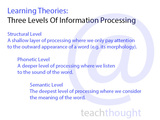
When Fergus Craik and Robert Lockhart researched human memory and recall, they argued that there was no clear difference between what others had identified as seemingly discrete memory stores, but that all memory was a result of the depth to which information was processed in the mind. Instead of referring to different stores of memory, Craik and Lockhart proposed that there are different levels of information processing. They identified at least three levels:
1. Structural level: This is a shallow layer of processing where we only pay attention to the outward appearance of a word (e.g. its morphology).
2. Phonetic level: This is a deeper level of processing where we listen to the sound of the word.
3. Semantic level: This is the deepest level of processing where we consider the meaning of the word.
Craik and Lockhart claimed that the deeper the processing, the stronger will be the trace of that memory, and thus recall will take less cognitive effort. This framework for human memory research is considered by many cognitive psychologists to be a stronger explanation than those of the multi-store memory models. Levels of processing theory certainly does seem to explain more about the human memory than the multi-store theories, although the framework has also attracted some criticism. It has also influenced other recently proposed cognitive processing theories including spreading activation theory and neural network theory.
How It Can Be Applied To Education
Teachers should be aware that children can process information in different ways and at different levels as they transform it into knowledge. Educators should think about how they can encourage students to process content in deeper and more meaningful ways. For example, students process content more deeply if they have to discuss its meaning, or are involved in solving a related problem.
Educators should also give students opportunities to present their learning through seminars, or through the creation of artefacts (e.g. blogs, videos, posters) to deepen the semantic processing of their learning, thereby strengthening their memories. This is one reason why participative and active forms of learning are more powerful than direct instruction through didactive methods.
Reference
Craik, F. I. M. and Lockhart, R. S. (1972) Levels of Processing: A framework for memory research. Journal of Verbal Learning and Verbal Behavior, 11 (6), 671-684. [Full text here]
This post first appeared on Steve’s personal blog; Graphic by Steve Wheeler; Learning Theories: Three Levels Of Information Processing
The post Learning Theories: Three Levels Of Information Processing appeared first on TeachThought.
TeachThought Blog
.
Blog
.
<span class='date ' tip=''><i class='icon-time'></i> Aug 05, 2015 09:50am</span>
|
|
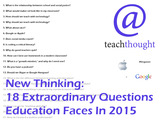
New Thinking: 18 Extraordinary Questions Education Faces In 2015
by Terry Heick
Who knows where education is going, but it’s not impossible to look back over the last 12 months to see some rhythms and discord.
2014 is yesterday, which gives us a chance to reflect on the year that was in order to better see 2015. The following, then, are a collection of entirely subjective observations-well, not entirely subjective I guess. Or not anymore than anyone else. We all see what we choose to see, and interpret it how we will. What we choose to "watch" is as subjective as any takeaway from that observation. But we have to pause the machine long enough to stop and reflect, so here we are.
At TeachThought, I see a lot of "data." Scores of daily emails. Press releases. Tweets. "Social engagement." Newsletters. Books, blog posts, headlines, pins, traffic numbers and clicks (more on that part later), conferences, keynotes, RSS feeds, social readers, subreddits, and more. There really is a lot to this edificio called public education.
Traditional questions that teachers and administrators face exist, and will for the foreseeable future: How can we "move students" from this performance level to that? How can we get every student to read on grade level? What can we do to improve parental communication? How can we motivate students? How should I manage my classroom? But-fingers crossed-this is the kind of training you get in your school staff meeting, district-mandated PD, and Monday morning emails.
I thought then it’d make sense to look at the new kinds of questions education faces-questions that can either underscore or erode the function of a school in a given community. So here is one person’s take (mine). As trends indicate a kind of temporary pattern, we may be able to trace the arc of what was to wonder what might be in 2015 and beyond.
1. What is the relationship between school and social justice?
The fact that this can be considered a "trend" is probably more relevant than talking about it as a trend, but education found itself in the line of fire in 2014 regarding, well, itself.
Just as profession, race, and income are at the core of "racial issues" (that really aren’t racial issues, but human issues which is why it’s impossible to segment them out that way), education has seen its untouchable image as savior, for some, erode. (See When Class Became More Important Than Race, for example.)
Instead of simply calling on schools to provide social justice, it is becoming clearer to the non Paulo Freires of the world that education is also implicit in this cultural malaise. And it’s no longer just about race, or slapping a "socioeconomic" label on things, but rather about seeing relationships and connecting a chaotic spread patter of dots. The purpose of K-12 can’t be "college and career readiness" anymore than the purpose of literacy can be "word and sentence readiness."
How should your classroom speak to or connect with "Ferguson"? It should, right? Should education not inform massive social change? Illuminate it? Contextualize it? Equip us with strategies? Prevent suffering? Promote strong communities?
2. What would maker ed look like in my classroom?
What would maker ed look like in my classroom? Judging by traffic, clicks, and social media responses, a lot of you had this question in 2014, and continue to in 2015.
And this is beautiful-this trend of educators as enablers and students as makers and classrooms as creative spaces where human beings actually produce something. Maybe most wonderfully, this trend reflects a subtle realization by education that perhaps proficiency of academic content isn’t as cutting edge as it sounds. In merely allowing "making" in classrooms, there is a kind of silent admittance that producing and creating and design are as valuable as listening, reading, and reflecting the priorities set by the teacher.
In a maker space, the maker is empowered and everyone else becomes an audience. This is not a small shift.
3. How should we teach with technology?
So some teachers are against technology in education. That’s not new. What might be interesting is that this isn’t as Ludditian as it seems. There is real concern by teachers about the money, training, and even effectiveness of education technology in "traditional classrooms." Education technology is neither good nor bad, but rather does or does not function to accomplish a task. (See here.)
This doesn’t even get at the consequence of the shoehorning of technology into dated learning models and curriculum forms not designed to accept it. Or maybe it does, and that’s the trend we’ll see moving forward. From the Jenkinson study (above):
"(Effective education technology integration) demands an understanding of how to best support student learning in an integrated, holistic way, and how to leverage technology to support this process; which, in turn, demands of us that we develop evaluative tools capable of capturing the learning process that occurs when students interact with technology."
4. Why should we teach with technology?
In other words, tech as a tool versus tech-for-the-sake-of-tech. This isn’t necessarily a 2014-only theme, but it seemed to have a different tone recently-not "hate edtech" but "why edtech?" Ask on twitter and you might get a lot of salty educators who make it their life’s work to stuff as much technology into a classroom as possible, but more and more, teachers want to know why.
Some of these questions are get-off-my-lawn pushback, but questions like "How can we best use technology? How does it work? What does it allow, promote, and produce?" are legitimate.
5. What about race?
This issue has been around for millenia-the idea of an "elite" education haunts us as a society. Content-based curriculum has a conditioning effect. It assimilates knowledge, language, image-so many strands of how we think of ourselves and the world around us (something Jamelle Bouie hints at here):
"[C]ontrary to the implications of the burden of acting white and oppositional peer culture hypotheses—that white students generally have superior standards for academic achievement and are embedded in peer groups that support and encourage academic striving—the experiences described by some of our white [student] informants indicate the presence of a much less achievement-oriented academic culture.In interviews, white students describe ostracism from peers and apprehension from parents who want to avoid the perception of "elitism" that comes with children in gifted programs….
None of this is to deny the reality of racialized ridiculing. It happens—I’ve experienced it—and it’s painful. But it isn’t a feature of black culture. Rather, it arises from a mix of factors, from social status to the composition of the school itself. As the sociologists note in their conclusion, stigmatization for whites and blacks seemed to come from the "perception that the low-status student was attempting to assume the characteristic of the ‘other,’ especially an air of superiority or arrogance."
6. Google or Apple?
Ah. More questions regarding iPads, 1:1, and the like.
When the iPad rollout in Los Angeles fell on its face, the utility of $30 million in hardware was put into question-and that’s a problem. The popularity of the iPad in education has always been catalyzed by more than a little consumerism, so we might’ve expected some kind of correction.
iPads are expensive mobile devices designed to play apps while glorifying Apple’s ecology. That doesn’t make them evil, but the idea that they were plug-n-play designed for classrooms may be naive.
We’ll talk more about this soon, but Google-and specifically Google Apps for Education-continue to gain momentum on the ground, in classrooms. In lieu of janky aesthetics and unpolished interfaces, Google’s focus on utility, productivity, and low-cost Chromebooks, in addition to the critical universal sign-in for all Google products, can make management for schools and districts simpler-and schools like simple.
7. Does social media count?
More specifically, does tweeting matter? How can a hashtag make a difference? The convergence of tool (the hashtag) and opportunity (increase in the visibility, if not the quantity, of digital and social media-based activism) made 2014 a year of clarity of the function of both hashtags, and social media at large, to both underscore and talk about pressing social issues. #blacklivesmatter, #crimingwhilewhite, #yesallwomen, and dozens of non-ironic, run-on appends aggregated social media chatter to something closer to the permanence such activism deserves.
There is an irony here that those on twitter using hashtags-likely on an expensive mobile device-to discuss edgy cultural issues has a preaching-to-the-choir effect-lots of digital noise to, perhaps, little physical action or substantive change. Social media is ready-made for moral and intellectual posturing which often does little to invite common-ground dialogue. That said, social change is a multidimensional thing. Who knows what impact X has on Y.
8. Is coding a critical literacy?
Is coding the new writing? Are coders the scribes of our time? How can we support #blackgirlscode? Thinking of coding as making. There is at least an undercurrent of folks who see coding as not just tech-savvy, but a core digital literacy.
9. Why do good teachers quit?
"Getting bad teachers out of the classroom" is old, but taking a second to wonder why a good teacher might quit is a fresher take. There is a cost to the push for teachers to innovate their curriculum, assessment practices, use of technology, etc., especially as that push is often at odds with local expectation, and one of the most visible effects is teacher fatigue. Why Good Teachers Quit by Kay Bisaillon saw more than a little traction. There is only so much a teacher can do-education is an ecology. Students aren’t products.
10. How can I best use homework in a modern classroom?
Along with letter grades, and "college," homework is an icon for traditional education. Developing alternatives to homework continues to be a popular idea for teachers. The flipped model of teaching is itself a way of reconsidering what students "do" and where they do it, i.e., the work students do at home.
11. What is a "growth mindset," and why do I need one?
We’ll have more on this soon, but for now, check out Jackie Gerstein’s thinking.
12. Should we Skype or Google Hangout?
It’s no longer about phone calls or emails-there are new(ish) tools that are being adopted by a wider audience. Should we Skype or GHO? While Skype had a headstart, 2014 saw Google Hangouts rise in credibility with its support for larger groups, and its easy transition to both YouTube channels and podcasting. In 2015, the question persists, especially as both platforms are platform-agnostic, and teachers are finding new ways to use Skype.
Others
13. Do you have a podcast?
Old media are new again.
Podcasting, as a word, feels 2006ish, but it’s actually quite edgy. The podcast has neither died nor exploded, but the quality-and legacy-of podcasting in education certainly seems on the uptick, no?
And video as well-YouTubers, for example. My children prefer them to actors and musicians, to the point where social media isn’t merely a launching pad into the mainstream, but is a stream of its own. Blogging, twitterchats, and other heavy-on-the-reading content (books, and to a degree, magazines) are increasingly supplemented with podcasts, video, and other content that’s easy to absorb on mobile devices.
There are only so many modalities-text, images, video; mixing and remixing them while adding and twisting social dynamics is all part of the evolution.
Other Critical Questions
Okay, so many of these are more important than those above, but these are pretty big questions, and I wanted the top 10 or 12 to be a mix of practical and crucial questions.
14. What is the the difference between learning and education?
15. How can I teach with YouTube? What role can video play in my curriculum?
16. Is Genius Hour something I can use in my standards-based classroom?
17. How should we, as an industry, update teacher training and ongoing professional development?
18. What is school? What should it do? What is its purpose?
19. How can we "teach globally" while acting locally?
20. How do we know if we’re doing a "good job"? If this lesson/unit/curriculum/school/idea is working?
21. How do I know if a student understands?
New Thinking: 18 Different Questions Education Faces In 2015
The post New Thinking: 18 Extraordinary Questions Education Faces In 2015 appeared first on TeachThought.
TeachThought Blog
.
Blog
.
<span class='date ' tip=''><i class='icon-time'></i> Aug 05, 2015 09:49am</span>
|
|
20 Ways To Get A Noisy Classroom’s Attention
by Terry Heick
Okay, so this isn’t about rethinking teaching and learning in a connected world, but that doesn’t change the fact that for many of you, simply beginning class can be the most challenging thing you do all day.
It’s not easy. My go-to for years what to simply start teaching, somewhat quietly, and hope students caught on, but I found that stressed some students who were trying to hear and couldn’t, so I had to come up with different strategies.
While muting an entire classroom for 35 minutes at a time so they "listen" isn’t ideal, every teacher needs to quiet a noisy classroom at some point. So recently, when I saw Todd Finley’s post on edutopia offering some fantastic ideas, I had to offer some of the tricks I had learned.
And note, much of what works is indeed about your personality. Classroom management isn’t a "strength" for me because I’m always nervous about being a "mean teacher," and tend to use learning models that depend on open-ended learning, student self-direction, and inquiry and project-based learning.
That said, students deserve to feel protected in a classroom that is efficient, protected, and under the control of a caring adult, so I have to make adjustments for my teaching style and how it relates to my natural personality.
So below are 20 (well, 19) ways to get a noise classroom’s attention. Some may work better than others depending on your grade level, teaching style, personality, or the personality of the class itself-down to who shows up to school that day and who doesn’t. Experiment, and let me know in the comments which strategies you use that I didn’t include.
20 Ways To Get A Noisy Classroom’s Attention
1. Help students understand
No matter the grade level, let students know right away exactly why you need them immediately responsive when you signal for the class to be quiet. Visualize the impact somehow-lost learning, future earnings potential, lowered intelligence each generation, which makes makes it harder on their great-great-great grandchildren, etc. (That’s obviously sarcastic-don’t use that unless you know what you’re doing.) Regardless, help them understand that it’s not about authority, it’s about knowledge.
2. Clap once, clap twice
This one is the old standby. After clearly explaining to the students on the first day of school how this will work, stand at the front of the room and say out loud "Clap once if you hear me, clap twice if you hear me," while modeling the clap.
3. Use a timer
If you’ve got some easy way to instantly project a time for all to see, set it to 3-5 seconds, and let students know the expectation is that each time that the timer reaches zero, the class should be completely silent.
You can also tie this to a reward, offering some sort of bonus time once a week or month, and detracting "time wasted" from that bonus time.
4. Stand in a designated spot
And let students know whenever you stand there and raise your hand, a certain finger indicating a requested noise level, etc., that the expectation is that they’re fully quiet within a certain time limit, or even a silent countdown on your fingers.
5. Count backwards from 4
Or count backwards out loud from 4, and experiment with slowing your countdown for certain classes to "adjust" to their characteristics, but without giving them too much flexibility.
6. Thank students that are already quiet individually
Thanking each student that is quiet, even with bonus items, etc., is a way to positively reward a desired behavior.
7. Use a notable name
Iggy Azalea. Ed Sheeran. Lebron James. Seth Rogen. Use a key word or phrase that grab’s attention-or even have a monthly theme, and whenever students hear a name from that category, they know to be quiet, and reward their performance.
8. Use a stop light
This was from Finley’s list on edutopia, and it’s perfect, Green they can talk, yellow they’re becoming quiet, red they’re silent. eBay, Amazon, etc., all carry products like these. Post it where everyone can see it.
9. Use an app
Quiet Classroom, or Too Noisy, for example. Experiment and see what works.
10. Have them stand
This one may not work for some classes, but many of my classes that had trouble becoming quiet weren’t being defiant-they were just full of energy. Have them stand and stretch, then begin
11. Use proximity
Stand near, or even touch select talking students on the shoulder while beginning to speak. (In some schools, classrooms, grade levels, etc., touching any student for any reason ever isn’t okay-obviously if this is the case, don’t.)
12. Record them
This wouldn’t work every day, and would only work if you have signed permission from each student’s family and the principal and….but if it fits, start recording, with some visible evidence of doing so-maybe a screen capture of Skype. Or even a fake red light that implies recording video. Tell them it’s for a project for a video all parents will see at the end of the year (for elementary), a YouTube channel, documentary, etc. You know them better than I do-what would convince them?
13. Get the right ones on your side
For more challenging classrooms, especially 8th grade and above, this one is incredibly important. Know who the key "players" are in the classroom, and get them on your side right away. Help them use the leadership skills they have to promote learning in the classroom, and periodically let them know-perhaps away from other students for older kids-how much it helps.
14. Use non-verbal cues
Using non-verbal cues that reflect a behavior system, perhaps one based on positive reinforcement. This can allow you not only to communicate simple messages, i.e., please be quiet, but also more complex messages, such as "The noise level so far has cost us two minutes from our game-based learning lesson on Friday." How? Use GBL for 15 minutes each Friday, and hold up one additional finger every time students lose a minute. Through that routine, they’ll get the picture.
15. Gamify it
Give points, take away points, offer badges, let classrooms level up, let them compete against one another, section off groups within a classroom to compete against one another; let their "scores" be rest so those that struggle don’t celebrate being "last" and get worse.
16. Turn the lights off
Who knows why, but most students love the lights off. You don’t have to turn them off and on like a madman-just off, and wait.
17. Resist the temptation to get emotional
Once students sense you’re upset, the implication is that you’re lacking control, and that has a snowball effect. Even if they aren’t, in fact, doing what you want them to, don’t let them in on that secret.
18. Ignore certain misbehaviors
Trying to quiet a noisy classroom is less about discipline, and more about routines. If a student makes a joke that gets the class roaring just as they were quieting down, smile a quick smile, let it go, and move on.
19. Be silly
Record audio, Vines, or Hyperlapse videos on Instagram that aggregate their progress and relative success.
20. Scream at them, slam the door until the glass shatters, flip desks, etc.
Then you’ll get fired and won’t have to worry about it any longer.
20 Ways To Get A Noisy Classroom’s Attention; 20 Ways to Quiet a Noisy Classroom; adapted image attribution flickr user usdepartmentofeducation
The post 20 Ways To Get A Noisy Classroom’s Attention appeared first on TeachThought.
TeachThought Blog
.
Blog
.
<span class='date ' tip=''><i class='icon-time'></i> Aug 05, 2015 09:49am</span>
|