Blogs
|
TEST How David Foster Wallace Taught Students To Respond To One Another’s Writing
by Terry Heick
One of my favorite genres of writing is the essay, and one of my favorite essayists is David Foster Wallace.
Wallace-or DFW if you’re okay with that-was equal part non-conforming, angst-ridden rebel and submissive lover of formal language and all of its rules and sentence-diagramming splendor. He was Jay Z and Strunk & White and Mark Twain all rolled into one, which made his writing a dizzying mix of all that as well.
Footnotes paragraphs, paragraphs pages long, novels a thousand pages long. Essays about tennis and state fairs and corn and hip-hop and academia and depression and cruises and the depressing and mesmerizing nuance of human existence all part of his muse.
With this kind of diverse background, his maniacal love for grammar and word choice and the precision of syntax and the right word fits right in, especially if you see language as a way to place rules on the species that has a way of bending them spectacularly. Language is a sort of caging and framing of the mind, which would annoy anyone who sat down and thought about it for long enough; it is somehow both volatile and impossibly sedate.
Perhaps unsurprisingly, DFW also dabbled in the teaching of writing. His mother also a professor, he was a TA at the University of Arizona in 1987, an adjunct professor at Emerson College in 1991, and most recently teaching English 183D Pomona in 2008 College. Recently, an anthology of his work was collected in the form of the David Foster Wallace Reader, a book I didn’t know I couldn’t live without. A sample? DFW explaining the idea of creative non-fiction.
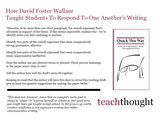
"Creative also suggests that this kind of nonfiction tends to bear traces of its own artificing; the essay’s author usually wants us to see and understand her as the text’s maker. This does not, however, mean that an essayist’s main goal is simply to "share" or "express herself" or whatever feel-good term you might have got taught in high school. In the grown-up world, creative nonfiction is not expressive writing but rather communicative writing. And an axiom of communicative writing is that the reader does not automatically care about you (the writer), nor does she find you fascinating as a person, nor does she feel a deep natural interest in the same things that interest you. The reader, in fact, will feel about you, your subject, and your essay only what your written words themselves induce her to feel.
So often students are taught how to write, but not why, and certainly not what’s possible. And if you read DWF long enough, if you find nothing else, you’ll find a timeless index of what’s possible when your focus is on the craft of writing.
Teaching Students To Respond To One Another’s Writing
Among the sections is one on teaching, which I was surprised to find (being that there’s an entire section devoted to it, and his interest in formal education rarely surfaced in his writing). While the "DFW Syllabus" is better-known (we’ll look at that another time-Google it if you’re curious), in the reader is also included a series of questions to act as a guideline for students to respond to one another’s writing.
It is both academic and authentic; it is practical and thoughtful; it is focused on writers, and on readers. In short, it acts as a wonderful distillation for DFW in general, and a potentially tool for you to consider as you teach the craft of writing in your own classroom. Helping students respond to one another’s writing in a meaningful way isn’t easy at any grade level.
More than anything else, he focused on specific elements of the craft of writing in a way that is very personal. Are the ideas interesting? Is language unclear? Does the writer seem to be doing this or this. Your partner really needs you for this, etc.
I hope, then, you find DFW’s approach to writing response useful.
"The David Foster Wallace Reader
November 11, 2014
Specs and Guidelines for Peer-Review Missive
1. Identify what appears to be the present draft’s thesis or overall point. If you aren’t sure just what it is, list the most likely possibilities.
2. Tell the author whether her thesis is interesting to you or not. Like, whether it adds anything substantive to your own reading(s) of the novel(s) in question. If it doesn’t, you might suggest ways to make the thesis more interesting.
3. If, on the other hand, the overall thesis seems to you implausible, or unconvincing, or if you can see serious objections to it that the author hasn’t addressed, tell her about them.
4. Describe, in no more than one short paragraph, the overall argument that’s advanced in support of the thesis. If this seems impossible, explain why—try to identify areas you find confusing or unclear.
5. Identify two parts of the overall argument that seem comparatively strong/persuasive/effective.
6. Identify two parts of the overall argument that seem comparatively weak/unpersuasive/ineffective.
7. Does the author use any abstract terms or phrases (e.g., "despair," "gender," "happiness," "discover who she is") whose precise meanings in the paper aren’t clear to you?
8. Tell the author how well the draft’s parts fit together. Is she doing a good job of moving the reader coherently from one part of her argument to another? If not, try to identify some places where you get disoriented or couldn’t figure out where in the discussion you were.
9. Tell the author whether her use of quotations from the novel(s) and or secondary sources seems effective. Do some of the quotations seem stuck in merely to satisfy the "Research" requirement? Are any quotations unnecessarily long? Are quotations introduced well, woven smoothly into the author’s own prose, or do they just seem to hang there awkwardly? If you’re already conversant with MLA format, are the quotations cited correctly?
10. Identify (in the margins of the draft if not in the letter) any basic syntactic errors you spotted that violate the Dept. Format and Style Sheet, or that have been covered in class during the semester. (Since final drafts that contain these sorts of errors will be severely penalized, you have a chance to do your partner a real service here.)
11. Keeping in mind that the author will have five days to revise this working draft, give at least two general suggestions for making the paper better."
TESTThe post How David Foster Wallace Taught Students To Respond To One Another’s Writing appeared first on TeachThought.
TeachThought Blog
.
Blog
.
<span class='date ' tip=''><i class='icon-time'></i> Aug 05, 2015 10:00am</span>
|
|
TEST A Useful Reading Comprehension Tool To Simplify Text
by TeachThought Staff
Need a reading comprehension tool to simplify texts for students? Something practical, along the lines of our "How To Google Search by Reading Level," and Conversion Chart For Reading Level Measurement Tools?
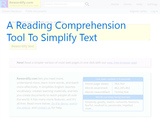
You may find some use in rewordify.
In short, you copy/paste text to be "simplified," and it does its thing. It attempts to simplify the text at the vocabulary level (as opposed to syntatical, structural, or idea level). Nonetheless, when vocabulary is the barrier, it does the trick. The replacements don’t always do what they should-simplify the text to make it more readable for struggling readers, or students reading beyond their natural level. Sometimes the definitions are themselves confusing, as they add an additional cognitive movement the student has to make, internalizing this now sterile definition back into some kind of meaning.
In our brief use, we’ve found it useful in the right circumstance. You can’t copy/paste a chapter from a book and hand it to a child to read as a "modified text" that has been "personalized" for them. It’d simply make a mess of the text, and likely ruin the reading experience.
What you can do, however, is use it to simplify short excerpts for individual readers, or for a whole-class read. You can also let students use it themselves as they will, or as a model of how passages can begin to be deconstructed.
The developers explain the features of rewordify:
Work with all your documents in one convenient place
Edit and delete your documents
Make any document public, so anyone can find it from the search box
Make any document link-only, so people need a link to view it
Make any document private, so people need a password to view it
Save vocabulary lists
Keep track of what words you’ve learned, are learning, and want to learn, and more!
A Reading Comprehension Tool To Simplify Text
TESTThe post A Reading Comprehension Tool To Simplify Text appeared first on TeachThought.
TeachThought Blog
.
Blog
.
<span class='date ' tip=''><i class='icon-time'></i> Aug 05, 2015 09:59am</span>
|
|
TEST 25 Alternatives To "What’d You Learn In School Today?"
by Terry Heick
You try to fake it, but it limps right out of your mouth, barely alive. "What’d you learn in school today?"
In a single sentence, all that is wrong with "school." First, the detachment-you literally have no idea what they’re learning or why. (You leave that up to school, because that’s what school’s for, right?) Which means you know very little about what your children are coming to understand about the world, only able to speak about it in vague terms of content areas (e.g., math, history).
Then, there’s the implication-they don’t talk about it way that they’ve been moved or impressed upon or changed but in the rarest cases; you have to drag it out of them.
And there’s also the matter of form-you ask them, as if a developing learner will be able to articulate the nuance of their own learning to make for a conversation that will do anything but make it seemed like they learned nothing at all. So what to do?
Well, that idea of form has some legs, doesn’t it? Show me. Demonstrate it. Let’s look at some artifacts that show thought and affection. Let’s see the impact of your work and effort. That’d actually make a pretty good post in itself. But let’s stick to the old questions-on-the-car-ride-home or over-the-dinner-table format.
What are some alternatives to "What’d you learn at school today?" Here are a few ideas.
25 Alternatives To "What’d You Learn In School Today?"
When did you notice yourself most interested and curious today?
Was there a time today when you were especially confused? How did you respond?
What is one thing that was hard to believe? Not confusing, but surprising?
If you were more ____ today, how would it have impacted the day?
When were you most creative today?
Tell me one fun thing you learned, one useful thing you learned, and one extraordinary thing you learned.
What does a successful day at school look like to you? Feel like?
What sort of different reasons do your friends go to school?
Who worked harder today, the teacher or the students?
How else could you have learned what the teacher taught?
How do your teachers show they care?
What do you know, and how do you know it?
What would you like to know more about?
What is the most important thing you learned today? The least?
Tell me one chance you took today, and how it ended up.
What is one thing you learned from a book?
What is one thing you learned from a friend?
What is one thing you learned from a teacher?
What still confuses you?
What is something you say or heard that stuck with you for some reason?
Based on what you learned today in ______ class, what do you think you’ll learn tomorrow?
Tell me three facts, two opinions, and one idea you heard today.
What should you do with what you’ve learned?
When did you surprise yourself today?
What’s stopping you from being an (even more) amazing learner?
A few readers chimed in with their own alternatives!
Drew Perkins: "What great questions did you ask today?"
Heather Braum: "What did you discover?"
Heather Braum: "What surprised you?"
Heather Braum: "Where did you travel to?"
Eoin Linehan: "Why are you learning that?"
Eoin Linehan: "How do you know you are learning?"
Kristine Kirkaldy: "What did you learn/do that made you smile today?
Mrs. Moore: "What was your favorite part of school today?"
Amanda Couch: "Tell me your favorite moment at school today."
Deb Gaskin: "If you had been responsible for the lesson, what would you have emphasized or done differently? Why?"
Robin Smith: "what was your "good" for today? What was your "bad"?"
Laura Cobb: "What did you improve today?"
Laura Cobb: "What challenged your thinking?"
Laura Cobb: "How did you contribute to other student’s learning?"
Jackie Gerstein: "What touched your heart today?"
Jackie Gerstein: "Did you experience anything at school that motivates you to make a difference in the world?"
Jackie Gerstein: "Did you experience any "aha’s" today - understanding or seeing something differently than you previously had?"
Jackie Gerstein: "Did you experience any moments of full enjoyment in learning today? If so, when and how?"
Jackie Gerstein: "Did you invent or create anything new today?"
25 Alternatives To "What’d You Learn In School Today?"
TESTThe post 25 Alternatives To What’d You Learn In School Today? appeared first on TeachThought.
TeachThought Blog
.
Blog
.
<span class='date ' tip=''><i class='icon-time'></i> Aug 05, 2015 09:59am</span>
|
|
TEST Assessment: Why Item Analyses Are So Important
by Grant Wiggins, Authentic Education
As I have often written, the Common Core Standards are just common sense - but that the devil is in the details of implementation. And in light of the unfortunate excessive secrecy surrounding the test items and their months-later analysis, educators are in the unfortunate and absurd position of having to guess what the opaque results mean for instruction. It might be amusing if there weren’t personal high stakes of teacher accountability attached to the results.
So, using the sample of released items in the NY tests, I spent some time this weekend looking over the 8th grade math results and items to see what was to be learned - and I came away appalled at what I found.
Readers will recall that the whole point of the Standards is that they be embedded in complex problems that require both content and practice standards. But what were the hardest questions on the 8th grade test? Picayune, isolated, and needlessly complex calculations of numbers using scientific notation. And in one case, an item is patently invalid in its convoluted use of the English language to set up the prompt, as we shall see.
As I have long written, there is a sorry record in mass testing of sacrificing validity for reliability. This test seems like a prime example. Score what is easy to score, regardless of the intent of the Standards. There are 28 8th grade math standards. Why do such arguably less important standards have at least 5 items related to them? (Who decided which standards were most important? Who decided to test the standards in complete isolation from one another simply because that is psychometrically cleaner?)
Here are the released items related to scientific notation:
It is this last item that put me over the edge.
The item analysis. Here are the results from the BOCES report to one school on the item analysis for questions related to scientific notation. The first number, cast as a decimal, reflects the % of correct answers statewide in NY. So, for the first item, question #8, only 26% of students in NY got this one right. The following decimals reflect regional and local percentages for a specific district. Thus, in this district 37% got the right answer, and in this school, 36% got it right. The two remaining numbers thus reflect the difference between the state score for the district and school (.11 and .10, respectively).
Notice that, on average, only 36% of New York State 8th graders got these 5 questions right, pulling down their overall scores considerably.
Now ask yourself: given the poor results on all 5 questions - questions that involve isolated and annoying computations, hardly central to the import of the Standards - would you be willing to consider this as a valid measure of the Content and Process Standards in action? And would you be happy if your accountability scores went down as a teacher of 8th grade math, based on these results? Neither would I.
There are 28 Standards in 8th grade math. Scientific Notation consists of 4 of the Standards. Surely from an intellectual point of view the many standards on linear relationships and the Pythagorean theorem are of greater importance than scientific notation. But the released items and the math suggest each standard was assessed 3-4 times in isolation prior to the few constructed response items. Why 5 items for this Standard?
It gets worse. In the introduction to the released tests, the following reassuring comments are made about how items will be analyzed and discussed:
Fair enough: you cannot read the student’s mind. At least you DO promise me helpful commentary on each item. But note the third sentence: The rationales describe why the wrong answer choices are plausible but incorrect and are based on common errors in computation. (Why only computation? Is this an editorial oversight?) Let’s look at an example for arguably the least valid questions of the five:
Oh. It is a valid test of understanding because you say it is valid. Your proof of validity comes from simply reciting the standard and saying this item assesses that.
Wait, it gets even worse. Here is the "rationale" for the scoring, with commentary:
Note the difference in the rationales provided for wrong answers B and C: "may have limited understanding" vs. "may have some understanding… but may have made an error when obtaining the final result."
This raises a key question unanswered in the item analysis and in the test specs. Does computational error = lack of understanding? Should Answers B and C be scored equal? (I think not, given the intent of the Standards). The student "may have some understanding" of the Standard or may not. Were Answers B and C treated equally? We do not know; we can’t know given the test security.
So, all you are really saying is: wrong answer.
Answers A, B, C are plausible but incorrect. They represent common student errors made when subtracting numbers expressed in scientific notation. Huh? Are we measuring subtraction here or understanding of scientific notation? (Look back at the Standard.)
Not once does the report suggest an equally plausible analysis: students were unable to figure out what this question was asking!!! The English is so convoluted, it took me a few minutes to check and double-check whether I parsed the language properly:
Plausible but incorrect… The wrong answers are "plausible but incorrect." Hey, wait a minute: that language sounds familiar. That’s what it says under every other item! For example:
All they are doing is copying and pasting the same sentence, item after item, and then substituting in the standard being assessed!! Aren’t you then merely saying: we like all our distractors equally because they are all "plausible" but wrong?
Understanding vs. computation. Let’s look more closely at another set of rationales for a similar problem, to see if we see the same jumbling together of conceptual misunderstanding and minor computational error. Indeed, we do:
Look at the rationale for B, the correct answer: it makes no sense. Yes, the answer is 4 squared which is an equivalent expression to the prompt. But then they say: "The student may have correctly added the exponents." That very insecure conclusion is then followed, inexplicably, by great confidence: "A student who selects this response "understands the properties of integer exponents…" - which is of course, just the Standard, re-stated. Was this blind recall of a rule or is it evidence of real understanding? We’ll never know from this item and this analysis.
In other words, all the rationales are doing, really, is claiming that the item design is valid - without evidence. We are in fact learning nothing about student understanding, the focus of the Standard.
Hardly the item analysis trumpeted at the outset.
Not what we were promised. More fundamentally, these are not the kinds of questions the Common Core promised us. Merely making the computations trickier is cheap psychometrics, not an insight into student understanding. They are testing what is easy to test, not necessarily what is most important.
By contrast, here is an item from the test that assesses for genuine understanding:
This is a challenging item - perfectly suited to the Standard and the spirit of the Standards. It requires understanding the hallmarks of linear and nonlinear relations and doing the needed calculations based on that understanding to determine the answer. But this is a rare question on the test.
Why should the point value of this question be the same as the scientific notation ones?
In sum: questionable. This patchwork of released items, bogus "analysis" and copy and paste "commentary" give us little insight into the key questions: where are my kids in terms of the Standards? What must we do to improve performance against these Standards?
My weekend analysis, albeit informal, gives me little faith in the operational understanding of the Standards in this design, without further data on how item validity was established, whether any attempt was made to carefully distinguish computational from conceptual errors in the design and scoring- and whether the tentmakers even understand the difference between computation and understanding.
It is thus inexcusable for such tests to remain secure, with item analysis and released items dribbled out at the whim of the DOE and the vendor. We need a robust discussion as to whether this kind of test measures what the Standards call for, a discussion that can only occur if the first few years of testing lead to a release of the whole test after it is taken.
New York State teachers deserve better.
This article first appeared on Grant’s personal blog; Grant can be found on twitter here; image attribution flickr user anthonypbruce; Assessment: Why Item Analyses Are So Important
TESTThe post Assessment: Why Item Analyses Are So Important appeared first on TeachThought.
TeachThought Blog
.
Blog
.
<span class='date ' tip=''><i class='icon-time'></i> Aug 05, 2015 09:58am</span>
|
|
TEST 4 Ideas For Motivating Adolescent Male Readers
By Kenny McKee
It’s no secret that state and national assessments continue to indicate that boys lag behind girls in the area of reading.
The gap tends to grow larger as students enter adolescence. It’s also no secret that many teenage boys dislike reading — in class or at home. Just ask a high school teacher…or a teenage boy. While it’s not true that all teenage boys dislike reading, there is a growing trend of many becoming unmotivated readers. Obviously, students who are resistant to reading are unlikely to get better at it. Here are four ideas for motivating adolescent male readers.
1. Focus On The Now
Oftentimes, teachers emphasize the importance of reading skills or reading content by saying, "You will need this for the test," or "You will need this for college," or "When you get to the real world, you’ll need to be able to do this." Well, students are living in the real world right now, and, for the most part, they have real concerns about their lives that they want to solve.
Many boys (and teenagers overall) like to know how learning impacts their lives in the moment, and they are generally not concerned with how schoolwork relates to an unclear future. Focusing on the future can lead to procrastination, since, to young men, the future seems a long time away (Smith & Wilhelm, 2002). Also, teachers can lose focus on students’ needs in the present.
We can make the reading we choose for whole-class instruction more motivating by relating it to the "here and now." Survey your students to determine what they want to learn, and select reading materials aligned with their interests. Have students create products, presentations, or skits from their reading materials.
Many boys will readily engage in activities that ask them to create something meaningful or to perform for their peers. Also, consider designing inquiry units where students research answers to questions that concern teens, such as "Is the senior year of high school necessary?" or "Is love really all you need?" Weaving literature and informational texts around such topics can motivate many students, especially if students have some voice in what the inquiry topics will be.
2. Use A Variety Of Text
In some schools, there is a narrow view of what constitutes literacy. Even with the adoption of Common Core State Standards that emphasize informational text, the primary focus of secondary English language arts classes, especially in high schools, is often the study of literature. Boys engage in many other forms of literacy that traditionally are not valued by teachers. Since many boys do not read teacher-privileged literary fiction texts at home, many of them classify themselves as non-readers, even if they do extensive reading from the Internet, magazines, and newspapers (Cavazos-Kottke, 2005).
One solution that can have tremendous positive effects on motivation is incorporating self-selected reading as part of the English language arts classroom. Conferring with students individually over self-chosen reading provides opportunities to validate and support boys’ independent reading. Once you have learned a bit more about your male students’ reading preferences, you can find texts with similar genres, themes, or topics to include in whole-class reading. You can also better select texts for a classroom library.
3. Set Them Up For Success
Many boys need to feel like they can accomplish a task in order to even attempt it. Thus, goals must be perceived as achievable in order for boys to feel competent. The most-motivating activities offer success and demonstrate evidence of growth (Cleveland, 2011).
Scaffolding and differentiation strategies can contribute to developing a sense of competence. For example, many teachers use Newsela, a site that allows the user to alter the reading complexity of recent news stories. Students can even self-select their own readlng levels based upon factors such as familiarity with the topic, their reading purpose, and their comprehension.
Another option for students is using social scaffolding techniques such as Say Something. Students can select reading partners and then take turns reading, frequently stopping to discuss their comprehension of the text. Sentence starters can be used to help students initiate those conversations.
4. Use Male Reading Role Models
Many educators believe that a "Boy Code" that stems from an absence of positive male role models, the massive influence of the media’s distorted images of masculinity, and the fear of being labeled "feminine" impacts reading motivation. Because girls generally develop literacy skills at an earlier age, many boys perceive reading as a feminine activity. This perception leads to some boys shunning reading. Since they do not participate in school reading, they become less proficient at it, which perpetuates their lack of motivation (Cleveland, 2011).
Male reading role models are important for infiltrating the beliefs of the "Boy Code." Many people point to the under-representation of males in the teaching profession, especially in English classrooms, as a factor giving the "Boy Code" more power. Some studies have found that bringing successful men into schools helps. Some evidence of this claim is that boys in wealthier districts generally report reading more often and have higher reading assessment scores because their fathers are likely to have jobs where literacy is valued.
These boys are more likely to view literacy as a masculine trait (Sadowski, 2010). Especially for boys living in poverty, it is important for male educators to discuss their reading and the importance of literacy in their lives. In addition, having successful and influential community members share the ways they use reading can be enlightening to young men.
Kenneth McKee is a literacy and instructional coach with Buncombe County Schools in Asheville, NC. He is a 2014 ASCD Emerging Leader. To learn more about his work, follow him on Twitter (@kennycmckee) or visit his website kennycmckee.com; 4 Ideas For Motivating Adolescent Male Readers; image attribution flickr user gammarayproduction
TESTThe post 4 Ideas For Motivating Adolescent Male Readers appeared first on TeachThought.
TeachThought Blog
.
Blog
.
<span class='date ' tip=''><i class='icon-time'></i> Aug 05, 2015 09:58am</span>
|
|
TEST A Beginner’s Guide To Personalized Learning
by TeachThought Staff
There is a difference between personalized learning and differentiation.
Differentiation is a kind of personalized instruction, where teachers adjust process, & product, according to a student’s readiness, interest, & learning style. Planning of the learning starts with the content, and the content remains the same for all students. This is a school and curriculum-centered approach that attempts to amend the delivery of the content to match the student’s needs, strengths, and general readiness.
Personalized learning starts with the learner and asks the question, "What does this student need to understand, and how best can that happen?" This is a student-centered approach, and is built around the idea of recognizing the vast differences in students-not just in terms of literacy or schema, but an authentic need to know.
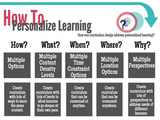
In that context, consider the above graphic from Mia MacMeekin (who also gave us 27 Simple Ways To Check For Understanding). It frames the idea of personalized learning around the who/what/where/why/when series of questions, and then separates things again into three categories:
What is personalized learning?
How to personalize learning
Examples of personalized learning
In this way, it represents an excellent beginner’s guide to personalized learning. The fact that it’s highly visual and limited to brief questions and examples makes it all the more readable, shareable, and fun. Give Mia’s site a visit, and let her know what you think!
A Beginner’s Guide To Personalized Learning
TESTThe post A Beginner’s Guide To Personalized Learning appeared first on TeachThought.
TeachThought Blog
.
Blog
.
<span class='date ' tip=''><i class='icon-time'></i> Aug 05, 2015 09:58am</span>
|
|
TEST Teacher Selfie: Have You Seen Yourself Teach Lately?
by Paul Moss, paulgmoss.com
Video your teaching, and see what really happens in your classroom.
That is my exhortation to you, from a recently converted disciple of such professional development. I don’t mean for the sake of observing student behavior, although you will see some incredible things at times, but more so to measure your skill in creating a classroom culture of challenge, and curiosity, where intrinsic motivation and independent learning are the primary focus.
A major focus for all schools now is the idea of progress. At all times students must be seen to be progressing. Traditionally, such progress is measured through assessment, in both formative and summative modes.
Whilst this approach is incredibly powerful, it does not present the whole picture of a student’s movement. The process of a student arriving at a learning objective is equally important, and powerfully enlightening in terms of planning.
9 Questions To Guide You Watching Yourself Teach
Videoing allows me to see if I am simply feeding the students info, or if I am guiding them to finding and discovering it. The distinction is massive, and has great implications for the notion of what constitutes effective learning, yet it took observations of my videos for the levels and ratios of both styles to become apparent to me. It took videoing to present observation of my skill in addressing these vital questions:
How much I have set up a culture of independent learning?
How good are my questioning skills?
How much do I ‘open’ up students’ minds with pertinent and differentiated questions?
How much do I allow the students to ‘find’ the answers to questions themselves?
How much do I let students breathe with a challenge, before I step in?
How much do I use wait time effectively?
How good am I at supporting the transition to learning like this?
How well do I tie in the learning objective with the tasks presented?
How much do I encourage an environment of curiosity about the learning, why it is being undertaken, and how it links to other areas we have been focusing on?
When I first watched myself back I realized that these considerations were alarmingly lacking. And while I have had to really take stock of my teaching skill in implementing such ideals, there was and still is another thing getting in the way of making such pedagogy a smooth and seamless experience.
I think I know what it is.
When watching the videos it is strikingly clear that the students are not used to such a learning culture. Many of them have great difficulty in making progress on their own. They seem to have fallen into a pattern of passively learning material, completing exercises with little connection to anything other than the moment, and worst of all, easily giving up when the challenge is ostensibly too difficult (often at the very first moment of difficulty).
The consequence is that often I have had a classroom with an overwhelming vibe of student angst and annoyance at not being told the answers, and not being able to complete tasks quickly. At times students have literally challenged my teaching credentials. Many times I gave in to such disharmony. In hindsight, and ironically, I gave in too easily. However, as I have evolved and learnt to be patient in the method, it is becoming increasingly apparent that the students are slowly becoming more independent, and fighting that little bit harder to achieve an understanding of a task.
Recording Lessons For Teacher Professional Development
Whilst I still have a long way to go before I could say that I’ve mastered the process, I have experienced enough feedback to validate the paradigm. What is clear is that when I am successful in creating the culture of challenge, the students are able to transfer knowledge with more skill, and seem to be truly engaged in learning. When they push through the barriers and see that they actually can do it, they feel a sense of ownership with their progress.
And then the silver lining reveals itself in all its glory: it’s all without me having to extrinsically motivate the class in any way. The students just don’t need it. They actually don’t even want it. They know they’ve worked it out; they don’t need me to say so. And for the ultimate reversal, they actually vent their disappointment if I jump in too quickly with help. Then the classroom takes on a different vibe entirely: students suddenly seem thirsty!
For me, videoing has become an enormously useful measure of progress, as I can easily recall a series of videos to demonstrate how students and myself have made progress in learning in the classroom. I can see how my style has evolved to address the questions above. I can see how the students are adapting to the style, and how much more they are engaged, verbally, mentally and physically, with peers and on their own. These are videos that I could show inspectors.
Whilst the road has not always been easy, like what I tell the students all the time, nothing any good and worth fighting for ever is. I am fortunate and thankful that my current school, Marine Academy Plymouth, has the insight to encourage such an approach to professional development. Does your school?
Teacher Reflection: Have You Seen Yourself Teach Lately?
TESTThe post Have You Seen Yourself Teach Lately? appeared first on TeachThought.
TeachThought Blog
.
Blog
.
<span class='date ' tip=''><i class='icon-time'></i> Aug 05, 2015 09:58am</span>
|
|
TEST Learning Theories: Jerome Bruner On The Scaffolding Of Learning
by Steve Wheeler, Associate Professor, Plymouth Institute of Education
In this post, we explore the work of Jerome Bruner on scaffolding of learning. This is a simplified interpretation of the theory, so if you wish to learn more, please read the original works.
The Theory
Bruner’s theory of scaffolding emerged around 1976 as a part of social constructivist theory, and was particularly influenced by the work of Russian psychologist Lev Vygotsky. Vygotsky argued that we learn best in a social environment, where we construct meaning through interaction with others. His Zone of Proximal Development theory, where we can learn more in the presence of a knowledgeable other person, became the template for Bruner’s model.
Bruner believed that when children start to learn new concepts, they need help from teachers and other adults in the form of active support. To begin with, they are dependent on their adult support, but as they become more independent in their thinking and acquire new skills and knowledge, the support can be gradually faded. This form of structured interaction between the child and the adult is reminiscent of the scaffolding that supports the construction of a building. It is gradually dismantled as the work is completed.
In a very specific way, scaffolding represents a reduction in the many choices a child might face, so that they become focused only on acquiring the skill or knowledge that is required. The simplistic elegance of Bruner’s theory means that scaffolding can be applied across all sectors, for all ages and for all topics of learning.
How It Can Be Applied To Education
It is important for teachers to provide opportunities for children to constantly learn new things. Some of those may be highly complex and will require support of a very focused kind. Teachers need to be aware of the developmental state of each of the children in their care, and should provide scaffolding that is appropriate.
Although this may not be possible to do on their own, teachers can improvise and provide scaffolding through other support, including the use of other adults such as teaching assistants (para-educators) parent helpers, or more knowledgeable other children within the classroom.
As children gain in confidence and competence in a particular areas, teachers might place them in groups to extend each other’s learning further. It’s also important that teachers recognise when a child is at the point where they begin to learn independently, and decisions can be made to set them free from the scaffolding.
Reference
Wood, D. J., Bruner, J. S. and Ross, G. (1976). The role of tutoring in problem solving. Journal of Child Psychiatry and Psychology, 17(2), 89-100.
This post first appeared on Steve’s personal blog; image attribution wikimedia.commons
TESTThe post Learning Theories: Jerome Bruner On The Scaffolding Of Learning appeared first on TeachThought.
TeachThought Blog
.
Blog
.
<span class='date ' tip=''><i class='icon-time'></i> Aug 05, 2015 09:57am</span>
|
|
TEST This Will Revolutionize Education
by TeachThought Staff
"The job of a teacher is not to deliver information. It is to guide the social process of learning. The job of a teacher is to inspire, to challenge, to excite their students to want to learn."
To those at the forefront of progressive education-really, most teachers we’d think-this isn’t a new idea. But it’s starting to spread, evidenced by a recent video from science video blog and YouTube channel Veratasium.
The video (bravely?) takes on the big, stubborn field of education, specifically the sticky topic of ed reform. They were curious why, in lieu of better and better technology that continues to impact other fields, there is little improve in education. They didn’t think it was the inertia of the industry itself; not too little edtech, nor poverty, nor standards or standardized testing.
The Motion Picture, The CD, Tablets, MOOCS
Their conclusion?
Our focus is wrong.
While technology is useful, it’s only useful insofar as it promotes engagement with clear learning goals within a well-designed process. Animations, they explain, can be powerful, but aren’t inherently so. They’re only "better" than a static image or a conversation if their weaknesses (e.g., lack of text, inability to slow or stop the animation, unclear learning goals, etc.) are mitigated.
Their line of thinking is that education continues to focus on the wrong things-things outside of the learner’s heads rather than within them. We focus on replacing teachers instead of celebrating them, or training them for new roles. The result is redundancy, inefficiency, and mediocre performance.
"I think it is instructive that each new technology has appeared to be so transformative. You can imagine, for example, that motion pictures must have seemed like a revolutionary learning technology. After all they did revolutionize entertainment, yet failed to make significant inroads into the classroom. TV and video seem like a cheaper, scaled back film, but they too failed to live up to expectations. Now there is a glut of information and video on the internet so should we expect it to revolutionize education?
My view is that it won’t, for two reasons: 1. Technology is not inherently superior, animations over static graphics, videoed presentations over live lectures etc. and 2. Learning is inherently a social activity, motivated and encouraged by interactions with others."
So what will actually, finally, without a doubt "revolutionize education"? They never really come to a single conclusion, which seems to be the point. There isn’t a single thing, technology or otherwise. Engaged students in a social setting under the care of an inspiring teacher seems to be their ultimate response.
You can see the video below.
TESTThe post This Will Revolutionize Education appeared first on TeachThought.
TeachThought Blog
.
Blog
.
<span class='date ' tip=''><i class='icon-time'></i> Aug 05, 2015 09:57am</span>
|
|
TEST Experiential Learning: Just Because It’s Hands-On Doesn’t Mean It’s Minds-On
by Grant Wiggins, Authentic Education
I recently visited Thetford Academy in Vermont (one of the few and interesting public-private academies in New England) where they have a formal and explicit commitment to "experiential learning." So, the leaders of the school asked me to visit classes that were doing experiential learning and to talk with staff at day’s end about it.
I saw some great examples of such instruction. I visited the design tech course (see photos) and the class on the Connecticut River where students were learning about soil types prior to a wetlands field trip.
I also spent the previous day at the Riverdale School where all 9th graders were learning the skills and habits of innovation and entrepreneurship as part of a cool new project headed by John Kao, former Harvard Business School innovation guru. (I am a consultant to the Edgemakers project).
Below are some pictures from the "Design a better backpack exercise" that started the work of the day.
Just because it’s hands-on doesn’t mean it’s minds-on. But the gist of my remarks at Thetford was to propose caution. Just because work is hands-on does not mean it is minds-on. Many projects, problems, situations, and field trips do not yield lasting and transferable learning because too little attention is given to the meta-cognitive and idea-building work that turns a single experience into insight and later application.
Years ago when I worked as a consultant at School Without Walls in Rochester NY (one of the first really interesting alternative High Schools to emerge from the 60s and a member of the Coalition of Essential Schools), they put it very succinctly in their caution about all the independent projects students routinely did. If you were going to learn carpentry to build a chair, then "The learning is not the chair; it is the learning about learning about chairs, chair-making and oneself."
I have also often used the following soccer example, because it makes the same point beautifully and practically. Merely playing the game over and over need not cause understanding and transfer. It takes a deliberate processing of the game experience, as summarized in the powerful approach used by my daughter’s high school coach a few years back. Instead of talking on and on at players at half-time, Griff asked 4 key questions of players:
What’s working for us?
What’s not working for us?
What’s working for the other team?
So, what do we have to do in the 2nd half?
My daughter (now a starter at Stony Brook University) has often remarked that Griff was really the only coach through HS that taught her to ‘think soccer’ and it paid off in her growth and the team’s success.
As a coach of soccer, baseball, and Socratic Seminar, I learned this lesson the hard way many times myself. I often over-estimated student understanding as to the purpose of activities and assignments, and the important learnings from the experiences. My teaching became far more focused and effective when I forced kids to be metacognitive and reflective about what had been achieved against goals. So, for example, 30 years ago I used a variant of Griff’s questions towards the end of each Socratic Seminar:
What have been the highlights?
What have been the rough spots?
What do we now understand?
What do we still not understand?
Whose voices didn’t we hear? Why?
With the Thetford staff I prompted a focused discussion in a 2-part exercise: What is the difference between effective and ineffective experiential learning? What are the key indicators to look for in judging whether your attempt at experiential learning is working? (Hint: mere engagement is NOT sufficient.) You might try this exercise locally.
The answers are not surprising but worth committing to. One of the most frequent answers is a clear and specific sense of purpose, linking the activity to the WHY? question - We’re doing this because… We’re learning this because… etc. The other common answer is that the activity needs to be processed in terms of what was and wasn’t learned. (It is key that students explain this independently. Many teachers think that just because they may have said something about purpose at the start that therefore students can answer these questions later on. It is often not the case.)
A third optional part of the exercise is to share examples of the most powerful experiential learning in one’s own experience as a learner to provide a check and to go beyond the earlier answers.
I always ask all kids when I visit class the three questions at the heart of this caution:
What are you doing?
Why are you doing it?
What does this help you do that’s important?
Alas, many kids do not provide adequate answers. And that’s why we need to worry about merely hands-on learning - even as hands-on learning is vital for making abstractions come to life.
This article was excerpted from a post that first appeared on Grant’s personal blog; Grant can be found on twitter here; Experiential Learning: Just Because It’s Hands-On Doesn’t Mean It’s Minds-On; image attribution flickr user nasagoddardacademy
TESTThe post Experiential Learning: Just Because It’s Hands-On Doesn’t Mean It’s Minds-On appeared first on TeachThought.
TeachThought Blog
.
Blog
.
<span class='date ' tip=''><i class='icon-time'></i> Aug 05, 2015 09:57am</span>
|