Blogs
|
Start Something: 13 Teacher Strategies For Digital Collaboration
by TeachThought Staff
Teacher collaboration is among the cornerstones of school improvement. When teachers connect-for the right reasons-good things happen.
The ability to connect is increased exponentially through technology. Digital collaboration by teachers has an infinite numbers out possible outcomes, from formal teacher improvement, to informal connecting for people that get you. A global teacher’s lounge, if you will.
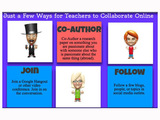
Social media-based professional development is another possible outcome when teachers connect. In contrast to sit-and-get, impersonal training, self-selected and self-directed PD has the potential for just in time, just enough, just for me qualities. The following infographic Mia MacMeekin takes these kinds of ideas and itemizes them, coming up with thirteen strategies for digital collaboration by teachers. She has a few ideas on the graphic, and we’ve added our own below.
Let us know in the comments what strategies you find useful for digital collaboration.
Start Something: 13 Teacher Strategies For Digital Collaboration
1. Co-author a book, blog post, essay, or conference session.
2. Join an edcamp, twitter chat, or blog community (ahem).
3. Follow mentors, colleagues, and inspiring thought leaders on social media.
4. Email someone and ask for help, or thank them for what they do.
5. Comment on an idea that forces you to consider a new perspective.
6. Start something useful and/or fun, local or global, digital or physical.
7. Step out of your comfort zone.
8. Discuss both critical and practical issues around your classroom.
9. Co-create something you’ve long hoped someone else would-an app, a community, a curriculum. Even a PowerPoint or Prezi that clarifies some often misunderstood academic topic.
10. Ask for help, details, resources, or ideas.
11. Join Me-or us. Meet people, connect groups, create potential in education.
12. Enter into new terms with your local school leadership to push for innovation, resources, and better training.
13. Organize your curriculum, your professional learning network, your RSS feed, or even a local event of your own, even if it’s only 4 or 5 colleagues for a book club at Starbucks.
Start Something: 13 Teacher Strategies For Digital Collaboration
Start Something: 13 Teacher Strategies For Digital Collaboration; Teacher Collaboration Through Technology
The post Start Something: 13 Teacher Strategies For Digital Collaboration appeared first on TeachThought.
TeachThought Blog
.
Blog
.
<span class='date ' tip=''><i class='icon-time'></i> Aug 05, 2015 09:49am</span>
|
|
The Question Game
by Sophie Wrobel, geist.avesophos.de
The Question Game: A Playful Way To Teach Critical Thinking
Big idea: Teaching kids to ask smart questions on their own
A four-year-old asks on average about 400 questions per day, and an adult hardly asks any. Our school system is structured around rewards for regurgitating the right answer, and not asking smart questions - in fact, it discourages asking questions. With the result that as we grow older, we stop asking questions. Yet asking good questions is essential to find and develop solutions, and an important skill in innovation, strategy, and leadership. So why do we stop asking questions - and more importantly, why don’t we train each other, and our future leaders, to ask the right questions starting from early on?
In A More Beautiful Question: The Power of Inquiry to Spark Breakthrough Ideas, Warren Berger suggests that there are three main questions which help in problem solving: Why questions, What If questions, and How questions.
Regardless of the question, the question needs to be phrased openly and positively in order to achieve positive results - a closed or negative question only raises bad feelings against each other.
Why questions help to find the root of a problem
What If questions open up the floor for creative solutions
How questions focus on developing practical solutions
So, perhaps, this lesson can be adapted to help trigger young children to start solve problems early too and stop accepting whatever the kindergarten teacher says to be fact? And perhaps, continue to keep up these inquiring and probing abilities later on in life?
Learning Goal: A Pattern Of Critical Thinking
The Question Game focuses on teaching children a kind of thinking which is particularly useful in creative problem-solving-a focused approach to get from a problem to the most effective solution. It is most effective when combined with regular repetition, which solidifies the thought pattern, and with groups, which encourages contributory exploration of alternative responses and creativity.
Thinking strategy is just one of many qualities that are necessary for imparting charisma and leadership skills to the next generation. Many of us would claim that we don’t have the ‚natural gift’ that charismatic leaders like Nelson Mandela or Mahatma Ghandi had. However, charisma and leadership are qualities that, to a large extent, can be cultivated and trained. With soft skills becoming more important in today’s job market, cultivating these skills early on can provide children with an additional edge in becoming effective, active citizens in our society. These skills can be broadly grouped into four logical skills and four emotional skills:
Logical skills: risk-taking, thinking strategy, creativity, and negotiation.
Emotional skills: persuasion, emotional connection, body language, and dealing with vulnerability.
Of these eight skills, the Question Game focuses on thinking strategy and creativity, and aims to solidify the critical thinking thought pattern from an early age onwards.
Introducing The Question Game
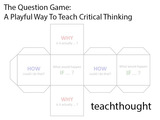
Preparation: print out the figure in the illustration, cut it out and glue the tabs together to form a cube.
One simple idea is to pick up your favorite illustrated fairy tale book-the kind of book you’d read a two-year-old for bedtime stories. (This also works with most fictional works; the natural ‘break point‘ for questions is at the end of a plot development or paragraph for older audiences.)
On each page, roll the cube and answer the question together. I’ll bet you’d be surprised by what turns Little Red Riding Hood can take. And more importantly after a while you and your child will both start asking these questions reflexively.
Evaluating Learning Progress
My personal experience introducing the game to my two children (aged Pre-K) is a gradual acceptance of the game and associated learning goals:
Initial excitement: Rolling the cube puts the child in control and made a fun addition to reading their picture books; they couldn’t wait for their turn to roll the cube.
Distress: The questions are hard, especially when they aren’t used to this sort of thinking pattern and are accustomed to the ’teacher knows everything’ thinking pattern. Here, my children often asked if we could read ‚without the cube‘, or ‚I don’t want to roll, but ___ can roll and answer the question.’
Acceptance: As they start to recognize that there isn’t a single correct answer, and they begin to understand what each question is trying to achieve, they begin to enjoy the game and insist that we read ‘with the cube‘.
Application: During more abstract conversations, discussions, or observing how the children go about solving day-to-day problems during play. Example: a particular lego construction doesn’t quite work, even though it was‚ built according to instructions‘-and the child goes about investigating what is wrong and fixing it himself. Another example: When they ask me questions and I give them answers that obviously don’t make sense, I get more pointed questions than just ‘why?‘ as a response.
Sophie Wrobel is a mother of two and independent information consultant with no pedagogic background. She runs a technology-oriented blog at avesophos.de and a self-improvement blog at geist.avesophos.de; The Question Game: A Playful Way To Teach Critical Thinking; image attribution flickr user usarmycorpofengineers
The post The Question Game: A Playful Way To Teach Critical Thinking appeared first on TeachThought.
TeachThought Blog
.
Blog
.
<span class='date ' tip=''><i class='icon-time'></i> Aug 05, 2015 09:49am</span>
|
|
Exactly How A Learning Management System Can Improve Your Teaching
by Jill Margerison, Ph.D
At term’s end, reporting season spells hours of tedium as teachers sift, sort and tally student scores. Typically, months of monitoring produce the ‘bottom-line’ - or a selection of five alphabetical letters - A,B,C,D or E - that measure so-called student progress. But in our data-driven age, are these traditional ‘time-lapse’ methods of reporting ‘measuring up’?
With the surge of ‘Big Data’ and uber-connected students, expectations regarding education are changing. Increasingly, like much of the interaction in our society these days, feedback from the teaching fraternity is required to not only be rapid, but also dynamically flexible, ongoing and personalised. Accordingly, the future of teaching involves teachers fulfilling the multiple role of instructor, analyst and facilitator. The future of teaching involves ‘learning analytics’.
Whilst ‘learning analytics’ might signal change, it also heralds new opportunities. Working with ‘learning analytics’ can leverage your educational delivery further than just the constraints of the classroom walls and the tight regime of time-tabled school days.
‘Learning analytics’ allows greater connection with up-and-coming i-Gen’s who crave personalised outreach and two-way communication across multiple platforms. Understanding the ‘learning analytics’ helps you play to the strengths of each and every student to encourage improvement, tailor feedback and predict future performance.
Learning analytics also offers opportunities to make students accountable for their engagement with the teaching materials.
So whereabouts do you find and how do you ‘mine’ this big data to the best academic advantage? How do you use ‘learning analytics’ in your classroom to further empower your teaching in 2015?
With each connection to your Learning Management System (LMS), there is login data that records frequency of site engagement, pace of click rates and posting responses on discussion forums. ‘Mining’ the data delivered from these types of digital platforms can be like ‘gold’ in supporting and motivating students to engage, improve and re-consider their interaction with the material. It is via platforms such as an LMS that data to analyse learning performance can be analysed.
The following stories come from teachers using their LMS to leverage their delivery. The LMS provides data that helps the teachers customize their teaching and personalise the learning.
Monitoring Engagement With Content
"It had been a great lesson discussing various aspects of human psychology from our reading of Lord of the Flies. For homework, I asked the students to respond to a discussion forum online.
The objective was to encourage students to share critical responses that they had voiced during class time, online in written form. I wanted to develop greater confidence in my students via collaborative writing. Collaborating like this in an online discussion forum meant that students could learn from each other’s writing in the comfort of their own learning space after the class had finished.
I explained to them that an email would appear in their inbox with a hyperlink to the discussion forum. It was the usual way that we leveraged discussion once class had finished and the students knew to go to this link and begin posting online.
But on this particular day my homework activity had a hitch! The best laid plans to post these extension questions were thwarted by an unscheduled staff meeting, a jam-packed highway of commuting traffic and my own son’s rugby pick up! I didn’t get to my computer until after 7.30 p.m that night. Was I too late to post the homework online for my class of 24, thirteen-year old English students?
To my astonishment when I logged into the LMS discussion forums, the homework had been posted.
Discussion forums and online discussion via text and photo uploads is second nature to my iGen students and in the absence of my starting thread, they had organised their own discussion about the novel. Student engagement, autonomy and authentic learning at work!
The next morning I thanked my class for their initiative. They smiled and thanked me for joining them online to further facilitate their discussion.
But you might ask did everyone join in? Were all 24 members of the class keen to chat about the novel online for homework? You probably know that the answer is ‘no’. Not everyone will be swept up in the motivation and desire to join in - that is a reflection of human behaviour.
The significant factor, however, is that I was able to monitor those that demonstrated interest in contributing and those that held back. The data in the dashboard of the LMS provided me with digital time-logs. This meant that I could further extend those students that had taken this literary initiative and intervene to support and encourage those who had shied away. It also meant that I could create a positive dialogue around students who had taken ‘academic leadership’ in starting the discussion. These students felt proud of their achievements and motivated to do more."
Tapping into this type of data doesn’t replace the traditional classroom teaching and learning experience but rather complements it. Learning analytics help teachers do their job by honing in on specific gaps in student knowledge. The benefit offers opportunity for timely intervention and rapid feedback prior to formal assessment.
Importantly, whilst it is still the pedagogy that must drive the learning and teaching, if students are not accessing their LMS to engage with course material and online classroom discussions, lack of data should flag immediate concerns to the teacher/facilitator.
Data & Ownership
"I use the LMS to embed key video clips that I ask my students to watch prior to class time. If they have some knowledge of the topic before we meet, we can have a more substantial discussion in class. Essentially, it is a flipped learning approach.
When the students arrive in class, I make the dashboard stats of the number of views visible on the whiteboard. We all monitor the viewing progress stats of the video clips together and know who is ‘ready’ for discussion.
Sometimes, students who have watched the clips, explain the relevance of the video to the class. This not only puts these students in a teaching position but also provides peer-to-peer coaching opportunities. Accountability, more control and ownership over the learning journey in my class are key reasons that I choose to leverage with the LMS. Students like knowing that their efforts are noticed and recorded accurately."
Conclusion
Harnessing the data through use of stats makes the process of academic ‘measurement’ more transparent. It helps the students recognise their mistakes and even facilitates communication between peers about grading. The LMS in your school is just another platform that offers opportunity to provide a ‘personalized’ element to schooling.
What is your classroom story using data-derived material? Can blending learning analytics into your teaching environment contribute to greater student engagement and academic performance?
This is a generation obsessed with connectivity and everything digital. It is also a generation with different expectations regarding knowledge dispersal, communication means and methods of response. As a result, working with learning analytics helps teachers meet these changing needs.
Learning analytics spells the future in education; a future which involves stronger collaboration, interactivity and ongoing (even near-real-time) feedback. These processes signify new realities and develop both community and identity for our ‘blooming’ i-GEn-ers. Effective management of Big Data via analytical tools is the ‘bottom-line’ in 21st century teaching and learning.
The question for 2015 is how do we ‘measure up’?
Exactly How A Learning Management System Can Improve Your Teaching; adapted image attribution flickr user tulanepublicrelations
The post Exactly How A Learning Management System Can Improve Your Teaching appeared first on TeachThought.
TeachThought Blog
.
Blog
.
<span class='date ' tip=''><i class='icon-time'></i> Aug 05, 2015 09:48am</span>
|
|
Shifting To Visual Teaching
by Timothy Gangwer
Ed note: This post is a preface to Timothy’s session at the International Conference of Creativity, Thinking & Education, April 18-20, 2015 at the University of St. Thomas in Minnesota
During a rehearsal of Debussy’s La Mer, Maestro Arturo Toscanini found himself unable to describe to the orchestra the effect he hoped to achieve from a particular passage.
After a moment’s thought, he took a silk handkerchief from his pocket and tossed it high into the air. The musicians, mesmerized, watched the slow, graceful descent of the silken square. Toscanini smiled with satisfaction as it finally settled on the floor. "There," he said. "Play it like that" (Fadiman, 1985).
This vignette is a perfect example of why I’m excited about being a keynote speaker at the upcoming International Conference of Creativity, Thinking & Education, April 18-19, 2015, in Minneapolis, MN. As a global community, we are in the midst of a paradigm shift. We are moving from a period in which the language of production and manufacturing dominated our way of seeing the world; now, ideas about information and communication shape our discourse. Could it be that we are actually in the midst of an even deeper change—one in which the pendulum of worldview is swinging from a more masculine and word-based culture to one that is more feminine and image-based?
It is hard to ignore that the generation of children now moving through our educational system is by far the most visually stimulated generation that system has ever had to teach. Having grown up with cable television, video games, computer software that educates and entertains, and the Internet, our children are truly visual learners coming of age in an increasingly visually oriented world.
Visual Stimulation
Notwithstanding individual differences in intelligence and learning style, this generation of children needs to be taught the way they learn best—with visual stimulation accompanied by active learning strategies. As educators, we need to prepare our students for the world in which they will live and work. We must allow this understanding of the visual nature of our students to influence our teaching techniques and the educational technologies we employ.
We need to become visual teachers.
Whether you are an early childhood teacher or high school chemistry teacher, visual teaching is a template for all your instructional strategies. Since vision develops rapidly in the infant and so governs human sensory occurrence, it soon evolves into the dominant means through which children learn about their world. Our student population is made up of 65 percent visual learners, 30 percent auditory learners, and 5 percent kinesthetic learners (Mind Tools, 1998). Based on the concept that visual images are a language, visual literacy can be defined as the ability to understand and create visual messages.
Development in the area of visual literacy has focused on the growth and expansion of educational programs that stimulate students’ abilities to assess and produce a visual language, as well as enhancement of students’ reading and writing skills through the use of visual literacy strategies. Visual Literacy refers to a group of vision-competencies a human being can develop by seeing and at the same time having and integrating other sensory experiences.
The development of these competencies is fundamental to normal human learning. When developed, they enable a visually literate person to discriminate and interpret the visible actions, objects, symbols, natural or man-made, that he encounters in his environment. Through the creative use of these competencies, he is able to communicate with others. Through the appreciative use of these competencies, he is able to comprehend and enjoy the masterworks of visual communication. —(John Debes, cofounder of the International Visual Literacy Association, 1969, 27) Visual literacy in the classroom has become increasingly important as more and more information and entertainment is accessed through technology. Students must maintain the ability to think critically and visually about the images presented to them in today’s society.
Learning Evolves From Concrete to Abstract
The Dale Cone of Experience model is based on the concept that learning evolves from the concrete to the abstract; visual symbols are nonverbal representations that precede verbal symbols (Sinatra, 1986). Because pictures or illustrations are analogs of experience and are only one step removed from actual events, these visual representations may be able to capture and communicate the concrete experience in various ways. To address the effective use of visual skills in the pursuit of learning, visual learning theory has evolved into four key elements: full-spectrum visual learning, active and performance-based learning, dynamic translation, and a multidisciplinary approach.
Although we should attempt to preserve textual notions of literacy, it would be a breach of our duties as teachers for us to ignore the rhetorical power of visual displays. Visual forms of media, by themselves, and in combination with text and sound, come at our students from all directions, including television and the World Wide Web. The critical media literacy we need to teach must include evaluation of these media, lest our students fail to see, understand, and learn to harness the persuasive power of visual media. —(Michael Day, Chair of the National Council of Teachers of English’s Assembly for Computers in English (Day 1997)
Visual Literacy
Visual skills can be learned. They are not usually isolated from other sensory skills. Teachers should provide appropriate learning environments and materials to allow students to create their own visual messages. Digital literacies such as computers, audiovisual materials, and multimedia, require different skills. Competency in one literacy does not necessarily transfer to another.
Because visual arts can impact student emotions and assist in comprehension, teachers should guide students through the process of learning to recognize and respond to visual and print messages of humor, irony, and metaphor. They may also require guidance to distinguish between factual and fictional visual representations. Students’ learning rates increase when teachers support a variety of learning styles. Studies have shown that processing in reading and math involves both phonological and visual information, thereby increasing reading, writing, and mathematical skills through the use of visual literacy (Stix, 1996).
In a study conducted with groups of students enrolled in a mathematics methods course (a required course using pictorial journals for those teaching at the elementary level), the groups reported a better sense of task and a more focused introduction to their visual learning journal. Both groups agreed that their math anxiety decreased and their self-confidence increased as a result of the pictorial journal assignments (Stix).
If visual literacy is perceived as a language, then there is a need to know how to communicate using this language, which includes being attentive to visual messages and critically reading or viewing images as the language of the messages. Visual literacy, like language literacy, is culturally specific, although there are certainly universal symbols or visual images that are globally understood. "When words and visual elements are closely entwined, we create something new and we augment our communal intelligence … visual language has the potential for increasing ‘human bandwidth’—the capacity to take in, comprehend, and more efficiently synthesize large amounts of new information" (Horn, 2001).
About That Conference
I’m doing a workshop at the Conference, "Visual Teaching & Creativity." My participants and I will explore the assessment of creativity (Can creativity actually be assessed?). We’ll sift through the six methods of visual learning, lateral thinking, testing visual perception while enhancing visual discrimination skills, brain-compatible strategies, critical/creative thinking, and the technological influences of the creative energy that attracts everything from engineering and biology, to the fine arts (Never let students know what subject you’re teaching!).
I’ll share the components of full-spectrum visual literacy, active and performance-based learning, dynamic translation, and the all-important multi-disciplinary approach to learning-how we learn best. Because my goal is to pair educators and parents with 21st century learners, we’ll also review the seven characteristics of a digitally competent teacher. At the conclusion of the workshop, everyone will leave knowing the twenty steps to cultivate lifelong learning. I hope to see you there!
Shifting To Visual Teaching; adapted image attribution wikimediacommons (also here)
The post Shifting To Visual Teaching appeared first on TeachThought.
TeachThought Blog
.
Blog
.
<span class='date ' tip=''><i class='icon-time'></i> Aug 05, 2015 09:48am</span>
|
|
How We Use A Mentoring Model For Socioeconomically Disadvantaged Students
by Karim Abouelnaga, CEO Practice Makes Perfect
I was raised in Long Island City, Queens by immigrant parents who knew very little about the public education system. As a result, I went through some of New York City’s most struggling public schools. At the time, I wasn’t aware of the struggle, nor would I have believed it if you told me.
During my freshman year of college, I started researching the achievement gap for a scholarship I was trying to win. Little did I know that the research I was doing in 2011 would be the foundation for Practice Makes Perfect (PMP).
When we started thinking about what a comprehensive summer education program should look like, we wanted to find a way to provide students with remedial support with the main driver of the knowledge being an older student. And not just any older student, an older student that is familiar with their neighborhood - either living directly in it or attending school there. That way they could empathize. In most cases, I figured the quality of life is similar for kids living in the same neighborhoods (there are always exceptions).
Once we decided it was a good idea, we had to come to terms with the realities. One of the pieces of literature I read on the education level of inner-city students was that there were 8th graders with rising 5th grade reading levels. Through my own personal experience, I also realized there was a drop-off in focus as many of my peers who were higher achieving were swayed down a different path that didn’t involve a focus on academics. Despite the fact that we were going to use higher achieving students in those neighborhoods, we figured we would pair our scholars with 9th graders.
In theory, it seemed like a great idea. The mentors shouldn’t struggle with the content. And in practice it worked even better. The scholars saw the mentors as cooler older siblings. They were close enough in age that they could relate to them, but also far enough in age that they would respect them. Similarly for the mentors, they saw the scholars as younger siblings and became invested in their success. And as their teachers, they took the success and setbacks of their scholars personally.
Today, we pride our success on the relationships we are building between our students and mentors. We build trust between the students and that translates into academic gains. Our schools are incredibly well positioned to implement near peer mentoring programs throughout the year as our primary and secondary schools are built with a least three years and at most 13 years spanning from the youngest to the oldest students.
Why not take advantage of our older students while they are there?
About Practice Makes Perfect
Practice Makes Perfect is a comprehensive summer education program with a proven "near-peer" model to support students from kindergarten through college matriculation. Our programs pair skills development for younger students with leadership development, career training and college prep for older students. Through a unique multi-relational approach, Practice Makes Perfect strategically matches academically struggling elementary and middle school students with older, higher achieving mentor peers from the same inner-city neighborhoods. Trained college interns and certified teachers supervise the "near-peer" relationship for a five-week, full-day academic experience.
Practice Makes Perfect addresses inequities in socioeconomically disadvantaged neighborhoods over the summer. Research has found that two-thirds of the ninth-grade achievement gap between lower and higher income youth can be explained by unequal access to summer learning opportunities. Students from low-income areas lose between 2.5 to 3.5 months of academic learning each summer, while their affluent peers are making academic gains.
How We Use A Mentoring Model For Disadvantaged Students
The post How We Use A Mentoring Model For Disadvantaged Students appeared first on TeachThought.
TeachThought Blog
.
Blog
.
<span class='date ' tip=''><i class='icon-time'></i> Aug 05, 2015 09:48am</span>
|
|
Are Schools Prepared For Great Teachers?
by Terry Heick
In On The Road, Jack Kerouac describes the "purity" of movement-the juxtaposition of a singular here, and a plural everywhere that create a kind of serenity. This is a purity, and most notably an enthusiasm, that we can learn from as educators.
After decades of disagreement and perceived waywardness in education, recent efforts in school improvement have focused less on movement and more on standardization (a sibling of industrialization, but not necessarily a twin). Among the tactics at use here is a "guaranteed and viable curriculum, which has been recognized not just as crucial to progress, but the most crucial, with Robert Marzano calling it "the first factor, having the most impact on student achievement" among all other improvement strategies in his oft-quoted What Works in Schools.
Richard DuFour, Mike Schmoker, and other professional development leaders consistently call on schools to start with this idea as a bedrock for further efforts. What is the definition of a guaranteed and viable curriculum? Marzano explains.
"There is a significant amount of research that providing students with access to a guaranteed and viable curriculum has a significant, positive impact on student achievement. Guaranteed means that all students will be taught the same skills and concepts regardless of the teacher to whom they have been assigned. Viable means that the curriculum can be taught in the amount of time a teacher has to teach. If a district is to provide students with a guaranteed and viable curriculum, it is perfectly reasonable that it establish parameters for common pacing."
Among other ideas, the words same, skills, concepts, taught, common, and pacing stand out to give us a sketch of what’s at work here. If our effort is to improve the school and the learning within it, it makes sense for teachers to pool their collective wisdom and might to make it happen. If you want to go fast, go alone; if you want to go far, go together.
But in the process, we might be losing the purity of brilliance. Of what makes great teachers great.
Scale As Proof Of Quality
One of the hallmarks of success is the pervasiveness and virality of an idea. In any profession, people strive to create an idea that stands out from the rest, in hopes that it eventually becomes adopted by the crowd, the idea disappearing again into anonymity.
This ironic pattern of expression is one of the great burdens of identity, and it’s no less egregious or sarcastic in schools, where we create mission statements promising to teach students to think for themselves—to create, design, and collaborate—in awkward pursuit of the mastery of admittedly academic content.
Stand out while fitting in. Be the best, but take everyone with you.
If we consider greatness—as cliché an idea as it seems—in terms of events and ideas, we can see part of the problem. Kerouac’s On The Road, Einstein’s Theory of Relativity, Dali’s surrealism, Martin Luther King Jr’s strength, Merton’s reflections, Flannery O’Connor’s sense of place, Ghandi’s wisdom, Muhammad Ali’s defiance, and other uber-human expressions were all jarring. They fractured accepted thinking. They humiliated their relative cultural circumstance in a way that didn’t just stand out or "shakes things up," but made it seem impossible to return to previous thinking patterns.
There’s a conflict with greatness in education. It makes a mess.
When Teachers Disrupt
In On The Road, Kerouac writes"…we were all getting ready for the purity of the road…the purity of moving and getting somewhere…" Anywhere’s better than here. There is a gleam to change; movement manufactures possibility.
But the change can overwhelm the destination. Just as a great teaching tool, literacy strategy, curriculum framework, etc., is one often characterized by its ability to distinguish itself, be replicated, and last, the same goes for great teachers. Why? Schools are fueled by scale, transparency, and sustainability. All on board to make sense of this good idea, and then smear it all over the walls of the school.
A great idea can’t be great without the ability to scale, to be seen through, and to endure for everyone in every circumstance. This is a factor of standardization.
When we ask for great teachers, then, it’s not clear if we all mean the same thing when we use the term. What’s a great teacher? If nothing else, by definition a great teacher is going to be exceptional. Different. If everyone is extraordinary, no one’s extraordinary.
A great teacher navigates the boundaries of policy, content, and the sensitivity of people to get the clearest view of students. The most important gift a teacher has is the ability to see children for who they are, who they can be, and the relationship between the two. They have the unique ability to see students and content and thought and ideas and then nothing else—a blindness to irrelevance that lets the rest of the world melt away. They see your literacy plan, and your assessment policy, and your hashtag, and your app—but they see it within a macro context that it doesn’t matter—and can’t survive-without.
This means that they might not "buy-in" to the new district initiatives. They may question the $500,000 iPad "rollout." They might resist the testing if all of the data is just going to sit there without substantively altering future curriculum and instruction. They may not be the stars of the PLC.
And unless they have enough charisma to pull it all off, it’s all going to cost them their "team-player" reputation. (Not fitting in is the first step to industrial obsolescence.)
This isn’t to suggest that a great teacher necessarily has to be a disruptive teacher. Nor that questioning the status quo makes you some sort of pedagogical martyr. You can check every box and smile every smile and integrate every bit of the district’s push and still be great. Some schools are designed to foster spectacular teaching and learning. Here, great teachers probably don’t seem the least bit disruptive. Instead, they energize its hallways.
But serving two masters is draining; so many strong teachers try for as long as they can to make it work, but ultimately, it just isn’t sustainable for too many of them. So they have to make a choice they shouldn’t have to make-students or policy. There is an inertia and strength and unpredictability to great teaching—a kind of informed and spectacular waywardness that may not waddle in the direction you point it. They fracture thinking and practice-not out of spite, but because they’re busy being great.
Teaching great means teaching differently--and that’s not easy. They often defy what you’re looking for because the standardization of education has you look for factors of standardization.
A fit.
A Common Language For Greatness
When you say "great teacher," you may be thinking "change lives," "reach students," and "teach thinking," but you may really mean "efficient actuator of district policy and non-negotiables, able to unpack standards and collect consistent data in order to inform precise and differentiated instruction of academic content in order to move students to proficiency."
And that’s okay, as long as you and the teacher and parents and students are all clear in that definition. As they are, the same schools that seek guaranteed and viable and common and same as catalysts for excellence may not be ready for great teachers. Great teaching is disruptive teaching, and this is an uncomfortable idea schools aren’t always designed to allow for.
What might a school designed for great teaching look like? How can they attract, produce, and protect great teaching that helps the school, as a cultural institution, reach its goals?
How might that school’s curriculum, instruction, assessment, collaboration, professional development, and other drivers of "disruptive greatness" be designed and integrated?
How can we honor the purity of pure pedagogy and knowledge-making as a process and endlessly human act? The most human of acts?
Which of our standardizations promote innovation and greatness, and which destroy them?
Are Schools Prepared For Great Teachers?; image attribution flickr user susanfernandez
The post Are Schools Prepared For Great Teachers? appeared first on TeachThought.
TeachThought Blog
.
Blog
.
<span class='date ' tip=''><i class='icon-time'></i> Aug 05, 2015 09:48am</span>
|
|
Duolingo For Schools Is Now A Thing
by TeachThought Staff
From a press release
Big Idea: Duolingo Builds On Popularity of World-Beating App, Launches Platform for Schools
In 2015, #edtech can go in either direction-mobile to platform, or platform to mobile. Or mobile can be the platform, because really, what is a platform anymore?
Learning technology that initially finds a niche in the informal-learn.ist, for example-can seek to become an academic product. Or non-academic technology, like YouTube, can itself be reimagined via an API-like approach, which gives us Brainfeed. And then there are apps like Sandbox, which become Sandbox EDU. Interesting trend.
So it’s not surprising that Duolingo, a blisteringly popular (and informal, non-academic, just because you want to) language learning app for Android and iOS, announced today the launch a platform for schools.
It may seem like just another fun mobile app, but there are already more people learning languages on Duolingo in the United States than in the entire US public school system. Now, in response to thousands of letters from language teachers and education ministries from governments around the world, Duolingo is announcing the launch of a platform aimed at enhancing learning in formal educational settings: Duolingo for Schools.
Developers explain that the "launch of Duolingo for Schools means educators will finally have a dashboard to track student progress on the popular Duolingo app in a consolidated manner."
"The platform can identify patterns in the way individuals learn and react accordingly to reinforce areas of difficulty. Duolingo’s technological companion for the classroom will help teachers understand each student’s learning needs at a level of detail previously impossible. For example, if a student hesitates before responding to certain questions, this indicates a lack of confidence and the need for more exercises of its kind. Additionally, incorrectly answered questions may all have an underlying commonality: some students may struggle with listening exercises, while others may have difficulties with verbs no matter the topic.
"The goal is to provide a personalized learning experience that gives each student and instructor immediate feedback in the classroom. This can free up teachers’ time to concentrate on difficult concepts, answer questions, and assist students falling behind," said Luis von Ahn, professor of computer science at Carnegie Mellon University and cofounder of Duolingo.
Some language teachers like Said Kassem Hamideh are already restructuring their entire curriculum to synch with Duolingo’s datadriven program. "The gamification really works with the kids and opens up an opportunity for them to reinforce what is taught during instructional time. I am the only foreign language teacher at a school of 750 students.
We have been using Duolingo this year, and I’m seeing really novel results," said the Spanish High School teacher at Washington High School of IT in Milwaukee. "Students see Duolingo as a fun activity, so assigning it in class is viewed as a reward for hard work," said Veronique BalouKovalenko, a middle school language teacher in Connecticut.
TeachThought’s Take
The trend here is more interesting than the tool. We use Duolingo with students ourselves (along with Lingua.ly, Vocabulario, and others), but the movement from an open niche (mobile, informal language learning) to one more closed (formal academic environments) is an interesting one. Developing a tool that’s successful in both domains isn’t simple. The burden is now on Duolingo to iterate what is now platform (as opposed to simply an app) to fit the needs of teachers and schools on both desktop and mobile devices.
Duolingo For Schools Is Now A Thing
The post Duolingo For Schools Is Now A Thing appeared first on TeachThought.
TeachThought Blog
.
Blog
.
<span class='date ' tip=''><i class='icon-time'></i> Aug 05, 2015 09:47am</span>
|
|
Too Much Sitting? Five Movement Strategies That Get Kids Thinking
by Kenny McKee
Each day more research confirms the link between movement and learning. Brain researcher David Sousa claims that physical activity increases the amount of oxygen in our blood, and this oxygen is related to enhanced learning and memory. A recent Washington Post article suggests that many student behaviors we associate with ADHD may stem from an overall lack of physical movement - both in and out of school. In addition, a phenomenally popular blog post by Alexis Wiggins recently touched upon how much sitting students actually do every day, and how all that sitting affects energy levels and learning.
However, many secondary teachers struggle to integrate movement into the classroom. I know that as a former English teacher, movement found its way into many of my "special" lessons, but it was often a missing ingredient of daily instruction. For example, when students created commercials, searched for books in the library, or carried out debates, movement was inevitable. However, when the main focus of a lesson was reading and writing (as many are in the English classroom), movement was minimal.
I’ve included some strategies that teachers of any content area can use to integrate movement into lessons. When you have a lesson that looks "sedentary," integrating one of these strategies will surely increase students’ learning and engagement.
1. Gallery Walks/Chalk Talks
In some lessons, students may need to analyze multiple texts. Why not post those texts on the walls, and have students rotate through them in small groups? I have used this strategy with students analyzing primary and secondary documents for DBQ’s (document-based questions) in history classes. One colleague has students analyze magazine ads for rhetorical techniques in her English class.
Gallery walks can also feature student-created texts, even digital ones. A colleague who teaches earth science once had student groups create informational Animoto videos on different geographic formations. She then had students participate in a digital gallery walk where they watched the student-created videos on laptops, and took notes on each geographic formation.
Chalk Talks are gallery walks where students are asked to respond to texts. For example, quotes could be posted, and student could post their reactions to them. In a math class, students could solve a problem on chart paper, and explain their process. Other students could then use Post-Its to write comments or critiques of their solution and process.
2. White Board Meetings
White Board Meetings are a strategy I have seen two science teachers use often. Essentially, students will investigate a situation (often using a data set). Students will then make sense of the problem in a group. They will display their findings on a mini-whiteboard. Usually, students are required to show information in graphs, pictures, mathematics, and writing. Once students post their information on whiteboards, they present their findings. Students can then receive feedback and answer questions about their information.
3. North Pole-South Pole/Continuum
This strategy is great for formative assessment or assessing background knowledge. Essentially, one side of the room represents one idea, and the other side of the room represents an opposing idea.
For example, I used the strategy while teaching in a statistics class recently. My "North Pole" was "I feel extremely confident in how well I can comprehend and remember information in the statistics textbook." My "South Pole" was "I feel NO confidence in how well I can comprehend and remember information in the statistics textbook." Students were asked to align themselves with how they felt. If they had a more moderate response, they positioned themselves more closely to the center of the room, showing a continuum of student confidence. Their responses affected how I presented an array of note-taking strategies and which students I worked with more closely during the lesson.
4. Musical Mingle
This strategy works along the same lines as Musical Chairs, but you simply ask students to stand. I often develop a series of questions that I want to ask students before the lesson begins (to assess background knowledge) or after the lesson (to assess learning). I ask all of the students to stand. When I play the music, they will meander around. When the music stops, I announce a question and they will discuss responses with a person close to them. Once students have had the opportunity to talk, we then repeat the process.
One caveat to this strategy is limiting your questions. Generally, any more than three or four questions results in diminished focus. Once the activity is completed, students to share some of their discussion points with the whole class. Most students feel confident sharing in the whole class because they have had an opportunity to clarify their thinking with a partner earlier.
5. Stations
Most educators view stations as a staple of the elementary school classroom, but they are also extremely effective in middle and high schools. Stations can be utilized for differentiation. For example, based upon students’ current writing trends, a teacher could place students at station based upon areas they need to practice. Activities can be on paper, or they can be embedded digitally using QR Codes. Other stations may be rotational, such as short writing prompts, differing math problems, selected poems to analyze, or different activities for new vocabulary or concepts.
Kenneth McKee is a high school literacy coach for Buncombe County Schools in Asheville, NC. His interests include teacher leadership, disciplinary literacies, and partnership approaches to instructional coaching. He is a 2014 ASCD Emerging Leader. Connect with him on his blog (kennycmckee.com) or on Twitter (@kennycmckee); image attribution flickr user flickeringbrad; Too Much Sitting? 5 Movement Strategies That Get Students Thinking
The post Too Much Sitting? Five Movement Strategies That Get Students Thinking appeared first on TeachThought.
TeachThought Blog
.
Blog
.
<span class='date ' tip=''><i class='icon-time'></i> Aug 05, 2015 09:47am</span>
|
|
Our Pedagogical Imperative: Making All Learners Feel Competent
by Grant Wiggins, Authentic Education
I happened to be in Paris the day of the terror attack, and it was a bit unnerving since I was at the American School. Our meeting abruptly ended as heightened security went into immediate effect, and I took the train back to Paris.
I seem to be bad luck: I was in DC during 9-11 (At NSF, no less), and I was in NYC during the first attack on the world trade center in the early 90s. So, I have had a lot of opportunity to ponder terror, our responses to it - and links to education generally (and UbD specifically).
"Ubd? Really, Grant? Isn’t that a bit of a stretch?"
No. Because we are talking about understanding and a lack of understanding - in this case, with very high stakes. It is crucial that we learn to understand - not like or respect, but understand! - why young men become alienated from civilized life broadly and school specifically, and resort to murder in the name of their understanding. In the language of the 6 facets, we have to have the courage and the intellectual integrity to empathize and have perspective.
Interestingly, when times get tough, as they are now, empathy is viewed as a sell-out, as dangerous, as providing respect and legitimacy to the Other, to the Enemy. But that is fearful thoughtlessness. Our only hope in facing this crisis is to better understand why people think and act as they do - whether we like or detest what they do. No good comes from dismissing them as ‘evil’ and ending all thought in our moral smugness.
It is not a stretch, I believe, to see our most alienated young people in school as similar in psychological state to these radicalized Islamic fighters. We have seen this play out in kids becoming gang members; we have seen it play out in school shootings by students. No good ever came from boys becoming increasingly marginalized and made to feel like outsiders and incompetents. That’s the pool from which Al Qaeda most successfully draws and it is the pool from which our lone wolf student shooters come. It is also, more mundanely, why boys drop out psychically from their work and just go through the motions.
What role, then, do we as educators have to play in this crisis? A very important one, I think. It is imperative that we aggressively fight bullying and all ‘softer’ forms of marginalization of students. But as importantly, it is imperative that we find countless ways-as part of curriculum-to make all learners feel competent and a part of something worthwhile.
A 7th grade girl, when interviewed by teachers as part of our summer institutes, said the most amazing thing when asked how she felt about ‘typical’ teaching. "The more the teacher talks, the more I feel alone and useless." Pedagogy, as everyone from Dewey to Freire has noted, has a moral dimension, whether we like it or not. What we feel comfortable with is irrelevant; "What does the student need to prosper?"
is the only question that matters.
My mentor John Goodlad, who died recently, noted repeatedly in "A Place Called School" what the authors of "How People Learn" noted 20 years later: motivation to learn and to participate in learning is greatly increased when you are made to feel a part of something and made to feel more competent at something. That’s why I believe so strongly in athletics, Socratic Seminar, Band, PBL, putting on plays, etc. as a central not peripheral part of learning.
That is our moral mission as educators, because the alternative is more than sad. It is dangerous, harmful to both our broad ideals and to individual students who may not fit our picture of ‘good’ students.
I tell this story often: A student of mine, was a pain in the rear: biting, sassy, headstrong. I was advisor to the paper; he was editor. He got me in trouble a few times with his journalism. But I felt honor-bound to help him be a better editor and learner even as he made it difficult for all of us. Fast forward: Chris Hedges wins the Pulitzer prize in journalism for his work in Bosnia. I gather he is still cranky and challenging. So be it.
Let’s keep trying to understand our misfits, our loners, our pains in the ass, even in the face of these difficult times in and out of school. We just may save some souls and prevent some tragedies.
PS: A relevant piece via the NYT: http://www.nytimes.com/2015/01/09/world/europe/raising-questions-within-islam-after-france-shooting.html
This article was excerpted from a post that first appeared on Grant’s personal blog; Grant can be found on twitter here; Our Pedagogical Imperative: Making All Learners Feel Competent; image attribution flickr user skokienorthshoresculpturepark
The post Our Pedagogical Imperative: Making All Learners Feel Competent appeared first on TeachThought.
TeachThought Blog
.
Blog
.
<span class='date ' tip=''><i class='icon-time'></i> Aug 05, 2015 09:47am</span>
|
|
My Journey Teaching Through Passion-Based Learning
by Nigel Coutts, thelearnersway.net
Ed note: This is the first part of a two-post mini-series (can you call two posts a mini-series?) The second part of this post will be published tomorrow morning, and will focus on the design cycle of genius hour and passion-based learning.
For the past eight years students in Year Six at Redlands have participated in a Personal Passion Project during Term Four.
It is a way to finish their time in Junior School with a project that connects their passion with all they have learned about managing inquiry/design based projects to that point. Over the years it has proven to be a highlight of the year and has produced amazing results. With a change to the Australian & NSW syllabus we have had to revise our approach to the Personal Passion Project and so now is the perfect time to reflect on the past and identify the lessons learned.
First, a little history. In 2007 Redlands was in the final stages of an experiment with Middle Schooling. Years Six, Seven and Eight were involved and the key difference between the middle school and a traditional primary school was that students spent most of their day in one of two classes; Humanities and Sciences.
Teachers worked in pairs with one taking the two classes for Humanities and the other taking these same classes for Sciences. Each teacher had one of these classes as their ‘Homeroom’ class with a pastoral focus. This model worked well as the team of two teachers knew the students in their classes well and was able to share insights and perspectives about the students that might have been missed by one teacher working alone.
My 2007 homeroom class contained the year group’s top cluster of students, at this time we partially streamed classes. These students were naturally high achievers with some unique personalities and quirky interests. By the time Term Four arrived I needed to offer them an alternative to the homework they were used to, something that would challenge their abilities and motivate them to show what they were capable of.
My idea was to offer the option of a ‘Personal Passion Project’ as a homework task. I had expected only a few to take up the offer, in the end the whole class did and the degree of enthusiasm was such that I needed to find time within the timetable to allow the students to work on and share their developing projects.
The idea of a ‘Personal Passion Project’ was not unique in 2007 but was less common than it is now. Ideas like ‘Google’s 20% Time’ were not well known in Education nor was the term ‘Genius Hour’ commonly used. How to best structure and support a Personal Passion Project was not something I had given much thought to as I really did not think many students would take the option.
The result was that the class and I sort of fell into the project and learned as we went along. A key to the success at this point was the collaboration that took place between the students. Without prompting from me they were encouraging and supporting each other through the projects. This collaboration ensured that deadlines were met and that individuals never felt overwhelmed by the scale of what they had taken on.
The results of this first year showed the potential of the concept. I had students designing and making horse blankets, creating dance costumes, exploring architecture, writing books of poetry, investigating aerodynamics and writing short stories. What impressed me most was the depth of understanding the students were able to demonstrate at the end of the projects. The students had solved real problems, applied the design cycle and managed their time effectively; they demonstrated all of the skills I hoped my students might have developed after seven years of formal education.
At the end of this year I had the opportunity to chat with a Year Six teacher from a nearby school. I heard of how difficult the students had become in the last weeks of the year. As I taught two Year Six classes I could relate to this experience but only for the class not involved in the Personal Passion Project. For the class that had been involved the experience was very different.
While one class was moving into holiday mode the other class was at their most engaged. Late in the final week of term we spent a morning sharing our projects and discussing the process. I asked the class ‘should I do this next year?’ and the resounding response was ‘yes’. The general feeling was that this was the best thing they had done at school.
The signs were positive and when I shared my experiences from this pilot programme with my colleagues in 2008 they were keen to give it a go. This time all of year six would take on a Personal Passion Project during Term Four. This would require some additional planning and as this was now a core piece of our teaching would require more detailed programming.
This was also our first year back in Junior School with a traditional one teacher per class model. This first year was a great success in many ways but there were also lots of lessons to be learned in a short period of time. Fortunately thanks to a skilled group of teachers and enthusiastic students we were able to solve most of the little problems that came along.
What The Students Have Done
The Personal Passion Projects have produced an enormous variety of projects, too many to list. There are those that recur each year and others that are truly unique. It is the projects that fall furthest from what one expects of a Year Six student or are least likely to be covered in a traditional syllabus that stand out. Projects like these:
In 2012 two projects stood out; one as it was the sort of project that at first I thought was going to be too difficult, the other because it was quite unexpected. The first student decided he wanted to build a laser CNC engraving machine from old printers. What impressed me from the outset was that he knew exactly how he would make it work and what difficulties he would encounter along the way including how he would control the movement of his laser in two axis and how he would program it.
In the end it worked almost as expected and if not for some last minute issues with the laser being fried by excessive voltage, would have been perfect. The second was a project to explore low cost emergency housing for cold climate situations. This became a highly scientific investigation of the insulation properties of a range of recycled materials.
In 2014 a student in my class decided he would make a guide to creating an ‘Internet Start Up’ company. His final product was exceptionally well produced and based on detailed research into the strategies that would allow a company to grow rapidly and adapt to unseen or changing circumstances. His work impressed me but more importantly it impressed the many parents with a business background who could fully understand the quality of his recommendations.
Some projects have proven popular such as making a skateboard or surfboard. The most recent adaptation of this has been a student using 3D software to design his surfboard and then investigating options to have this 3D printed. There have also been a number of outstanding efforts at recycling furniture or creating new fashions from pre-loved clothes. Greatest success has come where the students have had a clear vision for their designs.
For some students the Personal Passion Project has been their first taste of real success at school. While we tend to steer students away from projects that involve a more technical ‘make’ aspect due to the limitations of working in a junior school; however, we have made exceptions to this rule. One boy who was passionate about surfing set to the task of making a surfboard using traditional methods of foam and fiberglass. Working with a member of our Senior School Design and Technology department he was able to do this.
This was a student who had struggled to produce quality work in the classroom but on this project set and achieved the highest standards for quality. He learned that by taking a risk and giving attention to every detail he could achieve success and we all learned that the right project and the right environment will allow students to achieve great things.
There are also notable examples of where students have taken on more traditional projects but produced results beyond expectation. In 2007 one girl decided to write a piece of music and record this using software. For a school with a strong music program this is not so out of the ordinary but this girl had little interest in computers before this project and needed to teach herself ‘Sibelius’, a highly technical piece of professional software. The result was amazing, was produced to the highest of technical standards and in its simple beauty hides the complexity of thinking behind it.
Other Examples Of Passion-Based Learning
Another is an exploration of ‘Conceptual Art’. The finished artwork demonstrated high levels of creativity and a keen understanding of the genre. What was most surprising here was that the student selected a project outside of his comfort zone while he could have used his exceptional talent for writing and ensured himself a successful and less challenging end of year. The final piece incorporated video, audio, sculpture, re-cycled materials and performance art in a way that described the artists journey towards maturity. Read his history of Conceptual Art
There have been a number of books written through the Personal Passion Project but two stand out as examples of the surprising talents this can reveal. One was a book of poems written and illustrated by a student in 2007. This students attention to detail and desire for perfection bordered on obsession but in this project she used these personality quirks to great effect and produced a refined product of simple beauty and emotional depth. The other standout book was produced last year by a young author who wrote her first novel ‘Aftermath’. She used her writing to develop a compelling story that draws her readers into a dystopian world that seems all too real. Read or Download ‘Aftermath’
The Personal Passion Project has been enhanced for many students through ongoing reference to the Design Cycle and many students are able to fluidly move from one phase of this cycle to another as appropriate to their investigation. We introduce this cycle in Term One but the Personal Passion Project is the first time where students are applying this with complete independence. We display this cycle in our classrooms and have a copy on the website that accompanies the project. Redlands Year Six
Ed note: The second part of this post will be published tomorrow morning, and will focus on the design cycle of genius hour and passion-based learning; image attribution flickr user woodleywonderworks; My Journey Teaching Through Passion-Based Learning
The post My Journey Teaching Through Passion-Based Learning appeared first on TeachThought.
TeachThought Blog
.
Blog
.
<span class='date ' tip=''><i class='icon-time'></i> Aug 05, 2015 09:47am</span>
|