Blogs
|
A Call For Homeschool 2.0
by Terry Heick
Recently, Emma Thompson made (some) British headlines for deciding to homeschool her daughter. Schoolimprovements.net responded cynically, but not much differently than I’ve heard from other teachers, writing:
"I have no comment on this individual case, but I myself increasingly perplexed by the apparently growing gap between the stringent regulations around ‘normal’ schooling - with, for example, term time holidays banned - and the fact that just about any parent can decide not to send their child to school at all and teach them any way they want at home.
I understand it will work well for some but are we really happy this is always in the children’s best interest or might they end up suffering for what could in reality be the idealism or naivety of their parents? In other words, is homeschooling typically more for the parents or the children? Your thoughts on this? Please share in the comments or via Twitter."
So I did, suggesting that she may misunderstand homeschooling.
@terryheick Quite possibly - but I know situations where I find it very hard to believe it is in the best interest of the children
— Schools Improvement (@SchoolsImprove) February 10, 2015
Like school, then? Somehow the "it doesn’t scale" and "it’s not for everybody" arguments are smeared all over alternatives to traditional schooling without being applied to school itself. For all of our ranting and raving about their performance, schools are infinitely sympathetic icons-dramatic symbols on our cultural mindscape that can be questioned and criticized endlessly, but (somehow) never replaced.
For context, we need to go a little father back, to the piece last week on Wired-The Techies Who Are Hacking Education by Homeschooling Their Kids-that is getting a lot of run on twitter recently. In it, a homeschooling family is followed around the house while they-what’s the verb here?-homeschool? The tech-wielding entrepreneurial dad and the avante garde, life-hacking mom team-up (you have to) to lead the learning of their own three children using a combination of their personalized attention, and the growth of technology.
Dad explains, "I’m feeling like something is brewing right now. The cost of starting a company has gone down because there are online tools you can use for free. I can see that happening with school. So much of that stuff is just up for grabs." So self-guided inquiry-based and mobile learning. Adaptive learning apps. MOOCs. Smarter Every Day on YouTube. Blogging. iTunesU. Learning simulations. Dosomething.org. Khan Academy. Google Earth. Learning here becomes less about curriculum and more about possibility.
Or pushed further, it’s a matter not of what you put in, but what you leave out.
I have three children-a 14 year-old daughter, and two boys ages 9 and 7. I taught 8th grade English-Language Arts while my wife taught ECE. And every day was chaos. We’d see our kids maybe three hours a day. We’d go to baseball practice, finish homework, take baths, do chores, and (maybe) eat dinner together, all while waiting on the weekend, and then suffering the Sunday night blues.
My wife and I had created a family only to have someone else lead it by raising our children, teaching them to read, think, and navigate an increasingly connected world. Life was passing us by, and they were growing so fast it haunted me at night when I tucked them in. Yes I’m melodramatic, but I couldn’t shake the anxiety of it all. So we thought we’d give homeschooling a try.
My daughter, Madison, went to a "real school" until 6th grade, when we began to design learning experiences for them ourselves. Our middle son, Tyler, went through second grade, while our youngest, Terrell, has never seen the inside of a classroom. One over-simplified-but-still-relevant takeaway? While the data set isn’t very deep here, the impact of formal academia on all three of them is what you’d guess it might be.
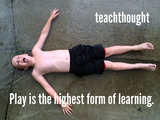
Madison, who spent the most time in school, needs the most structure-assurance that "she’s doing it right." Terrell just goes, with very little self-awareness of fear. He’s inventive and playful, and never embarrassed by mistakes. Never scared of being wrong (for better or for worse). Madison isn’t exactly the opposite, but she seems, whether by nature or nurture, to constantly look for affirmation and reward. Tyler? Somewhere in the middle, but then again he’s the most docile child you’ve ever seen, with soft blue eyes and a way of accepting the world that I never had. (That’s him laying in rain in the featured image.)
When people ask my wife and I about "homeschooling," the language is very dramatic. When did you make "the decision"? When did you "pull them out" of school? Aren’t you scared they’re going to be weird? I don’t know how you do it. I love my children, but I need a break from them.
Or the most telling: How could you do that to them?
There is a lot of implication going on here, but the latter is the most interesting to me. I’ve heard it more than once, often from adults who themselves had been "homeschooled" growing up, but that words tells you as much about their learning experience as does "schooling." Schooled how? Learning what, how, and why? Saying you’ve "seen homeschooling" is like saying you’ve seen salad or computer code or the internet.
But more crucially, as a parent how could I not accept the opportunity to lead my children intellectually? I didn’t homeschool as a rejection of public education, but as loving statement of affection and priority. Homeschooling is not a rejection of a school. I am an educator! Why the either/or?
How I saw myself as a father-what I thought my children needed on a moment basis, and my belief in myself to be able to provide that for them, or live with the guilt when I couldn’t-would lead to how my children saw themselves as learners. Somehow it’s easier to push that on schools and classroom teachers-that’s "their job," after all.
And when the learning doesn’t happen and the curiosity is stunted and the creativity unsure of itself and the literacy fragmented and confused, we can fall back on the hope that someone, somewhere is working on a "solution." And just like that, families become bystanders and passive, and their children-as students rather than learners-take on the same tone.
The Wired article editorializes, "Unless every family homeschools their children—a prospect that even homeschooling advocates say is untenable—it will remain an individualized solution to a social need." There’s the "scale" argument again, as if public schools haven’t scaled themselves all the way off the map decades ago. The art of living is an individualized solution to a social need. So is learning. So is a person’s work or craft. And agriculture. And the design of a building.
That’s what life is.
But to evaluate homeschooling-to know if it "works" or not-we have to know what it’s supposed to do. Same with a school or curriculum or assessment. Which means we have to define homeschooling 2.0, first by saying what it’s probably not for many: reproducing school at home.
While short on experts, rules, and policies, a home has agility and "scale" that a school necessarily lacks. This is an extraordinary opportunity if we can define what learning is and should be for students. If you’re trying to create a facsimile of a classroom at the kitchen table, parents and children are going to be miserable. But if you can let go of that? In 2015, it’s breathtaking.
Homeschooling has long suffered from the harmful connotation of politics, religion, and social aloofness. This might be thought of as homeschooling 1.0.
Homeschooling 2.0, then, is a logical response to locally prevailing technology. Things are possible today that weren’t even ten years ago, which offers new potential in how children learn. Like forward-thinking teachers, schools, and districts, there are some families on a kind of edge seeing what’s possible, and willing to be wrong about their choices.
There are deeper issues here, including the nature of knowledge, the role of education, the definition of "home" and "family," and the rights-and accountability-of families and communities. Also missing from this discussion? The idea of service, community interaction, humility, place-based education, project-based learning, the cost of technology, and more. Or, crucially, the justification of a model of learning that seems to tend towards the white, "plugged-in," and affluent.
The answer to all of this has to do with the bugger that keeps creeping up-scale. The scale of learning for one child-or in my case, three-suggests new paradigms for the process, content, and forms of learning of learning in 2015. If we’re re-envisioning libraries for a modern society, for example, should we start with the library as it exists and iterate it forward, adding computers and eBook checkout and so on and maybe put a 3D printer at the entrance when you first walk in to give the glow of technology?
Or should we think of why libraries came to be in the first place-their function-and rethink them in light of modern technology? A reader and a need-and desire-to read? A student and a need to know?
For my family, I made a shift from content to habits and forms. The ultimate goal is wisdom and self-knowledge practiced through inquiry, critical literacy, and learning through play. I am an educator, and so is my wife, and we’ve spent $6000 in the last year making all of this possible. That’s luck and privilege, and that part doesn’t scale.
But what can scale is the recentering of my home as a place of affection, curiosity, and literacy. If that can’t "scale," we might need to rethink the relationship between schools and families, and have some frank discussions about whether or not schools have created a vision-and tone-for learning so overtly academic that it no longer serves to communities that need its leadership.
Homeschool 2.0? Evolving how we see the relationship between communities and knowledge could do worse than start there.
A Call For Homeschool 2.0
The post A Call For Homeschool 2.0 appeared first on TeachThought.
TeachThought Blog
.
Blog
.
<span class='date ' tip=''><i class='icon-time'></i> Aug 05, 2015 09:36am</span>
|
|
When They Read But Don’t Understand: The Leap From Decoding To Comprehension
by Grant Wiggins, Authentic Education
How well are we doing in comprehension of text as a nation? You know the answer. We are doing poorly when it comes to genuine comprehension:
And look at math vs. reading:
And this, from a Christian Science Monitor article on 12th grade NAEP results in reading:
In many ways, the 2013 reading scores for 12th-graders were even more discouraging [than the lack of progress in math]. While the average score of 288 was unchanged from 2009 - and two points higher than in 2005, which represented a nadir for the reading score - it was lower than the average of 292 back in 1992.
A full 25 percent of 12th-graders in 2013 scored below basic, compared with 20 percent in 1992, and just 37 percent scored at or above proficient, compared with 40 percent in 1992. Those scoring at the proficient level could answer questions requiring them to recognize the paraphrase of an idea from a historical speech and the interpretation of a paragraph in such a speech.
[I added the NAEP chart on 12th grade reading since my focus here is on older students, and the trend is so dismal].
What should we infer from the data?
Numerous causes and their implied solutions, as readers know, have been proposed for flat reading scores: poverty, low expectations, inadequate background knowledge, an anti-boy bias in schools (especially in terms of book selection), IQ links to reading ability, computer games, TV, etc. etc.
The utterly flat national trend line, over decades, says to me that none of these theories holds up well, no matter how plausible each may seem to its proponents. Perhaps it’s time to explore a more radical but common sense notion: maybe we don’t yet understand reading comprehension and how it develops over time.
Maybe we have jumped to solutions before understanding the problems of naïve and superficial comprehension. Maybe we still haven’t specified, in diagnostic detail, what real readers do when they supposedly read books and articles and try to comprehend - regardless of what "good readers" supposedly do.
At the very least: it is a good time to question the premise that we understand the problem.
The Black Box
Reading is the hardest thing in the world to teach and assess because the reading mind is a black box: we cannot see inside the mind to see what people are doing when they read. We can only infer what readers are doing from what they tell us, write us, and show us. But what they tell, write, or show is neither direct nor necessarily valid evidence. (Maybe they read well but write or speak poorly, for example). Self-reporting of mental states is often inaccurate; expert readers may have forgotten how they came to learn to read for understanding; young readers may lack metacognitive ability and language to describe their reading as it unfolds.
In later posts I plan to share the surprisingly thin evidence about how readers actually read when they try to comprehend text. For now, I merely ask you to keep an open mind.
My Own Trials & Tribulations With Reading
I have always been puzzled by the idea of what it means to read because I was a poor reader in school - without realizing it! For a long time I got by. My analytic skills and basic smarts hid the fact, from me as well as my teachers in school, that I could not do what we now call close reading and core comprehension acts, such as summarize an author’s point, state the "moral of the story," or identify the key "moves" in an argument (and pose questions about those moves). There were hints: an English teacher who said I was "too literal" a reader (without telling me how to be otherwise); a teacher who said I "didn’t seem to be thinking" about what I was reading.
It wasn’t until much later - in college - that I became more aware of my failures as a reader and more self-conscious of how limited my take on "reading" really was. The "reality therapy" feedback became unavoidable: I was put on probation at the end of my sophomore year. (A sad irony in that I was attending St. John’s College, the so-called Great Books school.) Yet, I knew from seminar discussions and feedback on papers that my performance was weaker than it should have been. But I still didn’t understand exactly why or how. As in most high schools and all colleges, alas, I was not taught to read hard books, I was merely assigned them.
I didn’t realize that I wasn’t reading properly until my junior year when I serendipitously spotted a book on a friend’s shelf in his dorm room: How to Read a Book by Adler and Van Doren. Within a few minutes of skimming the first chapters I was bolted intellectually awake: the authors were vividly describing my bad habits as a reader and offering some clear and easy-to-follow tips on how to remedy them when faced with challenging texts. I was helped to realize that when I "read" I merely scanned words passively; I took no steps to converse with the text. Slowly but surely my reading improved by following their advice, the gist of which was to force oneself to ask and answer certain probing questions of the text, in writing, in the margins. To comprehend better is, in part, to force oneself to think more effectively.
Vital Hints In The Literature On Literacy
Thus, as my wife puts it, when is the problem of incomplete comprehension one of reading and when is it one of thinking? What is well-intentioned but ineffective reading/thinking, and how can one recognize the problem as such? This passage from Kylene Beers really resonated with me when I read it last year as part of my multi-year action research project on this topic:
I once thought that if my students could make an inference, any inference, then my teaching woes would be over… The problem with comprehension, it appeared, was that kids couldn’t make an inference.
I shared this frustration with Anne [the Principal]…. I stood leaning against her office door, complaining that that the kids she had given me that year could not make an inference. She simply replied: "Well, teach them."
"Teach them what?"
"Inferencing. Teach them how to make an inference."
"You can’t teach someone how to make an inference. It’s inferential. It’s just something you can or can’t do," I said, beginning to mumble.
"Tell me you don’t really believe that," she said….
I began to wonder just how I would teach inferencing. It took years for me to get a handle on that one.
As a teacher I, too, saw that some of my bright students could not read for meaning, although I often couldn’t figure out their problems. I could only say "Re-read it carefully and take notes" or some other advice. They, like I had, protested that they had "re-read" and "done the readings." Yet, even after re-reading and taking notes they were often unable to draw critical inferences about the text as a whole. What, then, were they doing when "reading"?
Oscar’s desire to drop my elective answered the question for at least one student - in a shocking way. When I asked him what his troubles were as a reader, he replied: "I just cannot memorize all the pages you are assigning!"
Ouch. He really did believe "reading" was "scanning and memorizing for later recall." But wasn’t that, in its own way, what I had done much of my academic life? He at least worked hard to memorize it all! I hadn’t even done that.
Chris Tovani offers a snippet of dialogue that underscores our need to better understand readers trying to understand:
"Luke, why don’t you try to get unstuck."
"Nothing helps me. Re-reading is a waste of time."
"Try another fix-up strategy, then."
"What’s a fix-up strategy?…When I was younger I tried sounding out word out but that didn’t really help."
"Did you learn to do anything else?"
"No, not really."
"Does anyone else have a strategy he or she can suggest?"
"I don’t do anything," brags Kayla.
"You don’t do anything?" I asked.
"Nope. I keep reading and hope it makes sense when I’m done."
"And what if it doesn’t?"
"Then, oh well."
I would venture to hypothesize that for many HS students their reading strategy is "Read on, then, oh well." But let’s find out.
The "re-reading" strategy is a perfect example of our failure to understand the problem. Why would "re-reading" a passage, by itself, clear up what was confused in the first place? All the re-readers are doing is - re-reading. They aren’t thinking differently about what they are re-reading. As Tovani says, telling someone to "think harder" is useless advice. Yet, "Re-read!" is the same unhelpful advice if we don’t know how to re-read or whether we are re-reading "properly." Too much of the reading-strategy literature amounts to such glib advice.
My first foray in writing about some of this was in a blog entry two years ago about the reading strategies. Boy, did I get a ton of hate mail from people who thought I had gone to the dark side and allied myself with the non-progressive camp. I had done no such thing, even if my prose was a bit dramatic. I had mostly raised these questions (and tried to clarify terms).
Indeed, a few of the more mainstream and thoughtful writers on literacy have made the very point that I was criticized for, such as Barnhouse & Vinton:
As we pondered what was happening with our strategy instruction, we came to several conclusions. The first was the discomfiting realization that while we were grounding our lessons in real literature… we were, in effect, using those books to practice strategies in isolation. As it was, most of the students’ connections stayed on the surface level. This led us to the conclusion that some of the so-called comprehension strategies - especially visualizing, predicting, connecting, and questioning - seemed aimed more at helping students develop the habits of active and engaged readers rather than to specifically help them comprehend more than they might have. We would need, in effect, to find strategies for the strategies to ensure that they were used as meaning-making tools, not as end products.
So, let’s go slowly. When you as a teacher of older students tell students to "read" and "re-read" a challenging text, what exactly are you assuming that they should be doing in their heads? What do they assume you are asking them to do when you ask them to read or re-read? And - most importantly - what do you think they will actually do when they get stuck? Is Tovani correct that, regardless of training, adolescent readers will have little or no intelligent approach? (I am not asking what they "should" do but what they will likely do.) Do they use the reading strategies or do they forget all about them or approach them randomly or revert to some other bad habit or naïve approach?
The Leap From Decoding To Comprehension
As I have long said, we give far too little feedback and too much advice. Beers, for example, has a nice chart in which she describes in general form what non-comprehenders do, but it is very brief and general, e.g. "can read all the words but consistently has difficulty asking questions, creating questions, discussing the text, doesn’t "see" anything in his mind while reading, thinking beyond literal questions…" and the book focuses on advice. I am calling for a far more intense look at what non-comprehenders do. Otherwise feedback and advice are easily too generic.
But to give feedback you have to somehow "see" what the reader is doing - which we said above is very hard. It is time, however, to pause in offering non-comprehending readers so much advice and to spend more time in trying to figure out what readers are actually doing in their heads when they supposedly "read." We might then, like good coaches, offer highly specific feedback based upon what was working and what wasn’t in the readers’ attempts; and only offer specific advice about what to do, based on the specific attempt and the feedback. We would thus want to do far more ungraded comprehension and self-reporting quizzes than we now do.
In follow-up posts, I plan to review briefly the literature from the past 30 years on what readers do (including look at some of the eye-tracking research) and explain why I believe a core premise behind the teaching of the reading strategies is flawed: just because "good readers" do certain things, doesn’t mean we understand how to improve "weak" readers. The strategies - e.g. visualize, predict, connect, re-read, infer, etc. - may only be correlated, not causal. (And, as I will again argue, some of the so-called strategies simply do not pass muster.) So it should not surprise us that reading scores do not improve much if the strategies are taught and learned. Finally, I will have some reports from teachers who have volunteered to give the previous survey or another like it to their students to see what we can learn from just studying kids trying to understand.
If you teach English, try out some of the self-monitoring questions I proposed that you consider, above; and report back to us!
In response to some comments and emails:
PS: Yes, I actually do understand the Kant passage - after dozens of readings and multiple under-graduate and graduate classes on Kant. I didn’t really understand the passage - even after a dozen or more re-readings! - until I was helped to understand what the point of the Critique of Pure Reason was, and how Kant was arguing with Hume’s view about what we can understand. That is the paradox of reading, to me: you cannot understand the part until you understand the whole and the "great conversation"; but you cannot understand the whole unless you understand the parts through close reading.
What, then, reading and English teachers? How do we better help students understand what they do and do not understand? How can they better self-assess their degree of understanding - and use that feedback to better understand?
PPS: There are some fabulous suggestions in the comments thus far for how to address the problem of poor comprehension. But note my caution and focus: what unsuccessful readers actually do is what we need to understand better. Then, we’ll be in a far better position to weigh and propose solutions that are valid and personalized.
When Readers Don’t Understand; This article first appeared on Grant’s personal blog; Grant can be found on twitter here; adapted image attribution flickr user guillaforysthe; Reading Comprehension: When They Read But Don’t Understand
The post When They Read But Don’t Understand appeared first on TeachThought.
TeachThought Blog
.
Blog
.
<span class='date ' tip=''><i class='icon-time'></i> Aug 05, 2015 09:36am</span>
|
|
Want To Know How Students Feel When They Read Complex Texts?
by Grant Wiggins, Authentic Education
Ed note: As a follow-up to Grant’s post on reading comprehension, he developed the following quiz for teachers to monitor their own reading behavior.
What, in fact, do you do when you read challenging text? What do you do when you do not understand on first pass? Try a little test, below: "read" the following paragraphs, then post a comment about what you were doing as you were "reading." Do not tell us what you think the passage means; tell us metacognitively, as best you can, what you believe you were doing with your eyes and thinking with your mind to try to determine the meaning of the text.
Monitor Your Understanding: A Revealing Exercise For Teachers
Unlike the famous ambiguous passage about "piles of things" developed by Bransford and Johnson for use in cognitive research (which we analyzed in Understanding by Design), this is a real text: the very first pages of the Introduction to Kant’s Critique of Pure Reason. What is Kant saying here?
"There can be no doubt that all our knowledge begins with experience. For how should our faculty of knowledge be awakened into action did not objects affecting our senses partly of themselves produce representations, partly arouse the activity of our understanding to compare these representations, and, by combining or separating them, work up the raw material of the sensible impressions into that knowledge of objects which is entitled experience? In the order of time, therefore, we have no knowledge antecedent to experience, and with experience all our knowledge begins.
But though all our knowledge begins with experience, it does not follow that it all arises out of experience. For it may well be that even our empirical knowledge is made up of what we receive through impressions and of what our own faculty of knowledge (sensible impressions serving merely as the occasion) supplies from itself. If our faculty of knowledge makes any such addition, it may be that we are not in a position to distinguish it from the raw material, until with long practice of attention we have become skilled in separating it.
This, then, is a question which at least calls for closer examination, and does not allow of any off-hand answer: whether there is any knowledge that is thus independent of experience and even of all impressions of the senses. Such knowledge is entitled a priori, and distinguished from the empirical which has its sources a posteriori, that is, in experience.
The expression ‘a priori‘ does not, however, indicate with sufficient precision the full meaning of our question. For it has been customary to say, even of much knowledge that is derived from empirical sources, that we have it or are capable of having it a priori, meaning thereby that we do not derive it immediately from experience, but from a universal rule — a rule which is itself, however, borrowed by us from experience. Thus we would say of a man who undermined the foundations of his house, that he might have known a priori that it would fall, that is, that he need not have waited for the experience of its actual falling. But still he could not know this completely a priori. For he had first to learn through experience that bodies are heavy, and therefore fall when their supports are withdrawn.
In what follows, therefore, we shall understand by a priori knowledge, not knowledge independent of this or that experience, but knowledge absolutely independent of all experience. Opposed to it is empirical knowledge, which is knowledge possible only a posteriori, that is, through experience. A priori modes of knowledge are entitled pure when there is no admixture of anything empirical. Thus, for instance, the proposition, ‘every alteration has its cause’, while an a priori proposition, is not a pure proposition, because alteration is a concept which can be derived only from experience."
After reading the passage, consider the following questions:
Using arrows and labels, what was the visual "itinerary" of your reading. Where did your eyes go to, when, and why, as you read?
What questions, if any, did you ask yourself as you read? Mark the places on the text.
Where did you get stuck, if any place? (Mark the text) What, then, did you do, if you got stuck?
If you could not "unstuck" yourself at each moment of being stuck, what did you do next - and why?
Which "reading strategies" did you use when (without my having prompted you to use any)? If not, why not, do you think? If so, which ones did you consciously choose and why?
Where /when did you start feeling dumb/frustrated if at all. What did you do/feel about it if you did? If you quit, say where and why.
On a scale of 1-4, how confident are you of your understanding of Kant’s opening setup of his inquiry?
After this self-monitoring, take this formative quiz:
Circle the 1-2 key sentences in this selection, and be ready to explain why you are confident that they are key even if you are not sure what they mean.
Title this reading and be ready to explain why you gave it that title
In a sentence, state what Kant intends to explore. And speculate as to why he might want to explore such a question.
Ed note: Share your thoughts in the comments below, at Grant’s blog, etc. Would love to hear it.
This article first appeared on Grant’s personal blog; Grant can be found on twitter here; Want To Know How Students Feel When They Read Complex Texts? image attribution flickr user .brioso.
The post Want To Know How Students Feel When They Read Complex Texts? appeared first on TeachThought.
TeachThought Blog
.
Blog
.
<span class='date ' tip=''><i class='icon-time'></i> Aug 05, 2015 09:35am</span>
|
|
Free Explain Everything Lesson Ideas For Your Classroom
by TeachThought Staff
If you use Explain Everything-or you don’t but perhaps should give it a look-there’s a free iBook of lesson ideas that you might appreciate.
First things first: Explain Everything is a whiteboard and screencasting app that is a wonderful flipped classroom companion, allowing teachers and students to access content asynchronously. Push content and let them access it. And there’s a discount for educators if you meet Apple’s criteria (which makes sense).
In the developer’s words, Explain Everything "is an easy-to-use design, screencasting, and interactive whiteboard tool that lets you annotate, animate, narrate, import, and export almost anything to and from almost anywhere. Create slides, draw in any color, add shapes, add text, and use a laser pointer. Rotate, move, scale, copy, paste, clone, and lock any object added to the stage."
And now they’ve released an iBook with lesson ideas to use the software, because caring is sharing.
The Free iBooks With The Free Lesson Ideas Part
So the iBook then? In their words, "the Apps in the Classroom series was created by Apple to provide teachers with a few ideas on how to integrate apps into daily classroom instruction. Inspired by Apple Distinguished Educators, this book is a collection of activities that let students ages 5 to 14+ use Explain Everything to demonstrate their learning across a range of subjects."
You can get the Explain Everything app, and the free iBook here.
Free Explain Everything Lesson Ideas For Your Classroom
The post Free Explain Everything Lesson Ideas For Your Classroom appeared first on TeachThought.
TeachThought Blog
.
Blog
.
<span class='date ' tip=''><i class='icon-time'></i> Aug 05, 2015 09:34am</span>
|
|
Twitter Digest: Fostering A Growth Mindset With Students
by TeachThought Staff
Below is a summary of the #reflectiveteacher twitter chat on February 10, 2015. The topic: Fostering A Growth Mindset With Our Students. You can find more information on the chat here.
[View the story "#reflectiveteacher Twitter Chat Feb 10, 2015″ on Storify]
Twitter Digest: Fostering A Growth Mindset With Students
The post Twitter Digest: Fostering A Growth Mindset With Students appeared first on TeachThought.
TeachThought Blog
.
Blog
.
<span class='date ' tip=''><i class='icon-time'></i> Aug 05, 2015 09:34am</span>
|
|
Hip-Hop University: War Is My Love by Kendrick Lamar
Hip-Hop University is a new series where we share hip-hop you can teach with. We’ll give you the song and lyrics-the rest is up to you. We’ll warn you if there is strong language or themes, but as with anything, make sure you watch it on your own before showing.
We’ll also add in other genres of music as well (ignoring the then ironic title), but our focus will be hip-hop because-well, so much of it is powerful, brilliant, and widely misunderstood.
Summary: an extended metaphor, powerful imagery, interesting juxtaposition of tone and mood.
War Is My Love by Kendrick Lamar
Look inside my eyes and tell me you see a warrior
I never felt the feeling of euphoria
Pain forever or prolong the pros and cons of prosperity is strong
Wake up in the morning and I gotta win
Not taking the victory, that’s my only sin
And so I send a message to your messenger
A warning shot to let em know I’m serious
I’m ready for a war, when I roar it can break a glass window
The only thing for sure: the perfect way to bend you
On your back even if I gotta slither through the cracks
I can crack every code you deliver, I attack
Every hole where the bomb squad sit it on the tripod
Even if you try hard, he can still die hard
Run but you can’t hide: white flags
You can pull em out fast and tell me your last goodbye
[Hook]
I will, I will climb the highest mountain
Before the flood comes
And all my fight is drowning in blood
What I got to lose? What I got to prove?
I guess war is my love
[Kendrick Lamar]
Make sure your next move is slick, your best move is nothing
You know I take risk: dark clouds, I love it
Cause I can hide in the mist, hop out
And crush every soldier you’re with, so I’m 6 for 6
I’m sick with determination: I’ll terminate ya quick
I lead the pack, I follow no rules
I see the traps, I know you’re close to
Falling on your face, unload, reload
Hand me another case, explode, explode
The fire of my eyes is waiting on your demise
I know you hope your help is close by
Lyrics via lyricsmania; Hip-Hop University: War Is My Love by Kendrick Lamar
The post Hip-Hop University: War Is My Love by Kendrick Lamar appeared first on TeachThought.
TeachThought Blog
.
Blog
.
<span class='date ' tip=''><i class='icon-time'></i> Aug 05, 2015 09:34am</span>
|
|
The Pedagogy Of John Dewey: A Summary
by Steve Wheeler, Associate Professor, Plymouth Institute of Education
This is number 7 in my blog series on major learning theories. My plan is to work through the alphabet of psychologists and provide a brief overview of their theories, and how each can be applied in education. In the last post we examined the work of Mihály Csíkszentmihályi on Flow Theory. In this post, we explore the work of John Dewey on experiential and interactive learning. This is a simplified interpretation of the theory, so if you wish to learn more, please refer to the original work of the theorist.
John Dewey is one of the giants in the history of educational theory, and it’s difficult to isolate one of his specific theories to discuss here. He was influential in so many areas of educational reform, that to choose one theme would do him a disservice, so I will highlight several of the areas in which he was ahead of his time.
The theory and how it can be applied to education
Even before the constructivist theories of Jean Piaget and Lev Vygotsky were widely known, Dewey was talking about how children learn best when they interacted with their environments and were actively involved with the school curriculum. He rejected much of the prevalent theory of the time - behaviourism - as too simplistic and inadequate to explain complex learning processes. He argued that rather than the child being a passive recipient of knowledge, as was presumed by many educators of the time, children were better served if they took an active part in the process of their own learning. He also placed greater emphasis on the social context of learning. At the turn of the 20th Century, these were radical ideas.
Dewey further argued that for education to be at its most effective, children should be given learning opportunities that enabled them to link present content to previous experiences and knowledge. Again, this was a ground breaking idea for the period. Yet another feature in Dewey’s theories was the need for learners to engage directly with their environment, in what came to be known as experiential learning, where ‘knowledge comes from the impressions made upon us by natural objects.’ This approach led later to a number of other similar approaches such as problem-based learning and inquiry based learning.
Notwithstanding, Dewey was wary of placing too much emphasis on the child’s abilities, but preferred to place his trust in a more balanced approach to education where teacher, students and content were given equal importance in the learning equation. Ultimately, his belief was that teachers should not be in the classroom to act simply as instructors, but should adopt the role of facilitator and guide, giving students the opportunities to discover for themselves and to develop as active and independent learners. In some schools, a return to these values is long overdue.
Reference
Dewey, J. (2011) Democracy and Education. Milton Keynes: Simon and Brown.
Previous posts in this series:
Anderson ACT-R Cognitive Architecture
Argyris Double Loop Learning
Bandura Social Learning Theory
Bruner Scaffolding Theory
Craik and Lockhart Levels of Processing
Csíkszentmihályi Flow Theory
This post first appeared on Steve’s personal blog; The Pedagogy Of John Dewey: A Summary; image attribution flickr user listeup
The post The Pedagogy Of John Dewey: A Summary appeared first on TeachThought.
TeachThought Blog
.
Blog
.
<span class='date ' tip=''><i class='icon-time'></i> Aug 05, 2015 09:34am</span>
|
|
The Opportunities For Empathy In The Classroom
by Terry Heick
So much talk about empathy in education recently. Why? What’s the big idea? In "The Role of Empathy in Learning," I wrote:
"The role of empathy in learning has to do with the flow of both information and creativity. A dialogic interaction with the world around us requires us to understand ourselves by understanding the needs and condition of those around us. It also encourages us to take collective measurements rather than those singular, forcing us into an intellectual interdependence that catalyzes other subtle but powerful tools of learning."
But where does it come from? What causes it? What are the authentic sources of empathy in a classroom?
Empathy Source: Analysis of "Other"
Whether by close academic examination, more personal "evaluation," or some kind of analysis that’s in-between, "other" lays the groundwork for empathy.
The act of an infant reaching out for your face as you hold, or making eye contact with someone during a conference, or even reading literate all are framed by empathy-or suffer tremendously without it. There is a moment when one "thing" recognizes another, followed by some momentary burst of analysis. Who is this person? Are they a threat, an opportunity, or neither? What do I need from them, and them from me? What social contracts or etiquette are at work here that I need to be aware of and honor?
Literary study is probably the most iconic case for empathy in traditional learning environment. A novel requires the reader see the world through one (or more) of the character’s eyes-to understand their motives, and draw close to their worldview so that can have a fictional-but-still-parallel experience.
Empathy Source: Your interactions with them
This is a powerful opportunity to model empathy. Reinforcement of desired behaviors. Socratic discussion. Grading writing. Evaluating projects. Missing homework. Behavior problems. All of the dozens of interactions you have with students on a daily basis are opportunities for them to see what empathy looks like.
This doesn’t mean they necessarily will, in turn, use it with others, but there’s no chance at all for that to happen if they don’t even know what they’re looking for. Your empathy with them may be the only empathy they’ve ever seen.
Empathy Source: Their interactions with one another
Another opportunity to see empathy in action is in working with one another—quick elbow-partner activities, group projects, peer response, group discussions and more. Sharing sentence stems that promote empathetic dialogue can be helpful to students—like training whees so they know where to start.
"I can tell you’ve…that must have…" as in, "I can tell you’ve worked hard on this writing. That must’ve taken self-determination, and even some courage."
Empathy Source: How content is framed
How content is framed is another opportunity for empathy. For example, using essential questions that require, reward, and promote empathy can turn a unit into a study on what other people think, why they think it, and what they feel? Grant Wiggins has held up "What’s wrong with Holden Caufield?" from The Catcher In The Rye as a powerful essential question, one that requires students to examine another person in an alien context, make deep inferences based on schema that is (obviously) personal, and then—hopefully—empathize with a fictional character not as a quick writing prompt or "higher-level question," but a 6-week study.
Studying fiction—or studying fiction well is an exercise in empathy as well. Studying history without empathy is like turning our shared human legacy, full of wonderful nuance and narrative and scandal and hope—into a dry, chronologically-based FAQ. Which sucks.
Empathy Source: Where learning goals come from
The relationship between learning goals and empathy may not be clear, but what we choose to study and why we choose to study it are—ideally—primarily human pursuits. When these are handled outside of the classroom, e.g., in the form of a curriculum standards, scopes-and-sequences, maps, units, power standards and the lessons that promote their study, this places the institution immediately at odds with the student, and sterilizes the learning experience.
When students are able to look to other schools, other classrooms, their own lives, or even non-academic "fields" to see how experts and passionate creatives identify, value, and improve their own knowledge and skills, it can help to tilt the learning experience to something emotionally immediate and relevant and authentic—fertile ground for empathy.
Empathy Source: Transfer of knowledge
What do we do with what we know? What happens when I try to take what I learned here, and use it there? What are my thinking habits? What are the chances I’ll make this transfer unprompted, now and in the future?
These questions surrounding students’ transfer of knowledge can all benefit from empathy, and promote its growth. Understanding is a problematic word, but let’s consider for a moment two kinds of understanding—that which is demonstrated within the context of a lesson or unit, and that which is able to leave this fragile academic bubble and can survive on its own outside of it. This kind of movement isn’t simple, or necessarily natural when they learning content and goals are all academic.
In The Courage To Think Critically, I was theorized as much:
"To think critically about something is to claim to first circle its meaning entirely—to walk all the way around it so that you understand it in a way that’s uniquely you. That’s not academic vomit but fully human. After circling the meaning of whatever you’re thinking critically about—a navigation necessarily done with bravado and purpose—you then analyze the thing.
See its parts, its form, its function, and its context. After this kind of survey and analysis you can come to evaluate it-bring to bear your own distinctive cognition on the thing so that you can point out flaws, underscore bias, emphasize merit—to get inside the mind of the author, designer, creator, or clockmaker and critique his work."
Empathy Source: Movement Within & Across Learning Taxonomies
Another example? Understanding by Design’s "6 Facets of Understanding." Note the progression:
6 Facets of Understanding-Peaking With Empathy & Self-Knowledge
"Facet 1: Explain
Provide thorough and justifiable accounts of phenomena, facts, and data.
Facet 2: Interpret
Examples: Tell meaningful stories, offer apt translations, provide a revealing historical or personal dimension to ideas and events; make subjects personal or accessible through images, anecdotes, analogies, and models.
Facet 2: Apply
Examples: Effectively use and adapt what they know in diverse contexts.
Facet 4: Have perspective
Examples: See and hear points of view through critical eyes and ears; see the big picture.
Facet 5: Empathize
Examples: Find value in what others might find odd, alien, or implausible; perceive sensitively on the basis of prior indirect experience.
Facet 6: Have self-knowledge
Examples: Perceive the personal style, prejudices, projections, and habits of mind that both shape and impede our own understanding; they are aware of what they do not understand and why understanding is so hard."
The movement in the 6 Facets here is from outward patterns to inward patterns. Explaining, interpretation, and application are, in large part, outward. The facets then tend inward—perspective, empathize, and self-knowledge. The lesson here-or one lesson of many-is that understanding is a deeply personal process. It is a matter of knowledge, but also identity, perspective, and empathy.
Our TeachThought Learning Taxonomy includes domains of "Self," "Interdependence," "Function," and "Abstraction," implying the human, emotional, and connected nature of learning. Learning is about experimenting through, playing with, and otherwise coming to internalize new information and perspective. Knowledge-holding is only one part of "knowing."
Empathy provides not only provides a common ground between people-and a human tone-but also an authentic need to know what we know, and use that knowledge to improve the interactions we value the most.
Adapted image attribution flickr user flickeringbrad; The Opportunities For Empathy In The Classroom
The post The Opportunities For Empathy In The Classroom appeared first on TeachThought.
TeachThought Blog
.
Blog
.
<span class='date ' tip=''><i class='icon-time'></i> Aug 05, 2015 09:33am</span>
|
|
31 Sources Of Royalty-Free Images
by TeachThought Staff
In a digital world, images are everything-and that goes for the classroom, too.
Whether students are putting together a graphic design project, you’re starting a classroom blog, or your school needs access to high quality images for any number of teaching and learning needs, Creative Commons provides a useful common language for discussing what to use, when, and how, but it’s not an image library. (You can see a guide to Creative Commons licensing here.)
So where can you get the images themselves? Images that you can use to design, produce, create, and publish for the authentic project-based learning happening in your classroom? The collection below represents a very nice starting point to find the royalty-free image you’re looking for.
Add wikimediacommons and flickr to the list, and you’ve got 31 sources of royalty-free images worth bookmarking.
Or saving to Pocket.
Or whatever your workflow is. (We don’t judge.)
Royalty Free Image Resources
1
KABOOMPICS
BROWSABILITY: Search box, categories & tags
LICENSE: CC0
BEST FOR: Nature, Textures & Backgrounds, Cityscapes, Landscapes, Food, Architecture
7 likes
I use this
0
Comments
Relist
Share
2
UNSPLASH
BROWSABILITY: Not searchableLICENSE: CC0BEST FOR: Nature, Music, People, Cityscapes, Landscapes, Food, Travel & Adventure, Architecture
4 likes
I use this
0
Comments
Relist
Share
3
NEW OLD STOCK
BROWSABILITY: Not Searchable
LICENSE: CC0
BEST FOR: Vintage, Nature, Technology, People, Cityscapes, Landscapes, Travel & Adventure, Architecture
1 likes
I use this
0
Comments
Relist
Share
4
MORGUEFILE
BROWSABILITY: Search Box
LICENSE: CC0
BEST FOR: Nature, Technology, Music, Textures & Backgrounds, People, Animals, Seasonal, Cityscapes, Landscapes, Food, Travel & Adventure, Architecture, Automotive
1 likes
I use this
0
Comments
Relist
Share
5
JAY MANTRI
BROWSABILITY: Not Searchable
LICENSE: CC0
BEST FOR: Nature, Cityscapes, Landscapes
1 likes
I use this
0
Comments
Relist
Share
6
GRATISOGRAPHY
BROWSABILITY: Not searchable
LICENSE: CC0
BEST FOR: Nature, Technology, People, Cityscapes, Landscapes
1 likes
I use this
0
Comments
Relist
Share
7
LITTLE VISUALS
BROWSABILITY: Not Searchable
LICENSE: CC0
BEST FOR: Nature, Music, Textures & Backgrounds, Landscapes
1 likes
I use this
0
Comments
Relist
Share
8
SUPERFAMOUS
BROWSABILITY: Category Links
LICENSING: CC3
BEST FOR: Nature, Textures & Backgrounds, Landscapes
0 likes
I use this
0
Comments
Relist
Share
9
STOCKVAULT
BROWSABILITY: Search Box & Categories
LICENSE: CC0
BEST FOR: Nature, Music, Textures & Backgrounds, People, Animals, Seasonal, Cityscapes, Landscapes, Food, Architecture, Automotive
0 likes
I use this
0
Comments
Relist
Share
10
UNSPLASH SEARCH
BROWSABILITY: Tags/Categories
LICENSE: CC0
BEST FOR: Nature, Music, People, Cityscapes, Food, Travel & Adventure, Architecture
0 likes
I use this
0
Comments
Relist
Share
11
UNRESTRICTED STOCK
BROWSABILITY: Search Box + Categories
LICENSE: See website terms
BEST FOR: Nature, Technology, Music, Textures & Backgrounds, Animals, Seasonal, Cityscapes, Landscapes, Travel & Adventure, Architecture
0 likes
I use this
0
Comments
Relist
Share
12
SPLITSHIRE
BROWSABILITY: Category Filters
LICENSE: CC0
BEST FOR: Nature, Technology, Music, People, Landscapes, Food, Architecture, Automotive
0 likes
I use this
0
Comments
Relist
Share
13
STOCKMEDIA
BROWSABILITY: Categories
LICENSE: CC3
BEST FOR: Nature, Technology, Textures & Backgrounds, Animals, Seasonal, Cityscapes, Landscapes, Food, Travel & Adventure, Architecture, Automotive
0 likes
I use this
0
Comments
Relist
Share
14
SNAPWIRE SNAPS
BROWSABILITY: Search Box
LICENSE: CC0
BEST FOR: Nature, People, Animals, Cityscapes, Landscapes, Travel & Adventure, Architecture
0 likes
I use this
0
Comments
Relist
Share
15
SNAPOGRAPHIC
BROWSABILITY: Category Filters
LICENSE: CC0
BEST FOR: Nature, Textures & Backgrounds, Animals, Cityscapes, Landscapes, Architecture
0 likes
I use this
0
Comments
Relist
Share
16
PUBLIC DOMAIN ARCHIVE
BROWSABILITY: Broad Categories (not very searchable)
LICENSE: CC0
BEST FOR: Nature, Technology, Music, Textures & Backgrounds, People, Animals, Cityscapes, Landscapes, Food, Travel & Adventure, Vintage, Architecture
0 likes
I use this
0
Comments
Relist
Share
17
PICOGRAPHY
BROWSABILITY: Not searchable
LICENSE: CC0
BEST FOR: Nature, Technology, Cityscapes, Landscapes, Travel & Adventure
0 likes
I use this
0
Comments
Relist
Share
18
PICJUMBO
BROWSABILITY: Search Box, Categories & Tag Filters
LICENSE: CC0
BEST FOR: Nature, Technology, People, Animals, Seasonal, Cityscapes, Landscapes, Food, Travel & Adventure, Architecture,
0 likes
I use this
0
Comments
Relist
Share
19
PIXABAY
BROWSABILITY: Search Box + Category Filters
LICENSE: CC0
BEST FOR: Nature, Technology, Music, Textures & Backgrounds, People, Animals, Seasonal, Cityscapes, Landscapes, Food, Travel & Adventure, Architecture
0 likes
I use this
0
Comments
Relist
Share
20
MAGDELEINE
BROWSABILITY: Search Box + Category / Tag Filters
LICENSE: Varies (CC0 & Attribution Required)
BEST FOR: Nature, Textures & Backgrounds, Cityscapes, Landscapes, Travel & Adventure,
0 likes
I use this
0
Comments
Relist
Share
21
LIFE OF PIX
BROWSABILITY: Not Searchable
LICENSE: CC0
BEST FOR: Nature, Technology, Textures & Backgrounds, People, Animals, Seasonal, Cityscapes, Landscapes, Travel & Adventure, Architecture, Automotive
0 likes
I use this
0
Comments
Relist
Share
22
PHOTO EVERYWHERE
BROWSABILITY: Search Box + Map & Tag Filters
LICENSE: CC3
BEST FOR: Cityscapes, Landscapes, Travel & Adventure
0 likes
I use this
0
Comments
Relist
Share
23
LOCK & STOCK PHOTOS
BROWSABILITY: Not searchable
LICENSE: CC4
BEST FOR: Nature, Animals, Cityscapes, Landscapes, Food, Architecture
0 likes
I use this
0
Comments
Relist
Share
24
IM FREE
BROWSABILITY: Search Box + Collections
LICENSE: CC0
BEST FOR: Nature, Technology, Music, People, Cityscapes, Landscapes, Travel & Adventure, Architecture
0 likes
I use this
0
Comments
Relist
Share
25
GET REFE
BROWSABILITY: Not Searchable
LICENSE: CC0
*BEST FOR: * Nature, People, Cityscapes, Landscapes (NOTE: all images taken by mobile phones)
0 likes
I use this
0
Comments
Relist
Share
View more lists from
Mesh Marketing
31 Sources Of Royalty-Free Images
The post 31 Sources Of Royalty-Free Images appeared first on TeachThought.
TeachThought Blog
.
Blog
.
<span class='date ' tip=''><i class='icon-time'></i> Aug 05, 2015 09:33am</span>
|
|
A Comprehensive Framework For Student Motivation
by Terry Heick
When researching student motivation and gamification late last year, I came across the most comprehensive gamification framework I’ve ever seen. Developed by gamification expert Yu-kai Chou, it was an ambitious effort that distinguished black hat gamification (which is "bad"-think Farmville and Candy Crush) from white hat gamification (which is "good"-think Minecraft or even an ACT score). (It’s also copyrighted, but they graciously allowed us to use it.)
While it is designed not as an educational framework, but rather as a way to demonstrate gamification and its many strands, gamification is about human encouragement and motivation. For educators, student motivation is one of the pillars of a academic performance. While the terms are sometimes misunderstood-and risk becoming cliche as we continue to talk about them topically rather than specifically-student motivation and student engagement are prime movers in the learning process. Without either, teaching is an uphill battle.
So what began as a post about gamification became more a matter of student motivation-what motivates students in the classroom and why. If we can nail down those factors-those characteristics that drive student motivation-we can, at worst, be more attentive to them as we design assessments, lessons, units, and even learning models.
8 Core Drives Of Student Motivation
1) Epic Meaning & Calling
Yu-kai Chou explains, "Epic Meaning & Calling is the Core Drive where a player believes that he is doing something greater than himself or he was "chosen" to do something. A symptom of this is a player that devotes a lot of his time to maintaining a forum or helping to create things for the entire community (think Wikipedia or Open Source projects)."
Educator takeaways? This is easy to reduce to "get good grades to get into college to "become" whatever you want to "be," but while they wait to "become" something (i.e., a "professional" of some kind), they need meaning from their work that is a matter of self, knowledge, and personal development (see Development & Accomplishment below).
What if…we continued to build on the ideas of problem-based learning, place-based education, and scenario-based learning, where students have the ability to interact with authentic-and hopefully local-problems, designing solutions to problems they see on a daily basis.
2) Development & Accomplishment
Yu-kai Chou explains: "Development & Accomplishment is the internal drive of making progress, developing skills, and eventually overcoming challenges. The word "challenge" here is very important, as a badge or trophy without a challenge is not meaningful at all."
Educator takeaways? Right now, letter grades, certificates, and in cases, digital portfolios are tasked with communicating a learner’s measure of performance, progress, and accomplishment. The visibility of this development and accomplishment is also limited and completely academic.
What if…the development of a "learner identity" was a matter of choice and authentically-sourced, rather than universal and academically-derived?
3) Empowerment of Creativity & Feedback
Yu-kai Chou explains: "Empowerment of Creativity & Feedback is when users are engaged a creative process where they have to repeatedly figure things out and try different combinations. People not only need ways to express their creativity, but they need to be able to see the results of their creativity, receive feedback, and respond in turn."
Educator takeaways? Learning feedback is different than grades, and grades are different than assessment, and assessment is different than learning results-offering feedback that promotes learning while encouraging creativity (part of the root of the word encourage is courage)? How can we give learners the space and emotional support to experiment with complex ideas and data sources without letting them flounder, or "play and experiment badly"?
What if…play was at the core of learning while married to an authentic feedback loop, and lessons and units and projects ground to a halt without creativity?
4) Ownership & Possession
Yu-kai Chou explains, "This is the drive where users are motivated because they feel like they own something. When a player feels ownership, she innately wants to make what she owns better and own even more."
Educator Takeaways? Space, place, voice, and choice are among the principles of student-centered learning. A sense of agency can be both empowering and overwhelming for students.
What if…Students "owned" their learning experiences in connection with mentors outside the school?
5) Social Influence & Relatedness
Yu-kai Chou explains, "This drive incorporates all the social elements that drive people, including: mentorship, acceptance, social responses, companionship, as well as competition and envy…Also, it includes the drive we have to draw closer to people, places, or events that we can relate to. If you see a product that reminds you of your childhood, the sense of nostalgia would likely increase the odds of you buying the product."
Educator takeaways? How can we design learning so that students need to connect to clarify a need for knowledge, to create knowledge, or to share knowledge? Pushed further, how does social influence change the knowledge and competencies we choose to value?
For example, how has social media-twitter for example-altered social currencies? In a physical environment, charisma can be a matter of aesthetics, height, voice tone, or verbal linguistics. In a digital realm, the ability to communicate concisely, to use hashtags effectively, and to time your messages properly all give the appearance of charisma. The lesson? Unique spaces create unique conditions for influence and value.
What if…we created a classroom where the social influence was both a cause and an effect for curiosity and an authentic need to know?
6) Scarcity & Impatience
Yu-kai Chou explains, "This is the drive of wanting something because you can’t have it…."
Educator Takeaways? Choosing what to make scarce, and how to build want in students is a matter of design with a few simple bullet points. Traditional academia has scarcity built in already-extra-credit, choice, opportunities for self-selected grouping, personal technology use (BYOD), course selection (in K-12) and more are all "scarce," and thus have value.
Education also withholds permanent markers of performance (i.e., final letter grades) until the end of a semester to both motivate students as well as provide the image of authority and control. Using "Scarcity & Impatience" becomes a matter of being selective in what is made scarce, and how that scarcity and requisite need-for-patience impacts student learning.
Put another way, what are we withholding, and to what end? That which is scarce-but still integral to a larger process-has embedded value. How can we use that?
What if…what we wanted students to value was a matter of personalized learning-this value for this student in this community based on this circumstance?
7) Unpredictability & Curiosity
Yu-kai Chou explains, "Generally, this is a harmless drive of wanting to find out what will happen next….The very controversial Skinner Box experiments, where an animal irrationally presses a lever frequently because of unpredictable results, are exclusively referring to the core drive of Unpredictability & Curiosity, although many have misunderstood it as the driver behind points, badges, and leaderboard mechanics in general."
Educator Takeaways? Learning without curiosity is like a fire without heat. Unpredictability is one source of curiosity, but there are many sources of curiosity. So much of a classroom is a matter of process and routine, which places a premium on predictability and procedural knowledge.
What if…instead, our classrooms were learning spaces that were charged with possibility, connections, creativity, and student-sourced emotion? And what if, by some matter of design, created intellectual chaos rather than worried about behavioral chaos? How would we need to design access to content, feedback loops, learning models, and outward visibility to make this work?
8) Loss & Avoidance
Yu-kai Chou explains, "This core drive is based upon the avoidance of something negative happening. On a small scale, it could be to avoid losing previous work. On a larger scale, it could be to avoid admitting that everything you did up to this point was useless because you are now quitting."
Educator Takeaways? As a profession, we tend to design learning experiences that discourage risk-taking and punish mistakes. "Loss" has been at the core of academia since its inception. If you don’t do this work by this date you lose this desirable alphanumeric symbol (letter grade) and may even fail the course outright (i.e. lose "progress" and credit and be forced to repeat).
This driver of student motivation has not been effective historically in K-12 education for many students because it requires students to value the loss, which requires them to see the long-term consequences of that loss. Unlike adults, students live in the now.
What if….we could somehow design a unit, for example, that "forced" the student to "start over" if they made certain mistakes, but through other principles of student motivation outlined above, they were somehow motivated to do so?
A Comprehensive Framework For Student Motivation; image copyright Octalysis and Yu-kai Chou
The post A Comprehensive Framework For Student Motivation appeared first on TeachThought.
TeachThought Blog
.
Blog
.
<span class='date ' tip=''><i class='icon-time'></i> Aug 05, 2015 09:33am</span>
|