Blogs
|
Putting Technology At The Center Of Learning
by Paul Moss
Is your school still in the dark ages of #edtech?
Does your school teach students with edtech only through an ICT subject, or does your school have a dedicated edtech agenda, with a strong focus on integration into the curriculum in general? As an English teacher, I can only dream of the latter, because in all of the schools around the world that I have worked in (Australia, Spain, UK), edtech takes a back seat every time. To say this is rather frustrating is an understatement, especially when most of those schools have cited the need to create independent learners as a means to achieve desirable results.
Schools are still in the dark ages when it comes to technology integration with the general curriculum. Of course, this is not the case for many schools, but many doesn’t compare to most. Most schools simply don’t have the policy to handle such a change in pedagogy, for two reasons: cost, and willingness. I deliberately place these in the order they are oft stated, but in truth it is always the other way round, as the latter would certainly facilitate the former if the desire was there. For all the promotion and obvious benefits that edtech encourages, edtech remains a tokenistic endeavor. Look at any adverts for teaching jobs in mainstream schools around the world. Look at how many of those ads don’t mention a need to be skilled in using edtech as one of its central requirements for a position.
Schools generally have ICT labs, and possibly a mobile trolley of laptops. If you are lucky, you can actually book such facilities maybe once a week. Most likely, once a fortnight. Free slots in an ICT lab are like needles in a haystack because ICT teaching consumes at least 60% of the calendar. So, if you’re savvy, you sit on the calendar as the new day unfolds (14 days away), and book anything that comes up, running the risk of becoming the scourge of other teachers who resent your hogging; after all there are 35 other teachers wanting the limited slots. If your lessons coincide with free slots of no ICT teaching, then you are lucky: I’ve got about 4 times a week that I could secure such places - but for one of my classes: never.
Excitedly you enter the computer suite, only to find that 2 or 3 of the machines aren’t working properly, and of course there isn’t a surplus of machines - there goes the once a fortnight experience for those 3 students: ‘You’ll have to share with Jim’. ‘The internet isn’t working sir’; ‘that site is blocked sir’; ‘my password isn’t working’; ‘That software won’t work sir - it says I haven’t got the latest version of ….’. Humans are resilient, but not stupid. Suffering several nightmares in the computer suite becomes a no-brainer for many teachers as to whether to try to rebook 2 weeks in advance for another go.
For someone who truly espouses the benefits of ICT in the classroom this situation is demoralizing, to say the least. The exciting cooperative learning opportunities offered by platforms like Blendspace, Pear Deck, Socrative, Nearpod, Padlet, and Verso most definitely promotes an independent approach to learning, as students learn that knowledge is constantly in flux, and that their responses can and should be tested against their peers’, as learning naturally has always been.
For an English teacher, edtech goes a long way to leveling the playing field for students. Edtech excites them, and offers students who haven’t come from a reading background a real chance to engage in the subject. Students understand instantly what best practice is as they explore the notion of networks, with responses from peers or the teacher’s interventions allowing them to continuously refine their thoughts. Students become more active learners, engaging in vital 21st century skills in communication, as they decide how to challenge ideas presented, and they learn that using initiative is a rewarding process, as they find and curate new knowledge that others use. They become better at learning to learn; surely the ultimate goal of any progressive educators.
BYOD is a natural progression in utilizing edtech, but if your school is hindered by any of the obstacles presented above, then I bet your Wi-Fi situation is limited too, rendering BYOD ineffective. I also bet your school has major reservations in freeing up Wi-Fi to students, citing safety and bandwidth as the main concerns, and in that order. Whilst the latter is harder to alter, it can, and in fact, must be done, if students are to maximize the potential that exists in this new learning context. To me, not utilizing BYOD is like trying to get to a town 100 miles away on a horse and cart, when there’s a car parked out the front, and you’ve got the keys. It’s such an obvious investment, yet seems to be a long way down the list on school priorities.
In light of the many advantages that integrating edtech into the general curriculum offers, to continue to deny students these opportunities seems like a hard pill to swallow. Edtech is no longer in the early adopters zone; no longer in the testing zone. It is well and truly here, and senior leadership not only has to accept such a fate, but take the bull by the horns and truly embrace it for what it is worth.
For the sake of all its students, edtech must become an integral part of a school’s pedagogy.
Putting Technology At The Center Of Learning
The post Putting Technology At The Center Of Learning appeared first on TeachThought.
TeachThought Blog
.
Blog
.
<span class='date ' tip=''><i class='icon-time'></i> Aug 05, 2015 09:18am</span>
|
|
Responding To Criticisms Of The Common Core
by Adam Blum, CEO of OpenEd
Ed note: Supporting "commonness" or standardization isn’t a part of our mission at TeachThought, but we are interested in giving equal voice to diverse voices across education. Further, the majority of educators in the United States teach according to the Common Core standards, which makes them of interest to us. While you’re not likely to see a significant amount of content related to CCSS (which our reader data suggests may not be so bad), we do publish it from time to time, like that below from OpenEd CEO Adam Blum.
Mention the words "Common Core" these days and you’re likely to elicit a litany of both positive and negative points of view. As most educators know, the Common Core is a set of high-quality academic standards in mathematics and English language arts/literacy. Simply put, the standards outline what a student should know and be able to do at the end of each grade to be prepared for success in school, college, career and life.
However, the implementation of the Common Core brings along with it a unique set of myths and misinformation. At OpenEd, we provide teachers with access to the best and largest catalog of free educational resources for teaching the Common Core State Standards. Every day, these dedicated teachers who are investing time - often outside of the regular school day - to find targeted resources for personalizing instruction share with us bits of misinformation that are circulating in their schools, districts and communities. We wanted to take an opportunity to debunk eight of the more pervasive falsehoods:
Myth #1: Fortune 500 publishers and corporations are force-feeding Common Core curriculum material to teachers.
First, the standards are not a curriculum but rather a set of learning goals for students. Yes, educational publishers - large and small - are developing curriculum to match the standards, but so are school districts and classroom teachers. And, for the record, the Common Core was developed by the nation’s governors and state education commissions through their membership organizations, the National Governors Association and the Council of Chief State School Officers - not by textbook publishers, technology companies or President Barack Obama.
Myth #2: The Common Core Standards are too vague and are "dumbing down" our students.
The governors and education commissioners agreed explicitly that no state would lower its standards through the implementation of the Common Core. The Common Core Standards provide teachers with a measure of flexibility to help them determine the level of complexity that works best in their classroom.
The standards include rigorous prerequisites for students, and educators who have reviewed them have, on the whole, found them to be incredibly stringent. In fact, in some instances, that has been the big complaint - that today’s students aren’t prepared for the rigor of the Common Core (see the next myth - #3).
Myth #3: Common Core sets the bar too high for students, leaving them discouraged.
If we want our students to be successful in today’s competitive, global economy, we need them to learn and achieve at a high level. That is where the Common Core sets the bar. Achievement at this level is attainable, however, with the help of the right resources to personalize learning for every student.
Myth #4: All students learn differently, and Common Core is not flexible enough to adapt to their needs.
The Common Core Standards are learning goals - not an instructional model. The way that instruction is delivered to individual students or classes remains the purview of districts, schools and teachers.
Myth #5: There were no K-12 educators or childhood experts on the Common Core development team.
Not true. Some of our country’s preeminent educators and standards experts were involved in the development of the Common Core - both in math and English language arts. And teachers, parents, school administrators and experts from across the country, together with state leaders, provided input into the development of the standards. State and local jurisdictions lead the actual implementation of the Common Core, including how the standards are taught, the curriculum developed, and the materials used to support teachers as they help students reach the standards.
Myth #6: Students are being forced to master abstract concepts too early in their development.
Not to worry - second-graders aren’t being asked to read Hemingway, and third-graders aren’t doing algebra. The truth is the standards make appropriate suggestions based on grade level (hence, Hemingway would be suggested for the 9th or 10th grades.) There is overwhelming evidence that supports the fact that what high school students are reading today isn’t nearly as comprehensive as what is found at the college level and beyond, leaving a big gap between what college freshmen are required to do and what they actually are prepared to do. The standards are built on increasing levels of complexity, spurring students to sharpen their skills and apply them to more comprehensive material as they advance in their coursework.
Myth #7: Common Core was developed by, and is being forced onto schools, by the U.S. Department of Education.
As stated earlier, the Common Core initiative was led by U.S. governors and state education commissioners. The standards are not by President Obama, the U.S Department of Education or any other federal governing body, and the federal government in no way, shape or form has any authority over the Common Core. Yes, there was an incentive to adopt the Common Core as part of the federal Race to the Top program - but it was up to individual states if they wanted to pursue that funding.
Myth #8: The Common Core is a national curriculum.
First, a reminder: The Common Core is not a curriculum. It is a clear set of shared goals and expectations for what knowledge and skills will help our students succeed. Local teachers, principals, superintendents and others will decide how the standards are to be met. Teachers will continue to devise lesson plans and tailor instruction to the individual needs of the students in their classrooms.
Second, and most importantly, the Common Core is a state-driven initiative. States have made individual decisions to participate. The only thing "national" about the Common Core is its potential to accelerate achievement for our students and, ultimately, increase our competitiveness on the world stage.
Adam Blum is the CEO of OpenEd, which provides teachers with access to the best educational resources for their students, with a focus on finding the right resources to teach the Common Core State Standards. To accomplish this important goal, OpenEd built the world’s largest catalog of lesson plans, assessments, educational videos and games. OpenEd is committed to keeping the majority of its content available for free to educators around the world. For more information, visit www.OpenEd.io; Responding To Criticisms Of The Common Core
The post Responding To Criticisms Of The Common Core appeared first on TeachThought.
TeachThought Blog
.
Blog
.
<span class='date ' tip=''><i class='icon-time'></i> Aug 05, 2015 09:18am</span>
|
|
25 Random Thoughts About Teaching & Learning
by Terry Heick
The picture? It’s Spring, and I missed the sun.
On to the random thoughts…
That #makered is as much a tone as it is a trend.
Every school and district needs a "Chief Change Officer."
That "screen time" may be an under-studied phenomenon worthy of some research.
That Meerkat is pretty amazing—and has stunning potential. That in terms of function, it’s not markedly different from Google+ Hangouts or Skype, but because it ties to twitter and forces you to record and share live and isn’t prefaced with "Google," it seems more interesting.
That learning starts with the student, not a standard or map. That this is hard to actuate in a class of 32. That how we plan and teach today makes it pretty much impossible. And that this—if both true in any sense, and communally understood—means we’re producing mediocrity on purpose.
That so many #edtech developers with decent ideas don’t understand the need for visibility, testing, feedback, and ecosystem. Marketing, too. (And that "boot strap" and "start-up" mislead a lot of folks into pushing forward with bad ideas.)
That edtech is focused almost exclusively on automating and digitizing the existing classroom. That unlike the lower-end of Bloom’s Taxonomy, the lower end of the SAMR model is not a great place to be.
That there is nothing wrong with memorization.
That Apple’s Apple Watch event was more awkward than usual, and that their 18 carat gold Apple Watch should, once and for all, deflate the Apple is for Education argument.
That mobile learning is already here, and if we can’t design with it in mind, we’re already behind.
That education buzzwords diminish understanding because of their reductive effect. Easier to talk "1:1" than it is learning models that realize 1:1 potential. That this isn’t limited to #edtech—the term "best practice" has done this for years.
That there is more attention on and enthusiasm for progressive, 21st century learning than ever before.
That one can perceive a shift from Apple to Google in the preferred edtech brand, but that Microsoft is still killing both in terms of usage.
That it’s not as simple as "What’s best for the kids." Unsustainable approaches to education are, well, unsustainable. For everyone.
That parents need help understanding education. That the fact that they don’t is the fault of education.
That fault doesn’t really matter.
That in 2015, anyone can create almost anything, for any reason, with anyone.
That the best answer isn’t always the most popular. That in fact, they’re often inversely proportional.
That common language precedes shared vision, which precedes mutual progress.
That what a teacher believes school "is for" will dictate the tone and terms of their teaching. That this is somewhat adjustable, but not entirely accessible because it’s at the belief level of a person.
That simulations are not only potent, but often too simply conceived. What would a racism simulator look like, for example? What would it allow students to toy with? What constructs would it allow students to feel free in testing, shedding, and/or clutching to?
That teaching should not be an endurance contest; learning should not be a "grind."
That you’ll know it when you see it.
That you’re pretty spectacular for doing what you do, improving every day, and choosing to take an active role in something bigger than yourself.
That learning can be addictive—should be addictive. Get it right, and you can’t get enough.
25 Random Thoughts About Teaching & Learning; adapted image attribution flickr user bobmical
The post 25 Random Thoughts About Teaching & Learning appeared first on TeachThought.
TeachThought Blog
.
Blog
.
<span class='date ' tip=''><i class='icon-time'></i> Aug 05, 2015 09:18am</span>
|
|
Taking A Closer Look At Teacher Effectiveness Ratings: Part 1
by Grant Wiggins, Authentic Education
Can a chronically "failing" school be inhabited by 100% "effective" teachers?
That’s the question that has caused Governor Cuomo to take a tough stance against the status quo of education in New York (for reasons known only to the Governor). His office recently released a grim document entitled The State of New York’s Failing Schools. The report rhetorically asks and tries to answer the opening question.
I have no comment here on the politics or wisdom of this move by Gov. Cuomo. I’m interested, rather, in a dispassionate consideration of the larger question raised by the report: What is and what ought to be the relationship between teaching ratings and school quality measures?
The gist of the Governor’s Report. Here are the facts that frame the Governor’s report:
In the 2013-2014 school year, the teacher evaluation system resulted in the following ratings for New York State:
95.6 percent of teachers were rated Highly Effective and Effective
3.7 percent of teachers were rated Developing
0.7 percent of teachers were rated Ineffective
Yet, the report notes, the schools on the watch list are struggling with student achievement and have not shown much improvement over time:
ELA Proficiency 5.9% (vs. 31.4% statewide)
Math Proficiency 6.2% (vs. 35.8% statewide)
Graduation Rate 46.6% (vs. 76.4% statewide)
Here’s the key conclusion in the Governor’s report:
It is incongruous that 99% of teachers were rated effective, while only 35.8 % of our students are proficient in math and 31.4 % in English language arts. How can so many of our teachers be succeeding when so many of our students are struggling?
That is surely a reasonable question; it does seem incongruous on its face. We should all be willing to consider that question, regardless of our feelings about the Governor and the politics of reform.
After the general case for pursuing this issue is made in the Cuomo report, each "failing" school is profiled in the Appendix. (The Governor’s Report calls these "failing" schools while the designation actually used by the Department of Education is "Priority" Schools.)
A Closer Look At The High School
Because I am greatly interested in high school reform, I decided to concentrate on that data. This also has the virtue of factoring out the new tough and controversial Common Core exams used in the lower grades because the data for HS is based on the widely-accepted Regents Exam results and Graduation rates.
The failing/priority determination was not made by the Governor’s Office. That designation is based on longstanding NYSED criteria for high schools: adequate growth in the English and Math Performance Index over two years, and a Graduation Rate of at least 60% and growth over two years. Strictly speaking, then, the designation "failing," in the Cuomo Report should read: "failed to show adequate improvement once targeted as an under-performing school."
Below is a typical profile from the Governor’s report - one page for each "failing" school. As with many schools on the list, this high school has not made adequate progress over a ten-year period:
Effectiveness Ratings-For The School
Alas, as you see above, the Cuomo report inexplicably only highlights district teacher effectiveness scores, not school scores. (Though, in this case, since this district reports 0% Ineffective and Developing teachers, we can infer that this must be true for this school.) Nor, as you can see, are exam scores given on the report for the HS, just graduation rates. So, to truly make the case the Governor wants to make we need school-based Teacher-Effectiveness ratings and school Regents Exam scores.
Fortunately, with a little digging on the NYSED site, I was able to find all the school data I needed. I picked three struggling high schools from the Cuomo Report list and 3 of the top-rated high schools in New York City to compare. (All six schools are public schools.)
3 key questions before we look at any specific school data, let’s ponder three predictive questions. What do you think?
Should Teacher Effectiveness ratings in struggling schools in general be lower, equal or higher to such ratings in the most successful high schools?
In a school that needs to improve and does not, what would be a reasonable expectation for %s in Teacher Effectiveness in the 4 categories of Ineffective, Developing, Effective, Highly Effective?
Should teacher ratings in the most struggling schools be lower than the district or state average, more or less equal to it, or higher than average? Or should there be no correlations at all?
I think that you’ll be interested in trying to predict the answers and in what I found.
The Data
Below are the teacher effectiveness scores from 6 NY public high schools. So: based on the data concerning teacher effectiveness ratings, which high schools are struggling and which are very successful on state outcome measures?
Note that four different ratings make up the total Teacher Effectiveness rating: the composite score, a state-calculated score based on test scores and value-added metrics, and two internally-generated scores. The two scores that are most salient, then, are the bottom two because they are based on locally-assigned ratings by administrators and on locally-developed growth measures proposed by teachers (along with other local measures, in some cases).
From this data on six high schools, then, which would you predict are the three schools that are struggling and which would you predict are the three very successful schools?
Let’s add a bit more suspense before revealing the answer.
School Performance Data For The Six Schools
Here is the data for the same high schools on Regents Exams and Graduation Rate trends:
You can thus fairly easily see which data reflect the successful vs. unsuccessful schools in absolute terms - the first three schools in this data. But can you pair each set of performance results with its partner teacher effectiveness data, above?
The Results
Made your predictions? Here are the results:
The first three schools listed in both sets are the successful schools, and the second set of six schools pairs up with its like-numbered partner in the first set. In other words, School #1 in the first list is School #1 in the second list, and Schools 1 -3 are the successful ones.
So, the teachers in the struggling schools are far more highly-rated internally than the teachers in some of New York’s most successful schools. (Two of these successful schools are on many short lists as the best high schools in the City). Indeed, in one of the struggling high schools (School #5), a school that has not made adequate improvement for 10 years, almost all teachers are rated Highly Effective locally!
Tentative Conclusion
From this (limited) data we can infer that in a successful school - whether clearly improving or doing well in absolute terms, on credible exams and client survey results - the local teacher effectiveness ratings are often lower, sometimes far lower, than those provided locally to teachers in failing schools.
So, there would appear to be some merit to the core premise of the Cuomo report, regardless of how mean-spirited the approach feels to many NY educators.
The Next Post
In Part 2, which I will post in a few days, I take a closer look at School #3 on this list - a successful high school in NYC - and compare its data to those from two other high schools in the City. New York City publishes a great deal of accountability data beyond test scores and teacher ratings, including survey data from teachers, students, and parents; and offers an extensive Quality Report for each school, based on site visits. So, we can come away far more confident as to whether the Teacher Effectiveness Ratings have merit or not in City schools.
I will look at the data from the three schools and end with 4 recommendations on how to make the teacher effectiveness ratings more honest and valid - hence, credible.
This post first appeared on Grant’s personal blog; Grant can be found on twitter here; Taking A Closer Look At Teacher Effectiveness Ratings: Part 1; adapted image attribution flickr user tulanepublicrelations
The post Taking A Closer Look At Teacher Effectiveness Ratings: Part 1 appeared first on TeachThought.
TeachThought Blog
.
Blog
.
<span class='date ' tip=''><i class='icon-time'></i> Aug 05, 2015 09:17am</span>
|
|
Snapshots Of Understanding? 10 Smart Tools For Digital Exit Slips
by Ryan Schaaf, Assistant Professor of Technology, Notre Dame of Maryland University
Do they get it?
After an instructional lesson is over, educators are left with a classroom full of students looking at them.
Did my students get the lesson?
Are there any ideas, concepts or skills they are still unsure of?
Do my students have any misconceptions about the lesson and its content?
Do I have to review anything tomorrow?
These are just a few of the questions reflective educators are left to contemplate after the bell has rung. In truth, many of these reflective questions educators are left asking themselves can be addressed if they use an exit ticket. Exit tickets are a simple, quick and oftentimes insightful formative assessment method employed close to the end of a lesson. It is a simple task that requires learners to answer a few questions or perform certain tasks explored during the learning process.
The format of an exit ticket varies. Educators can use a variety of question/activity types. There are multiple choice, true or false, short written response, matching, cloze (fill in the blank) and survey or polls to name but a few. In terms of classroom implementation, exit tickets should be short, concise and engage learners in a review of the skills, concepts and experiences explored during the lesson. They are also ideal for continuing the learning into the next class - many educators begin with the exit tickets from the previous lesson to activate students’ previous knowledge.
In the age of digital learning, exit tickets are no longer confined to small slips of paper collected by educators as students leave their classrooms (although this method is still fine). There are numerous digital tools at the disposal of educators to collect this valuable performance data from their students.
Here are ten digital exit slip tools to choose from.
Snapshots Of Understanding? 10 Smart Tools For Digital Exit Slips
Google Forms
Educators can set up exit tickets with varying question types and submit requests to participate via email or sharable link. Recent upgrades now allow questions to include images and You Tube links. All participants will have their responses populate a single spreadsheet. Educators will be able to review every single exit ticket on the same document.
Socrative
Socrative lets educators assess their students with educational activities on tablets, laptops or smartphones (ideal for BYOD environments). Through the use of real time questioning, educators and students alike can visualize the data to make decisions about upcoming learning.
Plickers
While using Plicker cards, students are able to provide answers to their teacher’s questions. The educator can use a smart phone or tablet to capture student responses and the app collects and reports the data.
Twitter
Ideal for older students, educators can ask students to post a 140 character summary of today’s lesson and allow the discussion to transpire after the class has officially ended.
Geddit
Another app that is ideal for a BYOD or 1-to-1 computing classroom, Geddit gauges how students understand with the use of multiple choice or short answer responses. What makes it truly unique from the other apps and tools is Geddit allows students to provide feedback on the pace of the class - beginning, middle or during lesson closure.
PollEverywhere
PollEverywhere allows educators to provide a poll for students to complete. Data can be displayed to the class in real-time in order to provide immediate feedback and clarity for students.
ExitTicket
Exit ticket is a student response system that is ideal for 1-to-1 or BYOD computing environments. Educators are able to receive real-time results using numerous question and activity options. Students are also able to receive feedback, so they are able to assume responsibility in the learning process. A basic teacher account is free.
VoiceThread
VoiceThread allows educators and students to discuss documents, presentations, images, audio files and videos using numerous methods. Students are able to add audio, text or video responses for a media-centric assessment experience.
lino
As a cloud-based sticky note and photo-sharing tool, lino allows educators and students to post content to an online corkboard. This tool is also a free!
Padlet
Similar to lino, Padlet is an online shared space students can post notes, multimedia files, hyperlinks and documents on. Educators are also able to adjust privacy settings to ensure student safety.
Of course there are hundreds of additional digital tools or strategies connected educators could use for administering an exit ticket to students that are not listed here. Please add a comment with some of the digital tools you use for your classroom exit tickets.
Snapshots Of Understanding? 10 Smart Tools For Digital Exit Slips
The post Snapshots Of Understanding? 10 Smart Tools For Digital Exit Slips appeared first on TeachThought.
TeachThought Blog
.
Blog
.
<span class='date ' tip=''><i class='icon-time'></i> Aug 05, 2015 09:17am</span>
|
|
Research Seeks Scale For Measuring Student Engagement
by TeachThought Staff
From a press release
COLUMBIA, Mo. - Educators believe that student engagement in the classroom is crucial to learning and that it can increase achievement and enrollment in challenging courses while decreasing dropout rates. Until recently, teachers and administrators lacked tools to measure the engagement levels of their students in the classroom. Now, a University of Missouri researcher has developed a scale that quantifies student engagement and could help educators identify barriers to student participation and increase levels of student involvement and learning.
"Many educators believe engagement leads to better school performance and is necessary for developing student motivation and interest," said Ze Wang, associate professor of educational, school and counseling psychology in the College of Education at MU. "After developing our scale, data from follow-up testing confirmed that students’ engagement scores were positively correlated with indicators of performance, such as good grades and independent learning outside of school motivated by interest. If teachers and administrators can understand how students differ in engagement levels through use of our scale, then they can take steps to increase academic engagement and positive learning outcomes among students in their classrooms."
Based on data collected in a Missouri school district by her MU colleagues Christi Bergin, associate research professor, and David Bergin, associate professor of educational psychology, Wang and her colleagues developed a scale that improves understanding of classroom engagement and can be readily used in fourth through 12th-grade classrooms. The survey is relatively short and inexpensive to administer, Wang said.
"Using the scale, we can compare different groups of students to see which have higher and lower levels of engagement," Wang said. "For example, we found that middle school students had less affective engagement or positive emotions - such as interest, happiness and excitement - than elementary school students. This makes sense because elementary students tend to be more obedient to their teachers, so they may show higher levels of this type of engagement at that younger age."
After Wang developed the scale, she and her colleagues tested it on the same students from whom the original data used to create the scale was collected. Wang found that engagement varied among different groups of students. Those who did not receive free or reduced-cost lunch had higher cognitive and behavioral engagement. Also, girls had greater affective and behavioral engagement than boys. Understanding how these groups differ in classroom engagement can help teachers and administrators adapt their strategies to fit the specific needs of students, Wang said.
The research study, "Measuring Engagement in Fourth to Twelfth Grade Classrooms: The Classroom Engagement Inventory," was published in School Psychology Quarterly.
Research Seeks Scale For Measuring Student Engagement; adapted image attribution flickr user jirkamatusek
The post Research Seeks Scale For Measuring Student Engagement appeared first on TeachThought.
TeachThought Blog
.
Blog
.
<span class='date ' tip=''><i class='icon-time'></i> Aug 05, 2015 09:17am</span>
|
|
13 Digital Research Tools And The Credibility Lessons They Teach
by TeachThought Staff
This post is promoted by Noet, makers of Encyclopedia Britannica Noet Edition and the free research app for the classics, who asked us to talk about the credibility of information research in a digital world. We thought, then, that it might make sense to focus on digital tools and resources that highlight the idea of credibility.
And because credibility and research are such important digital concepts-or really, data and thinking concepts, actually-we itemized each tool as lesson in and of itself.
The Google Generation has a universe of information, right there on a little pinch-and-zoom screen. In How Google Impacts The Way Students Think, we theorized that Google could create "the illusion that answers are always within reach even when they’re not. In fact, if users can Google answers to the questions they’re given, they’re likely terrible questions."
Further, "by ignoring the phases of inquiry learning, premature Googlers often find what they want rather than what they might need. In this way, it underscores the independence of information rather than the interdependence. Instead of looking at information and data as components of knowledge, and then understanding, it instead treats information in more binary terms: black or white, right or wrong, credible or not credible, good or bad."
This doesn’t make digital research better or worse, but rather different. So in response, here are 13 digital research tools and resources (one is a video), each complemented by a lesson on credibility and research for the 21st century student who has grown up in an age of information abundance, but contextual scarcity.
13 Digital Research Tools And The Credibility Lessons They Teach
13 Digital Research Tools To Help Students Understand Credibility
︾
358
views
13
items
13 Digital Research Tools To Help Students Understand Credibility
Listly by Terry Heick
13 Digital Research Tools To Help Students Understand Credibility
Follow List
Embed List
1
Noet | Scholarly Tools
Lesson 1: Not all sources are created equal.
0 likes
Comments
Relist
Share
2
PaperShip for Mendeley & Zotero
Lesson 2: Access matters.
0 likes
Comments
Relist
Share
3
Zotero | Home
Lesson 3: Want credibility? Cite your sources.
0 likes
Comments
Relist
Share
4
Wikipedia
Lesson 4: Wikipedia is neither good nor bad. Like anything, it's a matter of citation.
0 likes
Comments
Relist
Share
5
Internet Archive: Wayback Machine
Lesson 5: The internet never forgets. (It's out there somewhere.)
0 likes
Comments
Relist
Share
6
EasyBib
Lesson 6: There are different rules for citation depending on what form you're using.
0 likes
Comments
Relist
Share
7
The Telephone Game Free
Lesson 11: Go as close as you can to the original source.
0 likes
Comments
Relist
Share
8
Summon - the Google Scholar alternative - Google Scholar - LibGuides at Royal Roads University
Lesson 8: You can combine digital search with academic content.
0 likes
Comments
Relist
Share
9
Publish or Perish
Lesson 9: Metrics can help demonstrate credibility, but popularity and credibility are not the same.
0 likes
Comments
Relist
Share
10
SEO Automatic | Internet Marketing Tools | Membership & White Label
Lesson 13: Google doesn't make info easy to find based on credibility, but rather searchability, indexing, and other "SEO" logistics.
0 likes
Comments
Relist
Share
11
Today’s Document - Android Apps on Google Play
Lesson 12: There is a difference between primary and secondary sources--and both matter.
0 likes
Comments
Relist
Share
12
Pocket: Save Articles and Videos to View Later
Lesson 7: Curation and readability are critical parts of digital research.
0 likes
Comments
Relist
Share
13
Credibility and Authorship
Lesson 10: Question everything--even if you like the source.
0 likes
Comments
Relist
Share
View more lists from
Terry Heick
Lesson 1: Not all sources are created equal.
Lesson 2: Access matters-so improve it. Be ambitious. Don’t settle.
Lesson 3: Want credibility? Cite your sources.
Lesson 4: Wikipedia is neither good nor bad. Like anything, it’s a matter of citation.
Lesson 5: The internet never forgets. (It’s out there somewhere.)
Lesson 6: There are different rules for citation depending on what form you’re using.
Lesson 7: Curation and readability are critical parts of digital research.
Lesson 8: You can combine digital search with academic content.
Lesson 9: Metrics can help demonstrate credibility, but popularity and credibility are not the same.
Lesson 10: Question everything-even if you like the source.
Lesson 11: Go as close as you can to the original source. Blogs & journals can help. So can Google.
Lesson 12: There is a difference between primary and secondary sources-and both matter.
Lesson 13: Google doesn’t make info easy to find based on credibility, but rather searchability, indexing, and other "SEO" logistics.
Digital Credibility: 13 Lessons For the Google Generation; 13 Digital Research Tools And The Credibility Lessons They Teach
The post Digital Credibility: 13 Lessons For the Google Generation appeared first on TeachThought.
TeachThought Blog
.
Blog
.
<span class='date ' tip=''><i class='icon-time'></i> Aug 05, 2015 09:17am</span>
|
|
What A Struggling School Looks Like On Paper
by Grant Wiggins, Authentic Education
Ed note: This is part 2 of Grant’s series on Teacher Effectiveness ratings.
In the previous post I looked closely at the data on teacher effectiveness for six different high schools. In this follow-up post we look more closely at a range of data from two successful schools and one school identified in the Cuomo Report on Failing Schools. Finally, I draw some important conclusions and recommendations from the lessons of the data.
It appears that teacher effectiveness ratings are not valid measures in light of other available data, as the data showed in the previous post. Some of the better schools in NY (as measured by graduation rates and exam scores) have lower teacher effectiveness scores than some of the most struggling high schools in the state - sometimes greatly so.
In this post I want to dig deeper via additional data that is available for high schools in New York City to show that parent, student, and teacher survey data: School Quality Reports; and narratives from site visits further support the notion that the teacher effectiveness ratings are likely not accurate, especially in struggling schools.
A Struggling High School
A struggling NY City high school that I also know (having worked there twice), is on the Cuomo list of "failing" schools. Here are its survey and quality report data:
Overall Survey Data (and comparative graduation data)
Parent Satisfaction
Student Satisfaction
Teacher Views on Improvement
Student Views on Improvement
Teacher views of school culture
Student views of school culture
Student account of instructional approaches
It is noteworthy that the teachers in this school say that these instructional approaches happen "Often" - a student/teacher disconnect that does not occur at the other two schools discussed here.
Selected quotes from the school Quality Review Report, based on site visits
What the school does well
The principal organizes resources and time in order to support instructional goals and increase student outcomes from a social-emotional and academic perspective. (1.3)
The school uses various assessment practices to analyze student performance, target instruction, and provide students with feedback in order to increase student achievement and academic progress over time. (2.2)
The principal expects that all teachers will utilize the school-wide grading policy, more frequent formative assessment strategies, including exit slips, written reflection, and the use of rubrics.
Teacher teams meet weekly in each small learning community (SLC) to analyze and discuss student data, construct item analysis and determine where students have gaps in instruction.
What the school needs to improve
Increase the alignment of curricula across grades and content areas to Common Core Learning Standards, and refine units of study in order to increase rigor in tasks to advance the post-secondary readiness of all learners. (1.1)
With the support of a curriculum director/assistant principal, the school continues to work with teacher teams on aligning curricula to Common Core Learning Standards and to further develop unit plans and lesson plan templates to effectively support students, yet this process of curricula refinement is inconsistently documented and only beginning to emerge in the math and social studies curricula. Additionally, the progress made in curriculum development is not being accurately communicated to the principal in a timely manner.
Deepen academic rigor by consistently designing challenging tasks and utilizing effective questioning that elicits higher-order thinking and extends learning for students on all levels. (1.2)
The principal believes that students learn best when they are given the opportunity to delve deeper into rigorous content, engage in student-centered instruction, collaborate and discuss evidence and viewpoints with their peers, and reflect on the process and learning. However, these practices as evidenced in classroom observations, are not being consistently implemented, as the majority of instruction observed was teacher-directed with many tasks not appropriately challenging, with an absence of text-based discussion and lack of conceptual understanding.Forexample, in an English class, the students’ response to the teacher when asked to analyze the influence of X in the text Y, was met with disengagement from most. One student stated, "We have been reading this same story over and over again and we need a new story", while other students ignored the teacher and began talking about things unrelated to class.
In addition to the breakdown of classroom management, the lesson lacked rigor, directions for students to follow, and an ultimate objective, leaving the teacher scrambling to gain control and students not engaged in any meaningful learning.
In a history class, teachers asked students to annotate, but did not hold them accountable for what they annotated. Students were asked leading and lower-level questions which resulted in the teacher answering the questions rather than allowing students to engage in productive struggle.
In another class, the teacher designed a lesson using the lesson plan template the school devised, yet none of what was written in the plan was executed preventing students from interacting at high levels and from multiple entry points, which eventually caused the lesson to fall apart.
Out of 11 classes observed, there were only three where students were frequently asked to explain their answers. Furthermore, differentiation and multiple entry points for a variety of learners were not observed anywhere, with the majority of lessons requiring all of the students to do the same work.
The result is that across classrooms, not all students are consistently provided with the opportunity to engage in higher-level thinking or reflection, which is evident from low-level discussions and quality of student work products.
Enhance the monitoring of curriculum development and teacher team practices to ensure that teachers are effectively meeting the learning needs of all students as they work to meet the expectations of the Common Core. (5.1)
The principal monitors student progress and assesses teacher instructional practices across grades and content areas to ensure coherence and to ensure teachers participate in ongoing inter-visitations to learn best practices from each other. However, while there is student work posted with tasks and rubrics that align to Common Core expectations, there is insufficient evidence that academies regularly revise and modify curriculum plans to ensure that the learning needs of all students are being planned for, resulting in only some students being prepared to meet the expectations of the Common Core.
While there is a system in place for teacher teams to meet weekly, there is no evidence that the school has an accountability structure in place to regularly evaluate and adjust the SLC’s inquiry team practices and monitor the connection between the work they engage in during team meetings and the alignment to school goals.
What are the teacher effectiveness ratings for this school? Not one teacher is deemed Ineffective and only 5 are Developing., 90% are Effective and 5% are highly Effective.
Yet, note, above (under #9) that the only positive comments in the site report referred not to teaching but to actions taken by leadership: there are nopositive comments about "what the school does well" related to teaching per se. (In fact, despite the positive site review of the school leadership, the teachers strongly dislike the work of the Principal and other administrators, as visible in other teacher survey data.)
This post is excerpted from a post that first appeared on Grant’s personal blog; Grant can be found on twitter here; image attribution flickr user nasagoddard; What A Struggling Schools Looks Like On Paper
The post What A Struggling School Looks Like On Paper appeared first on TeachThought.
TeachThought Blog
.
Blog
.
<span class='date ' tip=''><i class='icon-time'></i> Aug 05, 2015 09:16am</span>
|
|
When Teaching Makes You Cry
by Terry Heick
Jackie Gerstein shared a video on facebook recently-the very kind of thing I usually scroll right past because I’m obtuse and abrasive and feel shame whenever I’m on facebook anyway. But it was Jackie, so I clicked and watched it, and was moved by what I saw.
After spending the vast majority of my time and energy helping rethinking learning, it was stunning to see a teacher that could simplify things to their most human and elemental and beautiful form: The interaction between people that need one another.
There is something about teaching that makes you cry, and so having taught for several years at different grade levels across different districts, I’ve cried more than once. It’s not always for the same reason, either. Joy. A sense of being overwhelmed. Breakthroughs. Failures. There’s a lot going on in any moment in a classroom-altering-the-arc-of-one’s-life-type stuff.
My most recent cry was about 18 months ago (I’m overdue). I was talking to a district administrator who wanted to see "more detail" in my lessons plans. This was part of an ongoing conversation that we’d been having for months. The administrator wanted to a level of "planning" that I was unable to provide, and I kept pushing and trying and revising and resubmitting and trying again, and I was getting nowhere, and she (the admin) wasn’t letting up. In fact, she was pushing harder.
I take tremendous pride in what I do, and am harder on myself than anyone critiquing me could ever be. I’m fiercely competitive, not so much with others, but with what’s possible-the gap between what we’re doing and what we could be doing.
What Gap Between What I Was Asked To Do & What I Was Able To Do
The district I was working for had a prodigious-and vigorously-referenced-set of "non-negotiables." This list of items and processes made it very clear what was expected of every teacher on a moment-by-moment basis, and what could be requested on-demand for the teacher to "prove." I understood this on a rational level-every profession has a job description with clearly delineated set of responsibilities. But my word-what had I gotten myself into? I wondered. This wasn’t teaching, and had little to do with learning.
The tone of it all was soul-crushing. The implications of the "expectations" and "non-negotiables" were dizzying. The assumption is that you’re delinquent; prove you’re not.
Not demonstrate effective pedagogy.
Not prove students understand.
Not emphasize select and relevant student growth.
Instead, it was spend an extraordinary amount of time proving that you’re preparing the way we want you to, and don’t complain because all teachers have to do it, and team players don’t complain about what is expected of the team because that’s selfish.
So I tried. The administrator wanted my lessons every Friday by 3 o’clock for the week after next. She’d respond to my lessons within 48 hours, and wanted a follow-up response for each of her requests by Sunday evening.
If I created a warm-up that included a journal prompt, it was requested that I provide anticipated responses for the prompts. If I provided three prompts, I’d need to provide anticipated responses for all three prompts. Same with any kind of Accountable Talk student questioning. How might the students respond to this question or that? Why? What would I say back? What might they say back?
"Here, it says you’re using inquiry-based learning in groups of four, with tiered reading and writing assignments to provide checkpoint "snapshots" of understanding. That’s Monday. And then Friday, it says you plan on using an exit slip as assessment? So I need that exit slip checked for rigor and okay’d, and I need to know exactly what that exit slip will be assessing (standard placed on existing curriculum map). I also need to know what kind of responses you might expect, and how you might respond to those range of responses.
"I also need to see (approved) research to support your choice to use inquiry, Reciprocal Teaching, and blended learning. And please email me and your principal and your team leader the research so they can okay it."
Same with learning targets, PLC work, data team work, committee artifacts, walkthrough documents, literacy probes, assessment data, IEP data, usernames, passwords, etc., etc., etc.-all with the implication that I’m not doing it, and that my choices are problematic, and that I must prove otherwise.
In a short time, teaching had become a matter of expectation, compliance, and proof, and was so stressful I began to dread Sunday nights. I had come to feel completely disconnected from my craft, and realized I was not capable of fulfilling what was expected of me.
And that is an awful feeling. To not feel good enough is not something I was accustomed to feeling. I went from Department Chair and Literacy Committee Chair and Literacy Plan Author to insufficient. As a person, I no longer recognized the joy and curiosity and inquiry and thought and self-knowledge and utility and affection of teaching and learning, and that wasn’t because I was "stressed," it was because, in lieu of all of the training in pedagogy, and all of the passion I had for my students, when I pushed with everything I had, nothing budged.
I felt lost, and this is what, in that meeting with that administrator that sunny October afternoon, made me cry.
The other end of the when teaching makes you cry? Something beautiful? There’s this.
The post When Teaching Makes You Cry appeared first on TeachThought.
TeachThought Blog
.
Blog
.
<span class='date ' tip=''><i class='icon-time'></i> Aug 05, 2015 09:16am</span>
|
|
How The Activity Learning Theory Works
by Steve Wheeler, Associate Professor, Plymouth Institute of Education
This is number 8 in my series on learning theories. My intention is to work through the alphabet of psychologists and provide a brief overview of each theory, and how it can be applied in education. In the last post we examined the various educational theories of John Dewey including experiential learning.
In this post, we explore the work of Yrjö Engeström on Activity Theory. This is a simplified interpretation of the theory, so if you wish to learn more, please refer to the original work of the theorist. Activity Theory (AT) originated in Soviet Russia from the work of Vygotsky and Leont’ev on Cultural Historical psychology and Rubenstein and others on related neuropsychological perspectives. It is a complex theory which draws on a number of disciplines and it has far reaching implications for education. The Scandinavian school of thought that has developed around Activity Theory is arguably the most referred to in the literature and is largely based on the work of Yrjö Engeström.
How The Activity Learning Theory Works
Vygotsky’s earlier concept of mediation, which encompassed learning alongside others (Zone of Proximal Development) and through interaction with artifacts, was the basis for Engeström’s version of Activity Theory (known as Scandinavian Activity Theory). Engeström’s approach was to explain human thought processes not simply on the basis of the individual, but in the wider context of the individual’s interactions within the social world through artifacts, and specifically in situations where activities were being produced.
In Activity Theory people (actors) use external tools (e.g. hammer, computer, car) and internal tools (e.g. plans, cognitive maps) to achieve their goals. In the social world there are many artifacts, which are seen not only as objects, but also as things that are embedded within culture, with the result that every object has cultural and/or social significance.
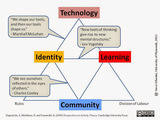
Tools (which can limit or enable) can also be brought to bear on the mediation of social interaction, and they influence both the behavior of the actors (those who use the tools) and also the social structure within which the actors exist (the environment, tools, artifacts). For further reading, here is Engeström’s own overview of 3 Generations of Activity Theory development. The first figure shows Second Generation AT as it is usually presented in the literature.
The first figure is my interpretation in relation to digital presence, community and identity, while the latter is based on Engeström’s work.
How It Can Be Applied In Education
Teachers should be aware that everything in the classroom has a cultural and social meaning. The way children interact with each other and with the teacher will be mediated (influenced) by objects such as the whiteboard, furniture, technology, and even the shape, size and configuration of the room. This also includes its ambient characteristics such as lighting and noise levels. Learning occurs within these contexts, and usually through specific activities.
Teachers should ensure that those activities are relevant and iterative, providing students with incremental challenges that they can engage with at a social level, so that the entire community of learners extends its collective knowledge through the construction of meaning. Teachers should also be aware that tools can limit as well as enable social interaction, so must be applied wisely and appropriately to promote the most effective learning.
Reference
Engeström, Y., Mietinnen, R. and Punamäki, R-L. (Eds: 1999) Perspectives on Activity Theory. Cambridge: Cambridge University Press.
Previous posts in this series:
Anderson ACT-R Cognitive Architecture
Argyris Double Loop Learning
Bandura Social Learning Theory
Bruner Scaffolding Theory
Craik and Lockhart Levels of Processing
Csíkszentmihályi Flow Theory
Dewey Experiential Learning
This post first appeared on Steve’s personal blog; How The Activity Learning Theory Works; Graphic by Steve Wheeler
The post How The Activity Learning Theory Works appeared first on TeachThought.
TeachThought Blog
.
Blog
.
<span class='date ' tip=''><i class='icon-time'></i> Aug 05, 2015 09:16am</span>
|