Blogs
|
The Benefits Of Learning Through Field Trips
by Steve Berer, musexplore.net
If you are going on a field trip, it is important to prepare your students by developing their visual literacy, and by integrating the trip actively into your curriculum.
However, important as that is, it is not enough. The museum (and field trip) experience takes place in a very different environment from your classroom. That may seem obvious, but let’s take a look at the differences, so that you can help your students maintain their focus to insure they have an engaging educational experience.
The Benefits of a Museum/Field Trip
Students are energized by the excitement and anticipation of leaving the school environment.
The transportation to and from the museum/site is often a pleasant open-social time.
Students have the opportunity to see new things and learn about them in a more unstructured way.
Students have the opportunity to determine what they learn and how they learn it. Said differently, student learning can be interest-driven, not teacher and curriculum driven.
Students will experience a more holistic, integrated picture of the information that, in the classroom, may have only been presented in a textual and abstract way.
Museums, and many other kinds of field trips are multi-media experiences; therefore, learning is enriched and reinforced with superimposing sensory and intellectual inputs.
Most museums are designed to stimulate curiosity and actively engage the visitor, so you have a very professional partner working with you to help your students learn.
In some museums you can arrange for your class to meet with a museum educator, often in a private classroom, to facilitate directed learning and/or provide a question-answer session.
Impediments to Learning on a Museum/Field Trip
Your classroom provides structure, limits, and authority to focus student attention and behavior. All of these are seriously diminished or entirely dispensed with on a field trip. Therefore, in spite of your high expectations, the museum trip may end up having little or no educational impact on your students.
Too often, for too many students, the trip becomes a texting opportunity, or a socializing event.
In open spaces and without close supervision, many students may simply not have the discipline or interest to pay attention to what they’re seeing.
Moving through rooms and/or open spaces, students can get lost from the group. Suddenly everyone’s attention is turned to finding the missing student(s) instead of being absorbed in the learning opportunity at hand.
Field trips take students into public spaces. Therefore, even if your students are disciplined and interested, the multi-media environment and the public bustle and noise will most likely be distracting. Also, if you’re in an enclosed public space (like a museum, as opposed to a park or battlefield), you can’t talk to your students as a whole group. Indeed, even in small groups, you will be limited in your ability to lecture or open a discussion. The multi-media environment and the public noise will definitely distract your students, and your discussions can disturb other visitors. These factor will deteriorate the quality of any kind of small group discussion you might try to have.
Besides the problem of public spaces, your field trip can take you to many different kinds of places. Each place has it’s own narrative and pacing. Consider these four different kinds of museums: American history museum, Holocaust museum, aviation museum, and art museum. Each of these museums has a very different story to tell, and they will probably tell it in very different ways.
An art museum may arrange its collection thematically (impressionism, modernism, Renaissance, etc), but there’s virtually no narrative connecting one object to another, or one room to another. How, then, will your students understand what they’re seeing, or remember the art once they leave the museum?
An aviation museum may arrange its collection chronologically, at least to some extent, and that will help your students contextualize the information, but such museums are usually exceedingly popular. Your students may experience large, noisy crowds that will be highly distracting. You may find yourself spending most of your time making sure they don’t get separated from the group, and looking for those who inevitably do get separated.
A Holocaust museum may arrange it’s collection chronologically (that’s good), and even if there are large crowds, you can expect them to be hushed and thoughtful (that’s good too). However, the material is usually so emotionally charged and troubling that your students’ emotions may well shut down their intellect. (Indeed, that’s a common response, in my experience.)
Very likely they will emerge with intense emotions and a few strong visual memories, but no new understanding or insight into how and why it all happened.
You can expect an American history museum to be thematic and/or chronological in its presentation (that’s good). The material, at least in part, will probably be familiar to your students (that’s good too). Very likely it will not be emotionally overwhelming (third good thing). But here, students will incline to fall back on what they already know. A fact here or an image there may catch their eye, but how can you keep them from becoming bored and turning their experience into a clandestine texting game?
These are some of the problems you may face if you want your museum/field trip to be educationally meaningful. If you would like me to address solutions to these problems in future issues, please write to me, expressing your interest. If you have questions, I’d be glad to field them.
You can also let me know about a positive or negative experience you’ve had on a field trip. What did you learn from it, or how can we help you make it better the next time?
Closing Note
Ken Robinson, in his engaging TED talk, ‘How to Escape Education’s Death Valley‘ says there are three principles that make human life thrive: "diversity, curiosity and creativity." Also from Robinson’s TED talk: "If you sit kids down, hour after hour, doing low grade clerical work, don’t be surprised if they start to fidget."
The Benefits Of Learning Through Field Trips
The post The Benefits Of Learning Through Field Trips appeared first on TeachThought.
TeachThought Blog
.
Blog
.
<span class='date ' tip=''><i class='icon-time'></i> Aug 05, 2015 09:08am</span>
|
|
Introducing The TeachThought ‘Diverse Teacher Voices‘ Program
by TeachThought Staff
The ‘Diverse Teacher Voices’ Program is something we think has a chance to be pretty awesome, if we can just convince teachers to take ownership of it and go.
The goal of this (experimental, let’s-see-how-it-goes) program is to help diverse teacher voices share their ideas, experience, affection, and innovative practices for the benefit of everyone. For now, this will be primarily about sharing ideas through writing. The future? We’ve got some ideas for a more robust process, but we want to see how the writing part goes first.
So, some information.
We’re actively seeking diverse voices and perspectives.
The second big idea here, above and beyond innovation-through-sharing, is diversity.
In pursuit, we’re officially encouraging every color, gender, ethnicity, faith, culture, sexual preference, cognitive bias, and pedagogically-principled kind of educator to not simply participate, but to write about education through those unique lenses if you feel it adds value to the global conversation around pedagogy, mobile learning, and the "new normal" of 21st century education.
Without this critical piece, the program is just teachers blogging. The majority of voices in the education space are the same as they’ve ever been-and we’ll all continue to benefit from their expertise. What we’re looking for is a new generation of teachers, thinkers, and innovators to not only be heard, but to create change.
The TeachThought Ethos still applies.
While we’re interested in diverse thinking, anything published must be compelling or useful for modern educators interested in a progressive classroom and curriculum, or replacing the idea of schools and classrooms and curriculum altogether. Within that range is the niche TeachThought tries to occupy.
Our focus on students over institutions, thought over content, inquiry over delivery, models and frameworks over "tips," (though we do those sometimes, too) and paradigm-shifting integration of education technology over "edtech" is important, but we’re more than willing to publish anything that pushes the global conversation around learning forward. You can write about how to more efficiently use calculators to better prepare students for timed testing and ultimate "career success," but that thinking is likely to find little traction here.
Think less about what classrooms do look like, and more about what they could look like.
You don’t have to be a "writer."
This is education-and blogging at that-not Grapes of Wrath. If you’re a teacher, your "blogging literacy" is likely more than sufficient to get you through here. If you can string together complete sentences, you can write. (We let Terry Heick write, don’t we?)
The real question is whether or not you’ve got something worth saying. What you say-fresh voice, new thinking, exciting ideas, etc.-is more important than your diction, syntax, and idea organization.
So, for the first "assignment" (or "growth opportunity")?
April 15-April 30 prompt:
If you’ve taught more than 3 years (which seem to be most of you), use the following prompt:
Dear First-Year Me…(as in, "Here’s What You’re Going To Need To Know")
If you’ve taught fewer than 3 years, use the following prompt:
Dear 10th-Year Me…(as in, "Here’s what I hope to have seen/done/learned/accomplished by year 10)
The Other Details
1. As stated above, the big idea of this program is to help a diverse set of voices and perspectives share their ideas, experience, affection, and innovative practices for the benefit of everyone.
2. For now, there will be two prompts per month. (We may do weekly prompts, or we may do monthly or even quarterly.)
3. While we encourage you to push yourself and write "outside of your comfort zone," don’t write outside of your expertise area. If you don’t have any thinking, ideas, experience, or strategies for a prompt, skip it.
4. Not all blog posts can be published-well, it depends on how many we get, but it’s likely that we won’t be able to publish everything. But who knows? Point is, no guarantees what you write will become a featured post and will win you eternal glory across the interwebs.
5. To apply, email all entries to us directly, or share as a Google Doc. To be considered, please include:
Your full name (required)
Years of experience (voluntary)
Grade level and content area (voluntary)
School name (voluntary)
Your twitter username or your personal blog url so we can share with the post (voluntary)
6. These posts are considered guest blogs by teachers. They are not paid opportunities or contracted assignments.
7. Don’t use any "real names" of other teachers, students, etc.
8. Images, diagrams, photos of student work, or any other supporting visual are encouraged by not necessary. Any images with students in it must have signed releases from those students (which makes them a pain, but legal is legal). Also, you must own the rights to any images you contribute. Don’t send any images of student work with student names or other crucial information visible. Anonymity is the rule.
Introducing The TeachThought ‘Diverse Teacher Voices’ Program;
The post Introducing The TeachThought ‘Diverse Teacher Voices’ Program appeared first on TeachThought.
TeachThought Blog
.
Blog
.
<span class='date ' tip=''><i class='icon-time'></i> Aug 05, 2015 09:08am</span>
|
|
Company Creates Video Pen Pal Technology, Seeks Teacher Support
by Saksham Khosla, LumenEd
Across the world, there is a widespread demand for young people to address major issues of global significance through cross-cultural cooperation.
While American schools are attempting to keep up with this demand, true global competency cannot be achieved through international exchange programs that less than 1% of young people participate in. In the developing world, access to engaging educational materials is largely limited to urban metropolises where infrastructure like the Internet and electricity is taken for granted.
There is vast potential for improving learning outcomes in these countries by providing digital educational resources independent of external infrastructure. At the same time, if previously inaccessible communities are given the chance to participate in virtual exchange programs, students anywhere can engage constructively with peers from diverse contexts and become globally competent in the process.
The Bright Orange Box
The Bright Orange Box is a smart projector designed to bridge a gap for classrooms without internet or reliable electricity. It’s an excellent tool for teachers, especially those that have never had access to multimedia content. It also allows us to connect classrooms around the world through our Video Pen Pal Program.
Bright and loud enough for the whole classroom
The device can play digital content for a whole classroom. We combined a 500 lumen DLP projector with 8W stereo speakers.
Battery-powered
The internal battery provides 2+ hours of uninterrupted playback at maximum brightness. The Box can be charged from a traditional wall outlet or using a portable solar-charging unit.
3G and Wi-Fi connected
A dedicated 3G connection in the box allows any classroom to access the internet. This provides a unique opportunity for the 90% of classrooms without internet in developing countries.
Any multimedia content
The Box plays a variety of multimedia formats including videos, pictures, music and PDFs. A custom Android interface on a 5″ touch display makes navigating content easy.
Video recording and sharing
With a video camera on the back, the box allows teachers to record and share videos. This means any classroom can participate in our Video Pen Pal Program.
The Video Pen Pal Program
We wanted to be able to connect classrooms anywhere in a world in a meaningful way. We developed a weekly video exchange called the Video Pen Pal Program. Through short and simple videos, classrooms gain insight into each other’s lives and explore cultural similarities and differences. Students are challenged to collaborate and find their own unique voices.
How it works
We developed a mobile app that allows teachers to record and edit short videos and send them to their partner’s classroom. We create the connection between the two classrooms and process and share the videos. This allows teachers to focus on the program and less on management.
Who we connect
We are pairing classrooms in the US with low income classrooms in India. Classrooms in the US communicate with their Pen Pals via our web platform and mobile app. Indian classrooms receive a Bright Orange Box which handles both video recording and playback.
LumenEd connects classrooms around the world through a Video Pen Pal Program, using a solar-powered smart projector called the Bright Orange Box. This device works everywhere, even in environments without electricity or Internet, helps teachers access online content, and makes the Pen Pal interaction possible. We want to empower students, teachers and schools across the world by providing them access to digital educational resources and a platform to share their stories creatively.
We’re already working with schools in Detroit, Illinois, New York, Washington DC and educational NGOs like Teach for India and Hope for Ghana. Our Kickstarter campaign is now live to help us develop an Android platform for our Box, and reach more than 100 schools in the US, India, Ghana and Senegal!
You can check it out here: www.bit.ly/lumenedkickstarter. We’re also looking for teachers who’d like to participate in a meaningful cultural exchange with classrooms across the world, so drop us a line at contact@lumened.org if you’re interested!
Like our work: www.facebook.com/lumenedinc; Follow our progress: www.twitter.com/lumened; Back our Kickstarter: www.bit.ly/lumenedkickstarter Learn about our vision: blog.lumened.org
LumenEd Seeks Teachers For Cultural Exchange; Company Creates Video Pen Pal Technology, Seeks Teacher Support
The post Company Creates Video Pen Pal Technology, Seeks Teacher Support appeared first on TeachThought.
TeachThought Blog
.
Blog
.
<span class='date ' tip=''><i class='icon-time'></i> Aug 05, 2015 09:08am</span>
|
|
#twitterchat: ‘Teaching Like Your Hair’s On Fire’
by TeachThought Staff
On April 15th, 2015, Beth Leidolf led the weekly #reflectiveteacher twitter chat, where they discussed, among other things, Rafe Esquith;s ‘Teaching Like Your Hair’s On Fire.’ One of our favorite exchanges?
@paullawleyjones: A4/1: Korean edu tells Ss that they must always have the ‘right’ answer. Wrong answers are unacceptable. #reflectiveteacher
@bleidolf67 how do you cope with that mindset as a teacher? #reflectiveteacher
@paullawleyjones: A4/2: I break down this mindset by sometimes deliberately screwing up and then laughing about it with Ss. #reflectiveteacher
You can catch this (still relatively new and growing) chat each Wednesday at 7 PM Eastern US time. This week’s chat has been embedded below if you missed it and want to give it a read, a skim, or let it conjure deep regret for having missed it to begin with.
[View the story "#reflectiveteacher at TeachThought Twitter chat " on Storify]
#twitterchat: ‘Teaching Like Your Hair’s On Fire'; #twitterchat: ‘Teaching Like Your Hair’s On Fire’
The post #twitterchat: ‘Teaching Like Your Hair’s On Fire’ appeared first on TeachThought.
TeachThought Blog
.
Blog
.
<span class='date ' tip=''><i class='icon-time'></i> Aug 05, 2015 09:07am</span>
|
|
Culturally Responsive Teaching Starts With Students
by Dr. Matthew Lynch, Dean of the School of Education, Psychology, & Interdisciplinary Studies at Virginia Union University
A multicultural society is best served by a culturally responsive curriculum.
Schools that acknowledge the diversity of their student population understand the importance of promoting cultural awareness. Teachers who are interested in fostering a cultural awareness in their classroom should actively demonstrate to their students that they genuinely care about their cultural, emotional, and intellectual needs.
To this end, there are several strategies that you can use to build trusting relationships with diverse students. For teaching cultural awareness, consider the following ideas.
6 Ways Teachers Can Foster Cultural Awareness In The Classroom
Express interest in the ethnic background of your students.
Encourage your students to research and share information about their ethnic background as a means of fostering a trusting relationship with fellow classmates.
Analyze and celebrate differences in traditions, beliefs, and social behaviors. It is of note that this task helps European-American students realize that their beliefs and traditions constitute a culture as well, which is a necessary breakthrough in the development of a truly culturally responsive classroom. Also, take the time to learn the proper pronunciation of student names and express interest in the etymology of interesting and diverse names.
Redirect your role in the classroom from instructor to facilitator.
Another important requirement for creating a nurturing environment for students is reducing the power differential between the instructor and students.
Students in an authoritarian classroom may sometimes display negative behaviors as a result of a perceived sense of social injustice; in the culturally diverse classroom, the teacher thus acts more like a facilitator than an instructor. Providing students with questionnaires about what they find to be interesting or important provides them with a measure of power over what they get to learn and provides them with greater intrinsic motivation and connectedness to the material.
Allowing students to bring in their own reading material and present it to the class provides them with an opportunity to both interact with and share stories, thoughts, and ideas that are important to their cultural and social perspective.
Maintain a strict level of sensitivity to language concerns.
In traditional classrooms, students who are not native English speakers often feel marginalized, lost, and pressured into discarding their original language in favor of English. In a culturally responsive classroom, diversity of language is celebrated and the level of instructional materials provided to non-native speakers are tailored to their level of English fluency. Accompanying materials should be provided in the student’s primary language, and the student should be encouraged to master English as well.
Maintain high expectations for student performance.
Given that culturally responsive instruction is a student-centered philosophy, it should come as no surprise that expectations for achievement are determined and assigned individually for each student.
Students don’t receive lavish praise for simple tasks but do receive praise in proportion to their accomplishments. If a student is not completing her work, then one should engage the student positively and help guide the student toward explaining how to complete the initial steps that need to be done to complete a given assignment or task.
Incorporate methods for self-testing.
Another potent method for helping students become active participants in learning is to reframe the concept of testing.
While testing is usually associated with grades (and therefore stress) in traditional classrooms, in a culturally responsive classroom frequent non-graded tests can be used to provide progress checks and ensure that students don’t fall behind on required material. Teaching students to self-test while learning new information will help them better remember and use what they’ve learned in class and will help them realize on their own when they need to study a topic in greater depth.
Maintain an "inclusive" curriculum that remains respectful of differences.
Among the most important tenets of cultural awareness is the content itself being delivered. A culturally responsive curriculum is both inclusive in that it ensures that all students are included within all aspects of the school and it acknowledges the unique differences students may possess. A culturally responsive curriculum also encourages teachers’ understanding and recognition of each student’s non-school cultural life and background, and provides a means for them to incorporate this information into the curriculum, thus promoting inclusion.
Schools have the responsibility to teach all students how to synthesize cultural differences into their knowledge base, in order to facilitate students’ personal and professional success in a diverse world. A culturally responsive curriculum helps students from a minority ethnic/racial background develop a sense of identity as individuals, as well as proudly identify with their particular culture group.
Teachers can play an important role in helping students succeed through the establishment of culturally responsive classrooms.
Dr. Lynch is an award winning writer, activist and the Dean of the School of Education, Psychology, & Interdisciplinary Studies and an Associate Professor of Education at Virginia Union University. Please visit his website at www.drmattlynch.com for more information. Follow him on twitter @lynch39083; 6 Ways Teachers Can Foster Cultural Awareness In The Classroom; Culturally Responsive Teaching Starts With Students; image attribution flickr user usdepartmentofeducation;
The post Culturally Responsive Teaching Starts With Students appeared first on TeachThought.
TeachThought Blog
.
Blog
.
<span class='date ' tip=''><i class='icon-time'></i> Aug 05, 2015 09:07am</span>
|
|
How Your Teacher Observation Can Help You Grow
by Paul Moss
For many, teacher observations are their biggest source of dread.
They stir feelings of nausea, spark vigorous and often angry debate about their efficacy, and are to be avoided at all costs.
But with the trend of performance pay sliding into the education environment like a rattlesnake, the fear of observations has some very real and legitimate origins. No one wants to lose his or her job, or his or her pay rise. In such a context, mastering the process of observation has become increasingly important for a teacher, and one of the keys to success, alongside planning excellent lessons, is approaching observation with a positive mindset.
Here is some thinking (that can hopefully help) to turn observations into desirable opportunities for personal growth.
Why Shouldn’t Fear Your Teacher Observation
1. You’ll have plenty of opportunity to show your strengths.
Observations are in plentiful supply. Before the dreaded ‘real thing’, you can have SO many chances to practice being observed. Being observed by faculty leaders, colleagues, and yourself (if you utilize technology) will go a long way to helping you to shape a picture of what your teaching is like, and where it needs to go in the future, and place you in good stead before the observation that counts.
If you wait until the ‘real’ observation to receive feedback, you forego opportunities to iterate in your teaching, and significantly increase the chances of failure.
2. If you want to improve, you need feedback.
I’ve never met a teacher who didn’t want to get better. To do so, you can either teach in isolation, and refine your craft after personal reflection, and eventually get better, or you can get to that same position in about a tenth of the time by having someone else in on the process. Sometimes it’s the little things that another set of eyes will see that can rapidly improve your teaching.
3. It will humble you-and humility is fuel for a growth mindset
Observations can be a humbling and grounding process. Few teachers would claim they have mastered the art of teaching, yet all progressive teachers would agree that learning from the feedback of others is essential. It is a strange paradox, but teaching is perhaps more about learning than anything else.
As a modern teacher, you can’t teach unless you are learning from the environment around you, adapting to the students’ needs. Seeking advice from others and knowing that others have lots to offer is humbling, and keeps your feet firmly on the ground. So, my friends, swallow your pride, and become the learner more often! The advent of worldwide personal learning networks truly reinforces this sentiment.
4. It means what you do is important.
If people are watching you, what you’re doing matters.
Observations can be an amazing professional development opportunity-you’re lucky you’ve got the support to improve, and are actively encouraged to receive the help of mentors and leaders in the field! The potential to improve quickly from such support is massive. Once an investment has been made in you, a school will work hard to ensure that you are getting better; a rare opportunity in the workplace.
5. It’s a part of our professional growth.
Observations are common to every one in your faculty, so use your immediate support network. Every teacher in your faculty is going through the same thing, so work together, and discuss what you are going to do before the observation takes place - get advice, feedback etc.
No one is going to judge you, because they are going through it too.
6.They’re only going to get easier.
Observations (should) become easier the more of them you do. The more times you get observed, the more used to it you get, and the more a part of your routine it will become. Don’t wait for formal observations. Pester your supervisor to watch you more; and your colleagues. And now you don’t even need to be limited by their time: utilize technology to look back on your lessons, and share them with anyone around your school, or the world, who similarly wants to improve their practice. Iris Connect looks like a great starting point for that.
7. They’re an opportunity.
Observations are a chance to demonstrate your skills, ideas, affection, and growth. Showing others what you can do is about taking ownership of your ability, and being proud of your growth and insights into what you do. Of course, there will be hitches on the path to success, but in the end, we all like to show others that we have a connection with what we do. You wouldn’t have been hired without it, and you wouldn’t have made numerous connections with students without it either.
Isolation Doesn’t Lead To Growth
Teaching in isolation may seem like an easier option compared to being observed, but it is not an effective way to get better. The key to embracing observations is all in the approach. Seeing observations as allies rather than enemies is the first step in such a process.
In part 2, we’ll talk about what schools and leadership teams can be doing to maximize the potential of observations.
How Your Teacher Observation Can Help You Grow; adapted image attribution flickr user leaflanguages
The post How Your Teacher Observation Can Help You Grow appeared first on TeachThought.
TeachThought Blog
.
Blog
.
<span class='date ' tip=''><i class='icon-time'></i> Aug 05, 2015 09:07am</span>
|
|
What I Think I Think About Teacher Effectiveness Ratings
by Grant Wiggins, Authentic Education
While exploring teacher effectiveness ratings, I went looking for a New York City high school that had the same demographic profile as the struggling high school referenced previously (see here), but had nonetheless earned good ratings for making adequate improvement on their graduation rates and test scores.
(Recall that school accountability in NY is based on improvement, not absolute scores and graduation rates, so schools with modest absolute scores can still be top-rated in New York. Put differently, the struggling school above failed to make adequate progress in the benchmark data of graduation rates and exam scores for 10 years.)
This "effective" school has the same demographics as the struggling school I cited above (more than 90% Black and Hispanic) and is located in Harlem. So what have I found thus far? What does the data suggest?
My Tentative Conclusions About Teacher Effectiveness Ratings
1. Local and state teacher effectiveness ratings are flawed if, as my sample suggests, teachers in less effective high schools generally get high ratings, and often get much higher ratings than those in more successful high schools (especially if they have been struggling to improve for up to 10 years).
2. The combination of survey data and Quality Review site visits presents a fairly consistent and credible picture of the relative strengths and weaknesses of schools - but these rarely align with teacher effectiveness ratings in either successful or unsuccessful schools.
3. This disconnect of Ratings vs. Review and Achievement data can only be reduced when there are exemplars of teaching to anchor the ratings, supported by calibration meetings across schools in a district. Without such exemplars, the teacher rating system will be based only on building-level norms (and politics) - and thus as flawed and non-standards-based as letter grades given to students.
Like grades, in other words, it appears that teacher effectiveness in schools is being scored on a curve (at best), rather than against any credible standard. (There is credible data to show that the typical % of employees in all walks of life whose work is judged to be ineffective is around 8%; in all NY schools the average is 1%, as the data show). NYSED (and/or each district) needs to rectify the lack of official models and calibration protocols.
4. At the very least, the state should say that teacher ratings of 100% effective in ANY school are of questionable validity on their face, and that extra justification for such ratings should be provided). Beyond that audit indicator, NYSED might require schools to provide 2-3 samples of video excerpts for effective teachers to be sure that there is calibration across the state (as is typically done in the AP and IB programs with scored student work, and on writing assessments in the state). The Teaching Channel videos could easily jumpstart such a process as could videos that exist in other states such as California.
5. For "rating inflation" to be lessened, there must be far better incentives for all administrators to be more accurate and honest in rating teachers (and teachers, in proposing credible value-added SLO measures). I have heard from Principal and Supervisor friends of mine that the politics of school climate and the possible counter-weight of exam scores entices everyone to rate teachers higher than they truly believe is warranted.
Perhaps, for example, schools should only be required to give aggregate "standards-based" ratings separate from the more delicate teacher-by-teacher "local norm" ratings. At least there might be an independent check on local rating standards by NYSED or via regional peer meetings chaired by BOCES staff, in the same way that IB teachers have their student grades "moderated" by the external reviewers of exams.
6. It is high time we made a critical examination of the wisdom of ranking each of the four dimensions in the Danielson Framework equally.
7. As it stands now, it is quite possible for a teacher in any school to do well on the three non-teaching dimensions of the four, do poorly on the teaching dimension, but still get a good "teacher effectiveness" score. That seems like a highly misleading way to rate "teacher effectiveness" (even as we should, of course, value planning, professionalism, and community relations).
8. Good schools improve and improvement is possible in all kinds of schools serving all kinds of students. Despite what many anti-reformers endlessly argue, from this data it is incorrect (and very fatalistic) to say that poverty plus ethnicity means ongoing adequate school and teacher improvement is impossible, as I have long argued that the data show.
Furthermore, there are outlier schools in this and every other state that cause successful absolute levels of student achievement in spite of the SES-related obstacles. (See, for example). Alas, the most successful such Charter schools in New York are not represented in the NYSED accountability data resources cited in this post.
A Final Thought
Do I think that Governor Cuomo is up to some crass politics in his report? I do.
Do I think that this is a hard time to be an educator? I do - so much harder than when I was a full-time teacher (where we pretty much left alone, for good and for ill).
Yet, I also believe that until we get an honest and credible accounting of teacher effectiveness in all schools (and especially in struggling ones) we will perform a great disservice to kids in need - and, yes, to their teachers who deserve more accurate feedback than many now receive.
POSTSCRIPT: Numerous people tweeted back after the previous post that many NYS struggling schools are under-funded and that far too much was thus being asked of them. While I agree that many schools are under-funded and that teachers in these schools face very difficult barriers, it seems odd that everyone who responded with this argument failed to engage with the teacher effectiveness data I provided. Many also said that without better funding and other kinds of state support, improvement in such schools is "impossible."
The data simply do not support this fatalistic conclusion, nor does my work in New York City and Toledo where we, too, have seen solid gains through UbD training and implementation in previously struggling schools.
Let’s get on with improving the schools our students currently attend, doing what is in our control to improve them.
This article was excerpted from a post that first appeared on Grant’s personal blog; Grant can be found on twitter here; What I Think I Think About Teacher Effectiveness Ratings; image attribution flickr user flickeringbrad
The post What I Think I Think About Teacher Effectiveness Ratings appeared first on TeachThought.
TeachThought Blog
.
Blog
.
<span class='date ' tip=''><i class='icon-time'></i> Aug 05, 2015 09:06am</span>
|
|
#Iwishmyteacherknew Examples Revealing All Around
by TeachThought Staff
Kyle Schwartz teaches third grade at Doull Elementary in Colorado.
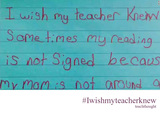
By now, you’ve likely heard of her-or at least one of her ideas, #Iwishmyteacherknew.
Every now and then, there’s an "Education" story that the masses take notice of-standardized testing, Michelle Rhee, Waiting for Superman, the flipped classroom, the iPad failure in LA, the testing scandal in LA, among others. The most recent to crossover is the hashtag #Iwishmyteacherknew, which is what it sounds like it might be-an asynchronous conversation (or rather, series of statements) illuminating the realities that many students face every day.
On one hand, there’s an inherent kind of other disconnect at work here that makes the whole thing a huge act of spectacle, while inviting frank discussions about privacy. We’ll talk more about that in a follow-up later this week. To provide context to that kind of analysis, first the tweets themselves.
Schwartz told ABC News, "As a new teacher, I struggled to understand the reality of my students’ lives and how to best support them. I just felt like there was something I didn’t know about my students." The emotional pull is, of course, heartbreak, and it’s here in spades-quick, visual vignettes that act as windows into often emotionally vulnerable minds and broken homes, the big idea is that students aren’t curriculum receptacles.
School overwhelms some, while providing a sanctuary for others. And sometimes both. Schwartz continued, "Ninety-two percent of our students qualify for free and reduced lunch. As a new teacher, I struggled to understand the reality of my students’ lives and how to best support them."
Good on her, but let’s reflect for a moment in our response. Reducing the whole "thing" to a socioeconomic wake-up call is missing the point. If nothing else-in lieu of some sensationalism born from the current viral tone of it all-there’s this real sense in these tweets that students are merely along for the ride in their education. They’re passively receiving instead of dead-center in the middle of it all, co-creating, curious, and constructing their pathways forward on-the-fly.
Students, teachers (and some trolls) have jumped in with both feet to provide an assortment of sharing that’s-well, check out 40 or so examples we’ve curated below. On Wednesday or Thursday, we’ll take a look at the bigger picture of #Iwishmyteacherknew.
[View the story "I Wish My Teacher Knew…" on Storify]
#Iwishmyteacherknew’ 40 Moving Examples Of #Iwishmyteacherknew; 40 Moving Examples Of #Iwishmyteacherknew
The post #Iwishmyteacherknew Examples Revealing All Around appeared first on TeachThought.
TeachThought Blog
.
Blog
.
<span class='date ' tip=''><i class='icon-time'></i> Aug 05, 2015 09:06am</span>
|
|
A School Designed To Let Kids Be Kids
by TeachThought Staff
As an architect, Takaharu Tezuka is a bit of an education outsider.
His ideas would get him thrown him out most classrooms, ridiculed for their danger, lack of rigor and complexity, inability to reflect a set curriculum, and a lack of "practical application." Thankfully, some people are still willing to be "ridiculous."
In true good work form, Tezuka has married his art (architecture) with a tremendous social need (innovation in learning and learning spaces) to create something simple and stunning and moving. A school designed on the idea of movement-one designed to let kids be kids. The net result is what is, at least as a matter of animation and survey, the best kindgarten you’ve ever seen.
In his TED Talk Tezuka explains, "This kindergarten is completely open, most of the year. And there is no boundary between inside and outside. So it means basically this architecture is a roof. And also there is no boundary between classrooms. So there is no acoustic barrier at all. When you put many children in a quiet box, some of them get really nervous. But in this kindergarten, there is no reason they get nervous.
Because there is no boundary."
"And the principal says if the boy in the corner doesn’t want to stay in the room, we let him go. He will come back eventually, because it’s a circle, it comes back.
"The traffic jam is awful in Tokyo, as you know. The driver in front, she needs to learn how to drive. Now these days, kids need a small dosage of danger. And in this kind of occasion, they learn to help each other. This is society. This is the kind of opportunity we are losing these days.
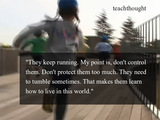
"They keep running. My point is, don’t control them. Don’t protect them too much. They need to tumble sometimes. That makes them learn how to live in this world."
You can hear more about how Tezuka married architecture, design, and education in his talk below.
"At this school in Tokyo, five-year-olds cause traffic jams and windows are for Santa to climb into. Meet: the world’s cutest kindergarten, designed by architect Takaharu Tezuka. In this charming talk, he walks us through a design process that really lets kids be kids."
A School Designed To Let Kids Be Kids: The Best Kindergarten You’ve Ever Seen
The post A School Designed To Let Kids Be Kids appeared first on TeachThought.
TeachThought Blog
.
Blog
.
<span class='date ' tip=''><i class='icon-time'></i> Aug 05, 2015 09:06am</span>
|
|
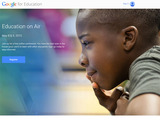
Google Education On Air May 8 & 9 & Here’s Your FAQ
by TeachThought Staff
What is it?
Google Education on Air, an online conference for teacher, administrator, and IT professional development.
When is it?
May 8 & 9, 2015
Is there any cost to education on air?
No, this is a free event.
What sessions will be available?
Day 1: Panels and keynotes 10:00AM - 3:00PM EDT
What are the skills of the future?
Inspiring learners with the power of storytelling
Making change happen
Making work rule
Three ways to drive system-wide change
Keynote Question & Answer
How to run a government
Creating innovation in schools
Student curiosity can help save lives
Transforming learning with technology
Empowering students
Day 2: There are dozens and dozens of sessions on Day 2, segmented by audience. Too many to list here. Try this link, then click "Day 2."
Do you have a schedule?
Check here for the most recent info.
Where can I register?
Try here.
Who should tune in for these sessions?
The sessions in the conference will focus on education. This will be of interest to educators in all roles, but also to many parents, students, and citizens. If you register for the event on this form, we’ll send you information about the exact speakers and sessions as that becomes available. Although many sessions will focus on primary/secondary (K-12) many will be of interest to the Higher Education audience too.
Do I need to logged in to watch Education on Air?
No, you do not need to be logged in to view this event, however it’s recommended that you sign in to have the ability to participate in a live Q&A.
How can I ask a question for the live Q&A
For all sessions except the short keynotes, you’ll be able to pose a question. To do this, scroll down below the live stream video. You’ll see the option to ask questions. Once you’ve logged into your account, you can pose your question and also up-vote others’ should you be interested in them as well.
Who is answering my question?
Your questions will be answered by the Google for Education team and the speakers. Speakers will answer some questions live, and the rest just after the event.
Is this event only for certain countries?
Anyone can tune in to watch live or recorded sessions on this website. All of the sessions for this event will be in English and will take place during European and North American time zones. We hope to expand to more time zones and languages in future.
How can I contribute to the social conversation?
You can add comments to the social graph, by clicking on the ‘add your voice’ icon. Or you can go on Google+ or Twitter and use the hashtag #GoogleEduOnAir
The post Google Education On Air FAQ appeared first on TeachThought.
TeachThought Blog
.
Blog
.
<span class='date ' tip=''><i class='icon-time'></i> Aug 05, 2015 09:05am</span>
|