Blogs
|
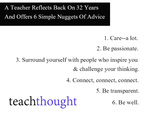
Teacher Advice? A Teacher Reflects Back On 32 Years And Offers 6 Simple Nuggets Of Advice
by Sharon Davison, Kindergartenlife Blog
Our first entry from our Diverse Teacher Voices program comes from Sharon Davison, a Kindergarten teacher from Vermont who responded to the "Dear First Year Me" prompt. For Sharon, there is some increased significance-or rather, there’s significance for each one of us as readers. Sharon has taught for 32 years-and here she is, from 1983 to today, still tweeting, still blogging, still connecting, still serving. Beautiful! Her class twitter account can be found here. Give her a visit.
Dear First Year Me,
So you have decided to share your energy, strength, perseverance and courage to become a teacher! Congratulations! You can do it because you care about making a difference. Just remember to…..
6 Simple Takeaways From 32 Years Of Teaching
1. Care, care a lot.
You will be able to make a difference for many if you have empathy and perseverance. Take the extra time to be patient and listen. Notice how your students react and interact with each other and the culture you create and design. Be responsive and flexible to making changes that support your students needs. Collaborate to make a difference for others in the communities you teach.
Through your modeling of caring, your students and their families will become engaged.
2. Be passionate.
Celebrate the learning that is happening inside and outside of your classrooms.
Express your excitement through your face to face, online and other opportunities that you create. Through your passion, your students will get inspired and become passionate about their learning explorations. Remember to dance, laugh and sing.
3. Surround yourself with people who inspire you and challenge your thinking.
Remember as a teacher you have lots of opportunities to learn and interact. Think about how you and your students might learn alongside each other. Look for others who are doing creative and innovative things. Through others ideas, you develop your own inspiration and find your voice. You have the ability to be brilliant and make a difference.
4. Connect, connect, connect.
Develop your PLN! This is vital and very important.
This is where your thinking is challenged and you will connect in many ways that will turn into future collaborations. Through your connections you will develop a group of people, who like you, care, want to make a difference and are willing to make changes that improve their teaching practice. Your PLN is always there. Count on them and lean on them when you need support, want to celebrate, collaborate and need inspiration. Join online communities that promote and engage what is important to you.
5. Be transparent.
It is okay to share what you are thinking and why.
Through your transparency you will invite others in and share your perspective. Think about asynchronous and synchronous tools that can share the learning you and your students are exploring together. Information is important for all of us. Make it meaningful and interactive.
Through your explicit modeling of sharing globally, your audience will be broad and you will connect and others will benefit from your ideas as you will be inspired by theirs.
6. Be well.
Remember that what you do for your own personal wellness is important. Your wellness of mind and body gives you stability, strength, endurance and patience. Exercise and healthy eating keeps your mind and body healthy and active. Be sure to pursue your passions that recharge you and make you feel energized. Positive energy is contagious and helps everyone be successful.
You will have many opportunities to growth, be inspired and have your thinking challenged. Be open to this idea. Through your ability to transform and be transparent, you will have endless opportunities to learn alongside others, who like you, care, care a lot.
Teacher Advice? A Teacher Reflects Back On 32 Years And Offers 6 Simple Nuggets Of Advice; 6 Simple Takeaways From 32 Years Of Teaching
The post 6 Simple Takeaways From 32 Years Of Teaching appeared first on TeachThought.
TeachThought Blog
.
Blog
.
<span class='date ' tip=''><i class='icon-time'></i> Aug 05, 2015 09:05am</span>
|
|
The Best Twitter Chat For Teachers In 2015
by TeachThought Staff
If there was ever a doubt that education twitter chats were kind of a big deal, this television guide-style document should set things straight. Twitter chats aren’t just "things," but have evolved into fully-functioning professional development for teachers.
At their worst, they’re laid-back, back-and-forth resource sharing and celebration of possibility. At their best, twitter chats are dynamic, digital, and easily curated cells of professional connected learning. Twitter is like reading a living, breathing magazine written by your peers that entertains and informs you while building your capacity as an educator. When you extend these characteristics using twitter tools, the potential is amplified further still.
So while we have a Twitter Guide for Teachers, it’s a couple of years old now, and really needs to be updated, which we thought we’d do one bit at a time. The first part is about identifying the best twitter chats for teachers in 2015. Some of these are established and well-known-#edtech and #edchat-while others are emerging and charged and full of promise, including #educolor and #whatisschool.
The list below, then, is not meant to be exhaustive, but rather a diverse and usable starting point for teachers to see the best chats out there that are also somewhat universal. Thus, content-specific chats like #engchat and #aplitchat, #scichat and #mathchat and others aren’t included. If we miss any that you love, let us know in the comments section.
Also, there is the matter of "ongoing hashtag" (which people use to append content within a certain area) versus "actual chat" (which has an actual meeting time people virtually attend and engage in dialogue). Though the former is more direct and the latter looser and asynchronous, we’ve combined them all into a single list here, as the point is to bring you the best content on twitter for educators in 2015, which means those chats that reflects the churning and shifting ecology of culture and education.
Thus, there are chats that look at the purpose of school, the role of race, the idea of students as makers, the role of student voice, the function of parents in education, and exciting learning models like mobile learning, project-based learning, and game-based learning. For all of the pressure (and need for our collective improvement), this is an exciting time to be an educator!
The list is shown below, in alphabetical order in the text, and what should be alphabetical order in the listly visual, but sometimes it has a mind of its own.
The Best Twitter Chat For Teachers In 2015
The Best Twitter Chats For Teachers In 2015
︾
2.23k
views
22
items
The Best Twitter Chats For Teachers In 2015
Listly by Terry Heick
The Best Twitter Chats For Teachers In 2015
Follow List
Embed List
1
#whatisschool
3 likes
Comments
Relist
Share
2
#edtechchat
3 likes
Comments
Relist
Share
3
#edtech
3 likes
Comments
Relist
Share
4
#kinderchat
1 likes
Comments
Relist
Share
5
#satchat
1 likes
Comments
Relist
Share
6
#mlearning
1 likes
Comments
Relist
Share
7
#Iwishmyteacherknew
0 likes
Comments
Relist
Share
8
#makeschooldifferent
0 likes
Comments
Relist
Share
9
#reflectiveteacher
0 likes
Comments
Relist
Share
10
#pblchat
0 likes
Comments
Relist
Share
11
#21stedchat
0 likes
Comments
Relist
Share
12
#educolor
0 likes
Comments
Relist
Share
13
#NYedchat
0 likes
Comments
Relist
Share
14
#ntedchat
0 likes
Comments
Relist
Share
15
#tlap
0 likes
Comments
Relist
Share
16
#stuvoice
0 likes
Comments
Relist
Share
17
#spedchat
0 likes
Comments
Relist
Share
18
#makered
0 likes
Comments
Relist
Share
19
#stem
0 likes
Comments
Relist
Share
20
#litchat
0 likes
Comments
Relist
Share
21
#ptchat
0 likes
Comments
Relist
Share
22
#gbl
0 likes
Comments
Relist
Share
View more lists from
Terry Heick
The Best Twitter Chat For Teachers In 2015
#edchat
#edtech
#edtechchat
#educolor
#gbl
#kinderchat
#litchat
#makered
#makeschooldiffer ent
#mlearning
#ntchat
#nyedchat
#pblchat
#ptchat
#reflectiveteacher
#satchat
#spedchat
#steam
#stem
#stuvoice
#tlap
#ttog
< ;/ol>
The Best Twitter Chat For Teachers In 2015
The post The Best Twitter Chat For Teachers In 2015 appeared first on TeachThought.
TeachThought Blog
.
Blog
.
<span class='date ' tip=''><i class='icon-time'></i> Aug 05, 2015 09:04am</span>
|
|
Changing What We Teach: Shifting From A Curriculum Of Insecurity To A Curriculum Of Wisdom
by Terry Heick
Increasingly, the idea of computer coding is being pushed to the forefront of "things."
In movies, on the news, and other digital avatars of ourselves, coders are increasingly here. In Hollywood, computer coders are characterized as aloof and spectacle geniuses in green army jackets who solve (narrative) problems in a kind of deus ex machina fashion.
Hack the mainframe, change the school grades, save prom, etc. In the news, they are painted as an eclectic mix of cutting-edge vigilante and binary terrorist, with secret documents, scary viral threats, and national security all a part of their tools and struggle. Combined with the recent positively torrid surge of priority digital technology plays in our daily lives, coding sits at an awkward intersection—misunderstood by most, but tangent to almost everything.
So we should totally teach it in schools, right?
Teaching Skills vs Teaching Content
Too often bits and pieces are tacked onto curriculum as yet another perfectly-reasonable-sounding-thing to teach.
Yet in the ecology of a school, they behave differently in the classroom where the rubber hits the road. I was taught basic computer coding in the 1980s in elementary school. It was forced out by a push for foreign languages, as I recall (or that’s what teachers told us), foreign languages recently pushed out themselves by "reading" classes or other periods of academic remediation.
There is nothing wrong with changes in priority. In fact, this is a signal of awareness and reflection and vitality. But when education—as it tends to do—continues to take a content and skills-focused view of what to teach rather than how students learn, it’s always going to be a maddening game of what gets added in, and what gets taken out, with the loudest or most emotionally compelling voices usually winning.
To try to address this problem, let’s consider a more macro question: What is school? From big picture down, it looks relatively simple.
Education is, more or less, a system of teaching and learning.
Teaching and learning are, more or less, concerned with knowledge.
And that knowledge can be broken down into two separate but connected parts: skills and content.
Skills are things students can "do"—procedural knowledge that yields the ability to do something. This could be revising an essay, solving a math problem, or decoding words to read.
Content can be thought of as a second kind of knowledge—a declarative knowledge that often makes up the face of a content area. In math, this might be the formula to calculate the area of a circle. In composition, it could be a writing strategy to form sound and compelling paragraphs. In history, it may refer to the geographic advantages of one country in a conflict versus another.
Should schools focus on content and skills, or should they focus on habits and thinking? Does that answer change as the culture its students come from does? And should it change faster or slower-ahead of the curve, or far enough behind for cautious perspective?
Whether or not schools should teach coding is a question that cannot responsibly be answered by itself. Against the backdrop of rapid technological change, mass cultural adoption of technology, and the mediocre performance of our current education system, the question becomes just one of many that deserve our attention.
Without this kind of critique, coding will suffer alongside chemistry, music, and other miracles of knowledge that have had the life tortured out of them by a well-intentioned but brutal infrastructure. It will be halved, then halved again, diced, packaged, and served at room temperature day after day after day until no one remembers what they’re doing or why they’re there.
When Standards Aren’t Standards
Literacy has been at the heart of teaching and learning since the very beginning of, well, everything.
Not only is it a goal in and of itself, but it also is a prerequisite of other goals. Without the ability to read and write well, students struggle everywhere. But instead of placing reading and writing at the core of all content, as it functions, it is segmented into a class of its own, where teachers in the United States struggle with as many as five sets of Common Core Standards, each with dozens of standards.
Reading: Informational
Reading: Literature
Reading: Foundational
Writing
Speaking & Listening
Language
So then, hundreds of standards. Hundreds! This places extraordinary pressure on educators—those who develop standards, those who create curriculum from those standards, those who create lessons from that curriculum, and on and on—to make numerous—and critical—adjustments to curriculum, assessment, and instruction on the fly.
At some point, the word "standards" have come to mean something different.
Imagine an over-worked kitchen struggling to make 130 versions of what people outside the kitchen recognize as the same sandwich. The influence of digital technology in our lives has forced education—already bursting at the seams with standards, assessment forms, data, mandated standards, accountability measures, instructional hours, and scores of other concerns-into the awkward position of believing it needs to fit in "more" when it already struggles with less.
And in response, rather than rethink or even add to, we swap instead—foreign language and humanities for STEM, and, presumably, coding. Tomorrow, something else will get our attention that students "need to know" that sounds important.
This reminds me of the Coen Brothers’ Raising Arizona. After hearing a long laundry list of things every baby needs from her friend Dot, Ed (Holly Hunter) turns to Hi (Nicholas Cage) in panic. The quick context is that they’re new parents that’ve just "adopted" a baby and the stress of being a good parent is washing over them.
Ed (The new mom): Who’s our pediatrician anyway? We ain’t exactly fixed on one yet, have we Hi?
Hi (The new dad): *stunned silence*
Ed: No, I guess we don’t have one yet.
Dot (The well-meaning-but-manic friend spreading her mania): What?! Well, you gotta have one this instant!
Hi: *stunned silence*
Ed: What if the baby gets sick, honey?
Dot: Even if he don’t, he’s gotta have his dip-tet.
Ed: He’s gotta have his dip-tet, honey.
Hi: *stunned silence*
Dot: You started his bank accounts yet?
Ed: Have we done that? We gotta do that. What’s that for, Dot? His orthodonture and his university!
Hi: *stunned silence, eyes like broken portals*
Changing Nature of Skills
Why not try a different approach-one that not only decenters curriculum, but reimagines it completely?
Change causes uncertainty, and uncertainty can understandably cause insecurity and even panic. Take coding for example. Let’s say that one definition of digital literacy might be "the ability to interpret and design nuanced communication across digital forms." Students need to be able to do this, yes?
Coding is just another collection of symbols. It’s the new reading and writing! And speak a foreign language too, right?
And paint and dance? Yes, yes.
And play an instrument and make things and manage projects through their own sustained inquiry and learn to be entrepreneurs?
Yes, yes, yes.
But a more apt question might be, how should schools—and the curriculum they seek to "deliver"—be reconsidered in light of prevailing local technologies and values?
What are people for, and how can schools help?
What is the relationship between a good school and good work and good living?
What’s worth knowing, how is that different for every person, and how might schools reconceive themselves in response?
How does a renewed global consciousness impact the "local"?
How does a connected planet change the kinds of things a person needs to understand? (It has to, right?)
Building A Curriculum Based On People
In the past, we’ve sought to add-to and revise. Add these classes and drop these. This isn’t as important as this. To make knowledge an index that reflects the latest thinking that reflects our most recent insecurities and collective misunderstandings. This doesn’t seem like the smartest path to sustainable innovation in learning.
As the pace of change quickens through jolting connections, fresh priorities, and newly visible (and overlapping) inequities and opportunities, it’s time to rethink curriculum and its role in the learning process. In a fixed curriculum with set boundaries that is based on content, start with "Want to add coding? What are you willing to give up? Let’s trade."
The idea of new skills and ideas being relevant in a changing world has been a core currency of ed debate since the 1990s (at least), manifesting as "21st century skills" and "the 4 Cs," and so on. A few years ago, we created a graphic that helped to capture what a modern academic learning environment might look like. And an Inside-Out School. And two dozen other models we’ve developed trying to etch out-and then illuminate-how learning is changing, and what might be coming next.
It’s difficult to lead from behind, and schools have stayed far behind the curve, in part, by the core mechanic of their design-curriculum. They start with something slippery and opaque and subjective and endlessly problematic-content.
They take that content and package it as curriculum. They then study the "best practices" of delivering that curriculum that yield the largest gains as measured by common assessments. A common curriculum and common assessments. They-or rather we-celebrate pie charts instead of people. The curriculum and its mastery is central. The schools and teachers and students are peripheral and entirely anonymous.
What if we took a different approach-something content-less and human-ful? Something fluid? In a fluid curriculum that’s based on something other than chronologically-sequenced opaque "understandings," there is new possibility-learning that’s not based on content and isn’t driven by teaching. In this case, it’s no longer restricted by either, so content and teachers can seek new roles.
Give me a curriculum based on people-based on their habits and thinking patterns in their native places. One that helps them see the utility of knowledge and the patterns of familial and social action. One that helps them ask, "What’s worth knowing, and what should I do with what I know?"
Then let’s work backwards from that.
Shifting From A Curriculum Of Insecurity To A Curriculum Of Wisdom; image attribution flickr user susanfernandez; the handsome kid in the featured image is the author’s son
The post Changing What We Teach appeared first on TeachThought.
TeachThought Blog
.
Blog
.
<span class='date ' tip=''><i class='icon-time'></i> Aug 05, 2015 09:04am</span>
|
|
Why Do High School History Teachers Lecture So Much?
by Grant Wiggins, Authentic Education
Why do high school teachers lecture so much?
Almost every high school I go to I see teachers talking and kids listening (or not) more in History than any other course.
And you needn’t take my anecdotal word for it. For the past year, students taking our survey have been asked to respond to questions about use of time in class. Here are the results for HS students (the "skipped" vs "answered" number refers to prior years when the question was not asked; this reflects all HS students from this school year, with no filtering out of answers):
So, half of HS teachers lecture at least 3/4 of the period regularly - some all period.
We also asked students what they think the ideal amount of lecturing is. Interestingly, below is not only the aggregate data, this is almost a universal answer across each school - there is practically no range on the answer to this question:
My question is basic, history teachers. Given that most history textbooks are comprehensive and reasonably well-written, why do you feel the need to talk so much? Your colleagues in science and English, for example, do not feel the same urge.
And please don’t tell me there is ‘so much to cover’ - that is silly. You are paid to cause understanding, not on how many words you speak. And don’t tell me you can’t do projects and simulations. My old friend and former colleague Mark Williams has prepared kids for AP for decades by doing cool simulations and performance challenges (e.g. Silk Road trading game plus debrief, editorial team decision on how to eulogize Sam Colt, etc.). The best teacher I have ever seen at the HS level, Leon Berkowitz at Portland HS years ago, organized his entire history course using the Steve Allen Meeting of Minds format.
Furthermore, most history programs have mission/goal statements that identify skills, performance abilities, and critical thinking that should be highlighted. (And the new AP framework which also does so is based on UbD.) That requires coaching kids to do things.
I can only see two good reasons for lecturing at length, sometimes, in history:
1. You have done original research that isn’t written down in a book
2. You have rich and interesting knowledge based on research that can overcome confusions and missing elements in the current course.
I am NOT saying "Don’t Lecture." I am wondering why you do it so much, more than I think reasonably is necessary to achieve your goals. (You might want to read the research on lectures while you’re at it, especially the forgetting and disengagement that comes after 20 minutes for college learners, never mind HS kids).
What am I missing? Or: what might you do differently for 3/4 of the period, to engage and equip students? I think any reasonable job description of "teacher" demands that you rethink this habit.
PS: A number of tweets and a few comments below cite the reason as: "Kids can’t/won’t read the text." But then that is a more serious problem than you lecturing all the time: they will be utterly unprepared for college at any level. Why isn’t this treated as a departmental priority? Why aren’t you looking for better books? Why aren’t you proving them with better incentives to read (e.g. necessary for simulations, debates, and Seminars)?
PPS: David McCullough on the 5 important things to learn in US history.
Here is a typical lecture, found on YouTube in a search on HS History Class Lecture. Is this the best use of class time?
PPPS: In response to a query: the data for just MS students:
This post first appeared on Grant’s personal blog; Grant can be found on twitter here; Why Do High School Teachers Lecture So Much? image attribution flickr user mikewillis
The post Why Do High School History Teachers Lecture So Much? appeared first on TeachThought.
TeachThought Blog
.
Blog
.
<span class='date ' tip=''><i class='icon-time'></i> Aug 05, 2015 09:04am</span>
|
|
7 Ways School Leaders Can Use Observations More Effectively
by Paul Moss
Whilst observations are certainly not the whole picture of a teacher’s skill, they can provide excellent opportunities for teachers to reflect on their practice.
If my last article How Your Teacher Observation Can Help You Grow convinced teachers of the benefits of observations, the onus is now placed on school leaders to provide the necessary conditions for such a culture to survive, and thrive.
The key word here is culture. The atmosphere or mood of a school is imperative if teachers are to embrace observation. And while that culture is the responsibility of every employee in a school, school leaders have the most influence in shaping it.
7 Ways School Leaders Can Use Teacher Observations More Effectively
Justify observations - most teachers are afraid of being observed, and feel they are unrepresentative of their skill. Convey to teachers the benefits of observation. Create an excitement about personal growth, and what it will do for the school. Presently, most teachers would feel that they are being checked up on. Creating the excitement begins with altering the language of observation.
Even the word observation has an Orwellian connotation. It may as well be ‘evaluated’. Change it to ‘performance’, or something similar. Straight away the semantics change the focus and the power from the watcher to the doer, and from something stale to something creative. ‘How did your ‘performance’ go?’
Facilitate personal observation - this is perhaps the most powerful way to eliminate observation anxiety, as teachers can work on areas on their own and build their capacity in being critical of their practice. This can be done using technology and recording lessons. There is no better way to reduce observation anxiety for even the shyest of teachers amongst us than to observe yourself.
The pressure is completely removed. Most teachers will quickly see where things could improve, especially with a set of criteria provided by the school. By the time observation gets to leadership or beyond, small easy things have already been fixed, only leaving room for positive discussions about growth. The next step is then to show the videos to colleagues.
Provide ample opportunities to reflect - if teachers are given time to reflect, it will become part of their routine. This is key to the culture shift - familiarity. Embedding personal reflection of lessons into the timetable is also the best way to translate to the team that you take personal development very seriously. In that timetable, schedule a build up in the observations in terms of who sees lessons.
Begin with personal, then to colleagues, then to area leaders, then to senior leaders. By the time it gets to the last group, the teacher will be on autopilot. This point can’t be stated more clearly - if you are serious about your teachers getting better, you have to provide time for them to reflect on their practice.
Begin with very short observations - let teachers know that you are only coming in for a short time, focusing on a specific area. Slowly building up the time in the room helps teachers get used to your presence.
Observe more often - providing teachers with several opportunities to demonstrate their skill is going to provide you with a better idea of what they can do. It also takes some pressure off teachers if they know that 1 lesson isn’t the be all and end all.
Interact in the observation - engage with the class as though you are also teaching. Engage with the teacher. Make it seem that you are there because you are anticipating good things to follow, and interact when things are done well. Most times, teachers get no feedback during the actual lesson, leaving them wondering and sometimes second guessing what they are doing when perceived good moments are met with indifference from the observer. Imagine doing that with the students.
Sitting in the back taking notes and avoiding eye contact may not be the best approach in eliminating the observer effect.
Accept nothing less - this requires patience as the culture transforms, but also assertiveness. Some staff may find the transition uncomfortable, or unnecessary, and resist, and it is in this time that strength and conviction is required from leadership. Belief in the process is paramount, and using early adopters as examples is important. Show reluctant teachers how other teachers are progressing. After all, the proof is in the pudding.
Teachers want to get better. It’s in our DNA. We are also proud professionals, and we want to be able to demonstrate to others exactly how good we are. When we are observed, we want that moment to be truly representative. We want people to leave our performance feeling inspired.
But practice makes perfect. Bands don’t just start playing at Wembley or Madison Square Garden. They build. They get used to crowds. They iterate after each gig. Eventually their performance becomes a true reflection of who they are, no matter who’s watching. Teaching too is an art form. But without the feedback, the iteration, and the time to improve, we can’t ever demonstrate it to others.
Give us the culture in which to shine though, and we will.
7 Ways School Leaders Can Use Teacher Observations More Effectively; image attribution flickr user denisekrebs
The post 7 Ways School Leaders Can Use Observations More Effectively appeared first on TeachThought.
TeachThought Blog
.
Blog
.
<span class='date ' tip=''><i class='icon-time'></i> Aug 05, 2015 09:04am</span>
|
|
33 Graphic Design Tools To Publish Visual Content
by TeachThought Staff
Digital literacy is, in part, about digital publishing.
Digital publishing is, in part, about the writing process-choosing an audience and purpose, drafting content, revising and editing that content, and then sharing it with the world.
But digital publishing is also about the right tools for the right platform and the right device. Education is no different; digital publishers in your classroom need the right tools to do amazing things. The pathway from idea to socializing has been lubricated by incredible technology. In fact, that’s a key theme of progressive technology: It makes new things possible.
If you think this isn’t true, sit down to create a book cover with Microsoft Word instead of Adobe InDesign. Or a stunning video game with Scratch instead of Unity. Tools matter.
In an era of digital literacy and digital publishing comes a new genre-visual content. Memes. eCards. Blogs. Gifs. Inspirational quotes. From magazine layouts to pinterest fodder, "visuals" are a new genre gifted from the ease of digital publishing and sharing.
So this list of graphic resources from Kimberly Reynolds for visual content fits right in this context-for you as a teacher, or your students as creators.
33 Graphic Resource Tools To Create Stunning Visual Content
105.6k
views
38
items
33 Graphic Resource Tools To Create Stunning Visual Content
Listly by Kimberly Reynolds
Resources to create awesome visual content for your blog, Instagram, PInterest and more!
Source: http://www.socialnotz.com/create-beautiful-visual-quotes/
Follow List
Embed List
1
PlaceIt by Breezi - Generate Product Screenshots in Realistic Environments
Your iPhone, iPad and other device screenshots automatically processed on the fly to be placed within a realistic environment of your choosing
5 likes
Comments
Relist
Share
2
PosterGen
Easily create your own quote posters and much more
Added by Joe Smith on Dec 07, 2013
5 likes
Comments
Relist
Share
3
Design Templates - Fonts - Logo - Icons | Customizable | GraphicRiver
Browse premium design templates and stock graphics for logos, fonts, print design, web design, Photoshop, InDesign, Lightroom, icons, business cards, and more.
2 likes
Comments
Relist
Share
4
Recite
Recite - Turn a quote into a masterpiece
Added by Jackie Bigford on Nov 04, 2013
2 likes
Comments
Relist
Share
5
Wordle - Beautiful Word Clouds
Wordle is a toy for generating "word clouds" from text that you provide. The clouds give greater prominence to words that appear more frequently in the source text. You can tweak your clouds with different fonts, layouts, and color schemes. The images you create with Wordle are yours to use however you like.
2 likes
Comments
Relist
Share
6
Haiku Deck
A simple, fun way to create beautiful visual text on images.
Added by Adam Loving on Feb 19, 2014
2 likes
Comments
Relist
Share
7
Canva - Amazingly simple graphic design for blogs, presentations, Facebook covers, flyers and so much more.
Canva makes design simple for everyone. Create designs for Web or print: blog graphics, presentations, Facebook covers, flyers, posters, invitations and so much more.
2 likes
Comments
Relist
Share
8
CC Search
Creative Commons licenses provide a flexible range of protections and freedoms for authors, artists, and educators.
1 likes
Comments
Relist
Share
9
GifMaker - Free Online Animated GIF Maker
Create high quality animated gifs of yourself or advertisement banners online with GIFMaker.me, easy to use, no sign up needed.
1 likes
Comments
Relist
Share
10
Chisel
Transform the way you express your thoughts and creations
Added by Jackie Bigford on Nov 04, 2013
1 likes
Comments
Relist
Share
11
Quozio - Make Beautiful Quotes
Quozio turns meaningful words into beautiful images in seconds. Then share 'em on Facebook, Pinterest, email and more!
Added by Jackie Bigford on Nov 04, 2013
1 likes
Comments
Relist
Share
12
Word Swag App - Generate Cool Text, Words & Quotes on Your Photos
Now you can create beautifully custom text layouts that would normally take minutes - or even hours - with just a tap.
1 likes
Comments
Relist
Share
13
Compfight / A Flickr Search Tool
Search engine for visual inspiration and free stock photos for the advertising community including images of creative commons and public domain.
0 likes
Comments
Relist
Share
14
Photo Pin : Free Photos for Bloggers via Creative Commons
Photo Pin is a free tool that helps bloggers and designers find beautiful photos for blogs and websites using Creative Commons licensing. Download the photos and get attribution links already formatted for you.
0 likes
Comments
Relist
Share
15
High Quality Royalty-Free Stock Photography From $1 - Stock Photo | PhotoDune
Buy royalty-free stock photography from PhotoDune, a huge marketplace of high quality photography from an incredibly creative community.
0 likes
Comments
Relist
Share
16
Online Image Editor
Free Online Image Editor create your own animated gifs resize crop avatars and images. Photo tool for your favorite pictures.
0 likes
Comments
Relist
Share
17
Quotes Cover
Create Beautiful Looking Quotes Picture for Facebook, Google Plus, Wallpapers, E-cards, or even for Prints. | QuotesCover.com
Added by Jackie Bigford on Nov 04, 2013
0 likes
Comments
Relist
Share
18
Pinstamatic - Get More From Pinterest
A tool for helping you add lots of different things to Pinterest
Added by Jackie Bigford on Nov 04, 2013
0 likes
Comments
Relist
Share
19
Pinwords
Pinwords is an app lets you instantly add beautiful captions and text to your images. Instantly share on Pinterest, Tumblr, Facebook, and more!
Added by Jackie Bigford on Nov 04, 2013
0 likes
Comments
Relist
Share
20
Image Raider
Image Raider is an automated reverse-image search tool - spend a few minutes adding your photo or image catalogue, and we'll let you know when we find any other websites using them. Who would use Image Raider?
0 likes
Comments
Relist
Share
21
Clipping Magic - Remove Image Backgrounds Instantly Online
Clipping Magic: Online image mask generator
0 likes
Comments
Relist
Share
22
PixTeller - Poster Maker!
Create targeted image quotes, personalized greeting cards, beautiful posters or any amazing image you wish on PixTeller.com.
Added by Alexandru Roznovat on Aug 26, 2014
0 likes
Comments
Relist
Share
23
Buncee Pro
Buncee Pro lets you quickly and easily create greetings, school projects, collages, artwork and more! Use your own photos, text and drawings, along with our huge library of backgrounds and stickers to personalize your buncee creation.
Then share your buncee by saving it to your photo stream, posting it to your favorite social networks, or e-mailing it to friends and family.
Added by Manasi H on Nov 26, 2014
0 likes
Comments
Relist
Share
24
PicMonkey
Editing your photos is easy with PicMonkey! Add filters, frames, text, and effects with our free online photo editing tool!
0 likes
Comments
Relist
Share
25
Phonto - Text on Photos - Android Apps on Google Play
Phonto is a simple application that allows you to add text to pictures. ★ More than 200 fonts are available. ★ You can install other fonts. ★ Text size is chan...
0 likes
Comments
Relist
Share
View more lists from
Kimberly Reynolds
33 Graphic Design Tools For Digital Publishing; 33 Graphic Design Tools To Publish Visual Content
The post 33 Graphic Design Tools To Publish Visual Content appeared first on TeachThought.
TeachThought Blog
.
Blog
.
<span class='date ' tip=''><i class='icon-time'></i> Aug 05, 2015 09:03am</span>
|
|
The Benefit Of Making The Curricular More Like The Extracurricular
by Mike Anderson
Few would argue with the importance of educating the whole child. Even in today’s age of standardized testing and emphasis on academic standards, perhaps even because of this recent emphasis, educators are increasingly aware of the need to nurture students’ complete development.
As I work with schools and talk with educators, I see a common way of supporting the whole child that I’d like to push back against. Too often, schools seem to rely on extra-curricular activities and afterschool programs to meet students’ needs for physical health, extra academic challenge and engagement, and more meaningful connections with adults. Now, don’t get me wrong—extra-curricular activities and special afterschool programs and events can be wonderful. My own children, both in middle school, participate in clubs, sports, and musical groups that are powerful and important in their lives and which clearly help nurture their development as whole people.
Perhaps it’s my bias as a classroom teacher that has me pushing back a bit, for I firmly believe that while extra-curricular activities can be one way of educating our children in more complete ways, they had better not be the main way in which we do so. This is important for two reasons. The first is that many children are unable to participate in outside activities. They may have to work or support their families. They may not have the resources or parental support needed to stay after school. If extra-curriculars are our main vehicle, the students who would most benefit from a whole child approach will be least likely to get it. Second, I worry about a subtle message that may be sent when the most engaging, supportive, and interesting work happens outside of the regular curriculum. Some students might come to believe that academic work is something to slog through—to endure. The fun learning happens in the band room, on the baseball field, on the ropes course, or in the afterschool art class.
Instead, schools who are working at educating the whole child should work to accomplish their goals within the context of the regular school day, as a part of everyday teaching and learning. We should make sure that algebra, reading workshop, biology, music, and social studies are challenging, supportive, safe, and engaging. Music, drama, and other arts should be integrated into daily academic work.
In every class, students should learn how to take care of their physical and emotional needs to do their best learning, should have access to healthy foods, and should get to move as they learn. In each class, students should feel safe enough to take the risks needed to engage in meaningful learning. Throughout the day, students should be in the company of caring and supportive adults who are positive role models. Throughout their academic day, students should have meaningful choices and engage in fun, interesting, and appropriately challenging work.
And when this is the way schools look—when students are safe, supported, healthy, engaged, and challenged throughout the day in every class—then all students reap the benefits.
A Few Ideas for Implementation
There are lots of ways we can make our daily teaching better meet the needs of the whole child. Here are a few quick ideas to get you started. Consider adding a comment to this blog to share some ideas of your own!
Safe: Have students co-create rules for your classroom and refer to rules frequently to help guide positive behavior. ("Our rules say that we should ‘be respectful.’ What are some ways we can do that as we work with our lab partners?")
Supported: Get to know your students. Keep a simple note-sheet where you can jot down information about students’ friends, family, and interests. Talk with students about this knowledge so they know they are known.
Healthy: Keep student moving. Have them rotate through the room solving problems posted on charts. Use conversation structures that have students standing and circulating as they share and learn with each other.
Engaged: Think through your lessons from your students’ perspectives. Ask yourself, "If I was a student, would I care about this content/activity?" If the answer is "probably not", find ways of connecting the work to what students value.
Challenged: Empower students to challenge themselves as they work. Give them some choices about what or how they learn, and encourage them to create their own "just right" challenge level. Remember, work that’s too easy is boring—appropriate challenges are fun!
Mike Anderson is a professional development specialist and educational consultant. A former Milken Award winner, he taught 3rd, 4th, and 5th grades in public schools in New Hampshire and Connecticut for 15 years and was previously a Responsive Classroom® consultant, presenter, and developer. His books have been released by leading publishers, such as ASCD and Heinemann, and include The Well-Balanced Teacher: How to Work Smarter and Stay Sane Inside the Classroom and Out (ASCD, 2010). Learn more about Mike’s work at www.leadinggreatlearning.com; A version of this blog was posted to Mike’s website, Leading Great Learning; image attribution flickr user skokiesculpturepark; The Benefit Of Making The Curricular More Like The Extracurricular
The post The Benefit Of Making The Curricular More Like The Extracurricular appeared first on TeachThought.
TeachThought Blog
.
Blog
.
<span class='date ' tip=''><i class='icon-time'></i> Aug 05, 2015 09:03am</span>
|
|
60 Smarter Ways To Use Google Classroom
by TeachThought Staff
Google Classroom is quietly becoming the most powerful tool in education technology.
It may lack the visual appeal of iPads, or the student credibility of a BYOD program. It may not be as forward-thinking as we’d like here at TeachThought, but Google Classroom excels in providing solutions for a broad swath of teachers who have a variety of expertise and comfort level with education technology. It also uses Google’s familiar template that many teachers have used for years. As such, it scratches the itch for many teachers in many classrooms right here, right now.
So below are (at least) 60 thing you can do with Google Classroom. We’ll be updating this list as new ideas come in, the platform changes, and we learn more about its subtleties on our own.
60 Smarter Ways To Use Google Classroom
When an assignment, lesson, or unit doesn’t work, add your own comments-or have students add their own feedback), then tag it or save it to a different folder for revision.
Align curriculum with other teachers.
Share data with professional learning community.
Keep samples of exemplar writing for planning.
Tag your curriculum.
Solicit daily, weekly, by-semester, or annual feedback from students and parents using Google Forms.
Share anonymous writing samples with students.
See what your assignments look like from the students’ point-of-view.
Flip your classroom. The tools to publish videos and share assignments are core to Google Apps for Education.
Communicate assignment criteria with students.
Let students ask questions privately.
Let students create their own digital portfolios of their favorite work.
Create a list of approved research sources. You can also differentiate this by student, group, reading level, and more.
Post an announcement for students, or students and parents.
Design more mobile learning experiences for your students-in higher ed, for example.
Have students chart their own growth over time using Google Sheets.
Share due dates with mentors outside the classroom with a public calendar.
Email students individually, or as groups. Better yet, watch as they communicate with one another.
Create a test that grades itself using Google Forms.
Control file rights (view, edit, copy, download) on a file-by-file basis.
Have students curate project-based learning artifacts.
As a teacher, you can collaborate with other teachers (same grade by team, same content across grade level).
Encourage digital citizenship via peer-to-peer interaction that is documented.
Use Google Calendar for due dates, events outside the classroom, and other important "chronological data."
Communicate digitally with students who may be hesitant to "talk" with you in person.
Streamline cross-curricular projects with other teachers.
Aggregate and publish commonly-accessed websites to make sure everyone has same access, same documents, same links, and same information.
Vertically-align student learning by curating and sharing "landmark" student assignments that reflect mastery of specific standards.
Encourage a common language by unpacking standards and share district-wide.
Encourage students to use their smartphones for formal learning. By accessing documents, YouTube channels, group communication, digital portfolio pieces and more on a BYOD device, students will have a chance to see their phone as something other than a purely for-entertainment device.
Create and publish "power standards" (with students, other teachers, and other schools) for transparency and collaboration.
Promote peer-to-peer and/or school-to-school interactions-students with other students, students with other teachers, and teachers with other teachers.
Create "by-need" groups as classes-based on reading level, for example.
Check which students have accessed which assignments.
Provide student with feedback.
Add voice comments to student writing (this requires a third-party app to do so).
Help students create content-specific YouTube channels.
"Closed-circuit publish" annotated research papers according to specific styles (MLA, APA, etc.) or other otherwise "confusing" work.
Share presentations.
Create a "digital parking lot" for questions.
Administer digital exit slips.
Instead of homework, assign voluntary "lesson extensions" for students. When questions arise about mastery or grades, refer to who accessed and completed what, when.
Create folders of miscellaneous lesson materials. digital versions of texts, etc.
Enjoy smarter conferencing with students and parents with easy-to-access work, data, writing, feedback, access data, and so on.
Save pdfs or other snapshots of digital resources in universally-accessed folders.
Create a data wall but with speadsheets and color-coding.
Make sub work or make-up work easy to access.
Collect data. This can happen in a variety of ways, from using Google Forms, extraction to Google Sheets, or your own in-house method.
Give prompt feedback for learning.
See who’s completed what-and when-at-a-glance.
Track when students turn-in work.
Since access is tracked, look for patterns in student habits-those that access assignments immediately, those that consistently return to work, and so on-and communicate those trends (anonymously) to students as a way of communicating "best practices in learning" for students who may not otherwise think
Differentiate instruction through tiering, grouping, or Bloom’s spiraling.
Create groups based on readiness, interest, reading level, or other factors for teaching and learning.
Use Google Forms to poll students, create reader interest surveys, and more.
Model a works cited page.
Create reference sheets.
Design digital team-building activities.
Create a paperless classroom.
Share universal and frequently-accessed assignments-project guidelines, year-long due dates, math formulas, content-area facts, historical timelines, etc.
60 Smarter Ways To Use Google Classroom
The post 60 Smarter Ways To Use Google Classroom appeared first on TeachThought.
TeachThought Blog
.
Blog
.
<span class='date ' tip=''><i class='icon-time'></i> Aug 05, 2015 09:03am</span>
|
|
What Does "College Ready" Really Mean, Anyway?
by Terry Heick
Yesterday, I was talking to my 14 year old daughter yesterday about the kinds of skills that translate to academic success.
I also actually used the sterile phrase "academic success." This was an important distinction, as she’s home-schooled (another term I dislike) and learns through a kind of hybrid approach-a self-directed learning framework coupled with inquiry, combined with traditional academic tools. So for her, learning can happen on her phone, outside painting, writing her own music, or within the boundaries of a scripted lesson or unit.
And while that’s true for anyone, her learning, on a day-to-day basis, is designed that way. So when she talks about what it means to "do well in school," she has to shift her thinking. As teachers, we often think of our classrooms and schools as "learning," but really it’s only one form of learning with very strong flavors and tone-one driven by the idea of coverage over mastery, with that mastery measured by mostly universal assessments, and with the motivation to learn mostly institutional-letter grades, certification, endorsements, titles, etc.
You can fail.
"Drop out."
Get "kicked out."
Be interviewed.
Be selected.
Be rejected.
This approach has alienated a significant number of potentially brilliant children who, for whatever reason, didn’t make the cut, which creates a useful context to rethink education. Right, so, with Madison (my daughter), I told her that the universal skills of "doing well in school" (college, in this case) were literacy (close reading, skimming, note-taking, argument analysis and formation, the writing process, etc.), research (inquiry, sources, citations, and-the big one-understanding the value of specific data, and how to package that in an argument of your own), resourcefulness (to know where to go for what, and when), and communication (working together with peers, teachers, and other university-and external-resources, getting help, etc.).
Of course, this is incomplete. I was standing over her on the deck while she read, not giving a formal presentation. Still, I was trying to make the case to her how you learn is more important than what you know.
What Does "College-Ready" Mean?
This begs the question, What should high school prepare students for? A job? College? These limited answers, to me, miss the point of education entirely, but I’ll get to that in another post. In K-12 we tend to focus on grades and content knowledge, success in college, and then within any "careers," may have unique factors. Grit is often the face of these skills, to which we can add resourcefulness, communication, collaboration, time-management, and other famously "soft skills." The first two years of an undergrad degree can be much different than the next two (or three). Before being concerned with a major, there are General Education Requirements to fulfill, which dictate that a student have specific skills in math or reading or language, and that strong or poor performance on ACT/SAT testing can increase or reduce this work. So to suggest that content knowledge doesn’t matter would be incorrect. It’s possible, though, that the hardest academic work might depend most on the softest of skills.
A student might be thought of as "prepared for college" when they are highly literate, research fluent, self-motivated, and eager to connect with the people and ideas and resources and opportunities around them. But that’s too broad for policy, apparently. Or too narrow. In an article on Politico, David T. Conley, a University of Oregon education professor who has researched both Common Core and college readiness, explains, "It’s not just that people don’t agree on what ‘ready’ means. It’s that most of the definitions of ‘ready’ are far too narrow, and we don’t gather data in many key areas where students could improve their readiness if they knew they needed to do so."
Not sure this makes sense, though. We need precise definitions and indicators for each specific student and their apparent "college readiness"? Like high school readiness? Or middle? Or the most problematic-career readiness? All of the "key areas" parsed and visible for teachers to "plan learning experiences"?
The more ambitious the scale of our improvement, the more we lose sight of the student in front of us-the one seeking wisdom, or the science background that nurtures a love of medicine, or the creative expression to become an artist, or the sheer courage to farm. College is just a word. The reasons for going to college is a more specific group of words, but also misunderstood (see the college dropout rate, which is somehow attributed to lack of "prep" instead of the high cost or dubious utility of many college classes). This whole education-to-life connection is a bit murky.
College Isn’t For Everybody
Without something at least approaching the universe of this kind of thinking, college is often a matter of momentum and social expectation and rat race. And 18 is way, way too early to enter the rat race. As a culture, we have an odd infatuation with college instead of the currency and output and rhythms of knowledge and people. College-worship is a deadly practice-same with GPA worship and letters-after-your-name ego. It’s nutty. The truth is, you never really know if a student is ready for college, because the college may not be ready for that student and their needs and dreams and vision.
College isn’t for everybody. If we were all rich and privileged, we could send every student to a 4-year undergrad program that could help give them a broad foundation of somewhat-personalized learning that high school never could. But some teens have babies. Or anxiety. Or creative angst. Or a need to provide for their family. Or learning disabilities. Or no sense of themselves as writers or thinkers. Or ambition bigger than a university campus.
This can’t all be untangled in middle and high school.
What A College Ready High School Student Can Say
So then, how can we recognize those students who might apply to, be accepted by, and otherwise excel in college?
A high school student might be ready for college when they can say:
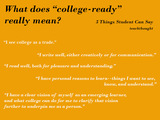
I read well, both for pleasure and understanding.
I write well, either creatively or for communication.
I understand how to research, extract key information, and evaluate its credibility and utility.
I have personal reasons to learn-things I want to see, know, and understand.
I see college as a trade-4-8+ years and X amount of dollars in exchange for something else. If that’s a good trade or a bad trade depends on my own measures that are personal to me and only me.
I can either manage money, or am perma-funded by my parents or endless scholarships and loans that will drown me in debt.
I am not scared of testing-or at least can test somewhat successfully.
I know that people will project their thinking about college on me-what I should study, what’s "valuable," why I should go, which one I should go to, etc. And that the more of this thinking I casually inherit (rather than think about and adopt), the more dangerous the takeaways.
I have a clear vision of myself as an emerging learner, and what college can do for me to clarify that vision further to underpin me as a person.
I can create and cultivate learning networks full of experts, mentors, peers, professionals, and educators.
I can distinguish a teacher that’s there from a teacher that cares, and then get the best from each. (Because like it or not, teachers still dictate the terms of a student’s success in college no matter how motivated or demotivated a student might be.)
I realize that knowledge precedes-and proceeds-vocation, and that the person precedes the knowledge.
If they can’t say these things, then they need to be able to say, with great certainty, "I have no idea what college is or why I might need it, but I trust myself to persevere and figure it out along the way."
Or not go, and find their own path to their own good work.
What Does "College-Ready" Really Mean, Anyway? image attribution flickr user iksme
The post What Does College Ready Really Mean, Anyway? appeared first on TeachThought.
TeachThought Blog
.
Blog
.
<span class='date ' tip=''><i class='icon-time'></i> Aug 05, 2015 09:03am</span>
|
|
Text Complexity? Helping Readers See The Whole Text
by Grant Wiggins, Authentic Education
Selecting Text For Comprehension
In the previous literacy posts in this series I identified a few guiding questions that stem from the research:
Do students understand the real point of academic reading?
Do students understand that the aim of instruction is transfer of learning?
Am I using the right texts for making clear the value of strategies?
Do students understand the difference between self-monitoring understanding and knowing what they might do when understanding does not occur?
Am I attending to the fewest, most powerful comprehension strategies for academic literacy?
Am I helping them build a flexible repertoire instead of teaching strategies in isolation?
Do students have sufficient general understanding of the strategies (which is key to transfer)?
Am I doing enough ongoing formal assessment of student comprehension, strategy use, and tolerance of ambiguity?
In this post we consider question #3, on the appropriate texts to use to develop text comprehension.
The Challenge Of A Common Language
I began this series by reminding readers that NAEP results show flat scores and far too weak results on text comprehension over 30 years, in middle and high school. (The gains have come in lower grades in terms of basic decoding and literal reading). Questions on "main idea" and "author purpose" on state tests also reveal this problem over a long time frame, as I noted in looking at some past test questions and item analysis.
Sitting in on numerous classes over the years reveals a key source of the problem: students are rarely expected to read a multi-page complete non-fiction text and be assessed on their grasp of it as a whole. Rather, most large-group instruction or reader-workshop mini-lessons involve small bits of text, typically no more than a few paragraphs. How can you possibly develop comprehension ability of a text this way?
Such bits of learning can lead to absurd lessons. A well-known and highly-regarded Toolkit - even by me - offers this teacher-script for the lesson on how to distinguish importance:
"To make it easier to sort through all the facts we are learning, let’s look at this three-column form. There are columns for Important Information, Interesting Details, and, of course, My Thinking. In the first column we’ll record the important things we want to remember about the topic. But sometimes it’s those interesting details that really engage us. We can add some of those in the second column…"
How can you judge importance without grasping the purpose? Nowhere is the criterion of "important to remember" discussed. To understand a text and to therefore judge what is "important information" you have to know the author’s purpose and the main ideas of a text. You simple cannot identify what is "important" vs. "merely interesting" by reading a brief excerpt. This leads them to leave the text, in fact: "things we want to remember." But what if that was not at all what the author was trying to say?
Worse, this is a deficient categorization: a detail could be both interesting and important. In fact, students in the provided transcript get hung up on this point in a few cases! Finally, how would any reader judge what is "important to remember" without asking the question: "Important to remember for what purpose?" (Another serious deficiency in the advice to teachers is that the overview of the lesson talks about learning to find important ideas, but that gets turned into important information in the text of the lesson as the excerpt, above, shows. This confusion about facts vs ideas is rampant in many lessons I have witnessed.)
In other words, when you read only a brief excerpt from a text, there is no practical difference between important vs. supporting information, between summary and message. Thus, the vital distinctions between topic, main idea, and summary get blurred. I have watched students get completely confused about these concepts because the brief resources and lessons easily led to muddled thinking. Indeed, I have heard more than a few teachers equate main idea and summary at different points in their teaching.
A Counter-Intuitive Choice Of Texts
Thus, we need to do something unobvious in our reading choices: we must choose complete fiction and non-fiction texts that can be easily read and grasped literally by all students, so that summarizing is easy; yet, be texts in which the main ideas are not obvious. Otherwise, there is little use for true comprehension, specific strategies, or distinctions between ideas and information. (Most blog readers who took the Kant test in Post #1 experienced this tension at their own reading level.)
If I were teaching 7th grade ELA, therefore, I would begin my year with Aesop’s Fables. The whole point of each Fable is an explicit "moral of the story" - a general life lesson stated at the end of the tale. We would start by reading one or two in which the moral is provided and modeling of analysis, then students would be asked to generate the moral of a few stories on their own, in a gradual release way. The text is easy; the inferring is challenging. You could also use very easy readings from much earlier grades, including fairy tales and short non-fiction books - with the added virtue that struggling readers would start off on the right foot since the texts and discussions would be accessible.
Another recurring "text" would be New Yorker and editorial cartoons, and familiar but rich song lyrics to help students understand that the text’s message may nowhere be stated explicitly - that even in very short texts inference is essential. (As I have written before, calling "inference" a strategy is categorically wrong: reading for meaning is all about inference.) I would also have them read a few satires, such as The REAL Story of the 3 Little Pigs? by A. Wolf. Satire has the virtue of painting a sharp contrast between topic, summary, and the author’s point. All of these early moves would build clarity of goal - understand by making meaning of the whole and see how the parts support the whole - and confidence in all readers.
Further along in the year, there would be paired non-fiction and fiction readings in which the topic was the same but each author’s point was different. Students would be asked to compare and contrast regularly. Essential questions would frame cross-text debate and regular Socratic Seminars. (In the ASCD DVD on Essential Questions, you can see me leading a seminar with high-schoolers using readings and activities linked by the EQ:Who Sees? Who is Blind?)
One of my favorite moves in terms of matched non-fiction readings was to have students read selections from the history textbooks of other countries. Here is a selection from one on the Revolutionary era:
What then were the causes of the American Revolution? It used to be argued that the Revolution was caused by the tyranny of the British government in the years following the Seven Years War. This view is no longer acceptable. Historians now recognize that the British colonies were the freest in the world…
The French menace was removed after 1763 and the colonies no longer felt dependent on England’s aid. This did not mean that they wished for independence. The great majority of the colonists were loyal, even after the Stamp Act. They were proud of the Empire and its liberties…In the years following the Stamp Act a small minority of radicals began to work for independence. They watched for every opportunity of stirring up trouble….The radicals immediately seized the opportunity of making a crisis and in Boston it was this group who staged the Boston Tea Party…. In the Thirteen Colonies the Revolution had really been a civil war in which the whole population was torn with conflicting loyalties. John Adams later said that in 1776 probably not more than one-third of the people favored war.
Where is this from? A Canadian textbook! Pair it with the relevant section from the students’ History textbook in 8th grade, and you have a recipe for engaged reading for meaning - indeed, further research. (I have done similar things in science by having students read Ptolemy’s proof that the earth is stationary and at the center of the universe.)
It is vital, therefore, to assess progress in understanding the whole of a text. I would ask students each week to title an article read (in which I had removed or covered the actual title) and justify the choice of title. I would supplement this activity with similar titling questions from released state and national tests (since such items are often used to test for understanding of main idea/author purpose). And there would be a regular cold read and short-answer test on the main idea of a non-fiction article. (None of these need be deemed formal grades until second semester).
Students would thus need to be taught and constantly practice a rudimentary logic: What’s the conclusion, the point? How do you infer this? How did the author take us there, i.e. what are the key pieces in the argument that supposedly support the conclusion?
Without understanding rudimentary logic it is almost impossible to understand the difference between "important" and "unimportant" parts of a text; and it is almost impossible to read beyond a word to word approach, which research shows undercuts understanding. Nor is it possible to meet the argument-related standards at the heart of the ELA Common Core standards.
Less Is More? Comprehension Strategies
Once students understood fully that their job is to think about what they read so that they understand the "logic" of a whole text, I would present students with texts that demand care in thinking as they read where the message is obscured.
Some obvious secondary-level text candidates include: Motel of the Mysteries, the mythic anthropological study of the "Nacirema" tribe, editorials and op-ed essays with unusual views on controversial topics. Poems are obvious candidates; so are puzzling allegories like The Lottery, Plato’s Allegory of the Cave, and the math story Flatland - all highly thought-provoking readings, though relatively easy to grasp at a surface level. But we need many more good examples of nonfiction than we have at present, in which the goal is not to learn information but ponder important ideas and arguments. Otherwise, there is far too little need to invoke any strategies.
As for reading strategies, I would use a very small set, as noted in the key research mentioned in previous posts. In addition to heavy attention to metacognitive self-monitoring (to be discussed in a later post), I would highlight questioning, summarizing, and outlining the logic.
In short, we worry too much about Lexile scores and "grade-level texts" and not enough about designing backward from our goal of text comprehension via intellectually-challenging whole readings that elicit thought and thus a need for strategies. Yes, I know what the Standards say about text difficulty; that’s a goal. But I am quite confident that - paradoxically - we would be more likely to meet grade-level standards in the end, by starting off with easier below-grade-level complete texts worthy of reading and thinking about. Otherwise, we quickly overwhelm and lose struggling readers with too-difficult text and a grab-bag of too many strategies.
I welcome suggestions from readers about non-fiction complete texts that have worked for them, in helping students to become better comprehenders via close-reading strategies.
Further Resources
Four books written for teachers stand out for me as helpful resources in this challenge: Notice and Note by Beers and Probst; Teaching Argument Writing by Hillocks, Deeper Reading by Kelly Gallagher, and the previously mentioned Questioning the Author by Beck et al. These books, written for secondary level teachers, are chock full of sensible advice and helpful tools for readers to use.
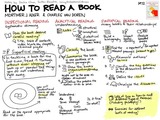
But by far the best book for learning to read intellectually challenging books is a classic:How to Read a Book by Mortimer Adler and Charles van Doren. This book transformed me as a college student from a lazy to an active and more careful reader, and many of my students have told me that this book was a life-saver for them as well when they went to college.
Adapted image attribution flickr user externus; This article was excerpted from a post that first appeared on Grant’s personal blog; Grant can be found on twitter here;
The post Text Complexity? Helping Readers See The Whole Text appeared first on TeachThought.
TeachThought Blog
.
Blog
.
<span class='date ' tip=''><i class='icon-time'></i> Aug 05, 2015 09:02am</span>
|