Blogs
|
10 Ideas For Upgrading Your Teaching This Summer
by Nellie Mitchell, thislittleclassofmine
When my district tech office sent out an email the last week of school announcing that we would be getting new computers mid-summer, I was ecstatic.
The MacBook computers we’ve been packing around for the last five years are great machines, but I am ready for the upgrade. Anticipating the news that new computers might be on the horizon, I started organizing my computer two months ago.
Along with the announcement came a 7-page document outlining the steps and options to back up our lesson plans, files, and slide shows. Computing has changed a lot in the last five years. Now, instead of backing up our documents on CDs, as we did the last time we got new computers, we are encouraged to use the cloud. Save the files on Google Drive. Make a ‘keep’ folder full of ‘essentials’ only. The district will not be transferring large files, media files or photos. It is our responsibility to remove those things from our devices before the upgrade. (Glad I had a head start!)
I’ve been with the district for my entire 9.5-year career, and this will be the third computer they’ve provided for us in that time—-needless to say, I have a lot of files. Last year when I moved to a new classroom, I started throwing away photocopied ‘idea’ folders and packets, in favor of my pin boards and ‘flipboards’. I consolidated three filing cabinets down to one. Most of the things I threw away already exist in a new-and-improved digital version.
Purging old files from my computer feels the same. My iPhoto was filled with thousands of photos and videos. My document file had documents that I created as a student teacher. It’s freeing to delete old documents, forms, and pictures that are backed up elsewhere. There is really no reason to save every single thing on a device. Most of that stuff was just unusable, irrelevant clutter.
It feels good to organize things that were saved haphazardly in random places into their new home in the cloud. It is funny to browse through the links that I bookmarked years ago and update my bookmark toolbar to only the necessary links.
Upgrading for me means a new computer, a clean, fresh start for next year. A true upgrade is a lot more than just rolling in some new shiny hardware. It’s about assessing what’s out there, removing the old outdated equipment and thinking, and investing in the future.
Upgrading means assessing the way you do things, evaluating the validity, and only saving the really good stuff. Upgrading means taking the time to clear out the clutter. It means pairing down the unnecessary junk into just the essentials. Upgrading is systematically sifting through the things that are right in front of you all the time, but are no longer relevant. It is about managing disorganized ideas and content. It is about updating and rebooting.
It means changing for the better.
It is nice to have a little time this summer to work towards the upgrade. During the regular school year, I don’t have multi-hour blocks of time to devote such a transformative project. The upgrade has forced me to think about other things in my teaching that deserve time an attention. What else needs an overhaul? Maybe you are already super organized. Maybe you just upgraded your computer.
A massive purge of ‘old clutter’?
A shiny new idea?
An evaluation of your old classroom management policies?
An entirely new system of collecting data?
We have put together a list of ideas to help you upgrade your teaching practices this summer. Obviously, travel, reading, relaxing and taking a break are critical during the summer, but implementing one of these suggested upgrades now, will be a good investment in the long run.
10 Teacher Upgrades For $10 Or Less
Clean, purge and restore. Clean out filing cabinets. Clean off your computer. Save only the essentials. Back up your important documents in the cloud. Browse through links that were bookmarked years ago and update the bookmark toolbar with only the necessary links. Purge old worksheets and curriculum tools that don’t apply to your classroom anymore. Cost: FREE.
Manage your email. Delete irrelevant messages and go through the process to unsubscribe from mailing lists. Adopt an inbox zero philosophy to help you avoid the spam/junk/clutter all year long. Cost: FREE.
Join a Twitter Chat. Fact.: 44% of users who are signed up for Twitter have never sent a single tweet!! Connect with sources that will strengthen your personal learning network. It will be a great investment in the future. Cost: FREE.
Find an Ed Camp near you and sign up. It is an incredible source of professional development and since it is summer, you won’t even need to create sub plans. You might just find that shiny new idea! Cost: FREE (and free food!)
Gather a few teacher friends and do a book study. Meet up a couple of times this summer at the pool, for brunch, or for a teachers-night out to talk about the book. I suggest Drive: The Surprising Truth About What Motivates Us by Daniel Pink, The Power of Habit, by Charles Duhigg or Thinking, Fast and Slow by Daniel Kahneman. Cost: All three have a Kindle edition under $10.
Take a class in something you are admittedly not good at, in order to understand the perspective of struggling learners. Seriously. A few hours in a dance or sewing class and you might be ready to quit. The process will be good for you and it will give you some insight into the frustration your students have. It will also give you a chance to observe a teacher in a different content area and setting, which could potentially transform your own practices. Cost: Price varies.
Print those school photos. Okay, this suggestion might be creating a little more physical clutter, but having tangible evidence of student projects, collaboration, and fun times in the classroom are a great investment in the future. Print them off, hang them up, share them with colleagues and use them in your classroom displays next year, or for parent conferences. If you never print them, look at them or share them, why bother backing them up and transferring them from device to device. Use it or lose it. Cost: Varies. Online printing services run deals for 99 prints for $0.99.
Develop a community service project and a plan to implement it next year. Figure out how to use your existing curriculum to make the world a better place. Find inspiration in a local, real-world problem. Do the legwork now and introduce it when student engagement is floundering. A dual investment in the future. Cost: Free.
Spend time reflecting and evaluating why/how you do things. You could finally start that blog. (My absolute favorite source for encouragement and reflection are sitting in a folder in my email inbox. I get a weekly article from SmartClassroomManagement.com but I don’t always have mental fortitude to digest the information during the school year. This summer, I plan to spend a little time with the articles that resonate with me so that I can update my classroom management plan.) Cost: Free.
Download a classroom library app. Spend some time organizing your books. Cost: varies, most are free.
What could you do this summer to upgrade your teaching? What could you do to change your teaching practices for the better? Let us know in the comments if you have any other tips for teacher upgrades!
image attribution pixabay
The post 10 Ideas For Upgrading Your Teaching This Summer appeared first on TeachThought.
TeachThought Blog
.
Blog
.
<span class='date ' tip=''><i class='icon-time'></i> Aug 05, 2015 08:54am</span>
|
|
The Cycle Of Reflective Teaching
by Pete Hall and Alisa Simeral
The authors of this post, Pete Hall (@educationhall) and Alisa Simeral (@AlisaSimeral), will be the guest experts on ASCD’s next #ASCDL2L Twitter chat, Tuesday, June 2 from 8 - 9 p.m. ET. The chat will give teachers a forum to discuss effective self-reflection and personal capacity-building and will be guest hosted by TeachThought (@TeachThought). Please join us, Pete, Alisa, and @ASCD for a terrific chat!
The more reflective you are, the more effective you are. This is a phrase that has become synonymous with the work we have done with building teachers’ reflective capacity. With a century’s worth of research touting the benefits of self-reflection and a slew of tools to help teachers (and the coaches and administrators who support them) strengthen their reflective habits, the causative relationship between the two is growing more evident.
People often ask us, "If self-reflection is a skill that can be developed, how exactly am I supposed to develop it?" Fortunately, with the release of our new book, Teach, Reflect, Learn: Building Your Capacity for Success in the Classroom, we have provided hundreds of reflective prompts and dozens of strategies. Here’s a cheat-sheet: 3 steps we can all take to build our self-reflective habits.
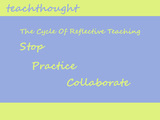
The Cycle Of Reflective Teaching
Step 1: Stop
Have you ever heard someone say, "Well, I never really stopped to think about it." More than likely, you’ve muttered that phrase yourself. We tend to get so caught up in the here and now, busy hustling from task to task, drowning in our to-do lists, that we find ourselves too deep in our routines to see beyond the ruts. We’re doing without really thinking about what we’re doing.
This is the cause of what we’ve come to call the doing-thinking gap. As a teacher, you do a thousand things a day - it’s high time that you stopped, took stock in what you’re doing, why you’re doing it, and how it’s going. It’s a cycle, which means it can be practiced and refined.
Step 2: Practice
Thinking about your work, as an act unto itself, will not singlehandedly make you a more reflective and effective educator. It is a necessary, though not sufficient, activity. How you reflect, and what you reflect about, will provide structure to this thinking strategy. In T,R,L, we share the Reflective Cycle - four key steps that usher you along the path to deeper self-reflection. If you center your reflective practices on these four, you’ll reap the dividends:
Awareness: Reflective practitioners are aware of their instructional reality. That means they know their students, their content, and the high-leverage pedagogy that leads to higher levels of learning. So pay attention to everything, pick up the details, look for opportunities to connect the three together.
Intentionality: You may have heard us exclaim, "Excellence is not happenstansical." Greatness is born from intentionality and planning. Everything a reflective teacher does is selected on purpose, to achieve a certain outcome, and is planned and executed deliberately. Emphasis here addresses the why you are doing things.
Assessment: If a teacher uses strategy x to accomplish outcome y, then it would make sense for that teacher to determine if it worked. Reflective practitioners assess the results of their work all the time, constantly determining the effectiveness and shortcomings of their efforts. Deeper reflection leads to an analysis of why certain teaching moves worked and others didn’t.
Responsiveness: Building off the assessment step, reflective teachers take action - if strategy x didn’t achieve outcome y to the degree needed, the teacher does something about it. Modifying lesson designs, providing reviews, delivering in-the-moment clarifications, and constructing intervention plans are all examples of how teachers can be responsive to that assessment.
Step 3: Collaborate
This work is far too complex, and far too important, to go it alone. In our first book, Building Teachers’ Capacity for Success: A Collaborative Approach for Coaches and School Leaders, we offered a coaching model and tools for administrators to "talk teaching" with their teachers. Now, we invite teachers to partner with their colleagues, create a network of reflective practitioners, and take the reins of their own reflective professional growth. It’s amazing what we can accomplish when we put our heads together. Think about it.
Pete Hall (@educationhall) is a veteran school administrator and professional development agent who has dedicated his career to supporting the improvement of our education systems. His is currently a faculty member with ASCD Professional Learning Services. Alisa Simeral (@AlisaSimeral) is a school turnaround specialist and veteran educator who has guided school-based reform efforts as a teacher, dean, and instructional coach. Together, they are co-authors of the new book, Teach, Reflect, Learn: Building Your Capacity for Success in the Classroom (ASCD); The Cycle Of Reflective Teaching; image attribution flickr user woodleywonderworks
The post The Cycle Of Reflective Teaching appeared first on TeachThought.
TeachThought Blog
.
Blog
.
<span class='date ' tip=''><i class='icon-time'></i> Aug 05, 2015 08:54am</span>
|
|
The Best States To Live And Work As A Teacher
by Brian Neese, Southeastern University
For years, the news has been clear — more teachers are needed. And many are stepping up to answer that call. But despite the need for teachers, not all states are created equal. Budgets are distributed differently, not only within states but also within counties. Resources and access can differ dramatically. And although many teachers begin the work for the love of education, salary and cost of living are still significant factors in career satisfaction.
With the patchwork quilt of information about how much teachers earn across the United States, it can be difficult to determine where to settle down. Although many factors contribute to the decision to live and work in a specific area, salary is one significant factor. Cost of living, however, also needs to be considered, because that is a determinant in how much pay a teacher actually takes home. The need for teachers in various regions, as well as what types of teachers are needed, can also play a role in the decision to live and work in a given state.
Using salary information from the National Education Association and the U.S. Department of Education, Southeastern University’s interactive map illustrates the best states to teach in America based on monetary factors. It also includes cost-of-living information from The Council for Community and Economic Research and a summary of tenure protections using information provided by the Education Commission of the States.
Top States for Teachers
Pennsylvania and Wyoming lead the nation as the best states to teach in America. As two top 10 states for all three salary metrics — average starting salary, average salary for teachers with a bachelor’s degree and average salary for teachers with a master’s degree — they are the only states that rank this highly for salary and also fall outside of the top 10 for the highest cost of living. Not only do these teachers earn more, but they also pay less for basic living expenses, leaving them with more take-home pay.
Other states that offer a strong value for teachers include Indiana, Illinois, Louisiana, Michigan and Ohio. These are the only states found in the top half nationally for all salary metrics while staying in the bottom half for cost of living.
It is important to note that metro areas can affect the statewide averages for salary and cost-of-living data. Teachers should examine various regions within a state to gain a clearer picture of how salary and cost of living interact in any given area.
Different Regions, Different Benefits
Of course, the various regions of the United States each have their own charms … and challenges. Here are just a few of the aspects teachers should consider about each area.
Northeast
This area offers a competitive salary with a relatively high cost of living. All nine states have a cost of living in the upper 40 percent of the country, with five states falling in the top 10.
New Jersey, New York, Massachusetts and Connecticut lead the region in salary indicators.
Pennsylvania is the best value for teachers in this region, with high salary figures and a slightly above-average cost of living.
South
This area fluctuates in terms of the cost of living and salary data for teachers.
Texas is the strongest value for teachers in the South. It has a cost of living in the bottom 25th percentile and offers two top 15 salary metrics.
Kentucky is another value in the South. It has the fourth-best cost of living in the nation and can be found in the top half of states in the country for average starting teacher salary and average salary for teachers with a master’s degree.
West
This region offers a generally high cost of living with varying ranges for salary metrics. Only four of the 13 states in the West place in the lower half of the cost-of-living rankings.
For states with a high cost of living, salary figures can be high (Alaska and California) or near the middle (Oregon, Washington, Nevada and Colorado) as compared to national averages.
Wyoming leads the West, and likely the nation, in terms of salary and cost of living balance. It ranks in the top 10 nationally for all three salary figures and has a 93.9 percent cost-of-living average for the state, which is below the national average.
Midwest
This region presents value for teachers looking to balance cost of living and salary. Nine of the 12 Midwestern states are in the bottom half nationally for highest cost of living, while seven are in the top half nationally for average base salary for teachers with a master’s degree.
Illinois, Indiana, Michigan and Wisconsin emerge as top states in the region for salary and cost of living.
Illinois and Michigan lead the country for the highest percent increase between average base salaries for teachers with a bachelor’s and a master’s degree. Illinois is first at 42.6 percent, while Michigan comes in second with a 35.7 percent increase in salary — no other states in the nation exceed the 30 percent mark.
The Importance of Education for Teachers
One of the most powerful ways for teachers to increase their earning potential is to advance their education. According to the U.S. Department of Education, teachers with a bachelor’s degree earn a national average base salary of $46,340, while teachers with a master’s degree earn an average base salary of $57,830 — a 24.8 percent increase.
In addition to an increase in earnings, teachers with a master’s degree are more competitive in the job market. Ease of mobility, enhanced job security and other opportunities are generally more open to teachers with a master’s degree than to those with just a bachelor’s degree.
A master’s degree can also lead to specialization opportunities that can enhance teachers’ career opportunities, earnings and overall career development.
Specializations Matter
The current need for teachers with specialized skills highlights an opportunity for teachers across the country. In the 2014-2015 school year, five subjects were in demand by at least half of the states in the U.S., including more than three-fourths of states for special education, math and science, and more than half of states for foreign language and teaching English to speakers of other languages (TESOL). In-demand specializations include the following:
Special Education: The number of U.S. students enrolled in special education programs in the past 10 years has risen 30 percent. (National Education Association).
Math and Science: Initiatives surrounding enhanced proficiency in the fields of science, technology, engineering and mathematics (STEM) have resulted in an increased demand for teachers. The U.S. Department of Education has reported a plan that includes developing, recruiting and retaining 100,000 STEM teachers over the next 10 years.
Foreign Language and TESOL: According to the National Center for Education Statistics, 9.1 percent of public school students in the United States were English language learners. The rise in English language learners — especially students from households that speak Spanish — has resulted in an increase of teachers who can help foreign language learners in their native language, as well as teachers who can help learners improve their English skills.
Teachers looking to specialize in a certain area can pursue certification in a specific degree concentration. For instance, a master’s degree in special education or TESOL is a common option for teachers to advance their education and earn a career specialization.
Conclusion
Although choosing a location is not based solely on salary and cost of living, understanding these factors can help teachers decide where to pursue a career. When taking into account available data for salary and cost of living, Pennsylvania, Wyoming, Indiana, Illinois and Louisiana fared well in the analysis of the best states to teach in America. Florida is another top state when considering state-specific data.
No matter where teachers live, however, a master’s degree improves salary and mobility prospects. Specializing in an in-demand subject area increases those metrics, as well.
For teachers looking to advance their careers with a master’s degree, it’s important to choose a university that offers the most valuable specializations. Southeastern University, for example, offers online Master of Education programs with five specialization options, as well as an online Doctor of Education program. Teachers can use these degrees to improve their career prospects and then choose the area that best meets their needs.
Online education degree programs at Southeastern University include the following:
MEd in Arts and Academic Interdisciplinary Education
MEd in Elementary Education
MEd in Educational Leadership
MEd in Exceptional Student Education
MEd in Reading Education
MEd in Teaching English to Speakers of Other Languages
Doctor of Education
Choosing where to live depends on many factors, but finding a state that balances salary with cost of living can be an important consideration. The good news is that the more education you have, the more flexibility you’ll have as a teacher to find a home that will meet your needs.
The post The Best States To Live And Work As A Teacher appeared first on TeachThought.
TeachThought Blog
.
Blog
.
<span class='date ' tip=''><i class='icon-time'></i> Aug 05, 2015 08:54am</span>
|
|
20 STEM Activities For Kids This Summer
by pltw.org
School may be winding down, but that doesn’t mean learning has to. In fact, it is vital that it doesn’t!
When students let their brains take a break over the summer, they can lose the equivalent of two months of their grade-level math and reading skills. To combat summer learning loss and keep those STEM skills fresh over the summer, Project Lead The Way put together a list of super simple (and fun) STEM activities you can do with your children over summer break.
Create a discovery jar. Sit down with your child at the beginning of the summer and brainstorm all of the questions or ideas your student is curious about. Maybe it is why grass is green or how space travel started. Or how many varieties of leaves exist on the trees in the yard. Then put all of the questions into a mason jar. Pull one out each day for your child to research and explore. PLTW Director of Assessment Claudia Guerere (@ClaudiaGuerere) recommends this activity, which she says engages kids’ natural curiosity and discovery.
Do try it at home! Matt Arnold (@ArnoldSTEM), PLTW instructional specialist, is a big fan of the Lemelson Center’s collection of ‘Do Try This at Home!’ activities, through which students develop their innovation and creativity. Try one of these free and fun activities.
Keep their math skills sharp. Bennett Brown (@BennettBrownIA), PLTW director of curriculum and instruction for computer science, prefers IXL.com, which offers grade-based math activities that feel more like fun than practice.
Bug out! Did you know that insects outnumber humans 200 million to one? No matter where you live, insects are a vital part of your community and play an important role in everything from recycling waste to helping plants spread pollen. Discover what bugs live in your neighborhood, and try to identify those you haven’t seen before.
Explore computer science.You don’t need to be a professional to create computer Apps! Help your student learn basic computer science principles with these easy-to-use computer science platforms. PLTW’s computer science curriculum developers recommend these resources:
Scratch Jr. (PreK-3) - Scratch Jr. is a free App available on both iPad and Android tablets that allows even the youngest students to learn to code.
Scratch (grades 3-9) - Scratch is a free platform for students to program interactive stories, games, and animations. All you need is a laptop and creativity.
App Inventor (grades 5+) - This platform allows students to create their own Apps in less than an hour. To use, you’ll need two devices: a Web browser on computer, as well as an Android device. Both must be able to access the same wireless Internet network.
Tynker (grades 4-5) - Tynker is a blocks-based programming platform available on desktops, laptops, and tablets that helps students learn to code. Both free and paid memberships are available.
DroidScript - DroidScript lets students of all skill levels easily and quickly write Apps for Android using JavaScript. Use a PC and an Android phone, tablet, or Smart Watch. Both must be connected to the same wireless Internet network.
Lightbot - Lightbot is an educational video game for learning software programming concepts. Paid versions ($2.59-$4.99) exist for both Apple and Android tablets, as well as Windows and Mac devices.
Feel the beat! Learn how different activities affect your heart rate with this fun activity from Rachel Allard, PLTW’s director of curriculum and instruction for PLTW Biomedical Science. Teach your child how to measure his or her resting heart rate, and then collect it at different points throughout the day to learn how quiet versus physically active tasks change their heart rate. Find a helpful guide here.
Bake! It’s one of the best ways to teach young children math and science. Work on their math vocabulary and measurement skills as you measure out ingredients. And explore where ingredients come from, or how solids and liquids transform during baking for a basic science lesson. Then reward them with a chocolate chip cookie or a Rice Krispies® treat!
Explore architecture and public works! @BennettBrownIA recommends taking children on a fieldtrip to your local infrastructure facilities - the waste water treatment plan, electric plant, or manufacturing plant - to learn about civil engineering and architecture. Most do free tours if you call ahead.
Sharpen their problem-solving skills! PBS Kids offers a great resource full of problem-solving games for young students. PLTW Director of Curriculum and Instruction Vanessa Stratton (@Vanessa_PLTW) enjoys these with her own children.
Go to camp! The Engineering Education Service Center is a great resource for a list of summer engineering camps happening across the U.S. Camps are listed by state.
Take a snack break. Several members of the PLTW Programs Team recommend the Exploratorium’s Science Snacks for hundreds of ideas, sorted by subject. Some of our favorites require few materials and even provide talking points for parents.
Balancing ball
Your sense of taste
Blind spot
Take it from the top
Make getting the mail fun. PLTW Director of Instruction Stephanie Poll subscribes to Tinker Crate to keep her children engaged outside of the classroom. Tinker Crate promises not to be just another science kit. This monthly subscription-based service designed for kids ages 9-14 creates ‘low threshold, high ceiling projects accessible and fun for all types of learners.’ A version of Tinker Crate is also available for ages 3-4 and 4-8.
Upcycle! Associate Director of Curriculum and Instruction Joanne Donnan (@JoanneDonnan) loves to see what students create when handed a bin full of recyclables. Gather your old materials and this kit of connectors ($12.50) and turn your kids loose. Modern Parents Messy Kids has another take on this creativity-inspiring activity.
Master physics. @BennettBrownIA and @ArnoldSTEM love the Minute Physics channel on YouTube. These videos, set to engaging animations, make some of the most complicated science topics easier to understand.
Grow a salad. Explore life sciences with this fun activity. Grow lettuce, cucumbers, and tomatoes in your garden or in separate pots. Students will learn the growth cycle of plants and the impact of soil, sun, water, and nutrition on plants’ growth.
Take the egg drop challenge. What happens when you drop an egg from ceiling-height? It cracks and creates a giant mess, right? Challenge your child to engineer a vessel that will protect the egg and keep it from breaking when dropped.
Go star gazing! Warm nights and clear skies allow for fun interstellar observation, with or without a telescope, says PLTW Director of Curriculum and Instruction Gerald Holt (@Holt10). Sky Map, built by a team of amateur astronomers who work at Google, helps Android users locate stars and planets in the night sky. NASA also provides a fun way to locate the International Space Station with its Spot The Station website.
Help your children boost their critical thinking skills."Instant challenges" are go-to resources for many on PLTW’s Programs Team with their own children. These challenges, set to a specific amount of time, force children to think on their feet, work in teams, and use their critical thinking skills. Google ‘Instant Challenge’ for ideas, or check out some of @Vanessa_PLTW’s favorites:
Instant Challenge Matrix
Roll-A-Challenge
Four Square Deal (Activity #2)
Catch it if you can! (Activity #4)
Learn about microorganisms! Microorganisms are important to life on Earth, acting as decomposers in various ecosystems and playing a vital role in the nitrogen cycle. Help your child learn about the different bacteria in their daily environment and the important role each plays with this interactive game.
Build a paper rollercoaster. @JoanneDonnan recommends Canon’s printer-friendly roller coaster template and corresponding instructions. Print and assemble your very own paper roller coaster, and then assemble your coaster car and race it around the track.
Take a picture as you enjoy these activities with your children, and share it with us on social media! Tag PLTW on Twitter @PLTWorg, on Facebook at ‘Project Lead The Way - PLTW’, or on Instagram at PLTWorg.
image attribution flickr user usarmyrdecom
The post 20 STEM Activities For Kids This Summer appeared first on TeachThought.
TeachThought Blog
.
Blog
.
<span class='date ' tip=''><i class='icon-time'></i> Aug 05, 2015 08:53am</span>
|
|
How To Make Learning Visible: A Spectrum
by Terry Heick
What students say and do and create are products of thought processes that, more or less, are predictable-and of significant potential if we can make those processes visible.
The idea of making learning visible isn’t new. This is an idea as old as conversation or writing-show me what you know. It comes in many forms, from essays, quizzes, and exams, to the lifeless "What’d you learn in school today?" conversation after school.
Playing an automotive racing video game recently, I unlocked a badge for accruing a certain number of miles on a specific track. As I was driving-or rather, pushing buttons on a controller that simulated a lot of the visuals and some of the sensations of racing a car-a little badge popped up at the bottom of the screen, along with a title reflecting what I’d accomplished. Badges and trophies are usually seen as a reward for an accomplishment, but they’re not very good at it. They flash on the screen, create an all-too-brief dopamine response, and are gone.
On modern video game platforms like The Xbox One, PlayStation 4, and Steam, no one really cares about these collections because everyone has them. They might be quantified, as in "I have more points or trophies than you," but as individual episodes of achievement, they’re mostly anonymous, which means they fail to signify something actually worth signifying.
In a learning ecology-as we use them now-digital badges usually cause little excitement and mean nothing. As levers of gamification, however, they have the potential to uncover the nuance of performance, as I explained in that post.
"A digital trophy system-if well-designed-offers the ability to make transparent not just success and failure, accolades and demerits, but every single step in the learning process that the gamification designer chooses to highlight. Every due date missed, peer collaborated with, sentence revised, story revisited, every step of the scientific process and long-division, every original analogy, tightly-designed thesis statement, or exploration of push-pull factors-every single time these ideas and more can be highlighted for the purposes of assessment, accountability, and student self-awareness."
So, in the best of cases, these icons can be gathered into a personal collection to act as an uber-report card. Imagine the icons on your phone or tablet as symbols of something important attempted or accomplished by a student. That’d be a great starting point for learning badge and gamification "2.0," but merely updating a broken system doesn’t seem like the best use of our time. It’s much more fun to speculate what might be possible if we’re willing to squint a little to maybe find something we haven’t found before.
Transfer
The shift from proving understanding of externally-driven content (i.e., curriculum maps and pacing guides created from a universal set of standards) to turning inward and learning to ask questions that sustain learning isn’t simply a matter of process, but purpose and human outcome. See John Dewey explain.
"From the standpoint of the child (Ed note: this is the only standpoint that matters, right?), the great waste in the school comes from his inability to utilize the experiences he gets outside the school in any complete and free way within the school itself; while, on the other hand, he is unable to apply in daily life what he is learning at school. That is the isolation of the school — its isolation from life. When the child gets into the schoolroom he has to put out of his mind a large part of the ideas, interests, and activities that predominate in his home and neighborhood. So the school, being unable to utilize this everyday experience, sets painfully to work, on another tack and by a variety of means, to arouse in the child an interest in school studies. While I was visiting in the city of Moline a few years ago, the superintendent told me that they found many children every year, who were surprised to learn that the Mississippi river in the text-book had anything to do with the stream of water flowing past their homes." (Dewey 1916)
In focusing on narrow data from a fixed curriculum using universal assessments, it might be that we’ve gotten the learning process itself all knotted up. Curiously, there haven’t been very many attempts to make learning, in and of itself, visible. Letter grades and paper certificates make up the bulk of these efforts, and digital portfolios and project-based learning artifacts are about as exotic as it gets.
Badges are a more recent entry into this field, but we’re falling far short of what’s possible. In short, badges as evidence of achievement are interesting, but insufficient because they are residual. Leftover. Effects. Artifacts. Fin. But if we use them as simply the first "stage" of a growing idea, then we can both illuminate and catalyze learning as a process while it’s happening-and in the process, connect students with someone other than the teacher.
The question becomes then, what should we make visible, how, and to whom?
How To Make Learning Visible: A Spectrum
Below is a kind of model to think about this. It is setup here as a spectrum. Stage 1 represents early thinking about the idea-essentially, where many classrooms are today, while Stage 4 represents more developed thinking-what "classrooms" might seek to become as we move beyond "I’m done with this assignment" thinking.
The big idea, then, is to evolve the thinking behind letter grades, certificates, and badges in pursuit of a genuine ecology of learning-pushing past simply sharing evidence of "mastery" (which is perishable), toward a focus on the students as they ask questions, seek information, apply their own thinking, and see learning as a fluid-and entirely personal-process.
Big Idea: A shift from emphasizing the products of learning to the process of learning
Stage 1: Product (The Artifacts Of Learning)
At the first stage of this "spectrum" of making learning visible, there is emphasis on the finished products students create. This can provide evidence of understanding, and allows other stakeholders in education an opportunity to infer what’s happening in the classroom. This is also where most classrooms are today.
Examples: Physical projects and models, essays, posters, blog posts, badges of completion, ribbons, letter grades, diplomas, certificates, PowerPoints, project-based learning artifacts, photographs
Driving Question(s): What compelling evidence of performance and understanding can be shared with others? What is the most authentic way to publish student work in affectionate and attentive communities?
Stage 2: Process (The Patterns & Sequence Of Learning)
As we make learning visible during this second stage, the process and sequence of learning is illuminated. This may include ongoing or even finished projects shared, but only insofar as student habits, decisions, developing understanding, and ongoing performance are concerned. This helps students see understanding as alive-and thus capable of growth or decay-and always evolving.
This also helps schools and teachers see student performance as an extraordinarily individual and often chaotic-even Rhizomatic-journey, and design curriculum, assessment, learning feedback, and other systems around that idea.
Examples: Any practices that encourage metacognition, journaling about the Habits of Mind, making room for failure, revisiting old work for reflection or improvement, entrepreneurship projects (including community projects and businesses), visual data that shows change over time, returning to "places" (physical or digital) of learning, the iteration of digital portfolios (rather than the artifacts themselves), reflecting on what students felt emotionally during the process of learning
Driving Question(s): What does "personalized learning" mean? How do students learn differently-both in a standardized curriculum, and in a model where each student learns something different? How can the nature of learning as a process be made visible-and in a way that serves the student as much as those around them?
Stage 3 : Need To Know (The Reason For Learning)
At this advanced stage of making learning visible, knowledge demands and curiosity are the focus. Here, what students need to know is supplemented-and empowered-by why they need to know it. These two concepts work together to bolster both curiosity and the utility of knowledge.
Driving Question(s): How can the need to know be communicated, emphasized, and published? What role does curiosity play? What is the difference between "engaged academic" and "authentic learning"?
Examples: Informal learning, demonstrated curiosity, problem-based learning, challenge-based learning, visible transfer of knowledge, communal constructivism, self-directed learning as a classroom model
Stage 4: The Self (The Context For Learning)
The last of these so-called "stages" of making learning visible finishes with the student themselves. A continuum that began with the idea of students proving themselves to others by what they "do" has now transformed into one that focuses on the students themselves as a context for learning-what they learn, why the learn it, and what they do with what they know.
Some of these kinds of questions can be found in our self-directed learning model, including:
What problems or opportunities are within my reach?
What important problems & solutions have others before me created?
What legacies am I a part of & what does that suggest that I understand?
For me, in this light, what’s worth understanding?
Examples: Self-directed learning as a classroom model, place-based education, learning through play
Driving Question(s): How is each child different? How are each child’s knowledge demands unique? In what contexts do students both need to know and then-unprompted-use what they know?
The next question to address, which I’ll do in a follow-up, is whom are we sharing the above with, and how?
For professional development around this idea or others you read about on TeachThought, contact us.
How To Make Learning Visible: A Spectrum; image attribution flickr user woodleywonderworks
The post How To Make Learning Visible: A Spectrum appeared first on TeachThought.
TeachThought Blog
.
Blog
.
<span class='date ' tip=''><i class='icon-time'></i> Aug 05, 2015 08:53am</span>
|
|
The Mistakes I Made As A New Teacher
by Robyn Jackson
I’ve been talking to teachers lately about creating an environment in their classrooms where students are free to make mistakes and supported in learning from their mistakes. I argue that learning from mistakes can be a powerful way of helping students learn. But the value in learning mistakes isn’t just limited to our students.
As professionals, we need to learn from our mistakes as well. I realize that the environment in our profession isn’t exactly friendly to making and learning from mistakes right now, but I would encourage you to not let that stop you. Don’t be afraid to make the inevitable mistake or two in the classroom as you teach. Instead, be open to learning from your mistakes and using them to make your teaching stronger.
To get the ball rolling, I thought I’d share five mistakes I made early in my career and what I learned from them. Please share your mistakes and best advice as well in the comments section and let’s learn from each other. Also take a look at our page full of advice for new teachers from seasoned teachers and leave your best advice there too!
Mistake #1: I took everything personally.
If the students disobeyed me, I got angry at them. If they didn’t do their work, I took it as a personal affront. Every time they put their heads down or didn’t turn in their homework, I was personally offended. The problem with taking things personally is that it usually leads to blaming the students.
The moment I realized that it wasn’t about me, I was able to to shift my focus from how offended I was to what I needed to do to help my students make better decisions the next time. When I stopped taking personal offense at everything my students did (or didn’t do) I was able to focus on how I could best respect, honor, appreciate, and capitalize on the currencies they brought to the classroom.
Mistake #2: I avoided dealing with parents.
When parents contacted me, I used to cringe. Usually, they were not calling with good news. I did everything I could to avoid dealing with them. By seeing them as an adversary, or at least a nuisance I wanted to avoid, I created more problems with parents than I solved.
Once I learned to see parents as my partners, to keep them informed about what was going on in my class, and to bring them into the loop early in the process, I found that parents were my best allies. As a result, even when we disagreed on a course of action for their child, we were more likely to work out a plan that we could both support.
Mistake #3: I waited until students were failing to intervene.
I was always surprised at interim time that certain students were failing. What made it even worse was that by the time I sent out interims, there was really little students could do to redeem their grades before the end of the marking period. It wasn’t until I created a proactive intervention plan that forced me to systematically look at student performance that I started to notice the moment students began to fail and plan in advance what I would do to get them back on track. Then, I could intervene before they got so far in the hole that they could not possibly ever get out.
Mistake #4: I was afraid to make mistakes.
I thought that as the teacher, I always had to be right. I worked really hard at being the smartest person in the room. When my students asked me a question for which I had no answer, I’d make one up. If I made a mistake, I would cover it up. Only when I gave myself permission to be, well, human, did my teaching get really good.
When I let my students see me make mistakes, admit them, and then take steps to correct them, it made it okay for them to make mistakes too. The more I took risks in the classroom, the more I made it safe for them to take risks. As a result, my classroom became a place where real learning could happen.
Mistake #5: I tried to cover everything.
I thought that if it was in the curriculum, it had to be taught. The problem is that most curriculum documents are so bloated that it is difficult to cover everything or allot the same amount of time to every assignment. What’s more, covering the curriculum does not guarantee that the students will meet all of the standards. Once I realized that, I began to focus on the standards and on helping my students reach the standards rather than just cover the curriculum. Doing so gave me more time to teach what really mattered and more flexibility to adjust my teaching based on my students’ needs.
What mistakes have you made and what have you learned from them? What is some advice you would give to teachers starting out?
Have you struggled with motivating reluctant learners? If so, come see Robyn’s keynote luncheon at the 2015 ASCD Conference on Teaching Excellence, June 26-28 in Nashville.
A version of this blog first appeared on ASCD EDge; Robyn Jackson is the founder of Mindsteps Inc. and the author of 10 books, including Never Work Harder Than Your Students and Other Principles of Great Teaching (ASCD, 2009), and her latest Real Engagement: How do I help my learners become motivated, confident, and self-directed learners? (ASCD, 2015), coauthored with Allison Zmuda; The Mistakes I Made as a New Teacher; adapted image attribution flicker user tulanepublicrelations
The post The Mistakes I Made As A New Teacher appeared first on TeachThought.
TeachThought Blog
.
Blog
.
<span class='date ' tip=''><i class='icon-time'></i> Aug 05, 2015 08:53am</span>
|
|
Why Students Should Read
by Terry Heick
Lately, there’s something about reading that’s bothering me about how we teach reading and writing.
I’ve written about it before and said a lot of what I say here, but never quite said what I was trying to say because I’m not sure what I really mean. It’s got something to do with how schools frame it. Call it "literacy." Sterilize it. Cleave it cleanly from its human contexts until it’s a school thing and good for you and you should totally do it and one day you’ll be thankful you did.
Like flossing.
Decoding & Comprehension
Reading, as taught, is a skill.
This is partly by definition. The word reading represents a slew of ideas. It’s a verb, but it’s such a familiar idea and outwardly passive process that it works almost like a noun. Reading can create a kind of flow state where the consciousness of the reader merges with that of the writer through the text.
And when this happens, all three can kind of disappear. There is no reader, no writer, and no text, but rather simply a mind dancing with ideas while the world falls away. But that’s a best-case scenario and disgustingly romantic and not what I mean to say either.
So then, education. As a matter of teaching and learning, reading is absolutely iconic. To teach reading requires us-teachers-to break it down into parts, usually somewhere along the fault lines of decoding and comprehension. The decoding part is a mix of letters and sounds. Digraphs, clumsy blends, irregular words, and pattern recognition. Phonemics. It’s literally learning to speak a new language, one made with alphanumeric characters on paper (that can travel through time) instead of sounds with your mouth. It begins and ends in your brain and if you can internalize it, ends up in your mind.
Comprehension, however, is somewhere close to your stomach. It’s more metacognitive and personal, where the reader takes the internalized symbols and, leveraging their own schema and background knowledge, turns the symbols into something they can recognize and their soul winks and spins. This is a person making meaning. How crazy is that? When a teacher, then, seeks to teach reading, they have to make a choice: Teach decoding, teach comprehension, or try to merge both.
This, though, isn’t necessarily a problem. Or the problem as I’m trying to better understand. For all of its intentions, pedagogy is inherently destructive. It seeks to change and reform and mash and refine and alter and reduce and increase. Put another way, focusing on reading-the-verb-the skill as assessed by reading speed and sight vocabulary and main idea extraction and author and purpose and details, and a million other silent efforts readers make in unfolding a text in a way that they can make some kind of sense of it-annihilates reading from the beginning.
The assumption is that if one can read, and read well, then they will. This is a useful microcosm that emphasizes how education can grow. Think:
Skills vs habits.
Competencies vs tendencies.
Abilities vs affections.
When we focus on teaching content rather than teaching the child, we lose the child. As it stands, we’re a curriculum-centered, data-driven, institutionally-focused industry, and our language reflects that approach. Progress. Acceptance. Rejection. Pass. Fail. Register. Enroll. Proficient. Assess. Data. When seeking improvement, we seek to improve how we’re doing what we’ve always done, but more of it-faster and more efficiently. We break the learner and their sense of self to fit in stuff. We seek to improve our collective processes to cause more learning, which makes as much sense as teaching students how to read instead of why.
And that’s about as close as I thought I was going to get (for now) as to why literacy, as taught, is gnawing at me. I was going to end there with useless uncertainty, but publish it anyway so I can read it later and shake my head. Until I read this quote from Franz Kafka on why we should read.
"I think we ought to read only the kind of books that wound or stab us. If the book we’re reading doesn’t wake us up with a blow to the head, what are we reading for? So that it will make us happy, as you write? Good Lord, we would be happy precisely if we had no books, and the kind of books that make us happy are the kind we could write ourselves if we had to. But we need books that affect us like a disaster, that grieve us deeply, like the death of someone we loved more than ourselves, like being banished into forests far from everyone, like a suicide. A book must be the axe for the frozen sea within us. That is my belief."
When we read-really, really read-for a while, a normally very loud part of us grows quiet and limp while our mind begins unraveling new ideas. Then, pushing further, we look inward, turning our skin inside out to expose our pulsing, naked nerves to the text. We erect a sense of self to withstand the sheer momentum of the text, then rummage through the debris when it’s all over to see what’s left behind.
And what we find is who we are.
That’s why students should read.
For professional development around this idea or others you read about on TeachThought, contact us.
Why Students Should Read; adapted image attribubtion flickr user wolfganglonien
The post Why Students Should Read appeared first on TeachThought.
TeachThought Blog
.
Blog
.
<span class='date ' tip=''><i class='icon-time'></i> Aug 05, 2015 08:53am</span>
|
|
Moving Up? 4 Tips For Managing Your Career As A Teacher
by Karen Baptiste
This March in Houston, ASCD held its 70th Annual Conference for educators and enthusiasts seeking information from the latest innovation and invention to the most effective resources. One of the memorable opportunities provided this year was the Student Career Chat for Student Chapter Members interested in advancing their job search or even relocating to continue their career. Many of the topics discussed were ideal for educators hoping to advance their career, whether in the current district or by relocating, and I’ve aimed to capture some of the best insights to share with you.Moving Up? 4 Tips For Managing Your Career As A Teacher
1. Build real relationships.
It can be easy to stay in the same position until you retire with no growth or movement, but if your desire is to move upward, you have to stay current with your organization’s progress or movement, and make sure the organization knows about you as well. I always think of myself as a brand: how will I market myself to decision-makers? This is a key question to consider as you establish your value.
For starters, introduce yourself to others and start building relationships. Everything you do is about relationships! If you’re moving up within the same organization, then you should have networked with other individuals who are in a position to hire you. You should attend events that the school or district holds, and even volunteer to help out with logistics.
Digital connections are fanastic, but they should serve authentic connections, not replace them.
2. Keep a compelling portfolio.
As your relationships will be grounded in your work, start showcasing your work to others in and outside of your department or school. You should keep a portfolio of the work you’ve done, along with measures of its effectiveness over a period of time. If you are in a position where you have had little demonstrable impact, then that may not be the right position for you, and chances are you will struggle with getting a promotion.
Something that is true in education and across all industries: employers always want to know what impact you have made to prove you will be an asset to their company. Your portfolio should be substantive, visual, easy to share, and indicative of your talent as an educator.
3. Technology can extend the reach of your work.
If you can, attend public events or job fairs that the school district is having and start to network and connect with individuals from there. Also, look up their social media page and see who people are and what they have done in the past. Technology has evolved immensely and we have access at our fingertips to look up organizations and people.
For example, you can search for different people on sites such as LinkedIn and friend request them. Networking with people via social media allows you to see what they support, believe in, and their career path. Finding their Twitter handle is also a great way to follow an organization or person’s work.
The school community’s local media and newspaper are great outlets for you to do your due diligence in researching before applying. This will start to give you a sense of the community and relationship that the school district has built with its constituents. If the school district is very secretive about their operations, salary and data around achievement, then chances are you don’t want to work there.
Ultimately, technology can both increase your visibility as well as extend the impact and reach of your work as an educator.
4. Do your homework before relocating.
Moving to another state, or even just a new city, can be overwhelming, especially when you are job seeking. As I mentioned before, do your homework on any organization―whether school, district, or otherwise―you apply to work for. Always read their mission, their results, employee retention or turnover, salary, and benefits. Research how employees feel about a company and if they are satisfied overall.
Before I relocated to Florida, I tracked the progress of the district to which I was applying for two years because I wanted to be sure that their mission and vision were aligned with mine. While I could not find out about all of the inner workings of this school district, I got a pretty good sense of how they operate by watching their school board meetings broadcasted live on the internet each week. I would read articles on the district and the changes the new superintendent was making to improve the schools.
Best of luck to you as you pursue the best opportunities for yourself as an educator!
This guest post by Karen Baptiste discusses lessons she shared with educators at the 2015 ASCD Annual Conference in March. This summer, teachers nationwide will have more great opportunities to supercharge their PD and expand and strengthen their PLNs at the ASCD Summer Academies, led by Heidi Hayes Jacobs and Harvey Silver. Learn more about these academies, Connect 21 Camp: Becoming a 21st Century Teacher, Leader, and School and The Strategic Teacher: Developing Every Teacher’s Instructional Know-How.
Karen Baptiste is the Supervisor of Teacher Development in Broward County, Florida and an ASCD Emerging Leader; 4 Tips For Managing Your Career As A Teacher; image attribution flickr user flickeringbrad
The post Moving Up? 4 Tips For Managing Your Career As A Teacher appeared first on TeachThought.
TeachThought Blog
.
Blog
.
<span class='date ' tip=''><i class='icon-time'></i> Aug 05, 2015 08:52am</span>
|
|
by Judy Seltz, Executive Director At ASCD
Sometimes the replacement is better than the original, and we don’t miss the original for more than a brief moment: think whiteboards v. blackboards, chalk, and erasers; or copy machines v. mimeograph machines and purple "masters." But then sometimes we look around and wonder why something important seems to have disappeared, like play, for example. Where has play gone, for both children and adults?
Think back to your childhood - what memories are the strongest? Probably the times you took off for an afternoon with friends, exploring a stream, playing an invented game in a vacant lot, finding a new neighborhood in your town, or supplying a hideout with forbidden candy bars. And yet, today, unstructured play for children has become an endangered species, replaced by organized sports, karate and dance lessons, and screen time.
Many families simply don’t have much unscheduled time - parents’ work schedules, long commutes, and children’s activities contribute to the logistical challenges of managing the week. Some families live in neighborhoods that may not be safe for outside play; others are concerned that their children need every possible advantage to compete successfully, and pile on tutoring, enrichment classes, and more.
To clarify, the need for play is not just about the need for physical activity. The American Academy of Pediatrics recommends that recess be unstructured, free play that is a complement to physical education, not a substitute for it. Play, they say, "is essential to developing social and emotional ties…. [and] is a natural tool that children can and should use to build their resilience." (PEDIATRICS, Volume 129, Number 1, January 2012)
Play helps young people discover and connect to their own interests, exploring what they want to do at their own pace and for their own satisfaction, rather than working for adult praise or trophies. Through play, they acquire mastery of their world, setting their own boundaries for risk taking and experimentation. What can I build with what’s at hand? How can I improvise? How do I negotiate with my peers? The lessons of inventiveness, resilience, and persistence are an integral part of play.
Research also indicates that play impacts brain development in young children by changing the connections of neurons in the brain’s executive control center, important in problem solving, planning, and regulating emotions. (NPR, August 6, 2014, "Scientists Say Child’s Play Helps Build A Better Brain")
Despite the evidence, schools have been whittling away at recess as they devote more time to academic subjects and test preparation. The disappearance of play is not peculiar to the United States, however; a New Zealand study found that nearly half of their children do not play daily, despite three-quarters reporting that their preference is outdoor activity. And a recent German study out of the University of Hildesheim indicates another reason to make time for play - researchers found that adults who reported significant childhood time in free play enjoyed high levels of social success as adults. The flexibility and problem-solving skills learned through free play translate to adaptability in adulthood.
As Ralph Waldo Emerson once said, "It is a happy talent to know how to play." Honing this talent is just as important for adults as it is for children. Play makes people happy. Playing with pets is fun. Playing with children is fun. You don’t need permission to play. Try it. And let’s make sure that play does not go the way of the manual typewriter or the floppy disk. Unlike those, play would be deeply missed.
How might you make room for play in your classroom-as a matter of design? Or even build your classroom around it as an idea?
Judy Seltz is the executive director of ASCD, a global community dedicated to excellence in learning, teaching, and leading. ASCD publishes professional development books by leading authors; produces Educational Leadership magazine; hosts conferences and institutes for teachers, principals, and administrators; advocates for federal policy that supports the well-rounded needs of all students; and much more. Learn about ASCD’s programs, products, services, and memberships at ascd.org; Where Has The Play Gone?
The post Where Has The Play Gone? appeared first on TeachThought.
TeachThought Blog
.
Blog
.
<span class='date ' tip=''><i class='icon-time'></i> Aug 05, 2015 08:52am</span>
|
|
June 15: Exclusive Live Stream Of The Atlantic’s Education Summit
by TeachThought Staff
TeachThought is excited to be the exclusive streaming partner for today’s The Atlantic’s Education Summit.
Summary
Two-year olds are entering preschool and learning on iPads. Primary schools are considering the role supportive environments play on students’ learning. Admission to college is a tangible goal for many, but cost and completion remain a challenge.
Via the stream below beginning at 8:30 am Eastern, join The Atlantic for our first annual Education Summit where we will gather educators, innovators and policymakers to examine America’s education system from cradle to college and explore changes that could improve how we approach learning in the years to come.
June 15: Live Stream Of The Atlantic’s Education Summit
The Atlantic Education Summit: 2015
Newseum Knight Conference Center (7th Floor)
555 Pennsylvania Avenue, NW
Washington, D.C. 20001
Agenda
8:30 a.m. Guest Arrival, Breakfast and Registration
8:55 a.m. Orientation
Margaret Low Smith, President, AtlanticLIVE
9:00 a.m. Remarks from The Robert Wood Johnson Foundation*
James Marks, Executive Vice President, Robert Wood Johnson Foundation
9:05 a.m. Building Blocks of Learning
Lisa Klein, Executive Director, Alliance for Early Success
Danielle Ewen, Senior Policy Advisor, EducationCounsel LLC
Lauren Hogan, Vice President of Programs and Policy, National Black Child Development Institute
With Claudio Sanchez, Education Correspondent, NPR
9:30 a.m. Leveling the Playing Field
Kaya Henderson, Chancellor, DC Public Schools
With Matt Thompson, Deputy Editor, TheAtlantic.com
9:55 a.m. The Age of Emotional Intelligence
Marc Brackett, Director, Yale Center for Emotional Intelligence
10:15 a.m. It Takes a Village
Randi Weingarten, President, American Federation of Teachers
With Steve Clemons, Washington Editor at Large,The Atlantic
10:35 a.m. Learning is a Team Sport
Tim Shriver, Co-Founder and Chair, Collaborative for Academic, Social and Emotional Learning
With James Bennet, Co-President and Editor in Chief, The Atlantic
10:55 a.m. "Why Principals Matter" Video Presentation
11:00 a.m. P.S. NYC: Lessons from America’s Largest School System
Carmen Fariña, Chancellor, New York City Department of Education
With Matt Thompson
11:55 a.m. Climbing the Rocky Mountain to Reform
Mike Johnston, Member, Colorado State Senate
12:15 p.m. Lunch Break
1:00 p.m. Afternoon Remarks
Margaret Low Smith
1:10 p.m. The Atlantic and College Board Writing Prize
TBA, Winner, The Atlantic and College Board Writing Prize
Stefanie Sanford, Chief of Global Policy and Advocacy, the College Board
John Williamson, Vice President, Advanced Placement Program, the College Board
James Bennet
1:25 p.m. Teaching Digital Natives How to Read and Write
Peter Gault, Executive Director, Quill.org
Peg Tyre, Author, The Good School
1:55 p.m. Southeast67: Reflecting on What Counts
Steve Bumbaugh, Manager, Breakthrough Schools: D.C., CityBridge Foundation
With James Bennet
2:35 p.m. Pomp and Circumstances: Making it from High School to College
Nick Ehrmann, CEO and Founder, Blue Engine
With Claudio Sanchez
3:00 p.m. The Community College Revolution
Eduardo Padrón, President, Miami Dade College
With Steve Clemons
3:30 p.m. Education for All: A Tall Order
Michael Crow, President, Arizona State University
Mary Hamm, Starbucks Employee and Arizona State University Student
With Amanda Ripley, Author, The Smartest Kids in the World
4:00 p.m. Commencement
Margaret Low Smith
4:05 Reception
* This session was programmed by our underwriter and not The Atlantic’s editorial staff.
June 15: Exclusive Live Stream Of The Atlantic’s Education Summit On TeachThought
The post June 15: TeachThought Exclusive Live Stream Of The Atlantic’s Education Summit appeared first on TeachThought.
TeachThought Blog
.
Blog
.
<span class='date ' tip=''><i class='icon-time'></i> Aug 05, 2015 08:52am</span>
|