Blogs
|
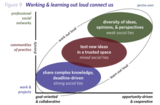
There is no such thing as a social business strategy.
There are only business strategies that understand networks.
Cooperative and distributed work is becoming the norm in the network era.
Social learning is how work gets done in networks.
Sharing power, enabling conversations, and ensuring transparency are some of the values of networked business.
Trust emerges when these principles are put in practice.
Learning is part of work, not separate from it.
It has been eleven years since I started blogging here. To mark the anniversary, this excerpt from finding perpetual beta is a summary of what I believe are some of the most important issues facing organizational design today.
Chaos, Complexity, Complication
Chaos is a state in which the only appropriate response is to do something quickly, as in an emergency. Chaotic situations require action. Organizations should try to avoid chaos. Complex environments are not chaotic but they cannot be completely understood in advance. Weather systems are complex. Patterns can be sensed and responses prepared, but each case is different. Emerging practices need to be developed while staying engaged with complex systems. Pretty well all human systems are complex. Complicated environments, on the other hand, have many pieces but they can be understood with enough analysis. An airplane is complicated.
Many traditional management practices assume the business system is complicated and understandable, given enough time to analyze it. This is perhaps the major flaw of industrial management. Most of our difficult organizational problems are actually complex. They cannot be understood except in hindsight. Each time we deal with a complex environment it is different. This means we cannot repeat what we did before and expect the same results. Instead, complex situations require constant small probing actions that are safe to fail. We can only understand complexity through active experiments, accepting that perhaps half of these will fail. Encouraging failure, and learning from it, must be the default management mode in complex environments.
Collaboration & Cooperation
Complex problems require cooperation while complicated projects need collaboration. Collaboration is working together on a common problem, while cooperation is freely sharing without any objective. Cooperation is not team work. It is helping the entire organization, as one would support a natural commons, and this requires people who are not just doing their job, but involved in the whole system. This is a major change in how business functions have been managed. Knowing what is complicated, and what is complex, can help the organization develop the appropriate work practices. Less structure and more flexibility is required for complex problems.
In complex environments, how can an organization build awareness, investigate alternatives, and act on problems, to become a triple-A enterprise? The organization needs to connect the outside with the inside. This is not a technology challenge but rather a structural one. Organizations need to help knowledge flow and this only happens when people are connected. Technology is a facilitator, but people are the key. This is too often overlooked, as in most enterprise social network implementations, where training is bolted on at the end of the technology build. Encouraging awareness, experimenting with alternatives, and taking action can each be supported within a unified organizational framework.
Social Learning
We already have the communication technologies to know what is happening across any organization. Most companies are also listening attentively to external social media. Given all this information, it is an easy next step to let people experiment, as long as they share what they are doing. Practices such as working out loud help build trust. In an age when information is no longer scarce and connections are many, organizations have to let all workers actively share their knowledge. To succeed in the creative economy, organizations require a combination of actively engaged knowledge workers, using optimal communications tools, all within a supportive work structure.
We are at the beginning of another management revolution, similar to the one that created modern business schools and their scientific methods. There are many examples today of companies testing out new management models such as the social enterprise, democracy in the workplace, self-organizing work teams, and networked free-agents. While there are no clear answers, it is fairly certain that standing still will lead to failure. Giving up control is the great challenge for management.
Networked Leadership
Organizations have to become knowledge networks. An effective knowledge network cultivates the diversity and autonomy of each worker. Networked leaders foster deeper connections, developed through ongoing and meaningful conversations. They understand the importance of tacit knowledge in solving complex problems. Networked leaders know they are just nodes in the knowledge network and not a special position in a hierarchy. The new focus of management has to be on supporting human networks.
For further elaboration on these subjects, see finding perpetual beta
Harold Jarche
.
Blog
.
<span class='date ' tip=''><i class='icon-time'></i> Aug 19, 2015 08:49am</span>
|
|
Every fortnight I collate some of the observations and insights that were shared on social media. I call these Friday’s Finds.
@johnrobb - "If you don’t own bots, bots will own you. Bots (software and hardware) are the capital & labor of the future in one package."
@goonth - "If people don’t know how to communicate, relate and interact, then tools are just tools. Businesses & markets depend on human competencies."
@Nynetjer-Maat-AtenRa - "If I plant seeds in the earth and get vegetables, did I create those veggies or the earth?"
It’s cheaper and easier to rent an MBA than to hire one - via @AchimMuellers
Across all industries, self-employed jobs rose 7% during that time, soaring through the frothy web development days of the 2000s but dropping precipitously during the latest recession. The numbers began to tick up last year.
Because the model shifts the risk and responsibilities once borne by big companies onto individual workers, critics decry the burden on the lower-income workforce. But for high-skilled workers there are great benefits to being able to decide when, where, and how they work.
@snowded - Rendering plants for people
When I first designed and programmed decision support systems on mainframes we were even worse, charging for times and MIPS. So if you were a poor programmer then the client got charged more. Time is not a measure of value, but manufacturing models of consultancy as opposed to artisan ones by their nature assume it is.
The Revolution in Syria Nobody’s Talking About - via @mbauwens
In the cantons of Rojava, there is a small central government with an absolute minimum of 40% female delegates, but most of the day-to-day work of running society happens at a local level, street by street and village by village. Democratic Confederalism’s chief architect, Abdullah Ocalan, says that "Ecology and feminism are central pillars" of the system he has spearheaded, something that you would have to go very far to the margins to hear from Western politicians. In Rojava, men who beat their wives face total ostracism from the community, making their lives in a highly social, connected society virtually impossible. Instead of a police force and jails, ‘peace committees’ in each municipality work to defuse the cycles of inter-family revenge killings by consensual agreements between both sides - and it works.
@mintzberg141 - Enough Leadership: Time for Communityship
How can you recognize communityship? That’s easy. You have found it when you walk into an organization and are struck by the energy in the place, the personal commitment of the people and their collective engagement in what they are doing. These people don’t have to be formally empowered because they are naturally engaged. The organization respects them so they respect it. They don’t live in mortal fear of being fired en mass because some "leader" hasn’t made his or her numbers. Imagine an economy made up of such organizations.
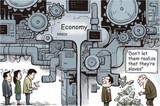
"Don’t let them realize they’re slaves," by Jang Bong-koon @HankyorehNews - via @BlueAnWhiteArmy
Image: Jang Bong-koon
Harold Jarche
.
Blog
.
<span class='date ' tip=''><i class='icon-time'></i> Aug 19, 2015 08:49am</span>
|
|
"Are there new ways to think about our digital workplace skills that allows us to take our thinking up to a new plane, the next meta-level of thinking and working where we have much higher leverage, can manage change that is an order of magnitude or greater in volume than today, work in fundamentally better and smarter new ways — and perhaps even work a bit less — yet produce much more value?"
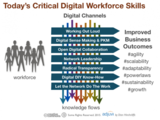
Dion Hinchcliffe asks What Are the Required Skills for Today’s Digital Workforce? and provides an image that addresses a good spectrum of skills for the network era.
I would like to add my perspective to each of these seven digital workplace skills.
Working Out Loud
Without learning out loud, working out loud can become mere noise (e.g. look at what I am doing!). Without taking action on ideas, working out loud is mere whimsy. But when complex work, the driver of the creative economy, gets a stream of new ideas that have been developed in trusted communities of practice, which are informed by even broader social networks, then we have the foundation for a true digital workplace.
Learning out loud in our social networks helps to seek new opinions and share our own with a diverse group of people. Outside the organization we can make new connections without permission. In addition, trusted spaces, like communities of practice, give us a place to take our half-baked ideas and test them out, with minimal risk. Meanwhile, we can sharpen these ideas and share them in our digital workplaces when we discern the time is appropriate. All of this is an art, requiring ongoing practice, and countless negotiated conversations and relationships.
Digital Sense Making + Personal Knowledge Management [Mastery]
PKM is a set of processes, individually constructed, to help each of us make sense of our world and work more effectively. If it is not personal, it is not PKM. Connecting people and knowledge is the focus of personal knowledge mastery. PKM builds reflection into our learning and working, helping us adapt to change and new situations. It can also help develop critical thinking skills. The discipline of PKM helps each person become a contributing node in a knowledge network. It is the foundation for social learning, which can help us develop new network era infrastructures to replace outdated institutions and markets. The PKM Seek > Sense > Share model may be simple, but it has multiple layers, such as diversifying our networks, adding value to what we find, curating for later use, and developing new skills to enhance communication: like storytelling.
I use the term ‘mastery’ instead of ‘management’ because PKM is a discipline. It takes time to master. Even if you participate in one of my workshops, you do not gain mastery. This is a difficult concept for managers who want everyone in the organization to have the required skills in ‘X’ months. Human learning does not happen this way. Mastery of a discipline is more than attending a course and taking a test. This is why I do not offer certification in PKM. It would be a useless piece of paper. Instead, recognition by one’s peers [the network] as a master, is an indicator of success.
Open Digital Collaboration
I differentiate between collaboration and cooperation. Collaboration is working together for a common goal, often with someone in charge. Cooperation is sharing freely amongst equals. Cooperating is a way of nourishing our knowledge networks. Cooperation is not reciprocal, so that what you give does not equate to what you get. This is the nature of networks and goes against many workplace practices, such as staying focused on your job. Being cooperative, so that the entire network gets stronger, helps individuals and organizations in the long run. Cooperation is missing in most workplaces, but as many freelancers already understand, cooperation pays off in the network era.
Network Leadership
Network leadership focuses on building better work structures. It consists of strengthening social networks, so that people can connect to do their work better. Network leaders practice and promote personal knowledge mastery, so everyone takes responsibility for sense-making and knowledge-sharing. Active experimentation is encouraged through constant learning by doing, as best practices are useless in dealing with complexity. Business results emerge from the entire network, while everyone is responsible in a transparent and open organization. Network leaders are builders. They focus on creating a more social workplace first and foremost.
Network leadership is helping the network make better decisions.
Radical Transparency
The social contract that we call employment has been changing for a while. Unions are shrinking, the self-employed are growing, and low wage service jobs are becoming our largest growth sector. What can unite us is our ability to easily connect with each other, without traditional intermediaries. Seb Paquet calls this "ridiculously easy group-forming".
In a digital workplace, the role of management is to give workers a job worth doing, the tools to do it, recognition of a job well done, and then let them manage themselves. Working smarter means using social media tools, which are inherently designed for transparency, and doing something worthwhile. Social media are the equivalent of an industrial factory for each worker.
Digital DIY Know-How
We can always learn from the edges of the economy and society, where creativity is usually in higher supply. Take for instance the hacker, defined as "one who enjoys the intellectual challenge of creatively overcoming or circumventing limitations". Playfulness, cleverness, and exploration constitute essential parts of creativity as well. Like hacking, creativity requires an ongoing commitment. We cannot merely take creative time; it has to be part of our workflow. David Williamson Shaffer says that we need to make space for conversations in order to be creative.
"Creativity is a conversation - a tension - between individuals working on individual problems and the professional communities they belong to."
Behaviour change comes through small, but consistent, changes in practice. So how do we move from responsibility, to creativity, and potentially to innovation? Play, explore, and converse. But first we need to build a space to practice. This is where management plays a key role: providing the space to ‘Do it Yourself’.
Letting the Network Do the Work
In an age when information is no longer scarce and connections are many, organizations must let all workers actively manage their knowledge networks. Systemic changes are sensed almost immediately in an interconnected world. Therefore reaction times and feedback loops have to get faster. Workers need to know who to ask for advice at the moment of need. However, this requires a certain level of trust, and we know that trusted relationships take time to nurture. The default action in emergencies is usually to turn to our friends and trusted colleagues; those people with whom we have shared experiences. Workers have to start sharing more of their work experiences now, in order to grow their trusted professional networks to deal with new and more complex situations. Practices like learning out loud can build trust.
Sharing complex knowledge in trusted networks does not happen overnight. It requires a combination of actively engaged knowledge workers, using optimal communications tools, all within a supportive organizational structure. Hierarchies, concentrated power, and control are remnants of market dominance and institutional dynamics. Networks are different, for better and worse.
"It’s all about thriving in networks that are smarter and faster than you are. It’s all about being utterly screwed if you don’t know what I’m talking about." - Hugh MacLeod
Harold Jarche
.
Blog
.
<span class='date ' tip=''><i class='icon-time'></i> Aug 19, 2015 08:48am</span>
|
|
It has been over 10 years that I have examined, practiced, and developed models for personal knowledge management/mastery. Here are some reflections on how my thoughts have evolved over that decade.
PKM shifts responsibility
I started down the path of personal knowledge mastery in 2004, inspired by Dave Pollard, Denham Gray, and others.
"To a great extend PKM [personal knowledge management] is about shifting responsibility for learning and knowledge sharing from a company to individuals and this is the greatest challenge for both sides. Companies should recognise that their employees are not "human resources", but investors who bring their expertise into a company. As any investors they want to participate in decision-making and can easily withdraw if their "return on investment" is not compelling. Creativity, learning or desire to help others cannot be controlled, so knowledge workers need to be intrinsically motivated to deliver quality results. In this case "command and control" management methods are not likely to work.
Taking responsibility for own work and learning is a challenge for knowledge workers as well. Taking these responsibilities requires attitude shift and initiative, as well as developing personal KM knowledge and skills. In a sense personal KM is very entrepreneurial, there are more rewards and more risks in taking responsibility for developing own expertise." - Lilia Efimova
Early Tools
I identified my blog as the main platform by which I try to make implicit knowledge (e.g. not codified or structured) more explicit, through the process of writing out my thoughts and observations of what I had come across in my work or on the web. In addition, I played with several feed readers (currently Feedly) and a series of social bookmark platforms (Furl; Magnolia; Delicious; Diigo).
After two years, I realized that because my website was searchable, I was able to easily retrieve thoughts and comments. This was practical for presentations, papers, proposals, and responding to questions. After just two years, I saw my blog as a valuable productivity tool, and comments and links from others added even more value.
A KM Replacement
By 2009, I saw PKM as the missing component of most enterprise KM efforts. I noted that the mainstream application of knowledge management, and I would include learning management, over the past decades had got it all wrong. Organizations over-managed information because it was easy to do. Organizations are still enamoured with information technology. However, the ubiquitous information surround of the Web may put a stop to this. As enterprises become more closely tied to the Web, the principle of "small pieces loosely joined" was beginning to permeate industrial walls. More and more workers were finding their own sources of information and knowledge, outside the organization
My suggestions for organizational KM was as follows [I still would recommend these]:
Develop measures that can help experienced knowledge workers capture and make sense of their knowledge.
Support the sharing of information and expertise between knowledge workers, on their terms, using personalized knowledge management methods & tools.
Keep only essential information, and what is necessary for inexperienced workers, in the organizational knowledge base - keep it simple.
Every Model is Flawed
"essentially, all models are wrong, but some are useful" - George Box
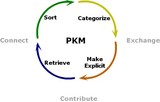
My first elaborated model consisted of four internal actions (Sort, Categorize, Retrieve, Make Explicit) and three externally focused ones (Connect, Contribute, Exchange).
c. 2009
It was not a great success, because few people could remember it.
There were many other PKM models put forth, in addition to Lilia’s original work. For me, there was little doubt that something like PKM was necessary to keep up in the network era. By late 2009, I described PKM as our part of the learning contract.
It is becoming more difficult to make sense of the world by ourselves. Understanding issues that affect our lives takes significant time and effort, whether it be public education, universal health care, or climate change. Even the selection of a mobile phone plan requires more than mere numeracy and literacy. We need context to understand complex issues and this can be provided by those we are connected to. The reach and depth of our connections become critical in helping us make sense of our environment and to solve problems. Problem-solving is what most people actually do for a living, so doing it better can have widespread effects. With social learning, everyone contributes to collective knowledge and this in turn can make organizations and society more effective in dealing with problems.
PKM is an individual, disciplined process by which we make sense of information, observations, and ideas. In the past it may have been keeping a journal, writing letters or having conversations. These are still valid, but with digital media we can add context by categorizing, commenting, or even remixing it. We can also store digital media for easy retrieval. However, PKM is of little value unless the results are shared by connecting to others, and contributing to meaningful conversations. The whole is greater than the sum of the parts as we build on the knowledge of others. As knowledge workers or citizens, PKM is our part of the social learning contract. Without effective PKM at the individual level, social learning has less value.
By 2010, others were interested in PKM and I taught a one-day course at the University of Toronto. I kept on playing with the model, looking for a metaphor to describe it. Here is how I explained Aggregate > Understand > Connect: in order to enhance serendipity.
Aggregate - looking for good sources of information (people) - noting or tagging pieces of information while working collaboratively.
Understand - saving information for later - considering how it may be useful in various contexts - making sense of it - finding the right information, at the right time, in the right format, from the information repositories of our subject matter networks.
Connect - ongoing conversations while learning and working including connecting ideas and people.
Enhanced Serendipity - PKM increases the chances of serendipitous learning. and as Louis Pasteur said, "Chance favours the prepared mind". According to Ross Dawson: "You cannot control serendipity. However you can certainly enhance it, act to increase the likelihood of happy and unexpected discoveries and connections. That’s is what many of us do day by day, contributing to others like us by sharing what we find interesting."
However, later that year I had a brief moment of inspiration with Seek > Sense > Share. I knew this worked, when a client quoted it back to me a few days after I mentioned it. At that time, I also came up with my working definition of PKM: a set of processes, individually constructed, to help each of us make sense of our world, work more effectively, and contribute to society.
PKM is an enabling process for wirearchy: "a dynamic two-way flow of power and authority based on knowledge, trust, credibility and a focus on results enabled by interconnected people and technology". Distributed power and knowledge are key components. Effective knowledge management (KM) really is dependent on effective PKM processes, but standardizing PKM destroys its value.
More recently I have been looking at PKM as it fits into KM. I was inspired by Patti Anklam’s work on Big, Little, and Personal KM, and developed this model:
c. 2013
I further developed this model to show how a simple approach to KM could be applied.
c. 2014
A simple approach to KM in the organization is to look at it as three interdependent levels. First, PKM must be practiced by all workers. It should focus on implicit knowledge, like anecdotes and observations. The format should be very loose so it stays personal. The key is to allow and support the practice of PKM so that more knowledge will be shared. Forcing PKM does not work. PKM can be facilitated by an enterprise social network like Jive or Yammer, but an ESN often forces a one-size fits all approach if it is the only knowledge-sharing tool available.
The next level is group KM, which focuses on teams and projects narrating their work to ensure as much common understanding as possible. One critical component of work narration is the capture of how exceptions are handled in order to get this information to anyone who may need it in the future. This does require some type of social sharing platform, and this is where an ESN can be quite useful. It is the group’s responsibility to curate exceptions in a format that is accessible to all. Some exceptions can become rules, leading to the next level of KM.
The simplest level is enterprise KM, which ensures that important decisions are recorded, codified, and easily available for retrieval. This is mostly explicit knowledge that ensures the organizational memory remains clear on what key decisions were taken and why others were not. Over time, this becomes more valuable. Focusing mainly on decision memories ensures that enterprise KM does not require significant resources but does yield useful results. The ESN can be the source of the flow that later becomes the stock of enterprise KM.
Enterprise social networks can help bridge personal and enterprise knowledge, connecting knowledge flows to knowledge stocks, but there has to be something on each side of that bridge. One critical side is PKM, for this is the source of implicit knowledge, a key to innovation.
Innovating with PKM
Innovation has been described as a combination of observing; questioning; experimenting; and networking. This correlates with Seek > Sense > Share in PKM.
c. 2012
Accepting PKM, as a flowing series of half-baked ideas, can encourage innovation and reduce the feeling that our exposed knowledge has to be ‘executive presentation perfect’. Workplaces that enable the constant narration of work and learning in a trusted space can expose more implicit knowledge. Organizations can foster innovation by accepting that collective understanding is in a state of perpetual Beta. A culture of innovation can be created by changing daily behaviours, which the practice of PKM can do.
Today, PKM is being used in a variety of fields, as organizations transition to the network era. It is being used in national healthcare, corporations, mental health, undergraduate and graduate studies. Perhaps the best impetus for PKM was developing an online workshop with exercises spread over time, as one-day on-site workshops provided too much information for many participants. The PKM in 40 Days format was inspired by my friends at Link2Learn in the Netherlands. The next public workshop begins on 16 March, and we are also starting a custom program for United Cities & Local Governments next week.
And the PKM story continues …
Harold Jarche
.
Blog
.
<span class='date ' tip=''><i class='icon-time'></i> Aug 19, 2015 08:48am</span>
|
|
"So it is important to understand that there is no one-size-fits-all philosophy in terms of successful innovation. The one constant is that you have to be open to change and new points of view. Innovation is continuous.
Successful innovators and entrepreneurs all embrace change and the risks that they pose. In fact, innovation is the poster child of the mantra that there are no rules. Only by trying out new things, by failing, by discovering what works and what doesn’t, do you gain answers to the innovation question." - Shaun Coffey
This is a continuation of my last post, where I said that innovation and PKM were interconnected. Innovation has been described as a combination of observing; questioning; experimenting; and networking. This correlates with Seek > Sense > Share in PKM.
Innovation and Learning
Practising PKM, as a flowing series of half-baked ideas, can encourage innovation and reduce the feeling that our exposed knowledge has to be ‘executive presentation perfect’. Workplaces that enable the constant narration of work and learning in a trusted space can expose more implicit knowledge. Organizations can foster innovation by accepting that collective understanding is in a state of perpetual Beta. A culture of innovation can be created by changing daily behaviours, which the practice of PKM can do.
Innovation is not so much about having ideas as it is about connecting and nurturing ideas. When we remove artificial boundaries, we enable innovation. In complex situations, where various people are working on similar problems, it is important to know who has done what. The challenge for distributed teams and organizations is to find ways of understanding what is happening throughout the system and ensuring it is communicated within the network.
The connection between innovation and learning is evident. We can’t be innovative unless we integrate learning into our work. Here are some questions that the practice of PKM can address:
How do I keep track of all of this information?
How do I make sense of changing conditions and new knowledge?
How can I develop and improve critical thinking skills?
How can we cooperate?
How can I collaborate better?
How can I engage in problem-solving activities at the edge of my expertise?
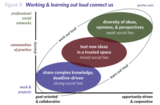
We seek new ideas from our professional social networks and then filter them through more focused conversations with our communities of practice, where we have trusted relationships. We make sense of these embryonic ideas by doing new things, either ourselves, or with our work and project teams. We later share our creations, first with our teams and perhaps later with our communities or even our networks. We use our understanding of our communities and networks to discern with whom and when to share our knowledge.
One challenge of finding new knowledge is that social networks are comprised mostly of non-core knowledge. There is often more noise than signal. However, given their diversity, social networks are where we can find innovative ideas. This is why PKM skills are so important for organizations today. Testing new knowledge is where communities of practice can be handy. Gaining competitive knowledge is the obvious return on investment for fostering internal and external communities of practice.
So here is a clear value proposition. Communities of practice act as filters of new knowledge in order to find competitive knowledge for your organization. People who understand the context of the work teams must participate in communities of practice, as only they can identify what new knowledge could be competitive. That means that those doing the work need time and support to get away from their teams and see the bigger picture.
Innovation at Work
Steven Johnson, author of Where Good Ideas Come From, observed that, "innovation prospers when ideas can serendipitously connect and recombine with other ideas" and that the "secret to organizational inspiration is to build information networks that allow hunches to persist and disperse and recombine". The network era workplace requires both goal-oriented collaboration and opportunity-driven cooperation, because complex problems cannot be solved alone. Implicit knowledge, that which cannot be codified or put into a database, needs to flow. Social learning, developed through many conversations, enables this flow of implicit knowledge. This is not ‘nonsense chat’, as traditional management might view it, but is essential for creating stronger bonds in professional social networks. Companies have to foster richer and deeper connections which can only be built over time through meaningful conversations. Social learning in the workplace is necessary for any business.
Narration is making implicit knowledge (what one feels) more explicit (what one is doing with that knowledge). Also known as ‘working out loud’, this can be a powerful behaviour changer, as long-term bloggers can attest. Narration can take many forms. It could be a regular blog; sharing day-to-day happenings in activity streams; taking pictures and videos; or just having regular discussions. Narrating work also means taking ownership of mistakes. This requires a culture of openness: making sure that sharing is the default mode for all communications. But people inside organizations, and professional communities, are often afraid to challenge conventional wisdom, even when the data are overwhelming. The power structure exerts great pressure to conform. Only organizations that share power and encourage conflict can advance different ideas. Openness alone cannot drive change.
With 3 billion people connected by the Internet, we are entering a post-industrial network era. Effective knowledge networks are composed of unique individuals working on common challenges, together for a discrete period of time before the network shifts its focus again. We are moving from a ‘one size fits all’ attitude on work and learning to an ‘everyone is unique’ perspective. The network enables infinite combinations between unique nodes. Our interconnectedness is resulting in an increasing number of discoveries from non-traditional areas. In addition, in a networked world, where everyone is unique, there is little need for generic work processes (jobs, roles, occupations) and no need for standard curricula. Institutions, and their mindsets, will collapse. This includes process improvement.
Process improvement is a tool set, not an overarching or unifying concept for an organization. Process improvement is a means and not an end in itself. The fundamental problem with process improvement methodologies is that you get myopic. Methodologies like Six Sigma are great for speeding up assembly lines or minimizing errors, but they fail to produce new ideas.
New ideas come from openness. In complex and changing markets, innovation has much higher business value than merely coordinating internal tasks or improving processes. In trusted networks, openness enables transparency, which in turn fosters a diversity of ideas. Supporting the creation of social networks can increase knowledge-sharing which can lead to more innovation, because chance favours the connected company.
We are all Innovators
Instead of asking, what have you done for the company this week, we should be asking what ideas you have had and what have you done to test them out? It might get us away from measuring and doing things that should be automated in the first place. Automation is not a bad thing if you know what to do with the extra time it provides. Organizations need more innovation catalysts. For example, Domino’s Pizza used the PKM framework to make learning a real-time activity within the flow of work, in order to develop innovation catalysts.
"Catalysts are bound to rock the boat. They are much better at being agents of change than guardians of tradition. Catalysts do well in situations that call for radical change or creative thinking. They bring innovation, but they’re also likely to create a certain amount of chaos and ambiguity. Put them into a structured environment and they might suffocate. But let them dream and they’ll thrive." - The Starfish and the Spider
An organization that accepts a certain amount of ambiguity can follow my suggested principles of network era ‘unmanagement’, as opposed to scientific management: It is only through innovative and contextual methods, the self-selection of the most appropriate tools and work conditions, and willing cooperation, that more productive work can be assured. The duty of being transparent in our work and sharing our knowledge rests with every person in the enterprise.
c. 1911
Innovative and contextual methods mean that standard processes do not work for exception-handling or identifying new patterns. Self-selection of tools puts workers in control of what they use, like knowledge artisans whose distinguishing characteristic is seeking and sharing information to complete tasks. Equipped with, and augmented by, technology, they cooperate through their networks to solve complex problems and test new ideas. This only works in transparent environments.
Innovation is not about smart individuals, but rather is a distributed network activity, which is why it is critical for enterprises to nourish their knowledge networks.
Harold Jarche
.
Blog
.
<span class='date ' tip=''><i class='icon-time'></i> Aug 19, 2015 08:47am</span>
|
|
Every fortnight I collate some of the observations and insights that were shared on social media. I call these Friday’s Finds.
@ericgarland - "Humility is often painful, but arrogance is always fatal."
"The very reason I write is so that I might not sleepwalk through my entire life." - Zadie Smith - via @ShaunCoffey
Healthcare with fewer managers with @josdeblok
"Jos de Blok is a nurse. He owns a company that employs 9,000 community nurses in Holland. The company has only 45 administrators, about a 10th of the average for a company that size.
The company, Buurtzorg, is the highest rated care organisation in Holland, as rated by patients. It is the highest rated employer in the country for 3 out of the last 4 years.
Its overheads are 8% vs the average of 25%. Imagine how much extra money you have we would have for patient care if we could copy this. Its employee sickness rate is about half that of similar organisations.
The company is 7 years old and now has 60% of the community nurses and community patients in the country. Nurses are leaving their old companies in droves.
Instead of managers, hierarchy and bureaucracy the nurses manage themselves in teams of about 12 nurses. They employ their own staff, order their own supplies, solve their own problems. And they love it!"
Your HR Department Hates You: How Corporate Overseers Exploit Workers
"The rebranding of "personnel" to "human resources" signaled that employees were now resources to be managed like any other capital, such as finances, office equipment and property. Like a copy machine, it suggested that humans were to be used as much as possible and discarded when they wore out or their usefulness came to an end."
The Eccentric Genius Whose Time May Have Finally Come [Albert Weiner]
Besides nuclear weapons, Wiener was perhaps most worried about the technology he was most directly responsible for developing: automation. Sooner than most, he recognized how businesses could use it at the expense of labor, and how eager they were to do so. "Those who suffer from a power complex," he wrote in 1950, "find the mechanization of man a simple way to realize their ambitions."
How the future of work leads to the future of organisations - by @rossdawson
"Work. There are two critical drivers of change in work: connectivity and machine capabilities. As we are connected almost any work can be done anywhere in the world, with richer interfaces enabling greater comfort with remote work and the ability to perform physical labour. Increased capabilities of robots and computers are matching and moving beyond those of humans in many cases, destroying jobs. There is the potential for these forces to reduce employment and polarise work opportunities. However we can also envisage and create a future of work in which job creation exceeds job destruction, and we make work increasingly human, tapping our expertise, creativity, and aptitude for relationships to create a more prosperous world."
Harold Jarche
.
Blog
.
<span class='date ' tip=''><i class='icon-time'></i> Aug 19, 2015 08:47am</span>
|
|
"It has been said that democracy is the worst form of government except all the others that have been tried." - Winston Churchill
Our society has tried many ways to organize work over the years, yet real democracy is a form that few have attempted. The need to control people runs deep in our work cultures. Managers have ‘direct reports’ and humans are regarded as ‘resources’. The need for command and control stems from inadequate means to effectively communicate. But in the past decade we finally have the circumstances where almost anyone can communicate with almost everyone. Hyperlinks have truly subverted hierarchy, even though institutional and market hierarchies are doing their utmost to prevent or control this. Oligopolies control most of our communications media, even democratic states run surveillance operations on their citizens, and many workplaces monitor all mediated communications. These are reactionary attempts to stop what has the potential to be the inevitable spread of democracy.
Why do we need democracy? It is the only way humans will be able to organize in order to deal with the complex problems facing us. Our intangible marketplaces, like the app economy, will continue to be highly volatile. Climate change and environmental degradation cannot be addressed by any existing institution. New approaches to solving wicked problems are required if humanity is to thrive or even survive into the next century.
There is sufficient evidence to show that people can be exceptionally innovative under certain conditions. Working in a machine-like organization is not one of them. Organizing according to biological principles is our best path forward. We need to use organizations merely as a medium to connect individuals to their environment, not as an end in themselves, nor as a way to concentrate wealth. The role of every organization must be to improve its environment, as that is where it draws its sustenance. The only reason individuals should join any organization is because they share a common purpose. Hierarchies may be needed to get work done, but they have to be mutually agreed-upon and temporary. Organizations should be seen as temporary structures to improve the state of humanity. Anything less is rather primitive.
Working in a truly democratic fashion requires changes at all levels, from the law, to labour legislation, and especially in our educational institutions. It also requires an aggressively intelligent citizenry, which should be the focus of all our public institutions. As Thoreau said, "Disobedience is the true foundation of liberty. The obedient must be slaves." The democratic workplace will be messy. But the alternative is worse. It is time to give up our mechanical toys and embrace a more complex way of interacting. There is no need for measured hours of work controlled by managers, only work for real value, as viewed by our fellow human beings.
Thinking for ourselves is the foundation of a new way of working. This requires an understanding of the whole environment in which we work. Artificial structures like jobs remove our ability to see the whole system. As we learn to think for ourselves, we must also connect with others. We are only as smart as our knowledge networks. But we do not need someone to manage our connections. The simple guideline of self-direction, often enabled by network technologies, can create beautifully complex relationships amongst interconnected people. This is already happening outside the organization. We need to bring it inside. For the first time, we have the technology for democracy at work. The writer, Gwynne Dyer, has observed that, "Tyranny was the solution to what was essentially a communications problem". This problem no longer exists.
The principles of the network era workplace are simple. It is only through innovative and contextual methods, the self-selection of the most appropriate tools and work conditions, and willing cooperation, that complex problems can be addressed. This requires creative work based on passion, creativity, and initiative. The duty of being transparent and sharing our knowledge rests with all workers. Chance will favour the democratically connected company.
Related
Hierarchies in Perpetual Beta
The Post-hierarchical Organization
Harold Jarche
.
Blog
.
<span class='date ' tip=''><i class='icon-time'></i> Aug 19, 2015 08:47am</span>
|
|
Every fortnight I collate some of the observations and insights that were shared on social media. I call these Friday’s Finds.
@EskoKilpi - "The Internet is the first communication environment that decentralises the financial capital requirements of production"
@goonth - "The web hasn’t been democratized, contrary to popular belief. But it is definitely heading in that direction, albeit with quite a fight."
@skinny - "There is no authority without responsibility. There is no responsibility without authority."
What I believe to be true about organisational culture, by @sonjabl
"In reality, culture emerges and evolves. When we think about the culture of a society or country, it is easy to see it’s evolutionary nature, yet in organisations we are prone to thinking that we can design and engineer an ideal culture and instill associated behaviours. This often leaves us with a cynical organisation that resists or ignores our culture interventions as they’ve seen too many of these initiatives never come to fruition."
Road Captain by @indalogenesis
"Like a good project manager or internal consultant in the corporate world, the cycling road captain can lead from the front, from behind, from the side or from the shadows. They coach, mentor and enable others, serving as social connectors between riders on the road and the support teams behind the race. They are master craftsmen, big-picture thinkers who improvise strategy on the fly. They are decision makers who unite teammates in common purpose, maintaining that unity through both failure and success. They are champions of the framework within which the team operates, the glue that holds the team together."
Five decades on, what can Marshall McLuhan’s Understanding Media tell us about today? via @marciamarcia
"All media, from the phonetic alphabet to the computer, are extensions of man that cause deep and lasting changes in him and transform his environment. Such an extension is an intensification, an amplification of an organ, sense or function, and whenever it takes place, the central nervous system appears to institute a self-protective numbing of the affected area, insulating and anesthetizing it from conscious awareness of what’s happening to it. It’s a process rather like that which occurs to the body under shock or stress conditions, or to the mind in line with the Freudian concept of repression. I call this peculiar form of self-hypnosis Narcissus narcosis, a syndrome whereby man remains as unaware of the psychic and social effects of his new technology as a fish of the water it swims in. As a result, precisely at the point where a new media-induced environment becomes all pervasive and transmogrifies our sensory balance, it also becomes invisible."
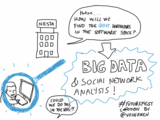
Cartoons from NESTA Futurefest 2015 conference by @voinonen
Image by Virpi Oinonen
Harold Jarche
.
Blog
.
<span class='date ' tip=''><i class='icon-time'></i> Aug 19, 2015 08:46am</span>
|
|
Michelle Ockers has been working hard at incorporating social learning in the workplace, as her posted case study shows. After reading, finding perpetual beta, Michelle asked me to elaborate on a few points. These are her questions, and my attempt to address them.
1) What are practical steps to create post-hierarchical organisations, particularly in regard to how to distribute power?
We finally have the technology, so that even business no longer needs to be run as a tyranny. Jonathan Gifford examines how Ricardo Semler changed his company, and describes 10 ways that democracy can be promoted in an organization, beginning with small, symbolic changes that make a big difference.
"Semler ended random searches aimed to prevent petty theft of stock. He took away ‘the big time clock at the main gate’ and introduced many smaller time clocks; employees were ‘requested’ not to clock-in their colleagues.
He eliminated dress codes. Manual workers, who were given work overalls, were invited to choose the colour of these overalls (petroleum blue: smart, but good at disguising the most typical workplace stains). Executive parking spaces were done away with.
‘Democracy,’ writes Semler, ‘begins with little things like neckties, time clocks, parking spaces and petroleum blue uniforms.’"
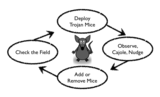
Another approach is to deploy Trojan mice (small, well-focused changes, which are introduced on an ongoing basis in an inconspicuous way). Deploy several at a time, then observe what happens. Cajole and nudge them and then add or remove as needed. Many attempts will fail so there’s little use in reinforcing these. Then take another look at the entire field (company or ecosystem), and see where else you might deploy more mice. Repeat.
2) How can we function effectively in a networked world, including how to be a great Connector or Catalyst?
Connectors are people with many relationships who find it easy to talk to people. The challenge for the organization is to use these skills to improve knowledge-sharing. Connectors can be identified through observation, interviews, or social network analysis. To become knowledge catalysts, connectors need to have good curation skills. They have to know how to add value to knowledge and discern when, where, and with whom to share.
Experts have deep knowledge on a subject but many lack the skills to synthesize what they know in order to share it with a broader audience. It is critical that experts share their knowledge so the organization can make better decisions. This is a leadership responsibility. Expertise in a closed room is of little use in a connected enterprise. Experts need to develop skills in working out loud and other sense-making practices. Connectors can help them but first there has to be something to share. Getting experts to share in a meaningful way can take time but first it requires a supportive environment and some basic skills, like PKM.
If an organization wants to get meaningful results by adopting PKM practices, but does not see how this can be implemented throughout the organization, then an initial pilot should identify two groups: Connectors and Experts. Help these people improve their PKM skills. Get Connectors to add value and be more discerning. Get Experts to simplify in order to share. It will take time and practice but the benefits will be an organization that can use more of its knowledge to make better decisions. Catalysts may emerge from this group. More Catalysts in the enterprise may also significantly improve innovation because it is inextricably linked to both networks and learning.
We should be asking everyone in the organization what ideas they have had and what have they done to test them out. It might get us away from measuring and doing things that should be automated in the first place. Automation is not a bad thing if we know what to do with the extra time it provides. Organizations need more innovation catalysts. Learning is a real-time activity within the flow of work, and when embraced by the organization, can develop innovation catalysts. But catalysts will disturb the status quo.
"Catalysts are bound to rock the boat. They are much better at being agents of change than guardians of tradition. Catalysts do well in situations that call for radical change or creative thinking. They bring innovation, but they’re also likely to create a certain amount of chaos and ambiguity. Put them into a structured environment and they might suffocate. But let them dream and they’ll thrive." - The Starfish and the Spider
Augmented by technology, knowledge catalysts cooperate through their networks to solve complex problems and test new ideas. But this only works in open and transparent environments. So the first step is always to open the organization and remove barriers to knowledge-sharing. Innovation is not about smart individuals, but rather is a distributed network activity, which is why it is critical for enterprises to nourish their knowledge networks.
3) How can we facilitate / support the development of healthy networks and communities within an organisation and beyond organisational boundaries?
In networks, cooperation trumps collaboration. Collaboration happens around some kind of plan or structure, while cooperation presumes the freedom of individuals to join and participate. Cooperation is a driver of creativity. Stephen Downes clearly explains the difference.
"collaboration means ‘working together’. That’s why you see it in market economies. markets are based on quantity and mass.
cooperation means ’sharing’. That’s why you see it in networks. In networks, the nature of the connection is important; it is not simply about quantity and mass …
You and I are in a network - but we do not collaborate (we do not align ourselves to the same goal, subscribe to the same vision statement, etc), we *cooperate*"
Collaboration happens around some kind of plan or structure, while cooperation presumes the freedom of individuals to join and participate. If workers only collaborate they will miss out on serendipitous connections made through cooperation. As a result, innovation may actually decrease. This is what happens when you slavishly adhere to process improvement models like Sick Stigma and ignore how humans relate in networks and communities. Supporting cooperative actions, that may not have an impact on short-term profit, will enhance the potential for long-term benefits to the entire business system.
4) How can those of us not in senior roles influence those who are to embrace the idea that we are in the networked era and to act to create post-hierarchical organisations?
Mavens (Experts) exhibit the greatest intellectual capital while Connectors have the most diverse (creative) networks, and Salespeople (Catalysts) get things done (action). However, Experts are often not as trusted in comparison to Connectors as they can lack the intimacy skills of Doers, Connectors and Catalysts (Salespeople). Many experts are very deep into their field and may be less interested in the general trends. Consider that people who popularize research, like Malcolm Gladwell, are often much more successful than those whose research their books are based on.
Image: TrustedAdvisor.com
Experts need champions, like Connectors, but Catalysts also need to find and connect to Doers. Network leadership can emerge from the Doers. Consider a social business initiative. We know that the main advantage of using social media is increasing speed of access to knowledge. We also know that very little of the knowledge we use on the job is stored in our heads, so there is a clear, logical reason for being more transparent and connected in our work. However, we also know that changing practices and developing a new sharing culture takes a lot of time and effort. Finding and engaging trustworthy people in the network may be a good place to start. The critical role may be the Doer, the most trusted of all, and the future leader in a networked organization.
Harold Jarche
.
Blog
.
<span class='date ' tip=''><i class='icon-time'></i> Aug 19, 2015 08:45am</span>
|
|
Managers need to be given non-traditional roles in order to become key units of intelligence in the organization. They will then have the mission to come back to pollinate intelligence throughout the organization.
However, managerial innovation is primarily reflective and collaborative. This is a real challenge in terms of societal evolution!
Making business intelligent is providing our organizations the opportunity to become more humanistic, which would in my view be a real proof of intelligence. - Marine Auger [l’originale en français à la fin]
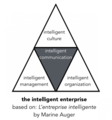
These are the concluding paragraphs of Marine Auger’s book, Et si vous rendiez votre entreprise intelligente? which I have loosely translated. It is accompanied by an image showing the three components of an intelligent enterprise: organizational; managerial; and cultural. These are supported by the foundation of intelligent communication.
On examining this model, I found four methods that could be used to start building such an enterprise (follow links for details).
Intelligent communication requires an openness for learning. Working and learning out loud is evident when everyone in the organization is practicing personal knowledge mastery. It is how we can communicate our emerging intelligence with our peers.
An intelligent organization embraces democracy and self-governance.
Intelligent management is based on networked leadership.
An intelligent culture adapts to life in perpetual beta.
Image updated 30 March
L’originale en français:
Pour devenir l’un des éléments de l’intelligence de votre entreprise, celle-ci doit également s’employer à opérer la mutation nécessaire pour rendre les managers agiles en leur donnant d’autres rôles que ceux jusqu’alors distribués. Car c’est à eux que reviendra la mission de libérer et de polliniser l’intelligence au sein de vos organisations.
L’innovation manageriale est avant tout réflexive et collaborative. Au-delà d’être un veritable enjeu en termes d’évolution sociétale!
Rendre l’entreprise intelligente c’est offrir à nos organisations la possibilité de devenir plus humanistes, ce qui serait à mon sens une véritable preuve d’intelligence.
Harold Jarche
.
Blog
.
<span class='date ' tip=''><i class='icon-time'></i> Aug 19, 2015 08:44am</span>
|