Blogs
|
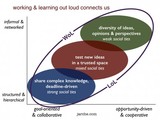
Working out loud is a way to ensure others know what you are doing and to be conscious of your own work. It is being mindful of your work and how it may influence others. But working out loud is nothing if there is no time taken for reflection. Learning out loud takes you to a different level; one that may seem even more precarious. It’s sharing your half-baked ideas with the world. But these ideas, combined with others over time, can build a resilient web of innovation.
Working out loud connect us as professionals and humans. It is a highly social activity. It also exposes us, so it requires trust. While we may get interesting ideas from our informal networks, such as on social media, we still need trusted spaces to test things out. A place to test new ideas is often the missing link between doing work and leisure time. We may see something interesting while engaging on social media at night, but when it comes time to go to work, there is no easy way to make the connection. At work we need to stay focused. We might have a chance for a quick chat over lunch, but for the most part we focus on getting things done.
While there is some current impetus behind working out loud at work, the concept falls apart if it does not connect outside the workplace. If not, WoL is just an echo chamber. When there is no place to test ideas in a trusted space, how can an individual’s ideas translate into new ways of doing things? We need others to help us. We have to test ideas together, but not under the constraints of deadline-driven projects. Helping make space, such as communities of practice, is an essential first step in enabling working out loud, and most importantly, reaping its benefits.
Working and learning out loud are integral parts of personal knowledge mastery. In our social networks they help us to seek new opinions and share our own with a diverse group of people. We can seek new connections without permission. Trusted spaces, like communities of practice, give us a place to take half-baked ideas and test them out, with minimal risk. Meanwhile, we can sharpen these ideas and share them in our workplaces when we discern the time is appropriate. All of this is an art, requiring ongoing practice, and countless negotiated conversations and relationships. I have likened it before to a dance hall.
Working out loud is definitely part of PKM but it is a varying practice, depending on the place and time. Without learning out loud it is just noise. Without experimentation it is merely whimsy. But when complex work, the driver of the creative economy, gets a stream of new ideas that have been developed in trusted communities of practice, which are informed by even broader social networks, then you have the foundation for a connected enterprise. Companies can deal with complexity by becoming learning organizations, engaging in continuous seeking, sense-making, and sharing of knowledge.
Harold Jarche
.
Blog
.
<span class='date ' tip=''><i class='icon-time'></i> Aug 19, 2015 09:07am</span>
|
|
In business, attention is paid to innovative individuals, especially those who go on to become captains of industry. But of more importance is the ability of the network (society, organization, company) to stay connected to its collective knowledge in order to keep innovating. Just think how quickly an organization would its lose collective knowledge if people did not share their knowledge. What about an entire society?
You start out with two genetically well-intermixed peoples. Tasmania’s actually connected to mainland Australia so it’s just a peninsula. Then about 10,000 years ago, the environment changes, it gets warmer and the Bass Strait floods, so this cuts off Tasmania from the rest of Australia, and it’s at that point that they begin to have this technological downturn. You can show that this is the kind of thing you’d expect if societies are like brains in the sense that they store information as a group and that when someone learns, they’re learning from the most successful member, and that information is being passed from different communities, and the larger the population, the more different minds you have working on the problem.
If your number of minds working on the problem gets small enough, you can actually begin to lose information. There’s a steady state level of information that depends on the size of your population and the interconnectedness. It also depends on the innovativeness of your individuals, but that has a relatively small effect compared to the effect of being well interconnected and having a large population. - How Culture Drove Human Evolution
Is your organization more like an isolated island or part of a connected and diverse continent? Are your knowledge networks large and diverse enough to ensure that collective knowledge does not get lost? These are serious questions to ask at another time of rising sea levels.
Innovation is not brilliant flashes of individual insight but collective learning through social networks. No networks, no learning.
In an effort to understand what drives the accumulation of cultural information, his colleague Hannah Lewis developed a mathematical model that can simulate how new cultural traits - technological inventions, traditions, or knowledge - arise and disappear over generations. With this model, [Kevin] Laland and Lewis plugged in various forms of innovation (inventing something outright, or modifying or combining existing inventions), as well as trait loss - losing knowledge through inaccurate transmission of information. They ran these simulations through 5,000 cycles, looking to see which factor had the biggest impact on the final richness and diversity of traits.
Accurate transmission of information had a massive impact on the outcome: with this model, increasing the fidelity of cultural transmission just a bit yielded huge increases in the amount and variety of culture. ‘It doesn’t matter how much novel invention or refinement is going on: if you don’t have accurate transmission you simply cannot build up culture,’ says Laland. ‘It was a real insight.’ - Imitation is what makes us human & creative
Imitation is how we learn as a species. This is social learning, best explained by Albert Bandura, recognized as the most eminent psychologist of the modern era.
"Learning would be exceedingly laborious, not to mention hazardous, if people had to rely solely on the effects of their own actions to inform them what to do. Fortunately, most human behavior is learned observationally through modeling: from observing others one forms an idea of how new behaviors are performed, and on later occasions this coded information serves as a guide for action." - Albert Bandura
If we want to innovate we need to work on the structures and systems that promote imitation - open access to information, wide distribution of knowledge, and easy copying. The focus of innovation has to be on we, not me. If we can make our knowledge-sharing networks stronger, then human nature can take care of the rest.
Harold Jarche
.
Blog
.
<span class='date ' tip=''><i class='icon-time'></i> Aug 19, 2015 09:07am</span>
|
|
Here are some observations and insights that were shared on social media this past fortnight. I call these Friday’s Finds.
"Power always thinks it has a great soul & vast views beyond the comprehension of the weak. - John Adams" via @JusticeWillett
You Are Not the Product: The Coming Revolution in Social Networks - by @gideonro
This idea that we are just products for advertisers pops up in lots of online conversations, a reflection of the current state of our advertising-driven social networks. These networks were built on TV’s old business model of "I sell your eyeballs and give you interesting stuff to watch in exchange." They’ve just modified that model a bit so that now, in addition to attention, we also surrender our personal data. Oh, and now we’re the ones supplying most of that "interesting stuff" to watch.
That’s why I’ve gotten excited over a flurry of recent announcements painting an alternative vision for social networks:
Reddit announced its intention to take a portion of its $50 million in recently raised venture capital and give it back to the community of people who built in the first place.
Ello, a brand new social network, just committed to never selling ads, never selling your data and never selling out to another company that would.
Tsu, another new social network, rolled out an aggressive, revenue-sharing model for end users.
Synereo announced plans for a fully distributed social network built on Bitcoin technology that will also compensate end users for their contributions.
The Surprising Truth About Where New Jobs Come From - by @stevedenning
"Both on average and for all but seven years between 1977 and 2005, existing firms are net job destroyers," write Wiens and Jackson, "losing 1 million jobs net combined per year. By contrast, in their first year, new firms add an average of 3 million jobs."
"New businesses account for nearly all net new job creation and almost 20 percent of gross job creation, whereas small businesses do not have a significant impact on job growth when age is accounted for." - Kauffman Foundation
Why it matters that networks in organizations and social systems are shifting to power-law distributions - by @rossdawson
* Networks are fundamental not just to our communications but to many aspects of our lives.
* There are many network topologies. One of the most important is ‘scale-free’ networks, in which the structure is identical irrespective of its size.
* The internet has maintained the same scale-free structure throughout its growth over the last 21 years.
* Scale-free networks develop through ‘preferential attachment‘, in which better-connected nodes tend to get more connections, in a version of ‘the rich get richer’.
Engineering serendipity - via @chumulu [sounds like PKM]
So, I’m staking my own claim: Serendipity is the process through which we discover unknown unknowns. Understanding it as an emergent property of social networks, instead of sheer luck, enables us to treat it as a viable strategy for organizing people and sharing ideas, rather than writing it off as magic. And that, in turn, has potentially huge ramifications for everything from how we work to how we learn to where we live by leading to a shift away from efficiency — doing the same thing over and over, only a little bit better — toward novelty and discovery.
"The difference between freedom and slavery is one thin line." - @thereaIbanksy
Harold Jarche
.
Blog
.
<span class='date ' tip=''><i class='icon-time'></i> Aug 19, 2015 09:06am</span>
|
|
"The Future’s So Bright, I Gotta Wear Shades" - Timbuk3
Complication
Many of today’s larger companies have overly complicated, hierarchical structures. As they grew to their current size, control processes were put in place to create efficiencies. To ensure reliable operations and avoid risk, work became standardized. New layers of supervision appeared, more silos were created, and knowledge acquisition was formalized, all in an attempt to gain efficiency through specialization. Support departments, like human resources, were added to manage the resulting complicated structure.
Complexity
These organizations are now facing increasingly complex business environments that require continuous learning while working. Typical strategies of optimizing current business processes or reducing costs only marginally influence the organization’s overall performance. Faster market feedback challenges the organization’s ability to act. Decision-making becomes paralyzed by process-based operations and the formal chain of command.
Hierarchies assume that management knows best and that the higher up the hierarchy, the more competent and knowledgeable that person is. But hierarchies are just centralized networks. They work well when information flows mostly in one direction: down. Hierarchies are good for command and control. They are handy to get things done in small groups. But hierarchies are rather useless to create, innovate, or change. Hierarchies are ineffective when things get complex.
In an interconnected world, systemic changes are sensed almost immediately. Therefore reaction times and feedback loops have to get faster. In addition, workers are dealing with increasingly complex situations, as software takes over routine work. Workers need more trusted relationships to share complex knowledge. But these take time to develop. Sharing knowledge in trusted networks does not happen over night. Complex problems cannot be solved alone. They require the sharing of tacit knowledge, which cannot easily be put into a manual. Tacit knowledge flows best in trusted networks. This trust also promotes individual autonomy and can become a foundation for organizational learning, as knowledge is freely shared. Without trust, few people are willing to share their knowledge.
Learning and Work
Guild Sign: Master Painter
For thousands of years people developed work skills through apprenticeship. This worked for small numbers and developed into the highly structured guild system in Europe. Industrialization marked the fall of the guild system. The industrial economy adopted a new management frameworks, which included something called ‘human resources’. But the industrial economy no longer drives the developed world. We are shifting to a creative economy.
In this new economy we have to change how we think about learning and work. The most significant change is in how we deal with information and knowledge. We no longer have to go to the library to get a book and we have access to a growing network of expertise from people, like bloggers, who are willing to share their knowledge for free. Expertise is becoming ubiquitous through the Internet and professional social networks. One’s position in the hierarchy is no longer an indicator of one’s influence or knowledge. As a result, many are challenging the hierarchical nature of the organization in a creative economy.
Human Resources
Recruiting, talent management, professional development, and every other area of HR is trying to deal with the post-industrial workplace. Most business leaders see that the Internet is changing their business. They understand that automation is a force to be reckoned with. However, many do not have a clue where or how to start. The old ways of thinking are still firmly entrenched but we cannot deal with the new era in the same way we managed the old one. Leaders need to understand what they are dealing with and use the appropriate methods. First they need to understand the difference between chaotic, complex, and complicated situations.
Chaotic situations require action; complex problems demand cooperation; and complicated projects need collaboration. Cooperation differs from collaboration, in that cooperation means freely sharing with no expectation of direct benefit. Cooperation is not team work. It is helping the entire organization, and this requires people who are not just doing their job, but involved in the whole system.
Most of our current human resources practices assume the system is complicated and understandable, given enough time to analyze it. But more of our problems are complex and cannot be completely understood except in hindsight. Complex situations require small probing actions that are safe to fail. We can only understand complexity through active experiments, accepting that perhaps half of these will fail. Encouraging failure, and learning from it, must be encouraged in complex environments. This should be the focus of human resources in a creative economy.
How can an organization build awareness, investigate alternatives, and act on complex problems? The organization needs to connect the outside with the inside. This is not a technology challenge but rather a structural one. Organizations need to help knowledge flow and this only happens when people are connected. Technology is a facilitator, but people are the key. This is too often overlooked, as in most enterprise social network implementations, where training is bolted on at the end of the technology build. Encouraging awareness, experimenting with alternatives, and taking action can each be supported within a unified organizational framework. Human resources can play an active role in such a framework.
New Work Structures
We have communication technologies to know what is happening across any organization. Most companies are also listening attentively to external social media. Given all this information, it is easier to let people experiment as long as they share what they are doing. Practices such as working out loud help build trust. In an age when information is no longer scarce and connections are many, organizations must let all workers actively share their knowledge. To succeed in the creative economy, organizations require a combination of actively engaged knowledge workers, using optimal communications tools, all within a supportive work structure.
We are at the beginning of another management revolution, similar to the one that created modern business schools and their scientific methods. There are many examples today of companies testing out new management models such as the social enterprise, democracy in the workplace, self-organizing work teams, and networked free-agents. While there are no clear answers, it is fairly certain that standing still will lead to failure. Giving up control is the great challenge for human resources management.
Organizations have to become knowledge networks. An effective knowledge network cultivates the diversity and autonomy of each worker. Networked leaders foster deeper connections, developed through ongoing and meaningful conversations. They understand the importance of tacit knowledge in solving complex problems. Networked leaders know they are just nodes in the knowledge network and not a special position in a hierarchy. The new focus of human resources has to be on supporting human networks.
Harold Jarche
.
Blog
.
<span class='date ' tip=''><i class='icon-time'></i> Aug 19, 2015 09:06am</span>
|
|
It’s International Working Out Loud Week, also known as #WOLWeek. Working Out Loud is a relatively new term for me, picking it up from John Stepper in 2012. I have used the term, narrating your work, which to me is the same thing, though some may differ. My observation is that combining transparency (in the workplace) with narration (of work) results in increased serendipity, or more chances of fortuitous outcomes. My own working out loud on this blog has resulted in speaking opportunities and meeting interesting clients. The more you give, the more you get; though not in any way how you may have expected it.
Simon Terry recently asked me, "Who inspires you to practice and learn as you work out loud?"
Initial inspiration for PKM came from Lilia Efimova, whose blog was a view on her doctoral research into knowledge-sharing. Without Lilia’s insight, I may not have started on this decade-long sense-making journey.
Dave Snowden’s views on complexity and knowledge management have informed much of my work, and I have watched his thoughts evolve over time, shared through his blog. I believe I found Dave through either Rob Paterson or Jon Husband, two fellow travelers along the road, freely sharing their experiences.
My biggest inspiration has been the hundreds, and now thousands, of bloggers who have shared their thoughts and actions. The list is too long, but if you have been reading my blog, you will know who has inspired my thinking. Just follow the links. The examples of so many others has made it much easier to continue working and learning out loud in this little corner of what used to be called the blogosphere. I owe everything to my blog and the ability to participate out loud in a worldwide network.
I also looked through my bookmarks to see what I have been inspired to collect on the topic of narration and WoL.
Glyn Moody: Thinking and Working Out Loud (2006)
In fact, I’d go further: blogging has become my notebook and general repository of digital bits and bobs. Whenever I find something of interest (to me), I usually bung it up; I hope that it will be of interest to others, but that’s really secondary. A blog is as much a very practical tool for my everyday work as an exercise in itself.
Dan Brodnitz: An Interview with Bob Holman (2007)
Well, you don’t even have to work out loud to hear. Do you see words pop up in front of your head? Only when I heard the poet Robert Creeley read did that work for me, because he placed each word in the air the way his words are placed on the page. Generally, as Whitman and Ginsberg have stated, the line in a poem equates to the breath. It is a physical thing. What I’m doing when I’m writing is, I’m hearing the words. Even if I’m not talking, I’m listening as I’m creating.
Dave Weinberger: Public Learning (2012)
Software developers have created an incredible educational environment for themselves that supports the idea of "public learning"…learning in a way that simultaneously makes the environment smarter.
John Tropea: There’s no need to report on what you’ve been doing (2013)
So let’s be clear on this … Your colleague is not "informing you" of the latest happenings on the task by leaving a reply on the task object. eg "so I contacted IT, they did this for me, but it wasn’t right, so we did this instead, and it worked". This is what we are used to, whether we hear it on the phone, read it in an email, or read it on a social software status update
Instead your colleague is executing the raw work (conversations) on the task object. And you witness the conversation unfold. You don’t need your colleague to report to you a bunch of stuff they did, cause you witnessed all those bits in that bunch as it happened.
There’s no need to report on what you’ve been doing, when we’ve seen you doing it.
So why do we need meetings anyway?
@gapingvoid
Harold Jarche
.
Blog
.
<span class='date ' tip=''><i class='icon-time'></i> Aug 19, 2015 09:06am</span>
|
|
I spoke at the UNL Extension conference in Nebraska last week. The theme was on the changing nature of work as we enter the network era and how learning is becoming integral to individual and organizational success. I noted how the period of 1900 to 1920 saw a significant shift in the American economy, with manufacturing replacing farming as the dominant economic activity. The resulting demographic shift was millions of men leaving farms and moving to factories. The Cooperative Extension program was created in 1914 while this shift was taking place. One hundred years later and we are witnessing a similar shift, from the industrial economy to the network era and a creative economy. For a deeper look at this phenomenon, see Nine Shift.
Today, knowledge-based work is replacing manufacturing jobs. Robots and software are displacing routine work. Meanwhile, collaborative work is dominating both transactional and production work. The future of valued, human work is in addressing complex problems and coming up with creative solutions.
One major difference between the 21st century and the work shift of the last century is that there are no jobs waiting for displaced workers today. One hundred years ago farm hands could move to the city and get a job. Today, the future of work is not in the form of a job. This may be a shock to those already in the workforce but it is an accepted reality amongst many younger people.
With creative work, much of the knowledge required is implicit. It cannot be found in a manual or text book, and there is no training program to become creative. Informal learning, often with peers, is how how creative workers have learned through the ages. We need to take the best aspects of what the artist studios and artisan guilds offered and find ways to replicate these. Social experiments, such as co-work spaces and crowd-funded projects, are emerging in the creative economy.
Networks are beginning to replace hierarchies as the organizational model to get work done and exchange value. Jobs are relics of hierarchies. In networks, there is no need for standardized and replaceable jobs. Every node is unique, which strengthens the overall network. In a network, relying on standard approaches only erodes trust, as it does not treat each node as an individual. Knowledge networks are built on human relationships and trust emerges over time.
How can an organization like Cooperative Extension adapt to the network era? First, it needs to structure as a network because the initial design of the organization influences everything else. Creating the best, and most human, environment for people to get work done should be the only job of a CEO.
Social networks have to be supported so that people can connect to do their work better. Frameworks such as personal knowledge mastery ensure that everyone takes responsibility for sense-making and knowledge-sharing. By practicing PKM, everyone can engage in critical thinking. All workers should continuously question the contexts in which they are working.
Active experimentation in the organization can be encouraged through constant learning by doing, as established best practices are useless in dealing with complexity. Everyone needs to be connected to the goals of the organization (network), not just doing their job. Results will emerge from the entire network, when everyone is responsible in a transparent and open organization.
A networked organization is more resilient and flexible. We do not know what the future will hold but it will be more complex. The ability to learn by doing will enable organizations to actively engage their communities and societies. Freedom will not be in independence but interdependence, which is something we can retrieve from 19th century America.
The book, Democracy in America, is, I think, the most useful book I know to help understand who we are. And he [de Tocqueville] says, if I can summarize him in a rather gross form, that he came here and he found a society whose definitions and solutions were not created by nobility, by professionals, by experts or managers, but by what he identified as little groups of people, self-appointed, common men and women who came together and took three powers: the power to decide there was a problem, the power to decide how to solve the problem - that is, the expert’s power - and then the power to solve the problem. These little groups of people weren’t elected and they weren’t appointed and they were everyplace, and they were, he said, the heart of the new society - they were the American community as distinct from the European community. And he named these little groups "associations" . Association is the collective for citizens, an association of citizens. And so we think of our community as being the social space in which citizens in association do the work of problem-solving, celebration, consolation, and creation - that community, that space, in contrast to the space of the system with the box at the top and lots of little boxes at the bottom. And I think it is still the case that the hope for our time is in those associations. - The Careless Society, John McKnight
Harold Jarche
.
Blog
.
<span class='date ' tip=''><i class='icon-time'></i> Aug 19, 2015 09:05am</span>
|
|
If you conduct workshops, finding activities that relate to your themes can be a challenge. I have used one activity several times, first in Toronto in 2011. A while later, over a beer in Copenhagen, I met Nick Martin, who was beginning to develop a new website, WorkshopBank, to share ideas on ice-breakers and other workshop/training activities. He liked my use of the equilateral triangles collaboration exercise and it is now posted. In perusing Nick’s site, there are at least two new exercises I plan to try out.
Culture Triangle: A team building motivational activity that helps separate teams or organizations understand each other better with a view to improving collaboration.
Prisoner’s Dilemma (aka Reds & Blues): Prisoner’s Dilemma is a fantastic team building game which demonstrates whether people display win-win (co-operative) or win-lose orientation (selfish competitive) in a fun situation which offers the possibility of both.
If you have other workshop ideas you would like to share, contact Nick and join the community. I think this is a resource that many people will find useful.
Harold Jarche
.
Blog
.
<span class='date ' tip=''><i class='icon-time'></i> Aug 19, 2015 09:04am</span>
|
|
"I remember regularly reiterating the question, while out at the pub with fellow disillusioned colleagues, or after conferences with newfound allies from other dysfunctional NGOs, How have we ended up creating organisations that are meant to create good in the world, but make so many of those involved in them so miserable in the process?" - Liam Barrington-Bush
Anarchists in the Boardroom, by Liam Barrington-Bush, is a comprehensive read showing how organizations can apply the 3 principles of ‘more like people’ organizations:
Humanity: What can we learn from ourselves?
Autonomy: Trusting ourselves and others to be brilliant
Complexity: Moving from cogs to consciousness
Anarchists in the Boardroom covers individual change, work change, and structure change in a very detailed manner. The intended audiences are non-profit organizations. The book describes 5 reasons why hierarchies suck: assume the worst in people; foster dishonesty; expect leaders to be superheroes; waste time; lack of context for decision-makers. It then goes on to show alternatives.
"Humanity, autonomy and complexity can offer us some guidance as to the steps each of us might take to influence better working cultures. Complexity tells us that culture change cannot be orchestrated, given the number of interdependent relationships it would have to shift, but that cultures move based on any of those individual relationships changing themselves in a way that resonates more widely."
The book finishes with practical advice on how to get started, and provides a long list of specific actions. The personal changes are pragmatic but the work and structural changes have to be done by those in power. While hierarchies may suck, they exist and they have great influence. This book would be best for people who have the power to change organizations. There are plenty of anecdotes and references in its 274 pages and it is worth adding to your inventory of organizational change books.
Here’s one of the stories that Liam shares:
Why an NGO funded a cock-fighting ring in Honduras
So the story goes like this:
An NGO wanted to build a school in a rural community in Honduras. Educational attainment was low there and the opportunities for schooling were minimal, so the choice seemed to make sense.
But when it was proposed to the community, the women of the pueblo came out against it.
The NGO staffers asked the women what they would prefer. Their answer? A cock-fighting ring.
The staff got uncomfortable, but asked why a cock- fighting ring would be of more benefit than a school.
Apparently, the next village over had a cock-fighting ring. On Fridays, after work, all the men in the village would take their pay and head to the neighbouring town and gamble away their income, often returning home empty-handed.
Because of this the children had to work, otherwise the families often wouldn’t eat.
So what would a school do, besides sit empty as the children made up for their fathers’ gambling habits?
The women proposed they could run the local cock- fighting ring cooperatively, so their husband’s losses could be reincorporated into the community. With a bit more money staying locally, their children would not have to work, thus paving the way for education, once hunger was no longer an issue.
Reluctantly, the brave NGO agreed, financing the new cock-fighting ring, and trusting the wisdom of the community, against their own - or their donors’ - best judgments from afar.
Harold Jarche
.
Blog
.
<span class='date ' tip=''><i class='icon-time'></i> Aug 19, 2015 09:04am</span>
|
|
The best way to understand your markets in the network era is by learning together. If markets are conversations, then the quality of your conversations will affect your value exchanges. Your markets will learn with or without your company. But when you learn with and from your customers, marketing and learning become the same. This is often lost in one-way broadcast marketing messages that are not directly connected to customer service or even product development. Network era marketing can benefit from a new learning focus. Marketing has to be connected to the rest of the company as well as the entire value network.
"People in networked markets have figured out that they get far better information and support from one another than from vendors. So much for corporate rhetoric about adding value to commoditized products." - Cluetrain
Work used to be fairly straight forward. You had a job, knew what to do, and were paid to do it. Then the Web appeared. Everybody got connected to almost everyone else. All these connections made things more complex. Some work was automated. Some of it outsourced. Much of it became more complex. Making sense of complexity, and developing ways to keep up, is the basis of personal knowledge mastery (PKM).
PKM is a framework for individuals to take control of their professional development through a continuous process of seeking, sensing-making, and sharing. Organizational learning is greatly enhanced when everyone practices some form of PKM. Learning while working can also be the basis of market conversations. Learning together starts by consciously learning ourselves.
As author Dan Pink remarked in his 2012 book To Sell is Human, in order to sell an idea, one must be able to distill its essence, or the one percent that gives life to the other ninety-nine percent - "Understanding that one percent, and being able to explain it to others, is the hallmark of strong minds".
Marketing and education have certain similarities - gaining attention; getting your message across; and changing behaviour. Much of our learning is through conversations with others. Without conversation (oral, written, graphical, physical) there are no social transactions. Without conversations, there are no relationships.
"Markets are relationships." - Doc Searls (co-author of the Cluetrain Manifesto)
Learning-oriented marketing, internal and external, is both getting the message across and understanding the needs of others. A great example of this is at Intuit, where training is part of the marketing department and involves the customer directly. At Intuit, customers are paid to develop content, and as one person wrote in a chat comment, "The e-Learning has kept my CPA husband loyal to Intuit versus Peachtree, etc."
Seeking is finding things out and keeping up to date. Building a community of colleagues is helpful in this regard. It not only allows us to "pull" information, but also have it "pushed" to us by trusted sources. We can then become knowledge curators for our networked markets.
Sense-making is how we personalize information and use it. Sensing includes reflection and putting into practice what we have learned. Often it requires experimentation, as we learn best by doing. This is called working out loud and shows our willingness to learn from others.
Sharing includes exchanging resources, ideas, and experiences with our network, making the network smarter. An important aspect of sharing is knowing when and with whom to share. As the writer Steven Johnson says in Where Good Ideas Come From; "Chance favors the connected mind." Therefore the more connections we make in seeking knowledge and sense-making, the more we will have to share when the opportunity arises.
Personal Knowledge Mastery is a sense-making framework that has been developed over the past decade. PKM can help improve insights through increased connections, enhance the potential for coincidences, and develop a discipline of curiosity. The best professionals in the network era, including marketing and sales, are those who are open to new insights.
The PKM framework has been used by the UK National Health Service, Domino’s Pizza, Bangor University, and hundreds of individual practitioners worldwide. Several workshops have been developed to practice the various skills that make up the discipline of PKM. Topics include critical thinking, curating, and working out loud. If markets are conversations, we need to learn from these conversations.
"Co-learning can differentiate services, increase product usage, strengthen customer relationships, and reduce the cost of hand-holding. It’s cheaper and more useful than advertising." - Jay Cross
Harold Jarche
.
Blog
.
<span class='date ' tip=''><i class='icon-time'></i> Aug 19, 2015 09:03am</span>
|
|
Here are some observations and insights that were shared on social media this past fortnight. I call these Friday’s Finds.
@doctorow - "Once you admit that luck was crucial to your success, you have to confront the terrifying possibility that your luck may run out someday."
@Mintzberg - "How many of us now realize the extent to which we have become the victims of our own economic structures?"
It is telling the extent to which economic vocabulary has infiltrated our everyday speech. Are you a human resource? a human asset? human capital? I am a human being. I do not "maximize value", whatever that means. (Trying to maximize anything is perverse.) I have no intention of competing, collecting, and consuming my way to neurotic oblivion. And if I am not cooperative alongside being competitive, selfless alongside being selfish, I am nothing.
BrainPickings.org on Anne Lamott’s ‘Small Victories’ via @SandyMaxey
The parental units were simply duplicating what they’d learned when they were small. That’s the system.
It wasn’t that you got the occasional feeling that you were an alien or a chore to them. You just knew that attention had to be paid constantly to their moods, their mental health levels, their rising irritation, and the volume of beer consumed. Yes, there were many happy memories marbled in, too, of picnics, pets, beaches. But I will remind you now that inconsistency is how experimenters regularly drive lab rats over the edge.
How Ayn Rand Helped Make the US Into a Selfish, Greedy Nation via @ross917
While Harriet Beecher Stowe shamed Americans about the United States’ dehumanization of African Americans and slavery, Ayn Rand removed Americans’ guilt for being selfish and uncaring about anyone except themselves. Not only did Rand make it "moral" for the wealthy not to pay their fair share of taxes, she "liberated" millions of other Americans from caring about the suffering of others, even the suffering of their own children.
@orgnet - Downsizing without social network analysis is like surgery in the dark
I can’t tell you how many times I have seen this situation: company downsizes/rightsizes, becomes more "lean and mean", and then in a few months, management scratches it’s collective head when things start to fall apart.
@hrheingold - Look who’s talking "If we decided that community came first, how would we use our tools differently?"
"We don’t want to be the kind of people who will interrupt a conversation at home to answer a telephone. It’s not just how you use the technology that concerns us. We’re also concerned about what kind of person you become when you use it." - Amish man
@SimonHeath1 - Ceci n’est pas un tweet
Image by Simon Heath
Harold Jarche
.
Blog
.
<span class='date ' tip=''><i class='icon-time'></i> Aug 19, 2015 09:03am</span>
|