Blogs
|
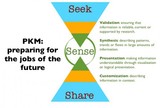
Ross Dawson says that people who have "learnt how to learn" will be better prepared for jobs of the future. "We’re finding people who have learnt how to learn know how to engage with a community and tap into others for support." This is what personal knowledge management is all about. It starts by seeking people and knowledge sources and the Seek-Sense-Share cycle finishes by sharing with communities and social networks. My recent workshops, both online and in person, indicate a need for PKM skills in all types of organizations and for people at all levels, from freelancers, researchers, managers, executives and more. The benefits are not just for individuals, preparing for their next job, but the organization gains from employees who take control of their learning and freely share their knowledge. PKM makes for more resilient individuals and companies.
Much of PKM is about finding balance. In seeking knowledge sources, we have to balance aggregation, or getting as much information as possibile, with filtering, or ensuring that we have more signal than noise. Our networks need to be diverse and varied in order to be exposed to new ideas, but we cannot keep track of everything, so we have to be judicious with our time. We need to constantly lump things together, such as with a feed reader, while filtering out the good stuff so we can find it again, such as with social bookmarks. It’s like breathing information in and out, while making sense of only a small portion at a time, sometimes built by many grains before trying to express our knowledge in order to make sense of it.
These processes are not taught in schools or training programes. There is no right answer in PKM. There are only processes that work. The test of PKM is whether it works for you. My experience is that a person’s PKM changes over time, and the most important aspect is being aware of how we seek sources of information, make sense of our own knowledge, and then share it at work, in communities or through networks.
As Helen Blunden has noted about her PKM, it’s about continuous learning.
It’s opened up a whole new world and it’s just made me eager to know more. It’s also made me realise that our learning will never stop - and we should get comfortable with that idea. (I believe the creativity is now coming from the "Seek" part of the model because information is not one-sided anymore; you get a variety of opinions, perspectives and angles and from a wider expanded network of people from all walks of life - different industries, different skillsets - my curiosity in life also helps me out here).
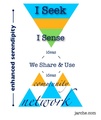
PKM practices can help make sense of the current environment, whether it be your profession, your job, or your areas of interest. A resilient learning network, that can develop from practising PKM, creates a more resilient framework from which to make decisions about the future. The more you give to your networks, the more you will receive. PKM provides a way to do this in a more structured, but personal, manner. The result is enhanced serendipity, always an advantage in a changing world.
The next online PKM workshop starts this Monday.
#itashare
Harold Jarche
.
Blog
.
<span class='date ' tip=''><i class='icon-time'></i> Aug 19, 2015 09:25am</span>
|
|
The title of this post is what Dan Pink, in his book To Sell is Human, would call a rhyming pitch. He also discusses the question pitch, and I followed his recommendation in the Pitch chapter and developed my own.
Are things more complex now, than they were five years ago?
Your Work? Your Markets? Your Customers? Your Profession?
I also developed a Pixar pitch:
Work used to be fairly straight forward. You had a job, knew what to do, and were paid to do it. Then the Web appeared. Everybody got connected to almost everyone else. All these connections made things more complex. Some work was automated. Some of it outsourced. Much of it became more complex. Making sense of complexity, and developing ways to keep up, is how I help people and organizations.
Finally I created a one-word pitch: SENSE-MAKING
The Pitch chapter also explains the Twitter pitch (140 characters) and the subject line pitch. These are all excellent exercises to focus on your business or mission, and I will continue to refine mine over time.
Here is Dan’s pitch to continue reading the book, subtitled "the surprising truth about moving others":
Here we confront a paradox. There are no "natural" salespeople, in part because we are all naturally salespeople. Each of us - because we’re human - has a selling instinct, which means that anyone can master the basics of moving others. The rest of the book will show you how.
I found the book quite compelling and much of what was covered, such as improv skills for business, are areas of interest for me. The chapter on Clarity was directly aligned with my work on personal knowledge management. In it, Beth Kanter is quoted using my Seek-Sense-Share framework in her Content Curation Primer and earlier post.
In this chapter, Dan also proposes that you seek out the "one percent".
Don’t get lost in the crabgrass of details, he [Pink's Law professor, Harold Hongju Koh] urged us. Instead, think about the essence of what you’re exploring - the one percent that gives life to the other ninety-nine. Understanding that one percent, and being able to explain it to others, is the hallmark of strong minds and good attorneys.
This is the essence of sense-making in PKM. It is about seeking information and knowledge and distilling it so that you can make sense of it and then it is ready to be shared. Seek, make-sense and share (then repeat).
Harold Jarche
.
Blog
.
<span class='date ' tip=''><i class='icon-time'></i> Aug 19, 2015 09:24am</span>
|
|
Catherine Lombardozzi writes, in Time for an Evolution:
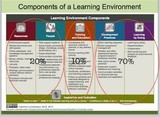
To those of you who feel like you just stepped into the middle of a conversation, a learning environment (to my mind) is a collect of resources and activities for learning. The resources may be inanimate or human; the activities may be formal or informal. A well designed learning environment is curated with a specific need in mind. It may be curated by an individual (as in a personal learning environment), by a group (such as a community of practice), or by a designer who is supporting a specific complex need that can’t be met by training or other formal programs alone.
I’ve been promoting learning environment design as a way of thinking about what we used to call blended learning, and as a way of capitalizing on informal learning resources by curating the best materials (in your judgment) and making them easily accessible by your learners.
I have taken her image and added a 70:20:10 overlay. This could serve as a decision support tool for allocating time and resources for organizational learning and development.
Harold Jarche
.
Blog
.
<span class='date ' tip=''><i class='icon-time'></i> Aug 19, 2015 09:23am</span>
|
|
As our markets and technologies get more complex, we need new models to get work done. For instance, we know that creative work can yield more innovation, yet our workplaces usually stifle creativity. Many of our practices are still premised on work being simple or complicated. Simple systems are easily knowable, whereas complicated systems, while not simple, are still knowable through analysis. These can be easily managed. However, complex systems are not fully knowable, though they can be partially understood through interaction with them. This is antithetical to many workplace control protocols.
Every day, jobs and work are getting automated and outsourced. If companies want to remain competitive in the global market, they need to focus on complex and creative work. Much of complex work is in exception-handling and when exceptions are the rule, rigid rules must become the exception.
We have to understand complex adaptive systems and develop work structures that let us focus our efforts on learning as we work in order to continuously develop next practices. In a knowledge-intensive and creative workplace the role of leadership becomes supportive and inspirational rather than directive. Artificial boundaries that limit collaboration and communication only serve to drag projects, and companies, down and create opportunities for more agile competitors.
A new mindset toward work is required. Frameworks like hyper-connected pattern-seeking or networked unmanagement can promote new perspectives on what valued work really should be. This can be fostered in a culture of perpetual Beta. Perpetual Beta means we accept never getting to the final release of our work, and that our learning will never stop. Organizations need to realize they will never reach some future point where everything stabilizes and they don’t need to learn or do anything new.
In additional to a new mindset, workers need autonomy. But many are not ready for it. We are trained early in life to look to authority for direction in learning and work. The idea that there is a right answer or an expert with the right answer begins in our schools. Too often, the message from the workplace continues to be that good employees wait for their managers to tell them what to do. This is counter-productive in dealing with complexity and working in perpetual Beta. It also destroys creativity. When we move away from a linear "design it first, then build it" mindset, we can then engage everyone in critical and systems thinking. Workers must be passionate, adaptive, innovative, and collaborative. Autonomy is the just beginning.
Fostering autonomy starts by looking at work differently. For example, dropping the notion of being paid for time is one way to start this change. An hourly wage implies that people are interchangeable. But no two minds are the same. Being paid for time fosters neither autonomy nor agility. There are many other human resource practices should be questioned and dropped, such as job competencies, or one-size-fits all training programs.
The new networked workplace requires both collaboration and cooperation. Complex problems cannot be solved alone. Tacit knowledge flows in networks through social learning. Learner autonomy is a foundation for effective social learning. It is the lubricant for a more agile organization. Agility becomes a necessity as we deal with increasing complexity. In order to develop the necessary emergent practices to handle complexity we therefore need to cultivate the diversity and autonomy of each worker. We also must foster richer and deeper connections which can be built through meaningful conversations. This is social learning in the workplace.
Change and complexity are becoming the norm in our work. We already see this with increasing numbers of freelancers and contractors. Any work where complexity is not the norm will be of diminishing value. Embracing complexity, and even chaos, is where the future of work lies.
As traditional core activities get automated or outsourced, almost all high value work will be done at the outer edge of organizations. At the fuzzy edge of the organization life is complex and even chaotic. On this periphery, where things are less homogenous, there is more diversity and more opportunities for innovation. Individuals, project teams and organizations have to move operations to the edge to continue learning and developing. In this century a greater percentage of workers will be moving to the edge. The core will be managed by very few internal staff. What does this mean for management? No matter what model one prefers, it will have to be more open, networked and cooperative. Are you ready to move to the edge?
Harold Jarche
.
Blog
.
<span class='date ' tip=''><i class='icon-time'></i> Aug 19, 2015 09:23am</span>
|
|
Here are some of the observations and insights that were shared via social media during the past week or two.
@paulbogush : "Needing to motivate a student is equivalent to jump starting a car. If you have to do it every day, something is wrong." via @surreallyno
The Atlantic: The End of Labor: How to protect workers from the rise of robots - via @RichardFlorida
The big question is: What do we do if and when our old mechanisms for coping with inequality break down? If the "endowment of human capital" with which people are born gets less and less valuable, we’ll get closer and closer to that Econ 101 example of a world in which the capital owners get everything. A society with cheap robot labor would be an incredibly prosperous one, but we will need to find some way for the vast majority of human beings to share in that prosperity, or we risk the kinds of dystopian outcomes that now exist only in science fiction.
Hacker in Residence - by @robpatrob
A tiny Trojan Mouse, such as Andy Carvin at NPR, Euan Semple or Peter Rukavina, can make a huge difference and move the entire organization. Tiny new things that contain the seeds of change.
If I was a CEO and wanted to create value from Big Data or from Social Media, I would set up a small office that reported to me and look for my own hacker in residence to be the agent and chief hacker. I would let them have a lot of space and time to discover things and I would give them access to everyone and to everything.
If I was the CEO of a big data firm or a firm that offered Enterprise Social Media, I would have a stable of such hackers and I would lend them out on yearly terms to my clients.
@DonaldClark : Failure led, spaced practice is better than training
Over nine months, 500 people in Booz Allen were initially given three types of training:
1. Placebo
2. Page-turning
3. Interactive
All three groups were then given surprise:
Three simulated phishing emails with remedial help if they failed i.e. spaced practice, learn through failure exercises.
>Based on actual simulated attacks, they discovered no significant difference between training and no training!
Pursuit of Everything: Question everything. Be deliberate. Sojourn beyond the boundaries. - via @boydjane
"The conscious and intelligent manipulation of the organized habits and opinions of the masses is an important element of democratic society. Those who manipulate this unseen mechanism of society constitute an invisible government which is the true ruling power of our country…’We are governed. Our minds are moulded, our tastes formed, our ideas suggested, largely by men we have never heard of’." - Edward Bernays (1928)
Harold Jarche
.
Blog
.
<span class='date ' tip=''><i class='icon-time'></i> Aug 19, 2015 09:22am</span>
|
|
"The basic unit of social business technology is personal knowledge management, not collaborative workspaces." - Thierry de Baillon
Personal knowledge management (PKM) is a set of processes, individually constructed, to help each of us make sense of our world and work more effectively. But what we loosely call knowledge, using terms like knowledge-sharing or knowledge capture, is often just an approximation. As knowledge management expert Dave Snowden says, we are not very good at articulating our knowledge; "We always know more than we can say, and we will always say more than we can write down."
Knowledge
When we use our knowledge to describe some data, such as what we remember from an experience or our summary of a book, we convey this knowledge by creating information, even though writing it down is not perfect. This does not mean that we shouldn’t even try, because the cumulative pieces of information, or knowledge artifacts, that we share can help us have better conversations and increase our understanding of things that cannot easily be codified. Our individual sense-making can be shared, and from it can emerge better organizational knowledge. This is not a linear process, as in from information we get knowledge, which over time becomes wisdom. Gaining knowledge is much messier than that.
Becoming knowledgeable can be thought of as bits of knowledge partially shared and experienced over time. It is laborious, hence the reason why masters through the ages could only have a limited number of apprentices. But when writing, and later books, came along, we had a new technology that could more widely distribute information created by the wise, and also the not so wise. Whether being mentored by a master or reading a book, knowledge does not actually get transferred, but shared observations and information can be helpful to those who have a desire to learn and do something with their learning.
Merely being well read is not enough to be knowledgeable, as possibly first noted by Socrates. Plato wrote in Phaedrus that Socrates felt the written language would result in "men filled, not with wisdom, but with the conceit of wisdom, who will be a burden to their fellows". Socrates saw a core truth in learning from artifacts like books. Even today, we cannot become complacent with knowledge and just store it away. It has a shelf life and needs to be used, tested and experienced. It should be shared amongst people who understand that they are only seeing a fragment of others’ knowledge. Because it is so difficult to represent our knowledge to others, we have to make every effort to continuously share it. Once is not enough, as most parents know. Knowledge shared in flows over time can help us create better mental pictures than a single piece of knowledge stock, like a book, can ever do.
Seek : Sense : Share
Capturing knowledge, as crudely as we do, is just a first step. The PKM framework I have developed over the past eight years suggests two more steps: sense-making and sharing. PKM, or learning in networks, is a continuous process of seeking, sensing, and sharing.
Seeking is finding things out and keeping up to date. Building a network of colleagues is helpful in this regard. It not only allows us to "pull" information, but also have it "pushed" to us by trusted sources.
Sensing is how we personalize information and use it. Sensing includes reflection and putting into practice what we have learned. Often it requires experimentation, as we learn best by doing.
Sharing includes exchanging resources, ideas, and experiences with our networks as well as collaborating with our colleagues. As Tim Kastelle notes:
Yes, when we send our ideas out into the world, they change the people with whom they interact.
But sending these ideas out, and seeing how they interact with people changes us as well.
Innovation
Scott Anthony, author of The Little Black Book of Innovation, identifies four skills exhibited by innovators: Observing; Questioning; Experimenting; Networking. These directly align with the PKM framework of Seek, Sense, Share. It is quite likely that innovation in organizations can be improved with individuals practising PKM. It could even be a major value proposition for Learning & Development departments everywhere, something to seriously think about.
Seeking includes observation through effective filters and diverse sources of information. Sense-making starts with questioning our observations and includes experimenting, or probing. Sharing through our networks helps to develop better feedback loops. In an organization where everyone is practising PKM, the chances for more connections increases.
PKM may be an individual activity but it is also social. It is the process by which we can connect what we learn outside the organization with what need to do inside. Research shows that work teams that need to share complex knowledge need tighter social bonds. Work teams often share a unique language or vocabulary. However, they can become myopic and may lack a diversity of opinions. Social networks, on the other hand, encourage diversity and can sow the seeds of innovation. However, it is almost impossible to get work done in social networks due to their lack of structure. PKM is the active process of connecting the innovative ideas that can arise in our social networks with the deadline-driven work inside organizations.
PKM is beneficial on both a personal and organizational level, but its real value is in increasing innovation. Without innovation, organizations cannot evolve.
Social Learning
Both collaborative behaviours (working together for a common goal) and cooperative behaviours (sharing freely without any quid pro quo) are needed in the network era. Most organizations focus on shorter term collaborative behaviours, but networks thrive on cooperative behaviours, where people share without any direct benefit. PKM helps to add cooperation to workplace collaboration.
In addition to seeking, sensing and sharing, we need to become adept at filtering information as well as discerning when and with whom to share. Like any skill, these require practice and feedback. Much of this feedback can be provided in communities of practice, a half-way space between work teams and social networks, where trusted relationships can form that enable to share more openly.?
Connecting social networks, communities of practice and work teams, becomes an important framework for integrating learning and working in the network era. We seek new ideas from our social networks and then filter them through more focused conversations with our communities of practice, where we have trusted relationships. We make sense of these embryonic ideas by doing new things, either ourselves, or with our work teams. We later share our creations, first with our teams and perhaps later with our communities of practice or even our networks. We use our understanding of our communities and networks to discern with whom and when to share our knowledge.?
Narration
Narrating one’s work does not get knowledge transferred, but it provides a better medium to gain more understanding. Working out loud is a concept that is very easy to understand, but not quite so easy to do. Most people are too busy managing in their information age workplaces and have little spare time to try to learn how to work in the network age. The most important step in learning a new skill is the first one. This same step has to be repeated many times before it becomes a habit.I have learned that the first step of starting to work out loud, as part of personal knowledge management, has to be as simple as possible. Here are three simple steps I recommend to begin a regular PKM practice with.
1) Free Your Bookmarks: This is a very simple shift that only requires a slight deviation from a common practice: saving bookmarks/favourites on your browser. Using tools like Diigo, or Delicious moves them off a single device, makes them more searchable, and (later) makes them shareable. Being able to share is usually not a prime reason why people start using social bookmarks but it becomes more important over time.
2) Aggregate: Driving as many information sources as possible through a feed reader such as Google Reader or Feedly, saves time and helps stay organized. It is amazing how many people still do not understand RSS or how to grab a feed and save it. Aggregation makes information flows much easier to deal with.
3) Connect: How does one get started micro-blogging on a platform like Twitter? I suggest beginning with an aim in mind, such as professional development or staying current in a specific field. The search function can help find people who post about a specific topics. To start, one should follow no less than 20 and no more than 30 interesting people. Once set up, beginners should dip into their stream once or twice a day and read through any posts of interest. Over time, as they follow links, they may add or delete feeds. Within a week or two, anyone should be able to sense some patterns and then modify their streams to provide more signal and less noise.
Sometimes we get all caught up in the latest social media tools. Getting started working out loud is not complicated and should not involve a steep learning curve on a complicated system. It is best to start with simple tools and frameworks.
Small pieces, loosely joined
The mainstream application of knowledge management and learning management over the past few decades has had it all wrong. We over-managed information, knowledge and learning because it was easy. Our organizations remain enamoured with the next wave of enterprise software systems. But the ubiquity of information outside the organization is showing the weakness of centralized enterprise systems. As organizations begin to understand the Web, the principle of "small pieces loosely joined" is permeating some thick industrial age walls. More workers have their own sources of information and knowledge, often on mobile devices, but they often lack the means or internal support to connect their knowledge with others to actually get work done. Supporting PKM, especially internal sharing, can help information flow more freely.
Personal knowledge management frameworks can help knowledge workers capture and make sense of their knowledge. Organizations should support the individual sharing of information and expertise between knowledge workers, on their terms, using PKM methods and tools. Simple standards like RSS can facilitate this sharing. Knowledge bases and traditional KM systems should focus on essential information, and what is necessary for inexperienced workers. Experienced workers should not be constrained by too much structure but rather be given the flexibility to contribute how and where they think they can best help the organization.
We know that formal instruction accounts for less than 10% of workplace learning. The same rule of thumb should apply to knowledge management. Capture and codify the 10% that is essential, especially for new employees. Now use the same principle to get work done. Structure the essential 10% and leave the rest unstructured, but networked, so that workers can group as needed to get work done. Teams are too slow and hierarchical to be useful for the network era. Organizations structured around looser hierarchies and stronger networks are much more effective for increasingly complex work.
Conclusion
PKM is a framework for individuals to take control of their professional development while working in organizations or across networks. Disciplined personal knowledge management brings focus to the information sea we swim in. The multiple pieces of information that we capture and share can increase the frequency of serendipitous connections, especially across disciplines and outside organizations. As Steven Johnson, author of Where Good Ideas Come From says; "chance favors the connected mind".
Harold Jarche
.
Blog
.
<span class='date ' tip=''><i class='icon-time'></i> Aug 19, 2015 09:22am</span>
|
|
They might all be called ‘social networks’, but Facebook is very different from Twitter, which is very different from Instagram, which is very different from Foursquare.
It’s quite likely that we’ll see a rise of niche-specific solutions, because a social intranet for realtors, who don’t spend much time in the office, must be very different from social intranet for software developers. The logic of business simply dictates it. - Dmitry Valyanov (Venture Beat)
Is there a need for a wide variety of enterprise social tools? This is what Valyanov, CEO of a cloud-based social intranet provider, asserts in his guest post on Venture Beat. Adding social (collaboration & cooperation) capabilities to existing productivity tools is a better approach than using a dedicated social platform, Valyanov suggests. If so, then Microsoft’s strategy with Office365, focused on tools first and collaboration second, may be on the right track.
As Aaron Golberg notes, enterprise collaboration platforms can have a tendency to use a lot of IT resources, if not handled appropriately. But even Microsoft is offering a separate collaboration platform, Yammer, in support of Office365. With both sides covered, and a joint sales force, Microsoft may be able to get some solid market data on what enterprise customers really want and buy.
As Microsoft moves its services to the cloud and starts combining SharePoint, Yammer and Office 365, we still don’t really know what this all will look like by the end of 2013. It makes sense all three will be combined in some way, but how much choice customers will be offered is a big unknown. In the cloud, it should be easier for customers to pick and choose which features they want and when, but that’s not always possible from an integration standpoint. - CMS Wire
Microsoft is also using these tools internally, as described by a senior IT staff member.
"Employees that need to collaborate now have two options: a SharePoint Online site (which already number 18,000 and growing) or a Yammer group. Teams that rely primarily on document management features favor SharePoint sites, and those teams that are more focused on the conversations lean toward Yammer groups. Increasingly, we are providing options of embedding Yammer feeds into SharePoint sites for people that want a mixture of the two." - ZDNet
Sharepoint supports people who are collaborating, focused on specific objectives, and sharing the same documents. As I mentioned in my last post on this subject, Yammer has the capability to not just support collaboration, but also workplace cooperation (freely sharing without any quid pro quo). Platforms like Yammer enable serendipitous connections by making work more transparent. But is a separate collaboration platform necessary, or just an added extra? It will be interesting to see if the triad of Yammer + Sharepoint + Office will dominate in large organizations, over more pure-play enterprise social platforms.
For enterprise decision-makers and budget-holders, it is still best to really understand workplace collaboration requirements before buying new tools and infrastructure. In addition, they should take a serious look at how better cooperation can improve innovation and the sharing of implicit knowledge across the enterprise, and outside it. Tools are only part of the solution. However, being able to look at all tools in a systemic manner should help make better decisions.
—
This post was sponsored by Microsoft Office 365 - I retained editorial control and take full responsibility for what is posted. Contract writing is one of the ways I make my living.
Harold Jarche
.
Blog
.
<span class='date ' tip=''><i class='icon-time'></i> Aug 19, 2015 09:22am</span>
|
|
I attended the annual meeting of the Canadian francophone distance education network, REFAD, this week, opening the conference, attending most events and finally participating in a panel discussion. The hospitality by the folks in Edmundston was fantastic and as a speaker I could not have asked for better support. The conference was focused on the future of distance education and I spoke about some of the external influences on educational institutions. My presentation slides, in French, are available on Slideshare.
During the conference, Daniel Peraya explained that in his studies with both entry level university students and more advanced graduate students, both groups avoided the tools and platforms provided by the institution and instead preferred tools that were easy to find, free, flexible, and open. I noted afterwards that this happens in enterprises as well, where workers prefer to bring their own device or create hacks around their learning management systems. Stephen Downes discussed MOOC’s (English transcript - en français), saying that they are like languages and require practice and time to master. This is similar to all social media.
A question arose whether educators need to be deep subject matter experts or instead more focused on facilitating learning. I brought up the work of Marina Gorbis in The Nature of the Future, where she discusses the changing nature of the medical field. Gorbis sees a new role for doctors. "In a socialstructed health care system, the doctor is not an omniscient God but a great conversationalist, astute observer, and insightful partner, that is, she is less a robot and more a real human being." If doctors are becoming more generalized - with specialist work like surgery getting automated or robotized - then will the same forces affect professors? If the most knowledgeable person on a subject is available via a mouse-click, will each institution need its own local specialist?
I closed with a quote from Marina Gorbis, which I think clearly paints a possible future for the focus of public education.
In a world where people’s jobs will not be given to them, each individual will need to look deeply and understand what she or he is good at, how she or he can contribute to multiple efforts and navigate multiple roles and identities as a part of different communities.
Jacques Cool, whose photo of the Edmundston campus appears above, kindly translated this into French for me.
Dans un monde où les emplois ne leur seront pas offerts directement, les individus ont besoin d’examiner en profondeur et dégager une meilleure compréhension de ce qu’ils ou elles peuvent faire, comment peuvent-ils contribuer aux différentes communautés dont ils font partie, ainsi que d’assumer de multiples rôles dans ces communautés.
Harold Jarche
.
Blog
.
<span class='date ' tip=''><i class='icon-time'></i> Aug 19, 2015 09:20am</span>
|
|
Richard Gayle discusses an observation made by Kurt Vonnegut on the three types of specialists it takes to start a revolution, none of whom can succeed in isolation.
First type - a true genius: "a person capable of having seemingly good ideas not in general circulation." By themselves they are just lunatics.
Second type - a thought leader: "a highly intelligent citizen in good standing in his or her community, who understands and admires the fresh ideas of the genius, and who testifies that the genius is far from mad." By themselves they are unsatisfied.
Third type - the integrator: "a person who can explain everything, no matter how complicated, to the satisfaction of most people." By themselves they are ignored.
This has a striking similarity to what Malcolm Gladwell popularized in his book, The Tipping Point, with Mavens equating to Geniuses; Connectors to Thought Leaders; and Integrators to Salespeople. I discussed this in more detail on my post: the work of many.
Innovation and revolution are both focused on change. Diversity of talents seems to be necessary for both. While I don’t think a group of three specialists can automatically become the magic combination for change, it is worthwhile looking at the composition of groups and seeing if there is sufficient diversity of talents. This triad of skills can also inform free agents, who may feel they are perceived as lunatics for their ideas, may be unsatisfied, or just ignored. In those cases, they should look at finding two others to complement their unique talents. While career coaches have a certain popularity, for people who fall into one of these specialties, perhaps it’s better to work on building a talent triangle.
Harold Jarche
.
Blog
.
<span class='date ' tip=''><i class='icon-time'></i> Aug 19, 2015 09:19am</span>
|
|
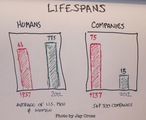
What will happen if the average lifespan of companies gets down to just a few years? As this photo by Jay Cross shows, there seems to be a trend for shorter-lived companies, staffed by longer-living employees.
What will happen to employee loyalty, pension plans, or other company benefits? I think many people know, because they are already living this reality. Add to this another statistic from the Standard & Poors (S&P) stock index - today, most economic value comes from intangible assets - over 80%. There is little "real stuff" being traded any more. Smarter Companies classes intangible assets as a combination of Relationship; Strategic; Structural; and Human capital.
So not only are companies lasting for shorter periods of time, but most of what is created is not concrete. Intangible assets do not have to be shipped and stored like real assets do. This increases the volatility of the marketplace, with larger and more frequent fluctuations over perceived value.
So what? Here’s what I think:
Networks will likely replace companies for worker loyalty.
The era of "jobs" is almost over.
New skills will be needed to thrive in connected workplaces.
Hugh MacLeod sums it up best:
It’s all about thriving in markets that are smarter and faster than you are. It’s all about being utterly screwed if you don’t know what I’m talking about.
The same goes for both workers and companies.
Harold Jarche
.
Blog
.
<span class='date ' tip=''><i class='icon-time'></i> Aug 19, 2015 09:19am</span>
|