Blogs
|
Too many poor presentations are given. It is time to up your game! Presentations are not only usually boring and largely a huge time suck, but they are much less effective in informing and creating consensus and buy-in. Turn each presentation into a much more effective conversation. In fact, don’t just talk about it, do […]
The post From Presentation to Conversation - A VINJONES Discussion appeared first on VINJONES - Kevin D. Jones.
Kevin Jones
.
Blog
.
<span class='date ' tip=''><i class='icon-time'></i> Aug 19, 2015 09:31am</span>
|
|
True collaborative networks do not rely so much on teams than on individuals, as B. Nardi, S. Whittaker and H. Schwartz have shown. The main benefits for networked organizations do not lie in the outcome from teams, but in individual knowledge acquisition, in the ability to connect with the right people and to access the right information at the right time. Instead of focusing on teams and communities, we must concentrate our efforts in providing workers with the right resources and knowledge to build their own connections. The basic unit of social business technology is personal knowledge management, not collaborative workspaces. - Thierry de Baillon, The Tainted Narrative of the Workplace
Teams are for sports, not knowledge work
Teamwork is over-rated. For instance, it can be a cover for office bullies to coerce fellow workers. The economic stick often hangs over the team; "be a team player or lose your job". Empowered individuals working in networks, not teams, will give organizations the flexibility they need to be creative and deal with complexity.
Teams seldom take into consideration the uniqueness of individuals. Usually individuals have to fit into the existing team like cogs in a machine. Team members can be replaced. The team, like the gang, rules.
People are more complex and multi-faceted than the simplistic view of Homo Economicus. Our lives have psycho-social aspects. We are more than our jobs and we are more than our teams. Teams promote unity of purpose, not diversity, creativity, and passion. The team, as a unit of work, is outdated in the network era.
As much as organizations advertise for "team players", what would be better are workers who can truly collaborate and cooperate, inside and outside the organizational walls. There are other ways of organizing work than in teams. Orchestras are not teams; neither are jazz ensembles. There may be teamwork on a theatre production but the cast is not a team. It is more like a social network. Teams are what we get when we use the blunt stick of economic consequences as the prime motivator. In a complex world, unity is counter-productive.
Small pieces, loosely joined
The mainstream application of knowledge and learning management over the past few decades has had it all wrong. We have over-managed information because it’s easy and we remain enamoured with information technology. The ubiquity of information outside the organization is showing the weakness of centralized enterprise systems. As enterprises begin to understand the Web, the principle of "small pieces loosely joined" is permeating thick industrial walls. More and more workers have their own sources of information and knowledge, often on a mobile device. But they often lack the means or internal support to connect their knowledge with others to get actually get work done.
Personal knowledge management frameworks can help knowledge workers capture and make sense of their knowledge. Organizations should support the individual sharing of information and expertise between knowledge workers, on their terms, using PKM methods & tools. Simple standards, like RSS, can facilitate this sharing. Knowledge bases and traditional KM systems should focus on essential information, and what is necessary for inexperienced workers. Experienced workers should not be constrained by work structures like teams but rather be given the flexibility to contribute how and where they think they can best help the organization.
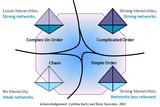
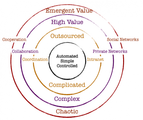
We know that formal instruction accounts for less than 10% of workplace learning. The same rule of thumb should apply to knowledge management. Capture and codify the 10% that is essential, especially for new employees. Now use the same principle to get work done. Structure the essential 10% and leave the rest unstructured, but networked, so that workers can group as needed to get work done. Teams are too slow and hierarchical to be useful for the network era. Organizations structured around Loose Hierarchies & Strong Networks, as described in the image below by Verna Allee, are much better for increasingly complex work.
Social businesses should leave teams for the sports field, and managing knowledge for each worker.
Harold Jarche
.
Blog
.
<span class='date ' tip=''><i class='icon-time'></i> Aug 19, 2015 09:29am</span>
|
|
Here is a review of the five most popular posts here this past year, with a short synopsis of each. One year, distilled into a few paragraphs.
Informal Learning: The 95% Solution
Informal learning is not better than formal training; there is just a whole lot more of it. It’s 95% of workplace learning, according to the research reviewed by Gary Wise.
To create real learning organizations, there is a choice. We can keep bolting on bits of informal learning to the formal training structure, or we can take a systemic approach and figure out how learning can be integrated into the workflow - 95% of the time.
You simply cannot train people to be social
Effective organizational collaboration comes about when workers regularly narrate their work within a structure that encourages transparency and shares power & decision-making.
Creating a supportive social environment is management’s responsibility.
My experience is that changing to more collaborative, networked ways of work requires coordinated change activities from both the top and the bottom. It has to be a two-pronged approach and it will take some time and effort.
Three Principles for Net Work
Narration of Work - Transparency - Shared Power
The high-value work today is in facing complexity, not in addressing problems that have already been solved and for which a formulaic or standardized response has been developed. One challenge for organizations is getting people to realize that what they already know has increasingly diminishing value. How to learn and solve problems together is becoming the real business advantage.
The Learning Organization
Learning is not something to "get".
The only knowledge that can be managed is our own.
Learning in the workplace is much more than formal training.
When we remove artificial barriers, we enable innovation.
Learning and working are interconnected.
Cooperation trumps Collaboration
In networks, cooperation trumps collaboration. Collaboration happens around some kind of plan or structure, while cooperation presumes the freedom of individuals to join and participate. Cooperation is a driver of creativity.
Shifting our emphasis from collaboration, which still is required to get some work done, to cooperation, in order to thrive in a networked enterprise, means reassessing some of our assumptions and work practices.
Collaboration is only part of working in networks. Cooperation is also necessary, but it’s much less controllable than our institutions, hierarchies and HR practices would like to admit.
Harold Jarche
.
Blog
.
<span class='date ' tip=''><i class='icon-time'></i> Aug 19, 2015 09:29am</span>
|
|
A number of people have requested that I run another Personal Knowledge Management workshop, so the next online PKM workshop is now scheduled for 21 Jan - 15 Feb 2013 through the Social Learning Centre. This will be the last workshop in the current format. In the Spring I will look at what has been learned to date and redesign the resources and activities.
In 2012, we conducted three online workshops and I also ran some on-site sessions for clients. What is becoming obvious is that the skills addressed in PKM are seen as important to many managers, knowledge workers, and practitioners in a wide array of disciplines. PKM combines aspects of traditional knowledge management, as well as digital curation, social learning, and critical thinking. I have shown how it is directly related to innovation and I believe it is an essential aspect of what are becoming known as digital competencies.
The Seek-Sense-Share framework I developed for PKM almost three years ago has helped many people establish their own sense-making processes. A common remark from workshop participants is how difficult sense-making can be, "I entered this workshop feeling I could seek and share quite effectively, it was the sensing I needed to work on." Another participant described PKM as a way of "cleaning out my crap filters so the right information can come through so I don’t feel overwhelmed with information"; a very good description.
The main concept behind the workshops is to create a bounded space of active learners who can share their thoughts around a selection of resources and activities. The only rule is that all communication is within the discussion area, available for all participants to read and comment on. As facilitators, we use these discussions as starting points for deeper inquiry. Without the participants narrating their learning, the value of the experience would diminish.
Each workshop is a shared, cooperative experience. Many participants have made connections and friendships that have continued afterwards. My objective is to provide just enough structure for people to focus, but not too much to constrain personal reflection and social learning. It is very dependent on the positive intentions of everyone. Usually, we have enough active participants to get some deep conversations. What one gets out of each workshop is very dependent on what one puts in. From me, you get my undivided attention for a month and I look at ways to make better connections for participants, based on what they share. The structure is not for everyone, and people looking to be guided through a more linear process, such as a typical self-paced course, can be disappointed.
Harold Jarche
.
Blog
.
<span class='date ' tip=''><i class='icon-time'></i> Aug 19, 2015 09:28am</span>
|
|
This past year I have worked on several projects that have extended my thinking on how we can use social media to promote cooperation and collaboration within and outside the enterprise. I explained some of this in a previous post on enterprise social network dimensions, which is based on the work of several others.
Ian McCarthy’s honeycomb of social media was an initial inspiration, showing how one could quickly and graphically portray differences between social media platforms. The Altimeter Group’s recent report on making the business case for enterprise social networks provided more detail on what happens inside organizations. Finally, Oscar Berg’s digital workplace concretized gave a good picture of what people-centric, service-oriented businesses should look like.
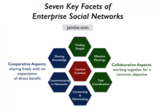
I would like to expand on this, highlighting some additions to that previous post in November. It seems that the seven facets identified by Oscar Berg align with some general digital competencies that are necessary for connected knowledge workers everywhere. These also align with the PKM framework that can support the flow of cooperative and collaborative work in a coherent organization. I have also shown examples of how one can look at various enterprise social network tools, such as the ubiquitous Sharepoint. I am not a Sharepoint fan, but almost all large organizations have it and it is usually a key part of their social network framework. Finally, I provide a few words of advice that I have learned from many projects. This presentation is a visual summary of a significant part of my work in 2012. I hope it is useful and I always appreciate discussions on how it can be improved.
Social enterprise tools and competencies from Harold Jarche
Harold Jarche
.
Blog
.
<span class='date ' tip=''><i class='icon-time'></i> Aug 19, 2015 09:28am</span>
|
|
Jaron Lanier in You Are Not a Gadget, wrote:
The people who are perhaps the most screwed by open culture are the middle classes of intellectual and cultural creation. The freelance studio musician, the stringer selling reports to newspapers from warzones are both crucial contributors to culture. Each pays dues and devotes years to honing a craft. They used to live off the trickle down effects of the old system, and like the middle class at large, they are precious. They get nothing from the new system.
In Heads You Win … (2010) I asked; if you are not one of the recognized leaders in your field, can you make a living online or are you just part of the long tail, valuable only to aggregators and their advertising revenues? As a content creator are you providing the fodder that lets Google, Facebook and YouTube earn huge market valuations? Will there be a middle class in the networked economy, or only heads & tails?
I think it will be possible to make a living in this digital economy and have what used to be a middle class life style but it will not be like the old middle class. First of all, it will be jobless, as described by Rob Paterson, in You don’t need a Job. It will also have to be creative, in that you will have to create your own way of making a living. There will be few jobs to fill, instead there will be opportunities you will have to see. Finally, we will realize that the only way to survive will be by working together in communities of practice and interest, and understanding networks. "We" can take on the faceless "them", if we work together and share.
We are seeing experiments in new forms of work all over the place. These range from co-working spaces, to shareable communities, to our non-traditional consultancy, Internet Time Alliance, which is still a work in progress. The trickle-down effects, that Lanier mentions, no longer share enough wealth for a viable middle class. We need to create our own network effects, but (this is important) it has to be within our own networks, not inside someone else’s walled garden. Google Ads or Facebook likes will not help you take control of your work destiny. We have to do it together, using new frameworks and models for the network era. The BIG kicker, is that there is no template or rule book. We have to embrace life in perpetual Beta and get started. The good news is that there are many others like us. Let’s write the new rules together.
Harold Jarche
.
Blog
.
<span class='date ' tip=''><i class='icon-time'></i> Aug 19, 2015 09:27am</span>
|
|
The Power of Pull by John Hagel. John Seely Brown & Lang Davison looks at how digital networks and the need for long-term relationships that support the flow of tacit knowledge are radically changing the nature of the enterprise as we know it. It is also an excellent reference book for understanding many facets of personal knowledge management. I have had this book on my reading list for quite some time and luckily Jay Cross gave me a copy which I read on the flight back from the west coast this week.
PKM helps people stay focused on the edges of their knowledge and look for innovation and opportunity. I have written, in embrace chaos, that I think the edge will be where almost all high value work gets done in organizations. Core activities will be increasingly automated or outsourced. Value is moving to the edge. The core is being managed by fewer internal staff and any work where complexity is not the norm will be of diminishing value. PKM enables tacit knowledge flows from the edge to the core and back.
Edge Participants also often reach out to participants in the core in an effort to build relationships and enhance knowledge flows. But these efforts are often frustrated - or at best marginalized - because core participants are too busy concentrating on defensive strategies within the core, trying to protect their profits and position, to understand the true growth opportunities represented by relevant edges. - The Power of Pull, p. 54
PKM is a process of moving knowledge from the edge (social networks) to the core (work teams) and back out to the edges. It is the way that Pull can be done on a daily basis. Connecting the edge (emergent & cooperative) to the core (controlled & automated) is a major challenge for organizations. Part of the solution is more open management frameworks but another part is "edge-like" individual skills and aptitudes. PKM covers the latter.
PKM is a continual process of seeking from the edge (networks), filtering through communities of practice (CoP) and sense-making at the core (work teams) and also sharing back out to our communities and networks. Once habituated, it’s like breathing.
As stated in the book, "Pull platforms tend to allow us to performa the following activities with a blurring of the boundaries between creation and use:", showing four components that map directly to Seek:Sense:Share.
Find (Seek)
Connect (Seek)
Innovate (Sense)
Reflect (Share)
As the authors write, "Pull is not a spectator sport." Neither is PKM. I would highly recommend The Power of Pull as a reference book that looks at how organizations need to change and how individuals need to redefine the nature of work.
The choices each of us makes about the environments we participate in and the practices and behaviors we choose to pursue once we’re there will make a crucial difference in what we experience and the extent to which we can shape these experiences or simply let random experiences shape us. - The Power of Pull, p. 99
"Chance favors the connected mind." - Steven B. Johnson.
Harold Jarche
.
Blog
.
<span class='date ' tip=''><i class='icon-time'></i> Aug 19, 2015 09:27am</span>
|
|
Here are some of the observations and insights that were shared via social media during the past week or two.
Christian Wiman: "At some point you have to believe that the inadequacies of words you use will be transcended by the faith with which you use them." - via @JohnnieMoore
The Icarus Deception: "if you blame your lack of job prospects on the tepid demand for hardworking, competent, but replaceable workers, you haven’t told us anything we didn’t already know." via @RichardMerrick
Stupid Management Tools, by Niels Pflaeging @BetaLeaders
#787 - Standardized job titles and salary ranges - produce pseudo-objectivity & transfer power to HR bureaucrats
#788 - Competence and Development Planning - unavoidably lead to behavioral control, another HR folly
#789 - Development Programs - If personal growth isn’t fostered, your organizational model is broken. HR plans don’t fix that
#790 - Employee Ranking and Classifying, e.g. ABC-style: it’s reductionist, context-free, unfair, self-fulfilling
Given tablets but no teachers, Ethiopian children teach themselves - #hacking - via @zecool
Elaborating later on Negroponte’s hacking comment, Ed McNierney, OLPC’s chief technology officer, said that the kids had gotten around OLPC’s effort to freeze desktop settings. "The kids had completely customized the desktop—so every kids’ tablet looked different. We had installed software to prevent them from doing that," McNierney said. "And the fact they worked around it was clearly the kind of creativity, the kind of inquiry, the kind of discovery that we think is essential to learning."
Design Is Hacking How We Learn - learning in action in a very different way - via @C4LPT & @CharlesJennings
Design Is Hacking How We Learn from frog
Harold Jarche
.
Blog
.
<span class='date ' tip=''><i class='icon-time'></i> Aug 19, 2015 09:26am</span>
|
|
The resurrection of American manufacturing will require more than simply bringing back production to America. Global manufacturing is at the cusp of a massive transformation as the new economics of energy and labor plays out and a set of new technologies—robotics, artificial intelligence, 3D printing, and nanotechnology—are advancing rapidly. Together these developments will spark a radical transformation of manufacturing around the world over the next decade. The winners in the rapidly changing world of manufacturing will be those firms that have mastered the agility needed to generate rapid and continuous customer-based innovation. - Steve Denning
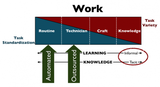
I have often said that anything that is simple enough to be automated will be, and that any work that is merely complicated will be outsourced to the lowest cost of labour. But a funny thing is happening with manufacturing in the 21st century. It is becoming complex. Manufacturing today requires interdependent workers with initiative, creativity and passion. The new manufacturing workplace has higher task variety, which is based on a greater percentage of tacit knowledge and requires more informal and social learning. This is not Ford’s assembly line, nor is it based on F.W. Taylor’s Principles of Scientific Management.
The new manufacturing, like new businesses everywhere, will have fewer people. Computers and software are replacing people, especially information processing jobs. This is the new reality. There will be more work variety (for what used to be called jobs) because there will be more task variety. That means there will be fewer plug-and-play jobs. We will have to create our roles in the 21st century workplace. They will not be created for us. This is liberating but scary for generations who have tried to fit in to the existing job structure. Younger people seem to get it. Generations caught in the middle may find it difficult.
Community and organizational leaders will need to figure out how to adapt to the transition period, which will continue to see high employment while conversely witnessing instant millionaires who create the next mobile app. Times are changing, and we will need new methods to manage and organize work. Even those who understand this cannot see how much things will change. We are like the early generations that witnessed the power of the printing press, without understanding that it would lead to years of religious wars.
As Steve Denning concludes in his Forbes article:
Success in this new world of manufacturing will require a radically different kind of management from the hierarchical bureaucracy focused on shareholder value that is now prevalent in large firms. It will require a different goal (delighting the customer), a different role for managers (enabling self-organizing teams), a different way of coordinating work (dynamic linking), different values (continuous improvement and radical transparency) and different communications (horizontal conversations). Merely shifting the locus of production is not enough. Companies need systemic change—a new management paradigm.
It will require even more.
Harold Jarche
.
Blog
.
<span class='date ' tip=''><i class='icon-time'></i> Aug 19, 2015 09:26am</span>
|
|
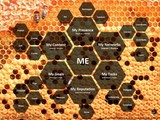
Joachim Stroh adds some perspective to my post on tools and competencies for the social enterprise: "It’s about you, but you’re not the only bee in the hive; the further you expand the more you grow."
I think this image gives a good view of the various facets people have in the workplace: My Content; My Presence; My Networks; My Tasks; My Reputation; My Goals. It also shows that workers are not mere human resources that fill job positions. They are all multi-faceted and each of these facets touches the facets of others. It is social and it is complex.
In the digitally connected workplace, systemic changes are sensed almost immediately. Therefore reaction times and feedback loops have to get faster and be more effective. We need to know who to ask for advice right now, but this requires a level of trust. But trusted relationships take time to nurture. This is evident from Joachim’s image, showing many facets that each take time to develop. Since our default action at work is usually to turn to our friends and known colleagues for help, we need to share more of our experiences with others in order to grow our trusted networks. The more colleagues we can depend upon, the better we can get work done. The time to start is now.
"We learned that individual expertise did not distinguish people as high performers. What distinguished high performers were larger and more diversified personal networks." - Rob Cross, The Hidden Power of Social Networks
Social learning is critical for organizational effectiveness today. Workers need to connect with others in order to co-solve problems. Sharing tacit knowledge through conversations is an essential component of knowledge work. Social media enable adaptation, and the development of emergent practices, through conversations. Ensuring our facets are interconnected is one way to become a more social business. For example:
Am I creating content that can easily be curated and shared?
Am I connecting my physical and virtual presences optimally?
Am I finding learning opportunities through my networks?
I create these tools and presentations in order to ask better questions while trying to solve client problems. If these provide some new insight, then they are useful. I am glad that others, like Joachim, share what they are doing so we can work on these together, without ever meeting (yet).
Harold Jarche
.
Blog
.
<span class='date ' tip=''><i class='icon-time'></i> Aug 19, 2015 09:26am</span>
|