Blogs
|
If you want to destroy the entrepreneurial nature of work, then make management part of the hierarchy. Removing management from the hierarchy is probably the simplest thing that could be done to improve innovation and increase the motivation of those who really create business value.
Management at Asana is seen as service role, rather than the next step in the pyramid on the org chart. The usual model, where exceptional work leads inevitably to the management track is a mistake, Rosenstein argues. "The effect of that is that individual work is looked down on," he says. "That is so caustic." - What managers do at a company that’s trying to replace them with software
Knowledge artisans don’t need managers, they need support to get work done. A lot of management, like performance reviews, is quite boring and repetitive. Much of management will be automated, along with anything else for which a flowchart can be created. In a networked workplace, management is just a service that needs to be provided, like electricity. There is little reason to connect such a basic service as management to the decision-making structure.
A flattened hierarchy requires less command and control. Self-managed teams require fewer external directives. Transparency eliminates the need for most control mechanisms. A world without bosses is possible.
For us, we’ve found that transparency is another great way to build trust in a team. If all the information about everything that’s going on is freely available, that helps everyone to feel completely on board with decisions. - Joel Gascoigne, CEO, Buffer
When organizations adopt practices such as working out loud, there is even less need for management. In a transparent organization, with self-directed teams working out loud, the shifting of management to a service will serve another purpose - power sharing. This can energize the entire workforce to be more entrepreneurial. Companies are doing this and are seeing great results, reinventing their organizations. It’s amazing that so many executives are not making more significant changes to basic management structures. Perhaps they are listening too much to their managers?
Phoenix Rising from a Collapsed Hierarchy - by Joachim Stroh
#ITASHARE
Harold Jarche
.
Blog
.
<span class='date ' tip=''><i class='icon-time'></i> Aug 19, 2015 09:13am</span>
|
|
Here are some observations and insights that were shared on social media this past fortnight. I call these Friday’s Finds.
@ayeletb: "I want to live in a world of possibilities and experiments; not a cookie cutter world, unless I am baking."
"If you want to do something new, you have to stop doing something old. - Peter Drucker" - HT @reuvengorsht
@alanwbrown: "The cluetrain changed my life … seriously! So very interesting reading RT @johngoode: Is IoT waiting for Cluetrain?"
Cluetrain states: The Market is the Conversation. Could that be reversed? The Conversation is the Market? If so, Cluetrain is what IoT is waiting for:
1. Individuals, Cities, Infrastructure and local authorities produce (and later, sell) IoT data.
2. Google, Amazon, Intel or similar builds a Meaning Engine: an IoT ingest warehouse. It publishes API’s for consuming data (for which it pays) and produces insight (which it sells).
I have no doubt the lawyers will do quite well from privacy, safeguarding and ownership matters.
Abstracts of Three Meta-Analysis Studies of Serious Games by Karl Kapp - via @downes
The most interesting result of this survey of meta-studies of serious games: "Learners learned less from simulation games than comparison instructional methods when the instruction the comparison group received as a substitute for the game actively engaged them in the learning experience (so activity, not game elements seems to increase the learning)." Which accords with what we know about learning.
@Forbes - American companies spend almost $14 billion annually on leadership development training.
Studies have found that adult learners in a lecture setting forget nearly 50% of what they learn within two weeks. And consider that the most highly trained leaders - CEOs - are often not able to translate their knowledge into experience. The Center for Creative Leadership found that 38% of new chief executives fail in their first 18 months on the job.
Learning lessons from successful KM projects.
I found myself reflecting last night, as I flew back to the UK, that perhaps the difference between the winners and those in second and third place lies not in structure nor in process, but in far more intangible areas, and that when collecting lessons from winners we need to look more at the softer aspects.[trust, relationships, rigour & control]
@plevey: "Intéressante expo Duchamp à Beaubourg [Paris]. Le "Nu descendant l’escalier" a *choqué*… les cubistes, en leur temps!"
Harold Jarche
.
Blog
.
<span class='date ' tip=''><i class='icon-time'></i> Aug 19, 2015 09:13am</span>
|
|
The Zeitgeist (spirit of the age or spirit of the time) is the intellectual fashion or dominant school of thought that typifies and influences the culture of a particular period in time.
At any conference or professional gathering today, someone will stand up and say that things are not working, and about two-thirds in attendance will nod in agreement. I hear that relationships with customers are broken. Some talk about generational differences in the workplace that disconnect senior management from young workers. Others see a need for better digital competencies. Many are challenging the hierarchical nature of the organization in an emerging networked economy.
I attended several presentations on the future of Human Resources (even the word reflects the hierarchical nature of the workplace) in Paris last week. Every session highlighted the fact that things are not working. Recruiting, talent management, professional development, and every other area of HR is trying to deal with a post-industrial workplace. The zeitgeist is the need for organizational change.
All the executives and managers I speak with today agree there is a need for change. They see that the Internet is changing their business. They understand that automation is a force to be reckoned with. However, many do not have a clue where or how to start. The zeitgeist may be obvious, but the old ways of thinking are still firmly entrenched. We cannot deal with the new era in the same way we managed the old one.
I usually suggest that it does not matter what you do, just do something. Let people safely experiment. I suggested to a school board that they give $100 to every teacher to invest in whatever they wanted, without any direction. Teachers could buy something for their classrooms, or perhaps a number of them could pool their money and make a larger impact. The cost would be low. The impact would be wide. The possibilities would be greater than any central committee could plan.
Real experimentation is not about quick wins, which are so appealing to management, as Tim Kastelle clearly shows:
"We need to find some quick wins to get this going, so we’ll look for the low-hanging fruit."
Here’s the thing: there is no low-hanging fruit.
If there were, we’d have picked it already. I mean, we’re not stupid, right?
Businesses often want to see the ROI of something before committing to it. This is just a defence mechanism to ensure the status quo. If we keep the investment low enough, we don’t need to worry about the return on it. This allows for wide experimentation; not quick wins but quick losses.
We have communication technologies now to know what is happening across any organization. All large companies are also listening attentively to social media. Given all this information, it is easy to let people experiment as long as they share what they are doing. The solution to the problems inherent in organizations are inside the organization itself. But will management be able to give up control? This is the challenge today. The good news is that the nature of the problems are massively evident in the current zeitgeist.
Harold Jarche
.
Blog
.
<span class='date ' tip=''><i class='icon-time'></i> Aug 19, 2015 09:12am</span>
|
|
I attended the Community Forests International planning session yesterday. This organization, located in our small town of Sackville, is working on two continents and recently received €1.2 million from the European Union for its work on the island of Pemba in Tanzania. The day included participation from many community groups, such as Renaissance Sackville, which I represented. It finished with a wine & cheese at Cranewood (a must-see for any visitor to town) which drew even more people from the community. I’d like to highlight what Jeff Schnurr, the founder had to say, as it reflects the advice I give to many organizations (my paraphrasing here).
There is no difference between our organization, our community, and individual people. All of our relationships are personal.
We conduct pilots all the time. We do several in different conditions to see what happens. All of our learning is through pilot projects.
We need to find ways to learn quicker [note that CFI has a new staff position, an internal journalist, who focuses on explicit knowledge capture and sharing through stories].
The way that CFI, and its greater mission, will scale for growth will be by telling its story.
Read about CFI and the amazing work that has been done to date. This organization started on nothing, just an idea, and has grown to an international operation, with a for-profit arm as well as demonstration farm here in New Brunswick.
My discussions with Jeff over several years provide me with an excellent example of how organizations can deal with complexity and manage to grow and be sustainable. At yesterday’s sessions, one of the suggestions was to ‘open source’ all of CFI’s practices and processes so they can be shared with others. This will become a valuable resource over time, for both non-profits as well as any other organization that wants to succeed in this era of climate change, economic volatility, resource scarcity, and inter-connectedness.
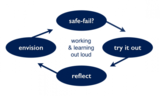
A safe-to-fail approach enables continuous learning in complex environments
Harold Jarche
.
Blog
.
<span class='date ' tip=''><i class='icon-time'></i> Aug 19, 2015 09:12am</span>
|
|
Two late 19th century theorists still firmly inform management thinking.
Henri Fayol’s functions of management pretty well sum up how many managers see their responsibilities today.
To forecast and plan
To organize
To command or direct
To coordinate
F.W. Taylor’s Principles of Scientific Management viewed management as the necessary controlling layer in order to systematize work and make it efficient. If labourers could not adapt to managers’ directions, then they should be let go.
Much of management thinking is still overly focused on managers. It is premised on a parent-child relationship, with managers requiring special training and increased rewards in order to look after their ‘direct-reports’. But today, a lot of management can be done with machines. You don’t need a manager to find information. Managers don’t always have the right answers. As managers lose control over information flow, their usefulness is decreasing. Labour today is not made up of predominantly bricklayers and iron workers, which Taylor’s studies were based on. In a new company, like game-maker Valve Corp., owner Gabe Newell says that "management is a skill, it’s not a career path", and explains how management is removed from the hierarchy.
Everybody is a mixture of individual and group contribution. There’s a set of tasks related to project organization and keeping things going. And usually, people refuse to do it twice in a row, on back-to-back projects, because it’s very much a service job. "My job is to entirely define myself in terms of the productivity that I enable in other people. That’s a very stressful job and it’s hard to measure your own productivity. People say, hey, Jay, you should do it again, and Jay says ‘screw you guys!’." So we look for some younger sucker to give the job to, who thinks it’s authority within a hierarchy related to decision-making, and then finds out that it’s, oh, working really really hard to make other people more productive. - Reflections of a Video Game Maker
I think the major reason that these ideas have not been put into the dustbin of history is they are too convenient. Thinking of management as a science makes it special. Giving power to managers ensures the status quo. Who wants to rock the boat and say they are adding little value as a manager? If you want to know what is ailing your organization, maybe lack of innovation or over-bureaucratization, then look no further than management. Of course few managers think they are part of the problem. But self-management is possible, if not inevitable.
Harold Jarche
.
Blog
.
<span class='date ' tip=''><i class='icon-time'></i> Aug 19, 2015 09:12am</span>
|
|
When was the last course you took? How about e-learning? When was it designed? Was it current? Did it reflect your current reality? Was it useful?
One of the limitations of instructional design is the assumption that a program can be designed and built based on the initial specifications. Assuming you know everything at the start of a complex development project is rather arrogant. Arrogance is believing that the perfect system can be engineered on the first try.
Instead, the principles of communicating, focusing on simplicity, releasing often, and testing often are all applicable to developing good instructional programs. A culture of perpetual Beta is critical. Perpetual Beta means we never get to the final release and that our learning will never stop. Connected organizations realize they will never reach some future point where everything stabilizes and they don’t need to learn or do anything new.
While good instruction from the organization is important, fostering autonomous learners is the more important side of the organizational learning relationship. A significant portion of the workforce has not been able to develop the skills to learn for themselves or are blocked from doing so inside their organizations. What many lack are tools, methods, and practices to learn and to take action. In addition, autonomous learners face many barriers on the job, particularly the pervasive attitude that you must look busy or you’re not working. We are trained early in life to look to authority for direction in learning and work. The idea that there is a right answer or an expert with the right answer begins in our schools and continues into many organizations.
When we move away from a "design it first, then build it" mindset, we can then engage everyone in critical and systems thinking. Workers in connected workplaces must be passionate, adaptive, innovative, and collaborative. The way to begin is to first become autonomous learners.
Developing practical methods, like PKM, is a start on the path to autonomy. A major premise of PKM is that it is personal and there are many ways to practice it. We need to think and talk about work differently. For example, dropping the notion of being paid for time is one way to start this change. An hourly wage implies that people are interchangeable, but no two minds are the same. Many of our human resource practices should be questioned and dropped. Here are some ways that HR or L&D can support autonomous workers:
Think and act at a macro level (what to do) and leave the micro (how to do it) to each worker or team. The little stuff is changing too fast.
Engage with social media and understand how they work. Knowledge networks are too important to be left to IT, communications, or outside vendors.
Use tools like enterprise social networks to make work easier or more effective. Let the network solve problems for you.
Make yourself and your function redundant and prepare for the next challenge. If your work can be standardized, it will be automated. Teach people how to fish and move on to the next challenge. If you’re maintaining a steady state then you’ve failed to evolve with the organization and the environment.
According to anthropologist Michael Wesch, "when media change, then human relationships change". People of all ages are now digital content creators, no longer satisfied with being supplied with learning programs but creating tutorials, job aids, and explanatory videos for each other. Access to much of the world’s information, coupled with online professional social communities has turned us into grazers and foragers, no longer content to feed our intellect only at the corporate trough. This empowerment outside the organization is changing how workers value and perceive professional development inside.
Autonomous learners have a new set of needs. HR and L&D have to evolve to support these. Arrogance is assuming you know the answers.
Harold Jarche
.
Blog
.
<span class='date ' tip=''><i class='icon-time'></i> Aug 19, 2015 09:09am</span>
|
|
Here are some observations and insights that were shared on social media this past fortnight. I call these Friday’s Finds.
@morgenpaul - "Psst … Your people are not your greatest asset; they’re not yours and they’re not assets. Let’s treat them like people."
Will robots make our lives better or worse? - via @gideonro
So the question is not whether robots and computers will make human labour in the goods, high-tech services, and information-producing sectors infinitely more productive. They will. What really matters is whether the jobs outside of the robot-computer economy - jobs involving people’s mouths, smiles, and minds - remain valuable and in high demand.
With regard to Ebola, Helmuth von Moltke the Elder said it best:
General principles and specific rule-based systems have no value for creating a winning strategy. You can try and develop one before battle starts and hope you have it all figured out, but you must also have in place a way to change as battle changes the table..
All you can do is create an organization that can quickly adapt and respond to the changing conditions. The winners of any battle seen today are those that can most rapidly adjust.
@madelynblair - Pulling the chocks out
I personally find it impossible to dig really deep to find my assumptions by myself. I need someone who questions me in a way that demands I look deeper. It’s usually a friend or colleague that I respect who can do this best for me. That’s why I have said that a Practice Partner is an essential crew member of any journey where you are seeking new knowledge or insight - or innovation.
NYT: When Uber and Airbnb Meet the Real World
Why have these companies run into so many problems? Part of the reason is that they think of themselves as online companies — yet they mostly operate in the offline world.
They subscribe to three core business principles that have become a religion in Silicon Valley: Serve as a middleman, employ as few people as possible and automate everything. Those tenets have worked wonders on the web at companies like Google and Twitter. But as the new, on-demand companies are learning, they are not necessarily compatible with the real world.
GMOs Expose Dangerous Science Disconnect in Agriculture via @shauncoffey
A huge gulf exists in farmer attitudes toward science. Growers clearly accept the scientific evidence that modified food is safe while rejecting the scientific evidence that climate change is real and caused by human activity. And this chasm is driven by simple economics. One finding makes farmers money, but the other doesn’t — yet.
"@karen_goudie: What a great way to give info to patients families … who will care for them today @NHSBorders " via @ribtickler1:
Harold Jarche
.
Blog
.
<span class='date ' tip=''><i class='icon-time'></i> Aug 19, 2015 09:09am</span>
|
|
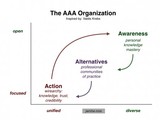
For an organization to be agile and adaptive, the people in it need to be aware of what is happening around them, have alternative pathways to gather information and knowledge, and must be allowed to act to meet/solve both local and global goals/problems. They need to both work in their hierarchy and in a self-organizing network simultaneously! - Valdis Krebs, Orgnet
How can an organization build awareness, investigate alternatives, and act on complex problems? The organization needs to connect the outside with the inside. This is not a technology challenge but rather a structural one. Organizations need to help knowledge flow and this only happens when people are connected. Technology is a facilitator, but people are the key. This is too often overlooked, as in most enterprise social network implementations, where mere training is bolted on at the end of the technology build. Awareness, alternatives, and action can each be supported within a unified organizational framework.
Wirearchy: a dynamic two-way flow of power and authority based on knowledge, trust, credibility and a focus on results, enabled by interconnected people and technology. - Jon Husband
To let knowledge flow, people first have to become responsible for their own sense-making. This reverses the existing practice of corporate training that is designed centrally and distributed through the hierarchy. Personal knowledge mastery (PKM) is a set of processes, individually constructed, to help each of us make sense of our world and work more effectively. People can learn more and connect to diverse knowledge networks outside the organizational walls. To remain relevant, organizations have to become less hierarchical and more networked. The first step is connecting to external knowledge networks, a key part of PKM. Increasing connections, developing meaning, and improving autonomy are necessary skills in the network era. PKM ties these into an easy to understand framework: Seek > Sense > Share.
With every worker actively practicing PKM, seeking new knowledge and making sense through experimentation, then communities of practice can form to promote knowledge-sharing. Professional communities of practice connect the work being done with the ever-changing external world. They are an essential safe place to fail. Organizations need to support and reinforce existing communities, not build these as if they were project teams. People only share complex knowledge with others whom they trust. This takes time.
Finally, the way work is done needs to change to reflect a wirearchy. Hierarchies can be temporary agreements to get work done, but the general organization structure has to be much more flexible, enabling self-directed work teams. Loose hierarchies and strong networks can help build a functioning wirearchy. The AAA organization is an evolving work in progress, adaptable to a changing environment but first each worker needs to master sense-making and then workers have to organize in communities to make sense together. One challenge for traditional organizations is that a core aspect of PKM is critical thinking, or questioning assumptions, which may be threatening to command & control management systems. But as Valdis states, "Awareness and alternatives are useless without the ability to take action on them." Giving up control so that people can take action is the essence of the AAA Organization.
Harold Jarche
.
Blog
.
<span class='date ' tip=''><i class='icon-time'></i> Aug 19, 2015 09:09am</span>
|
|
The 70:20:10 (Experience, Exposure, Education) Framework is focused on learning at work, not in a classroom, and not in a lab. Charles Jennings has described workplace learning as based on four key activities:
Exposure to new and rich experiences.
The opportunity to practice.
Engaging in conversation and exchanges with each other.
Making time to reflect on new observations, information, experiences, etc.
Studies show that informal learning accounts for between 70 and 95% of workplace learning [USBLS: 70%; Raybould: 95%; EDC: 70%; CapitalWorks: 75%; OISE: 70%; eLG: 70%; Allen Tough: 80%]. Gary Wise extrapolated Josh Bersin’s data from 2009 and found that as much as 95% of workplace learning is informal. Offering only sanctioned courses as professional development is completely inadequate in a complex work environment. It is arrogant to think that we can know in advance what people need to learn on the job today. Everyone needs to experiment, learn from experience, and share with colleagues, as part of their work.
PKM is a framework to make sense of the 70%. It helps connect our experiences. It is also a very inexpensive way to promote learning and development. Perhaps that is why PKM and similar practices are not the norm in many workplaces. Nobody will get a big budget to manage them. PKM is personally managed. People just need time, space, some coaching, and organizational support. Tools help, but there are a lot of inexpensive ones available. But quite often the only tools available at work are at cross-purposes with PKM. They are not personal and they do not help people to seek > sense > share.
Smaller companies and young companies appear to be quite open to PKM-like practices. It may just be a matter of time before they become the norm. Most free-agents understand the importance of taking control of their professional development. For the employed, the realization often comes on news of unemployment. People quickly see that their professional network is primarily business contacts from their previous company. Cast aside, they have no support network. Building one takes time.
The foundation of PKM (seek) is participating in professional knowledge networks. From these social networks, one can find the right crew for more focused journeys of sense-making. This is 21st century networking, not the stuff of cocktail parties and passing out business cards of the previous half-century. Creating a diverse network of loose and strong ties takes time. Nurturing these connections takes more time. Part of the 70% of workplace learning should be focused on connecting with others, inside and outside the organization. How much time do you spend? How much time would your organization let you spend? If you are in a position of authority, how much time do you let others spend on participating in professional knowledge networks?
Getting started with PKM is probably the cheapest professional development program that any company can initiate. It requires no special technology or proprietary system. My own objective in promoting PKM is not to sell it, or even teach others how to do it. My objective is to enable people to learn and teach it for themselves. If I can guide people to take the first step, then that is usually all it takes. PKM in 40 Days is one way I try to provide a starting point. I will work on other ways in the coming year.
Jay Cross likened informal learning to riding a bicycle. Maybe that’s a good way to look at PKM. It’s a bike to get out and explore all those paths and places you do not find on the main motorways.
Seek > Sense > Share the Journey
Harold Jarche
.
Blog
.
<span class='date ' tip=''><i class='icon-time'></i> Aug 19, 2015 09:08am</span>
|
|
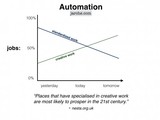
Nesta, a UK-based innovation charity, recently looked at jobs and automation, in the article, Creativity versus Robots. I have summarized some of their findings, and added my own perspective, with an image showing how standardized work is decreasing while creative work is increasing in the job market. Overall, we are seeing an increasing percentage of creative jobs in the workforce. But this is not a zero-sum game, as many jobs are getting automated and disappearing. If nothing is done, there will be severe societal repercussions.
Nesta cites US and UK data on jobs, indicating a near future of more automation, as well as uncertainty for about a third of current jobs.
It is no longer a question of whether standardized work will be automated, but when. In an era of increasingly complex challenges, such as climate change, today’s workforce has to deal with more complexity and even chaos. We need to skill-up jobs for emergent and novel practices which requires a completely different mindset about work.
Those workers whose jobs are getting automated need not just skills, but opportunities to do more creative work. In addition, we cannot leave behind the one-third of workers in no-man’s land. In the USA today, 79% of the labour force needs to shift to highly creative work. Jobs, as currently defined, are not the answer. We need to develop structures that encourage and value creative work, from our education establishments, unions, employers, and politicians.
No society can afford to leave over three quarters of the workforce behind as it shifts to a creative economy. Gary Hamel has described traditional (industrial) employee traits of Intellect, Diligence & Obedience as commodities (ripe for automation). A creative economy requires independent and interdependent workers (more like theatre productions) with traits that cannot be commoditized: Initiative, Creativity, Passion.
The job is nothing more than a social construct. I think it’s outlived its usefulness. The construct of the job, with its defined skills, effort, responsibilities, and working conditions, is a key limiting organizational factor for a creative economy.
To realize the creative potential of individuals we have to cast off old notions of how work gets done. There is no such thing as a generic job description into which we just drop some "qualified" candidate. Job competencies are a myth. People are individuals. The role of an effective HR department would be to know each person individually. Everyone can be creative, including janitors. We need to understand this as automation replaces people, but may leave nobody in place to do the creative human aspects of work.
And yet, when some psychologists interviewed hospital janitors to get a sense of what they thought their jobs were like, they encountered Mike, who told them about how he stopped mopping the floor because Mr. Jones was out of his bed getting a little exercise, trying to build up his strength, walking slowly up and down the hall. And Charlene told them about how she ignored her supervisor’s admonition and didn’t vacuum the visitor’s lounge because there were some family members who were there all day, every day who, at this moment, happened to be taking a nap. And then there was Luke, who washed the floor in a comatose young man’s room twice because the man’s father, who had been keeping a vigil for six months, didn’t see Luke do it the first time, and his father was angry. And behavior like this from janitors, from technicians, from nurses and, if we’re lucky now and then, from doctors, doesn’t just make people feel a little better, it actually improves the quality of patient care and enables hospitals to run well. - Barry Schwartz
Understanding and incorporating humanity back into our workplaces will liberate us from the scientific management models that inform too many of our organizations. One small change, that could have a major impact, would be to look at everyone’s work from the perspective of standardized versus creative work. Every person in the company, with the help of some data and peer feedback, should be able to determine what percentage of their time is spent on standardized work. If the percentage is over a certain threshold, say 50%, then it becomes a management task to change that person’s job and add more creative work. The company should be constantly looking at ways to automate any standardized work, in order to stay ahead of technology, the market, and the competition. While automation may be inevitable, it does not have to destroy the workforce.
Looking at the overall company balance between standardized and creative work should be an indicator of its potential to succeed. By visualizing the split, people in the company can make plans and take action. In this environment, jobs will have to become more flexible and open to change. Jobs of the 21st century may look nothing like the structured one-size-fits-all jobs of the 20th century.
Building ways to constantly change roles will be one way to get rid of the standardized job, which has no place in a creative economy. This small change could have a major impact on any organization. It requires a new way of looking at work, and then collecting good data, engaging workers in the process, and being transparent. Most of all, a creative workplace requires managers who really care about creative talent development.
Harold Jarche
.
Blog
.
<span class='date ' tip=''><i class='icon-time'></i> Aug 19, 2015 09:08am</span>
|