Blogs
|
Training, and education, are often solutions looking for a problem. But good training and education can have a huge impact on behaviour and performance. Remember that great teacher who inspired you? Did you ever have a coach who got you to a higher level of performance? But throwing content at someone and hoping for learning to happen is not a good strategy. This is how far too many courses are designed and delivered.
"As I’ve been working with the Foundation over the past 6 months I’ve had the occasion to review a wide variety of elearning, more specifically in the vocational and education space, but my experience mirrors that from the corporate space: most of it isn’t very good. I realize that’s a harsh pronouncement, but I fear that it’s all too true; most of the elearning I see will have very little impact." - Clark Quinn
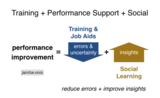
But if courses are all you know, that’s what gets built. Moving from Training, to Performance, to Social can sum up my professional journey in supporting organizational learning. All are needed, but too often the easiest solution is the course, designed to disseminate the approved content. There are ways to improve course design, support work, and improve collaboration, as Clark Quinn has written about very well in his book, Revolutionize Learning.
Much of workplace performance improvement comes from better designed ways to get things done. People can get help with the right tools at the right time. How to do this is the realm of human performance technology (HPT). It’s often more a case of removing barriers than training people.
Solving problems together is what a lot of us have to do at work. Social learning is a key part of this. It’s about learning with and from our peers.
From Training, to Performance, to Social
I am now offering a three-week online workshop on Workplace Learning. It is focused on nine practices for organizational performance improvement. The workshop provides examples and exercises to cover more than courses. It addresses three ways to enhance training, three performance support approaches, and three methods to support social learning. It’s hands-on and practical, with a handy job aid provided to all participants at the end.
If you are involved in designing or supporting any aspect of workplace learning, this may be just what you need. The first workshop of this series begins on 9 February 2015.
#ITASHARE
Harold Jarche
.
Blog
.
<span class='date ' tip=''><i class='icon-time'></i> Aug 19, 2015 08:56am</span>
|
|
The core premise of finding perpetual beta is that the digital world is bumping against the analog world and we are currently caught in-between.
Changing How We Organize
With an external environment that is highly connected, organizations have to get connected inside.
Faster market feedback challenges the organization’s ability to act.
The solutions are staring us in the face. We just have to stop looking in the rear-view mirror and see the many possible roads ahead.
Hierarchies do not need to be the natural organizational model. People can work in self-managing networks.
Changing How We Work
If those who are educated, knowledgeable, and experienced do not push for a better world of work, then who will?
An effective knowledge network cultivates the diversity and autonomy of each worker.
Knowledge networks function best when each person can choose with whom and when they connect.
Solving problems together is becoming the real business challenge.
Changing How We Learn
Complex problems require the sharing of tacit knowledge, which cannot easily be put into a manual.
Tacit knowledge flows best in trusted networks.
Sharing knowledge in trusted networks does not happen overnight.
Sharing makes us think more about what we publish, knowing it will be seen by others.
Personal Knowledge Mastery is a framework for individuals to take control of their professional development.
The test of personal knowledge mastery is whether it works for you.
Watch the slideshow
More on Slideshare
Harold Jarche
.
Blog
.
<span class='date ' tip=''><i class='icon-time'></i> Aug 19, 2015 08:55am</span>
|
|
I was recently asked what I thought about content management systems (CMS); how content should be developed; whether generational differences should be considered; and how to keep content relevant. The best example of a CMS is the Web. There is relevant and irrelevant content. The relevant content is often found through referrals. This may be in terms of ratings, curation by a trusted party, or from a known source. Referrals can be pushed, through something like a subscription service, or pulled from knowledge networks when there is an immediate need for information. People with more diverse and deep knowledge networks get better information.
So what does a CMS have to do with it? Not much.
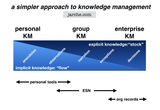
I was also asked about the best ways for "creating and gathering internal enterprise content, organizing and maintaining that content and making it easily accessible to employees and other stakeholders". The CMS does not really enable any of this. It’s all about people: those who seek knowledge, make sense of it, and share it. The better they do these three components of PKM, then the better content an organization will have. I have explained this in a simpler approach to knowledge management. It is also a simpler approach to content management. Just let people do it.
Using the example of the web, enable all workers to use easy content creation and sharing tools. Put the internet inside the organization. Focus on removing barriers to knowledge-sharing, like Twitter. Nurture a culture of learning out loud, sharing knowledge like YouTube. Appoint staff to work as curators, like Wikipedia. Let people comment upon and rate content, like Amazon. Focus on the visual, like Pinterest or Instagram.
While good content management cannot be done without technology, it’s not about the technology. It’s 90% people.
Harold Jarche
.
Blog
.
<span class='date ' tip=''><i class='icon-time'></i> Aug 19, 2015 08:54am</span>
|
|
Platform capitalism is the ability of a common internet exchange medium to enable easy commercial transactions. Buyers of services get convenience, while sellers get a larger market. The spoils go to the owner of the platform, receiving a percentage of revenues. Most of these platforms are created when regulations and oligopolies make these transactions difficult by traditional means. Platform capitalism initially disrupts a sector that is poorly served.
PayPal is an example of facilitating small financial transactions between parties in different countries because the banks were terrible at it. PayPal facilitates small businesses to engage in e-commerce. Uber is disrupting taxi monopolies. Uber enables car owners to make some extra money and eases payment for passengers. Airbnb is taking on the hotel industry and its practices. Airbnb provides an easy way to rent out extra space in your home by connecting you to a global market.
At some point, network effects kick in. This is the hope of the investors in these platform companies. Once they dominate a sector, it is almost impossible for a competitor to compete directly. Facebook has achieved this for social networking; Amazon is getting there for online retail sales; and Google controls online advertising. The wealth that is created for the users pales in comparison to the value for the platform owners. For instance, it is very difficult for any site to make significant revenue from Google ads.
Once the platform capitalists achieve dominance, they act like any monopolist. This can be seen by looking at consumer complaints about PayPal, driver and passenger abuse at Uber, and how dependent we have become on Google. These companies shift from rebels with a cause, to the 800-pound gorilla you cannot get away from.
So what can the average person do to uber-proof their labour in a post-job economy?
As they say on the Web, if you are not paying for the service, then you are the product. We need to be careful about what free services we use and understand the total cost of use. Once our data are trapped in a system, it is tough to get them out. With all these new platforms being launched, any independent, small, or medium-sized business needs to play the long game. Determine what 5 or 10 years of use and growth will look like. Something cheap at the onset may be expensive later. Never build a business model on their platform, unless it is short-term and you have an exit strategy. Sites that are dependent on Google’s ads now have to ride every change to the system, with no control. The famous long tail helps nobody but the platform owners.
Collectively we should put more energy into the real sharing economy. There are already cooperative models that work, like Mondragon with 74,000 members. Seb Paquet said that the Web and social media enable ‘ridiculously easy group-forming’. Use this to join with peers and develop new ways to create wealth together, outside traditional organizations and beyond the platform capitalists. We have been experimenting at the InternetTimeAlliance since 2009, and I am now engaged with EthosVO, a new way of creating and exchanging value amongst peers. As we go through this next phase of the Internet economy we have to avoid the easy money, and play the long game.
Harold Jarche
.
Blog
.
<span class='date ' tip=''><i class='icon-time'></i> Aug 19, 2015 08:54am</span>
|
|
Every fortnight I collate some of the observations and insights that were shared on social media. I call these Friday’s Finds.
Beans & Noses by @jmspool
The idea is blindingly simple, actually. Every so often, you’ll run into someone with beans who has, for no good reason, decided to put them up their own nose. Way up there. In a place where beans should not go.
Now, there is no logical explanation for this. There is no way to say, "Yes, I can see exactly why you’d want to do that." They came to this decision all on their own. The way they got to this decision defies logic.
Yet, here they are. Waiting for the moment when the bean goes up the nose.
@Rayke - "No one is as happy as they seem on Facebook, as depressed as they seem on Twitter, or as employed as they seem on LinkedIn."
What wine pairs well with your innovation strategy? What One Winery Can Teach You About Innovation - via @gregverdino
What are your most important, labor-intensive, or expensive processes? This is where you should start innovating.
Imagine looking out over 180 acres of grapes. All of those vines have shoots that must be repositioned within a few days to allow the grapes to grow. It would take a crew of 30 people a week to complete this process, and with Missouri’s higher labor costs in relation to crop value, this process is an expensive one.
But our team created and applied a new innovation that allows us to get this done mechanically in just a day. As soon as we implemented this real-time system, there was an immediate impact on our cost per acre.
Why Finland is finished as role model for education by @DonaldClark [read the comments too]
It comes as no surprise that Finland is flaunted as being the ideal by educationalists, because it sees teachers as the sole key to success. We may have to rethink this. If true, why then have they performed poorly in TIMMS? Teachers alone are not a sufficient condition for success. In fact, Strahlberg doubts that the Finnish system is easily transferable at all.
Holacracy at Zappos via @jesselynstoner
Some critics charge that the shift to Holacracy is more about Zappos marketing itself as an innovative company than fundamentally changing how it is run. "If you look at the system, the lead link is really almost like a manager," says the former senior-level employee. "There was a disconnect between what was being represented internally and externally. You can say all you want, but within Zappos, if you look deeper, the inner circle still dictates."
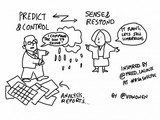
Predict & control vs sense & respond. Cartoon inspired by @fred_laloux #rsasoulful by @voinonen
Image by Virpi Oinonen
Harold Jarche
.
Blog
.
<span class='date ' tip=''><i class='icon-time'></i> Aug 19, 2015 08:53am</span>
|
|
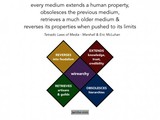
Wirearchy is "a dynamic two-way flow of power and authority, based on knowledge, trust, credibility and a focus on results, enabled by interconnected people and technology". It is a medium for organizing how people work together. Wirearchy is a new way to work. Viewing wirearchy through the tetradic laws of media might give some clarity on what it can be, and what we need to beware of.
Harold Jarche
.
Blog
.
<span class='date ' tip=''><i class='icon-time'></i> Aug 19, 2015 08:53am</span>
|
|
This article appeared in Inside Learning Technologies & Skills Magazine, January 2015
Harold Jarche issues a challenge to L&D professionals in an environment where getting the work done is more important than learning anything new.
In the mid 1990s I became involved with my most expensive learning project. I was then serving as a Training Development Officer with the Canadian Armed Forces, working in tactical aviation (helicopters that support the Army). We had just purchased 100 helicopters. A $25 m full-motion combat simulator had been thrown in with the $1 bn budget. I was able to watch as the new simulator was installed at our training unit, as my office was next to it. As it was tested, discussions began on how best it could be used. As the ‘training guy’ I started researching best practices in flight simulation, and was able to see what our NATO allies were doing.
My work also involved research into the use of other simulators, such as cockpit procedure trainers and maintenance trainers, which were much cheaper than the one we had purchased. These lower-fidelity simulators had not been part of the original budget as it had been assumed that one comprehensive simulator would be enough. Unfortunately, a single simulator creates a bottleneck as only two pilots can be trained at any time. It also creates a potential single point of failure.
I wrote a paper on the need to develop an integrated approach to specifying what type of simulation was most suitable for any training tasks. For example, teaching start-up and shutdown sequences does not require a full-motion simulator, as those actual tasks occur while the aircraft is on the ground. They require switches, gauges, and dials that act like the real things, though. I suggested we develop a decision- support tool that looked at both physical and functional fidelity, and integrate this into the training system documentation. My recommendations were based on current practices with several other armed forces. Without such a documented process, decisions to purchase expensive simulators would continue to be made on a best-guess basis. We needed a way to clearly specify our training resource needs at the onset of a project, as millions of dollars were at stake and it was difficult to purchase any extra equipment once the main capital project had been funded.
HISTORY REPEATS ITSELF
After retiring from the military, and almost ten years after writing my internal military discussion paper, I was hired by a defence contractor to look at how training could be analysed to determine the optimal maintenance training for helicopter technicians. The focus was on specifying a maintenance simulator which could develop trouble-shooting skills. Upon asking for the available military documentation on training analysis, I found that there was still nothing that addressed simulation. There was no guidance on what type of simulator to purchase to meet training needs.
I wrote another paper on behalf of my client, explaining the need for a decision- support tool that connected simulation fidelity with both human learning and the operational tasks. The main question I tried to answer was: How do we specify the optimal level of simulation fidelity for any task? I could only suggest a general path forward, as I lacked all the data and research to go further, but it was obviously feasible to do so.
Several years later, in 2013, I met with representatives of the same contractor at a military training and simulation conference. One of the themes was how the military needed to make better uses of simulation and emulation for training. Presentations by military staff confirmed that they had no clear way to specify to industry what level of simulation was required to train personnel on a new piece of equipment. Again, millions of dollars were at stake. Not only had none of my recommendations been implemented, but my ex-client also had no record of my report. Nothing had changed. It was not just that my paper had not been used. The documentation on how to analyse tasks for training still did not include any discussion of the use of simulation. Training simulation analysis and design was continuing to be done on an ad hoc basis, usually as an afterthought to a major equipment purchase.
I learned from this series of events that training will always be a secondary player in the enterprise landscape.
WHAT OTHERS SEE
Good training analysis and design, in the larger scheme of organisational management, does not matter. Capital projects consider it a mere add-on. The training world can come up with better instructional design or new standards, but the folks who make the real decisions will continue to ignore them.
It is important for the learning and development world to understand the mindset of those making the big enterprise decisions. Training and learning are of little importance to them. However, acceptance of this fact can put the L&D profession in the right position to advance learning and development. They must be prepared to sell the idea behind anything they need to accomplish. L&D professionals have to become internal marketing specialists.
ACADEMIA AND EDUCATION
Those who read this magazine may talk about the importance of learning, but for the most part, organisations do not actively support learning. Let’s start with schools. Schools tend to focus on weaknesses instead of strengths. They also focus too much on content dissemination. Our institutions have failed to foster the love of learning, and often do not motivate students to learn for themselves - in many cases it’s the opposite. One problem is the continuing focus on subject-based curriculum. It separates education from reality. We do not live our lives in subject areas, and no workplace is subject-based, but almost all of our curricula are stuffed into subject silos. For anyone who does not enjoy school, this sets up learning as something to avoid later in life. In addition, mastery of the curriculum (content) is what the school administration assesses. Once again, this separates the school from outside reality.
Our educational models disconnect school (learning) from business (work). I remember as a young infantry officer arriving at my new unit, and being told to forget everything I had learned in training. Now I would have to learn how things really worked. This kind of attitude exists in many workplaces, attesting to how the education world is perceived.
LEARNING IS THE WORK
Our workplaces are becoming highly networked. The transmission of ideas can be instantaneous. There is no time to pause, go into the back room, and then develop something to address our learning needs. The problem will have changed by then. We need to learn as we work. In an era of exploding knowledge in all fields of science and technology, taking care of business should mean taking care of learning.
Learning has to be part of work. We have to make it everyone’s job to share what he or she learns. But in many businesses, getting work done is more important than learning anything new. Short-term thinking starts with quarterly market results and drives down to individual performance management. Learning something new hardly has a chance in the busy workplace.
Look at how corporate e-learning is usually developed. Often it’s a case of putting content online and hoping some of it sticks and translates into changed workplace behaviour. It’s easy to build a course based on defined content, as there are no messy, individual, radical learners to get in the way, only a fictional, generalised target population. My experience is that neither the public educational system, higher education, nor the corporate training business have made any great achievements in facilitating learning during the past two decades. The greatest advances have been in people learning for themselves as they connect via the Web.
We know that people learn socially. We learn through observation and modelling. Promoting learning is not the same as promoting education and training. Individual and peer-to-peer learning is a key part of workplace learning. I developed a personal knowledge mastery (PKM) framework to support this kind of learning for professional development.
I have worked with universities to include PKM as part of their curriculum, as well as companies who incorporate PKM into their leadership programmes, or make it a core component of work competence. Getting individuals to take control of their workplace learning then frees the L&D field from filling orders for training courses. Instead, they can respond to workplace needs.
REMOVING BARRIERS
Practices like PKM are only the first step. Systemic barriers to learning also have to be removed. Imagine a research intensive organisation where scientists should be sharing what they learn, and the official company policy is to share information and expertise among public and private partners. However, the company is ‘downsizing’ and layoffs are based on performance reviews. If one scientists helps a peer develop a patented product, and as a result the peer gets a better annual review, then the former may end up losing his job during the next round of layoffs.
Sharing knowledge is not a good personal strategy in this work environment. So, we see that government policies, like intellectual property regulations, can drive business practices, like financial rewards for patents, which can impede learning, and in the end we all lose. In complex systems, the solutions are never simple, but our only hope is learning how to learn better and faster - individually and as a society. If we want to promote learning we should first look at what is blocking it. L&D professionals have to think bigger than training and courses in a world where everything is connected.
Removing barriers should be the focus of the learning and development professional, not delivering content. It is time to stop being takers of orders and become better diagnosticians. Solving problems will help L&D be seen a valued part of the enterprise. L&D professionals therefore have to master their own field as well the business they support.
In addition, they have to understand that few outside L&D think what they do is important. It’s a big challenge, but learning is becoming critical to all businesses. It is up to L&D to be part of this.
Harold Jarche
.
Blog
.
<span class='date ' tip=''><i class='icon-time'></i> Aug 19, 2015 08:53am</span>
|
|
The performance analysis used in HPT, is a good tool to find barriers to workplace performance. For example, a lack of skills & knowledge usually requires formal instruction or job aids. A lack of appropriate tools may require better processes and support. Training is expensive, so it is best to use it only when needed. Combining HPT with instructional systems design, ensures that training is designed only when there is a clear lack of sills and knowledge. Other non-instructional interventions, like job aids and checklists, can then be developed to reduce other barriers to performance. Using HPT methods can save resources and make for more efficient and effective workplaces.
Harold Jarche
.
Blog
.
<span class='date ' tip=''><i class='icon-time'></i> Aug 19, 2015 08:52am</span>
|
|
I think I have always been averse to hierarchies, yet I joined the Army and entered the most hierarchical organization in the country. I graduated from military college and began my career as an infantry officer. Career progression was through promotion, based on yearly performance reviews. It was supposed to be a meritocracy but was much more tribal. Having a senior officer looking after your career was a great help. I did not have that. I also bored easily and it was the Cold War with us fighting fictional Soviet troops on the Canadian prairies. So I decided to leave the infantry and transfer to the medical services, where I thought I would do more practical work.
On transferring, and removing all the the accoutrements of my regiment, I quickly found out that I was a different person. Well at least I was treated differently by my fellow officers. First of all, I had abandoned my tribe and was now an outcast. Other combat arms officers treated me as if I could never understand the profession of arms, because I was wearing a medical badge. Those inside the medical services saw me as a stranger. I had been told I was joining a multidisciplinary team of medical professionals, but really I was there to handle anything the medical officers (physicians) did not want to do. Again, I thought that doing a good job would be enough. It was not.
After four years with the medical services I was posted to a job at defence headquarters that did not really exist. My superiors wanted to send me back to Canada, as my unit in Germany was down-sizing. There was no real position open, so one was created for me. I went to work, sat in my office, and had about an hour’s worth of administration to do in the course of a day. They say that if you want to drive a person crazy, give him nothing to do. I was under orders to go to work each day, but there was little work to do. I was able to pick up some French writing courses that kept me busy, and I also started doing some personal career planning. With 15 years of service, I was only five years away from a small pension, so financially it made sense to stay in the military. I was able, once again, to transfer to another branch of the services: training development.
I threw myself into my new profession, reading whatever I could, picking up courses, implementing the frameworks of change management, instructional systems design, and human performance technology. I also went back to school to complete a Master’s degree in education. I developed significant expertise in the learning aspects of flight simulation. But five years later I realized that no matter how good I was, I would only be respected for my rank, not my knowledge or ability. As a junior officer, my role in the hierarchy was to implement policy, not think about the big picture. Systems thinking was, "beyond my pay grade", as they would say. So I decided it was time to leave the services.
The Friday afternoon I turned in my military identification card, I dropped by the officers’ mess to say one last good-bye. I had a drink with a college acquaintance who was now a Colonel, whereas I had been a Captain, three ranks below. Now that I was a civilian, I noticed that finally I could have a real, human conversation with a senior officer. In far too many instances, my recommendations at work had been ignored because someone senior to me disagreed. In the military the hierarchy is always visible with rank insignia. Suddenly, I had no rank, and could no longer be put into a box by my fellow officers. My last conversation in that officers’ mess was my best. Over the years, many people have asked how long it took me to make the transition from military to civilian life. In my case, it was about 24 hours.
The fact that I had three careers inside the military (not normal at the time) is probably the main reason I was able to serve 21 years. I had a horizontal, rather than a vertical, career. This put me in a good position for future career changes: working at a university and at a web technology company, and then as a freelancer serving multiple industries. It was as a free-agent that I was finally able to work in an environment that was as close to a meritocracy as possible. Life outside a hierarchy requires multiple skills and perspectives, which my varied past had prepared me for. It had also taught me a certain degree of humility, as I had little rank to force my will on others.
For the past twelve years I have been working in an overlapping network of networks. In my professional networks each node and relationship is unique. Some of the relationships have been formalized, such as with the Internet Time Alliance, Adjuvi, and EthosVO. But each is founded on a two-way flow of power and authority based on knowledge, trust, and credibility, that is the core of Jon Husband’s wirearchy.
Perhaps this is why I have written over 250 posts on wirearchy here. It just makes sense to me. In each of my careers, I had hoped for a two-flow of power and trust with my colleagues, but often it was not the case. Someone would always use positional power to get their way. I firmly believe that the more we can remove positional power from organizations, the more human they will become. I know that I have felt more engaged, and have been more creative, as a single node in my various networks, than in any hierarchical organization.
In the recent report on The Future of Work, the authors list three key findings from their research:
The biggest fundamental shift in capacity is in freeing people to do their best … the future of work is moving from hierarchy to wirearchy.
Engagement - and how we approach employees’ relationship with a company - is so horribly incomplete that it is dangerous to leaders who rely on it.
The future of work is personal. Very personal. The hardest and most important work in the future of work centers on one detail: personal accountability in decision-making.
All organizations should be built on "a dynamic two-way flow of power and authority, based on knowledge, trust, credibility and a focus on results, enabled by interconnected people and technology". Can anyone, other than a sociopath, see any reason why they should not?
Harold Jarche
.
Blog
.
<span class='date ' tip=''><i class='icon-time'></i> Aug 19, 2015 08:52am</span>
|
|
Henry Demarist Lloyd wrote in March 1881, that "When monopolies succeed, the people fail …", in his piece denouncing the practices of Rockefeller’s Standard Oil. Capitalism does not have to be corporatism. There is little doubt today about the extent of corporate power and influence of monopolies, especially in their newest form: platform capitalism. In 1967, John Kenneth Galbraith warned of the dangers of blindly having faith in our corporatist systems.
"The greater danger is in the subordination of belief to the needs of the modern industrial system … These are that technology is always good; that economic growth is always good; that firms must always expand; that consumption of goods is the principal source of happiness; that idleness is wicked; and that nothing should interfere with the priority we accord to technology, growth, and increased consumption."
In 1994, Peter Drucker discussed the rise of the knowledge worker, a term that Drucker coined in 1959 [coincidentally, the year I was born]. Drucker saw that the shift to a society of knowledge workers would not be easy, as we still struggle with it today.
"It is also the first society in which not everybody does the same work, as was the case when the huge majority were farmers or, as seemed likely only forty or fifty years ago, were going to be machine operators.
This is far more than a social change. It is a change in the human condition."
Today, we deal with some of the same struggles against monopolies as Demarist Lloyd, but we are several billion more people, facing climate change and environmental degradation. At the same time, our democracies are under attack from the abuse of surveillance technologies by corporations and governments. The change in the human condition identified by Drucker requires new thinking and new models in practice. Part of changing the human condition is changing the way we organize to work.
I became a partner at EthosVO this year because I want to continue my work toward the democratization of the workplace, which has been my professional focus for the past decade. Many people talk about the future of work, on stages around the world, and say that organizations must become more transparent and work out loud. Yet many of these people structure their companies in the same manner as Standard Oil, with the spoils going to the few. EthosVO is different.
"Our business model is to secure long term annuity revenue associated with service innovation around our themes, focussing on execution capability rather than creation of IP [intellectual property]. We have mixed the limited-company model with the partnership model, taking what we believe is the best of both, to create a governance framework for our own work.
We think many of the principles we have adopted can be usefully generalised for the world at large, and that our environment can act as a stepping-off point from pure capitalism less painfully than a pure contracting/sole trader model." - Robert Pye
In order to talk about the future of work, I believe I have to practice it. First I did this as a freelancer, part of a new wave of work-from-home, globally-connected knowledge workers, beginning in 2003. Later, in 2009, five of us established an international think-tank, the Internet Time Alliance, where we continue to advance better ways for people to work and learn. EthosVO is the next step on this journey. If work is learning, and learning is the work, we need to work in order to learn. Just talking about the future of work is not enough. Jon Husband has described wirearchy as, "an interconnected hyperlinked structure of negotiated (either implicit or explicit) agreements based upon accessible information and knowledge, credibility, trust, and results." Putting this into practice is a start.
Harold Jarche
.
Blog
.
<span class='date ' tip=''><i class='icon-time'></i> Aug 19, 2015 08:50am</span>
|