Blogs
|
One of the greatest issues that will face Canada in the next decade will be wealth distribution. While it is currently not a major problem, the disparity between rich and poor will increase. The main reason will be the emergence of a post-job economy. Almost all of our institutions and many of our laws are based on the notion of the job as the normal mode of working life. Schools prepare us for jobs. Politicians campaign on job creation. Labour laws are based on the employer-employee relationship. Amongst those Canadians who had or have a job are the few who also have a drug plan, a missing component from our universal health care system. The haves are becoming outnumbered by the have-nots.
When farm hands left their fields at the turn of the last century, replaced by tractors, they found better paying jobs in the factories clustered around cities. As manufacturing moved offshore or became automated, those who left would find jobs in information processing and the knowledge economy. But as we move into the network era, there is no visible sector that will employ people whose jobs are getting automated by software and robots. These people include lawyers and other white collar workers.
The emerging economy of platform capitalism includes companies like Amazon, Facebook, Google, and Apple. These giants combined do not employ as many people as General Motors did. But the money accrued by them is enormous and remains in a few hands. The rest of the labour market has to find ways to cobble together a living income. Hence we see many people willing to drive for a company like Uber in order to increase cash-flow. But drivers for Uber have no career track. The platform gets richer, but the drivers are limited by time. They can only drive so many hours per day, and without benefits.
The job was the way we redistributed wealth and protected workers from the negative aspects of capitalism. As the knowledge economy disappears, we need to re-think our concepts of work, income, employment, and most importantly education. If we do not find ways to help citizens lead productive lives, our society will face destabilization. This is a challenge for government, as our institutions are premised on many assumptions that are no longer valid. Changing the worldview of politicians, public servants, and citizens will be a key part of addressing the issue of wealth redistribution. Old mental models will not help us much.
Harold Jarche
.
Blog
.
<span class='date ' tip=''><i class='icon-time'></i> Aug 19, 2015 08:44am</span>
|
|
"We are living in a world where access trumps knowledge every time. Those who know how to search, find and make the connections will succeed. Those who rely on static knowledge and skills alone will fail." - Charles Jennings
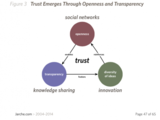
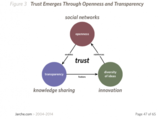
We are all interconnected because technology has enabled communication networks on a worldwide scale, so that systemic changes are sensed almost immediately, which means that reaction times and feedback loops have to be better. Therefore we need to know who to ask for advice right now, which requires a level of trust, but this takes time to nurture. So we turn to our friends and trusted colleagues, who are those with whom we have shared experiences, which means that we need to share experiences in order to trust each other. This is social learning.
In 2005 I wrote that the beauty of a decentralized social learning approach, versus a closed learning management system (LMS) was that each person keeps all of his/her content, and it does not get locked away in an inaccessible archive of a centrally controlled LMS. Back then, there were few options to cooperate and share knowledge and learning online. Now we have the technology but many organizations are still wedded to the old command and control instructional systems.
The essence of social learning is that as our work becomes more complex, we need faster feedback loops to stay on top of it. Courses, with their long development cycle, are inadequate to meet the learning and performance needs of those dealing with complexity. Social learning can give us more and better feedback if we engage our networks in order to develop emergent work practices.
"There is a growing demand for the ability to connect to others. It is with each other that we can make sense, and this is social. Organizations, in order to function, need to encourage social exchanges and social learning due to faster rates of business and technological changes. Social experience is adaptive by nature and a social learning mindset enables better feedback on environmental changes back to the organization." - George Siemens
Most organizations have structures and systems in place that promote and validate individual training but they leave almost all the social learning to chance. I was asked how an organization that accepts the importance of social learning can create the structures necessary to support it. On reflection, I selected nine methods that would provide the foundation for social learning in the enterprise. It would be part of formal education, provide additional exposure to new ideas, and be integrated with the everyday experiences at work. These are described in detail in the post, from training to social learning.
We recently completed the first online workshop on how to move to social learning. Participants worked through the nine activities and related them to their own context. A lot was shared in the small community.
"I’m participating in Harold Jarche’s Workplace Learning Workshop (training > performance > social) and it’s almost eerie (but a good eerie) how relevant each topic is to where I’m at in terms of professional development and my current work focus." - Nancy Slawski
The next online workshop begins on 13 April, with special early pricing currently in effect. If your organization needs to move to social learning, this is the place to start.
Harold Jarche
.
Blog
.
<span class='date ' tip=''><i class='icon-time'></i> Aug 19, 2015 08:43am</span>
|
|
Every fortnight I collate some of the observations and insights that were shared on social media. I call these Friday’s Finds.
"Zen pretty much comes down to 3 things - everything changes; everything is connected; pay attention." - Jane Hirshfield - via @jhagel
@RobinGood: You Can Be a Trusted Guide To The Most Relevant Information Online: Not Google
As for Google there is one area where it cannot really compete with talented humans: trust.
True information curators, of the expert kind, may indeed become in great demand in the near future. And personal trust will determine which one you and I will rely on. Whether Google will exist or not.
@nytdavidbrooks: What human skills will be more valuable in the future, because machines can’t do them? via @marciamarcia
In the 1950s, the bureaucracy was the computer. People were organized into technocratic systems in order to perform routinized information processing. But now the computer is the computer. The role of the human is not to be dispassionate, depersonalized or neutral. It is precisely the emotive traits that are rewarded: the voracious lust for understanding, the enthusiasm for work, the ability to grasp the gist, the empathetic sensitivity to what will attract attention and linger in the mind.
@BryanAlexander: The age of extractive democracy
The idea is that American society is becoming an extractive democracy.
Short version: our economy and political institutions are now constructed to draw money and other resources from the lower half of society in order to transfer it to the wealthiest. It’s a kind of plutocracy.
@ChrisCorrigan: Why rules can’t solve everything
Rules look after complicated problems in which the cause and the effect are clear going forward. But the problems we are seeing now are complex, meaning that the cause and the effect are only obvious in retrospect. This property of complex system is called "retrospective coherence," yet another useful term from Dave Snowden. Retrospective coherence contains a dangerous pitfall for decision makers: it fools you into believing that the causes of a particular event are knowable.
@mintzberg141: Productive & Destructive Productivity
I came to the conclusion that there are two kinds of productivity, one productive, the other destructive. The problem is that economists can’t tell the difference … Thus do productive companies survive while productive societies collapse.
Bitcoin is Teaching Realism to Libertarians - via @dajbelshaw
The ecological function of dissent inside a complex society is not that the dissent immediately takes over. It’s that the dissent stabilizes the core within safe temperature parameters. With Bitcoin in the system, there’s every chance that if you really try and clamp down on society, more and more and more of the stuff will resort to Bitcoin, and it becomes harder and harder and harder to credibly lock the doors. You can imagine, for instance, how Bitcoin might have accelerated the fall of the Soviet Union if it had existed in the 1980s, just because it would have made the black market so much more powerful than the government in all kinds of ways.
So Bitcoin serves a protective function, a balancing function that didn’t exist before. And that does not require any extraordinary claims about its security against the NSA.
How Ordinary People Are Building A New World - via @goonth
In this crucial time of transition from the overarching ambition of corporate oligarchs, the blockchain based cryptocurrencies allow anyone to more fully connect with their own principles and ideals and to act on them without permission. This is a new social ecosystem that fuels innovation and activism on the edges, providing new ways to fund projects and aspirations that have traditionally been rejected by a monolithic vision of the world conceived by the few and dictated from above.
Artists as gatekeepers of truth - via @valdiskrebs
Harold Jarche
.
Blog
.
<span class='date ' tip=''><i class='icon-time'></i> Aug 19, 2015 08:43am</span>
|
|
There is an aspect of leadership that gets little attention in the popular management press. It is about holding space. Holding space means protecting the boundaries so that people can work. Nations hold their space through laws, treaties, and armed forces. Organizational leaders need to hold their space so that people can work. I do not mean controlling place, just holding it.
Frederic Laloux describes this in his book, Reinventing Organizations. The key role of a CEO is in holding the space so that teams can self-manage. If democratic workplaces are the best organizational structure for the network era, then keeping the space for democracy is the primary role for the leadership. In America, the democratic space was designed to be kept by the three branches of government - legislative, judiciary, executive - and protected by a written constitution. When this space is not protected, democracy loses. In constitutional monarchies, space can be protected by the monarch, who has little power other than to hold the space of democracy. When the Crown loses power, democracy can suffer the tyranny of the majority.
Ricardo Semler, who has created one of the most democratic companies in the world, described this in a recent talk. Even though Semler has not been voted to be CEO for over 10 years, as founder and owner, he still has a role in keeping the space.
"Slowly we went to a process where we’d say things like, we don’t want anyone to be a leader in the company if they haven’t been interviewed and approved by their future subordinates. Every six months, everyone gets evaluated, anonymously, as a leader. And this determines whether they should continue in that leadership position, which is many times situational, as you know. And so if they don’t have 70, 80 percent of a grade, they don’t stay, which is probably the reason why I haven’t been CEO for more than 10 years."
"Reading the literature and listening to a variety of sources, I’m not getting a sense of how you take a very large organization and shift it into the new. The authors at Holacracy.org claim it can work anywhere. They would since Holacracy IS their agenda, but the proof points don’t exist - yet." - Den Howlett
Leadership will emerge in the network era, and history will likely remember those who were able to hold the space so that a new way of work could be co-created. So far, those numbers are few. Like the earliest democracy, democratizing the workplace requires intelligent and aggressively engaged people. This is where we can find our leaders.
"A good example of the contempt the first democrats felt for those who did not participate in politics can be found in the modern word ‘idiot’, which finds its origins in the ancient Greek word ἰδιώτης, idiōtēs, meaning a private person, a person who is not actively interested in politics; such characters were talked about with contempt, and the word eventually acquired its modern meaning. According to Thucydides, Pericles may have declared in a funeral oration: ‘We do not say that a man who takes no interest in politics is a man who minds his own business; we say that he has no business here at all.’" - Wikipedia
Harold Jarche
.
Blog
.
<span class='date ' tip=''><i class='icon-time'></i> Aug 19, 2015 08:43am</span>
|
|
Jane Hart sees modern day learning and development (L&D) professionals as agents of change, who are not "order takers" but "trusted advisers". Therefore the challenge is to become a trusted adviser. Trust is not gained by being an expert, but by doing something of value for others. People trust those who help make useful connections, or initiate change for the better.
How many L&D departments show trust to the colleagues they support?
If you trust your colleagues to manage their learning, you don’t need a learning management system.
If you trust your colleagues to get things done, you don’t need a tracking system.
If you trust your colleagues to learn, you don’t have as much pre-programmed training because they will find what’s best.
If you trust your colleagues to be self-directed learners they would have a say in the L&D budget.
Removing barriers to knowledge-sharing should be the focus of the L&D professional, not delivering content. It is time to stop being takers of orders and become better diagnosticians. Solving problems will help L&D be seen as a valued part of the enterprise. L&D professionals therefore have to master their own field as well as the business they support.
In addition, they have to understand that few outside L&D think what they do is important. L&D can learn a lot from marketing. For example, marketing and education have certain similarities - gaining attention; getting your message across; and changing behaviour. Much of our learning is through conversations with others. Without conversations there are no social transactions. Without conversations, there are no relationships.
As with marketing, learning professionals should learn with and from the people they serve, by engaging in conversations. Learning-oriented marketing is the way forward for a world where markets are conversations. Marketing-oriented learning is how L&D can remain relevant to their organizations when work is learning and learning is the work.
Work used to be fairly straight forward. L&D professionals had a job, knew what to do, and were paid to do it. Then the Web appeared. Everybody got connected to almost everyone else. All these connections made work more complex. A lot of work was automated. Some of it was outsourced. Today, making sense of this complexity, and developing ways to keep up, is how L&D can help the organization.
Harold Jarche
.
Blog
.
<span class='date ' tip=''><i class='icon-time'></i> Aug 19, 2015 08:42am</span>
|
|
I recently had one of my images used in article that was posted to LinkedIn and Academia.edu (one of the articles has since been removed) without giving proper attribution. What is ‘proper’ attribution? On the bottom of each page of this website is my Creative Commons license: BY-NC-SA (attribution / non-commercial / share alike). The license is simple and has stood the test of courts in many countries.
If you are going to use some writing or an image from the Net, it is best to first determine its provenance. This source is not usually Google, which is merely an index. I suggest following the advice of Kate Hart, on Citing Sources [note the name & link]: "in general, the reason the internet has images at all is because of ‘fair use.'" This is known as ‘fair dealing‘ in Canada, and copyright laws are different around the world. It is best to be informed.
In general, giving attribution to the originator is the minimum requirement. Nina Paley, creator of the Mimi & Eunice cartoons, sums it up well in this animated video, via QuestionCopyright.org. Just remember, "Proper citation will make you a star".
Harold Jarche
.
Blog
.
<span class='date ' tip=''><i class='icon-time'></i> Aug 19, 2015 08:42am</span>
|
|
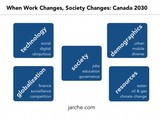
Professor Lynda Gratton at the London Business School outlines five forces in The Shift: The Future of Work is Already Here, that will shape the future patterns of work.
"Technology (think 5 billion people, digitized knowledge, ubiquitous cloud).
Globalisation (think continued bubbles and crashes, a regional underclass, the world becoming urban, frugal innovation).
Longevity and demography (think Gen Y, increasing longevity, aging boomers growing old poor, global migration).
Society (think growing distrust of institutions, the decline of happiness, rearranged families)
Energy resources (think rising energy prices, environmental catastrophes displacing people, a culture of sustainability emerging)."
Work informs much of our relationship with society. It is common to ask new acquaintances what they do for a living. Our jobs are often the prime source of personal wealth. Many jobs provide benefits we could not otherwise afford. Too often, we are our jobs, and when that changes, on a large scale, society will change.
The changing nature of work will have ramifications across society. There are strong indicators that we are moving into a post-job economy, with routine cognitive work being continuously automated. Structural changes in jobs and the education needed to do work are already being felt. Is a university degree worth the debt load? Is backward-looking data - how well a degree prepares one for today’s work - a valid indicator to look forward into the next decade? Young people are less involved in the political process, even as current legislation affects their future. Where is the disconnect? But we need to first prepare people - individuals, families, communities - to be adaptable in dealing with technological and demographic changes, in a globalized, resource-challenged world.
Every one of the major challenges facing us is complex. But our organizations are not designed for complexity. Our education institutions do not teach an understanding of complexity. Our workplace training does not factor in complexity. While not all of our problems are complex, the simpler issues are being dealt with. We need to take what Clay Shirky calls the cognitive surplus, and use it to wrestle with complex problems. Understanding complexity must be part of any informed discussions on government policy or governance. We ignore it at our peril.
We already have many methods and frameworks to address complexity.
We can build new structures that promote whole, self-managing, and evolutionary organizations as explained by Frederic Laloux in Reinventing Organizations. Of course one model is not adequate, and there is more than one way to organize for complexity. Overall we should reinforce democratic principles in order to have organizations that can adapt to perpetual beta.
In addition to structures, we need new practices that helps us address complex problems. Cognitive Edge, based on the Cynefin framework, gives us tools like Sense-Maker to address complexity. Personal knowledge mastery is how individuals can take control not only of their own learning, but build professional social networks for knowledge-sharing and cooperation. Powerful visualization tools, fed by increasing amounts of data, can help people make sense of complexity and easily share new insights.
We have many tools, and a number of techniques to deal with complexity. What we need are structures to hold the space so that our collective intelligence can deal with the wicked problems we face. Holding this critical space is a key role that government can play in the emerging complex network era.
Harold Jarche
.
Blog
.
<span class='date ' tip=''><i class='icon-time'></i> Aug 19, 2015 08:39am</span>
|
|
We show that over the past 40 years, structural change within the labor market has revealed itself during downturns and recoveries. The arrival of robotics, computing, and information technology has allowed for a large-scale automation of routine tasks. This has meant that the elimination of middle-wage jobs during recessions has not been accompanied by the return of such jobs afterward. This is true of both blue-collar jobs, like those in production occupations, and white-collar jobs in office and administrative support occupations. Thus, the disappearance of job opportunities in routine occupations is leading to jobless recoveries. - Third Way: Jobless recoveries
The Phenomena
Work is getting automated [references]
We are moving to a post-job economy
Crowd-milking
Some Solutions
Pre-empting automation
Uber-proof your labour
Play the long game
Open-source workers
Adapt to perpetual beta
Harold Jarche
.
Blog
.
<span class='date ' tip=''><i class='icon-time'></i> Aug 19, 2015 08:38am</span>
|
|
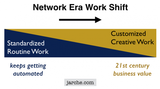
Most routine, standardized work will be automated, as we enter The Second Machine Age. Any process that can be analyzed and mapped is the raw material for a machine, whether it be a computer or a robot. Cashiers, bank tellers, managers, and lawyers are some of the vocations that have been automated. In the near future, taxi drivers, analysts, and researchers will join them.
One of the main assumptions about a job is that it can be analyzed and mapped to a set of core competencies. This makes jobs ripe for automation, which is how many workers are treated: as replaceable human resources. When one worker leaves, another one can always be found. If this assumption was not common management wisdom, then we would not have the constant lay-offs we see in all sectors of our capitalist economies. If several people can do the same job, it is likely that much of that job will soon get automated.
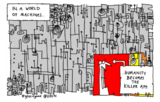
The ramifications of a post-job economy will be significant. Individuals will have to take control of their learning and work in order to be unique and creative. Our economic value will be in doing what machines cannot do. What were once considered soft skills - empathy, creativity, emotion - will become core skills. A machine can get me what I want, but what if I don’t know what I want, or I want to be surprised? That will take a human.
Image: @gapingvoid
Education that trains for skills will become useless, as the pace of automation increases. A one-size-fits-all curriculum will only ensure that entire cohorts of graduates get replaced by machines. An educational offering that promotes creativity and experimentation will become valuable and in demand.
Many businesses already use workers in jobs like replaceable parts of a machine and are outsourcing work to the lowest cost of labour. This is only a temporary measure, as even that work will get replaced by cheaper, tireless machines. These businesses will likely be disrupted by other businesses that have embedded automation from the onset. In the search for efficiency, machines are the best bet.
But there is an infinite amount of creative work that can be done by humans. It will take new models to ensure a positive future for human workers. We need to be creative in our education systems, as well as our work structures. Institutional policies and best practices can stifle creativity. Diversity is the foundation for creativity. We have to create a variety of education models. We have to enable a variety of business systems and structures. The second machine age should be the impetus for an age of experimentation. We have to try out new ways of working and learning. There are no best practices for creativity, only unique practices, of which we need many. Knowledge workers have to become learning workers and stop looking for the next best practice and create their own emergent practices.
Harold Jarche
.
Blog
.
<span class='date ' tip=''><i class='icon-time'></i> Aug 19, 2015 08:38am</span>
|
|
What is the optimal digital transformation technology for a networked organization? It is a suite of capabilities that foster an organizational culture that is constantly learning in order to understand and engage the complex environment in which it lives. Like the Internet, that enabled a digital transformation of society and business, these technologies must be based on a simple structure.
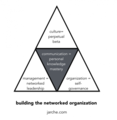
The seeking, sense-making, and sharing of PKM can be the core communication technology* of a networked organization.
* "Technology is the application of organized and scientific knowledge to solve practical problems." - Harold Stolovitch
PKM as communication means each person taking responsibility for working and learning out loud.
A networked organization embraces democracy and self-governance.
Networked management requires networked leadership (collaboration).
A networked culture adapts to life in perpetual beta (cooperation).
There are only four interdependent capabilities required to support digital transformation:
1. Promote the active practice of PKM:
a. seek out knowledge from our professional networks
b. enable sense-making on a personal leve
c. facilitate the sharing of the knowledge artifacts we create
2. Enable distributed authority and the ability to self-govern
3. Facilitate temporary and negotiated leadership for collaborative work
4. Allow for cooperation outside the organization and encourage experimentation
This reduces the requirements to those technologies that help individuals learn as they work, facilitate making decisions without asking permission, enable teams to get together to solve problems, and promote a culture of trying new things out. The human brain is the best interface for complexity. Digital transformation technologies need to enable the human component and leave the machines to handle the boring stuff. It is interesting to note that a simple tool like Slack has had such growth lately. I think this is an indicator of things to come. Complexity needs simple, adaptive structures. Human cognition can fill in the gaps.
Harold Jarche
.
Blog
.
<span class='date ' tip=''><i class='icon-time'></i> Aug 19, 2015 08:38am</span>
|