Blogs
|
One of the greatest issues that will face Canada, and many developed countries in the next decade will be wealth distribution. While it does not currently appear to be a major problem, the disparity between rich and poor will increase. The main reason will be the emergence of a post-job economy. The ‘job’ was the way we redistributed wealth, making capitalists pay for the means of production and in return creating a middle class that could pay for mass produced goods. That period is almost over. From self-driving vehicles to algorithms replacing knowledge workers, employment is not keeping up with production. Value in the network era is accruing to the owners of the platforms, with companies such as Instagram reaching $1 billion valuations with only 13 employees.
We have connected the world so that data and information can flow in the blink of an eye. There are fewer information asymmetries, as companies like Amazon bust down one industry after another. Interconnectedness and increasing computational power will continue to automate work and outsource any job that can be standardized. New businesses are employing fewer employees, while manufacturing is moving to an increased use of robots.
We are entering the platform capital economy, where a common internet exchange medium (the platform) can enable easier commercial transactions. Buyers of services get convenience, while sellers get a larger market. The spoils go to the owner of the platform, receiving a percentage of revenues. Most of these platforms are created when regulations and oligopolies make these transactions difficult by traditional means. Platform capitalism initially disrupts a sector that is poorly served.
PayPal is an example of facilitating small financial transactions between parties in different countries because the banks were terrible at it. PayPal facilitates small businesses to engage in e-commerce. Uber is disrupting taxi monopolies. Uber enables car owners to make some extra money and eases payment for passengers. AirBNB is taking on the hotel industry and its practices. Airbnb provides an easy way to rent out extra space in your home by connecting you to a global market.
At some point, network effects kick in. This is the hope of the investors in these platform companies. Once they dominate a sector, it is almost impossible for a competitor to compete directly. Facebook has achieved this for social networking; Amazon is getting there for online retail sales; and Google controls online advertising. The wealth that is created for the users pales in comparison to the value for the platform owners. Once the platform capitalists achieve dominance, they act like any old-fashioned monopolist.
The emerging economy of platform capitalism includes companies like Amazon, Facebook, Google, and Apple. These giants combined do not employ as many people as General Motors did. But the money accrued by them is enormous and remains in a few hands. The rest of the labour market has to find ways to cobble together a living income. Hence we see many people willing to drive for a company like Uber in order to increase cash-flow. But drivers for Uber have no career track. The platform owners get richer, but the drivers are limited by finite time. They can only drive so many hours per day, and without benefits. At the same time, those self-driving cars are poised to replace all Uber drivers in the near future. Standardized work, like driving a vehicle, has little future in a world of nano-bio-cogno-techno progress.
For the past century, the job was the way we redistributed wealth and protected workers from the negative aspects of early capitalism. As the knowledge economy disappears, we need to re-think our concepts of work, income, employment, and most importantly education. If we do not find ways to help citizens lead productive lives, our society will face increasing destabilization. This is a challenge for government, as our institutions are premised on many assumptions that are no longer valid. Changing the worldview of politicians, public servants, and citizens will be a key part of addressing the issue of wealth redistribution. Old mental models will not help us much.
Consider that almost all of our institutions and many of our laws are based on the notion of the job as the normal mode of working life. Schools prepare us for jobs. Politicians campaign on job creation. Labour laws are based on the employer-employee relationship. What happens when having a job is not the norm? In the USA today, half of all jobs are at a high risk of automation. But no society can afford to leave half of the workforce behind as it shifts to a creative economy. We have not had to deal with a problem of this scale before.
For example, when farm hands left their fields at the turn of the last century, replaced by tractors, they found better paying jobs in the factories clustered around cities. Later, as manufacturing moved offshore or became automated, those without work might find jobs in information processing in the knowledge economy. But as we move into the network era, there is no visible sector that will employ millions of people whose jobs are getting automated by software and robots. These people include lawyers and other white collar workers.
The job is a social construct that has outlived its usefulness. Freelancing may be a replacement but often lacks a safety net, and many of the self-employed become the pawns of the platform capitalists. In the next five years, many professionals will have to change not only who they work for, but what they do. Are they prepared? We are entering a post-job economy. Our careers will be shorter as our lives get longer. Companies and institutions are no longer the stable source of employment they once were. The structures we create now to shift society to a post-job economy will determine how much turmoil the transition will create. Now is the time to construct better ways to distribute the wealth of the network era.
Note: This is an update of a previous post.
Harold Jarche
.
Blog
.
<span class='date ' tip=''><i class='icon-time'></i> Aug 19, 2015 08:29am</span>
|
|
Every fortnight I curate some of the observations and insights that were shared on social media. I call these Friday’s Finds.
@willrich45 - Engagement: "Not a metric for learning. A prerequisite."
@trishgreenhalgh - "2nd big message on NHS [National Health Service] IT [information technology]:"ruthless standardisation" held back progress. We need local innovation, customisation, ad hoc solutions if needed"
Peter Senge on learning - via @nickknoco
All learning occurs in a social context.
In any learning process you can be 100% sure that you will fail
Learning is a process of disciplined mistake-making
An environment of safety is crucial to learning
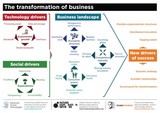
@RossDawson - The Transformation of Business: 6 New Drivers of Success
"Social networks lie at the intersection of two very human behaviors."- via @sacke & @ldduval11
Harold Jarche
.
Blog
.
<span class='date ' tip=''><i class='icon-time'></i> Aug 19, 2015 08:29am</span>
|
|
I will be speaking this Wednesday in Issy-les-Moulineaux, France at a conference on ‘The Smart City, the Cloud, and Citizens’ (link in French). My presentation will be short and focused. Here are the main points, in English. The French version may be webcast, so watch my Twitter feed for updates.
We are connecting our cities to the cloud via the internet of everything, so that objects share data with each other. With these data, governments, organizations, and companies can sense patterns and make decisions - from traffic control to geographically specific advertising. But this is merely the tip of the iceberg of the real potential of smart cities and digital networks. A major challenge for society will be to enable an intelligent and aggressively engaged citizenry to build upon the potential of these growing digital interconnections.
For the past century we have compartmentalized the life of the citizen. At work, the citizen is an ‘employee’. Outside the office he may be a ‘consumer’. Sometimes she is referred to as a ‘taxpayer’. All of these are constraining labels, ignoring the full spectrum of citizenship. As the network era connects people and things, society needs to reconnect with the multifaceted citizen. This is the primary role the smart city can play.
The last century’s division of work and personal life are still evident in many organizations where employees are cut off from their online social networks. Workers are often expected to put their personal lives aside and concentrate on the work at hand for eight or more hours per day. But as we have connected computers and devices, we have made standardized work obsolete. In the emerging workplace, where complex and creative tasks become the norm, work cannot remain isolated from the rest of the world.
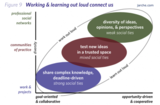
Complex work requires multiple perspectives and non-linear processes. While teams still need time and space to get things done, they also have to stay connected to the quickly-changing external environment. This week’s events in Greece and Europe show the volatility of interconnected political-financial systems. The challenge for the modern workplace is to connect external social systems with internal projects, and still remain capable of getting deadline-driven work done. This balance requires organizational systems that enable knowledge to flow, but more importantly it requires workers who are also engaged citizens.
Alexis de Tocqueville, in his book ‘Democracy in America’ based on his travels in 1831, identified ‘associations’ of citizens to be a driving force in the new democracy. These associations could also be described as communities of practice - self-forming groups of engaged citizens. John McKnight, in The Careless Society, described these groups as having three key capabilities: "the power to decide there was a problem, the power to decide how to solve the problem - that is, the expert’s power - and then the power to solve the problem". The association of engaged and connected citizens that enabled a functioning democracy in early America is now necessary in the early network era. As de Tocqueville saw how a society could function without an aristocracy, we now must see how companies can function without a managerial elite, and cities can operate without bureaucratic overlords.
Today, the connected citizen must concurrently be the connected worker, as well as the connected taxpayer and the connected consumer, among many other roles. Cities can play an important part in this transition. They are the logical place for citizens to act out their roles on a daily basis. For example, co-working spaces are one way to enable the necessary cross-pollination of ideas and action. Public transportation infrastructure can enable more serendipitous encounters between citizens. Public spaces and walkable communities can encourage citizens to connect. Smart technologies should be designed to enable more connections between citizens.
The smart citizen is connected: to communities of practice, extended social networks, the community, and society. Helping citizens engage intelligently is another role that smart cities can play. In addition to creating space, opportunities to develop skills and abilities should be supported. Cities should be encouraging citizens to seek new connections and knowledge, make sense of these in a disciplined manner, and share their knowledge. Smart cities need smart citizens.
Harold Jarche
.
Blog
.
<span class='date ' tip=''><i class='icon-time'></i> Aug 19, 2015 08:29am</span>
|
|
As networks become the dominant organizational form, disciplines like personal knowledge mastery will be essential for all knowledge workers.
"By creating millions of networked people, financially exploited but with the whole of human intelligence one thumb-swipe away, info-capitalism has created a new agent of change in history: the educated and connected human being." - End of Capitalism
Being educated is not enough. Effective citizens in a post-job, creative economy will also have to be connected. As objects get connected, the platform owners will aggregate more power and control. Smart cities without smart citizens will result in the tyranny of the platform capitalists.
"In truth, competing visions of the smart city are proxies for competing visions of society, and in particular about who holds power in society. ‘In the end, the smart city will destroy democracy,’ Hollis warns. ‘Like Google, they’ll have enough data not to have to ask you what you want.’" - Smart Cities Destroy Democracy
Power in networks is based on reputation which is developed through relationships. For citizens to exert power in the network era, they must be connected. Elected representatives have been the standard medium that citizens have used to exert their democratic power. But as everything gets connected, complexity will increase, and reaction times decrease. A connected citizenry can be an effective way to re-balance democratic power. But in order to do so, all citizens must make the effort to be connected and take the time to discuss important issues. No person can know everything, but connected people can know more than any individual, elected or appointed. Connecting to others is no longer a luxury, it is essential in order to keep our democracies alive.
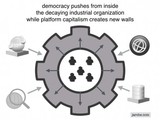
Democracy vs Platform Capitalism
Harold Jarche
.
Blog
.
<span class='date ' tip=''><i class='icon-time'></i> Aug 19, 2015 08:26am</span>
|
|
An article in Time magazine on engineering serendipity discusses ways to create better physical environments as well as the push for software that will improve innovation by increasing the potential for serendipitous encounters. The author, Greg Lindsay, concludes that social networks are the key.
"Serendipity is the process through which we discover unknown unknowns. Understanding it as an emergent property of social networks, instead of sheer luck, enables us to treat it as a viable strategy for organizing people and sharing ideas, rather than writing it off as magic. And that, in turn, has potentially huge ramifications for everything from how we work to how we learn to where we live by leading to a shift away from efficiency — doing the same thing over and over, only a little bit better — toward novelty and discovery." - Greg Lindsay, The Aspen Institute
While Silicon Valley CEO’s keep trying to engineer serendipity in their organizations, I would focus on the individual. Chance favours the connected mind, said Steven B. Johnson, and with social media, any mind can be connected today. No special tools or software are required, only the meta-cognition inherent in all people. Stepping outside our routines and looking at how we get information, and from whom, should be a regular reflective activity. Examining your social networks for diversity (age, gender, location, language, religion, political views, etc.) can indicate if you are living in a media echo chamber.
While not required, organizational network analysis tools can help, such as Synapp or mapping tools like Kumu.io. However, focusing on the technology is the wrong priority. Simple exercises, like asking yourself - why am I following this person on Twitter? - can be more helpful. Getting out and doing different activities is often missed in today’s over-scheduled work and home life. For example, I often take public transport when traveling. You will get a much better feel for a place and its people when you do than you would in a chauffeured limousine. I saw a very different part of Las Vegas, while at a conference, by cycling and taking public buses across the city.
We can all discover unknown unknowns, by being mindful of our connections and our actions that can bring about new connections. This is a key component of the discipline of personal knowledge mastery. It is a practice of "accidental intentions".
"Putting myself into places (online and physical places) where serendipitous discoveries can happen is not efficient, and of course, cannot be planned. Serendipity helped me discover people, concepts, and ideas that I would have never known before. Relationships-online, physical, mixed, new and old-and time and space are not easily planned. Serendipity does not map to set goals or plans. Instead serendipity has surprised me with energy, thoughts, knowledge, ideas, concepts, realizations, experiences, and relationships." - Anne Adrian
Harold Jarche
.
Blog
.
<span class='date ' tip=''><i class='icon-time'></i> Aug 19, 2015 08:26am</span>
|
|
When I started writing this blog almost a dozen years ago, I was pretty excited to connect with people in other countries. Just over a year ago I launched the first ‘PKM in 40 days‘ online workshop. The idea was hatched in the Netherlands, inspired by my friends at Link2Learn. Now, after only six workshops, the global audience of PKM practitioners is growing. We have had individual participants from 21 countries, in addition to an international audience through UCLG who participated in a custom, private workshop this year.
Australia, Belgium, Brazil, Canada, China, Colombia, France, Germany, India, Ireland, Italy, Netherlands, New Zealand, Norway, Russia, South Africa, Spain, Sweden, Switzerland, United Kingdom, United States … (who is next?)
Being able to connect so easily with others who have similar interests is incredibly powerful, and this was very difficult even when I started as a freelancer in 2003. Easy payment enablers, like PayPal, have allowed me to do business all over the world. In my early years as an independent consultant, all of my work was with organizations. I had to respond to Requests for Proposals (which I no longer do) and had to deal with various financial departments in order to get paid. Once I had to wait over 200 days for payment. Now that I can provide a service to individuals, I no longer deal as often with middlemen. This has been very liberating for my business, and I really appreciate getting to personally know the people who have signed up for my workshops.
I would like to thank all the participants who have helped to promote the concepts and ideas behind PKM and social learning. The last PKM workshops for 2015 starts on 7 September, but I plan on continuing to adapt and revise the program and run more workshops in 2016. I am also developing a new workshop, but there is still a lot of design work needed.
Harold Jarche
.
Blog
.
<span class='date ' tip=''><i class='icon-time'></i> Aug 19, 2015 08:26am</span>
|
|
What happens when reputation-based networked leadership comes up against hierarchical institutions and competitive market forces? In the short-term, it looks like it loses, as was the case of Greece’s finance minister, Yanis Varoufakis.
"So what Varoufakis is doing here is harnessing the capacities of communication technologies to support transparency and genuinely intelligent policy debate, and thus empower the polity. Alas, the opposite of both of those trends is the dominant norm in the political use of the mass media and communication technologies." - Open Democracy
But it may be the winning strategy for the long-term.
"Varoufakis is experimenting with open and representative politics which seeks to advance the economic and social wellbeing of those he is elected to represent. Surprisingly, such an enterprise seems ‘new’ because the ‘realist’ norms of power governing high finance view the very idea of that sort of politician as an impossibility. If we have any serious commitment to the West’s democratic vision of power, let us hope there are more impossible politicians out there." - Open Democracy
I noted in leadership in perpetual beta that in an age of pervasive networks, creativity and design are extended while command and control mechanisms like the executive suite are made obsolete. The art of storytelling as a leadership skill is retrieved from the past. Networks like Open Democracy are a platform for the narratives of new leaders like Varoukis. Other aspects of older societal leadership practices are also being retrieved, such as this example of democratic self-management used in West Africa.
"Being self-managers by definition, they navigate conditions and engage in practices that drive serious effectiveness without bureaucracy:
Zero Command Authority. All relationships, and all activities, are purely voluntary. No one has any authority to direct activities of any kind. All leadership is exercised through influence, persuasion and trust. The voluntary gathering of forty unpaid leaders for two full days of training was an expression of pure self-management.
Nurturing the Network. The overall network is actually a network of networks (in the parlance of my friend, Ken Everett, N2N). Each leader has a local community network, nested within the larger community of communities. The leaders operate fluidly at both network levels and internalize self-management at a visceral level because they have no other way to get things done. Resources from the larger level (like learning) flow to the local level, and local resources (like information) flow to the larger level. Both network levels are necessary, and each nourishes the other.
Learning Organization. The leaders gathered in small groups at break times to share insights, questions, observations and updates. The groups were fluid and information flowed easily from group to group and person to person, refining and anchoring the learning." - Doug Kirkpatrick
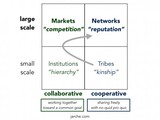
As I complete my third book in the perpetual beta series, I see more signs of an emerging form of connected leadership as society and our economies move into the the next organizational form, from Tribes to Institutions to Markets, and now to Networks dominating the previous three forms.
While tribes were mostly cooperative, sharing freely amongst themselves, they had a near horizon for sharing, and were usually patriarchal for major decision-making. In networks, these tribal tendencies for control are not optimal. Neither are the more sophisticated control methods of institutions and those of markets. Thinking that the role of leadership is to act and make short-term decisions misses out on how well fully functioning human networks can deal with most problems without intervention from above. When managers and executives get involved, they often make things worse for those doing the day-to-day work. This is even more pronounced when those doing the work are connected to their peers in social networks and communities of practice that have established and trusted knowledge-sharing practices.
The real job of leaders today is to ‘hold the space’, and in order to hold it they need to first establish a space where connections are flourishing. Leading is connecting.
Leaders help make connections.
Leaders are network weavers, connecting others to make the network stronger.
Leaders model good learning behaviours.
Leaders practice personal knowledge mastery.
My new e-book, Adapting to Perpetual Beta: Leadership in the Network Era, will be published here before the end of Summer.
Harold Jarche
.
Blog
.
<span class='date ' tip=''><i class='icon-time'></i> Aug 19, 2015 08:25am</span>
|
|
Every fortnight I curate some of the observations and insights that were shared on social media. I call these Friday’s Finds. This is the 250th in the series.
"I think it’s a discovery all artists make: the most interesting and bravest work is likely the hardest to make a living from." - @berkun
"Our most successful clients have cross-flowing knowledge networks to handle the complexity/variety of their marketplace." - @orgnet
"In a sense, cooperation is the temporary alignment of multiple, occasionally contradictory, purposes." - @indalogenesis
"The One Year Club", a series of tweets by @infocloud
"The One Year Club - organizations that buy tools to embrace a new way of working without understanding fit, and finding it really complex. Organizations realize 9 to 18 months in that their tools don’t fit and what they are trying to do is really complex & they need help. Today the One Year Club is far broader and running into vastly deeper problems than 6 to 8 years ago. The One Year Club persists and got worse by not trying to get smarter and understand things, but still thinking it was simple."
Why Is It Difficult To Understand Complex Problems? - via @ToughLoveForx
"Traditional problem solving depends on established patterns only. Problems are solved using pattern recognition. So traditional problem solving depends on having a grasp of well established patterns presented in form of comprehensible knowledge, which is available in public domain. However, complex systems and their problems have both patterns and "no patterns." "No pattern" means existence of new patterns that have not been seen earlier. Therefore, to solve complex problems requires creation of new knowledge to address the emergence of "no pattern." Creating new knowledge is a difficult task. And the process of creating new knowledge, under constraints of time and resources, is not available. There is a gap. Hence most find it difficult to tackle complex problems and issues."
Teaching with Twitter - via @JeffMerrell
"The constraints of Twitter are also its affordances. Being asked to take an idea and put it in this constrained linguistic space of 140 characters forces us to think about and question our thinking in ways we wouldn’t otherwise." - Jesse Stommel
"If people knew how hard I had to work to gain my mastery, it would not seem so wonderful at all." - Michelangelo - via @AmyBurvall
Mastery by Amy Burvall
Harold Jarche
.
Blog
.
<span class='date ' tip=''><i class='icon-time'></i> Aug 19, 2015 08:24am</span>
|
|
If you want to learn something about a field you know little about, what do you do? There are many areas where I know very little, and learning about them in depth would be a major time commitment. Is there anything we can do do to make it easier? I think so.
My knowledge of biology is quite limited. I never took the subject in high school or in university. Part of my strategy in using social media, like Twitter, is to connect with people who know more than I do. Shaun Coffey @shauncoffey is one of these people. We share an interest in knowledge management and PKM, but Shaun has a background in agricultural science of which I know nothing. A recent tweet of his was a link to an article on GMO (genetically modified organisms) which is an area of interest to me as a consumer, but something I found rather complex to understand. Since I trust Shaun, I read the article, Unhealthy Fixation. While I am still not an expert, I feel better informed on GMO.
More of my knowledge and understanding is coming through my network. First I develop a relationship with the person, in understanding perspectives, depth of knowledge, and consistency. The small pieces shared and commented on via Twitter let me start to see patterns and determine the authenticity of the person. We don’t need to have conversations, as I can lurk on their conversations with others. Over time I can get a good sense of the person. This is why I follow Michael Geist @MGeist as he brings a fair and comprehensive perspective on Canadian Internet and e-commerce law. There are many others in my networks who help me make sense of my world, such as Valdis Krebs @orgnet for organizational network analysis.
Building knowledge networks of trusted connections is one way we can learn as a society and address the complex problems facing us. Nobody can do it alone. Explicitly using social media and social networks to better understand complex issues should be part of all education programmes and everyone’s professional practice. There is so much to know and very little time. I call this serendipitous drip-fed learning. You just have to find the feeds, thankfully of which there are many.
Harold Jarche
.
Blog
.
<span class='date ' tip=''><i class='icon-time'></i> Aug 19, 2015 08:23am</span>
|
|
The third volume in the perpetual beta series is now ready. Adapting to Perpetual Beta continues to explore the network era and its effects on society, business, and education. It follows seeking perpetual beta and finding perpetual beta published in 2014. This volume is focused on leadership and adapting to perpetual beta: dealing with constant change while still getting things done.
All of the ideas discussed here have been explored initially on my blog, established in 2004. I describe my blog as a place to post ‘half-baked ideas’, and often build upon one post after another. Discussing these ideas in public lets me test them before committing them to my professional practice. I have written over 2,700 posts on my blog, so this book series provides a concise synthesis of the various themes posted here.
Adapting to Perpetual Beta, a 67 page DRM-free PDF, is available for individual purchase until mid-September for $19. All three perpetual beta volumes may be purchased for $33 here.
The files will be emailed to the address provided within 12 hours (usually much quicker).
Table of Contents
1. THE INTELLIGENT ENTERPRISE
Perpetual Beta
Complexity
Democracy
2. LEADERSHIP IN THE NETWORK ERA
Sharing Power
Social Structures
Leadership by Example
Immersion
3. ORGANIZATIONAL LEARNING
Hard Soft Skills
Managing Talent
4. NETWORKED MANAGEMENT
Implementing Networked Management
The Networked Workplace
Excerpt:
Adapting to a networked life in perpetual beta means that people have to learn how to deal with more ambiguity and complexity at work. Automation of routine and standardized work is forcing people to do do more non-routine manual and cognitive work. If the work can be mapped and analyzed, it will be automated. As networked, distributed, non-routine work becomes the norm, trust will emerge only in those work environments that are open, transparent, and diverse. Trust is necessary to ensure that implicit knowledge flows, which contributes to organizational longevity. Organizations need to learn as fast as their environments. Constant experimentation must be the order of each day.
Therefore, those in leadership and management positions today must find ways to nurture creativity and critical thinking. Management must set the initial example of transparency and working out loud. In addition, self-management is required at all levels. When there is no one to defer work to, everyone sets an example through their actions. In this environment everyone is learning and everyone is teaching by example. As a result, work gets done very quickly. From this foundation, today’s organizations can prepare for a new world of work. Machines will continue to replace jobs but people can create new work roles that are creative and social, beyond the reach of automation.
Leadership in networks is exercised through reputation, not positional authority. Having influence in multiple networks, not just the organization, makes a leader even more effective. The ability to span networks becomes important as organizational lifespans decrease and worker mobility increases. To remain connected to the changes in their networks, good leaders are curious and promote experimentation, but do not need to control it. Leadership in networks is helping the network make better decisions, and this requires a focus on the best organizational design to meet the changing situations. Strong networks, combined with temporary and negotiated hierarchies to get work done, become the simple building blocks for an organization in a state of perpetual beta.
Harold Jarche
.
Blog
.
<span class='date ' tip=''><i class='icon-time'></i> Aug 19, 2015 08:23am</span>
|