Blogs
|
Every fortnight I curate some of the observations and insights that were shared on social media. I call these Friday’s Finds.
Buzzfeed - Anecdoche (n): "A conversation in which everyone is talking but nobody is listening." - via @lombardi_gloria
@JesseLynStoner - "Cooperation, like respect, is often assumed. And in reality, ignored."
@AllisonEck - The best teams act like musicians
Switch Chairs (and Roles) Often
Play Your Part
Don’t Compare
Distribute Your Energy Wisely
Anticipate Needs
Don’t Assign: Nominate
Sound Check Often
Know the Score
Embrace Uncertainty
@mathemagenic - Holding the space
"I help to negotiate rules and exceptions from those, to prevent or resolve conflicts, to make appointments and to get to people and places. I do all kinds of things "meta" - keep eyes on meta-learning, observe, document, reflect and get others in the loop.
Most of the work kids do themselves. It’s their learning and I’m holding the space for them."
Denmark is stopping hospital accreditation/inspection (PDF) - via @HelenBevan
"The quality of our health care system has to be satisfactory, and there is nothing wrong with the intention behind giving hospitals a stamp of approval, if they live up to a range of quality standards. But when hospital staff no longer can see the use in filling out forms, going through guidelines and standards and they seek a different and less difficult way of improving quality, then of course I’ll listen. And I believe, that the time has come to give up the quality programme in the hospitals, so the staff will have more time for the patients," [Health Minister] Nick Hækkerup says.
The Backwards Brain Bicycle - Smarter Every Day - via @dajbelshaw
[Great video: How difficult it is to unlearn and relearn, and how easy it is to go back to our old ways.]
Harold Jarche
.
Blog
.
<span class='date ' tip=''><i class='icon-time'></i> Aug 19, 2015 08:37am</span>
|
|
Most people have heard Clay Shirky’s quote that, "It’s not information overload, it’s filter failure." The professor and author has coined terms such as ‘cognitive surplus’ to explain that we have the mental capacity to do a lot more with our collective intelligence, but too often, societal barriers inhibit us. We are too busy with the day-to-day commute, usually in a deluge of noise from radios, billboards, and news sources, to reflect and consider bigger issues. Getting paid every two weeks focuses employee attention on the short term, as do quarterly reports for executives.
Filter failure is only part of our challenge to make sense of our world. Even with good information filters in place, we remain passive consumers of information. We can share our filtered information, which many do on social media or over a coffee, but what value are we adding to it? It takes more time and effort to take our filtered information and make sense of it. Shirky, once again, says that "Curation solves the problem of filter failure". I would say that curation adds a layer of value, but is still not enough.
Co-creation enables large scale change. Harold Stolovitch wrote a book called "Telling Ain’t Training" . Well, curation ain’t creation. Curation is an important aspect of personal knowledge mastery. But we have to do something with our knowledge. That means experimentation. Probing our complex environments is the only way to understand them. Businesses that do not experiment will fail over time. People who fail to continuously learn will be replaced by machines. But it is not necessary for each of us to do this on our own.
We can become knowledge catalysts - filtering, curating, thinking, and doing - in conjunction with others. No one can live in an ivory tower of knowledge any more. We need to use our own knowledge in conjunction with others. Only in collaboration with others will we understand complex issues and create new ways of addressing them. As expertise is getting eroded in many fields, innovation across disciplines is increasing. We need to reach across these disciplines.
For example, I have been working on the personal knowledge framework for over a decade. Each PKM workshop [next workshop starts 18 May] that I conduct, I learn by doing it with participants. This is why the workshops are conducted as cohorts of a dozen or more, so that our learning is social, and grounded in reality. In addition, I work with organizations to see how the PKM framework could work in their context. Recently we examined how an international NGO could implement it. Currently we are looking at PKM as a framework for professional development for educators. PKM is also used as a change management framework in healthcare. In each case, people had to put into practice what they were thinking. Just talking about it, or curating relevant information, was not enough. A comment [paraphrased] from a participant on one of our PKM workshops shows how we need to re-frame our perspectives on knowledge.
"A doctor cannot tell me anymore, on his own, what sickness I have, but only in collaboration with me. I have to make an effort to learn about the topic, and he must make an effort to listen to me. We can have a much better impact collaborating like this."
Good knowledge catalysts have diverse knowledge networks from which to seek knowledge. These networks are part of their filters. Catalysts also share, adding value through processes such as curation. In addition, and most importantly, they are catalysts in creating and doing something new.
Harold Jarche
.
Blog
.
<span class='date ' tip=''><i class='icon-time'></i> Aug 19, 2015 08:37am</span>
|
|
One way to make sense of something is to walk around it by looking at it from a different perspective. Time and a different context can give new insights. Chris Mackay gave me this PKM tip on how to make a decision on purchasing books. Chris adds the book’s name & link to OmniFocus and then puts a 30 day reminder on it. One month later he gets an automated notice about the book. What is interesting is that in most cases, Chris decides not to buy the book. Chris admits that he loves buying books and often makes quick purchase decisions. This new discipline helps him save money. He still has a large pile of books on his current reading list though.
Think about this tip for other things you are trying to make sense of. Maybe it’s best to save a link (or use the favorite button on twitter) before you share or comment on it. You might only use this action for certain topics, such as politics. Review them the next day or week, and then decide if they are worth sharing. Part of the PKM sense-making process is to set aside enough time for the important things. Automating certain processes may save you this time.
During the 40-day PKM online workshop, we discuss all manner of ways to improve our seeking, sense-making, and sharing of knowledge. The objective is to find processes and practices that work for you. Combining a number of small new practices can help develop larger changes in taking control of your professional development.
Harold Jarche
.
Blog
.
<span class='date ' tip=''><i class='icon-time'></i> Aug 19, 2015 08:36am</span>
|
|
Social learning is the process by which groups of people cooperate to learn with and from each other. The network era is creating a historic reversal of education, as discourse replaces institutions, and social learning in knowledge networks obsolesces many aspects of organizational training. It is as if Socrates has come back to put Plato’s academy in its place, but this time the public agora is global.
I have learned by facilitating dozens of online workshops that the social aspect is the most important. No matter how much content I design, it is the the discourse amongst participants that is the most powerful accelerator of learning. I run PKM workshops as social cohorts because I realize that I am getting farther removed from novice behaviour. I forget what I was learning myself over 10 years ago. I do not remember how difficult it was to post something online for the first time. Learning with others helps to ensure that it is not just my opinion that informs the other participants.
My current online workshops - PKM & Moving to Social - have not grown into large offerings, with me on the stage and everyone else listening. I know this will not work. The social aspect, having an international group of people cooperating in their learning, is the essential element that can often enhance serendipity, such as an impromptu video conference with an author. No matter how much I design, each cohort goes in a different direction. From each, I learn a little more.
The next PKM workshop starts tomorrow, with participants from AU, CA, MM, NL, UK, & US so far. The diversity of the participants is the special sauce that makes these workshops unique.
"The more I am out there chatting to clients, the more I realise that your PKM approach is the number one critical skill set. Any way I look at it, all roads seem to end there. It is the foundation. That’s why I thought this is where they need to start - and not just the employees - everyone including the managers." - Helen Blunden, AU
Harold Jarche
.
Blog
.
<span class='date ' tip=''><i class='icon-time'></i> Aug 19, 2015 08:36am</span>
|
|
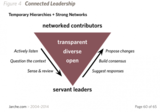
As we enter the network era, we see that leadership is an emergent property of a network in balance and not some special property available to only the select few. Effective knowledge networks require leadership from everyone - an aggressively intelligent and engaged workforce, learning with each other. Positional leadership, by the authority of some hierarchy, is giving way to reputational leadership, as determined by the myriad feedback loops of the network. To lead in a network, is to learn in a network, as relationships and conditions change. Anyone can show leadership, not just managers or those with ‘high potential’.
Network leadership assumes human creative potential can be realized in supportive and challenging environments by engaging everyone. In networks, everyone can be a contributor within a transparent environment. Anyone can lead in a network, if there are willing followers. Leadership in networks is developed through the reputation of one’s actions. Those who have the consensus to lead have to actively listen and make sense of what is happening. They are in service to the network, to help keep it resilient through transparency, diversity of ideas, and openness. These servant leaders can help to set the context around them and build consensus around emergent practices.
Networked leaders make better decisions by actively listening to networked contributors who are closely in touch with their environment. As everyone is continuously questioning the contexts in which the enterprise is working, appointed servant leaders can look at the big picture, not manage the contributors, who for the most part can manage themselves when everyone’s work is transparent. With an informed perspective, they can propose changes and build consensus around suggested responses. Connected leadership is helping the network make better decisions.
Adapting to a networked life in perpetual beta means that people have to learn how to deal with more ambiguity and complexity at work. Automation of routine and standardized work is forcing people to do do more non-routine manual and cognitive work. If the work can be mapped and analyzed, it will be automated. As networked, distributed, non-routine work becomes the norm, trust will emerge only in those work environments that are open, transparent, and diverse. Trust is necessary to ensure that implicit knowledge flows, which contributes to organizational longevity. Organizations need to learn as fast as their environments. Constant experimentation must be the order of each day.
Therefore, those in leadership and management positions today must find ways to nurture creativity and critical thinking. Management must set the initial example of transparency and working out loud. In addition, self-management is required at all levels. When there is no one to defer work to, everyone sets an example through their actions. In this environment everyone is learning and everyone is teaching by example. As a result, work gets done very quickly. From this foundation, today’s organizations can prepare for a new world of work. Machines will continue to replace jobs but people can create new work roles that are creative and social, beyond the reach of automation.
seeking perpetual beta
Harold Jarche
.
Blog
.
<span class='date ' tip=''><i class='icon-time'></i> Aug 19, 2015 08:34am</span>
|
|
Every one of the major challenges facing us is complex. But our organizations are not designed for complexity. Our workplace training does not factor in complexity. While not all of our problems are complex, the simpler issues are being dealt with, especially through software and automation. Understanding complexity means working in it together and using our collective intelligence.
One example of using the collective wisdom of an organization is to map a path forward. Robert Paterson worked with US public radio, NPR, in 2005 to help determine how to adapt to the industry-wide changes wrought by social media. Six years later, Rob noted this report from The New York Times, "Amid all that creative destruction, there was a one large traditional news organization that added audience, reporters and revenue. That unlikely juggernaut was NPR."
Part of the secret was to prepare the existing culture by embracing pathfinders from the new culture.
"So if you want to be successful, please think of hiring someone who knows the other native people out there and the new culture. Who is a native of the world that you aspire to go to. Who is less of a guide than a trusted friend. Who you can talk to quietly in the evening around the fire and have her hear you out. Someone who risks as much as you do on the journey - or even more than you. Someone who is safe and who helps you feel safe as you take risks." - Robert Paterson
Organizations cannot learn how to learn faster by continuing with their traditional methods. They need to get people to marinate in complex systems. It takes more than a course, a report, a retreat, or white paper. It takes time, and space. This space must be created, and guarded against intrusions from the existing system. Xerox created its famous PARC ‘skunk works’ in order to foster innovation. It was separate from the main company.
‘PARC, or Palo Alto Research Center, Inc., was founded in 1971 as a research arm of the Xerox Corporation. Its critical contributions to computer science included development of the laser printer, the Ethernet, a variation of ARPANET (a predecessor of the Internet); various email delivery systems; the nucleus of the modern personal computer - featuring a monitor with graphical user interface, or GUI (pronounced "gooey"), and the first modern version of Stanford Research Institute’s Douglas Engelbart’s invention: the computer "mouse".’ - HighTechHistory
Diversity of opinions and ideas gives any organization more resilience to deal with change and more potential for innovation. An organization’s networked creative surplus can be enabled by blocking the noise of every day ‘busyness’. While this may not be available to everyone, there needs to be a diverse group that has the time and space to try new things, have deep conversations, reflect, and learn by doing. Organizations of any size today need to become a Xerox-PARC, or have access to one. Of course, management will still have to pay some attention to what may sound like crazy ideas emanating from this new edge.
Innovation comes from the edge, almost never from the centre. It is time to start creating the edge of the organization now. As organizations become more technologically networked, they also face skilled, motivated and intelligent workers who can now see systemic dysfunctions. But those who talk about these problems are often branded as rebels. Pitting rebels against the incumbent power-holders is detrimental to organizational learning. Instead, rebels should be allowed to move to the edge. With some additional help from native pathfinders, organizations can then learn to solve their own problems.
Change management then has to be seen as a way of working, not a separate process, and not an event. On the edges the answers will not be clear, but they will be less obscured than in the centre. A new partnership is needed, between current management on the inside, workers on the edges, and others living beyond the organizational edges. This can start by creating a trusted space away from the centre, funding it, and letting people start to work and learn anew. It’s like giving birth to a child, and will take time and a lot of nurturing. It’s also a bit of a leap of faith.
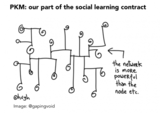
Image: @gapingvoid
Harold Jarche
.
Blog
.
<span class='date ' tip=''><i class='icon-time'></i> Aug 19, 2015 08:34am</span>
|
|
This is a synopsis of my opening keynote for the workplace learning & VET stream at EduTECH15 in Brisbane today.
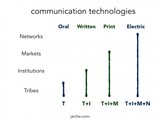
We cannot look at the 2020 workplace merely from the perspective of what will be different from today, as if these five years will pass in splendid isolation. How we think of work has changed over the millennia and one major factor has been our communications technologies. When communication changes, work does too, as well as our understanding of what is knowledge, and what it means to be knowledgeable.
When our various civilizations shifted from a predominantly oral society to the rule of the written word, we saw the rise of kingdoms and institutions. The age in which Socrates was able to guide discourse in the open agora was slowly replaced by structured academies, in the spirit of Plato. But Socrates felt that men who relied on written words would be a burden to their fellow men, as these artifacts would give them the ‘conceit of wisdom’. Despite Socrates’ reported concerns, the written word dominated for over 2,000 years.
When the written word was usurped by the printed page, the sharing of knowledge exploded. Bibles printed in the vernacular showed the common people that often their priests had hidden much of the text from them. This questioning helped to give impetus to the Protestant reformation and the age of enlightenment, which revived the classic Greek science and philosophy texts that could now be easily shared in print. The accessibility of books enabled more universities to be built, and printing helped to create better bookkeeping systems, so that global markets could flourish.
The printed word continued to dominate, even as it was initially obsolesced by the electric impulse, first with the telegraph (dashes & dots) in 1844, followed slowly by radio and television (electrical signals), and only recently gathering speed with the Internet and the Web (zeros & ones). The next five years will be an acceleration of a phenomenon that began in the mid-nineteenth century: the electrification of knowledge.
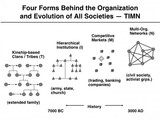
Each time that our mode of communication changed, so too did our dominant organizational structures. We went from Tribes, to Institutions, to Markets, and now to Networks. This is David Ronfeldt’s TIMN model, which aligns with historical changes in communication technologies.
In Tribes, power was often controlled through the bonds of kinship. People frequently did things for the betterment of their family. Members of a tribal group would cooperate with each other, as this was best for the longevity of the tribe. In institutions, power was controlled through the hierarchy, so individuals held their power by the virtue of their position. Work was done collaboratively, directed by those in control. As markets dominated, work continued to be collaborative but more competitive. The aim was to dominate the market. But as we move into a network society, for which we have no precedent, it appears that the cooperative behaviours of tribes may be the best way to work together, as our reputation in the network becomes visible to all.
Cooperation, giving freely with no expectation of direct reciprocity, makes sense in family groups, and is the optimal behaviour in knowledge networks as well. Cooperative behaviour enhances one’s reputation and creates more links in a network. Those with more connections can exert greater influence, but this is usually indirect.
The current speed of change from markets to networks is evident in the automation of human work. Automated tellers are an obvious example. Even higher level work is getting automated, such as legal discovery, once done by armies of lawyers and now replaced by software. Since the beginning of the century, routine work, both cognitive and manual, has decreased, while non-routine work has increased. This is a direct result of automation in all fields of work, whether it be self-serve kiosks, software replacing accountants, or driverless cars. As one recent article stated, "Self-Driving Trucks Are Going to Hit Us Like a Human-Driven Truck". Automation is eating jobs.
Any work that is routine will be automated. Jobs that only do routine work will disappear. Valued work, enhanced by our increased connectivity, will be based more on creativity than intelligence. The future of human work will require tacit knowledge and informal learning, and will create intangible value that cannot easily be turned into commodities. The future of work will be complex and this will be even more obvious in the next five years, as robots and software keep doing more complicated work. Just as people had to become literate to work in the 20th century workplace, now they will have to be creative, empathetic, and human: doing what machines cannot do.
To deal with this work shift, people need to engage with professional communities in order to share tacit knowledge through conversations with trusted colleagues. Work silos are barriers to knowledge-sharing, as are education silos.
Marshall McLuhan gave us "the global village" as well as the aphorism that "the medium is message". Even the typographical error in the book’s title, "The Medium is the Massage", reinforced his point that communications media have strong influences on society. McLuhan’s Laws of Media can help us see what influence technology has on us. The media tetrad, explained by Derrick de Kerkchove, co-author of McLuhan for Managers, is that every technology has four effects.
1. extends a human property (the car extends the foot);
2. obsolesces the previous medium by turning it into a sport or a form of art (the automobile turns horses and carriages into sports);
3. retrieves a much older medium that was obsolesced before (the automobile brings back the shining armour of the knight);
4. flips or reverses its properties into the opposite effect when pushed to its limits (automobiles, when there are too many of them, create grid lock)
Let’s look at pervasive digital networks, currently known as "the cloud". All of this open knowledge extends democratic and open structures, with growing experiments such as blockchain for finance or open source software. This shift to one big computer obsolesces the personal computer, with most computation now taking place beyond the individual’s control. As a result, off-grid computing and even the use of typewriters to avoid the Internet are now the realm of the rich and powerful. This pervasive digital network is retrieving the communal cooperation of the tribal era, with crowd-sourced fundraising and shared common goods, facilitated by trusted connections. However, the cloud can easily reverse into a panopticon of deception, as is already manifested through wide-ranging government surveillance and growing cyber crimes.
What can the tetrad tell us about learning? Networked learning extends individual control over personal and professional development, as articulated in personal knowledge mastery or personal learning networks. It obsolesces the hierarchy of the academy, opening education to more people, but makes private schooling an in-demand luxury. Social media retrieve the discourse of the age of Socrates, providing a public agora for all to engage. However, when pushed to its limits, networked learning may become nothing more than massively open online courses pushing a corporate agenda.
The retrieval of Socrates and the fuzziness of discourse reflects the complexity of the network era. Work is too complex for the structured academy. Training and education systems, run by a central authority (the academy) are effective when developing instruction to deal with complicated phenomena, where all the components are understandable and can be analyzed and mapped. Best practices and good practices can align easily with a curriculum. But in complex environments, emergent practices need to be developed while simultaneously engaging the problem. Social learning is the process by which groups of people cooperate to learn with and from each other. As discourse replaces the academy, social learning in knowledge networks replaces training and education.
If you are involved in workplace learning or education, consider these changes in how we communicate, organize, and work.
How important is developing new content, as opposed to helping make connections?
How can we help people get better at creating new practices, and not just replicate old ones?
How can our organizations promote better and deeper conversations?
How can we help to build trust so that people freely share their knowledge?
We know that the machines will continue to improve. Barring the collapse of civilization, digital networks are here to stay. In the network era, work is learning and learning is the work. Our job, as learning professionals, is to make humanity the killer app for our organizations. While 2020 will not be that different from 2015, it will be further along the progression into the network era and a shifting world of work and learning, away from routine jobs and toward unique and creative work. This has to be supported through widespread opportunities for informal learning and ways to share tacit knowledge. This is the challenge for workplace learning as well as higher education.
Harold Jarche
.
Blog
.
<span class='date ' tip=''><i class='icon-time'></i> Aug 19, 2015 08:34am</span>
|
|
This is a summary of my closing keynote for the workplace learning & VET stream at EduTECH15 in Brisbane on 3 June 2015.
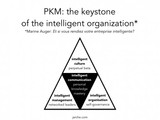
The intelligent enterprise [l’entreprise intelligente] has to be founded first and foremost on intelligent communication, which in the network era is much more than just passing information. It is actively engaging in conversations to continuously make sense of the changing environment. As it was necessary to be literate in order to work in the industrial era, it is now a basic work requirement to be able to communicate effectively. This means adding value to knowledge, in various mediated forms (video, audio, written, oral). Being able to read and write is not enough. Intelligent communication requires seeking out knowledge in social networks, making sense by creating new communications, and being cognizant of the appropriate times and ways to share that knowledge.
The intelligent organization is based on a simple structure that has the flexibility to deal with complex situations. This is enabled by individuals learning as they work, making decisions without explicit permission, solving problems together, and trying out new things. The human brain is the best interface for complexity. Organizations have to be designed to promote creative and non-routine work, and leave the machines to handle the boring stuff. Complexity requires simple, adaptive organizational structures. Human cognition can fill in the gaps.
Without intelligent communication (PKM), it would be impossible to have self-governance. Intelligent organizations are built on self-managed teams that require fewer external directives. Power sharing can energize the entire workforce to be more entrepreneurial.
Without intelligent communication, managers would not have the basic skills to be networked leaders. The transparency of intelligent communication eliminates the need for most traditional management control mechanisms. Intelligent management focuses on making the whole network smarter.
Without intelligent communication, it would be difficult to adapt to perpetual beta through continuous experimentation. Culture is built upon daily actions. Trust is an emergent property of an intelligent organization, stemming from a healthy workplace culture.
PKM is one way to expand our literacy beyond the passage of information and toward co-creating knowledge and actively engaging in sense-making at work and beyond. Reading and writing are not enough in an era when connections are many and information is abundant. Literacy today requires an aggressively engaged citizenry. It starts with intelligent communication.
Harold Jarche
.
Blog
.
<span class='date ' tip=''><i class='icon-time'></i> Aug 19, 2015 08:33am</span>
|
|
The Tribal form of society was premised on kinship, which added the Institutional form based on hierarchical position, and later the Market form based on competitive advantage. The current Market form of society is a myopic creature, extracting short-term value from the entire ecosystem and redistributing it to a priesthood of investors. Every quarter companies must pay tribute to the gods of the market. Even our governments are run like markets, with slightly longer payback periods. The US House of Representatives gets market feedback every two years, the Australian government every three years, Canadian parliamentarians every four years, and lucky US Senators every six years. The focus on short-term results is the hallmark of the market era.
TIMN
What will the network era bring? Longer term thinking or actions based on micro-feedback? Both are likely. If reputation is the source of power and influence in the network era, then long-term strategies are necessary to build it and keep it. But if big data tells us everything that is happening in the moment, we may be seduced into continuously shifting with the spirit of the times. This tension is the great challenge in building new organizational models. How can we balance the short and long term? It is tempting to focus on the short term, as we see with data analytics for everything, including learning, which is definitely a long-term endeavour.
Developing ways to ensure a long term view will be necessary to counter the urge to do everything at twitch speed. Our markets have shown themselves susceptible to this in the way currency markets work. We still see the excesses of the market era in sweat shops around the world. We need to start now on creating new forms of long-term governance structures, political as well as commercial, to control the potential excesses of the network era. One way is to focus our training and education programs on long term thinking, not mere job preparation or 21st century skills. As with those educational visionaries who built our public education systems, there is again an opportunity for learning and development to lead the way.
Harold Jarche
.
Blog
.
<span class='date ' tip=''><i class='icon-time'></i> Aug 19, 2015 08:32am</span>
|
|
Work is learning, and learning is the work. I have repeated this hundreds of times over the past six years and I know some people may think it is a trite statement. But the fact that learning is usually supported by an organizational department that has less influence than sales, marketing, operations, or information technology, shows that learning is not a priority in most enterprises. It’s often bolted on after the major decisions have been made. Several times on consulting engagements I have been perceived as ‘the learning guy’ dealing with a minor aspect of the ‘real’ project.
As I have noted before, as standardized work keeps getting automated, the only work left for people will be complex and creative. This type of work requires a culture of continuous learning. Imagine going to work where people cannot speak, read, or write. It would be impossible to run an organization if this were the case. We are moving into an era where it will be impossible to run a company where everyone is not constantly learning. This does not mean everyone will be on a training course. The network era workplace will require constant independent and interdependent learning by doing. In the very near future, those who cannot learn will miss out on employment opportunities and will be ineffective in self-employment.
The good news is that everyone can learn. The bad news is that many have forgotten how. Learning is the key requirement in dealing with complexity, because you first have to try something new, and then learn from the experiment. Emergent practices have to be developed, as it is too late to find out what has already worked for other companies (best practices), and your context will not be the same anyway.
The writing is on the wall, as this report on how innovation happens today shows, with examples from:
Adobe - "the challenge of creating a culture that supports experimentation"
Etsy - "Innovation is a process of continuous learning and improvement."
WonderSpark - "While founders have a tolerance for failure, most employees don’t."
Intercom - "one of the biggest challenges to innovating is simply getting started"
Comcast - "connect the dots between established processes and new opportunities"
"The untold story behind today’s most innovative brands, however, is what happens behind the scenes. While success stories are plentiful, what most people don’t see is the amount of trial, error, and learning that goes into setting up workflows, empowering employees, and figuring out initiatives to prioritize. Regardless of whether you’re a part of an established company or two-person startup, the task of bringing new ideas to market is hard." - The Next Web
Developing a do-it-yourself learning discipline is the core of personal knowledge mastery. Organizations that do not actively support something like the PKM framework are seriously limiting new insights that feed innovation. Larger organizations, with training departments, have to move their focus to social learning. They cannot keep up with rapid change by waiting to do a training needs analysis. Learning is the literacy of the 21st century.
Harold Jarche
.
Blog
.
<span class='date ' tip=''><i class='icon-time'></i> Aug 19, 2015 08:32am</span>
|