Blogs
|
Finding Perpetual Beta is now in production. This new ebook is part of the continuing journey to understand how individuals and organizations can manage fundamental changes in networked society, business, and education. It is a series of reflections on the themes presented in Seeking Perpetual Beta, published in April 2014. It questions the status quo of how organizations are structured in order to get work done. In addition, there is an expanded Part 2 on personal knowledge mastery (PKM), a foundational discipline for working in the network era and a creative economy.
Here are some highlights, covering the main themes in Part 1: The Network Era.
Today, knowledge-based work is replacing manufacturing and information processing jobs. Robots and software are displacing routine work. Meanwhile, collaborative work is dominating both transactional and production work. The future of valued, human work is in collaboratively addressing complex problems and coming up with creative solutions.
Automation is ending the industrial era. Examples include lawyers replaced by software, bank staff replaced by websites, travel agents replaced by apps, and soon drivers will be replaced by robots. Workplaces are finding themselves at a break-point between the industrial era and the network era, with industrial era systems and structures unable to adapt to a world of mostly non-standardized, non-repeatable work processes.
A new model for work is required. Hierarchies, simple branching networks, are obsolete. They work well when information flows mostly in one direction: down. Hierarchies are good for command and control. They are handy to get things done in small groups. But hierarchies are rather useless to create, innovate, or change.
We are at the beginning of a management revolution, similar to the one that created modern business schools and their scientific methods. There are many examples today of companies testing out new management models such as the social enterprise, democracy in the workplace, self-organizing work teams, and networked free-agents. While there are no clear answers, it is fairly certain that standing still will lead to failure. Giving up control is the great challenge for management.
Another challenge for organizations is getting people to realize that what they know has diminishing value. How to solve problems together is becoming the real business imperative. Sharing and using knowledge is where business value lies. With computer systems that can handle more and more of our known knowledge, the network era worker has to move to the complex and chaotic edge of the organization to do the valued work of exception handling.
We are seeing growing complexity both inside and outside the enterprise. In this complex and connected world we cannot predict outcomes, but we can engage our environments and markets and then learn by doing. This makes constant learning a critical business skill. It requires do-it-yourself learning as well as social learning skills.
A networked enterprise needs to be organized more like the Internet, and less like a tightly controlled machine. While hierarchies are practical to get work done, they should not be the overarching structure for the organization. There is still a need for responsibility and accountability, but authority has to be distributed to deal with complex problems.
Part 2: Personal Knowledge Mastery:
The Seek > Sense > Share Framework
PKM Tips
PKM and the Future of Work
—
I am starting to plan for the third ebook in this series. My intention is that it will be based on a series of interviews to understand what people are doing differently this past decade, such as working in non-hierarchical organizations, or how they are practicing some form of PKM. Interest in these themes is growing. For example, students in a US education doctoral program will be using these ebooks for one of their modules. A community of practice of Canadian training managers will also incorporate these books into their 2015 professional discussions. Many people are seeking, and hopefully finding, perpetual Beta.
Harold Jarche
.
Blog
.
<span class='date ' tip=''><i class='icon-time'></i> Aug 19, 2015 09:02am</span>
|
|
Is this the journalism of the future?
"We can conjecture, for example, that the journalism of the future will be distributed — with every individual in society playing a continuous role in providing the function. Indeed, given the primary importance and power of True Information to a well functioning Abundance Society, we might well expect that providing honest and thoughtful evaluation of experiences will become one of the principal activities in the future. Perhaps a main portion of the economy of Abundance will involve having experiences, evaluating them and curating them in a collective effort to ensure that every member of society is consistently presented with the best possible set of experiences for them to encounter at every moment." - Reinvent Everything
We made the news!
Jordan Greenhall paints a very clear picture why distributed journalism is likely to happen. It is an accepted fact in some jurisdictions. As the Supreme Court of Canada ruled on defamation in 2009, all citizens can be viewed by the law as journalists.
"However, the traditional media are rapidly being complemented by new ways of communicating on matters of public interest, many of them online, which do not involve journalists. These new disseminators of news and information should, absent good reasons for exclusion, be subject to the same laws as established media outlets."
As distributed and shared sense-making pervades society, it is quite likely a similar pattern will emerge inside and across organizations. We will all have to be sense-makers and curators of knowledge in our increasingly distributed workplaces.
Evidence of one’s knowledge-sharing and sense-making may become the new résumé. It would be up to date and multifaceted, showing activities across multiple networks. It might even replace the useless annual performance review. In the network era, where work is learning and learning is the work, would it not be better to find out how people are actively learning? It would be good to see questions like the following in workplace conversations and interviews:
How do you keep your learning up to date?
With whom do you learn?
How do you capture your learning?
How do you narrate your work? Please show us an example …
How do you stay current in your field?
How diverse is your network? Could you give us some examples?
How would you begin to look at the following problem, which is out of your normal scope of work …
Describing how we stay actively engaged in our learning is a better indicator of future performance than a list of past achievements. In a world where many answers do not lie in the past, but in how we manage to make connections with the present, our thinking has to remain relevant. In the network era people need to re-skill and address today’s and tomorrow’s problems, not yesterday’s. We need to think more like artists and look at creating new ways of working, not polishing our previous successes. Showing how we learn and manage our knowledge keeps us focused on the present and ready for the future.
Practicing sense-making, such as with the PKM framework, is a solid way to get people ready for the future of work.
Harold Jarche
.
Blog
.
<span class='date ' tip=''><i class='icon-time'></i> Aug 19, 2015 09:02am</span>
|
|
The five most-viewed posts here this past year provide a good synopsis of the over 150 articles I have written since January. They cover the main themes of organizations, work, and learning, that I have been discussing on this blog since 2004.
The Seek > Sense > Share framework
This article was published by UK-based Inside Learning Technologies & Skills magazine. It is an overview of personal knowledge mastery (PKM).
Key point: The mainstream application of knowledge management and learning management over the past few decades is mostly wrong; we over-managed information, knowledge, and learning, because it was easy to do so.
Four basic skills for 2020
This is another post related to PKM, that focuses on 4 of the skills critical for success in the emerging network era workplace, as identified by the Institute for the Future.
Key point: Knowledge in a networked society is different from what many of us grew up with in the pre-Internet days.
The post-hierarchical organization
This article describes the limitations of hierarchies and asks: What does a post-hierarchical organization look like?
Key point: Organizations have to become knowledge networks.
Organizational learning in the network era
This post states that organizational learning is more than training. People in today’s workplace need ongoing, real-time, constantly-changing, collaborative, support. They can only work effectively if barriers to organizational learning are removed.
Key point: Systemic factors account for most organizational problems, and changing these has more potential for improvement than changing any individual’s performance.
Management in networks
This article asks: What are the functions of management in the network era?
Key point: The company no longer offers the stability it once did as innovative disruption comes from all corners. Economic value is getting redistributed to creative workers and then diffused through networks.
Harold Jarche
.
Blog
.
<span class='date ' tip=''><i class='icon-time'></i> Aug 19, 2015 09:00am</span>
|
|
Every fortnight I collate some of the observations and insights that were shared on social media. I post the best as Friday’s Finds. Here are the best of 2014.
"The nature of work is changing. People’s relationship with work is changing. The changes to society will be vast." - @gapingvoid
"Every great cause begins as a movement, becomes a business, & eventually degenerates into a racket." —Eric Hoffer - via @tom_peters
"Again, while enlightened animal trainers are recognizing the danger of a purely behavioral / Skinner approach, VC’s [venture capitalists] are funding it for humans." - @SeriousPony
"Humans require the difficult and messy social routing protocol of trust." - Valdis Krebs @orgnet - via @voinonen
"The Industrial era was based on the principle that an organisation produces, not the individuals, so the workers cannot produce without an organisation." - @EskoKilpi
"How do we evaluate teachers? We never speak of this. It is irrelevant in our country. Instead, we discuss, ‘How can we help them?’" - Pasi Sahlberg, Finnish Educator, via @PascalVenier
The Leadership Paradox - Leadership is … an activity or behavior that can arise anywhere in a human system.
The overall conclusion of this research was that the leaders of successful organisations did play a key role in radical transformations of those organisations, but not by specifying it or directing it but by creating the conditions which allowed for the emergence of such change.
Liz Ryan: ‘If You Can’t Measure It, You Can’t Manage It': Not True - Forbes
Luckily, humans are very good at reading energy and responding to it. It’s always been human energy and mojo that have powered everything good that’s ever happened in business or institutional life. We delude ourselves when we pretend that the yardstick and the milestone matter … More measurement won’t do anything except clog the pipelines through which your company’s mojo flows.
The secret to the Uber economy is wealth inequality - via @MarkFederman
It did not take technology to spur the on-demand economy. It took masses of poor people … All that modern technology has done is make it easier, through omnipresent smartphones, to amass a fleet of increasingly desperate jobseekers eager to take whatever work they can get.
Deming & Me by @Tom_Peters - "High potentials" will take care of themselves. The secret is improving the performance of the 60% in the middle - via @TomGram1
W. Edwards Deming, the quality guru-of-gurus, called the standard evaluation process the worst of management de-motivators. I don’t disagree. For some reason or other, I launched several tweets on the subject a couple of days ago. Here are a few of them:
Do football coaches or theater directors use a standard evaluation form to assess their players/actors? Stupid question, eh?
Does the CEO use a standard evaluation form for her VPs? If not, then why use one for front line employees? …
WSJ: Drop the nature vs nurture debate
But new research has led biologists to a different view. We didn’t adapt to a particular Stone Age environment. We adapted to a newly unpredictable and variable world. And we did it by developing new abilities for cultural transmission and change. Each generation could learn new skills for coping with new environments and could pass those skills on to the next generation.
As the anthropologist Pascal Boyer points out in his answer, it’s tempting to talk about "the culture" of a group as if this is some mysterious force outside the biological individual or independent of evolution. But culture is a biological phenomenon. It’s a set of abilities and practices that allow members of one generation to learn and change and to pass the results of that learning on to the next generation. Culture is our nature, and the ability to learn and change is our most important and fundamental instinct.
Social Networks: What Maslow Misses | Psychology Today - via @mslogophiliac
Humans are social animals for good reason. Without collaboration, there is no survival. It was not possible to defeat a Woolley Mammoth, build a secure structure, or care for children while hunting without a team effort. It’s more true now than then. Our reliance on each other grows as societies became more complex, interconnected, and specialized. Connection is a prerequisite for survival, physically and emotionally.
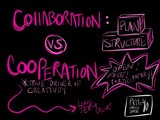
@amyburvall - Difference between collaboration ( directed) & Cooperation ( open, participatory) #PKMastery
Cooperation & Collaboration by Amy Burvall
If you have liked my articles and Friday’s Finds over the past year, consider purchasing my ebook, finding perpetual beta
Harold Jarche
.
Blog
.
<span class='date ' tip=''><i class='icon-time'></i> Aug 19, 2015 08:59am</span>
|
|
Power and Leadership
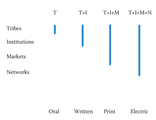
The TIMN [Tribes + Institutions + Markets + Networks] model shows how society grew from a collection of tribes, added institutions, and later developed markets. These aligned with revolutions in communications: from oral, to written, to print. The network era began with the advent of electric communications, though it is by no means completely established.
Each type of societal structure has required different types of leadership. Alexander the Great was probably one of the best tribal leaders. He led his armies from the front and created an enormous empire. After his death, some of his generals created long-lasting institutions not based on military tactics. Ptolemy’s library at Alexandria is one example. Later, institutions like the Catholic Church dominated more through soft institutional power, rather than wielding swords. Others did that for them when necessary. As a market society developed, new types of power were exercised by the Fuggers and the Hanseatic League. Later, captains of industry such as Andrew Carnegie, would dominate in their markets, often circumventing institutional power.
As we enter the network era, we see companies like Apple dominating, often ignoring Wall Street pundits. With network effects, Google can control the online advertising market, making market competition almost irrelevant. Power shifts as a society’s organizing principles change.
Niels Pflaeging states that, "All organizations know three kinds of power, and two forms of leadership".
Hierarchy is necessary for (and only for!) building compliance. It is not networked. As formal power, It is not a form of leadership - but of management. In the presence of formal power, leadership is actually quite impossible to happen.
Influence is necessary for social density and connection. It is networked. It is a form of leadership.
Reputation is necessary for value creation. It is networked, as well. It is the second form of leadership.
In almost all organizations today, positional power is alive and well. For some managers, this is all the power they have, and they are at the mercy of the hierarchy. If they lose their position, they lose their power. More effective leaders influence people through their social leadership abilities. This is what most modern leadership training programs focus on developing. In the network era, effective leaders also have to build their reputational power through networked leadership.
Like the TIMN model, social and networked leadership can build on each other.
One major change as we enter the network era is that positional power (based on institutions and hierarchies) may no longer be required to have influence in a network society.
This may change a lot about how we think about leadership.
I call this connected leadership: the combination of social and networked leadership.
Leadership as Craft
Leadership training usually does not work. In most cases, leadership coaching and mentoring is not that effective either. Perhaps the problem is the nature of leadership. Is it a skill that can be fairly quickly developed, or rather a craft that takes time to develop? When it comes to crafts that require much time and practice, modelling may be a better method than shaping.
Education and training are shaping technologies. They reward successive approximations of the desired behaviour. Modelling, on the other hand, is the foundation of social learning. Trying to directly shape behaviour can work when the task to be done is straight-forward, time is of the essence, and the learner is ready. For complex behaviours like leadership, consisting of several skills, modelling may be best, as there is much implicit knowledge to be learned, which takes time. Education and training usually don’t provide the time for enough reflective practice. As long-time Canadian painter Stephen Scott has noted, most of what he knows about the technique of oil painting he learned on his own after leaving university. Management and leadership are similar types of abilities.
If we look at how organizational training and development has functioned over the past half-century, it has been mostly separate from the work being done and focused on shaping behaviours. But the valued work in the enterprise is shifting, as it increases in variety and decreases in standardization. There is strong evidence that we need to integrate learning into our work in order to deal with the increasing complexity of knowledge work. Modelling is integrative, while shaping is usually external and out of the work context.
Consider also that as knowledge expands and new information is constantly added, who has the base knowledge to do the shaping anyway? In our networked world, modelling behaviours may be a better strategy than shaping on any pre-defined curriculum. With modelling, the learner is progressively supported. In connected leadership, people can be both teachers and learners. Therefore neither training programs, nor coaching, are enough. Leadership by example becomes the key.
Leadership in Networks
Connected leadership is not the status quo and it is not based on great man theories. As organizations, markets, and society become networked, complexity in all human endeavours increases. There are more variables as a result of more connections. In complex adaptive systems, the relationship between cause and effect can only be known after the fact. This makes traditional planning and control obsolete. Connected organizations must learn how to deal with ambiguity and complexity. Those in positions of leadership have to find ways to nurture creativity and critical thinking. The connected workplace is all about understanding networks, modelling networked learning, and strengthening networks. In networks, anyone can show leadership, not just those appointed by management.
A guiding principle for connected organizational design is for loose hierarchies and strong networks. As networked, distributed work becomes the norm, trust will emerge from environments that are open, transparent, and diverse. Strengthening professional social networks will ensure that knowledge is shared and contributes to organizational longevity. Connected organizations need to learn as fast as their environments.
As a result of this improved trust in the workplace, leadership will be seen for what it is — an emergent property of a network in balance and not some special property available to only the select few. This requires leadership from everyone — an aggressively intelligent and engaged workforce, learning with each other. In the connected workplace, it is a significant disadvantage to not actively participate in social learning networks.
Leadership in networks does not come from above, as there is no top. To know the culture of the workplace, one must be the culture. Marinate in it and understand it. This cannot be done while trying to control the culture. Organizational resilience is strengthened when those in leadership roles let go of control.
Building Trust
The connected workplace requires collaboration as well as cooperation. Both collaborative behaviours (working together for a common goal) and cooperative behaviours (sharing freely without any quid pro quo) are needed, but most organizations today focus their efforts on shorter term collaboration. However, networks really thrive on cooperation, where people share without any direct benefit. Modelling cooperation is another important leadership skill in the connected workplace.
Connected leaders know that people naturally like to be helpful and get recognition for their work. But humans need more than extrinsic compensation, as our behaviour on Wikipedia and online social networks proves. For the most part, people like to help others. Cooperation makes for more resilient knowledge networks. Better networks are better for business.
Research shows that tacit knowledge flows best in trusted networks. Trust pro- motes individual autonomy and this becomes a foundation for more open social learning. Without trust, few are willing to share their knowledge. An effective knowledge network also cultivates the diversity and autonomy of each worker. Connected leaders know how to foster deeper connections which can be devel- oped through meaningful conversations. They understand the importance of tacit knowledge in solving complex problems.
The power of human social networks, like electricity, will inevitably change almost every business model. Those who are trusted as leaders will need to understand the new connected workplace. Connected leadership starts by organizing to embrace networks, manage complexity, and build trust.
Servant Leadership
Managers, acting as servant leaders in a connected enterprise, should spend much of their time focused on complex situations, where the relationship between cause and effect can only be seen after the fact. Actively listening requires an engagement with networked contributors who are closely in touch with their environment. Everyone should continuously question the contexts in which the enterprise is working. Appointed servant leaders have an even greater responsibility to look at the big picture, not manage the contributors, who for the most part can manage themselves when everyone’s work is transparent. Leaders can then propose changes and build consensus around suggested responses. Connected leadership is helping the network make better decisions.
—
You can support my writing by purchasing my latest ebook: finding perpetual beta
Harold Jarche
.
Blog
.
<span class='date ' tip=''><i class='icon-time'></i> Aug 19, 2015 08:59am</span>
|
|
Corporations were created to give limited liability to organizations that were taking on large, capital-intensive projects, like building railways. Today, most corporations have little physical capital and instead derive their value from intangible goods and services. Such a significant economic shift should make us question the value of putting so much value into the corporation, when most of it now is created by workers. Do we still need a corporation to enable wealth-creation for a post-industrial, and more importantly, a post-job, economy? For example, the open source model has shown that software can be developed faster and cheaper (and many would say better) without a corporate, hierarchical structure. There are alternatives.
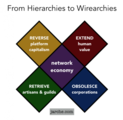
A network economy can retrieve artisans and guilds, distributing power to those who do the work, and reconnecting thinkers and doers. This can extend human value through the economy, distributing value so it does not only accrue to the top of the hierarchical pyramid. Corporations, as we know them, are obsolete for a network economy. However, they could still re-emerge in the form of platform capitalism, masquerading as the sharing economy.
Post-job Economy
The "job" was the way we redistributed wealth, making capitalists pay for the means of production and in return creating a middle class that could pay for mass produced goods. That period is almost over. America has hit peak jobs TechCrunch informs us. The New York Times calls it the rise of the permanent temp economy. The recession, combined with technology, is killing middle class jobs, reports the Associated Press.
Knowledge Artisans
An artisan is a skilled worker in a particular craft, using specialized tools and machinery. Artisans were the dominant producers of goods before the Industrial era. Knowledge artisans are retrieving the older artisan model and re-integrating previously separate skills. Knowledge artisans not only design the work but they can do the work. It is not passed down the assembly line. Many integrate marketing, sales, and customer service with their creations. To ensure that they stay current, they become members of various Guilds, known today as communities of practice or knowledge networks. One of the earliest guilds was the open source community which developed many of the communication tools and processes used by knowledge artisans today: distributed work; results only work environments (your code speaks for you); RSS, blogs, wikis, etc.
Platform Capitalism
Companies like Uber are not part of a ‘sharing economy’ but are rather ‘platform capitalists’, the new robber barons of the 21st century. They have combined the power of network effects with a 20th century corporate capitalist, winner-takes-all approach. Amazon is choking the book publishing industry, Google and Facebook are dominating advertising, and telecommunications companies are using their control of the pipes to directly compete with service providers. Uber is going after the taxi and car rental industries, getting to be larger than established rental car brands, with none of the overhead. All of these companies may provide initially good services to customers. But over time their monopolistic tendencies kill competition and the entire ecosystem of innovation.
Wirearchy
We should be looking at alternatives to the corporate model in a market economy. Networks are not markets. Networks require structures that are more flexible and can respond faster to change than hierarchical corporations. Work in complex environments requires faster feedback loops. Social networks, which are comprised of people that we trust in some way, can speed up knowledge feedback loops at work. However, to do this, we have to already have that human connection. The post-corporate organization has to incorporate social networks as part of its structure. This can be the first step in developing a wirearchy: giving explicit permission to engage in social networks and bypassing, or even obsolescing, the formal communications structures. If the work still gets done, you don’t need the formal structure any more.
Let’s make 2015 the year of the wirearchy.
—
If you like my writing you might want to purchase:
finding perpetual beta
seeking perpetual beta
Harold Jarche
.
Blog
.
<span class='date ' tip=''><i class='icon-time'></i> Aug 19, 2015 08:58am</span>
|
|
Platform capitalism is beginning to define the economy for the second Gilded Age we seem to be entering. It requires 4 contributing factors, which when combined, create a perfect opportunity for the "uberization" of almost any industry.
A platform: a mobile application delivered through an oligopoly like iTunes or Google Play.
A critical mass of users: upwardly mobile knowledge workers, especially those in Silicon Valley or the tech sector.
Desperate service providers: people with no ability to organize due to weak or non-existing trade unions in their field, who see opportunities for better cash flow.
Lack of regulations and oversight: bureaucracies that either cannot keep up with technology advances, or political leadership that condones poor working conditions in the name of progress.
Platform capitalism is not just affecting the taxi, cleaning, and hotel businesses. Many professions are getting "uberized".
Elance-oDesk offers 4m companies the services of 10m freelances. The model is also gaining ground in the professions. Eden McCallum, which was founded in London in 2000, can tap into a network of 500 freelance consultants in order to offer consulting services at a fraction of the cost of big consultancies like McKinsey. This allows it to provide consulting to small companies as well as to concerns like GSK, a pharma giant. Axiom employs 650 lawyers, services half the Fortune 100 companies, and enjoyed revenues of more than $100m in 2012. Medicast is applying a similar model to doctors in Miami, Los Angeles and San Diego. Patients order a doctor by touching an app (which also registers where they are). A doctor briefed on the symptoms is guaranteed to arrive within two hours; the basic cost is $200 a visit. - The Economist
Individuals can counter this movement toward the commodification of labour, but it won’t be easy. It means looking at all your skills and abilities and determining which ones are commodities. Any work that can be billed by the hour is probably a commodity. Any work that can be standardized is a commodity in the eyes of platform capitalists. Any work that can be represented as a flowchart, and eventually put into a software program, is a commodity.
What’s left is work that is creative. Solving complex or wicked problems is another area for human work. Dealing with people as individuals, requires human compassion and empathy. What kinds of skills do you have in these areas? It would probably be a good idea for all of us to start improving them now.
These changes in the relationship between labour and platform capitalism are happening so fast that many people do not see them. They may only notice once they have lost their full-time job. Driving for Uber while renting out their house on Airbnb could be their only way to pay the mortgage as they seek gainful employment that may never come. Now is the time to prepare for an alternative to turking for the platform capitalists.
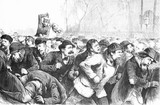
Tomkins Square Riot 1874
Harold Jarche
.
Blog
.
<span class='date ' tip=''><i class='icon-time'></i> Aug 19, 2015 08:58am</span>
|
|
I doubt that students at Stanford thought they would become sadistic prison guards when they entered that university, primed for higher learning.
I doubt that the teacher who gave electric shocks to a "student" had planned that as part of her day.
I doubt that when budding physicians enter medical school, any plan on torturing people through rectal feeding.
Why do good people do bad things? In most cases, it’s the system.
Leadership is not getting people to do things for you. It is not being in charge and making decisions. Real leadership, the only leadership anyone should aspire to, is making more human systems. This can be a company, a non-profit organization, an institution, a government agency, or your family.
Anything less than working on creating a better system for people is not leadership. It may be self-aggrandizement, vanity, or even custodial work, but it is not leadership. Good leaders prepare for their departure. All that is left when they depart are the structures and systems they have helped put in place. The measure of a leader is his or her legacy. If they get a performance review, it should be given years after they leave. I wonder how many of our current leaders would get a positive review in retrospect. Probably not very many, if 19 alumni of Harvard Business School who made it to the top, are any indication.
"A majority, 10, seemed clearly to have failed, meaning that the company went bankrupt, they were forced out of the CEO chair, a major merger backfired, and so on. The performance of another 4 we found to be questionable at least. Some of these 14 CEOs built up or turned around businesses, prominently and dramatically, only to see them weaken or collapse just as dramatically." - Henry Mintzberg
Harold Jarche
.
Blog
.
<span class='date ' tip=''><i class='icon-time'></i> Aug 19, 2015 08:57am</span>
|
|
Major technological advances, like the printing press or the Internet, create economic volatility. This in turn changes the existing social contract. A common assumption for the past century has been that with education and effort, you can get a job and earn a decent wage. This is no longer the norm.
Consider that some or all of your current work will be automated in the next five years, probably to be replaced by software. As with agriculture last century, fewer people are needed to do manufacturing, information, or service work today. We are entering a post-job economy. Our careers will be shorter as our lives get longer. Companies are no longer the stable source of employment they once were.
"Half a century ago, the life expectancy of a firm in the Fortune 500 was around 75 years. Now it’s less than 15 years and declining even further." - CS Investing
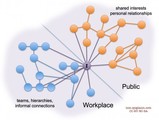
In the next five years, many professionals will have to change not only who they work for, but what they do. Are you prepared? There is no guaranteed way to avoid obsolescence but we can be sure that the ability to learn will be a definite asset. How well you are connected outside your current organization will help in finding new opportunities. Tom Spiglanin shows in this image that individuals (I) need to connect their work with the outside world.
Connecting people and knowledge is the focus of personal knowledge mastery (PKM). In a post-job economy, we all need to increase our connections, find meaning, and enhance our autonomy. The depth and diversity of our professional networks is the new version of job security.
One of the reasons I started working on PKM, in 2004, was to stay current in my profession. I became quite interested in understanding the network era and how the world of work will change. I tested out new models of co-learning, such as when Michele Martin and I ran a six-week ‘MOOC’ in 2008 on what we called ‘network literacy’, with over 900 participants.
"Gone are the days when you could let the company take care of you and you could rely on stable jobs and predictable career paths. Situations are changing quickly and these questions can help you keep up. Today’s careers are about being entrepreneurial and continually preparing yourself for and seeking the right opportunities." - Michele Martin
For the past year, I have hosted several forty-day online workshops focused on taking control of your professional development and creating a diverse knowledge network to stay current in any field. We have had participants from 17 countries. Like any discipline, PKM takes time to master. The 40 day program, with 18 activities, can get you started.
Join us for PKM in 40 days, a journey in seeking, sense-making, and sharing knowledge. We start on 12 January.
Harold Jarche
.
Blog
.
<span class='date ' tip=''><i class='icon-time'></i> Aug 19, 2015 08:57am</span>
|
|
I wrote in the post, knowledge is personal, that pretty well everything I have achieved professionally is a result of my sharing online, especially through this blog. I still learn a lot by sharing ideas and engaging with others who do as well. But I am wondering if there is a law of diminishing returns on sharing. The platform capitalists may be winning.
My posts are shared and copied a lot: 15,905 times in 2013, according to one source. Many of my models and presentations are used inside organizations. Salaried workers and consultants use what I give away in order to earn their livelihood. For the most part, I am fine with this, as it raises my profile and the level of engagement. But it seems we are entering a time when people expect to get whatever information they need for free and feel no obligation to support the people who create it. I am beginning to question my current business model. Last week I was twice asked to work for free. In each case the person asking me to work for ‘exposure’ was a salaried employee. My bank has yet to accept exposure as a form of payment.
Like they say, entrepreneurs have to work on their business and not in their business. Peter Drucker said that, "The purpose of any business is to create and keep a customer." Customers are not people who ask you to work for free. I call these charities, and I support several.
Perhaps there is a glut of speakers, writers, and consultants in my field, and price is tending to zero. In that case, any smart business person would change their business model away from these services. I am going to seriously re-evaluate my business model, which is always a good thing to do from time to time. As for my blog, there may be more short posts and fewer fully-formed articles. I may move my journal to one of my private communities and keep Twitter for public conversations, limited to 140 characters at a time. I was recently invited to the Tsu platform which shares revenues, and maybe I’ll put my writing there. For now, I’ll keep working and learning out loud here, but I’m feeling it may be time for a change.
Feeding crowd-milking platforms is not a sane business model.
Harold Jarche
.
Blog
.
<span class='date ' tip=''><i class='icon-time'></i> Aug 19, 2015 08:56am</span>
|