Blogs
|
Social business has the potential to change the way we work, but for the most part it has not. The social enterprise is not yet here, though many talk about it, and confuse it with using social tools. For that, we can blame management.
As many people, from W. Edwards Deming to Gary Hamel have observed, management is what really differentiates organizations. It was better management that allowed Japanese automobile manufacturers to dominate the North American market, using the same raw materials and work force. Most management practices have changed little since the beginning of the millennium. We still have many vestiges of early 20th century industrial management — hierarchies; work standardization; job specialization; planning; and control. Extrinsic rewards are then dispersed by management based on these principles.
The first elephant in the social room is compensation. As Gary Hamel describes:
… compensation has to be a correlate of value created wherever you are, rather than how well you fought that political battle, what you did a year or two or three years ago that made you an EVP or whatever." — Leaders Everywhere: A Conversation with Gary Hamel
If compensation was really linked to value, then salaries, job models, and other ways of calculating worth would have to be jettisoned. As it stands, in almost all organizations, those higher up the hierarchy get paid more, whether they add more value or not. It is a foregone conclusion that a supervisor has more skills and knowledge than a subordinate. This has also resulted in the requirement for more formal education as one goes up the corporate ladder, whether it’s needed or not.
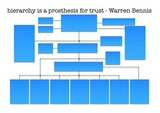
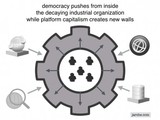
The other elephant in the room is democracy. For management to work in the network era, it needs to embrace democracy, but we are so accustomed to existing structures that many executives would say it is impossible to run a business as a democracy. But hierarchy is a prosthesis for trust, according to Warren Bennis, and trust is what enables networked people to share knowledge and innovate faster. A key benefit of social tools is to share knowledge quicker. Trust is essential for social business but management can easily kill trust. Democracy is the counterweight to hierarchical command and control.
As more people work in distributed networks they are beginning to realize how little they actually benefit from standard management practices. In an economy based on trusted knowledge networks of individuals, the organization should revert to merely a supporting role.
A hierarchy is nothing more than a centralized branching network. It is inadequate for the complex challenges facing all organizations today. Decentralized networks, based on intrinsic motivation, are a much better vehicle for rewarding work than hierarchies can ever be. Any organization driven by external direction, with social tools or not, cannot innovate as fast as self-motivated and hyper-connected workers can. Democracy in the workplace therefore makes for more resilient companies.
A stated commitment to democratic principles is often lacking in descriptions of social business practices. But without compensation for value in an open network, social initiatives likely will be seen in hindsight as just another management buzz-word. "Lipstick on a pig," I believe is the term.
So what’s next in social business? A serious look at its foundations is needed. While social business may have changed the way some of us work, it has not changed the way most organizations are managed. As networked, distributed work becomes the norm, trust will only emerge in workplaces that are open, transparent and diverse.
In these trusted environments, leadership will be seen for what it is — an emergent property of a network in balance and not some special property available to only the select few. Leadership should be drawn from an aggressively intelligent and engaged workforce, learning with each other. Social business requires social management that marinates in and understands the work culture. This cannot be done while trying to control it.
Social business will become reality when management lets go of command and control, makes work transparent so that value is visible to all, and treats workers as adults, engaged in democratic work practices. We are a long way from that until management is reconnected to the work being done. People naturally like to be helpful and get recognition for their work. Leadership in a social enterprise is based on this assumption.
Connected leaders need to foster deeper connections with the entire enterprise, often through meaningful conversations. This is an ongoing process, not a "town hall" meeting from time to time. They have to listen to and analyze what is happening in order to help set the work context according to changing conditions, and then work on building consensus. Given the constantly changing conditions in hyper-connected work environments, a much higher tolerance for ambiguity is becoming a critical leadership trait.
This article was originally published in CMS Wire
Harold Jarche
.
Blog
.
<span class='date ' tip=''><i class='icon-time'></i> Aug 19, 2015 09:18am</span>
|
|
Fridays Finds:
"Only in fairy tales are emperors told that they are naked." - Warren Buffett - via @WallyBock
"Everything that needs to be said has already been said. But since no one was listening, everything must be said again." - Andre Gide - via @RonJeffries
The changing nature of work - via @pieriaview
Those who bewail the loss of our industrial base, sniff at service industries and think that only "making stuff" is proper work, are living in the past: the future of work lies in social activity and caring for people, not "making stuff" that we can produce for nearly nothing with little human involvement.
The job of a lifetime no longer lasts a lifetime - SocialHire.com
How had this [being jobless] happened to him? He had worked hard. Been successful. What he hadn’t been was constantly curious. It had been a long time since he had read anything outside of his direct field. It had been years since he had pro-actively sought knowledge outside his small range of expertise. He had become one of the best at a job that few companies were looking for any more. It will take him a long time to dig himself out of that hole, not the least because, since he had not been trying new things, he has no idea what he might be interested in. Simply put, he had stopped learning.
Pattern recognition, quantified self and big data by @eskokilpi
Companies are not managing their employees’ long term careers any more. Workers must be their own HRD-professionals. With opportunity comes new responsibility. It is up to the worker to construct the narrative of work-life, to know what to contribute, when to change course and how to keep engaged - much longer than we have been used to. To do those things well you have to develop a new understanding of yourself and what you are actually up to.
Note: These last three quotes give some of the reasons why Jane Hart and I have launched the Connected Knowledge Lab
Harold Jarche
.
Blog
.
<span class='date ' tip=''><i class='icon-time'></i> Aug 19, 2015 09:18am</span>
|
|
It’s back to school time and education issues come to the fore with a provincial election in a few weeks. According to a local professor, the New Brunswick education system is too centralized, but it’s not just education. Addressing the problems of centralization is an issue with all established institutions as we shift from an industrial to a networked economy. First we might look at the underlying premises of the current system. According to SFU Professor Kieran Egan, in The Educated Mind, three premises compete for attention in our public education systems:
education as socialization
education as a quest for truth (Plato)
education as the realization of individual potential (Rousseau)
Since no one premise can dominate without precluding the others, we continue to have conflict in our education system. When one dominates, then the others get less attention. We see this in initiatives like "no child left behind" or the demise of music and physical education in the Canadian public school systems. There is no clear idea of what our education systems are trying to achieve, and we constantly go through "flavour of the year" initiatives, like the early French immersion programme in New Brunswick. But none of these three approaches is appropriate for a modern society, as Egan explains:
Socialization to generally agreed norms and values that we have inherited is no longer straightforwardly viable in modern multicultural societies undergoing rapid technology-driven changes. The Platonic program comes with ideas about reaching a transcendent truth or privileged knowledge that is no longer credible. The conception of individual development we have inherited is based on a belief in some culture-neutral process that is no longer sustainable.
Public education has become all things to all people, and this conflict is clear in Egan’s book. You cannot socialize, seek the truth, and realize individual potential all at the same time - within a single, enclosed system. Our public education system was created to give equal access to all (a good thing) and to prepare workers for industrial jobs (a self-serving thing for the industrialists). Public education was embraced by reformers as well as factory owners. I call it a shotgun wedding.
The lack of agreement on what our education system should be is muddying the waters in our discussions about learning. When reduced to the basic process, learning is an individual and personal activity. But learning also has significant social aspects and can be helped or hindered in many ways. How we build systems to nurture, support, or coerce it, are the issues that we can address as a community.
While the industrialists would have preferred education as socialization and the progressives would have leaned toward education as learning about truth, we are stuck with a standardized curriculum that benefits few. In addition, the education system is in for some new competition. We may soon get invited to another shotgun wedding, this time between techno-utopians, with financial speculators as bridesmaids, and libertarians, who feel the state and teachers have screwed-up education. It will be education as socialization, but socialization to the dominant business paradigm. However, problems with any education system are mostly a result of the governance and economic environment in which it resides.
What can New Brunswick do?
Decentralize.
Allow for experimentation at the local level.
Empower teachers in a transparent manner so everyone can see what is happening.
Sadly, I think the province will continue to stumble into an increasingly complex future, for which its institutions are poorly prepared.
Harold Jarche
.
Blog
.
<span class='date ' tip=''><i class='icon-time'></i> Aug 19, 2015 09:17am</span>
|
|
Here are some observations and insights that were shared on social media this past fortnight. I call these Friday’s Finds.
"We teach people how to remember, we never teach them how to grow. - Oscar Wilde" - via @BestOscarWilde
@ShawnCallahan - "The stories we find, and especially the ones we retell, change who we become."
@edmorrison - "Our challenge is not to banish hierarchies, but to balance them with open systems, properly guided."
Last taboo: Secrecy About Salaries May Be on the Wane. Will that make for a happier or more miserable workplace? - via @LucyMarcus
As is human nature, those who made more than their co-workers were not noticeably happier, he said, but those below the average were much unhappier.
NYT: IFTTT Looks to the Internet of Things - via @downes
The future will be run by companies like IFTTT: "The way we see the Internet of Things playing out, there’s going to be a need for an operating system that’s detached from any specific device," Linden Tibbets said. "What we’re doing now is the foundation for that."
Happy Labor Day - @the realbanksy (fan account):
Harold Jarche
.
Blog
.
<span class='date ' tip=''><i class='icon-time'></i> Aug 19, 2015 09:17am</span>
|
|
Listening to a story about exploitation in the ivory tower on CBC Sunday Edition this morning made me realize how much we are prisoners of our current reality. The poorly paid contract teaching staff saw no way out of their plight and the professor-turned-administrator went from questioning the current system to promoting its inequalities as the only viable way to keep universities afloat. It seems that as soon as you identify with a system, whether it is good for you or not, then it becomes the only frame of reference. There was no discussion on what systemic changes could humanize the life of sessional instructors. Everyone sounded so powerless.
The situation of universities in this country, with high fixed costs and deep bureaucracies, is not that different from any other institution, including the private corporation. People on all sides inside the organization can only imagine how to tinker with the existing system. But the system is the problem. The radio program noted that one university has over 50% contract staff, who earn about 1/3 what tenured faculty do, and have almost no hope of permanent employment. Something as simple as only hiring new tenure-track positions from the pool of sessionals could flip this situation. It is a small, simple change that at least one university could experiment with. But it seems that administrators are not hired for their ability to experiment, and neither are faculty, outside the lab anyway.
A fundamental shift in organizational design is needed, beginning with organizational leadership. Those in positions of power need to understand complexity, the default state of most situations they face, and will be dealing with for the foreseeable future. They need to work on the system, not in the system. This is social leadership, a requirement for success in the network era. Social leadership needs network thinking, which is as difficult as learning a new language for adults.
The inability to understand complexity is the problem facing almost all large organizations. It is next to impossible to have a deep and meaningful conversation about complexity, and the new world of work in a networked society, inside the traditional workplace. It requires a common language, some shared experiences, and a willingness to think critically and abandon some very comfortable assumptions that inform our understanding of ourselves and our work. It is very tough to do this in one hour briefings, powerpoint decks, or elevator rides. There is too much to digest. I noted that time for reflection is missing in most workplaces today. Even more rare is time for sense-making, and sense-making takes a LOT of time, for example:
2009 sense-making-with-pkm
2010 sense-making
2011 sense-making-through-conversation
2012 manual-not-automatic-for-sense-making
2013 sense-making-for-success
2014 sense-making-and-sharing
If networks really are the new companies, and I believe they are, then there is a lot of sense-making required to build the new value structures for the networked economy. Creating the time and space for continuous sense-making is a cornerstone to building the organizations and management structures for our collective future. Now would be a good time to start.
Harold Jarche
.
Blog
.
<span class='date ' tip=''><i class='icon-time'></i> Aug 19, 2015 09:16am</span>
|
|
The simple structure of the company, with its solidly embedded organizational chart restricting knowledge flow, cannot deal with the complexity of the networked economy. It takes too long to make decisions or try new things out. Looser hierarchies and stronger networks are required, but how do you go about this?
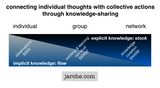
Working and learning out loud are essential practices that can change the nature of work. They help make transparent what is happening in the organization and democratize knowledge creation. First of all, everyone must be engaged in observing their environment. Then groups of people can work on problems together and learn as they work. The results of working and learning out loud can then be codified as network knowledge, which is always open for modification, as knowledge flow becomes knowledge stock. PKM - Seek > Sense > Share - is a core part of enabling knowledge to flow, unrestricted by hierarchies.
Imagine a community of explorers in a new land. There are many cooks who try out new recipes, testing to see what tastes good or goes well together. As they cook in groups to feed their families or part of the community, they talk and share their latest work. The cooks have a friendly competition to see who can come up with the most interesting meal. They have to prepare three meals a day, but each day is different, as the situation changes and new foods are discovered. Some of the recipes are popular, or especially good during certain seasons, so recipes are informally published. These are shared throughout the community and with travelers passing through, who also have their own recipes and bring new spices. In such a complex adaptive environment, working and learning together just makes sense.
Imagine if this community instead had a single chef and a team of food preparation specialists that reported directly to him. He would decide what to cook for the community kitchen. Weekly reports from community leaders would be collated by the chef’s staff, reviewed by the chef, and would inform the next week’s menu planning. Certain recipes would be published annually in the official community cookbook, certified for general use. Imagine how long it would take, and how much knowledge would be missed, with such a structure. Imagine how many wonderful recipes would not be created. The community members would be merely passive consumers of food, disconnected from the environment that nourishes them. Well, this is what happens with knowledge in most organizations today.
Harold Jarche
.
Blog
.
<span class='date ' tip=''><i class='icon-time'></i> Aug 19, 2015 09:16am</span>
|
|
There’s a common saying that entrepreneurs should work on the business, and not in the business. It makes sense to stay above the day-to-day details in order to help steer the business. Perhaps it’s time to think of all businesses as networks of entrepreneurs. Everyone should be working on the business. As Peter Drucker said, "Nothing is less productive than doing what should not be done at all". Being efficient at something that is not effective is a waste of time, and a cause for workers to mentally disconnect from the company. Efficiency for its own sake makes job a four-letter word.
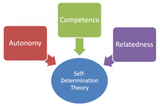
How do you get an entrepreneurial mindset in a hierarchical, just-follow-the-rules, organization? Start by looking at what motivates people. Dan Pink popularized three key motivators in his book, Drive (2011): Autonomy, Mastery, Sense of Purpose. The basis of this is self-determination theory, which I think provides a clearer understanding of motivation at work, and from which the following image comes from.
Source: Wikipedia
Not only does an entrepreneurial mindset require autonomy and competence, but relatedness as well. People have to feel they are part of something. Relatedness "is the universal want to interact, be connected to, and experience caring for others". This is what the military, organized religions, and many NGO’s clearly understand.
Working out loud is one way to foster relatedness, by seeing what is happening throughout the enterprise and being connected to the work flow. Autonomy can be promoted by encouraging experimentation from which new insights can be gained and shared. Increased confidence results from having the freedom to try things out within a sharing and caring work environment.
This foundation of self-determination aligns with the general structure of Teal Organizations, as described in Frédéric Laloux’s book, Reinventing Organizations. The book covers in detail how Teal organizations, based on self-managing teams, can work. Examples include AES, Buurtzorg, FAVI, Morning Star, RHD, Sun Hydraulics, and Patagonia. These companies have changed the traditional industrial era structure of work and enabled self-determination on an organizational level.
But the bottom line is autonomous workers relating to others in an organizational space protected by the leadership. This is the future of work when facing rapid technological change, shifting demographics, resource and climate crises, and economic volatility. The answer is to simplify our work structures, not make things more complicated. Entrepreneurship is economic self-determination. What motivates entrepreneurs can also drive a company.
Harold Jarche
.
Blog
.
<span class='date ' tip=''><i class='icon-time'></i> Aug 19, 2015 09:16am</span>
|
|
Here are some observations and insights that were shared on social media this past fortnight. I call these Friday’s Finds.
A Digital Declaration - by Shoshana Zuboff
In the shadow and gloom of today’s institutional facts, it has become fashionable to mourn the passing of the democratic era. I say that democracy is the best our species has created so far, and woe to us if we abandon it now. The real road to serfdom is to be persuaded that the declarations of democracy we have inherited are no longer relevant to a digital future. These have been inscribed in our souls, and if we leave them behind— we abandon the best part of ourselves. If you doubt me, try living without them, as I have done. That is the real wasteland, and we should fear it.
"MT @glovink: Stop talking about Uber as ‘sharing economy’ says German net guru Sascha Lobo. I like his concept: ‘platform capitalism'" - @martinlessard
@edmorrison - "Our challenge is not to banish hierarchies, but to balance them with open systems, properly guided."
Competition is for losers, build a monopoly by @peterthiel - @indy_johar: "shocking piece; 1st they killed democracy now free markets"
Harold’s comment: My focus is the democratization of work. Democracy is messy & has redundancies, which is why it’s perfect for a complex society & economy.
Harold Jarche
.
Blog
.
<span class='date ' tip=''><i class='icon-time'></i> Aug 19, 2015 09:15am</span>
|
|
Every organization today is trying to address the changing nature of work, driven by rapid technological change, and made more complex by global changes in economics, politics, and resources. Simultaneously we are seeing rapid advances in all the sciences and their intersections. But what about our structures that organize how people work together? Providing better tools and developing individual skills only address part of the needs of the digital workplace. There is also a need for cognitive skills that enhance creativity and initiative. For example, working and learning out loud in online social networks significantly change the flow of knowledge and influence power structures. Pattern sensing becomes all important. Even leadership has to be exercised in a different way from the hierarchical organization, understanding the dynamics of networks.
Personal knowledge mastery is a foundational discipline needed to work in digital communities and networks so that personal know-how continuously feeds organizational knowledge. The PKM framework is currently used by Domino’s Pizza, Bangor University, and the UK’s National Health Services amongst others. It has been adopted by hundreds of professionals around the world who have participated in PKM workshops. PKM gives a structure to develop a network of people and sources of information that can be drawn upon daily. It a process of seeking knowledge, active sense-making, and discerning when and with whom to share knowledge. Initially, with good PKM practices, less time is spent on answering email or finding information, and more time focused on being a better knowledge worker. As mastery is developed, professional learning networks become more diverse and resilient, so that serendipitous finds of new knowledge and people become commonplace.
Only providing digital tools and teaching people how to use them is not enough. A new language of working in digital networks and communities must be mastered. Practices like network weaving have to become natural. So does the idea of sharing ideas before they are fully formulated. One challenge is to understand the difference between Alpha and Beta ideas, and with whom to share each. Another challenge is to think critically, questioning assumptions and using the network to help surface the best knowledge. Workers are no longer employees but knowledge artisans, whose relationship with knowledge is entrepreneurial, driven by self-determination. Organizations structured on flattened hierarchies and self-managed teams are more attractive to these artisans, who will drive the emerging creative economy.
Most organizations are playing with all these new digital technologies and not putting in place structures to support knowledge artisans. But all these levels of hierarchy and control processes, based on a systemic lack of trust, will be overwhelmed by the resulting complexity of a hyper-connected economy. Overarching knowledge work principles have to be first established. An adult-to-adult relationship model like wirearchy is one example; "a dynamic two-way flow of power and authority based on knowledge, trust, credibility and a focus on results, enabled by interconnected people and technology." Complex environments are the new normal. Relationship building is needed in order to share complex knowledge. Implicit knowledge takes time to share, so time has to be set aside for sense-making, reflecting, and conversing. These are significant workplace changes, but can be mastered with a stable foundation of PKM practiced by interdependent and autonomous knowledge artisans. When everybody is engaged in sense-making, then any organization can better sense where it needs to go.
Related Posts:
New Artisans of the Network Era
A Swiss Army Knife for the Network Era
Reflecting on Reflection
Self-determination at Work
Harold Jarche
.
Blog
.
<span class='date ' tip=''><i class='icon-time'></i> Aug 19, 2015 09:14am</span>
|
|
A valuable practice advocated by the authors of Everything Connects is the art and craft of blueprinting, centred on the practice of decision mapping.
As you map decision after decision - and perhaps finding yourself making mistake after mistake - you’ll begin to recognize the elements of your identity, your various strategies, and the assets you’re drawing upon for a given decision.
Being mindful of our actions, like any discipline, takes time to master. This personal discipline can then become the foundation for organizational asset mapping, building something beyond ourselves, to include:
people;
insights;
capital;
infrastructure; and
ecosystem.
The ‘people’ element is the foundation of our lives, including our work lives, and the authors go into a lot of detail on the power of relationships. "We as humans are fundamentally intra- and interpersonal, and so the depth of understanding that we have of ourselves and others will be the asset that we use most throughout our working lives." This should be fairly obvious to anyone who thinks about it, but can be forgotten in the complicated nature of our workplaces. This book is a good reminder about what is important in life and provides some new ways of putting things in perspective.
What the authors call "dating ideas" is very much like seeking, in the PKM Seek > Sense > Share framework. They suggest dating new ideas from three main sources, of which the second is the most important in my opinion.
The media you consume.
The people you see.
The events you attend.
From a state of mindfulness, or listening with an intent to hear, insights may become more visible. These insights can then be shared through practices such as working out loud, openly questioning assumptions, and trying things out together. All of these take practice.
The authors state that "an entrepreneur is someone who takes responsibility for his or her economic well-being". In a connected world, we must all become entrepreneurs because our knowledge and know how will determine our economic well-being. This book is a good addition to management books that discuss how to change our current impasse between structuring organizations and giving meaning to each each person’s work life. The authors promote organizing work around implementation clusters, increasing diversity; enabling autonomy; and most importantly, focusing on long-term value. While it gives many examples, this is not a much of a how-to book but would go well with The Connected Company or Reinventing Organizations.
Harold Jarche
.
Blog
.
<span class='date ' tip=''><i class='icon-time'></i> Aug 19, 2015 09:14am</span>
|