Blogs
|
Like much of the rest of the country, President Obama is getting some downtime in August — in his case spending 16 days in Martha’s Vineyard. From that nice getaway spot, POTUS has launched on Spotify (download the free software here) two playlists of music — 20 songs for a hot summer day, and another 20 for a nice summer evening. You can play the songs below, and further down the page, find six books on his summer vacation reading list.
Daytime listening features songs from Bob Dylan, Bob Marley, Coldplay, Howlin’ Wolf, Aretha Franklin, Florence and the Machine, and The Rolling Stones. For nighttime, he’s serving up John Coltrane, Van Morrison, Joni Mitchell, Nina Simone and more. The man has taste. And for summer reading you can do worse than offer Jhumpa Lahiri, James Salter and Elizabeth Kolbert.
"The President’s Summer Playlist: Day"
"The President’s Summer Playlist: Night"
Obama’s Summer Reading List:
All That Is, by James Salter
All The Light We Cannot See, by Anthony Doerr
The Sixth Extinction, by Elizabeth Kolbert
The Lowland, by Jhumpa Lahiri
Between The World and Me, by Ta-Nehisi Coates
Washington: A Life, by Ron Chernow
Dan Colman is the founder/editor of Open Culture. Follow us on Facebook, Twitter, Google Plus and LinkedIn and share intelligent media with your friends. Or better yet, sign up for our daily email and get a daily dose of Open Culture in your inbox.
http://www.openculture.com/2015/08/pres-obama-releases-a-hip-playlist-of-40-songs-for-a-summer-day.html is a post from: Open Culture. Follow us on Facebook, Twitter, and Google Plus, or get our Daily Email. And don't miss our big collections of Free Online Courses, Free Online Movies, Free eBooks, Free Audio Books, Free Foreign Language Lessons, and MOOCs.
%%POST_LINK%% is a post from: Open Culture. Follow us on Facebook, Twitter, and Google Plus, or get our Daily Email. And don't miss our big collections of Free Online Courses, Free Online Movies, Free eBooks, Free Audio Books, Free Foreign Language Lessons, and MOOCs.
Open Culture
.
Blog
.
<span class='date ' tip=''><i class='icon-time'></i> Aug 26, 2015 01:11pm</span>
|
|
We are bombarded by music, all the time, whether we like it or not. In many cases—such as those almost daily, inescapable trips to the grocery store, drug store, pet store, what-have-you store—the musical accompaniment to our journey through life has been chosen specifically for its ability to make us buy things: However grating we may find the soft rock, lite pop, or easy listening that pumps out of pharmacy speaker systems, some sinister cabal of marketing researchers determined long ago that schmaltz equals sales. And so we endure yet another terrible pop song while waiting in line with our essentials. For people like myself—highly sensitive to sound and unable to tune out bad background music—the experience can be excruciating.
In our own private spaces—offices, cars, the space between our ears with headphones on—we become our own sound designers. We may prefer silence, or we may choose very specific kinds of music to accompany our leisure and our work (as we discussed in a few posts on music to write by some years back). These days, we can make our own digital playlists, grabbing music from all over the web, or we can have the algorithms of internet radio services like Pandora or Apple Radio curate our listening for us, a more—or sometimes less—satisfying experience. Lovers of classical music have a third online option, thanks to an enterprising digital curator who goes by the name of Ulyssestone and who compiled the Spotify playlist above of 58 hours of classical music — from Sibelius to Satie, Bach to Debussy. It’s designed for anyone who wants to study, work, or simply relax.
Ulysses has previously brought us a playlist of the enduringly classical music in Stanley Kubrick’s films and all of Mozart in a 127 hour playlist. As one music blogger put it, his interventions have made Spotify’s service "a whole lot easier for classical listeners." See for yourself at Spotify Classical Playlists, where you’ll find blog posts on the changes to Spotify’s classical radio, as well as over 50 playlists dedicated to famous composers—"great starting points," writes Ulysses, "for people who want to get into classical music or explore a bit more." You can stream the 58-hour playlist of study-enhancing classical music (featuring 789 free tracks in total) by clicking this link, or streaming the player above. To download Spotify and start a free account, head on over to their site.
Related Content:
Download Free Music from 150+ Classical Composers, Courtesy of Musopen.org
The World Concert Hall: Listen To The Best Live Classical Music Concerts for Free
The Classical Music in Stanley Kubrick’s Films: Listen to a Free, 4 Hour Playlist
Philip K. Dick’s Favorite Classical Music: A Free, 11-Hour Playlist
Josh Jones is a writer and musician based in Durham, NC. Follow him at @jdmagness.
http://www.openculture.com/2015/08/stream-58-hours-of-classical-music-for-studying-working-or-simply-relaxing.html is a post from: Open Culture. Follow us on Facebook, Twitter, and Google Plus, or get our Daily Email. And don't miss our big collections of Free Online Courses, Free Online Movies, Free eBooks, Free Audio Books, Free Foreign Language Lessons, and MOOCs.
%%POST_LINK%% is a post from: Open Culture. Follow us on Facebook, Twitter, and Google Plus, or get our Daily Email. And don't miss our big collections of Free Online Courses, Free Online Movies, Free eBooks, Free Audio Books, Free Foreign Language Lessons, and MOOCs.
Open Culture
.
Blog
.
<span class='date ' tip=''><i class='icon-time'></i> Aug 26, 2015 01:09pm</span>
|
|
Beautiful city, shame about all those Nazis.
Yes, this color newsreel above shows Berlin in 1936 as it gets ready to welcome the world for the Olympic Games. It’s a PR film meant to show the upside of the Reich, as Germans looked forward to a "better future", and indeed the city looks just as gorgeous and exciting as other bustling European metropolises. There’s new construction alongside the classical architecture. There’s couples dancing to the latest hit tunes—Malneck and Mercer’s "Goody Goody" (which Benny Goodman had just released in February). There’s young men frolicking in the Wannsee while ladies sunbathe.
But then there’s those Nazis, ruining everybody’s travel plans. The streets are "festively decorated with flags with the current pattern" (ie. the swastika); we see a group of Hitler youth on a parade for the Führer; and while the "changing of the guard" may put some in mind of Buckingham Palace, here they’ve got the full goose-stepping going on. And the film ends very oddly: a shot of the guards outside the Ministry of Aviation, home to morphine addict and concentration camp co-creator Hermann Göering.
Flash forward to July 1945, and what a difference surrender to the Allies makes: Berlin in ruins, large posters of Stalin, and the signs of the divisions that eventually end in the 1961 building of the Berlin Wall. The newsreel concludes with a dramatic aerial shot of the entire city, taking in the amount of destruction.
We’ve featured this 1945 film before, but this before-and-after comparison speaks to the devastation of war and the determination to rebuild.
Related Content
Berlin Street Scenes Beautifully Caught on Film (1900-1914)
1,000,000 Minutes of Newsreel Footage by AP & British Movietone Released on YouTube
Watch World War II Rage Across Europe in a 7 Minute Time-Lapse Film: Every Day From 1939 to 1945
Ted Mills is a freelance writer on the arts who currently hosts the FunkZone Podcast. You can also follow him on Twitter at @tedmills, read his other arts writing at tedmills.com and/or watch his films here.
http://www.openculture.com/2015/08/see-berlin-before-and-after-world-war-ii-in-vivid-startling-color.html is a post from: Open Culture. Follow us on Facebook, Twitter, and Google Plus, or get our Daily Email. And don't miss our big collections of Free Online Courses, Free Online Movies, Free eBooks, Free Audio Books, Free Foreign Language Lessons, and MOOCs.
%%POST_LINK%% is a post from: Open Culture. Follow us on Facebook, Twitter, and Google Plus, or get our Daily Email. And don't miss our big collections of Free Online Courses, Free Online Movies, Free eBooks, Free Audio Books, Free Foreign Language Lessons, and MOOCs.
Open Culture
.
Blog
.
<span class='date ' tip=''><i class='icon-time'></i> Aug 26, 2015 01:09pm</span>
|
|
Ecce panis—try your hand at the kind of loaf that Mel Brooks’ 2000-year-old man might have sunk his teeth into. Literally.
In 1930 a loaf of bread dating to AD 79 (the year Vesuvius claimed two prosperous Roman towns) was excavated from the site of a bakery in Herculaneum.
Eighty-three years later, the British Museum invited London chef Giorgio Locatelli, above, to take a stab at creating an edible facsimile for its Pompeii Live exhibition.
The assignment wasn’t as easy as he’d anticipated, the telegenic chef confesses before whipping up a lovely brown miche that appears far more mouth watering than the carbonized round found in the Herculaneum oven.
His recipe could be mistaken for modern sourdough, but he also has a go at several details that speak to bread’s role in ancient Roman life:
Its perimeter has a cord baked in to provide for easy transport home. Most Roman homes were without ovens. Those who didn’t buy direct from a bakery took their dough to community ovens, where it was baked for them overnight.
The loaf was scored into eight wedges. This is true of the 80 loaves found in the ovens of the unfortunate baker, Modestus. Locatelli speculates that the wedges could be used as monetary units, but I suspect it’s more a business practice on par with pizza-by-the-slice.
(Nowadays, Roman pizza is sold by weight, but I digress.)
The crust bears a telltale stamp. Locatelli takes the opportunity to brand his with the logo of his Michelin-starred restaurant, Locanda Locatelli. His inspiration is stamped ‘Property of Celer, Slave of Q. Granius Verus.’ To me, this suggests the possibility that the bread was found in a communal oven.
Locatelli also introduces a Flintstonian vision when he alludes to specially-devised labor saving machines to which Roman bakers yoked "animals," presumably donkeys…or knowing the Romans and their class system, slaves.
His published recipe (a variation of the one in the video) is below. Here is a conversion chart for those unfamiliar with metric measurements.
INGREDIENTS
400g biga acida (sourdough)
12g yeast
18g gluten
24g salt
532g water
405g spelt flour
405g wholemeal flour
Melt the yeast into the water and add it into the biga. Mix and sieve the flours together with the gluten and add to the water mix. Mix for two minutes, add the salt and keep mixing for another three minutes. Make a round shape with it and leave to rest for one hour. Put some string around it to keep its shape during cooking. Make some cuts on top before cooking to help the bread rise in the oven and cook for 30-45 minutes at 200 degrees.
For an even more artisanal attempt (and extremely detailed instructions) check out the Artisan Pompeii Miche recipe on the Fresh Loaf bread enthusiast community.
True Roman bread for true Romans!
via Metafilter/Make
Related Content:
Cook Real Recipes from Ancient Rome: Ostrich Ragoût, Roast Wild Boar, Nut Tarts & More
Animation Gives You a Glimpse of What Life Was Like for Teenagers in Ancient Rome
Building The Colosseum: The Icon of Rome
Ayun Halliday is an author, illustrator, and Chief Primatologist of the East Village Inky zine. Follow her @AyunHalliday
http://www.openculture.com/2015/08/how-to-bake-ancient-roman-bread-dating-back-to-79-ad.html is a post from: Open Culture. Follow us on Facebook, Twitter, and Google Plus, or get our Daily Email. And don't miss our big collections of Free Online Courses, Free Online Movies, Free eBooks, Free Audio Books, Free Foreign Language Lessons, and MOOCs.
%%POST_LINK%% is a post from: Open Culture. Follow us on Facebook, Twitter, and Google Plus, or get our Daily Email. And don't miss our big collections of Free Online Courses, Free Online Movies, Free eBooks, Free Audio Books, Free Foreign Language Lessons, and MOOCs.
Open Culture
.
Blog
.
<span class='date ' tip=''><i class='icon-time'></i> Aug 26, 2015 01:08pm</span>
|
|
If you put together a list of the world’s greatest Vincent Price fans, you’d have to rank Tim Burton at the top. That goes for "greatest" in the sense of both the fervency of the fan’s enthusiasm for all things Price, and for the fan’s accomplishments in his own right. Burton’s filmmaking craft and his admiration for the midcentury horror-film icon intersected early in his career, when he made the six-minute animated film Vincent for Disney in 1982, three years before his feature debut Pee-Wee’s Big Adventure.
The short’s title refers not to Vincent Price himself, but to its seven-year-old protagonist, Vincent Malloy: "He’s always polite and does what he’s told. For a boy his age, he’s considerate and nice. But he wants to be just like Vincent Price." Those words of narration — as if you couldn’t tell after the first one spoken — come in the voice of Price himself. Vincent Malloy, pale of complexion and untamed of hair, surely resembles Burton’s childhood self, and in more aspects than appearance: the filmmaker grants the character his own idolatry not just of Price but of Edgar Allan Poe, and it’s into their macabre masterworks that his daydreaming sends him — just as they presumably sent the seven-year-old Burton.
Burton and Price’s collaboration on Vincent marked the beginning of a friendship that lasted the rest of Price’s life. The appreciative actor called the short "the most gratifying thing that ever happened," and the director would go on to cast him in Edward Scissorhands eight years later. Price died in 1993, the year before the release of Ed Wood, Burton’s dramatized life of Edward D. Wood Jr. In that film, the relationship between semi-retired horror actor Bela Lugosi and the admiring schlock auteur Wood parallels, in a way, that of the more enduringly successful Price and the much more competent Burton.
Vincent also drops hints of other things to come in the Burtoniverse: Nightmare Before Christmas fans, for instance, should keep their eyes open for not one but two early appearances of that picture’s bony central player Jack Skellington. This demonstration of the continuity of Burton’s imagination underscores that, as both his biggest fans and biggest critics insist, he’s always lived in a world of his own — probably since Vincent Malloy’s age, when teachers and other authority figures might have described him in exactly the same way.
Related Content:
700 Free Movies Online: Great Classics, Indies, Noir, Westerns, etc.
Six Early Short Films By Tim Burton
Tim Burton’s The World of Stainboy: Watch the Complete Animated Series
How German Expressionism Influenced Tim Burton: A Video Essay
Edgar Allan Poe’s "The Raven," Read by Christopher Walken, Vincent Price, and Christopher Lee
5 Hours of Edgar Allan Poe Stories Read by Vincent Price & Basil Rathbone
Colin Marshall writes on cities, language, Asia, and men’s style. He’s at work on a book about Los Angeles, A Los Angeles Primer, and the video series The City in Cinema. Follow him on Twitter at @colinmarshall or on Facebook.
http://www.openculture.com/2015/08/watch-vincent-tim-burtons-animated-tribute-to-vincent-price-edgar-allan-poe-1982.html is a post from: Open Culture. Follow us on Facebook, Twitter, and Google Plus, or get our Daily Email. And don't miss our big collections of Free Online Courses, Free Online Movies, Free eBooks, Free Audio Books, Free Foreign Language Lessons, and MOOCs.
%%POST_LINK%% is a post from: Open Culture. Follow us on Facebook, Twitter, and Google Plus, or get our Daily Email. And don't miss our big collections of Free Online Courses, Free Online Movies, Free eBooks, Free Audio Books, Free Foreign Language Lessons, and MOOCs.
Open Culture
.
Blog
.
<span class='date ' tip=''><i class='icon-time'></i> Aug 26, 2015 01:08pm</span>
|
|
If you’ve ever played Call of Cthulhu, the tabletop role-playing game based on the writing of H.P. Lovecraft, you’ve felt the frustration of having character after painstakingly-created character go insane or simply drop dead upon catching a glimpse of one of the many horrific beings infesting its world. But as the countless readers Lovecraft has posthumously accumulated over nearly eighty years know, that just signals faithfulness to the source material: Lovecraft’s characters tend to run into the same problem, living, as they do, in what French novelist Michel Houellebecq (one of his notable fans, a group that also includes Stephen King, Joyce Carol Oates, and Jorge Luis Borges) calls "an open slice of howling fear."
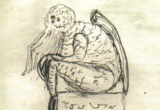
Read enough of Lovecraft’s middle-class east-coast professional narrators’ mortal struggles for the words to convey what he called "the boundless and hideous unknown" that suddenly confronts them, and you start to wonder what these creatures actually look like. The clearest word-picture comes in the 1928 story "The Call of Cthulhu," whose narrator describes the titular ancient malevolence—avoiding instantaneous mental breakdown by looking at an idol rather than the being itself—as "a monster of vaguely anthropoid outline, but with an octopus-like head whose face was a mass of feelers, a scaly, rubbery-looking body, prodigious claws on hind and fore feet, and long, narrow wings behind."
And so modern Lovecraftians have enjoyed a new variation of that giant octopus-dragon-man form on "Cthulhu for President" shirts each and every election year. (You can find one for 2016 here.) While that phenomenon would surely have surprised Lovecraft himself, constantly and fruitlessly as he struggled in life, I like to think he’d have approved of the designs, which align in fearsome spirit with the sketches he made. At the top of the post you can see one sketch of the Cthulhu idol, drawn in 1934 on a piece of correspondence with writer R.H. Barlow, Lovecraft’s friend and the eventual executor of his estate.
If "The Call of Cthulhu" ranks as Lovecraft’s best-known work, his 1936 novella At the Mountains of Madness surely comes in a close second. Just above, we have an illustrated page of the writer’s plot notes for this unforgettable cautionary tale of an Antarctic expedition that happens disastrously upon the mind-bending ruins of a city previously thought only a myth - and the monsters that inhabit it. It exemplifies the defining quality of Lovecraft’s mythology, where, as Slate‘s Rebecca Onion puts it, "ancient beings of profound malevolence lurk just below the surface of the everyday world."
"Mountains featured several species of forgotten, intelligent beings, including the ‘Elder Things.’ The sketch on the right side of this page of notes (click here to view it in a larger format), with its annotations (‘body dark grey'; ‘all appendages not in use customarily folded down to body'; ‘leathery or rubbery’) represents Lovecraft working out the specifics of an Elder Thing’s anatomy." That such things lurked in Lovecraft’s imagination have made his state of mind a subject of decades and decades of rich discussion among his enthusiasts. But just the body count racked up by Cthulhu, the Elder Things, and the other denizens of this unfathomable realm should make us thankful that Lovecraft saw them in his mind’s eye so we wouldn’t have to.
Note: The second image on this page was featured in the 2013 exhibition held at Brown University, "The Shadow Over College Street: H. P. Lovecraft in Providence." The Brown University Library is the home to the largest collection of H. P. Lovecraft materials in the world.
Related Content:
H.P. Lovecraft Gives Five Tips for Writing a Horror Story, or Any Piece of "Weird Fiction"
H.P. Lovecraft Highlights the 20 "Types of Mistakes" Young Writers Make
H.P. Lovecraft’s Classic Horror Stories Free Online: Download Audio Books, eBooks & More
Lovecraft: Fear of the Unknown (Free Documentary)
Colin Marshall writes on cities, language, Asia, and men’s style. He’s at work on a book about Los Angeles, A Los Angeles Primer, and the video series The City in Cinema. Follow him on Twitter at @colinmarshall or on Facebook.
http://www.openculture.com/2015/08/h-p-lovecrafts-monster-drawings.html is a post from: Open Culture. Follow us on Facebook, Twitter, and Google Plus, or get our Daily Email. And don't miss our big collections of Free Online Courses, Free Online Movies, Free eBooks, Free Audio Books, Free Foreign Language Lessons, and MOOCs.
%%POST_LINK%% is a post from: Open Culture. Follow us on Facebook, Twitter, and Google Plus, or get our Daily Email. And don't miss our big collections of Free Online Courses, Free Online Movies, Free eBooks, Free Audio Books, Free Foreign Language Lessons, and MOOCs.
Open Culture
.
Blog
.
<span class='date ' tip=''><i class='icon-time'></i> Aug 26, 2015 01:07pm</span>
|
|
For some years now linguist Daniel Everett has challenged the orthodoxy of Noam Chomsky and other linguists who believe in an innate "universal grammar" that governs human language acquisition. A 2007 New Yorker profile described his work with a reclusive Amazonian tribe called the Piraha, among whom Everett found a language "unrelated to any other extant tongue… so confounding to non-natives that" until he arrived in the 70s, "no outsider had succeeded in mastering it." And yet, for all its extraordinary differences, at least one particular feature of Piraha is shared by humans across the globe—"its speakers can dispense with their vowels and consonants altogether and sing, hum, or whistle conversations."
In places as far flung as the Brazilian rainforest, mountainous Oaxaca, Mexico, the Canary Islands, and the Black Sea coast of Turkey, we find languages that sound more like the speech of birds than of humans. "Whistled languages," writes Michelle Nijhuis in a recent New Yorker post, "have been around for centuries. Herodotus described communities in Ethiopia whose residents ‘spoke like bats,’ and reports of the whistled language that is still used in the Canary Islands date back more than six hundred years."
In the short video from UNESCO at the top of the post, you can hear the whistled language of Canary Islanders. (See another short video from Time magazine here.) Called Silbo Gomero, the language "replicates the islanders’ habitual language (Castilian Spanish) with whistling," replacing "each vowel or consonant with a whistling sound." Spoken (so to speak) among a very large community of over 22,000 inhabitants and passed down formally in schools and ceremonies, Silbo Gomero shows no signs of disappearing. Other whistled languages have not fared as well. As you will see in the documentary above, when it comes to the whistled language of northern Oaxacan peoples in a mountainous region of Mexico, "only a few whistlers still practice their ancient tongue." In a previous Open Culture post on this film, Matthias Rascher pointed us toward some scholarly efforts at preservation from the Summer Institute of Linguistics in Mexico, who recorded and transcribed a conversation between two native Oaxacan whistlers.
Whistled languages evolved for much the same reason as birdcalls—they enable their "speakers" to communicate across large distances. "Most of the forty-two examples that have been documented in recent times," Nijhuis writes, "arose in places with steep terrain or dense forests—the Atlas Mountains, in northwest Africa; the highlands of northern Laos, the Brazilian Amazon—where it might otherwise be hard to communicate at a distance." Such is the case for the Piraha, the Canary Islanders, the Oaxacan whistlers, and another group of whistlers in a mountainous region of Turkey. As Nijhuis documents in her post, these several thousand speakers have learned to transliterate Turkish into "loud, lilting whistles" that they call "bird language." New Scientist brings us the example of whistled Turkish above (with subtitles), and you can hear more recorded examples at The New Yorker.
As with most whistled languages, the Turkish "bird language" makes use of similar structures—though not similar sounds—as human speech, making it a bit like semaphore or Morse code. As such, whistled languages are not likely to offer evidence against the idea of a universal grammar in the architecture of the brain. Yet according to biopsychologist Onur Güntürkün—who conducted a study on the Turkish whistlers published in the latest Current Biology—these languages can show us that "the organization of our brain, in terms of its asymmetrical structure, is not as fixed as we assume."
Where we generally process language in the left hemisphere and "pitch, melody, and rhythm" in the right, Nijhuis describes how the whistled Turkish study suggests "that both hemispheres played significant roles" in comprehension. The opportunities to study whistled languages will diminish in the years to come, as cell phones take over their function and more of their speakers lose regional distinctiveness. But the work of Güntürkün and other biological researchers may have fascinating implications for linguists as well, creating further connections between speech and music—and perhaps even between the speech of humans and that of other animals.
via The New Yorker
Related Content:
Speaking in Whistles: The Whistled Language of Oaxaca, Mexico
How Languages Evolve: Explained in a Winning TED-Ed Animation
Noam Chomsky Talks About How Kids Acquire Language & Ideas in an Animated Video by Michel Gondry
What Makes Us Human?: Chomsky, Locke & Marx Introduced by New Animated Videos from the BBC
Josh Jones is a writer and musician based in Durham, NC. Follow him at @jdmagness.
http://www.openculture.com/2015/08/fascinating-whistled-languages-of-the-canary-islands-turkey-mexico.html is a post from: Open Culture. Follow us on Facebook, Twitter, and Google Plus, or get our Daily Email. And don't miss our big collections of Free Online Courses, Free Online Movies, Free eBooks, Free Audio Books, Free Foreign Language Lessons, and MOOCs.
%%POST_LINK%% is a post from: Open Culture. Follow us on Facebook, Twitter, and Google Plus, or get our Daily Email. And don't miss our big collections of Free Online Courses, Free Online Movies, Free eBooks, Free Audio Books, Free Foreign Language Lessons, and MOOCs.
Open Culture
.
Blog
.
<span class='date ' tip=''><i class='icon-time'></i> Aug 26, 2015 01:07pm</span>
|
|
Last year, we revisited the high school days of Neil deGrasse Tyson. Growing up in New York City during the 1970s, Tyson attended Bronx Science (class of ’76), ran an impressive 4:25 mile, captained the school’s wrestling team, and, he fondly recalls, wore basketball sneakers belonging to the Knick’s Walt "Clyde" Frazier. Tyson was, of course, also a precocious student. Famously, Carl Sagan recruited Tyson to study with him at Cornell. But Tyson politely declined and went to Harvard for his undergraduate studies. Then, he headed off to Texas, to start his PhD at UT-Austin. That’s where the photo, taken circa 1980, captures him above — hanging out with friends, and looking hipper than your average astrophysics student.
This photo (now making the rounds on Reddit) originally appeared in a 2012 article published in the Alcalde, the alumni magazine of The University of Texas. To the magazine’s credit, the article takes an unvarnished look at Tyson’s "failed experiment" in Texas. The piece starts with the lede "Neil deGrasse Tyson, MA ’83, is the public face of science. But he says his success has nothing to do with UT." And, from there, it recounts how professors and university police immediately stereotyped him.
The first comment directed to me in the first minute of the first day by a faculty member I had just met was, ‘You must join the department basketball team!
or
I was stopped and questioned seven times by University police on my way into the physics building. Seven times. Zero times was I stopped going into the gym—and I went to the gym a lot. That says all you need to know about how welcome I felt at Texas.
But the real problem wasn’t race. According to Tyson, "there was simply no room for me to be the full person that I was." "An obsessive focus on one thing at a time; a strong connection to pop culture, from the moonwalk to the Rubik’s cube; and a refusal to put research first: these traits contributed to Tyson’s failure at UT," concludes the Alcalde. They also allowed him to flourish later in life.
After his "advisors dissolved his dissertation committee—essentially flunking him," Tyson transferred to Columbia, earned his PhD in 1988, and became the greatest popularizer of science since Carl Sagan. We like stories with happy endings.
Read more about Tyson’s experience in Texas at the Alcalde.
via Boing Boing
Related Content:
Neil deGrasse Tyson, High School Wrestling Team Captain, Invented a Physics-Based Wrestling Move
Carl Sagan Writes a Letter to 17-Year-Old Neil deGrasse Tyson (1975)
Neil deGrasse Tyson Lists 8 (Free) Books Every Intelligent Person Should Read
http://www.openculture.com/2015/08/1980s-photo-captures-neil-degrasse-tyson-looking-hip-in-grad-school.html is a post from: Open Culture. Follow us on Facebook, Twitter, and Google Plus, or get our Daily Email. And don't miss our big collections of Free Online Courses, Free Online Movies, Free eBooks, Free Audio Books, Free Foreign Language Lessons, and MOOCs.
%%POST_LINK%% is a post from: Open Culture. Follow us on Facebook, Twitter, and Google Plus, or get our Daily Email. And don't miss our big collections of Free Online Courses, Free Online Movies, Free eBooks, Free Audio Books, Free Foreign Language Lessons, and MOOCs.
Open Culture
.
Blog
.
<span class='date ' tip=''><i class='icon-time'></i> Aug 26, 2015 01:06pm</span>
|
|
In 1924, Zenon Komisarenko, Youry Merkulov and Nikolai Khodataev produced Interplanetary Revolution, which might just be one of the strangest Soviet propaganda films ever produced.
First, the film is animated using not only traditional cel animation but also collage and stop motion, giving the work a queasy, disorienting feel. A bit like looking at a painting by Henry Darger.
Then there is the film’s story. As an intertitle proclaims, this is "a tale about Comrade Coninternov, the Red Army Warrior who flew to Mars, and vanquished all the capitalists on the planet!!" This already sounds better that John Carter.
The movie, however, is rather hard to follow without either the appropriate amount of revolutionary fervor or, perhaps, hallucinogens. Interplanetary Revolution opens with a wild-eyed, ax-wielding bulldog with a top hat - a capitalist, obviously. Other capitalists, with swastikas on their foreheads, suck the blood from a hapless member of the proletariat. Then the revolution comes and a pantless capitalist demon loses his mind after devouring a copy of Pravda. Next, the capitalists all board a giant flying shoe and fly off into space. From there, the film gets kind of weird.
You can watch the whole thing above. It’s also added to our list of Free Animated Films, a subset of our collection, 700 Free Movies Online: Great Classics, Indies, Noir, Westerns, etc..
Related Content:
Watch Dziga Vertov’s A Man with a Movie Camera, Named the 8th Best Film Ever Made
Watch Soviet Animations of Winnie the Pooh, Created by the Innovative Animator Fyodor Khitruk
"Glory to the Conquerors of the Universe!": Propaganda Posters from the Soviet Space Race (1958-1963)
Jonathan Crow is a Los Angeles-based writer and filmmaker whose work has appeared in Yahoo!, The Hollywood Reporter, and other publications. You can follow him at @jonccrow. And check out his blog Veeptopus, featuring lots of pictures of vice presidents with octopuses on their heads. The Veeptopus store is here.
http://www.openculture.com/2015/08/interplanetary-revolution.html is a post from: Open Culture. Follow us on Facebook, Twitter, and Google Plus, or get our Daily Email. And don't miss our big collections of Free Online Courses, Free Online Movies, Free eBooks, Free Audio Books, Free Foreign Language Lessons, and MOOCs.
%%POST_LINK%% is a post from: Open Culture. Follow us on Facebook, Twitter, and Google Plus, or get our Daily Email. And don't miss our big collections of Free Online Courses, Free Online Movies, Free eBooks, Free Audio Books, Free Foreign Language Lessons, and MOOCs.
Open Culture
.
Blog
.
<span class='date ' tip=''><i class='icon-time'></i> Aug 26, 2015 01:06pm</span>
|
|
Image by David Shankbone
Michael Stipe’s tenure as frontman and lyricist for R.E.M. certainly revealed a literate mind. A former art major at the University of Georgia and current art teacher at NYU, his best lyrics scan well as poetry. One can imagine being invited over for a dinner party to Mr. Stipe’s place, and, glass of wine in hand, absolutely having to nose through his bookshelf. What does the writer of "Nightswimming" read? With the historical references that course through those early albums, would he have socio-political books about America? Would he pull a book off the shelf and say, here, "You have to read this. It will change your life"?
Wonder no more, because Stipe was recently asked to write down his Top Ten list of books to take to a desert island. The list was published in The New York Times. Find a skeletal version here:
Complete Works - Arthur Rimbaud
On the Road - Jack Kerouac
Dhalgren - Samuel R. Delaney
Breakfast of Champions - Kurt Vonnegut
All Families Are Psychotic - Douglas Coupland
Lolita - Vladimir Nabokov
Play It as It Lays - Joan Didion
Four Plays by Aristophanes (translated by William Arrowsmith)
Bonjour Tristesse - François Sagan
Just Kids - Patti Smith
Some of these are classics—for example Kerouac’s On the Road, which Stipe calls "my band’s template"—and the one poet on the list, Rimbaud, is very much an early influence on his writing. Dhalgren was also a favorite of David Bowie’s, who based a lot of Diamond Dogs on the novel. The Copeland and Didion choices stand out, mostly by being less obvious selections from their bibliographies. And as he says that he’s currently reading the Patti Smith book (now being turned into a series on Showtime), we can’t take the selection too seriously. Maybe he just wants to take it to the desert island to finish it.
Stipe has included a few sentences on each book to explain his choices. Find them here.
Related content:
Patti Smith’s List of Favorite Books: From Rimbaud to Susan Sontag
David Bowie’s Top 100 Books
Brian Eno Lists 20 Books for Rebuilding Civilization & 59 Books For Building Your Intellectual World
Ted Mills is a freelance writer on the arts who currently hosts the FunkZone Podcast. You can also follow him on Twitter at @tedmills, read his other arts writing at tedmills.com and/or watch his films here.
http://www.openculture.com/2015/08/michael-stipe-recommends-10-books-for-anyone-marooned-on-a-desert-island.html is a post from: Open Culture. Follow us on Facebook, Twitter, and Google Plus, or get our Daily Email. And don't miss our big collections of Free Online Courses, Free Online Movies, Free eBooks, Free Audio Books, Free Foreign Language Lessons, and MOOCs.
%%POST_LINK%% is a post from: Open Culture. Follow us on Facebook, Twitter, and Google Plus, or get our Daily Email. And don't miss our big collections of Free Online Courses, Free Online Movies, Free eBooks, Free Audio Books, Free Foreign Language Lessons, and MOOCs.
Open Culture
.
Blog
.
<span class='date ' tip=''><i class='icon-time'></i> Aug 26, 2015 01:05pm</span>
|