Blogs
|
Discover The Backwards Brain Bicycle: What Riding a Bike Says About the Neuroplasticity of the Brain
Like most of us, engineer Destin Sandlin, creator of the educational science website Smarter Every Day, learned how to ride a bike as a child. Archival footage from 1987 shows a confident, mullet-haired Sandlin piloting a two-wheeler like a boss.
Flash forward to the present day, when a welder friend threw a major wrench in Sandlin’s cycling game by tweaking a bike’s handlebar/front wheel correspondence. Turn the handlebars of the "backwards bike" to the left, and the wheel goes to the right. Steer right, and the front wheel points left.
Sandlin thought he’d conquer this beast in a matter of minutes, but in truth it took him eight months of daily practice to conquer his brain’s cognitive bias as to the expected operation. This led him to the conclusion that knowledge is not the same thing as understanding.
He knew how to ride a normal bike, but had no real grasp of the complex algorithm that kept him upright, a simultaneous ballet of balance, downward force, gyroscopic procession, and navigation.
As he assures fans of his Youtube channel, it’s not a case of the stereotypical uncoordinated science geek—not only can he juggle, when he took the backwards bike on tour, a global roster of audience volunteers’ brains gave them the exact same trouble his had.
Interestingly, his 6-year-old son, who’d been riding a bike for half his young life, got the hang of the backwards bike in just two weeks. Children’s brain’s possess much more neuroplasticity than those of adults, whose seniority means habits and biases are that much more ingrained.
It couldn’t have hurt that Sandlin bribed the kid with a trip to Australia to meet an astronaut.
Did the arduousness of mastering the backwards bike ruin Sandlin for normally configured bicycles? Watch the video above all the way to the end for an incredible spontaneous moment of mind over matter.
Related Content:
The Physics of the Bike
The Mysterious Physics Behind How Bikes Ride by Themselves
Science Behind the Bike: Four Videos from the Open University on the Eve of the Tour de France
The Neuroscience of Drumming: Researchers Discover the Secrets of Drumming & The Human Brain
Ayun Halliday is an author, illustrator, and Chief Primatologist of the East Village Inky zine. Follow her @AyunHalliday
http://www.openculture.com/2015/08/the-backwards-brain-bicycle.html is a post from: Open Culture. Follow us on Facebook, Twitter, and Google Plus, or get our Daily Email. And don't miss our big collections of Free Online Courses, Free Online Movies, Free eBooks, Free Audio Books, Free Foreign Language Lessons, and MOOCs.
%%POST_LINK%% is a post from: Open Culture. Follow us on Facebook, Twitter, and Google Plus, or get our Daily Email. And don't miss our big collections of Free Online Courses, Free Online Movies, Free eBooks, Free Audio Books, Free Foreign Language Lessons, and MOOCs.
Open Culture
.
Blog
.
<span class='date ' tip=''><i class='icon-time'></i> Aug 26, 2015 12:57pm</span>
|
|
This week, 1,000 North Koreans witnessed the first live performance by a Western pop act on its soil. And it was perhaps a bit anti-climatic.
The East Germans got their first taste of Western rock in 1988 when Bruce Springsteen played a massive gig in East Berlin. (See video here.) The North Koreans had to settle for the Slovenian industrial rock band, Laibach. According to The New York Times, their set included a "‘Sound of Music’ medley. A cover of the Beatles’ ‘Across the Universe.’ [And a] martial-sounding version of the arena rock anthem ‘The Final Countdown.'" You can watch short clips of the concert just below, and John Oliver offers some funny commentary on the spectacle here.
Laibach’s historic North Korean gig was apparently arranged by Morten Traavik, a Norwegian artist who previously made the Internet gyrate when he released a clip of young North Korean accordion players performing A-ha’s 1984 hit, "Take On Me." In 2012, Traavik met the musicians from the Kum Song Music School while traveling in North Korea. He told the BBC, "I lent them a CD of Take on Me on a Monday morning. By the following Wednesday morning they had mastered the song, with no annotation and no outside help. It showed incredible skill." And, says Traavik, it all just goes to show, "you can have fun in North Korea."
Related Content:
Watch 98 Korean Feature Films Free Online, Thanks to the Korean Film Archive
Watch Jimi Hendrix’s ‘Voodoo Chile’ Performed on a Gayageum, a Traditional Korean Instrument
Pakistani Musicians Play Amazing Version of Dave Brubeck’s Jazz Classic, "Take Five"
http://www.openculture.com/2015/08/a-has-take-on-me-performed-by-north-korean-kids-with-accordians.html is a post from: Open Culture. Follow us on Facebook, Twitter, and Google Plus, or get our Daily Email. And don't miss our big collections of Free Online Courses, Free Online Movies, Free eBooks, Free Audio Books, Free Foreign Language Lessons, and MOOCs.
%%POST_LINK%% is a post from: Open Culture. Follow us on Facebook, Twitter, and Google Plus, or get our Daily Email. And don't miss our big collections of Free Online Courses, Free Online Movies, Free eBooks, Free Audio Books, Free Foreign Language Lessons, and MOOCs.
Open Culture
.
Blog
.
<span class='date ' tip=''><i class='icon-time'></i> Aug 26, 2015 12:57pm</span>
|
|
How can a modern educator go about getting a student to connect to poetry?
Forget the emo kid pouring his heart out into a spiral journal.
Ditto the youthful slam poetess, wielding pronunciation like a cudgel.
Think of someone truly hard to reach, a reluctant reader perhaps, or maybe just someone (doesn’t have to be a kid) who’s convinced all poetry sucks.
You could stage a rap battle.
Take the drudgery out of memorization by finding a pop melody well suited to singing Emily Dickinson stanzas.
Or appeal to the YouTube generation via short animations, as educator Justin Moore does in the TED-Ed lesson, above.
Animation, like poetry, is often a matter of taste, and Moore’s lesson hedges its bets by enlisting not one, but three animator-narrator teams to interpret Walt Whitman’s "A Noiseless Patient Spider."
Originally published as part of the poem "Whispers of Heavenly Death," and included in the 1891 "deathbed edition" of Leaves of Grass, the poem equates the soul’s desperate struggle to connect with something or someone with that of a spider, seeking to build a web in a less than ideal location.
Two of the animators, Jeremiah Dickey and Lisa LaBracio launch themselves straight toward the "filament, filament, filament." Seems like a solid plan. An industrious spider industriously squirting threads out of its nether region creates a cool visual that echoes both Charlotte’s Web and the repetition within the poem.
Mahogany Browne’s narration of Dickey’s painting on glass mines the stridency of slam. Narrator Rives gives a more low key performance with LaBracio’s scratchboard interpretation.
In-between is Joanna Hoffman’s spiderless experimental video, voiced with a wee bit of vocal fry by Joanna Hoffman. Were I to pick the one least likely to capture a student’s imagination…
Once the student has watched all three animations, it’s worth asking what the poem means. If no answer is forthcoming, Moore supplies some questions that might help stuck wheels start turning. Question number five strikes me as particularly germane, knowing the ruinous effect the teenage tendency to gloss over unfamiliar vocabulary has on comprehension.
Ultimately, I prefer the below interpretation of Kristin Sirek, who uses her YouTube channel to read poetry, including her own, out loud, without any bells or whistles whatsoever.
A noiseless patient spider,
I mark’d where on a little promontory it stood isolated,
Mark’d how to explore the vacant vast surrounding,
It launch’d forth filament, filament, filament, out of itself,
Ever unreeling them, ever tirelessly speeding them.
And you O my soul where you stand,
Surrounded, detached, in measureless oceans of space,
Ceaselessly musing, venturing, throwing, seeking the spheres to connect them,
Till the bridge you will need be form’d, till the ductile anchor hold,
Till the gossamer thread you fling catch somewhere, O my soul.
Related Content:
Hysterical Literature: Art & Sexuality Collide in Readings of Whitman, Emerson & Other Greats (NSFW)
Orson Welles Reads From America’s Greatest Poem, Walt Whitman’s "Song of Myself" (1953)
Marilyn Monroe Reads Walt Whitman’s Leaves of Grass (1952)
Ayun Halliday is an author, illustrator, and Chief Primatologist of the East Village Inky zine. Follow her @AyunHalliday
http://www.openculture.com/2015/08/walt-whitmans-poem-a-noiseless-patient-spider-brought-to-life-in-three-animations.html is a post from: Open Culture. Follow us on Facebook, Twitter, and Google Plus, or get our Daily Email. And don't miss our big collections of Free Online Courses, Free Online Movies, Free eBooks, Free Audio Books, Free Foreign Language Lessons, and MOOCs.
%%POST_LINK%% is a post from: Open Culture. Follow us on Facebook, Twitter, and Google Plus, or get our Daily Email. And don't miss our big collections of Free Online Courses, Free Online Movies, Free eBooks, Free Audio Books, Free Foreign Language Lessons, and MOOCs.
Open Culture
.
Blog
.
<span class='date ' tip=''><i class='icon-time'></i> Aug 26, 2015 12:56pm</span>
|
|
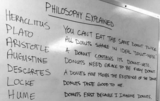
We’ve all seen them, on the boardwalks of Venice Beach or of the Jersey Shore: poop-joke t-shirts that state the gist of various world religions or philosophies by reference to the aforementioned bodily function. Clever they aren’t, but the form adapts to another, more tasteful formulation (pun most definitely intended) in the list above, which briefly describes the philosophical programs of sixteen prominent Western thinkers with reference to that universally beloved food, the donut. To wit: pre-Socratic Greek philosopher Heraclitus gets summed up with "You can’t eat the same donut twice," a twist on one of his famous few aphorisms. Ludwig Wittgenstein’s philosophy becomes an elliptical series of possible donuts in various language games: "Fried Pastry, Zero, Parking lot spin, Spare tire." And so on.
No need to point out the oversimplification inherent in this strategy; that’s kind of the point. It’s a joke, after all, but one the author—whoever that is—clearly intends as a means of breaking the ice and getting down to more serious explorations. But what if the donut is the serious exploration? Such is the case in a 2001 article published in the journal Basic Objects: Case Studies in Theoretical Primitives by Columbia philosophy professor Achille C. Varzi. Simply titled (in the British spelling) "Doughnuts," Varzi’s paper explores the donut, or "torus" in the language of topographers, as a theoretical object for an ontological thought experiment. In short, he asks whether or not we can say that the donut hole is an actual existing entity or simply a figure of speech, a "façon de parler." In the traditional view, that of the topographers, who practice "a sort of rubbery geometry…. The only thing that matters is the edible stuff. The hole is a mere façon de parler."
On another, more three-dimensional view of the relationship "between void and matter," things look different: "We must be very serious about treating them [donut holes] as fully-fledged entities, on a par with the material objects that surround them." The real existence of the hole cannot be easily dismissed without running into a problem, "the dilemma of every eliminative strategy: if successful, it ends up eliminating everything just in order to eliminate nothings." No hole, no donut. (Though, as Simone De Beauvoir apparently recognized, "Patriarchy is responsible for the shape of the donut.") The donut hole thesis also forms part of the argument in an academic philosophy paper from 2012 entitled "Being Positive About Negative Facts" from Philosophy & Phenomenological Research. On the way to showing that "negative facts exist in the usual sense of existence," authors Stephen Barker and Mark Jago, both of the University of Nottingham, come to similar conclusions about the donut, with reference to earlier work by Varzi:
Holes pose something of a philosophical quandary and, perhaps as a result of their mystery, are often treated as immaterial entities (Casati and Varzi 1994). Yet we seem to be able to perceive holes, gaps, dents and the like. The view of holes as immaterial objects is, we think, very much in line with thinking of the negative as the metaphysically undead. Given our acceptance of negative facts, we can offer a story about holes on which they are material entities. If there is a donut hole then there is a spatial region involving the instantiation of donut-dough which is intimately connected with an absence thereof.
Make of these claims what you will, but I think what we see in both essays is that serious interest in a frivolous object can produce illuminating discussion. That describes the thesis of the site Improbable Research, who bring us both of these donut examples; their motto—"Research that makes people LAUGH and then THINK." I don’t know if either essay—or even the donut joke at the top of the page—really makes for ha-ha laughs so much, but these arguments about the material existence of the immaterial space of donut holes certainly challenged my thinking.
via Improbable Research
Related Contents:
140+ Free Online Philosophy Courses
Philosophy Referee Hand Signals
Monty Python’s Best Philosophy Sketches
The Epistemology of Dr. Seuss & More Philosophy Lessons from Great Children’s Stories
The History of Philosophy, from 600 B.C.E. to 1935, Visualized in Two Massive, 44-Foot High Diagrams
Josh Jones is a writer and musician based in Durham, NC. Follow him at @jdmagness
http://www.openculture.com/2015/08/philosophy-explained-with-donuts.html is a post from: Open Culture. Follow us on Facebook, Twitter, and Google Plus, or get our Daily Email. And don't miss our big collections of Free Online Courses, Free Online Movies, Free eBooks, Free Audio Books, Free Foreign Language Lessons, and MOOCs.
%%POST_LINK%% is a post from: Open Culture. Follow us on Facebook, Twitter, and Google Plus, or get our Daily Email. And don't miss our big collections of Free Online Courses, Free Online Movies, Free eBooks, Free Audio Books, Free Foreign Language Lessons, and MOOCs.
Open Culture
.
Blog
.
<span class='date ' tip=''><i class='icon-time'></i> Aug 26, 2015 12:56pm</span>
|
|
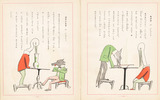
Most of us have internalized the content of a fair few of Aesop’s fables but have long since forgotten the source — if, indeed, we read it close to the source in the first place. Whether or not we’ve had any real awareness of the ancient Greek storyteller himself, we’ve certainly encountered his stories in countless much more recent interpretations over the decades. My personal favorite renditions came, skewed, in the form of the "Aesop and Son" segments on Rocky and Bullwinkle, but this 1925 Japanese edition of Aesop’s Fables, illustrated by hugely respected children’s artist Takeo Takei, must certainly rank in the same league.
Takei began his career in the early 1920s, illustrating children’s magazine covers, collections of Japanese folktales and original stories, and even youngster-oriented writings of his own. Even in that early period, he showed a professional interest in giving new aesthetic life to not just old stories but old non-Japanese stories, such as The Thousand and One Nights and Hans Christian Andersen’s fairy tales. It was during that time that he took on the challenge of putting his own aesthetic stamp on Aesop.
You can see quite a few of Takei’s Aesop illustrations at the book design and illustration site 50watts, whose author notes that he found the images in the database of Japan’s National Diet Library. Even if you can’t read the Japanese, you’ll know the fables in question — "The Tortoise and the Hare," "The North Wind and the Sun," "The Wolf and the Crane" — after nothing more than a glance at Takei’s lively artwork, which takes Aesop’s well-known characters (often animals or natural forces personified) and dresses them up in the natty style of jazz-age Tokyo high society.
Takei would go on to enjoy a long career after illustrating Aesop’s Fables. A decade after its publication, he would begin producing his best-known series of works, the "kampon" (in Japanese, "published book"). With these 138 volumes, he explored the form of the illustrated children’s book in every way he possibly could, using, according to rarebook.com, "traditional methods of letterpress, woodblock, wood engraving, stencil, etching and lithography," as well as clay block-prints and "definitely non-traditional images of woven labels, painted glass, ceramic, and cello-slides - transparencies composed of bright cellophane paper." He would continue working working right up until his death in 1983, leaving a legacy of influence on Japanese visual culture as deep as the one Aesop left on storytelling.
via 50watts
Related Content:
Early Japanese Animations: The Origins of Anime (1917-1931)
Advertisements from Japan’s Golden Age of Art Deco
Glorious Early 20th-Century Japanese Ads for Beer, Smokes & Sake (1902-1954)
Vintage 1930s Japanese Posters Artistically Market the Wonders of Travel
Colin Marshall writes on cities, language, Asia, and men’s style. He’s at work on a book about Los Angeles, A Los Angeles Primer, and the video series The City in Cinema. Follow him on Twitter at @colinmarshall or on Facebook.
http://www.openculture.com/2015/08/a-wonderfully-illustrated-1925-japanese-edition-of-aesops-fables-by-legendary-childrens-book-illustrator-takeo-takei.html is a post from: Open Culture. Follow us on Facebook, Twitter, and Google Plus, or get our Daily Email. And don't miss our big collections of Free Online Courses, Free Online Movies, Free eBooks, Free Audio Books, Free Foreign Language Lessons, and MOOCs.
%%POST_LINK%% is a post from: Open Culture. Follow us on Facebook, Twitter, and Google Plus, or get our Daily Email. And don't miss our big collections of Free Online Courses, Free Online Movies, Free eBooks, Free Audio Books, Free Foreign Language Lessons, and MOOCs.
Open Culture
.
Blog
.
<span class='date ' tip=''><i class='icon-time'></i> Aug 26, 2015 12:55pm</span>
|
|
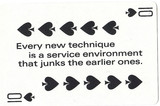
Image via EricMcluhan.com
Six years before Brian Eno and Peter Schmidt designed their first pack of Oblique Strategies cards—a set of random aphorisms meant to clear creative blocks—communication theorist and philosopher Marshall McLuhan had designed a very similar deck in 1969, this one with a more direct nod to the classic playing card deck.
The name of the card deck, Distant Early Warning, was a reference to the 3,000 mile long DEW Line, a system of 63 radar stations that acted as an early detection invasion buffer during the Cold War. And in his 1964 book Understand Media, McLuhan explained,
"I think of art, at its most significant, as a DEW line, a Distant Early Warning system that can always be relied on to tell the old culture what is beginning to happen to it."
And so with help from advertising and publishing guru Eugene Schwartz, The Marshall McLuhan DEW-Line Newsletter and its spinoff deck of cards was born. Schwartz saw the newsletter much like we see blogs today: a very immediate way of disseminating information, deeper than television and faster than books. The newsletter lasted only two years, came in several forms (one issue was a set of slides, another a record), and represents the height of "McLuhan Mania" in American culture. Business and thought leaders were its target audience.
Much like Oblique Strategies (you can still find vintage versions online), the instructions for Distant Early Warning (also available online here) suggest that the user think of a personal or business problem, shuffle the deck, choose a card and interpret its meaning. Although divinatory cards have long been a part of western culture, the idea of indeterminacy and consulting the I Ching was very much in vogue through artists like John Cage.
The cards contain plays on aphorisms, like "The Victor Belongs to the Spoils" or "Thanks for the Mammaries." Sometimes they quote Victorian novelist Samuel Butler, like "The chicken was the egg’s idea for getting more eggs" or W.C. Fields ("How do you like kids?" "Well cooked," he said sternly), or John Cage ("Silence is all the sounds of the environment at once.") Many are McLuhan’s own quotes.
McLuhan and Schwartz’ ideas can still be felt in any number of TED talks or whenever a business leader talks about thinking outside the box. Steve Jobs was a walking deck of these cards.
Should you feel like pushing your brain laterally, check out the full deck here at this Flickr feed, and if you long to own a physical copy, it can still be had for $65 Canadian dollars at the site run by McLuhan’s son.
via Flashbak
Related content:
The Visionary Thought of Marshall McLuhan, Introduced and Demystified by Tom Wolfe
McLuhan Said "The Medium Is The Message"; Two Pieces Of Media Decode the Famous Phrase
Norman Mailer & Marshall McLuhan Debate the Electronic Age
Ted Mills is a freelance writer on the arts who currently hosts the FunkZone Podcast. You can also follow him on Twitter at @tedmills, read his other arts writing at tedmills.com and/or watch his films here.
http://www.openculture.com/2015/08/marshall-mcluhans-1969-deck-of-cards-designed-for-out-of-the-box-thinking.html is a post from: Open Culture. Follow us on Facebook, Twitter, and Google Plus, or get our Daily Email. And don't miss our big collections of Free Online Courses, Free Online Movies, Free eBooks, Free Audio Books, Free Foreign Language Lessons, and MOOCs.
%%POST_LINK%% is a post from: Open Culture. Follow us on Facebook, Twitter, and Google Plus, or get our Daily Email. And don't miss our big collections of Free Online Courses, Free Online Movies, Free eBooks, Free Audio Books, Free Foreign Language Lessons, and MOOCs.
Open Culture
.
Blog
.
<span class='date ' tip=''><i class='icon-time'></i> Aug 26, 2015 12:54pm</span>
|
|
Jared Diamond is a true polymath. He got his start researching how the gall bladder absorbed salt and then moved on to other fields of study - ornithology, anthropology, linguistics. His wildly diverse interests have given him a unique perspective of how and why our species evolved. His Pulitzer Prize-winning book Germs, Guns and Steel makes a pretty convincing argument about why Europe - and not China or South America - ended up dominating the world. The answer, it turns not, has everything to do with geography and little to do with any kind of cultural superiority.
Back in 2013, Diamond spoke at The Royal Institution about how we think of risk in the first world versus those who live in remote New Guinea. The RI has taken a portion of that hour and a half talk and set it to some glorious animation. You can watch it above.
Early in Diamond’s career, he was in the jungle with his New Guinean guides. He found what he thought was a perfect spot to pitch camp - under a massive dead tree. His guides refused to sleep there, fearing that the tree might fall in the middle of the night. He thought that they were being overly paranoid until he started seeing things from their perspective.
Every night you’re in New Guinea sleeping in a forest, you hear a tree fall somewhere and then you go do the numbers. Suppose the risk of that tree falling on me tonight is 1 in 1000. If I sleep under dead trees for 1000 nights, in three years I’m going to be dead. … The New Guinea attitude is sensitive to the risks of things you are going to do regularly. Each time they carry a low risk but if you are not cautious it will catch up with you.
Diamond then extrapolated this realization to modern life. He notes that he is 76 years old and will statistically speaking probably live another 15 or so years. Yet if the risk of taking a fall in the shower is roughly the same as getting brained by a dead tree in the jungles of New Guinea (1 in 1000), then Diamond figures he could kill himself 5 ½ times over his the course of those 15 years.
"And so I’m careful about showers," he says in the full video of the talk. "I’m careful about sidewalks. I’m careful about stepladders. It drives many of my American friends crazy but I will survive and they won’t."
People in the first world are terrified by the wrong things, Diamond argues. The real danger isn’t terrorism, serial killers or sharks, which kill a very, very small percentage of people annually. The real risks are those things that we do daily that carry a low risk but that eventually catch up with you - driving, taking stairs, using step ladders.
You can watch the full interview, which is fascinating, below.
Related Content:
Jared Diamond Explains Haiti’s Enduring Poverty
The Evolution of Religions: A Talk by Jared Diamond
"Professor Risk" at Cambridge University Says "One of the Biggest Risks is Being Too Cautious"
MIT’s Introduction to Poker Theory: A Free Online Course
Jonathan Crow is a Los Angeles-based writer and filmmaker whose work has appeared in Yahoo!, The Hollywood Reporter, and other publications. You can follow him at @jonccrow. And check out his blog Veeptopus, featuring lots of pictures of vice presidents with octopuses on their heads. The Veeptopus store is here.
http://www.openculture.com/2015/08/jared-diamond-underscores-the-real-risks-in-everyday-life.html is a post from: Open Culture. Follow us on Facebook, Twitter, and Google Plus, or get our Daily Email. And don't miss our big collections of Free Online Courses, Free Online Movies, Free eBooks, Free Audio Books, Free Foreign Language Lessons, and MOOCs.
%%POST_LINK%% is a post from: Open Culture. Follow us on Facebook, Twitter, and Google Plus, or get our Daily Email. And don't miss our big collections of Free Online Courses, Free Online Movies, Free eBooks, Free Audio Books, Free Foreign Language Lessons, and MOOCs.
Open Culture
.
Blog
.
<span class='date ' tip=''><i class='icon-time'></i> Aug 26, 2015 12:54pm</span>
|
|
When you think of the most astute minds of our time, you might well think of Ray Bradbury’s — but you probably don’t think of him as one of the most astute terrorist minds of our time. The Federal Bureau of Investigation, however, saw things differently. Collaborative news site MuckRock found that out through files "released to former MuckRocker Inkoo Kang [which] document the decade the Bureau spent trying to determine if Bradbury was, if not a card-carrying Communist, at least a sympathetic ‘fellow traveler.'" See snippets of documents here from 1959.
You can view the files themselves, obtained under the Freedom of Information Act, at MuckRock. There, the site’s JPat Brown also summarizes the organization’s basis for suspicion against the author: his "membership in the Screen Writer’s Guild, as well as his vocal opposition to McCarthyism, drew particular attention," as did the use in The Martian Chronicles of the "repeated theme that earthmen are despoilers and not developers." Not just Bradbury’s work but the whole of science fiction, which informant Martin Berkeley calls a possibly "lucrative field for the introduction of Communist ideology," comes in for an indictment.
"Communists have found fertile opportunities for development," Berkeley says, "for spreading distrust and lack of confidence in America [sic] institutions in the area of Science Fiction writing." Another, unsurprisingly clearer view of the genre comes from Bradbury himself, quoted disapprovingly in the file from a 1959 Women’s Legislative Action Bulletin. There, he said he uses the medium of science fiction to "try to bring to light some of the current fallacies in human values today" — the one thing, as the author of Fahrenheit 451 must have known full well, that the powers that be least want anybody to do. Get more at MuckRock.
via Metafilter
Related Content:
Ray Bradbury: "I Am Not Afraid of Robots. I Am Afraid of People" (1974)
Ray Bradbury: Literature is the Safety Valve of Civilization
Soviet Animations of Ray Bradbury Stories: ‘Here There Be Tygers’ & ‘There Will Comes Soft Rain’
FBI’s "Vault" Web Site Reveals Declassified Files on Hemingway, Einstein, Marilyn & Other Icons
Colin Marshall writes on cities, language, Asia, and men’s style. He’s at work on a book about Los Angeles, A Los Angeles Primer, and the video series The City in Cinema. Follow him on Twitter at @colinmarshall or on Facebook.
http://www.openculture.com/2015/08/who-was-afraid-of-ray-bradbury-science-fiction-the-fbi-it-turns-out-1959.html is a post from: Open Culture. Follow us on Facebook, Twitter, and Google Plus, or get our Daily Email. And don't miss our big collections of Free Online Courses, Free Online Movies, Free eBooks, Free Audio Books, Free Foreign Language Lessons, and MOOCs.
%%POST_LINK%% is a post from: Open Culture. Follow us on Facebook, Twitter, and Google Plus, or get our Daily Email. And don't miss our big collections of Free Online Courses, Free Online Movies, Free eBooks, Free Audio Books, Free Foreign Language Lessons, and MOOCs.
Open Culture
.
Blog
.
<span class='date ' tip=''><i class='icon-time'></i> Aug 26, 2015 12:53pm</span>
|
|
In the early seventies, at the height of their powers, unforgettable hits seemed to tumble out one after another from The Rolling Stones, solidifying Jagger and Richards’ reputation for elemental, immediate songwriting that seemed to cut through more baroque studio productions of the late sixties and seventies and deliver the goods raw. As Brian Jones’ influence waned, Richards’ dark, raunchy riffs took over the band’s sound, and even when Jagger’s vocals are near incomprehensible, as in much of Exile on Main Street, his peculiar intonation—part fake Delta bluesman, part sneering delinquent schoolboy—gets across everything you need to know about the Rolling Stones’ ethos.
The immediacy of the Stones’ recordings is largely an artifact of their trial-and-error method in the studio. Unafraid of last-minute inspiration and unorthodox technical experiments, they built songs like "Gimme Shelter" from inspired demos to powerful anthems over the course of many versions and mixes. We’ve told the story of that song’s last-minute inclusion of Merry Clayton’s stirring vocal performance. Now, at the top, hear an early demo of the song lacking not only her voice, but Jagger’s as well—at least in the lead spot. Everything else is there: the tremolo-soaked opening riff, the haunting, reverb-drenched "Oooo"’s. But instead of Jagger’s faux-Southern drawl suddenly breaking the tension, we get the much more subdued voice of Richards, pushed rather far back in the mix and sounding pretty underwhelming next to the final album version.
It’s not that Richards is a bad singer—here he almost captures the cadences of Jagger, if not the projection (we do hear Jagger’s voice backing his). It’s just that we’ve come to associate the song so closely with Jagger’s quirks that hearing anyone else deliver the lyrics is a little jarring. On the other hand, Richard’s unadorned acoustic demo of "Wild Horses," above, gets right to the heart of the song, sounding more like his friend Gram Parsons’ mournful early version than the later 1971 release on Sticky Fingers. (Hear another acoustic demo here, with Jagger on vocals.)
These two tracks represent rare opportunities to hear Richards take the vocal lead on Stones tracks, though he would begin releasing solo work in 1978 and fronted his own band, the X-pensive Winos, in 1987, assembled in tribute to his hero Chuck Berry. Just the year previous, the Stones released Dirty Work, a high point in an otherwise creative slump for the band. The album’s first track, "One Hit (to the Body)," became its second big hit, and you can hear a scratchy, lo-fi demo version, with Keith on lead vocals, above. A thread at the Steve Hoffman Music Forums points us toward many more demos of Stones songs with Keith’s vocals, from outtakes and demos of Voodoo Lounge, Talk is Cheap and other albums. Many of these recordings show how much Richards was responsible for the band’s vocal melodies as well their signature guitar tones and rhythms. Amidst all these demos—of varying degrees of sound quality and states of inebriation—one song in particular stands out, and it’s not a Stones song.
Above, Richards’ delivers a Bourbon Street take on "Somewhere Over the Rainbow." His quiet voice haunts the song, again pushed so far back in the mix you have to strain to hear him at all as he trails in and out. The recording, from 1977, leaked in 2008, along with Richards covers of other standards by Hoagy Carmichael and Perry Como. "The songs," writes The Guardian, "feature melancholy piano, an even more melancholy Keef and sound like he’s doing an impression of early Tom Waits." Fitting, then, that Richards would collaborate with Waits in 2006, on a recording that sounds like he’d been practicing for it his entire career.
Related Content:
Tom Waits and Keith Richards Sing Sea Song "Shenandoah" for New Pirate-Themed CD: Listen Online
The Rolling Stones Release a Soulful, Never-Heard Acoustic Version of "Wild Horses"
Mick Jagger Tells the Story Behind ‘Gimme Shelter’ and Merry Clayton’s Haunting Background Vocals
Josh Jones is a writer and musician based in Durham, NC. Follow him at @jdmagness
http://www.openculture.com/2015/08/hear-demos-of-keith-richards-singing-lead-vocals-on-rolling-stones-classics-gimme-shelter-wild-horses-more.html is a post from: Open Culture. Follow us on Facebook, Twitter, and Google Plus, or get our Daily Email. And don't miss our big collections of Free Online Courses, Free Online Movies, Free eBooks, Free Audio Books, Free Foreign Language Lessons, and MOOCs.
%%POST_LINK%% is a post from: Open Culture. Follow us on Facebook, Twitter, and Google Plus, or get our Daily Email. And don't miss our big collections of Free Online Courses, Free Online Movies, Free eBooks, Free Audio Books, Free Foreign Language Lessons, and MOOCs.
Open Culture
.
Blog
.
<span class='date ' tip=''><i class='icon-time'></i> Aug 26, 2015 12:53pm</span>
|
|
Creative Commons image by Chris Stone
There’s no shortage of Grateful Dead concerts freely available on the web. Indeed, head over to Archive.org and you’ll find hundreds of Dead shows, some going as far back as the 1960s. But when you start rummaging around, you’ll discover that some nights were magic, while many others fell far short. That’s why we can be thankful that Dick’s Picks came along. Named after the band’s tape archivist Dick Latvala, Dick’s Picks (released between 1993 and 2005) featured 36 volumes/albums of Grateful Dead concerts, all sourced from soundboard recordings captured on two-track master tapes. The recordings, as Tony Sclafani notes in The Grateful Dead FAQ, gave everyone a chance to "experience what going to a classic Dead show was like" — "to easily access recordings of legendary shows."
Caught up in some Grateful Dead nostalgia myself, I quickly realized that all 36 volumes of Dick’s Picks are available on Spotify — at no cost. As much for my own musical edification as for yours, I’ve created a list below. (Some of you might have a beef with Spotify, or want to own your own copies, so I’ve included Amazon links too.) You can register for Spotify and download the free software here.
Dead fans will surely argue over which Dick’s Picks are the best. But, from what I’ve seen, Vol. 4 (above), Vol. 8, Vol. 10, and Vol. 12. offer great places to begin.
And although it doesn’t appear in the Dick’s Picks series, you can find on Archive.org what’s often considered one of the Dead’s finest live recordings — their May 8, 1977 concert in Barton Hall, at Cornell University.
Also, if you’re looking for a good introduction to the Dead’s musical career, listen to this recent episode of the Sound Opinions podcast, coming out of WBEZ in Chicago.
Enjoy.
Vol. 1, 1993 : Tampa, 12/19/73 - Spotify - Amazon
Vol. 2, 1995 : Columbus, 10/31/71 - Spotify - Amazon
Vol. 3, 1995 : Pembroke Pines, 5/22/77 - Spotify - Amazon
Vol. 4, 1996 : Fillmore East, 2/13-14/70 - Spotify - Amazon
Vol. 5, 1996 : Oakland, 12/26/79 - Spotify - Amazon
Vol. 6, 1996 : Hartford, 10/14/83 - Spotify - Amazon
Vol. 7, 1997 : London, 9/9-11/74 - Spotify - Amazon
Vol. 8, 1997 : Binghamton, 5/2/70 - Spotify - Amazon
Vol. 9, 1997 : Madison Square Gardens, 9/16/90 - Spotify - Amazon
Vol. 10, 1998 : Winterland, 12/29-30/77 - Spotify - Amazon
Vol. 11, 1998 : Jersey City, 9/27/72 - Spotify - Amazon
Vol. 12, 1998 : Providence & Boston, 6/26 & 28/74 - Spotify - Amazon
Vol. 13, 1999 : Nassau Coliseum, 5/6/81 - Spotify - Amazon
Vol. 14, 1999 : Boston, 11/30/73 & 12/2/73 - Spotify - Amazon
Vol. 15, 1999 : Englishtown, 9/3/77 - Spotify - Amazon
Vol. 16, 2000 : Fillmore Aud, 11/8/69 - Spotify - Amazon
Vol. 17, 2000 : Boston, 9/25/91 - Spotify - Amazon
Vol. 18, 2000 : Madison & Cedar Falls, 2/3 & 5/78 - Spotify - Amazon
Vol. 19, 2000 : Oklahoma City, 10/19/73 - Spotify - Amazon
Vol. 20, 2001 : Landover & Syracuse, 9/25 & 28/76 - Spotify - Amazon
Vol. 21, 2001 : Richmond, 11/1/85 - Spotify - Amazon
Vol. 22, 2001 : Lake Tahoe, 2/23 & 24/68 - Spotify - Amazon
Vol. 23, 2001 : Baltimore, 9/17/72 - Spotify - Amazon
Vol. 24, 2002 : Cow Palace, 3/23/74 - Spotify - Amazon
Vol. 25, 2002 : New Haven & Springfield, 5/10-11/78 - Spotify - Amazon
Vol. 26, 2002 : Chicago & Minneapolis, 4/26-27/69 - Spotify - Amazon
Vol. 27, 2003 : Oakland, 12/16-17/92 - Spotify - Amazon
Vol. 28, 2003 : Lincoln & Salt Lake City, 2/26 & 28/73 - Spotify - Amazon
Vol. 29, 2003 : Atlanta & Lakeland, 5/19 & 21/77 - Spotify - Amazon
Vol. 30, 2003 : Academy of Music, NYC, 3/25 & 28/72 - Spotify - Amazon
Vol. 31, 2004 : Philadelphia & Jersey City, 8/4-6/74 - Spotify - Amazon
Vol. 32, 2004 : Alpine Valley, East Troy , 8/7/82 - Spotify - Amazon
Vol. 33, 2004 : Oakland, 10/9 & 10/76 - Spotify - Amazon
Vol. 34, 2005 : Rochester, 11/5/77 - Spotify - Amazon
Vol. 35, 2005 : San Diego, Chicago and Hollywood, August 1971 - Spotify - Amazon
Vol. 36, 2005 : Philadelphia 9/21/72 - Spotify - Amazon
Related Content:
The Grateful Dead’s "Ripple" Played by Musicians Around the World
Bob Dylan and The Grateful Dead Rehearse Together in Summer 1987. Listen to 74 Tracks.
The Grateful Dead Play at the Egyptian Pyramids, in the Shadow of the Sphinx (1978)
http://www.openculture.com/2015/08/stream-36-recordings-of-legendary-grateful-dead-concerts-free-online.html is a post from: Open Culture. Follow us on Facebook, Twitter, and Google Plus, or get our Daily Email. And don't miss our big collections of Free Online Courses, Free Online Movies, Free eBooks, Free Audio Books, Free Foreign Language Lessons, and MOOCs.
%%POST_LINK%% is a post from: Open Culture. Follow us on Facebook, Twitter, and Google Plus, or get our Daily Email. And don't miss our big collections of Free Online Courses, Free Online Movies, Free eBooks, Free Audio Books, Free Foreign Language Lessons, and MOOCs.
Open Culture
.
Blog
.
<span class='date ' tip=''><i class='icon-time'></i> Aug 26, 2015 12:52pm</span>
|