Blogs
|
If you keep up with the animation we post here at Open Culture, you’ll know we have a strong fascination with techniques that require seemingly inhuman levels of devotion to the craft. Sterling earlier examples of that include the pinscreen animation of Alexander Alexeieff and Claire Parker as used to envision Nikolai Gogol’s "The Nose" and Modest Mussorgsky’s "Night on Bald Mountain." More recent practitioners of such severely labor-intensive animation include Nina Paley, the self-taught animated filmmaker who singlehandedly created Sita Sings the Blues, the feature-length jazz-scored adaptation of classic Indian myth we featured in 2009.
Since then, Paley has taken her considerable skills to a form she calls "embroidermation." It looks how it sounds: like frame by embroidered frame sequenced into life. You can get an idea of the process at Paley’s blog. She’s done this project under the banner of PaleGray Labs, "the textile collaboration of Nina Paley and Theodore Gray" (whose slogan announces their mission to "put the NERD in quiltiNg and EmbRoiDery"). They used it to make Chad Gadya, a three-minute rendering of a traditional passover folk song. (Below it, you can also see another embroidermation made by another artist for Throne’s song "Tharsis Sleeps.") PaleGray Labs bills Chad Gadya as "our most ridiculously labor-intensive animation ever," which must also make it the most ridiculously labor-intensive animation we’ve yet featured on Open Culture. Its creation required not only formidable embroidery abilities, but a deft hand with industrial-strength number-crunching software Mathematica in order to create the processes that allowed them to animate the stitched figures smoothly. If the results capture your imagination, know that you can purchase the original physical materials: "Each unique, approximately 16″ square, unbleached cotton matzoh cover contains 6 frames of animation and is signed by the artists," PaleGray’s site assures us. Perhaps you’d like to consider stocking up early on gifts for next Passover?
Related Content:
Nikolai Gogol’s Classic Story, "The Nose," Animated With the Astonishing Pinscreen Technique (1963)
Night on Bald Mountain: An Eery, Avant-Garde Pinscreen Animation Based on Mussorgsky’s Masterpiece (1933)
Sita Sings the Blues
Colin Marshall writes on cities, language, Asia, and men’s style. He’s at work on a book about Los Angeles, A Los Angeles Primer, and the video series The City in Cinema. Follow him on Twitter at @colinmarshall or on Facebook.
http://www.openculture.com/2015/08/nina-paleys-embroidermation.html is a post from: Open Culture. Follow us on Facebook, Twitter, and Google Plus, or get our Daily Email. And don't miss our big collections of Free Online Courses, Free Online Movies, Free eBooks, Free Audio Books, Free Foreign Language Lessons, and MOOCs.
%%POST_LINK%% is a post from: Open Culture. Follow us on Facebook, Twitter, and Google Plus, or get our Daily Email. And don't miss our big collections of Free Online Courses, Free Online Movies, Free eBooks, Free Audio Books, Free Foreign Language Lessons, and MOOCs.
Open Culture
.
Blog
.
<span class='date ' tip=''><i class='icon-time'></i> Aug 26, 2015 01:26pm</span>
|
|
According to singer, songwriter and crowed funder extraordinaire, Amanda Palmer, there’s an "epidemic of mild-mannered British men who say weird shit in their sleep."
Her husband, author Neil Gaiman, is no exception.
Neil Gaiman is a total weirdo when he’s half asleep. in a GOOD way, usually. you know all that cray shit he’s been writing for the past 30 years? it has to come from *somewhere*. the guy is a fleshy repository of surreal strangeness, and he’s at his best when he’s in the twilight zone of half-wakefulness. he’s the strangest sleeper I’ve ever slept with (let’s not get into who I’ve slept with…different animation) not just because of the bizarro things that come out of his mouth when he’s in the gray area, but because he actually seems to take on a totally different persona when he’s asleep. and when that dude shows up, the waking Neil Gaiman is impossible to get back, unless you really shout him awake.
She’s made a habit of jotting down her husband’s choicest somnambulistic mutterings. One paperless night, she repaired to the bathroom to recreate his nocturnal statements on her iPhone’s voice recorder as best she could remember.
As someone who’s sorely tempted to get incontrovertible proof of her bedmate’s erratic snoring patterns, I wonder that Palmer wasn’t tempted to hit record mid-rant, and let him hoist himself on his own petard. Revenge does not seem to be the motive here, though. Palmer uses the device as more of a diary, rarely revisiting what she’s laid down. It’s more process than product.
That said, when she rediscovered this track, she felt it deserved to be animated, a la the Blank on Blank series. (BrainPicking’s Maria Popova urged her on too.) The ever-game Gaiman reportedly "laughed his head off" at the prospect of getting the Janis Joplin found text treatment.
The financial support of some 5,369 fans on the artist-friendly crowd funding platform, Patreon, allowed Palmer to secure the services of animator Avi Ofer, who reenvisioned the couple as a New Yorker cartoon of sorts. He also managed to squeeze in a deft Little Prince reference.
Perhaps his services will be called upon again. Gaiman reports that his very pregnant bride is also prone to nonsensical sleep talk. ("I want to go dancing and i don’t want them to take the sheep, Don’t let them take the sheep.") Turnabout is fair play.
Related Content:
Neil Gaiman’s Free Short Stories
Where Do Great Ideas Come From? Neil Gaiman Explains
Watch Lovebirds Amanda Palmer and Neil Gaiman Sing "Makin’ Whoopee!" Live
Amanda Palmer’s Tips for Being an Artist in the Rough-and-Tumble Digital Age
Ayun Halliday is an author, illustrator, and Chief Primatologist of the East Village Inky zine. Follow her @AyunHalliday
http://www.openculture.com/2015/08/amanda-palmer-animates-narrates-husband-neil-gaimans-unconscious-musings.html is a post from: Open Culture. Follow us on Facebook, Twitter, and Google Plus, or get our Daily Email. And don't miss our big collections of Free Online Courses, Free Online Movies, Free eBooks, Free Audio Books, Free Foreign Language Lessons, and MOOCs.
%%POST_LINK%% is a post from: Open Culture. Follow us on Facebook, Twitter, and Google Plus, or get our Daily Email. And don't miss our big collections of Free Online Courses, Free Online Movies, Free eBooks, Free Audio Books, Free Foreign Language Lessons, and MOOCs.
Open Culture
.
Blog
.
<span class='date ' tip=''><i class='icon-time'></i> Aug 26, 2015 01:26pm</span>
|
|
Since George Orwell published his landmark political fable 1984, each generation has found ample reason to make reference to the grim near-future envisioned by the novel. Whether Orwell had some prophetic vision or was simply a very astute reader of the institutions of his day—all still with us in mutated form—hardly matters. His book set the tone for the next 60 plus years of dystopian fiction and film. Orwell’s own political activities—his stint as a colonial policeman or his denunciation of several colleagues and friends to British intelligence—may render him suspect in some quarters. But his nightmarish fictional projections of totalitarian rule strike a nerve with nearly everyone on the political spectrum because, like the speculative future Aldous Huxley created, no one wants to live in such a world. Or at least no one will admit it if they do.
Even the institutions most likely to thrive in Orwell’s vision have co-opted his work for their own purposes. The C.I.A. rewrote the animated film version of Animal Farm. And if you’re of a certain vintage, you’ll recall Apple’s appropriation of 1984 in Ridley Scott’s Super Bowl ad that very year for the Macintosh computer. But of course not every Orwell adaptation has been made in the service of political or commercial opportunism. Long before the Apple ad, and Michael Radford’s 1984 film version of Nineteen Eighty-Four, there was the 1949 radio drama above. Starring British great David Niven, with intermission commentary by author James Hilton, the show aired on the educational radio series NBC University Theater.
This radio drama, the "first audio production of the most challenging novel of 1949," opens with a trigger warning, of sorts, that prepares us for a "disturbing broadcast." To audiences just on the other side of the Nazi atrocities and the nuclear bombings of Japan, then dealing with the threat of Soviet Communism, Orwell’s dystopian fiction must have seemed dire and disturbing indeed. In addition to the Internet Archive stream at the top, you can download the program in various formats at their site, or listen to it above on Spotify (download Spotify here).
Every adaptation of a literary work is unavoidably also an interpretation, bound by the ideas and ideologies of its time. The Niven broadcast shares the same historical concerns as Orwell’s novel. More recently, this nearly 70-year old audio has itself been co-opted by a podcast called "Great Speeches and Interviews," which edited the broadcast together with a perplexing selection of popular songs and an interview between journalists Glenn Greenwald and Dylan Ratigan.
A coming new film adaptation first took shape with a collaboration between Ron Howard’s Imagine Entertainment and Barack Obama "Hope" poster designer Shepard Fairey. It has since become a "romantic update" of the novel called Equals, starring Nicholas Hoult and Kristen Stewart—and the project was at one point attached to Paul Greengrass, director of the Bourne films, Captain Phillips, and United 93. Whatever we make of these recent Hollywood developments, one thing seems certain. We won’t be done with Orwell’s 1984 for some time, and it won’t be done with us.
Related Content:
George Orwell’s 1984: Free eBook, Audio Book & Study Resources
Huxley to Orwell: My Hellish Vision of the Future is Better Than Yours (1949)
Ridley Scott Talks About Making Apple’s Landmark "1984" Commercial, Aired 30 Years Ago on Super Bowl Sunday
Josh Jones is a writer and musician based in Durham, NC. Follow him at @jdmagness
http://www.openculture.com/2015/08/hear-the-very-first-adaptation-of-george-orwells-1984-in-a-radio-play-starring-david-niven-1949.html is a post from: Open Culture. Follow us on Facebook, Twitter, and Google Plus, or get our Daily Email. And don't miss our big collections of Free Online Courses, Free Online Movies, Free eBooks, Free Audio Books, Free Foreign Language Lessons, and MOOCs.
%%POST_LINK%% is a post from: Open Culture. Follow us on Facebook, Twitter, and Google Plus, or get our Daily Email. And don't miss our big collections of Free Online Courses, Free Online Movies, Free eBooks, Free Audio Books, Free Foreign Language Lessons, and MOOCs.
Open Culture
.
Blog
.
<span class='date ' tip=''><i class='icon-time'></i> Aug 26, 2015 01:23pm</span>
|
|
Underlying image by Gage Skidmore.
Echoing Bill Murray, the Urban Dictionary defines sarcasm as "your body’s natural defense against stupid," noting that it’s "the highest form of wit" in countries like the UK, but the lowest in America, owing to the population’s inability to detect whether or not one is being sarcastic.
Example:
Idiot: I beat up a ten-year-old today.
You: (with a hint of sarcasm) That’s impressive!
Idiot: I know, right!
A new study by Francesca Gino, Adam Galinsky, and Li Huang, of Harvard, Columbia and INSEAD business schools, respectively, suggests that the use of sarcasm promotes creativity for those on the giving and receiving end of sarcastic exchanges.
Gino told the Harvard Gazette, "To create or decode sarcasm, both the expressers and recipients of sarcasm need to overcome the contradiction (i.e., psychological distance) between the literal and actual meanings of the sarcastic expressions. This is a process that activates and is facilitated by abstraction, which in turn promotes creative thinking."
Galinsky added, the givers and receivers in sarcastic exchanges "subsequently performed better on creativity tasks than those in the sincere conditions or the control condition. This suggests that sarcasm has the potential to catalyze creativity in everyone." "That being said, although not the focus of our research, it is possible that naturally creative people are also more likely to use sarcasm, making it an outcome instead of [a] cause in this relationship."
The evidence certainly seems solid in the hands of master practitioners such as Louis CK, Sarah Silverman, and the staff of The Onion, not to mention newcomer Shirley Jester, an animated Sarcastic Foul-Mouthed Teenage Comedian Girl from the Renaissance.
Things get a bit murkier when amateurs attempt to adopt their idols’ caustic poses. Tone and intent are easily misconstrued. Feelings get hurt.
Is sarcasm best left to the professionals?
Not necessarily. Gino and Galinksy found that the degree of trust between expresser and recipient determines how sarcasm is received. In other words, know your audience.
Even at its meanest, sarcasm—from the Greek and Latin for "to tear flesh"—involves abstraction, a hallmark of creative thinking.
Meanwhile, you can review Clinical Psychologist Chris Fulton’s "Try that again method," below, one of many strategies for handling "sarcastic and sassy teenagers." Creativity be squelched.
Cue a million teenage eye rolls, and check out Gino and Galinksy’s findings here.
via the Harvard Gazette
Related Content:
John Cleese’s Philosophy of Creativity: Creating Oases for Childlike Play
The Psychology of Messiness & Creativity: Research Shows How a Messy Desk and Creative Work Go Hand in Hand
The Most "Intellectual Jokes": Our Favorite Open Culture Reader Submissions
http://www.openculture.com/2015/08/sarcasm-can-boost-creativity-according-to-research-from-harvard-columbia-business-schools.html is a post from: Open Culture. Follow us on Facebook, Twitter, and Google Plus, or get our Daily Email. And don't miss our big collections of Free Online Courses, Free Online Movies, Free eBooks, Free Audio Books, Free Foreign Language Lessons, and MOOCs.
%%POST_LINK%% is a post from: Open Culture. Follow us on Facebook, Twitter, and Google Plus, or get our Daily Email. And don't miss our big collections of Free Online Courses, Free Online Movies, Free eBooks, Free Audio Books, Free Foreign Language Lessons, and MOOCs.
Open Culture
.
Blog
.
<span class='date ' tip=''><i class='icon-time'></i> Aug 26, 2015 01:23pm</span>
|
|
As brevity in fiction goes, who can top "For sale: baby shoes, never worn"? That much-referenced six-word story, often attributed to Ernest Hemingway, certainly packs an impressive amount of human drama into its short length. But what about other genres? What would a six-word science- fiction story look like? i09 crowdsourced countless such works in 2014: responses, which tended toward the eschatological, included "The Universe died. He did not," "New world. Cryogenic failure. Seeds dead," and "Finally sentient, it switched itself off."
Not bad, but what would we get if we went to the professionals? Alas, Sir Arthur C. Clarke, prolific author of such respected sci-fi novels as 2001: A Space Odyssey and Rendezvous with Rama, passed away just five years before i09 issued its challenge. Still, we have an idea of the direction his entry might have gone in from of "siseneG," a story story — a very short story indeed — Clarke sent in to Analog magazine in 1984:
And God said: DELETE lines One to Aleph. LOAD. RUN.
And the Universe ceased to exist.
Then he pondered for a few aeons, sighed, and added: ERASE.
It never had existed.
"This is the only short story I’ve written in ten years or so," Clarke wrote in the accompanying note. "I think you’ll agree that they don’t come much shorter." We now know that they can come somewhat shorter, at least 25 words shorter than "siseneG," but surely we can all agree that Clarke set a high standard for scientific (or perhaps technological-existential) flash fiction decades before the coinage of the term. But then, we always knew the man had a knack for looking ahead.
via Letters of Note
Related Content:
In 1964, Arthur C. Clarke Predicts the Internet, 3D Printers and Trained Monkey Servants
Arthur C. Clarke Predicts in 2001 What the World Will Look By December 31, 2100
Arthur C. Clarke Narrates Film on Mandelbrot’s Fractals; David Gilmour Provides the Soundtrack
Free Science Fiction Classics on the Web: Huxley, Orwell, Asimov, Gaiman & Beyond
Colin Marshall writes on cities, language, Asia, and men’s style. He’s at work on a book about Los Angeles, A Los Angeles Primer, and the video series The City in Cinema. Follow him on Twitter at @colinmarshall or on Facebook.
http://www.openculture.com/2015/08/read-arthur-c-clarkes-super-short-31-word-sci-fi-story-siseneg.html is a post from: Open Culture. Follow us on Facebook, Twitter, and Google Plus, or get our Daily Email. And don't miss our big collections of Free Online Courses, Free Online Movies, Free eBooks, Free Audio Books, Free Foreign Language Lessons, and MOOCs.
%%POST_LINK%% is a post from: Open Culture. Follow us on Facebook, Twitter, and Google Plus, or get our Daily Email. And don't miss our big collections of Free Online Courses, Free Online Movies, Free eBooks, Free Audio Books, Free Foreign Language Lessons, and MOOCs.
Open Culture
.
Blog
.
<span class='date ' tip=''><i class='icon-time'></i> Aug 26, 2015 01:22pm</span>
|
|
Record label Caedmon Audio specialized in spoken-word recordings, pairing great literary works with great actors. They got James Mason to read the poetry of Robert Browning, multi-Oscar winner Walter Brennan to read the works of Mark Twain and Sir Laurence Olivier to read Winston Churchill.
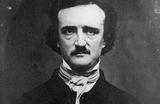
But there were a couple releases, later compiled into one glorious CD set, that is so head-slappingly perfect that it requires special attention: Basil Rathbone and Vincent Price read the works of Edgar Allan Poe over the course of 5 hours. Rathbone was, of course, a South African-born Shakespearean actor who is most famous for playing Sherlock Holmes in a string of films (watch one here) and radio plays, though he was also a veteran star of low-budget horror films like The Black Sheep and Tales of Terror. Vincent Price was, well, Vincent Price - the iconic cackling villain in dozens of horror flicks including Roger Corman’s campy cinematic adaptations of Poe - The House of Usher, The Raven and The Masque of the Red Death.
The Caedmon recordings, which are now available on Spotify (download the software here) and can be heard above, are pretty much Poe’s greatest hits - from "The Tell-Tale Heart" to "The Pit and Pendulum." Poe’s gothic gloominess pairs brilliantly with Rathbone and Price’s sinister baritone.
So get into your favorite smoking jacket, get a fire started, pour yourself a stiff glass of absinthe, set aside a good block of time, and have a listen.
Note: Looking for free, professionally-read audio books from Audible.com, including works by Edgar Allan Poe? Here’s a great, no-strings-attached deal. If you start a 30 day free trial with Audible.com, you can download two free audio books of your choice. Get more details on the offer here.
Related Content:
Edgar Allan Poe’s "The Raven," Read by Christopher Walken, Vincent Price, and Christopher Lee
Watch the 1953 Animation of Edgar Allan Poe’s "The Tell-Tale Heart," Narrated by James Mason
Edgar Allan Poe Animated: Watch Four Animations of Classic Poe Stories
Download The Complete Works of Edgar Allan Poe on His Birthday
630 Free Audio Books: Download Great Books for Free
Jonathan Crow is a Los Angeles-based writer and filmmaker whose work has appeared in Yahoo!, The Hollywood Reporter, and other publications. You can follow him at @jonccrow. And check out his blog Veeptopus, featuring lots of pictures of vice presidents with octopuses on their heads. The Veeptopus store is here.
http://www.openculture.com/2015/08/5-hours-of-edgar-allan-poe-stories-read-by-vincent-price-basil-rathbone.html is a post from: Open Culture. Follow us on Facebook, Twitter, and Google Plus, or get our Daily Email. And don't miss our big collections of Free Online Courses, Free Online Movies, Free eBooks, Free Audio Books, Free Foreign Language Lessons, and MOOCs.
%%POST_LINK%% is a post from: Open Culture. Follow us on Facebook, Twitter, and Google Plus, or get our Daily Email. And don't miss our big collections of Free Online Courses, Free Online Movies, Free eBooks, Free Audio Books, Free Foreign Language Lessons, and MOOCs.
Open Culture
.
Blog
.
<span class='date ' tip=''><i class='icon-time'></i> Aug 26, 2015 01:19pm</span>
|
|
Walter Benjamin, Ludwig Wittgenstein, and Sigmund Freud: if these theorists share any quality at all, they share a reputation for not going easy on their readers. Each of them wrote in a way that exudes a different kind of intellectual difficulty — Benjamin’s sudden swerves into the zone where high relevance meets high irrelevance, Wittgenstein’s austere certainty, Freud’s elaborate flights into the near-fantastical — but all of their work poses a challenge to readers approaching it for the first time. And so Kenneth Goldsmith Sings Theory addresses the obvious question: what if you didn’t read it, but heard it sung instead?
"What is it about academic theory that begs to be, well, sung by people who can’t sing?" asks Goldsmith, poet, prof, UBUweb creator, and WFMU radio host, on the station’s blog. He cites examples from a punk-rockified Theodor Adorno to a Finnish eccentric’s conversion of the Tractatus Logico-Philosophicus into a songbook, eventually coming to his own "adventures into the field," which you can hear in the Pennsound archive. Just above, we have have Goldsmith singing Benjamin’s "Unpacking my Library" to music by experimental violinist Eyvind Kang [MP3]. "Just as Benjamin lists copies of other books and the associations they bring," writes Jacob Edmond at Jacket2, "so Goldsmith copies Benjamin, creating an idiosyncratic audio book version. "
Wittgenstein Part 1
Wittgenstein Part 2
"In his performance of the text, Goldsmith fuses precisely delineated musical sections, or movements, with the chaotic, shifting pitch and tone of his voice, paralleling Benjamin’s observation in the essay that ‘if there is a counterpart to the confusion of a library, it is the order of its catalogue.'" Can you find similar parallels between Goldsmith’s manner of singing and the theory he delivers with it when he performs Wittgenstein’s Philosophical Investigations to Igor Stravinsky [MP3 part one, MP3 part two]? Or below, where he sings Sigmund Freud’s The Psychopathology of Everyday Life, starting on the passage of the "slips of the tongue" which have popularly come to bear Freud’s name, to The Who [MP3]? After all, style doesn’t count for much, as such a strikingly dressed character as Goldsmith knows full well, unless it aligns with substance.
Related Content:
Walter Benjamin’s Mystical Thought Presented by Two Experimental Films
Walter Benjamin’s Radio Plays for Kids (1929-1932)
Wittgenstein’s Masterpiece, the Tractatus Logico-Philosophicus, Gets Turned into Beautiful, Meditative Music
Ludwig Wittgenstein’s Tractatus Gets Adapted Into an Avant-Garde Comic Opera
Sigmund Freud Speaks: The Only Known Recording of His Voice, 1938
Colin Marshall writes on cities, language, Asia, and men’s style. He’s at work on a book about Los Angeles, A Los Angeles Primer, and the video series The City in Cinema. Follow him on Twitter at @colinmarshall or on Facebook.
http://www.openculture.com/2015/08/the-theory-of-walter-benjamin-ludwig-wittgenstein-sigmund-freud-sung-by-kenneth-goldsmith.html is a post from: Open Culture. Follow us on Facebook, Twitter, and Google Plus, or get our Daily Email. And don't miss our big collections of Free Online Courses, Free Online Movies, Free eBooks, Free Audio Books, Free Foreign Language Lessons, and MOOCs.
%%POST_LINK%% is a post from: Open Culture. Follow us on Facebook, Twitter, and Google Plus, or get our Daily Email. And don't miss our big collections of Free Online Courses, Free Online Movies, Free eBooks, Free Audio Books, Free Foreign Language Lessons, and MOOCs.
Open Culture
.
Blog
.
<span class='date ' tip=''><i class='icon-time'></i> Aug 26, 2015 01:19pm</span>
|
|
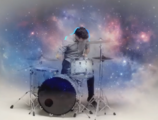
An old musician’s joke goes "there are three kinds of drummers in the world—those who can count and those who can’t." But perhaps there is an even more global divide. Perhaps there are three kinds of people in the world—those who can drum and those who can’t. Perhaps, as the promotional video above from GE suggests, drummers have fundamentally different brains than the rest of us. Today we highlight the scientific research into drummers’ brains, an expanding area of neuroscience and psychology that disproves a host of dumb drummer jokes.
"Drummers," writes Jordan Taylor Sloan at Mic, "can actually be smarter than their less rhythmically-focused bandmates." This according to the findings of a Swedish study (Karolinska Institutet in Stockholm) which shows "a link between intelligence, good timing and the part of the brain used for problem-solving." As Gary Cleland puts it in The Telegraph, drummers "might actually be natural intellectuals."
Neuroscientist David Eagleman, a renaissance researcher The New Yorker calls "a man obsessed with time," found this out in an experiment he conducted with various professional drummers at Brian Eno’s studio. It was Eno who theorized that drummers have a unique mental makeup, and it turns out "Eno was right: drummers do have different brains from the rest." Eagleman’s test showed "a huge statistical difference between the drummers’ timing and that of test subjects." Says Eagleman, "Now we know that there is something anatomically different about them." Their ability to keep time gives them an intuitive understanding of the rhythmic patterns they perceive all around them.
That difference can be annoying—like the pain of having perfect pitch in a perpetually off-key world. But drumming ultimately has therapeutic value, providing the emotional and physical benefits collectively known as "drummer’s high," an endorphin rush that can only be stimulated by playing music, not simply listening to it. In addition to increasing people’s pain thresholds, Oxford psychologists found, the endorphin-filled act of drumming increases positive emotions and leads people to work together in a more cooperative fashion.
Clash drummer Topper Headon discusses the therapeutic aspect of drumming in a short BBC interview above. He also calls drumming a "primeval" and distinctly, universally human activity. Former Grateful Dead drummer Mickey Hart and neuroscientist Adam Gazzaley have high hopes for the science of rhythm. Hart, who has powered a light show with his brainwaves in concerts with his own band, discusses the "power" of rhythm to move crowds and bring Alzheimer’s patients back into the present moment.
Whether we can train ourselves to think and feel like drummers may be debatable. But as for whether drummers really do think in ways non-drummers can’t, consider the neuroscience of Stewart Copeland’s polyrhythmic beats, and the work of Terry Bozzio (below) playing the largest drumkit you’ve ever seen.
Related Content:
Playing an Instrument Is a Great Workout For Your Brain: New Animation Explains Why
Isolated Drum Tracks From Six of Rock’s Greatest: Bonham, Moon, Peart, Copeland, Grohl & Starr
Josh Jones is a writer and musician based in Durham, NC. Follow him at @jdmagness.
http://www.openculture.com/2015/08/the-neuroscience-of-drumming.html is a post from: Open Culture. Follow us on Facebook, Twitter, and Google Plus, or get our Daily Email. And don't miss our big collections of Free Online Courses, Free Online Movies, Free eBooks, Free Audio Books, Free Foreign Language Lessons, and MOOCs.
%%POST_LINK%% is a post from: Open Culture. Follow us on Facebook, Twitter, and Google Plus, or get our Daily Email. And don't miss our big collections of Free Online Courses, Free Online Movies, Free eBooks, Free Audio Books, Free Foreign Language Lessons, and MOOCs.
Open Culture
.
Blog
.
<span class='date ' tip=''><i class='icon-time'></i> Aug 26, 2015 01:18pm</span>
|
|
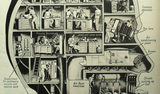
Click here to view the infographic in a larger format.
From the December 6, 1938 issue of LOOK magazine comes this vintage "infographic" showing "The Wonders Within Your Head." It takes the human brain/head and presents it as a series of rooms, each carrying out a different function. Drawn a little more than a decade after Calvin Coolidge famously declared "The business of America is business," it’s not surprising that the cognitive functions are depicted in corporate or industrial terms.
Besides for this visualization, the same edition of LOOK featured articles on Jean Harlow, Joan Crawford, President Roosevelt, and the Tragedy of the European Jews. Kristallnacht, or the "Night of Broken Glass," had taken place a month before in Nazi Germany — another sign that the world was about to become a very, very dark place.
Follow us on Facebook, Twitter, Google Plus and LinkedIn and share intelligent media with your friends. And if you want to make sure that our posts definitely appear in your Facebook newsfeed, just follow these simple steps.
Related Content:
The Tree of Languages Illustrated in a Big, Beautiful Infographic
Download 78 Free Online History Courses: From Ancient Greece to The Modern World
4000 Years of History Displayed in a 5-Foot-Long "Histomap" (Early Infographic) From 1931
Free Online Biology Courses
http://www.openculture.com/2015/08/the-wonders-within-your-head-a-vintage-infographic-of-the-human-brain-1938.html is a post from: Open Culture. Follow us on Facebook, Twitter, and Google Plus, or get our Daily Email. And don't miss our big collections of Free Online Courses, Free Online Movies, Free eBooks, Free Audio Books, Free Foreign Language Lessons, and MOOCs.
%%POST_LINK%% is a post from: Open Culture. Follow us on Facebook, Twitter, and Google Plus, or get our Daily Email. And don't miss our big collections of Free Online Courses, Free Online Movies, Free eBooks, Free Audio Books, Free Foreign Language Lessons, and MOOCs.
Open Culture
.
Blog
.
<span class='date ' tip=''><i class='icon-time'></i> Aug 26, 2015 01:18pm</span>
|
|
Even by the standards of United States Presidents, Barack Obama has led a pretty unusual life. His early experiences included a childhood plunge into internationalism in the form of not just his Kenyan father but his Indonesian stepfather, to whose homeland the family moved when Obama was six years old. For the next four years, the young future Commander in Chief attended local schools in Jakarta, and the language he picked up then has stuck with him today. It certainly served him well when he returned to Indonesia as President to give the speech above, in which he talks about his love for that country and his belief in its importance to the future, speaking bits and pieces in Indonesian throughout — and drawing great applause each time.
If you want to be like Barry and meet with a similarly rapturous reception when next you give a public address in the Emerald of the Equator, start by learning the basics of the Indonesian language at our Free Foreign Language Lessons page. There, you’ll find a wealth of podcasts like Learning Indonesian (iTunes), Indonesianpod101 (iTunes), and Indonesian Survival Phrases (iTunes). [Advanced learners might prefer tuning in to news-in-Indonesian podcasts from SBS (iTunes) and NHK World (iTunes) radio.] Indonesianpod101 even has a Youtube page with video lessons like the one just above.
Even if you don’t plan on becoming President, you may still have plenty of reasons to learn Indonesian. With its familiar alphabet and simple grammar without tenses, gender forms, noun cases, and the like, it ranks as one of the very easiest languages in which to attain fluency. I know an American college professor in South Korea who constantly urges his students to study Indonesian, since it offers the "golden tip" of a wedge into the rest of Asia: master it, and you’ll have built up momentum to learn the other, more complicated languages of the region, from Mandarin to Cantonese to Japanese and beyond — all of which you can also begin studying at, of course, our Free Language Lessons page.
If your linguistic interests slant toward Europe rather than Asia, don’t worry, we’ve still got your back: our lists include learning resources for languages of that continent as major as Spanish, French, Italian, Russian, English, and German to niche languages like Catalan, Finnish, Hungarian, and Serbo-Croatian. If you notice we’ve missed any language you’ve harbored a burning desire to learn, drop us a line so we can start gathering podcasts, videos, and PDFs on it. In the meantime, surely the Free Language Lessons page offers you something to start on and get that incomparable feeling of breaking into a new language for the first time. Semoga beruntung, as we say in Jakarta!
Related Content:
Learn 48 Languages Online for Free: Spanish, Chinese, English & More
Study 40+ Languages with Free Lessons from the U.S. Foreign Service Institute
Let’s Learn Japanese: Two Classic Video Series to Get You Started in the Language
Learn Latin, Old English, Sanskrit, Classical Greek & Other Ancient Languages in 10 Lessons
Colin Marshall writes on cities, language, Asia, and men’s style. He’s at work on a book about Los Angeles, A Los Angeles Primer, and the video series The City in Cinema. Follow him on Twitter at @colinmarshall or on Facebook.
http://www.openculture.com/2015/08/learn-to-speak-48-languages-for-free.html is a post from: Open Culture. Follow us on Facebook, Twitter, and Google Plus, or get our Daily Email. And don't miss our big collections of Free Online Courses, Free Online Movies, Free eBooks, Free Audio Books, Free Foreign Language Lessons, and MOOCs.
%%POST_LINK%% is a post from: Open Culture. Follow us on Facebook, Twitter, and Google Plus, or get our Daily Email. And don't miss our big collections of Free Online Courses, Free Online Movies, Free eBooks, Free Audio Books, Free Foreign Language Lessons, and MOOCs.
Open Culture
.
Blog
.
<span class='date ' tip=''><i class='icon-time'></i> Aug 26, 2015 01:17pm</span>
|