Blogs
|
Anyone with a Facebook or Twitter account last week couldn’t avoid hearing about Walter James Palmer, the Minnesota dentist who allegedly went trophy hunting in Zimbabwe and killed Cecil the Lion, a local favorite who had been illegally lured away from a protected wildlife preserve. I won’t say anything more about it, other than that you can sign a petition to get Palmer extradited to Zimbabwe and let him defend his actions to local authorities.
Meanwhile, back in New York City, two artists Travis Threlkel and Louie Psihoyos were getting ready to turn The Empire State building into a Noah’s Ark of Endangered Animals. And that’s exactly what happened on Saturday night. Placing "40 stacked, 20,000-lumen projectors on the roof of a nearby building," Threlkel and Psihoyos projected an array of endangered animals "onto a space 375 feet tall and 186 feet wide covering 33 floors," reports The New York Times. You can see photos of the animals over at the Racing Extinction Twitter stream. Touchingly, there was an homage to Cecil the Lion. A video from the Times appears above; another from The New Yorker below.
To learn more about how Project Mapping works, and to see other examples of Threlkel’s work, see the videos on this page.
Follow us on Facebook, Twitter, Google Plus and LinkedIn and share intelligent media with your friends. And if you want to make sure that our posts definitely appear in your Facebook newsfeed, just follow these simple steps.
http://www.openculture.com/2015/08/endangered-species-including-cecil-the-lion-projected-onto-the-empire-state-building.html is a post from: Open Culture. Follow us on Facebook, Twitter, and Google Plus, or get our Daily Email. And don't miss our big collections of Free Online Courses, Free Online Movies, Free eBooks, Free Audio Books, Free Foreign Language Lessons, and MOOCs.
%%POST_LINK%% is a post from: Open Culture. Follow us on Facebook, Twitter, and Google Plus, or get our Daily Email. And don't miss our big collections of Free Online Courses, Free Online Movies, Free eBooks, Free Audio Books, Free Foreign Language Lessons, and MOOCs.
Open Culture
.
Blog
.
<span class='date ' tip=''><i class='icon-time'></i> Aug 26, 2015 01:41pm</span>
|
|
Paintings by Maria A. Aristidou
As philosopher Marshall McLuhan wrote in Understanding Media, "the medium is the message."
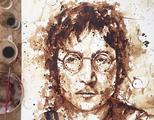
Artist Maria A. Aristidou’s medium is coffee, and lately, she’s been garnering a lot of attention for java-based portraits of such cultural luminaries as Einstein, Darth Vader and The Beatles.
The prolific and highly-caffeinated artist found her niche when an accidental spill gave rise to a somewhat sullen facsimile of Vermeer’s Girl with a Pearl Earring.
She has since applied her espresso blends toward the Mona Lisa and one of Baroque era painter Juan de Arellano’s floral still lifes, but for the most part, she draws her subjects from the realm of pop culture.
Dorm room faves like Marilyn Monroe, Bob Marley, and John Lennon are overshadowed by fictional superstars like Frozen’s Queen Elsa, Nintendo’s Mario, and various personages from Game of Thrones.
My favorite? Kyle MacLachlan as Twin Peaks’ Agent Dale "Damn fine cup of coffee, Diane!" Cooper. That’s not just medium. That’s meta!
Aristidou is not the only artist finding inspiration in this non-traditional pigment. A recent NPR story on the trend cites coffee artists Angel Sarkela-Saur and Andy Saur and Giulia Bernardelli.
Scroll backwards to the mid-1800s and you’ll find author—and gifted draftsman—Victor Hugo experimenting with the stuff. Nor was his promiscuous nib a stranger to the artistic possibilities of soot, coal dust, and blood.
Aristidou, who holds degrees in Fine Art Printmaking and Arts Health, eschews the traditional artist’s website in favor of social media. Not only is she a master of the hashtag, she also designs cakes. View her complete oeuvre—including several cartons of corporate logo Easter eggs and some recent fashion illustrations that combine watercolor with java—on her Facebook or Instagram pages.
Above you can watch Aristidou paint portraits of Einstein, the Beatles and R2D2 in quick time-lapse motion.
Related Content:
Victor Hugo’s Surprisingly Modern Drawings Made with Coal, Dust & Coffee (1848-1851)
J.S. Bach’s Comic Opera, "The Coffee Cantata," Sings the Praises of the Great Stimulating Drink (1735)
Black Coffee: Documentary Covers the History, Politics & Economics of the "Most Widely Taken Legal Drug"
The Fine Art of Painting Portraits on Coffee Foam
Ayun Halliday is an author, illustrator, and Chief Primatologist of the East Village Inky zine. Follow her @AyunHalliday
http://www.openculture.com/2015/08/coffee-portraits-of-john-lennon-albert-einstein-marilyn-monroe.html is a post from: Open Culture. Follow us on Facebook, Twitter, and Google Plus, or get our Daily Email. And don't miss our big collections of Free Online Courses, Free Online Movies, Free eBooks, Free Audio Books, Free Foreign Language Lessons, and MOOCs.
%%POST_LINK%% is a post from: Open Culture. Follow us on Facebook, Twitter, and Google Plus, or get our Daily Email. And don't miss our big collections of Free Online Courses, Free Online Movies, Free eBooks, Free Audio Books, Free Foreign Language Lessons, and MOOCs.
Open Culture
.
Blog
.
<span class='date ' tip=''><i class='icon-time'></i> Aug 26, 2015 01:39pm</span>
|
|
It may be true that speculation about an author’s personal history can prove not especially illuminating to reading their books. We generally think it best to read a literary work on its own terms. But in certain cases, as in the well-worn case of Ernest Hemingway, the parallels between life and work are impossible to ignore or to pass over without comment, and, for many critics, this goes particularly for discussions about Hemingway’s gender and sexuality. Even Hemingway’s contemporaries had their commentary. Zelda Fitzgerald supposedly remarked that no one could be as masculine as Hemingway, for example, and Virginia Woolf referred to him as "self consciously virile." Themes of homosexuality and gender anxiety crop up in Hemingway’s fiction, and more prominently in unpublished work unearthed in the 1980s.
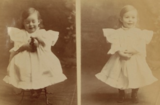
For critics like Debra Moddelmog, author of Reading Desire: In Pursuit if Ernest Hemingway, the biographical interest begins with the hyper-macho modernist’s early childhood, during which his mother Grace raised him and his older sister Marcelline as twin girls, dressing them alike "in fancy dresses and flowered hats." This apparently happened over a period of several years, until Hemingway was at least five years old, and Grace even held Marcelline back a year so that the two could attend the same grade. Though one of Hemingway’s younger sisters, Sunny, has "denied that the twinning ever took place" the evidence seems to show otherwise—in Marcelline’s reminisces and in photograph after photograph of young Ernest and Marcelline dressed exactly alike and having tea parties, riding in wagons, and holding bouquets. You can see them in 1901, in bonnets above and flowered hats below.
At the top of the post, see Hemingway in a girlish haircut identical to his sister’s, and below, see two photographs of him in a wide-shouldered dress. At the JFK Library website (click here and scroll to bottom), you can now view many more of these photographs from Hemingway’s first few years on up to the age of 18. The digitized collection of six childhood scrapbooks, the library writes, were "collected by Ernest Hemingway himself and donated to the John F. Kennedy Library by his widow, Mary Hemingway." Many of the childhood photographs are fascinating for various reasons, though the "twinning" photographs have provoked the most interest and contributed to already rich theories of Hemingway’s identity as a person and an artist.
Looked at in the context of the time, these photographs don’t seem all that odd. As anyone who has flipped through family albums from the turn of the century (should they have them) will have noticed, little boys were routinely dressed in ambiguously girlish attire, their long hair often styled and curled. The fashion derived partly from a hugely popular character in children’s fiction named "Little Lord Fauntleroy," the Harry Potter of his day, who had a rags-to-riches story that captivated American readers especially. The character has been the subject of film adaptations even as late as 1980, in which he was played by a young Ricky Schroeder. Fauntleroy had some influence on Grace Hemingway. (See Hemingway in a Lord Fauntleroy suit, with football, in a 1909 photograph below.)
Fauntleroy and other similar characters’ model of "genteel manhood" gained widespread currency. Frances Hodgson Burnett’s Victorian novels featuring this character came at a time when childhood was viewed through a much different lens than it is today. (As we’ve seen in the photography of Lewis Carroll and many other artists of the time in which children appear as props and dolls, sometimes in strangely suggestive or androgynous poses that would not have seemed especially prurient or gender-bending to their original viewers.) The trend continued into the early twentieth century. Nonetheless, despite less rigid childhood gender norms, as Hemingway biographer Kenneth Schuyler Lynn writes, Grace Hemingway’s "elaborate pretense that little Ernest and his sister were twins of the same sex" was very unusual. Critics like Moddelmog and Mark Spilka have argued convincingly that Hemingway "rebelled against that identity," a rebellion that "lasted a lifetime."
Related Content:
18 (Free) Books Ernest Hemingway Wished He Could Read Again for the First Time
Download 55 Free Online Literature Courses: From Dante and Milton to Kerouac and Tolkien
Ernest Hemingway’s Delusional Adventures in Boxing: "My Writing is Nothing, My Boxing is Everything."
Lewis Carroll’s Photographs of Alice Liddell, the Inspiration for Alice in Wonderland
Josh Jones is a writer and musician based in Durham, NC. Follow him at @jdmagness
http://www.openculture.com/2015/08/ernest-hemingway-his-sister-dressed-as-twin-girls.html is a post from: Open Culture. Follow us on Facebook, Twitter, and Google Plus, or get our Daily Email. And don't miss our big collections of Free Online Courses, Free Online Movies, Free eBooks, Free Audio Books, Free Foreign Language Lessons, and MOOCs.
%%POST_LINK%% is a post from: Open Culture. Follow us on Facebook, Twitter, and Google Plus, or get our Daily Email. And don't miss our big collections of Free Online Courses, Free Online Movies, Free eBooks, Free Audio Books, Free Foreign Language Lessons, and MOOCs.
Open Culture
.
Blog
.
<span class='date ' tip=''><i class='icon-time'></i> Aug 26, 2015 01:39pm</span>
|
|
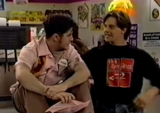
Kevin Smith’s 1994 debut Clerks did much to define the low-budget, high-profile "Indiewood" boom of that era. But set a trend on America’s cultural fringe, and it never takes long for the mainstream to come calling. In this case, the mainstream wanted to cash in on a Clerks television sitcom, the only produced episode of which spent the past couple decades languishing in the vast graveyard of pilots no network would pick up before its rediscovery just this year. You can watch it in all its sanitized glory just above.
Even though those of us who grew up on the mid-1990s televisual landscape won’t recognize the never-aired Clerks itself, we’ll recognize its sensibility right away. "It gives me bad flashbacks to the pre-web monoculture," writes one commenter on the Metafilter thread about the show — a monoculture built, at that time, upon one-liners and their corresponding laugh tracks, floppy hair and baggy clothes. Ironically, it was that very same dominant glossy blandness that made Clerks, the movie, feel so fresh when it first made its way from festival to theatrical release.
Still, this failed TV adaptation does retain a few elements of its source material: the convenience-store setting (though here called Rose Market rather than Quick Stop), the main characters named Dante and Randal. But the resemblance more or less stops there. "Gone are the movie’s iconic drug dealers Jay and Silent Bob," writes the A.V. Club’s Christopher Curley, "replaced by backup characters including an ice cream server and a tanning salon ditz. Some of the beats of the film are still there, like Randal harassing his video store customers, but nothing lands or even remotely coheres."
Kevin Smith made Clerks with $27,575. Clerks the sitcom pilot, made entirely without Smith’s involvement, certainly cost much more — money that bought zero cultural impact, especially by comparison to the film that inspired it. The Indiewood movement showed us how much untapped vitality American cinema still had; almost everything on television looked like lifeless productions-by-committee by comparison. But now that Clerks has passed its twentieth anniversary, the tables have turned, and we look to television for the raw, real stories Hollywood doesn’t tell. The travails of a couple of young sex- and Star Wars-obsessed dead-enders in grim suburban New Jersey, shot in black-and-white 16-millimeter film — would CBS care to hear more?
via Metafilter/AV Club
Related Content:
Watch the Hardcore Original Ending to Kevin Smith’s 1994 Cult Hit Clerks
Watch Kevin Smith’s Clever First Film, Mae Day: The Crumbling of a Documentary (1992)
The Always-NSFW Kevin Smith and Jason Mewes Catch Up in Jay and Silent Bob Get Old Podcast
Hear Kevin Smith’s Three Tips For Aspiring Filmmakers (NSFW)
Colin Marshall writes on cities, language, Asia, and men’s style. He’s at work on a book about Los Angeles, A Los Angeles Primer, and the video series The City in Cinema. Follow him on Twitter at @colinmarshall or on Facebook.
http://www.openculture.com/2015/08/watch-the-never-aired-pilot-for-clerks-1995.html is a post from: Open Culture. Follow us on Facebook, Twitter, and Google Plus, or get our Daily Email. And don't miss our big collections of Free Online Courses, Free Online Movies, Free eBooks, Free Audio Books, Free Foreign Language Lessons, and MOOCs.
%%POST_LINK%% is a post from: Open Culture. Follow us on Facebook, Twitter, and Google Plus, or get our Daily Email. And don't miss our big collections of Free Online Courses, Free Online Movies, Free eBooks, Free Audio Books, Free Foreign Language Lessons, and MOOCs.
Open Culture
.
Blog
.
<span class='date ' tip=''><i class='icon-time'></i> Aug 26, 2015 01:38pm</span>
|
|
Next month, David Gilmour will release his first solo album since 2006 and launch his first tour since ’08. But right now, in the dead of August, you can watch a new animated video for his upcoming track, "Rattle That Lock."
Created under the leadership of Aubrey Powell of Hipgnosis (the design group that produced the iconic artwork for Dark Side of the Moon and other Pink Floyd LPs), the animation pays homage to Gustave Doré, whose illustrations of Dante, Poe and Cervantes we’ve featured here before. And the lyrics themselves, they draw inspiration from John Milton’s Paradise Lost, reports Rolling Stone. Gilmour, Doré, Milton — surely a trifecta for many OC readers.
Related Content:
Gustave Doré’s Dramatic Illustrations of Dante’s Divine Comedy
Gustave Doré’s Splendid Illustrations of Edgar Allan Poe’s "The Raven" (1884)
Gustave Doré’s Exquisite Engravings of Cervantes’ Don Quixote
William Blake’s Hallucinatory Illustrations of John Milton’s Paradise Lost
Pink Floyd’s David Gilmour Sings Shakespeare’s Sonnet 18
http://www.openculture.com/2015/08/pink-floyds-david-gilmour-releases-new-animated-video-inspired-by-gustave-dore-miltons-paradise-lost.html is a post from: Open Culture. Follow us on Facebook, Twitter, and Google Plus, or get our Daily Email. And don't miss our big collections of Free Online Courses, Free Online Movies, Free eBooks, Free Audio Books, Free Foreign Language Lessons, and MOOCs.
%%POST_LINK%% is a post from: Open Culture. Follow us on Facebook, Twitter, and Google Plus, or get our Daily Email. And don't miss our big collections of Free Online Courses, Free Online Movies, Free eBooks, Free Audio Books, Free Foreign Language Lessons, and MOOCs.
Open Culture
.
Blog
.
<span class='date ' tip=''><i class='icon-time'></i> Aug 26, 2015 01:38pm</span>
|
|
Depending on who’s counting, Joe Maggard was the eighth or ninth person to have the honor of officially portraying Ronald McDonald. (The first, if you’re looking for some pop culture trivia, was Willard Scott, from the Today show.) Maggard filled Ronald’s big red shoes from 1995 until 2007. And nowadays you can find him chilling in Las Vegas, occasionally donning the famous clown costume at local carnivals, and helping kids (he says with a straight face) learn the importance of healthy eating. He’s a colorful guy, who can use some colorful language.
I Was Ronald McDonald is a short doc from The Guardian. Find more docs in our collection of 200 Free Online Documentaries.
Follow us on Facebook, Twitter, Google Plus and LinkedIn and share intelligent media with your friends. And if you want to make sure that our posts definitely appear in your Facebook newsfeed, just follow these simple steps.
http://www.openculture.com/2015/08/the-eighth-ronald-mcdonald-a-short-slightly-strange-documentary-from-the-guardian.html is a post from: Open Culture. Follow us on Facebook, Twitter, and Google Plus, or get our Daily Email. And don't miss our big collections of Free Online Courses, Free Online Movies, Free eBooks, Free Audio Books, Free Foreign Language Lessons, and MOOCs.
%%POST_LINK%% is a post from: Open Culture. Follow us on Facebook, Twitter, and Google Plus, or get our Daily Email. And don't miss our big collections of Free Online Courses, Free Online Movies, Free eBooks, Free Audio Books, Free Foreign Language Lessons, and MOOCs.
Open Culture
.
Blog
.
<span class='date ' tip=''><i class='icon-time'></i> Aug 26, 2015 01:37pm</span>
|
|
Ralph Steadman will always best be known—and for good reason—as the visual interpreter of Hunter S. Thompson’s druggy gonzo vision of American excess and hubris. As Colin Marshall wrote in a previous post on Steadman and Thompson’s powerful collaborative relationship, it’s hard to imagine a more "suitable visual accompaniment to the simultaneously clear- and wild-eyed sensibility of Thompsonian prose." But the British artist has had a long and distinguished career, pre- and post-Thompson: illustrating Lewis Carroll’s surrealist classic Alice in Wonderland; creating limited edition DVD covers for the dark cult hit TV show Breaking Bad; making bullet-riddled collage art with counterculture hero William S. Burroughs…. To name just a few of his offbeat assignments over the years.
Today we bring you a lesser-known facet of Steadman’s work: designing album covers. As artist and illustrator John Coulthart notes in a post on Steadman’s album designs, he’s been at it since the mid-fifties, when—for example—he illustrated a release of Conception (top), "an underappreciated masterpiece of cerebral cool jazz" featuring the likes of Miles Davis, Stan Getz, and Sonny Rollins. Steadman’s abstract expressionist-inspired jazz covers soon gave way to more Steadmanesque, though still relatively tame, covers like that above for The Who’s single "Happy Jack"/"I’ve Been Away" from 1966.
It’s not until the 70s, however—after he’d begun his collaboration with Thompson—that his album covers begin to take on the decidedly crazed look his work is known for, such as in the cover for Paul Brett’s Phoenix Future, above, from 1975.
By 1997, Steadman seems to have perfected his inimitable riot of grotesque imagery, wild color palette, and unhinged black lines and lettering, as in the cover for Closed On Account Of Rabies: Poems And Tales Of Edgar Allan Poe, a compilation of Poe readings by stars like Christopher Walken, Iggy Pop, Marianne Faithfull, Jeff Buckley, and Abel Ferrara, which we’ve featured on OC before. The artists represented here are—as in his work with Thompson and Burroughs—perfectly fitting for Steadman’s sensibility. So, of course, is the clean-living but otherwise totally bonkers Frank Zappa, whose 1997 Have I Offended Someone? received the Steadman treatment, as you can see below.
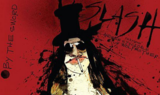
In the past few years, Steadman has mellowed a bit, if you could call it that, and his work has taken on a slightly more refined character. His Breaking Bad illustrations seem restrained by the standards of his work with Thompson or Zappa. And in a 2010 cover for Slash’s first official single, "By the Sword," below, he reigns in some of his wilder graphic impulses while retaining all of the stylist signatures he developed over the decades.
Steadman has always been a one-of-a-kind illustrator. In his album cover design, we can perhaps best watch his work evolve. As Coulthart writes, "the style of the early sleeves is markedly different to the angry, splattery creations that made his name, and without a signature you’d be unlikely to recognise the artist." See many more Steadman album covers over at Coulthart’s excellent blog.
via Feuilleton
Related Content:
Breaking Bad Illustrated by Gonzo Artist Ralph Steadman
See Ralph Steadman’s Twisted Illustrations of Alice’s Adventures in Wonderland on the Story’s 150th Anniversary
Gun Nut William S. Burroughs & Gonzo Illustrator Ralph Steadman Make Polaroid Portraits Together
Josh Jones is a writer and musician based in Durham, NC. Follow him at @jdmagness
http://www.openculture.com/2015/08/ralph-steadmans-evolving-album-cover-designs.html is a post from: Open Culture. Follow us on Facebook, Twitter, and Google Plus, or get our Daily Email. And don't miss our big collections of Free Online Courses, Free Online Movies, Free eBooks, Free Audio Books, Free Foreign Language Lessons, and MOOCs.
%%POST_LINK%% is a post from: Open Culture. Follow us on Facebook, Twitter, and Google Plus, or get our Daily Email. And don't miss our big collections of Free Online Courses, Free Online Movies, Free eBooks, Free Audio Books, Free Foreign Language Lessons, and MOOCs.
Open Culture
.
Blog
.
<span class='date ' tip=''><i class='icon-time'></i> Aug 26, 2015 01:37pm</span>
|
|
The BBC’s recent series of Nigel Warburton-scripted, celebrity-narrated animations in philosophy haven’t shied away from the hard questions the discipline touches. How did everything begin? What makes us human? What is the self? How do I live a good life? In all those videos, Gillian Anderson, Stephen Fry, and Harry Shearer told us what history’s most thought-about thinkers have had to say on those subjects. But for the latest round, Warburton and The Hobbit‘s Aidan Turner have taken on what some would consider, at least for our practical purposes, the trickiest one of all: what is love?
You might not turn to Jean-Paul Sartre, life partner of Simone de Beauvoir, as a first love consultant of choice, but the series devotes an entire video to the Being and Nothingness author’s theories on emotion. The freedom-minded Sartre sees the condition of love as a "hazardous, painful struggle," one of either masochism or sadism: "masochism when a lover tries to become what he thinks his lover wants him to be, and in the process denies his own freedom; sadism when the lover treats the loved one as an object and ties her down. Either way, freedom is compromised."
Have we any lighter philosophical perspectives on love here? Well, we have a variety of philosophical perspectives on love, anyway: Aristophanes’ creation myth of the "missing half," Sigmund Freud and Edvard Westermarck’s disagreement over the Oedipus complex, and the conviction of "psychological egoists" from Thomas Hobbes to Richard Dawkins that no such thing as strictly selfless love exists. The philosophy of love, like love itself, can get complicated, but the clear and witty drawings accompanying the ideas discussed in these videos can help us envision the different ideas they encompass. Should you need even clearer (or less witty) illustrations on the subject, you could always turn to Love Is…, though I have a feeling you’d find that solution a bit too simple.
Watch all of the animated videos in the What is Love? playlist here.
Related Content:
What is the Self? Watch Philosophy Animations Narrated by Stephen Fry on Sartre, Descartes & More
How Did Everything Begin?: Animations on the Origins of the Universe Narrated by X-Files Star Gillian Anderson
What Makes Us Human?: Chomsky, Locke & Marx Introduced by New Animated Videos from the BBC
How to Live a Good Life? Watch Philosophy Animations Narrated by Stephen Fry on Aristotle, Ayn Rand, Max Weber & More
How Can I Know Right From Wrong? Watch Philosophy Animations on Ethics Narrated by Harry Shearer
Download 130 Free Philosophy Courses: Tools for Thinking About Life, Death & Everything Between
Lovers and Philosophers — Jean-Paul Sartre & Simone de Beauvoir Together in 1967
Colin Marshall writes on cities, language, Asia, and men’s style. He’s at work on a book about Los Angeles, A Los Angeles Primer, and the video series The City in Cinema. Follow him on Twitter at @colinmarshall or on Facebook.
http://www.openculture.com/2015/08/what-is-love-bbc-philosophy-animations-feature-sartre.html is a post from: Open Culture. Follow us on Facebook, Twitter, and Google Plus, or get our Daily Email. And don't miss our big collections of Free Online Courses, Free Online Movies, Free eBooks, Free Audio Books, Free Foreign Language Lessons, and MOOCs.
%%POST_LINK%% is a post from: Open Culture. Follow us on Facebook, Twitter, and Google Plus, or get our Daily Email. And don't miss our big collections of Free Online Courses, Free Online Movies, Free eBooks, Free Audio Books, Free Foreign Language Lessons, and MOOCs.
Open Culture
.
Blog
.
<span class='date ' tip=''><i class='icon-time'></i> Aug 26, 2015 01:36pm</span>
|
|
Imagine a hat. Flip it upside down, and you’ve got yourself the outline of a story the public will never weary of, according to author Kurt Vonnegut, who maps it on out a chalkboard in the video above.
His Y-axis charts a range between good and ill fortune. Vonnegut recommends positioning your main character slightly closer to the good (i.e. wealth and boisterous health) end of the spectrum, at least in the beginning. He or she will dip below midline soon enough.
As for the X-axis, Vonnegut labels it B-E, from beginning to end.
Now plot your points, remembering that it’s all about the curves.
Some popular themes include people getting in and out of trouble, and the evergreen boy gets girl. (The always progressive Vonnegut reminds his viewers that the genders in the latter scenario are always open to interpretation. Again, it’s the curves that count…)
Thinking about my favorite books and films, it seems that most do follow Vonnegut’s upside-down hat narrative arc.
Are there exceptions?
Horatio Alger’s rags to riches stories, for example. We should all be so lucky to find ourselves powering up such a steep uphill grade.
Of course there are exceptions!
Vonnegut himself identifies a particularly high profile one, whose geometry is less an elegant curve than a staircase that terminates in a free fall. (SPOILER: it involves a fairy godmother and ends in an infinity symbol.
Those weary of parsing story using the Hero’s Journey template should investigate Vonnegut’s graphic approach. It works!
Related Content:
Kurt Vonnegut’s 8 Tips on How to Write a Good Short Story
Kurt Vonnegut Explains "How to Write With Style"
Kurt Vonnegut Urges Young People to Make Art and "Make Your Soul Grow"
Ayun Halliday is an author, illustrator, and Chief Primatologist of the East Village Inky zine. Follow her @AyunHalliday
http://www.openculture.com/2015/07/kurt-vonnegut-maps-out-the-universal-shapes-of-our-favorite-stories-2.html is a post from: Open Culture. Follow us on Facebook, Twitter, and Google Plus, or get our Daily Email. And don't miss our big collections of Free Online Courses, Free Online Movies, Free eBooks, Free Audio Books, Free Foreign Language Lessons, and MOOCs.
%%POST_LINK%% is a post from: Open Culture. Follow us on Facebook, Twitter, and Google Plus, or get our Daily Email. And don't miss our big collections of Free Online Courses, Free Online Movies, Free eBooks, Free Audio Books, Free Foreign Language Lessons, and MOOCs.
Open Culture
.
Blog
.
<span class='date ' tip=''><i class='icon-time'></i> Aug 26, 2015 01:35pm</span>
|
|
Salvador Dalí and Luis Buñuel reportedly carried rocks in their pockets during the premiere of their first film Un Chien andalou, anticipating a violent reaction from the audience.
It was a fair concern. The movie might be almost 90 years old but it still has the power to provoke - the film features a shot of a woman getting her eye slashed open with a straight razor after all. As it turned out, rocks weren’t needed. The audience, filled with such avant-garde luminaries as Pablo Picasso and André Breton liked the film. A disappointed Dalí later reported that the night was "less exciting" than he had hoped.
Un Chien andalou featured many of Dalí’s visual obsessions - eyeballs, ants crawling out of orifices and rotting animals. Dalí delighted in shocking and inciting people with his gorgeous, disturbing images. And he loved grandiose spectacles like a riot at a movie theater.
Dalí and Buñuel’s next movie, the caustic L’Age d’or, exposed the differences between the two artists and their creative partnership imploded in pre-production. Buñuel went on to make a string of subversive masterpieces like Land Without Bread, Exterminating Angel and The Discreet Charm of the Bourgeois; Dalí largely quit film in favor of his beautifully crafted paintings.
Then Hollywood came calling.
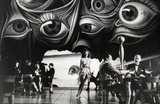
Alfred Hitchcock hired Dalí to create a dream sequence for his 1945 movie Spellbound. Dalí crafted over 20 minutes of footage of which roughly four and a half minutes made it into the movie. "I wanted to convey the dream with great visual sharpness and clarity-sharper than film itself," Hitchcock explained to Francois Truffaut in 1962. The sequence, which you can see immediately above, is filled with all sorts of Daliesque motifs - slashed eyeballs, naked women and phantasmagoric landscapes. It is also the most memorable part of an otherwise minor work by Hitchcock.
Dalí’s follow up film work was for, of all things, the Vincente Minnelli comedy Father of the Bride (1950). Spencer Tracy plays Stanley Banks whose beautiful daughter (Elizabeth Taylor, no less) is getting married. As Stanley’s anxiety over the impending nuptials spirals, he has one very weird nightmare. Cue Dalí. Stanley is late to the wedding. As he rushes down the aisle, his clothes mysteriously get shredded by the tiled floor that bounces and contorts like a piece of flesh.
This dream sequence, which you can see at the top of the article, has few of the visual flourishes of Spellbound, but it still has plenty of Dalí’s trademark weirdness. Those floating accusatory eyes. The way that Tracy’s leg seems to stretch. That floor.
Father of the Bride marked the end of Dalí’s work in Hollywood, though there were a couple potential collaborations that would have been amazing had they actually happened. Dalí had an idea for a movie with the Marx Brothers called Giraffes on Horseback Salad. The movie would have "included a scene of giraffes wearing gas masks and one of Chico sporting a deep-diving suit while playing the piano." Though Harpo was reportedly enthusiastic about the proposed idea, Groucho wasn’t and the idea sadly came to nothing.
Later in life, Dalí became a fixture on the talk show circuit. On the Dick Cavett Show in 1970, he flung an anteater at Lillian Gish.
Related Content:
Two Vintage Films by Salvador Dalí and Luis Buñuel: Un Chien Andalou and L’Age d’Or
The Seashell and the Clergyman: The World’s First Surrealist Film
Alfred Hitchcock Recalls Working with Salvador Dali on Spellbound
A Soft Self-Portrait of Salvador Dali, Narrated by the Great Orson Welles
A Tour Inside Salvador Dalí’s Labyrinthine Spanish Home
Jonathan Crow is a Los Angeles-based writer and filmmaker whose work has appeared in Yahoo!, The Hollywood Reporter, and other publications. You can follow him at @jonccrow. And check out his blog Veeptopus, featuring lots of pictures of vice presidents with octopuses on their heads. The Veeptopus store is here.
http://www.openculture.com/2015/08/salvador-dali-goes-to-hollywood-creates-wild-dream-sequences-for-hitchcock-vincente-minnelli.html is a post from: Open Culture. Follow us on Facebook, Twitter, and Google Plus, or get our Daily Email. And don't miss our big collections of Free Online Courses, Free Online Movies, Free eBooks, Free Audio Books, Free Foreign Language Lessons, and MOOCs.
%%POST_LINK%% is a post from: Open Culture. Follow us on Facebook, Twitter, and Google Plus, or get our Daily Email. And don't miss our big collections of Free Online Courses, Free Online Movies, Free eBooks, Free Audio Books, Free Foreign Language Lessons, and MOOCs.
Open Culture
.
Blog
.
<span class='date ' tip=''><i class='icon-time'></i> Aug 26, 2015 01:35pm</span>
|