Blogs
|
Cast your mind back to 1979, a time before Internet radio, Twitter, Tumblr, and other social networks beginning with the letter T. And now imagine that you’d never heard the Velvet Underground, Talking Heads, Blondie, Roxy Music, hell, even Bruce Springsteen—all of whom were just beginning to break through to mainstream consciousness. Now imagine your introduction to these artists comes from none other than Ziggy Stardust himself—or the Thin White Duke—David Bowie, immersed in his Berlin period and recording a trilogy of albums that together arguably represent the best work of his career. That would be something, wouldn’t it?
Perhaps some of you don’t have to imagine. If you had tuned into BBC Radio One on May, 20 of that year, you would have heard David Bowie DJ his own two hour show, "Star Special," playing his favorite records and jovially chatting up his audience. "There are some famous names here," says an announcer introducing Bowie’s show, "some you’ve never heard of before." Bowie laughs at his own jokes, and obviously takes great pleasure in sharing so many then-obscure artists. "You can hear that deep need to show," writes Dangerous Minds, "to bring listeners something new, in every word Bowie utters." He doesn’t mind bringing them his own new stuff either, playing "Boys Keep Swinging" and "Yassassin" from that year’s Lodger.
Track listing
The Doors, "Love Street"
Iggy Pop, "TV Eye"
John Lennon, "Remember"
? & The Mysterians, "96 Tears"
Edward Elgar, "The Nursery Suite" (extract)
Danny Kaye, "Inchworm"
Philip Glass, "Trial Prison"
The Velvet Underground, "Sweet Jane"
Mars, "Helen Fordsdale"
Little Richard, "He’s My Star"
King Crimson, "21st Century Schizoid Man"
Talking Heads, "Warning Sign"
Jeff Beck, "Beck’s Bolero"
Ronnie Spector, "Try Some, Buy Some"
Marc Bolan, "20th Century Boy"
The Mekons, "Where Were You?"
Steve Forbert, "Big City Cat"
The Rolling Stones, "We Love You"
Roxy Music, "2HB"
Bruce Springsteen, "It’s Hard To Be A Saint In The City"
Stevie Wonder, "Fingertips"
Blondie, "Rip Her To Shreds"
Bob Seger, "Beautiful Loser"
David Bowie, "Boys Keep Swinging"
David Bowie, "Yassassin"
Talking Heads, "Book I Read"
Roxy Music, "For Your Pleasure"
King Curtis, "Something On Your Mind"
The Staple Singers, "Lies"
See a complete playlist of Bowie’s "Star Special" above, and hear the entire show at the top of the post. It’s a great listen even with the benefit of hindsight, but if you can put yourself in the place of someone who’d never heard Lou Reed mumble and moan his way through "Sweet Jane"—or for that matter never heard the still-obscure experimental punk band Mars—it’s even better. For other excellent examples of British rock stars as radio tastemakers, hear the Sex Pistols’ John Lydon introduce an audience to Can, King Tubby, Nico, Captain Beefheart, and more in this 1977 Capital Radio interview. (Lydon says he loves "Rebel Rebel," but thinks Bowie is "a real bad drag queen.") And don’t miss Joe Strummer’s eclectic 8-episode BBC Radio Show "London Calling" from 1998/2001.
via John Coulthart/Metafilter/Dangerous Minds
Related Content:
David Bowie’s Top 100 Books
David Bowie Releases Vintage Videos of His Greatest Hits from the 1970s and 1980s
"Joe Strummer’s London Calling": All 8 Episodes of Strummer’s UK Radio Show Free Online
Josh Jones is a writer and musician based in Durham, NC. Follow him at @jdmagness.
http://www.openculture.com/2015/07/david-bowie-becomes-a-dj-on-bbc-radio-in-1979.html is a post from: Open Culture. Follow us on Facebook, Twitter, and Google Plus, or get our Daily Email. And don't miss our big collections of Free Online Courses, Free Online Movies, Free eBooks, Free Audio Books, Free Foreign Language Lessons, and MOOCs.
%%POST_LINK%% is a post from: Open Culture. Follow us on Facebook, Twitter, and Google Plus, or get our Daily Email. And don't miss our big collections of Free Online Courses, Free Online Movies, Free eBooks, Free Audio Books, Free Foreign Language Lessons, and MOOCs.
Open Culture
.
Blog
.
<span class='date ' tip=''><i class='icon-time'></i> Aug 26, 2015 02:02pm</span>
|
|
During these summer months, we’ve been busy rummaging around the internet and adding new courses to our big list of Free Online Courses, which now features 1,150 courses from top universities. Let’s give you the quick overview: The list lets you download audio & video lectures from schools like Stanford, Yale, MIT, Oxford and Harvard. Generally, the courses can be accessed via YouTube, iTunes or university web sites, and you can listen to the lectures anytime, anywhere, on your computer or smart phone. We didn’t do a precise calculation, but there’s probably about 35,000 hours of free audio & video lectures here. Enough to keep you busy for a very long time.
Right now you’ll find 133 free philosophy courses, 85 free history courses, 120 free computer science courses, 71 free physics courses and 55 Free Literature Courses in the collection, and that’s just beginning to scratch the surface. You can peruse sections covering Astronomy, Biology, Business, Chemistry, Economics, Engineering, Math, Political Science, Psychology and Religion.
Here are some highlights from the complete list of Free Online Courses. We’ve added a few unconventional/vintage courses in the mix just to keep things interesting.
A Romp Through Ethics for Complete Beginners - Free iTunes Video - Free Online Video - Free Online Audio - Marianne Talbot, Oxford University
Against All Odds: Inside Statistics - Free Online Video - Pardis Sabeti, Harvard
Ancient Greek History - Free Online Video - Free iTunes Audio - Free iTunes Video - Course Materials - Donald Kagan, Yale
Creative Reading and Writing - William S. Burroughs - Free Online Audio - Naropa University
Critical Reasoning for Beginners - Free iTunes Video - Free iTunes Audio - Free Online Video & Audio - Marianne Talbot, Oxford
Developing iOS 8 Apps with Swift - Free iTunes Video - Paul Hegarty, Stanford
Edible Education 101 (Spring 2014) - Free Online Video - Free iTunes Video - Michael Pollan, UC Berkeley
Financial Markets - Free Online Video - Free iTunes Audio - Free iTunes Video - Course Materials - Robert Shiller, Yale
Growing Up in the Universe - Free Online Video - Richard Dawkins, Oxford
The Habitable Planet: A Systems Approach to Environmental Science - Free Online Video - Harvard/Smithsonian
Harvard’s Introduction to Computer Science - Various Formats - David Malan, Harvard
Hemingway, Fitzgerald, Faulkner - Free Online Video - Free iTunes Audio - Course Materials - Wai Chee Dimock, Yale
Heidegger’s Being & Time - Free iTunes Audio - Hubert Dreyfus, UC Berkeley
Human Behavioral Biology - Free iTunes Video - Free Online Video - Robert Sapolsky, Stanford
Introduction to the Old Testament (Hebrew Bible) - Free Online Video - Christine Hayes, Yale.
Introduction to Visual Studies - Free iTunes iOS App - Anna Divinsky, Penn State
Invitation to World Literature - Free Online Video - David Damrosch, Harvard
Philosophy of Language - Free iTunes Audio - John Searle, UC Berkeley
Physics for Future Presidents - Free Online Video - Richard Muller, UC Berkeley
Quantum Electrodynamics - Free Online Video - Richard Feynman, Presented at University of Auckland
Science and Cooking: From Haute Cuisine to the Science of Soft Matter - Free Online Video - Free iTunes Video - Course Info - Team taught, Harvard
Shakespeare After All: The Later Plays - Free Online Video - Marjorie Garber, Harvard
Speak Italian with Your Mouth Full - Free Online Video & Course Info - Free Online Video - Free iTunes Video - MIT, Dr. Paola Rebusco
The American Novel Since 1945 - Free Online Video - Free iTunes Audio - Free iTunes Video - Download Course - Amy Hungerford, Yale
The Central Philosophy of Tibet - Free Online Audio - Robert Thurman, Columbia University
The Character of Physical Law (1964) - Free Online Video - Richard Feynman, Cornell
The Hobbit - Free iTunes Video - Free Online Audio - More - Corey Olsen, Washington College
The Tempest - Free Online Audio - Allen Gisnberg, Naropa
Walter Kaufmann Lectures on Nietzsche, Kierkegaard and Sartre - Free Online Audio
The complete list of courses can be accessed here: 1,200 Free Online Courses from Top Universities
Related Content:
630 Free Audio Books: Download Great Books for Free.
700 Free eBooks for iPad, Kindle & Other Devices.
700 Free Movies Online: Great Classics, Indies, Noir, Westerns, etc..
Learn 48 Languages Online for Free: Spanish, Chinese, English & More.
http://www.openculture.com/2015/07/a-master-list-of-1200-free-courses-from-top-universities-35000-hours-of-audiovideo-lectures.html is a post from: Open Culture. Follow us on Facebook, Twitter, and Google Plus, or get our Daily Email. And don't miss our big collections of Free Online Courses, Free Online Movies, Free eBooks, Free Audio Books, Free Foreign Language Lessons, and MOOCs.
%%POST_LINK%% is a post from: Open Culture. Follow us on Facebook, Twitter, and Google Plus, or get our Daily Email. And don't miss our big collections of Free Online Courses, Free Online Movies, Free eBooks, Free Audio Books, Free Foreign Language Lessons, and MOOCs.
Open Culture
.
Blog
.
<span class='date ' tip=''><i class='icon-time'></i> Aug 26, 2015 02:02pm</span>
|
|
Last week, we featured a trio of ridiculously cute commercials about a cat called Konyara. The company that made them was none other that Studio Ghibli, Hayao Miyazaki’s animation shop. Those commercials, drawn in an elegantly simple style that recalls traditional Japanese sumi-e illustrations, had the same meticulous attention to detail and fluid movements that are Miyazaki’s trademark.
As it turns out, Ghibli didn’t restrict its commercial endeavors to cartoon cats. Above are a bunch of commercials the company did over the years stretching all the way back to 1992. The ads range from ones about bread to banks to green tea. There are also quite a number of tie-ins from the studio’s movies, like an ad for Lawson’s convenience stores that features collectible dolls from Spirited Away. What is fascinating about these ads is the range of styles they exhibit. Many are done in a way that clearly recalls Miyazaki’s movies, others look much more minimal and much more gestural.
In other Miyazaki related news, it turns out that the master isn’t retiring after all. Following the release of his feature The Wind Rises in 2013, Hayao Miyazaki announced he was getting out of the animation biz. But as with his numerous declarations of retirement in the past, it didn’t take.
Miyazaki is reportedly making a 10-minute long animated short called Kemushi no Boro (Boro the Caterpillar). The director describes the short as "a story of a tiny, hairy caterpillar, so tiny that it may be easily squished between your fingers." He has been developing on the idea for a couple decades now and, in spite of the short’s length, the film is projected to take three years to make.
What might be surprising is that the film will be entirely computer generated. Miyazaki is perhaps the world’s most famous proponent of hand-drawn cel animation. As a younger man, he railed against CGI calling the method "shallow, fake." Over the years, however, his feelings evolved.
"If [hand-drawn cel animation] is a dying craft we can’t do anything about it," he told The Guardian back in 2005. "Civilization moves on. Where are all the fresco painters now? Where are the landscape artists? What are they doing now? […] Actually I think CGI has the potential to equal or even surpass what the human hand can do. But it is far too late for me to try it."
Apparently it is not.
Boro will screen exclusively in his Studio Ghibli Museum in Mitaka, Tokyo, so if you want to see the master’s next work, be prepared to fly to Japan.
Related Content:
The Simpsons Pay Wonderful Tribute to the Anime of Hayao Miyazaki
How to Make Instant Ramen Compliments of Japanese Animation Director Hayao Miyazaki
French Student Sets Internet on Fire with Animation Inspired by Moebius, Syd Mead & Hayao Miyazaki
Jonathan Crow is a Los Angeles-based writer and filmmaker whose work has appeared in Yahoo!, The Hollywood Reporter, and other publications. You can follow him at @jonccrow. And check out his blog Veeptopus, featuring lots of pictures of vice presidents with octopuses on their heads. The Veeptopus store is here.
http://www.openculture.com/2015/07/the-delightful-tv-ads-directed-by-hayao-miyazaki-other-studio-ghibli-animators-1992-2015.html is a post from: Open Culture. Follow us on Facebook, Twitter, and Google Plus, or get our Daily Email. And don't miss our big collections of Free Online Courses, Free Online Movies, Free eBooks, Free Audio Books, Free Foreign Language Lessons, and MOOCs.
%%POST_LINK%% is a post from: Open Culture. Follow us on Facebook, Twitter, and Google Plus, or get our Daily Email. And don't miss our big collections of Free Online Courses, Free Online Movies, Free eBooks, Free Audio Books, Free Foreign Language Lessons, and MOOCs.
Open Culture
.
Blog
.
<span class='date ' tip=''><i class='icon-time'></i> Aug 26, 2015 02:00pm</span>
|
|
You may recall our posting last year of Jorge Luis Borges’ review of Orson Welles’ Citizen Kane — surely one of the most Open Culture-worthy intersections of 20th century luminaries ever to occur. Borges described Welles’ masterwork as possessed of one side that, "pointlessly banal, attempts to milk applause from dimwits," and another, a "kind of metaphysical detective story" whose "subject (both psychological and allegorical) is the investigation of a man’s inner self, through the works he has wrought, the words he has spoken, the many lives he has ruined." On the whole, the author of Labyrinths called the picture "not intelligent, though it is the work of genius."
Not long after our post, the Paris Review‘s Dan Piepenbring wrote one that also quoted another, later review of Citizen Kane by none other than Jean-Paul Sartre:
Kane might have been interesting for the Americans, [but] it is completely passé for us, because the whole film is based on a misconception of what cinema is all about. The film is in the past tense, whereas we all know that cinema has got to be in the present tense. ‘I am the man who is kissing, I am the girl who is being kissed, I am the Indian who is being pursued, I am the man pursuing the Indian.’ And film in the past tense is the antithesis of cinema. Therefore Citizen Kane is not cinema.
The 1945 review originally ran in high-minded film journal L’Écran français under the headline "Quand Hollywood veut faire penser … Citizen Kane d’Orson Welles," or, "When Hollywood Wants to Make Us Think … Orson Welles’ Citizen Kane." According to The Writings of Jean-Paul Sartre: A Bibliographical Life, "in re-reading this [review], which he did not remember at all, Sartre hardly recognized his style and expressed some doubt about the authenticity of his signature. On the other hand, he did find in it the ideas Citizen Kane suggested to him when he first saw it in the United States. After he saw the film again in France, Sartre had a slightly more favorable opinion of it, but he still thinks it is undoubtedly no masterpiece."
But at the time, writes Simon Leys, "the impact of this condemnation was devastating. The Magnificent Ambersons was shown soon afterwards in Paris but failed miserably. The cultivated public always follows the directives of a few propaganda commissars: there is much more conformity among intellectuals than among plumbers or car mechanics." Or at least the cultivated public did so in 1940s Paris; the mechanics of culture have changed somewhat since then, but as far as Citizen Kane goes, high-profile opinions about it have grown only more positive over time. Sure, Vertigo recently knocked it down a peg in the Sight and Sound poll, but that just makes me wonder what Sartre thought of Hitchcock’s masterwork — a film that might have had a resonance or two in the mind of an existentialist.
Related Content:
Jorge Luis Borges, Film Critic, Reviews Citizen Kane — and Gets a Response from Orson Welles
Orson Welles Explains Why Ignorance Was His Major "Gift" to Citizen Kane
Jean-Paul Sartre Rejects the Nobel Prize in Literature in 1964: "It Was Monstrous!"
Jean-Paul Sartre Breaks Down the Bad Faith of Intellectuals
Human, All Too Human: 3-Part Documentary Profiles Nietzsche, Heidegger & Sartre
Nietzsche, Wittgenstein & Sartre Explained with Monty Python-Style Animations by The School of Life
Download Walter Kaufmann’s Lectures on Nietzsche, Kierkegaard, Sartre & Modern Thought (1960)
Colin Marshall writes on cities, language, Asia, and men’s style. He’s at work on a book about Los Angeles, A Los Angeles Primer, and the video series The City in Cinema. Follow him on Twitter at @colinmarshall or on Facebook.
http://www.openculture.com/2015/07/citizen-kane-is-not-cinema-jean-paul-sartre-reviews-orson-welles-masterwork-1945.html is a post from: Open Culture. Follow us on Facebook, Twitter, and Google Plus, or get our Daily Email. And don't miss our big collections of Free Online Courses, Free Online Movies, Free eBooks, Free Audio Books, Free Foreign Language Lessons, and MOOCs.
%%POST_LINK%% is a post from: Open Culture. Follow us on Facebook, Twitter, and Google Plus, or get our Daily Email. And don't miss our big collections of Free Online Courses, Free Online Movies, Free eBooks, Free Audio Books, Free Foreign Language Lessons, and MOOCs.
Open Culture
.
Blog
.
<span class='date ' tip=''><i class='icon-time'></i> Aug 26, 2015 01:59pm</span>
|
|
Both Faulkner and the physicists may be right: the passage of time is an illusion. And yet, for as long as we’ve been keeping score, it’s seemed that history really exists, in increasingly distant forms the further back we look. As Jonathan Crow wrote in a recent post on news service British Pathé’s release of 85,000 pieces of archival film on YouTube, seeing documentary evidence of just the last century "really makes the past feel like a foreign country—the weird hairstyles, the way a city street looked, the breathtakingly casual sexism and racism." (Of course there’s more than enough reason to think future generations will say the same of us.) British Pathé’s archive seems exhaustive—until you see the latest digitized collection on YouTube from AP and British Movietone, which spans from 1895 to the present and brings us thousands more past tragedies, triumphs, and hairstyles
This release of "more than 1 million minutes" of news, writes Variety, includes archival footage of "major world events such as the 1906 San Francisco earthquake, exclusive footage of the bombing of Pearl Harbor in 1941, the fall of the Berlin Wall and the 2001 terrorist attacks on the U.S." And so much more, such as the newsreel above, which depicts Berlin in 1945, eventually getting around to documenting the Potsdam Conference (at 3:55), where Churchill, Stalin, and Truman created the 17th parallel in Vietnam, dictated the terms of the German occupation, and planned the coming Japanese surrender. No one at the time could have accurately foreseen the historical reverberations of these actions.
Another strange, even uncanny piece of film shows us the English football team giving the Nazi salute in 1938 at the commencement of a game against Germany. "That’s shocking now," says Alwyn Lindsay, the director of AP’s international archive, "but it wasn’t at the time." Films like these have become of much more interest since The Sun published photographs of the royal family—including a young Queen Elizabeth II and her uncle Prince (later King, then Duke) Edward VIII—giving Nazi salutes in 1933. Though it was not particularly controversial, and the children of course had little idea what it signified, it did turn out that Edward (seen here) was a would-be Nazi collaborator and remained an unapologetic sympathizer.
This huge video trove doesn’t just document the grim history of the Second World War, of course. As you can see in the AP’s introductory montage at the top of the post, there is "a world of history at your fingertips"—from triumphant video like Nelson Mandela’s release from prison, above, to the below film of "Crazy 60s Hats in Glorious Colour." And more or less every other major world event, disaster, discovery, or widespread trend you might name from the last 120 or so years.
The archive splits into two YouTube channels: AP offers both historical and up-to-the-minute political, sports, celebrity, science, and "weird and wacky" videos (with "new content every day"). The British Movietone channel is solely historical, with much of its content coming from the 1960s (like those hats, and this video of the Beatles receiving their MBE’s, and other "Beatlemania scenes.")
Movietone’s one nod to the present takes the form of "The Archivist Presents," in which a historian offers quirky context on some bit of archival footage, like that above of the Kinks getting their hair curled. The completely unironic lounge music and casually sexist narration will make you both smile and wince, as do Ray Davies and company when they see their new hair. Most of the films in this million minutes of news footage (and counting) tend to elicit either or both of these two emotional reactions—joy (or amusement) or mild to intense horror, and watching them makes the past they show us feel paradoxically more strange and more immediate at once.
Related Content:
Free: British Pathé Puts Over 85,000 Historical Films on YouTube
New Archive Makes Available 800,000 Pages Documenting the History of Film, Television & Radio
700 Free Movies Online: Great Classics, Indies, Noir, Westerns, etc.
Josh Jones is a writer and musician based in Durham, NC. Follow him at @jdmagness.
http://www.openculture.com/2015/07/1000000-minutes-of-newsreel-footage-by-ap-british-movietone-released-on-youtube.html is a post from: Open Culture. Follow us on Facebook, Twitter, and Google Plus, or get our Daily Email. And don't miss our big collections of Free Online Courses, Free Online Movies, Free eBooks, Free Audio Books, Free Foreign Language Lessons, and MOOCs.
%%POST_LINK%% is a post from: Open Culture. Follow us on Facebook, Twitter, and Google Plus, or get our Daily Email. And don't miss our big collections of Free Online Courses, Free Online Movies, Free eBooks, Free Audio Books, Free Foreign Language Lessons, and MOOCs.
Open Culture
.
Blog
.
<span class='date ' tip=''><i class='icon-time'></i> Aug 26, 2015 01:58pm</span>
|
|
Before Netflix killed Blockbuster, Blockbuster killed the mom and pop video store. Maybe you had your favorite ma and pa shop, where under the surface of new releases you’d find the quirky, curated selections that reflected the mind of the owner.
When Allen Ginsberg lived in New York’s East Village, it was Kim’s Video, opened in 1987 by Yongman Kim. With so many artists frequenting its St. Marks Place location, Kim asked its more famous customers to share their lists of top ten favorite films. Ginsberg obliged. And you can now find his top 10 list online (in two parts: Part 1 - Part 2) thanks to The Allen Ginsberg Project.
Ginsberg’s oldest choice is Sergei Eisenstein’s 1925 Battleship Potemkin, which you can watch above. One must wonder if it was the very poetic editing that drew Ginsberg to the film, or something else, perhaps, maybe the film’s revolutionary nature?
Many of Ginsberg’s choices reflect his interest in poetic realism, the French film movement that combined stories of real folks with sometimes very impressionist camera work. Three of its most famous proponents, Julian Duvivier, Jean Renoir, and Marcel Carné appear on the Ginsberg list.
Julian Duvivier’s Pépé le Moko (1937) is set in that most wonderful location for the Beat poets, Tangiers, and inspired Graham Greene to write The Third Man. Marcel Carné’s classic Children of Paradise (1945) makes the list, as does his 1938 film noir Port of Shadows. Jean Renoir’s The Grand Illusion, which still tops many top 10 film lists today, is here too.
Another Frenchman, Jean Cocteau gets on the list twice, with two films from his Orphic trilogy, The Blood of a Poet (1930) and Orpheé (1950). The mix of the dreamlike and the erotic make a perfect choice for the poet.
Ginsberg saves space for Beat cinema, a lot of which is still not on DVD. Ron Rice’s The Flower Thief (1960) is often called one of the main films of the Beat Generation, a largely improvised, low budget film about the artists and writers of San Francisco. It sadly remains unavailable on DVD, and one wonders if the film was even available at Kim’s, as it doesn’t appear to be on VHS either.
More available are his final two choices, Robert Frank and Alfred Leslie’s Pull My Daisy (1959), which was named after (and executed in a style similar to) an Exquisite Corpse-style poem written by Ginsberg, Jack Kerouac, and Neil Cassady in the late ‘40s. Also largely improvised, the film involves bohemian party crashers who make life complicated for a man and wife trying to impress a respectable bishop who’s come for dinner.
Lastly, Ginsberg names Harry Smith’s visionary cut-up animation masterpiece Heaven and Earth Magic (1957 - 1962), which you can see above. Smith was not just a superb filmmaker, but a great influence on the Beats through his interest in psychedelics and mysticism, as well as the man behind the American Anthology of Folk Music on Folkways records. A great friend of Ginsberg, Harry Smith gets the final tip of the hat.
via The Allen Ginsberg Project
Related Content:
13 Lectures from Allen Ginsberg’s "History of Poetry" Course (1975)
The First Recording of Allen Ginsberg Reading "Howl" (1956)
Rare Footage of Allen Ginsberg, Jack Kerouac & Other Beats Hanging Out in the East Village (1959)
Ted Mills is a freelance writer on the arts who currently hosts the FunkZone Podcast. You can also follow him on Twitter at @tedmills, read his other arts writing at tedmills.com and/or watch his films here.
http://www.openculture.com/2015/07/allen-ginsbergs-top-10-favorite-films.html is a post from: Open Culture. Follow us on Facebook, Twitter, and Google Plus, or get our Daily Email. And don't miss our big collections of Free Online Courses, Free Online Movies, Free eBooks, Free Audio Books, Free Foreign Language Lessons, and MOOCs.
%%POST_LINK%% is a post from: Open Culture. Follow us on Facebook, Twitter, and Google Plus, or get our Daily Email. And don't miss our big collections of Free Online Courses, Free Online Movies, Free eBooks, Free Audio Books, Free Foreign Language Lessons, and MOOCs.
Open Culture
.
Blog
.
<span class='date ' tip=''><i class='icon-time'></i> Aug 26, 2015 01:58pm</span>
|
|
For years, it was hard to come across Hear the Wind Sing and Pinball 1973, Haruki Murakami’s first and second novels, unless one wanted to pony up something between $250 and $400 at Amazon for their Kodansha English editions. The author has long dismissed them as juvenilia, though he was far from a juvenile at that time, and was actually managing a jazz bar on the outskirts of Tokyo with his wife and writing his first works at their kitchen table. He was searching for a style as a novelist, and it was once he wrote A Wild Sheep Chase that Murakami became the writer he envisioned.
On August 4, Knopf will publish both novels in a single volume with new translations by Ted Goossen, so readers can make up their own minds on whether Murakami is being too hard on himself. A lot of the familiar Murakami elements and themes are there: a nameless narrator who likes his beer and smokes, cats, music, literature, spaghetti, mysterious appearances and disappearances, loneliness, and his poetic observations of nature.
Now that Murakami has relented on the book’s publication, he has penned an introduction that explores the beginning of his writing career, chance decisions, his sometimes blind search for a style, and the baseball game that changed his life:
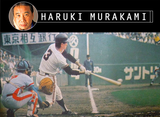
I think Hiroshima’s starting pitcher that day was Yoshiro Sotokoba. Yakult countered with Takeshi Yasuda. In the bottom of the first inning, Hilton slammed Sotokoba’s first pitch into left field for a clean double. The satisfying crack when the bat met the ball resounded throughout Jingu Stadium. Scattered applause rose around me. In that instant, for no reason and on no grounds whatsoever, the thought suddenly struck me: I think I can write a novel.
I can still recall the exact sensation. It felt as if something had come fluttering down from the sky, and I had caught it cleanly in my hands. I had no idea why it had chanced to fall into my grasp. I didn’t know then, and I don’t know now. Whatever the reason, it had taken place. It was like a revelation. Or maybe epiphany is the closest word. All I can say is that my life was drastically and permanently altered in that instant—when Dave Hilton belted that beautiful, ringing double at Jingu Stadium.
After the game (Yakult won as I recall), I took the train to Shinjuku and bought a sheaf of writing paper and a fountain pen. Word processors and computers weren’t around back then, which meant we had to write everything by hand, one character at a time. The sensation of writing felt very fresh. I remember how thrilled I was. It had been such a long time since I had put fountain pen to paper.
Each night after that, when I got home late from work, I sat at my kitchen table and wrote. Those few hours before dawn were practically the only time I had free. Over the six or so months that followed I wrote Hear the Wind Sing. I wrapped up the first draft right around the time the baseball season ended. Incidentally, that year the Yakult Swallows bucked the odds and almost everyone’s predictions to win the Central League pennant, then went on to defeat the Pacific League champions, the pitching-rich Hankyu Braves in the Japan Series. It was truly a miraculous season that sent the hearts of all Yakult fans soaring.
You can read the rest of Murakami’s introduction over at Lithub. And pre-order the new translation of Wind/Pinball here.
Related Content:
A 56-Song Playlist of Music in Haruki Murakami’s Novels: Ray Charles, Glenn Gould, the Beach Boys & More
Haruki Murakami Reads in English from The Wind-Up Bird Chronicle in a Rare Public Reading (1998)
Discover Haruki Murakami’s Advertorial Short Stories: Rare Short-Short Fiction from the 1980s
A Dreamily Animated Introduction to Haruki Murakami, Japan’s Jazz and Baseball-Loving Postmodern Novelist
Ted Mills is a freelance writer on the arts who currently hosts the FunkZone Podcast. You can also follow him on Twitter at @tedmills, read his other arts writing at tedmills.com and/or watch his films here.
http://www.openculture.com/2015/07/read-online-haruki-murakamis-new-essay-on-how-a-baseball-game-launched-his-writing-career.html is a post from: Open Culture. Follow us on Facebook, Twitter, and Google Plus, or get our Daily Email. And don't miss our big collections of Free Online Courses, Free Online Movies, Free eBooks, Free Audio Books, Free Foreign Language Lessons, and MOOCs.
%%POST_LINK%% is a post from: Open Culture. Follow us on Facebook, Twitter, and Google Plus, or get our Daily Email. And don't miss our big collections of Free Online Courses, Free Online Movies, Free eBooks, Free Audio Books, Free Foreign Language Lessons, and MOOCs.
Open Culture
.
Blog
.
<span class='date ' tip=''><i class='icon-time'></i> Aug 26, 2015 01:57pm</span>
|
|
Patreon, a crowd funding site where fans can automatically tithe a set amount to their fave artist every time that person uploads content, is a great way for passionate, under-recognized individuals to gain visibility and a bit of dough.
So what’s astrophysicist Neil deGrasse Tyson doing there? He’s already famous, and one would think his gig as director of New York City’s Hayden Planetarium, coupled with the proceeds from his books and dvds, would prove sufficient to any financial needs.
(Is it some sort of Amanda Palmer thing?)
Nope. Turns out Dr. Tyson is there on someone else’s behalf, narrating an episode of Harry Reich’s Minute Physics. The video series often employs whiteboard animations to explain such scientific phenomena as dark matter, wave/particle duality, and bicycles.
The latest Tyson-narrated episode, above, shoots the moon by cramming the entire History of the Universe (and some complimentary Stravinsky) into an 8.5-minute framework (a negligible amount when you consider phenomena like light years, but still many times the series’ standard minute).
Thus far, 1075 fans of Minute Physics have anted up, resulting in a take of $2,992.66 per video. (Click here to see how that amount compares to the various wages and salaries of Dr. Tyson’s coworkers at the American Museum of Natural History…it’s clear Reich devotes a lot of labor to every episode.)
If you’re feeling flush (or nervous about the upcoming school year), you can join these 1075 fans, earning admission to a supporters-only activity feed where you can ask questions, watch outtakes, preview upcoming attractions, and possibly even get your name in the credits.
Related Content:
Stephen Colbert & Neil deGrasse Break Down Our Awesome 3 Billion-Mile Journey to Pluto
Neil deGrasse Tyson Talks Asteroid Physics & "Non Newtonian Solids" with Inspiring 9-Year-Old Student
Neil deGrasse Tyson’s StarTalk Radio Show Podcast Tackles the History of Video Games
Ayun Halliday is an author, illustrator, and Chief Primatologist of the East Village Inky zine. Follow her @AyunHalliday
http://www.openculture.com/2015/07/neil-degrasse-tyson-presents-a-brief-history-of-everything-in-an-8-5-minute-animation.html is a post from: Open Culture. Follow us on Facebook, Twitter, and Google Plus, or get our Daily Email. And don't miss our big collections of Free Online Courses, Free Online Movies, Free eBooks, Free Audio Books, Free Foreign Language Lessons, and MOOCs.
%%POST_LINK%% is a post from: Open Culture. Follow us on Facebook, Twitter, and Google Plus, or get our Daily Email. And don't miss our big collections of Free Online Courses, Free Online Movies, Free eBooks, Free Audio Books, Free Foreign Language Lessons, and MOOCs.
Open Culture
.
Blog
.
<span class='date ' tip=''><i class='icon-time'></i> Aug 26, 2015 01:57pm</span>
|
|
Of all the various types of professional explainers out there, none may come across as more clueless than the television news reporter faced with a minority youth culture and trying to account for its existence—one he or she had previously been unaware of. Every description gets reduced to the broadest of judgements, easy stereotypes fill in for appreciation. The larger the media outlet, the more these tendencies seem to manifest; in fact a string of such sensualized reportage put together seems to constitute both the rise and the fall of a corporate news career.
All of the above should prepare you for what you are about to see in ABC’s 20/20 special "Rappin’ to the Beat" from 1981. Investigative reporter Steve Fox journeys into the world of rap music, a form—his condescending co-anchor tells us in a back-handed remark—"so compelling, you’ll never miss the fact there’s no melody." "It’s a music that is all beat," he says, "strong beat, and talk." With the tone established, enter Fox to tell us that Blondie’s "Rapture" is the main reason rap caught on. It only gets worse. I suppose you could blame Debbie Harry, but she didn’t ask to be the first voice of rap we hear in a 20/20 special. That decision was the special purview of "Rappin’ to the Beat"’s producers.
But like all archival film and video of emerging creative movements, these clips redeem themselves with footage of the scene’s pioneers, including a performance from a 22-year-old Kurtis Blow and some early breakdancing—or, as one NYC Transit cop calls it, a riot. The second part, above, gives us some insightful commentary from NYC radio DJ Pablo Guzman, folklorist John Szwed (who wrote the definitive biography of Sun Ra), and syndicated rock columnist Lisa Robinson, who reminds us of how "very black and very urban" rap is, then goes on to say, "people hated rock and roll 15 years ago."
It’s certainly true that 15 years or so after this clumsy attempt at capturing the moment, rap and hip-hop became ubiquitous—at a time when punk rock also hit the suburbs. Punk also had its 20/20 moment in the late 70s (above); it symbolized, the announcer tells us, "the dreadful possibility of riot which has always seemed to cling to rock and roll." Metal got the Geraldo treatment in "Heavy Metal Moms"—the examples abound. Which of them is more banal, condescending, or just painfully awkward is impossible to say, but they make fascinating windows onto the media’s consistently weirded-out response to outsiders they can’t ignore. As a counterpoint, check out the way Fred Rogers welcomed to his show a 12-year-old breakdancer or a couple of experimental electronic musicians, making no effort to be cool, knowledgeable, or detached, only kind and curious. It’s just my opinion, but I always thought TV news needed more Mr. Rogers and less…. whatever the journalistic approach in "Rappin’ to the Beat" is supposed to be.
via Mental Floss
Related Content:
The "Amen Break": The Most Famous 6-Second Drum Loop & How It Spawned a Sampling Revolution
Fight For Your Right Revisited: Adam Yauch’s 2011 Film Commemorates the Beastie Boys’ Legendary Music Video
Mr. Rogers Takes Breakdancing Lessons from a 12-Year-Old (1985)
Josh Jones is a writer and musician based in Durham, NC. Follow him at @jdmagness.
http://www.openculture.com/2015/07/abc-news-program-2020-introduces-america-to-rap-music-in-a-painfully-awkward-way-1981.html is a post from: Open Culture. Follow us on Facebook, Twitter, and Google Plus, or get our Daily Email. And don't miss our big collections of Free Online Courses, Free Online Movies, Free eBooks, Free Audio Books, Free Foreign Language Lessons, and MOOCs.
%%POST_LINK%% is a post from: Open Culture. Follow us on Facebook, Twitter, and Google Plus, or get our Daily Email. And don't miss our big collections of Free Online Courses, Free Online Movies, Free eBooks, Free Audio Books, Free Foreign Language Lessons, and MOOCs.
Open Culture
.
Blog
.
<span class='date ' tip=''><i class='icon-time'></i> Aug 26, 2015 01:56pm</span>
|
|
Experimental music, by its very nature, stays out of the mainstream. All styles of music begin as experiments, but most sooner or later, in one form or another, find their way to popular acceptance. But if one living musician personifies the intriguing borderlands between the popular and the experimental, Björk does: since at least the 1980s (and, technically, the 1970s), she has steadily put out records that constitute master classes in how to keep pushing forms forward while maintaining a wide fan base, seemingly giving the lie to John Cage’s dictum that making something 20 percent new means a loss of 80 percent of the audience.
Cage, an icon of minimalist experimental music who still caught the public ear now and again, doesn’t appear in the BBC’s Modern Minimalists [part one, part two], but only because he died in 1992, five years before it aired. But this Björk-hosted whirlwind tour through the company of a selection of innovative minimalist composers of the day actually feels, at points, a bit like Cage’s 1960 performance of Water Walk on I’ve Got a Secret: we not only hear them talk, but we hear their music, see them make it, and get an insight into the way they work and — perhaps most importantly — the way they think.
"When I was asked to do this program," Björk says in her distinctive Icelandic inflection, "it was very important for me to introduce the people I think are changing music today." That roster includes Alasdair Malloy from Scotland, Mika Vainio from Finland, and, most famously, Arvo Pärt from Estonia. Björk not only draws out their musical philosophies, but responds with a few of her own. "People have moved away from plots and structures, and moved to its complete opposite, which is textures," she says over a series of postmodern landscapes, "A place to live in, or an environment, or a stillness." And the role of the musician in that modern reality? "To take these everyday noises that are ugly, and make them beautiful. By this, they’re doing magic."
via Network Awesome
Related Content:
Watch Björk’s 6 Favorite TED Talks, From the Mushroom Death Suit to the Virtual Choir
Hear the Album Björk Recorded as an 11-Year-Old: Features Cover Art Provided By Her Mom (1977)
A Young Björk Deconstructs (Physically & Theoretically) a Television in a Delightful Retro Video
Björk and Sir David Attenborough Team Up in a New Documentary About Music and Technology
John Cage Performs Water Walk on US Game Show I’ve Got a Secret (1960)
Colin Marshall writes on cities, language, Asia, and men’s style. He’s at work on a book about Los Angeles, A Los Angeles Primer, and the video series The City in Cinema. Follow him on Twitter at @colinmarshall or on Facebook.
http://www.openculture.com/2015/07/bjork-introduces-groundbreaking-experimental-musicians-on-the-bbcs-modern-minimalists-1997.html is a post from: Open Culture. Follow us on Facebook, Twitter, and Google Plus, or get our Daily Email. And don't miss our big collections of Free Online Courses, Free Online Movies, Free eBooks, Free Audio Books, Free Foreign Language Lessons, and MOOCs.
%%POST_LINK%% is a post from: Open Culture. Follow us on Facebook, Twitter, and Google Plus, or get our Daily Email. And don't miss our big collections of Free Online Courses, Free Online Movies, Free eBooks, Free Audio Books, Free Foreign Language Lessons, and MOOCs.
Open Culture
.
Blog
.
<span class='date ' tip=''><i class='icon-time'></i> Aug 26, 2015 01:56pm</span>
|