Blogs
|
Though his name may not carry much weight in English speaking circles—his virtues "lost in translation"—no Russian writer stood as high in his time as Alexander Pushkin (1799-1837). In his short life of 37 years, Pushkin—the great grandson of a captured African prince—authored two of his country’s most revered and influential works, the play Boris Godunov and the novel in verse Eugene Onegin. Like a character in that latter work, the erudite nobleman poet met his death at the hands of a supposed romantic rival "on a winter evening," writes Phoebe Taplin in The Telegraph, when he "travelled by sleigh from Nevsky Prospekt to the Black River area of St. Petersburg, then filled with woods and dachas, where Georges D’Anthès fatally wounded him in the stomach."
Pushkin wrote as passionately as he lived—and died. (That final duel was the last of twenty-nine he fought). His work remains viscerally compelling, even in translation: into other languages, other genres, and other media, as in the animated film above of a short poem of Pushkin’s called Rusalka, or "The Mermaid." Animated in a masterful hand-painted style by Russian artist and filmmaker Alexander Petrov, the film tells the story of a monk who falls in love with a beautiful and dangerous mythical water spirit. You can read a paraphrase, translation, and interpretation of the poem here. I recommend watching the ten-minute film first. Though presented in Russian without subtitles, you will—even if you don’t speak Russian—find yourself seduced.
Petrov, who painstakingly paints his images on glass with oils, has also adapted the work of other dramatic writers, including another fellow Russian artist, Dostoevsky. His take on Hemingway’s The Old Man and the Sea won an Academy Award in 2000, and most deservedly so. Petrov does not adapt literary works so much as he translates them into light, shadow, and sound, immersing us in their textures and images. His Rusalka, just like the poem on which it’s based, speaks directly to our imaginations.
Find more literary animations in the Animation section of our collection, 700 Free Movies Online: Great Classics, Indies, Noir, Westerns, etc..
Related Content:
Watch a Hand-Painted Animation of Dostoevsky’s "The Dream of a Ridiculous Man"
Crime and Punishment by Fyodor Dostoyevsky Told in a Beautifully Animated Film by Piotr Dumala
Nikolai Gogol’s Classic Story, "The Nose," Animated With the Astonishing Pinscreen Technique (1963)
Josh Jones is a writer and musician based in Durham, NC. Follow him at @jdmagness
Alexander Pushkin’s Poem "The Mermaid" Brought to Life in a Masterfully Hand-Painted Animation is a post from: Open Culture. Follow us on Facebook, Twitter, and Google Plus, or get our Daily Email. And don't miss our big collections of Free Online Courses, Free Online Movies, Free eBooks, Free Audio Books, Free Foreign Language Lessons, and MOOCs.
http://www.openculture.com/2015/07/alexander-pushkins-poem-the-mermaid-brought-to-life-in-a-masterfully-hand-painted-animation.html is a post from: Open Culture. Follow us on Facebook, Twitter, and Google Plus, or get our Daily Email. And don't miss our big collections of Free Online Courses, Free Online Movies, Free eBooks, Free Audio Books, Free Foreign Language Lessons, and MOOCs.
The post Alexander Pushkin’s Poem "The Mermaid" Brought to Life in a Masterfully Hand-Painted Animation appeared first on Open Culture.
Open Culture
.
Blog
.
<span class='date ' tip=''><i class='icon-time'></i> Aug 26, 2015 02:24pm</span>
|
|
In September of 1978, the Grateful Dead traveled to Egypt and played three shows at the Great Pyramid of Giza, with the Great Sphinx looking over their shoulders. It wasn’t the first time a rock band played in an ancient setting. Pink Floyd performed songs in the middle of the Amphitheatre of Pompeii in October 1971. But Floyd performed to an "empty" house, playing to no live fans, only ghosts. (Watch footage here.) The Dead’s shows, on the other hand, were real gigs, attended by Deadheads who made the journey over, and they could thank Phil Lesh for putting it all in motion. Lesh later said, "it sort of became my project because I was one of the first people in the band who was on the trip of playing at places of power. You know, power that’s been preserved from the ancient world. The pyramids are like the obvious number one choice because no matter what anyone thinks they might be, there is definitely some kind of mojo about the pyramids."
Logistically speaking, the concerts weren’t the easiest to stage. Rolling Stone reported that an "equipment truck got stuck in sand and had to be towed by camels." Because the electricity in Egypt was an "a winkin’, blinkin’ affair," Bob Weir later recalled, the jetlagged band had difficulties recording the first of the three shows. But, as with most adventures, the inconveniences were offset by the wondrous nature of the experience. Weir captured it well when he said: "I got to a point where the head of the Sphinx was lined up with the top of the Great Pyramid, all lit up. All of a sudden, I went to this timeless place. The sounds from the stage — they could have been from any time. It was as if I went into eternity." The Sphinx and Great Pyramid date back to roughly 2560 BC.
The Dead were joined on this trip by the counterculture author Ken Kesey (not to mention Bill Graham and Bill Walton) who apparently captured footage on Super-8 reels. (Watch it above.) Kesey himself later tried to explain the symbolism of the visit, saying: "The people who were there recognized this as a respectful and holy event that went back to something we can all just barely glimpse, them and us both. Our relationship to ancient humans. To this place on the planet. To the planet’s place in the universe. All that cosmic stuff is what the Dead are based on. The Egyptians could understand that."
At the very top of the post, you can see the Dead performing "Ollin Arageed," with Egyptian oudist Hamza el-Din and other local musicians, before seguing into "Fire on the Mountain." The clip gives you a good feel for the awe-inspiring scene. Just above, we have a longer playlist of performances that took place on September 16, 1978 — the same night there was a lunar eclipse. The complete 9/16/78 show can be streamed on Archive.org, as can the shows from 9/14 and 9/15. A 2CD/1 DVD package (Rocking the Cradle: Egypt 1978) captures the Dead’s visit and can be purchased online.
To get more on the Pyramid concerts, read Chapter 43 of Dennis McNally’s book, A Long Strange Trip: The Inside History of the Grateful Dead.
Related Content:
Watch Pink Floyd Play Live in the Ruins of Pompeii (1972)
Louis Armstrong Plays Trumpet at the Egyptian Pyramids; Dizzy Gillespie Charms a Snake in Pakistan
Louis Armstrong Plays Trumpet at the Egyptian Pyramids; Dizzy Gillespie Charms a Snake in Pakistan
The Grateful Dead Play at the Egyptian Pyramids, in the Shadow of the Sphinx (1978) is a post from: Open Culture. Follow us on Facebook, Twitter, and Google Plus, or get our Daily Email. And don't miss our big collections of Free Online Courses, Free Online Movies, Free eBooks, Free Audio Books, Free Foreign Language Lessons, and MOOCs.
http://www.openculture.com/2015/07/the-grateful-dead-play-at-the-egyptian-pyramids.html is a post from: Open Culture. Follow us on Facebook, Twitter, and Google Plus, or get our Daily Email. And don't miss our big collections of Free Online Courses, Free Online Movies, Free eBooks, Free Audio Books, Free Foreign Language Lessons, and MOOCs.
The post The Grateful Dead Play at the Egyptian Pyramids, in the Shadow of the Sphinx (1978) appeared first on Open Culture.
Open Culture
.
Blog
.
<span class='date ' tip=''><i class='icon-time'></i> Aug 26, 2015 02:23pm</span>
|
|
Earlier this year, we featured vintage Japanese print advertisements from the golden age of Art Deco and for such products as beer, sake, and cigarettes. If you like that sort of thing, you might consider paying attention to the recently launched Branding in Asia, a site detected to covering "the art of branding" as expressed in "the exciting new ideas and concepts exploding from the mind of Asia" — or the exciting old ideas and concepts which, aesthetically speaking, remain pretty explosive still.
Take, for instance, their collection of classic Japanese steamship ads. "In the early part of the 20th century," writes Steph Aromdee, "Japan’s increasingly prosperous middle class was taking to the high seas for travel. One company, the Japan Mail Steamship, advertised heavily, hoping to attract would-be tourists to their luxury ships. What were likely at the time regarded as simple advertisements and brochures that simply showed departures and destinations, have today become viewed as stunning works of art."
Here we’ve excerpted a few such advertisements from their impressive selection which, as you can see, ranges artistically from the stylized to the realistic, and conceptually from the practical to the purely evocative. They might entice readers onto a steamship voyage with an Art Deco bathing beauty, a contrast of human traveler against mountain’s majesty, a detailed map enumerating a variety of possible destinations, or, as in the case of deer-filled Nara, a scattering of local icons.
The age of the steamship has, of course, long since dissolved into the romantic past, even in Japan. Or perhaps I should say especially in Japan, whose shinkansen bullet train not only put every other mode of transport straight into obsolescence, but — at least to my mind — also boasts a cutting-edge romance of its own.
And so these advertisements, more than 70 years after their printings, still get me planning my next trip to Japan, a country that knows a thing or two about desire and place. "Even in Kyoto," wrote 17th-century poet Matsuo Bashō, "I long for Kyoto."
via Branding in Asia
Related Content:
Advertisements from Japan’s Golden Age of Art Deco
Glorious Early 20th-Century Japanese Ads for Beer, Smokes & Sake (1902-1954)
Hand-Colored Photographs of 19th Century Japan
Colin Marshall writes on cities, language, Asia, and men’s style. He’s at work on a book about Los Angeles, A Los Angeles Primer, and the video series The City in Cinema. Follow him on Twitter at @colinmarshall or on Facebook.
Open Culture
.
Blog
.
<span class='date ' tip=''><i class='icon-time'></i> Aug 26, 2015 02:23pm</span>
|
|
Etgar Keret, above, is a best selling author and award-winning filmmaker with the soul of a teenage zine publisher. He’s a master of the strange and short who plays by his own rules. This sounds like a recipe for outsider status but Keret frequently pops up in The New York Times, The New Yorker, and on public radio’s This American Life.
The child of Holocaust survivors told Tikkun that he began writing stories as a way out of his miserable existence as a stuttering 19-year-old soldier in the Israeli army. This may explain why he’s so generous with young fans, handing his stories over to them to interpret in short films and animations.
When Rookie, a website for teenage girls, invited him to share ten writing tips, he playfully obliged. It’s worth noting that he refrained from prescribing something that’s a staple of other authors’ tip lists - the adoption of a daily writing practice. As he told the San Francisco Bay Guardian:
For me, the term "writing routine" sounds like an oxymoron. It is a bit like saying "having-a-once-in-a-lifetime-insight-which-makes-you-want-to burst-into-tears routine."
With no further ado, here are his ten rules for writers, along with a liberal sprinkling of some of my favorite Keret stories.
1. Make sure you enjoy writing.
You won’t find Keret comparing his chosen profession to opening a vein. As he told Rookie:
Writing is a way to live another life…be grateful for the opportunity to expand the scope of your life.
2. Love your characters.
…though few will ever seem as lovable as the girl in Goran Dukic’s charming animation of Keret’s story "What Do We Have In Our Pockets?" below.
3. When you’re writing, you don’t owe anything to anyone.
Don’t equate loving your characters with treating them nicely. See Keret’s story "Fungus."
4. Always start from the middle.
This is perhaps Keret’s most conventional tip, though his writing shows he’s anything but conventional when it comes to locating that middle. His novella, Kneller’s Happy Campers (on which the film Wristcutters: A Love Story, starring Tom Waits, was based) manages to start at the beginning, middle and end.
5. Try not to know how it ends.
At the very least, be prepared to dig yourself out to a different reality, like the narrator in Keret’s very short story "Mystique," read below by actor Willem Dafoe.
6. Don’t use anything just because "that’s how it always is."
Here, Keret is referring to what he termed "the shrine of form" in an interview with his great admirer, broadcaster Ira Glass, but his content is similarly unfettered. If your writing’s become bogged down by reality, try introducing a magic fish who’s fluent in everything, as in "What, of This Goldfish, Would You Wish?," read by author Gary Shteyngart, below.
7. Write like yourself.
Leave the critics holding the bag on comparisons to Franz Kafka, Kurt Vonnegut and Woody Allen, Lydia Davis, Amos Oz, Donald Barthelme…
8. Make sure you’re all alone in the room when you write.
um…Etgar? Does this mean I have to give up my coffice?
9. Let people who like what you write encourage you.
Nerts to underminers, frenemies, withering internal editors, and deliberately hateful reviewers!
10. Hear what everyone has to say but don’t listen to anyone (except me).
Read the Rookie interview in which Keret expands on his rules.
via Rookie
Related Content:
Stephen Kings’ Top 20 Rules for Writers
Kurt Vonnegut’s 8 Tips on How to Write a Good Short Story
Ray Bradbury Gives 12 Piece of Writing Advice to Young Authors (2001)
Ayun Halliday is an author, illustrator, and Chief Primatologist of the East Village Inky zine. Follow her @AyunHalliday
Open Culture
.
Blog
.
<span class='date ' tip=''><i class='icon-time'></i> Aug 26, 2015 02:22pm</span>
|
|
In the 1980s, The Parents Music Resource Center (PMRC), an organization co-founded by Tipper Gore and the wives of several other Washington power brokers, launched a political campaign against pop music, hoping to put warning labels on records that promoted Sex, Violence, Drug and Alcohol Use. Along the way, the PMRC issued "the Filthy Fifteen," a list of 15 particularly objectionable songs. Hits by Madonna, Prince and Cyndi Lauper made the list. But the list really took aim at heavy metal bands from the 80s — namely, Judas Priest, Mötley Crüe, Twisted Sister, W.A.S.P., Def Leppard, Black Sabbath, and Venom. (Interesting footnote: the Soviets separately created a list of blackballed rock bands, and it looked pretty much the same.)
Above, you can watch Twisted Sister’s Dee Snider appear before Congress in 1985 and accuse the PMRC of misinterpreting his band’s lyrics and waging a false war against metal music. The evidence 30 years later suggests that Snider maybe had a point. A new study by psychology researchers at Humboldt State, Ohio State, UC Riverside and UT Austin "examined 1980s heavy metal groupies, musicians, and fans at middle age" — 377 participants in total — and found that, although metal enthusiasts certainly lived riskier lives as kids, they were nonetheless "significantly happier in their youth and better adjusted currently than either middle-aged or current college-age youth comparison groups." This left the researchers to contemplate one possible conclusion: "participation in fringe style cultures may enhance identity development in troubled youth." Not to mention that heavy metal lyrics don’t easily turn kids into damaged goods.
You can read the report, Three Decades Later: The Life Experiences and Mid-Life Functioning of 1980s Heavy Metal Groupies here. And, right above, listen to an interview with one of the researchers, Tasha Howe, a former headbanger herself, who spoke yesterday with Michael Krasny on KQED radio in San Francisco.
Follow us on Facebook, Twitter, Google Plus and LinkedIn and share intelligent media with your friends. And if you want to make sure that you always see Open Culture in your newsfeed, give this a read.
Related Content:
Soviet Union Creates a List of 38 Dangerous Rock Bands: Kiss, Pink Floyd, Talking Heads, Village People & More (1985)
Free Online Psychology Courses
Heavy Metal: Documentary Explores the Music, Personalities & Great Clothing That Hit the Stage in the 1980s
Orson Welles Records Two Songs with the 1980s Heavy-Metal Band Manowar
A Bluegrass Version of Metallica’s Heavy Metal Hit, "Enter Sandman"
1980s Metalhead Kids Are All Right: New Study Suggests They Became Well-Adjusted Adults is a post from: Open Culture. Follow us on Facebook, Twitter, and Google Plus, or get our Daily Email. And don't miss our big collections of Free Online Courses, Free Online Movies, Free eBooks, Free Audio Books, Free Foreign Language Lessons, and MOOCs.
http://www.openculture.com/2015/07/1980s-metalhead-kids-are-all-right.html is a post from: Open Culture. Follow us on Facebook, Twitter, and Google Plus, or get our Daily Email. And don't miss our big collections of Free Online Courses, Free Online Movies, Free eBooks, Free Audio Books, Free Foreign Language Lessons, and MOOCs.
The post 1980s Metalhead Kids Are All Right: New Study Suggests They Became Well-Adjusted Adults appeared first on Open Culture.
Open Culture
.
Blog
.
<span class='date ' tip=''><i class='icon-time'></i> Aug 26, 2015 02:21pm</span>
|
|
Most cinephiles want to watch not just their favorite directors’ films, but their favorite directors’ favorite films. And how many cinephiles’ lists of favorite directors fail to include Stanley Kubrick? In 2013, we featured the only top-ten list the director of 2001: A Space Odyssey and A Clockwork Orange ever wrote, for Cinema magazine in 1963, which runs as follows:
1. I Vitelloni (Fellini, 1953)
2. Wild Strawberries (Bergman, 1957)
3. Citizen Kane (Welles, 1941)
4. The Treasure of the Sierra Madre (Huston, 1948)
5. City Lights (Chaplin, 1931)
6. Henry V (Olivier, 1944)
7. La notte (Antonioni, 1961)
8. The Bank Dick (Fields, 1940)
9. Roxie Hart (Wellman, 1942)
10. Hell’s Angels (Hughes, 1930)
But fans eager to find out more of what shaped the cinematic taste of this auteur of all auteurs do have a few more resources to turn to. At criterion.com, Joshua Warren has compiled, "from interviews with Kubrick’s family, friends and colleagues, an interview [Kubrick] did in 1957 for Cahiers du cinéma as well as an interview in 1963 for Cinema magazine and the ‘Master list’ by the BFI," an annotated list of Kubrick’s favorite films. And at the BFI’s site, Nick Wrigley ("with the help of Kubrick’s right-hand man, Jan Harlan") has another set of such lists. Their combined selections, organized by director, run as follows. Note that one film on the extended list, Fritz Lang’s 1927 masterpiece Metropolis, can be viewed above.
Annie Hall (Woody Allen, 1977)
Husbands and Wives (Woody Allen, 1992)
Manhattan (Woody Allen, 1979)
Radio Days (Woody Allen, 1987)
McCabe & Mrs. Miller (Robert Altman, 1971)
If… (Lindsay Anderson, 1968)
Boogie Nights (Paul Thomas Anderson, 1998)
La notte (Michelangelo Antonioni, 1961)
Harold and Maude (Hal Ashby, 1971)
Pelle the Conqueror (Bille August, 1987)
Babette’s Feast (Gabriel Axel, 1987)
Casque d’Or (Jacques Becker, 1952)
Édouard et Caroline (Jacques Becker, 1951)
Cries and Whispers (Ingmar Bergman, 1972)
Smiles of a Summer Night (Ingmar Bergman, 1955)
Wild Strawberries (Ingmar Bergman, 1972)
Deliverance (John Boorman, 1972)
Henry V (Kenneth Branagh, 1989)
Modern Romance (Albert Brooks, 1981)
Children of Paradise (Marcel Carné, 1945)
City Lights (Charles Chaplin, 1931)
The Bank Dick (Edward Cline, 1940)
Beauty and the Beast (Jean Cocteau, 1946)
Apocalypse Now (Francis Ford Coppola, 1979)
The Godfather (Francis Ford Coppola, 1972)
The Silence of the Lambs (Jonathan Demme, 1991)
Alexander Nevsky (Sergei Eisenstein, 1938)
The Spirit of the Beehive (Victor Erice, 1973)
La strada (Federico Fellini, 1954)
I vitelloni (Federico Fellini, 1953)
La Kermesse Héroïque (Jacques Feyder, 1935)
Tora! Tora! Tora! (Richard Fleischer, 1970)
The Fireman’s Ball (Miloš Forman, 1967)
One Flew Over the Cuckoo’s Nest (Milos Forman, 1975)
Cabaret (Bob Fosse, 1972)
The Exorcist (William Friedkin, 1973)
Get Carter (Mike Hodges, 1971)
The Terminal Man (Mike Hodges, 1974)
The Texas Chainsaw Massacre (Tobe Hooper, 1974)
Hell’s Angels (Howard Hughes, 1930)
The Treasure of Sierra Madre (John Huston, 1947)
Dekalog (Krzysztof Kieslowski, 1990)
Rashomon (Akira Kurosawa, 1950)
Seven Samurai (Akira Kurosawa, 1954)
Throne of Blood (Akira Kurosawa, 1957)
Metropolis (Fritz Lang, 1927)
An American Werewolf in London (John Landis, 1981)
Abigail’s Party (Mike Leigh, 1977)
La bonne année (Claude Lelouch, 1973)
Once Upon a Time in the West (Sergio Leone, 1968)
Very Nice, Very Nice (Arthur Lipsett, 1961)
American Graffiti (George Lucas, 1973)
Dog Day Afternoon (Sidney Lumet, 1975)
Eraserhead (David Lynch, 1976)
House of Games (David Mamet, 1987)
The Red Squirrel (Julio Medem, 1993)
Bob le flambeur (Jean-Pierre Melville, 1956)
Closely Watched Trains (Jiří Menzel, 1966)
Pacific 231 (Jean Mitry, 1949)
Roger & Me (Michael Moore, 1989)
Henry V (Laurence Olivier, 1944)
The Earrings of Madame de… (Max Ophuls, 1953)
Le plaisir (Max Ophuls, 1951)
La ronde (Max Ophuls, 1950)
Rosemary’s Baby (Roman Polanski, 1968)
The Battle of Algiers (Gillo Pontecorvo, 1966)
Heimat (Edgar Reitz, 1984)
Blood Wedding (Carlos Saura, 1981)
Cría Cuervos (Carlos Saura, 1975)
Peppermint Frappé (Carlos Saura, 1967)
Alien (Ridley Scott, 1977)
The Anderson Platoon (Pierre Schoendoerffer, 1967)
White Men Can’t Jump (Ron Shelton, 1992)
Miss Julie (Alf Sjöberg, 1951)
The Phantom Carriage (Victor Sjöström, 1921)
The Vanishing (George Sluizer, 1988)
Close Encounters of the Third Kind (Steven Spielberg, 1977)
E.T. the Extra-terrestrial (Steven Spielberg, 1982)
Mary Poppins (Robert Stevenson, 1964)
Platoon (Oliver Stone, 1986)
Pulp Fiction (Quentin Tarantino, 1994)
The Sacrifice (Andrei Tarkovsky, 1986)
Solaris (Andrei Tarkovsky, 1972)
The Emigrants (Jan Troell, 1970)
The Blue Angel (Josef von Sternberg, 1930)
Danton (Andrzej Wajda, 1984)
Girl Friends (Claudia Weill, 1978)
The Cars that Ate Paris (Peter Weir, 1974)
Picnic at Hanging Rock (Peter Weir, 1975)
Citizen Kane (Orson Welles, 1941)
Roxie Hart (William Wellman, 1942)
Ådalen 31 (Bo Widerberg, 1969)
The Siege of Manchester (Herbert Wise, 1965)
As you might expect from a filmmaker who entered a different genre with every picture, this list of all the movies he went on record as admiring includes all different kinds of movies. We expect to find respected films by his colleagues in respected auteurhood like Woody Allen, Ingmar Bergman, Andrei Tarkovsky, and Max Ophuls (who, said Kubrick, "possessed every possible quality"). But perhaps more surprisingly, the list also includes thrillers like The Terminal Man, exercises in horror like The Texas Chainsaw Massacre, and grotesque comedies like The Cars That Ate Paris. But think about those movies for a moment, and you realize that, like Kubrick’s own work, they all transcend their supposed genres. As for what he saw in White Men Can’t Jump — well, I suppose we’ve all got to take some secrets to the grave.
Related Content:
Stanley Kubrick’s List of Top 10 Films (The First and Only List He Ever Created)
Stanley Kubrick’s Very First Films: Three Short Documentaries
Terry Gilliam: The Difference Between Kubrick (Great Filmmaker) and Spielberg (Less So)
Napoleon: The Greatest Movie Stanley Kubrick Never Made
Colin Marshall writes on cities, language, Asia, and men’s style. He’s at work on a book about Los Angeles, A Los Angeles Primer, and the video series The City in Cinema. Follow him on Twitter at @colinmarshall or on Facebook.
Open Culture
.
Blog
.
<span class='date ' tip=''><i class='icon-time'></i> Aug 26, 2015 02:19pm</span>
|
|
Back in 2010, Hayao Miyazaki’s company Studio Ghibli produced a commercial for the massive food conglomerate Nissin Seifun. The spot centers on a rotund cat named Konyara who bats lazily at a red butterfly - Nissin’s logo. Konyara is rendered in simple thick, black lines that recall Japanese sumi-e painting.
Miyazaki reportedly didn’t have much to do directly with the piece but his influence is all over it. The commercial was produced by Miyazaki’s long time collaborator Toshio Suzuki and animated by Katsuya Kondo, who did the character design for perhaps Miyazaki’s most cat-centric movie Kiki’s Delivery Service. Another Miyazaki collaborator, pop legend Akiko Yano, did the music. More to the point, Konyara looks like some of Miyazaki’s most enduring characters from Totoro to Ponyo to the Kodama from Princess Mononoke. Adorable, elegant and vital.
The commercial was so successful that Nissin commissioned two more. The second one aired in 2012 and featured a sleepy Konyara struggling to grab 40 winks while her offspring, named Ko-Konyara (trans: Little Konyara), insists on cuddling. The calligraphy on the side reads "Always together."
The most recent Ghibli/Nissin commercial came out a few months ago. Konyara’s brood has expanded to three - the two new cats named Kuroneko and Buchi. All three tumble into the frame as Konyara presents them with a fish while text appears reading, "I’m hungry." When the little black kitten, who looks a lot like a soot sprite from Totoro, runs off with dinner, Konyara gives a resigned sigh. It’s an expression that anyone who has spent long periods with very young children will recognize.
You can watch all three above or here.
via Cartoon Brew
Related Content:
The Simpsons Pay Wonderful Tribute to the Anime of Hayao Miyazaki
How to Make Instant Ramen Compliments of Japanese Animation Director Hayao Miyazaki
French Student Sets Internet on Fire with Animation Inspired by Moebius, Syd Mead & Hayao Miyazaki
Jonathan Crow is a Los Angeles-based writer and filmmaker whose work has appeared in Yahoo!, The Hollywood Reporter, and other publications. You can follow him at @jonccrow. And check out his blog Veeptopus, featuring lots of pictures of vice presidents with octopuses on their heads. The Veeptopus store is here.
Insanely Cute Cat Commercials from Studio Ghibli, Hayao Miyazaki’s Legendary Animation Shop is a post from: Open Culture. Follow us on Facebook, Twitter, and Google Plus, or get our Daily Email. And don't miss our big collections of Free Online Courses, Free Online Movies, Free eBooks, Free Audio Books, Free Foreign Language Lessons, and MOOCs.
http://www.openculture.com/2015/07/insanely-cute-cat-commercials-from-studio-ghibli.html is a post from: Open Culture. Follow us on Facebook, Twitter, and Google Plus, or get our Daily Email. And don't miss our big collections of Free Online Courses, Free Online Movies, Free eBooks, Free Audio Books, Free Foreign Language Lessons, and MOOCs.
The post Insanely Cute Cat Commercials from Studio Ghibli, Hayao Miyazaki’s Legendary Animation Shop appeared first on Open Culture.
Open Culture
.
Blog
.
<span class='date ' tip=''><i class='icon-time'></i> Aug 26, 2015 02:19pm</span>
|
|
I freely admit it—like a great many people these days, I have a social media addiction. My drug of choice, Twitter, can seem like a particularly schizoid means of acquiring and sharing information (or knee-jerk opinion, rumor, innuendo, nonsense, etc.) and a particularly accelerated form of distractibility that never, ever sleeps. Given the profound degree of over-stimulation such outlets provide, we might be justified in thinking we owe our short attention spans to 21st century technological advances. Not necessarily, says Michigan State University professor Natalie Phillips—who studies 18th and 19th century English literature from the perspective of a 21st century cognitive theorist, and who cautions against "adopting a kind of historical nostalgia, or assuming those of the 18th century were less distracted than we are today."
Early modern writers were just as aware of—and as concerned about—the problem of inattention as contemporary critics, Phillips argues, "amidst the print-overload of 18th-century England." We might refer, for example, to Alexander Pope’s epic satire "The Dunciad," a hilariously apocalyptic jeremiad against the proliferation of careless reading and writing in the new media environment of his day. (A world "drowning in print, where everything was ephemeral, of the moment.") Phillips focuses on the work of Jane Austen, who, she believes, "was drawing on the contemporary theories of cognition in her time" to construct distractible characters like Pride and Prejudice‘s Elizabeth Bennett. Taking her cues from Austen and other Enlightenment-era writers, as well as her own inattentive nature, Phillips uses contemporary neuroscience to inform her research, including the use of brain imaging technology and computer programs that track eye movements.
In collaboration with Stanford’s Center for Cognitive and Biological Imaging (CNI), Phillips devised an experiment in 2012 in which she asked literary PhD candidates—chosen, writes Stanford News, "because Phillips felt they could easily alternate between close reading and pleasure reading"—to read a full chapter from Austen’s Mansfield Park, projected onto a mirror inside an MRI scanner. At times, the subjects were instructed to peruse the text casually, at others, to read closely and analytically. Afterwards, they were asked to write an essay on the passages they read with attention. As you’ll hear Phillips describe in the short NPR piece above, the neuroscientists she worked with told her to expect only the subtlest of differences between the two types of reading. The data showed otherwise. Phillips describes her surprise at seeing "how much the whole brain, global activations across a number of different regions, seems to be transforming and shifting between the pleasure and the close reading." As CNI neuroscientist Bob Dougherty describes it, "a simple request to the participants to change their literary attention can have such a big impact on the pattern of activity during reading," with close reading stimulating many more areas of the brain than the casual variety. What are we to make of these still inconclusive results? As with many such projects in the emerging interdisciplinary field of "literary neuroscience," Phillips’ goal is in part to demonstrate the continued relevance of the humanities in the age of STEM. Thus, she theorizes, the practice and teaching of close reading "could serve—quite literally—as a kind of cognitive training, teaching us to modulate our concentration and use new brain regions as we move flexibly between modes of focus."
The study also provides us with a fascinating picture—quite literally—of the ways in which the imaginative experience of reading takes place in our bodies as well as our minds. Close, sustained, and attentive reading, Phillips found, activates parts of the brain responsible for movement and touch, "as though," writes NPR, "readers were physically placing themselves within the story as they analyzed it." Phillips’ study offers a scientific look at a mysterious experience serious readers know well—"how the right patterns of ink on a page," says Dougherty, "can create vivid mental imagery and instill powerful emotions." As with the so-called "hard problem of consciousness," we may not understand exactly how this happens anytime soon, but we can observe that the experience of close reading is a rewarding one for our entire brain, not just the parts that love Jane Austen. While not everyone needs convincing that "literary study provides a truly valuable exercise of people’s brains," Phillips’ research may prove exactly that.
via Stanford News
Related Content:
Jane Austen, Game Theorist: UCLA Poli Sci Prof Finds Shrewd Strategy in "Cluelessness"
This is Your Brain on Jazz Improvisation: The Neuroscience of Creativity
What Happens When Your Brain is on Alfred Hitchcock: The Neuroscience of Film
Josh Jones is a writer and musician based in Durham, NC. Follow him at @jdmagness
This Is Your Brain on Jane Austen: The Neuroscience of Reading Great Literature is a post from: Open Culture. Follow us on Facebook, Twitter, and Google Plus, or get our Daily Email. And don't miss our big collections of Free Online Courses, Free Online Movies, Free eBooks, Free Audio Books, Free Foreign Language Lessons, and MOOCs.
http://www.openculture.com/2015/07/this-is-your-brain-on-jane-austen-the-neuroscience-of-reading-great-literature.html is a post from: Open Culture. Follow us on Facebook, Twitter, and Google Plus, or get our Daily Email. And don't miss our big collections of Free Online Courses, Free Online Movies, Free eBooks, Free Audio Books, Free Foreign Language Lessons, and MOOCs.
The post This Is Your Brain on Jane Austen: The Neuroscience of Reading Great Literature appeared first on Open Culture.
Open Culture
.
Blog
.
<span class='date ' tip=''><i class='icon-time'></i> Aug 26, 2015 02:18pm</span>
|
|
Yesterday we ran a list of 93 films beloved by Stanley Kubrick, which includes two by Andrei Tarkovsky: 1972’s Solaris and 1986’s The Sacrifice. You expect one auteur to appreciate the work of another — "game recognize game," to use the modern parlance — but the selection of Solaris makes special sense. Just four years before it, Kubrick had, of course, made his own psychologically and visually-intense cinematic voyage out from Earth into the great beyond, 2001: A Space Odyssey.
The appreciation, alas, wasn’t mutual. "Tarkovsky supposedly made Solaris in an attempt to one-up Kubrick after he had seen 2001 (which he referred to as cold and sterile)," writes Joshua Warren at criterion.com. "Interestingly enough, Kubrick apparently really liked Solaris and I’m sure he found it amusing that it was marketed as ‘the Russian answer to 2001.'" Jonathan Crow recently quoted Tarkovsky as saying: "2001: A Space Odyssey is phony on many points, even for specialists. For a true work of art, the fake must be eliminated."
That pronouncement comes from a 1970, pre-Solaris interview with Tarkovsky by Naum Abramov. The Russian auteur indicts what he sees as 2001‘s lack of emotional truth due to its excessive technological invention, effectively declaring that, in his own foray into the realm of science-fiction, "everything would be as it should. That means to create psychologically, not an exotic but a real, everyday environment that would be conveyed to the viewer through the perception of the film’s characters. That’s why a detailed ‘examination’ of the technological processes of the future transforms the emotional foundation of a film, as a work of art, into a lifeless schema with only pretensions to truth."
Critic Philip Lopate writes that "the media played up the cold-war angle of the Soviet director’s determination to make an ‘anti-2001,’ and certainly Tarkovsky used more intensely individual characters and a more passionate human drama at the center than Kubrick." And the films do have similarities, from their "leisurely, languid" narratives to their "widescreen mise-en-scène approach that draws on superior art direction" to their "air of mystery that invites countless explanations." But Lopate argues that the themes of Solaris resemble those of 2001 less than those of Hitchcock’s Vertigo: "the inability of the male to protect the female, the multiple disguises or ‘resurrections’ of the loved one, the inevitability of repeating past mistakes."
As a lover of both Kubrick and Tarkovsky’s work, I can hardly take sides. Maybe I just need to watch both 2001 and Solaris yet again, one after another, in order to better compare them. (Find Tarkovsky’s films free online here.) And maybe I need to throw Vertigo into the evening as well. Now that’s what I call a triple feature.
Related Content:
Watch Solaris (1972), Andrei Tarkovsky’s Haunting Vision of the Future
Andrei Tarkovsky’s Solaris Shot by Shot: A 22-Minute Breakdown of the Director’s Filmmaking
Tarkovsky Films Now Free Online
The Masterful Polaroid Pictures Taken by Filmmaker Andrei Tarkovsky
Tarkovsky’s Advice to Young Filmmakers: Sacrifice Yourself for Cinema
A Poet in Cinema: Andrei Tarkovsky Reveals the Director’s Deep Thoughts on Filmmaking and Life
93 Films Beloved by Stanley Kubrick: From Fritz Lang’s Metropolis (1927) to Ron Shelton’s White Men Can’t Jump (1992)
Colin Marshall writes on cities, language, Asia, and men’s style. He’s at work on a book about Los Angeles, A Los Angeles Primer, and the video series The City in Cinema. Follow him on Twitter at @colinmarshall or on Facebook.
Andrei Tarkovsky Calls Kubrick’s 2001: A Space Odyssey a "Phony" Film "With Only Pretensions to Truth" is a post from: Open Culture. Follow us on Facebook, Twitter, and Google Plus, or get our Daily Email. And don't miss our big collections of Free Online Courses, Free Online Movies, Free eBooks, Free Audio Books, Free Foreign Language Lessons, and MOOCs.
http://www.openculture.com/2015/07/andrei-tarkovsky-calls-kubricks-2001-a-space-odyssey-a-phony-film-with-only-pretensions-to-truth.html is a post from: Open Culture. Follow us on Facebook, Twitter, and Google Plus, or get our Daily Email. And don't miss our big collections of Free Online Courses, Free Online Movies, Free eBooks, Free Audio Books, Free Foreign Language Lessons, and MOOCs.
The post Andrei Tarkovsky Calls Kubrick’s 2001: A Space Odyssey a "Phony" Film "With Only Pretensions to Truth" appeared first on Open Culture.
Open Culture
.
Blog
.
<span class='date ' tip=''><i class='icon-time'></i> Aug 26, 2015 02:18pm</span>
|
|
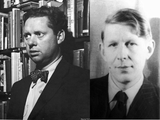
Separated by only seven years, Dylan Thomas and W.H. Auden had what might be called a friendly rivalry—at least, that is, from Thomas’ point of view. The hard-drinking Welsh poet once wished Auden a happy seventieth birthday—on his thirtieth. It’s a typical comment, writes biographer Walford Davies, expressed "with the attractive brio of a younger brother." Thomas wrote of his admiration for "the mature, religious, and logical fighter," but deprecated "the boy bushranger" in the older, more reserved Auden. Whether we take these appraisals as gentle ribbing or—as another Thomas biographer Andrew Lycett writes—"disdain," it does not seem that Thomas felt such antipathy for Auden’s poetry. One would think the contrary listening to him read Auden’s "As I Walked Out One Evening," above. Thomas, Lycett tells us, "approved of Auden’s propensity for radical cultural change" but disapproved of the way his "political tub thumping got in the way of his poetry."
Thomas uses his sonorous voice in a theatrical way that well-suits Auden’s stately verse. That voice became a regular feature for several years on the BBC for whom Thomas recorded broadcast after broadcast of readings and radio plays in the late 1940s. As we’ve detailed in a previous post, he made many recordings of his own work as well, including of his most well known poem, "Do Not Go Gentle into that Good Night," which he reads in somber, measured tones. Above, in a reading of Auden’s "September 1, 1939," Thomas takes a strained, almost affected, tone, perhaps evincing some aversion to the "political tub-thumping" in Auden’s poem. His breathing is labored, and he was, in all likelihood, drunk. He usually was, and he did suffer from a breathing condition. Thomas sadly drank himself to death, while Auden, who didn’t quite see seventy, lived on twenty more years, and recorded his own readings of "As I Went Walking" and "September 1, 1939."
Both the latter Auden poem and the one Thomas reads above, "Song of the Master and Boatswain," begin in bars: the speaker in "September 1" sits "in one of the dives / on Fifty-Second Street." "Song of the Master and the Boatswain" opens "At Dirty Dick’s and Sloppy Joe’s" where "we drank our liquor straight." Aside from these settings neither has anything at all in common. "Master and Boatswain" is almost bawdy, but ends on a cynical note. Written days after the event and dense with philosophical and classical allusions, "September 1" laments Germany’s invasion of Poland, the effective beginning of what would become World War II. Thomas was a more anarchic, less restrained poet, and Auden, the more educated, and disciplined, of the two. But it can certainly be said that they shared a similar sensibility in a taste for the tragic.
You can immerse yourself in Auden and Thomas’ poetry by picking up copies of Collected Poems: Auden and The Collected Poems of Dylan Thomas: The Original Edition.
Related Content:
Dylan Thomas Recites ‘Do Not Go Gentle into That Good Night’ and Other Poems
"September 1, 1939″ by W.H. Auden
Josh Jones is a writer and musician based in Durham, NC. Follow him at @jdmagness
Open Culture
.
Blog
.
<span class='date ' tip=''><i class='icon-time'></i> Aug 26, 2015 02:17pm</span>
|