Blogs
|
There’s something about Wes Anderson films that prompts people to get creative — to start creating their own video essays and supercuts exploring themes in Anderson’s whimsical movies. You can find a list below.
The latest comes from Luís Azevedo, founder of The A to Z Review. "Bibliophilia - Books in the Films of Wes Anderson" (above) tells this story:
In the work of Wes Anderson, books and art in general have a strong connection with memory. The Royal Tenenbaums (2001) begins with a homonymous book, as does Fantastic Mr. Fox (2009). The Grand Budapest Hotel (2014) begins and ends with a book. Moonrise Kingdom (2012) ends with a painting of a place which no longer exists. These movies have a clear message: books preserve stories, for they exist within them and live on through them.
For a detailed explanation of the video, bibliography, filmography and more visit this page.
I would also encourage you to watch the book animation that Anderson himself created for Moonrise Kingdom, which sadly never made it into the film. Find it here.
Related Content:
Watch 7 New Video Essays on Wes Anderson’s Films: Rushmore, The Royal Tenenbaums & More
Wes Anderson & Yasujiro Ozu: New Video Essay Reveals the Unexpected Parallels Between Two Great Filmmakers
The Perfect Symmetry of Wes Anderson’s Movies
A Glimpse Into How Wes Anderson Creatively Remixes/Recycles Scenes in His Different Films
630 Free Audio Books: Download Great Books for Free.
700 Free eBooks for iPad, Kindle & Other Devices
Open Culture
.
Blog
.
<span class='date ' tip=''><i class='icon-time'></i> Aug 26, 2015 02:38pm</span>
|
|
View image | gettyimages.com
It’s easy to write off the Grateful Dead—and I’ll admit I did for years—as aging "hippies stuck in the Summer of Love," as a recent Wired article puts it. But this reputation belies a musical depth due in part, as we pointed out yesterday, to the band’s lyrical sophistication. But it isn’t only their lyricism, or their self-sustaining subculture, that has consistently won them generations of devoted followers born long after Jerry Garcia and company got their start at Ken Kesey’s Acid Test parties. "Long before it became necessary (or cool) to do so," writes Wired, "the band embraced a DIY ethos in everything from manufacturing its own gear to publishing its own music distribution system. The Dead’s obsession with technology was almost inseparable from the band’s psychedelic ambition and artistic independence."
Not only has the Dead fostered what is surely the most widespread bootleg industry in existence, but they also "pioneered rock concert broadcasts," starting with a Carousel Ballroom show in 1968. Thanks to the spread of the Grateful Dead gospel through channels both official and unofficial, we have access to quality recordings of Jerry Garcia’s last show with the Grateful Dead twenty years ago, and to their last shows as a band, played just this past week in a two-city, 50th anniversary "Fare Thee Well" series of concerts in Santa Clara and at Chicago’s Soldier’s Field. The final shows are now largely available online thanks to the efforts of an enterprising "taper," as the diligent amateur recording engineers who capture each Dead show are called.
At the top, hear "The Golden Road (To Unlimited Devotion)"—the first song on the band’s 1967 debut album—taped at the July 4th farewell gig. (Head over to NYCtaper’s site to hear/download the complete show.) And above, hear "Passenger" from the previous night. (Get the complete 7/3/2015 show here). The final July 5th show is sure to come online soon.
Opinions on these final gigs have varied widely, but no matter how uneven some of the performances, as always—scattered amidst the ramshackle jams—the Dead conjure trance states of interlocking rhythms and harmonies that make all the listening worthwhile. We may never get the chance to see them sprawl out live on stage again, but thanks to the stalwart taper community, nearly every moment of the Dead’s 50 year career in rock and roll—from the confusingly noodly to the truly sublime—has been preserved for the ages. Thousands of concerts can be found at The Internet Archive, one of the best sanctioned Grateful Dead bootleg archives on the web. Don’t miss it.
Related Content:
Every Grateful Dead Song Annotated in Hypertext: Web Project Reveals the Deep Literary Foundations of the Dead’s Lyrics
The Grateful Dead’s "Ripple" Played by Musicians Around the World
10,173 Free Grateful Dead Concert Recordings in the Internet Archive
The Grateful Dead’s "Ultimate Bootleg" Now Online & Added to the Library of Congress’ National Recording Registry
The Acid Test Reels: Ken Kesey & The Grateful Dead’s Soundtrack for the 1960s Famous LSD Parties
Josh Jones is a writer and musician based in Durham, NC. Follow him at @jdmagness
The Grateful Dead’s Final Farewell Concerts Now Streaming Online is a post from: Open Culture. Follow us on Facebook, Twitter, and Google Plus, or get our Daily Email. And don't miss our big collections of Free Online Courses, Free Online Movies, Free eBooks, Free Audio Books, Free Foreign Language Lessons, and MOOCs.
http://www.openculture.com/2015/07/the-grateful-deads-final-farewell-concerts-now-streaming-online.html is a post from: Open Culture. Follow us on Facebook, Twitter, and Google Plus, or get our Daily Email. And don't miss our big collections of Free Online Courses, Free Online Movies, Free eBooks, Free Audio Books, Free Foreign Language Lessons, and MOOCs.
The post The Grateful Dead’s Final Farewell Concerts Now Streaming Online appeared first on Open Culture.
Open Culture
.
Blog
.
<span class='date ' tip=''><i class='icon-time'></i> Aug 26, 2015 02:38pm</span>
|
|
Blade Runner, unlike most science-fiction movies of the 1980s, improves with age — in fact, it seems to hold up more robustly with each passing year. Ridley Scott’s adaptation of Philip K. Dick’s Do Androids Dream of Electric Sheep? endures for many reasons, none of them quite so strong as the richness of its setting, a vision of 2019 Los Angeles replete with fire-belching smokestacks, towering corporate obelisks, 30-story geishas glowingly endorsing products on the sides of buildings, and crumbling "old" architecture retrofitted to inhabit this simultaneously glossy and ramshackle reality.
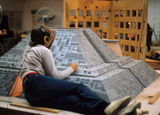
The film’s production design pays close attention to those big things, but also to the small ones: the sidewalk noodle bar where we meet replicant-hunting detective Rick Deckard; the glowing handles of the umbrellas held by the countless passersby streaming past; the detailing of the firearm with which he cuts down his android prey one by one. And often, the big things are small things; at the top of the post, for instance, we see the hulking headquarters of the replicant-building Tyrell Corporation — and, for scale, a member of the design team working on it.
Blade Runner, you see, represents perhaps the high water mark of the now seemingly lost art of miniature-based practical visual effects. Most everything in its slickly futuristic yet worn and often makeshift Los Angeles actually existed in reality, because, in that time before realistic CGI, everything had to take the form of a model (or, farther in the background, a matte painting) to get into the shot at all. You can take an extensive behind-the-scenes look at the blood, sweat, and tears involved in building all this in a gallery showcasing 142 photos taken in the Blade Runner model shop.
"Take a look at the dystopian miniatures, each tiny car hand painted with future dirt from riding clouds stuffed with future smog," writes io9’s Meredith Woerner. Partisans of these sorts of techniques argue that miniatures remain superior to digital constructions because of their perceptible physicality, and perhaps that very quality has helped keep the look and feel of Blade Runner relatively timeless. Plus, unlike CGI, it gives die-hard fans something to hope for. If you dream about owning a piece of the film for your very own, you theoretically can; just make sure to do your homework first by reading the threads at propsummit.com, a forum about — and only about — Blade Runner props.
Enter the photo gallery here.
via io9
Related Content:
The Art of Making Blade Runner: See the Original Sketchbook, Storyboards, On-Set Polaroids & More
The Blade Runner Promotional Film
The Blade Runner Sketchbook: The Original Art of Syd Mead and Ridley Scott Online
The City in Cinema Mini-Documentaries Reveal the Los Angeles of Blade Runner, Her, Drive, Repo Man, and More
Colin Marshall writes on cities, language, Asia, and men’s style. He’s at work on a book about Los Angeles, A Los Angeles Primer, and the video series The City in Cinema. Follow him on Twitter at @colinmarshall or on Facebook.
Open Culture
.
Blog
.
<span class='date ' tip=''><i class='icon-time'></i> Aug 26, 2015 02:37pm</span>
|
|
In 1964, Stanley Kubrick was riding high from the success of his Cold War black comedy Dr. Strangelove. For his next film, Kubrick wanted to make something different. He wanted to make a science fiction epic at a time when sci-fi was a byword for cheap and cheesy. And so, the director reached out to writer Arthur C. Clarke, after reading his short story "The Sentinel." In a letter dated March 31, 1964, Kubrick wrote:
I had been a great admirer of your books for quite a time and had always wanted to discuss with you the possibility of doing the proverbial "really good" science-fiction movie.
My main interest lies along these broad areas, naturally assuming great plot and character:
1. The reasons for believing in the existence of intelligent extra-terrestrial life.
2. The impact (and perhaps even lack of impact in some quarters) such discovery would have on Earth in the near future.
3. A space probe with a landing and exploration of the Moon and Mars.
The two soon met at Trader Vic’s in New York and started hashing out a story that became 2001: A Space Odyssey. Over the course of the next four years, Kubrick and Clarke talked and corresponded frequently. The original plan was for both to develop the novel first and then adapt the resulting work into a screenplay. In practice, the script developed in parallel to the book. Kubrick demanded rewrite after rewrite from an increasingly impatient Clarke as the movie went into production. The book ultimately came out a couple months after the movie’s April 1968 premiere. Ever the master manipulator, Kubrick, in all likelihood, did this on purpose so that Clarke’s efforts wouldn’t overshadow the film.
The folks over at Cinefix put together a video on the differences between the book and the movie. If you can get past the bro-tastic voice-over, the piece offers a pretty thorough accounting. You can watch part one and part two above.
One of the biggest differences is that in the book, HAL, Dave Bowman and company are off to Saturn. But Kubrick’s special effects guru Douglas Trumbull couldn’t get the ringed planet to look right, so the director simply changed the mission’s destination.
Most of the other differences boil down to a difference in the medium. Clarke explains everything in the story in great detail - from the man-apes’ evolution to the real reason HAL9000 went on his killing spree. Kubrick, in contrast, explained almost nothing.
In a 1970 interview, Kubrick talked more about the difference between the two works.
It’s a totally different kind of experience, of course, and there are a number of differences between the book and the movie. The novel, for example, attempts to explain things much more explicitly than the film does, which is inevitable in a verbal medium. […]
[The movie], on the other hand, is basically a visual, nonverbal experience. It avoids intellectual verbalization and reaches the viewer’s subconscious in a way that is essentially poetic and philosophic. The film thus becomes a subjective experience, which hits the viewer at an inner level of consciousness, just as music does, or painting.
Actually, film operates on a level much closer to music and to painting than to the printed word, and, of course, movies present the opportunity to convey complex concepts and abstractions without the traditional reliance on words. I think that 2001, like music, succeeds in short-circuiting the rigid surface cultural blocks that shackle our consciousness to narrowly limited areas of experience and is able to cut directly through to areas of emotional comprehension.
So you are someone who finds the movie to be frustratingly oblique, the book will give you answers. But it probably won’t blow your mind.
Related Content:
Signature Shots from the Films of Stanley Kubrick: One-Point Perspective
The Shining and Other Complex Stanley Kubrick Films Recut as Simple Hollywood Movies
Lost Kubrick: A Short Documentary on Stanley Kubrick’s Unfinished Films
Napoleon: The Greatest Movie Stanley Kubrick Never Made
Explore the Massive Stanley Kubrick Exhibit at the Los Angeles County Museum of Art
Jonathan Crow is a Los Angeles-based writer and filmmaker whose work has appeared in Yahoo!, The Hollywood Reporter, and other publications. You can follow him at @jonccrow. And check out his blog Veeptopus, featuring lots of pictures of vice presidents with octopuses on their heads. The Veeptopus store is here.
What’s the Difference Between Stanley Kubrick’s & Arthur C. Clarke’s 2001: A Space Odyssey (A Side-by-Side Comparison) is a post from: Open Culture. Follow us on Facebook, Twitter, and Google Plus, or get our Daily Email. And don't miss our big collections of Free Online Courses, Free Online Movies, Free eBooks, Free Audio Books, Free Foreign Language Lessons, and MOOCs.
http://www.openculture.com/2015/07/difference-between-stanley-kubricks-arthur-c-clarkes-2001-a-space-odyssey.html is a post from: Open Culture. Follow us on Facebook, Twitter, and Google Plus, or get our Daily Email. And don't miss our big collections of Free Online Courses, Free Online Movies, Free eBooks, Free Audio Books, Free Foreign Language Lessons, and MOOCs.
The post What’s the Difference Between Stanley Kubrick’s & Arthur C. Clarke’s 2001: A Space Odyssey (A Side-by-Side Comparison) appeared first on Open Culture.
Open Culture
.
Blog
.
<span class='date ' tip=''><i class='icon-time'></i> Aug 26, 2015 02:37pm</span>
|
|
So simple and yet so complex. The bicycle remains the world’s most popular form of transportation, found in households worldwide, in countries rich and poor. And yet the bike remains something of a mystery to us. How the bike can ride almost on its own is something physicists still ponder and write academic papers about. It’s also the subject of this new episode from the popular YouTube series Minute Physics. The video explains in a few succinct minutes what we know and still don’t know about this fixture in our everyday lives. All stuff to think about on your next ride….
via NPR
Related Content:
Physics: Free Online Courses
The Feynman Lectures on Physics, The Most Popular Physics Book Ever Written, Now Completely Online
Physics from Hell: How Dante’s Inferno Inspired Galileo’s Physics
The Art & Science of Bike Design: A 5-Part Introduction from the Open University
The Mysterious Physics Behind How Bikes Ride by Themselves is a post from: Open Culture. Follow us on Facebook, Twitter, and Google Plus, or get our Daily Email. And don't miss our big collections of Free Online Courses, Free Online Movies, Free eBooks, Free Audio Books, Free Foreign Language Lessons, and MOOCs.
http://www.openculture.com/2015/07/the-physics-behind-how-bikes-ride-by-themselves.html is a post from: Open Culture. Follow us on Facebook, Twitter, and Google Plus, or get our Daily Email. And don't miss our big collections of Free Online Courses, Free Online Movies, Free eBooks, Free Audio Books, Free Foreign Language Lessons, and MOOCs.
The post The Mysterious Physics Behind How Bikes Ride by Themselves appeared first on Open Culture.
Open Culture
.
Blog
.
<span class='date ' tip=''><i class='icon-time'></i> Aug 26, 2015 02:36pm</span>
|
|
Last week, The Guardian reported:
Google has made its "inceptionism" algorithm available to all, allowing coders around the world to replicate the process the company used to create mesmerising dreamscapes with its image processing neural-network.
The system, which works by repeatedly feeding an image through an AI which enhances features it recognises, was first demonstrated by Google two weeks ago. It can alter an existing image to the extent that it looks like an acid trip, or begin with random noise to generate an entirely original dreamscape.
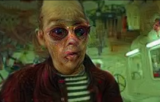
Since then a coder, Roelof Pieters, began messing around with the publicly-available software, and decided to take the "Great San Francisco Acid Wave" scene from Terry Gilliam’s Fear and Loathing in Las Vegas (1998) and run it through "Deep Dream," as the software is known. The results (below), now going viral across the internet, are pretty trippy and intense. Just when you thought Hunter S. Thompson couldn’t get more "out there," this comes along.
We noticed that Pieters ran a similar experiment with pieces of Kubrick’s 2001: A Space Odyssey, and we couldn’t help but put them on display. Watch above.
via Gizmodo
Dan Colman is the founder/editor of Open Culture. Follow us on Facebook, Twitter, Google Plus and LinkedIn and share intelligent media with your friends. Or better yet, sign up for our daily email and get a daily dose of Open Culture in your inbox.
Related Content:
Free Online: Hunter S. Thompson’s Fear and Loathing in Las Vegas
Read 18 Lost Stories From Hunter S. Thompson’s Forgotten Stint As a Foreign Correspondent
Read 10 Free Articles by Hunter S. Thompson That Span His Gonzo Journalist Career (1965-2005)
Watch Fear & Loathing in Las Vegas and 2001: A Space Odyssey Get Run Through Google’s Trippy Deep Dream Software is a post from: Open Culture. Follow us on Facebook, Twitter, and Google Plus, or get our Daily Email. And don't miss our big collections of Free Online Courses, Free Online Movies, Free eBooks, Free Audio Books, Free Foreign Language Lessons, and MOOCs.
http://www.openculture.com/2015/07/watch-terry-gilliams-fear-loathing-and-kubricks-2001-a-space-odyssey-run-through-googles-trippy-deep-dream-software.html is a post from: Open Culture. Follow us on Facebook, Twitter, and Google Plus, or get our Daily Email. And don't miss our big collections of Free Online Courses, Free Online Movies, Free eBooks, Free Audio Books, Free Foreign Language Lessons, and MOOCs.
The post Watch Fear & Loathing in Las Vegas and 2001: A Space Odyssey Get Run Through Google’s Trippy Deep Dream Software appeared first on Open Culture.
Open Culture
.
Blog
.
<span class='date ' tip=''><i class='icon-time'></i> Aug 26, 2015 02:36pm</span>
|
|
Image by The Wellcome Trust
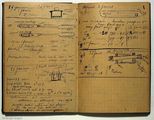
When researching a famous historical figure, access to their work and materials usually proves to be one of the biggest obstacles. But things are much more difficult for those writing about the life of Marie Curie, the scientist who, along her with husband Pierre, discovered polonium and radium and birthed the idea of particle physics. Her notebooks, her clothing, her furniture, pretty much everything surviving from her Parisian suburban house, is radioactive, and will be for 1,500 years or more.
If you want to look at her manuscripts, you have to sign a liability waiver at France’s Bibliotheque Nationale, and then you can access the notes that are sealed in a lead-lined box. The Curies didn’t know about the dangers of radioactive materials, though they did know about radioactivity. Their research attempted to find out which substances were radioactive and why, and so many dangerous elements-thorium, uranium, plutonium-were just sitting there in their home laboratory, glowing at night, which Curie thought beautiful, "like faint, fairy lights," she wrote in her autobiography. Marie Curie carried these glowing objects around in her pockets. She and her husband wore standard lab clothing, nothing more.
Marie Curie died at age 66 in 1934, from aplastic anemia, attributed to her radioactive research. The house, however, continued to be used up until 1978 by the Institute of Nuclear Physics of the Paris Faculty of Science and the Curie Foundation. After that it was kept under surveillance, authorities finally aware of the dangers inside. When many people in the neighborhood noticed high cancer rates among them, as reported in Le Parisien, they blamed the Curie’s home.
The laboratory and the building were decontaminated in 1991, a year after the Curie estate began allowing access to Curie’s notes and materials, which had been removed from the house. A flood of biographies appeared soon after: Marie Curie: A Life by Susan Quinn in 1995, Pierre Curie by Anna Hurwic in 1998, Curie: Le rêve scientifique by Loïc Barbo in 1999, Marie Curie et son laboratoire by Soraya Boudia in 2001, and Obsessive Genius: The Inner World of Marie Curie by Barbara Goldsmith in 2005, and Radioactive: Marie and Pierre Curie, a Tale of Love and Fallout by Lauren Redniss in 2011.
Still, passing away at 66 is not too shabby when one has changed the world in the name of science. Marie Curie was the first woman to win a Nobel Prize (1903), the only woman to win it again (1911), the first woman to become a professor at the University of Paris, and the first woman to be entombed (on her own merits) at the Panthéon in Paris. And she managed many of her breakthroughs after the passing of her husband Pierre in 1906, who slipped and fell in the rain on a busy Paris street and was run over by the wheels of a horse-drawn cart.
via Christian Science Monitor/Gizmodo
Related Content:
New Archive Puts 1000s of Einstein’s Papers Online, Including This Great Letter to Marie Curie
A Haunting Drone’s-Eye View of Chernobyl
Free Online Chemistry Course
Ted Mills is a freelance writer on the arts who currently hosts the FunkZone Podcast. You can also follow him on Twitter at @tedmills, read his other arts writing at tedmills.com and/or watch his films here.
Open Culture
.
Blog
.
<span class='date ' tip=''><i class='icon-time'></i> Aug 26, 2015 02:34pm</span>
|
|
The auteur responsible for The Disorderly Orderlies might not be the obvious choice to make a movie about the Holocaust but that’s apparently what happened. For the handful of people who have seen Jerry Lewis’s The Day the Clown Cried — his unreleased 1972 film about a washed-up clown named Helmut Doork who amuses a boxcar of Jewish children all the way to an Auschwitz gas chamber — say that the movie is far, far worse than you might imagine.
"This film was really awe-inspiring, in that you are rarely in the presence of a perfect object," said Harry Shearer in a 1992 Spy Magazine article about the movie. "This was a perfect object. This movie is so drastically wrong, its pathos and its comedy are so wildly misplaced, that you could not, in your fantasy of what it might be like, improve on what it really is. "Oh My God!" — that’s all you can say." (Below you can hear Shearer tell Howard Stern more about the film.)
There is reportedly only one copy of the movie and that print is under lock and key. Lewis is adamant that the movie is never going to be seen by the public while he still has a say in the matter. "It was all bad and it was bad because I lost the magic," Lewis told an audience at the 2013 Cannes Film Festival. "You will never see it, no-one will ever see it, because I am embarrassed at the poor work."
Its mind-boggling awfulness and its inaccessibility has placed The Day the Clown Cried into that rarified pantheon of legendary lost films like the original cut of Erich von Stroheim’s Greed. Only the film is purposefully kept in obscurity. Every once in a while, a new fragment of the movie will pop up on the internet only to be quickly quashed.
The latest glimpse of this famously wrong-headed production comes in the form of a seven-minute clip of a making-of documentary on the film that aired on Flemish TV. You can watch it above. There’s a longer section here.
The clip opens with Lewis in clown face doing his rubber-faced slapstick shtick. It’s not especially funny out of context. In context one can only imagine that the routine would be about as hilarious as a whoopie cushion during the My Lai massacre.
Later, the documentary shows Lewis behind the camera and he seems every bit the auteur. The voice over notes that Lewis is working "as a clown, actor, director, conductor and producer." Lewis is even seen telling his French sound engineer how to use his Nagra tape recorder.
But perhaps the most surprising moment in the clip is when that 1960s power couple Jane Birkin and Serge Gainsbourg are seen hanging around the set. There really does seem to be something with the French and Jerry Lewis.
Related Content:
Auschwitz Captured in Haunting Drone Footage (and a New Short Film by Steven Spielberg & Meryl Streep)
Memory of the Camps (1985): The Holocaust Documentary that Traumatized Alfred Hitchcock, and Remained Unseen for 40 Years
Anne Frank: The Only Existing Video Now Online
Jonathan Crow is a Los Angeles-based writer and filmmaker whose work has appeared in Yahoo!, The Hollywood Reporter, and other publications. You can follow him at @jonccrow. And check out his blog Veeptopus, featuring lots of pictures of vice presidents with octopuses on their heads. The Veeptopus store is here.
Behind-the-Scenes Footage of Jerry Lewis’ Ill-Conceived Holocaust Movie The Day The Clown Cried is a post from: Open Culture. Follow us on Facebook, Twitter, and Google Plus, or get our Daily Email. And don't miss our big collections of Free Online Courses, Free Online Movies, Free eBooks, Free Audio Books, Free Foreign Language Lessons, and MOOCs.
http://www.openculture.com/2015/07/behind-the-scenes-footage-of-jerry-lewis-ill-conceived-holocaust-movie-the-day-the-clown-cried.html is a post from: Open Culture. Follow us on Facebook, Twitter, and Google Plus, or get our Daily Email. And don't miss our big collections of Free Online Courses, Free Online Movies, Free eBooks, Free Audio Books, Free Foreign Language Lessons, and MOOCs.
The post Behind-the-Scenes Footage of Jerry Lewis’ Ill-Conceived Holocaust Movie The Day The Clown Cried appeared first on Open Culture.
Open Culture
.
Blog
.
<span class='date ' tip=''><i class='icon-time'></i> Aug 26, 2015 02:34pm</span>
|
|
Image via Diego Sevilla Ruiz
A certain Zen proverb goes something like this: "A five year old can understand it, but an 80 year old cannot do it." The subject of this riddle-like saying has been described as "mindfulness"—or being absorbed in the moment, free from routine mental habits. In many Eastern meditative traditions, one can achieve such a state by walking just as well as by sitting still—and many a poet and teacher has preferred the ambulatory method.
This is equally so in the West, where we have an entire school of ancient philosophy—the "peripatetic"—that derives from Aristotle and his contemporaries’ penchant for doing their best work while in leisurely motion. Friedrich Nietzsche, an almost fanatical walker, once wrote, "all truly great thoughts are conceived by walking." Nietzsche’s mountain walks were athletic, but walking—Frédéric Gros maintains in his A Philosophy of Walking—is not a sport; it is "the best way to go more slowly than any other method that has ever been found."
Gros discusses the centrality of walking in the lives of Nietzsche, Rimbaud, Kant, Rousseau, and Thoreau. Likewise, Rebecca Solnit has profiled the essential walks of literary figures such as William Wordsworth, Jane Austen, and Gary Snyder in her book Wanderlust, which argues for the necessity of walking in our own age, when doing so is almost entirely unnecessary most of the time. As great walkers of the past and present have made abundantly clear—anecdotally at least—we observe a significant link between walking and creative thinking.
More generally, writes Ferris Jabr in The New Yorker, "the way we move our bodies further changes the nature of our thoughts, and vice versa." Applying modern research methods to ancient wisdom has allowed psychologists to quantify the ways in which this happens, and to begin to explain the reasons why. Jabr summarizes the experiments of two Stanford walking researchers, Marily Oppezzo and her mentor Daniel Schwartz, who found that almost two hundred students tested showed markedly heightened creative abilities while walking. Walking, Jabr writes in poetic terms, works by "setting the mind adrift on a frothing sea of thought." (Hear Dr. Oppezzo discuss her study in a Minnesota public radio interview above.)
Oppezzo and Schwartz speculate that "future studies would likely determine a complex pathway that extends from the physical act of walking to physiological changes to the cognitive control of imagination." They recognize that this discovery must also account for such variables as when one walks, and—as so many notable walkers have stressed—where. Researchers at the University of Michigan have approached the where question in a paper titled "The Cognitive Benefits of Interacting with Nature" that documents a study in which, writes Jabr, "students who ambled through an arboretum improved their performance on a memory test more than students who walked along city streets."
One wonders what James Joyce—whose Ulysses is built almost entirely on a scaffolding of walks around Dublin—would make of this. Or Walter Benjamin, whose concept of the flâneur, an archetypal urban wanderer, derives directly from the insights of that most imaginative decadent poet, Charles Baudelaire. Classical walkers, Romantic walkers, Modernist walkers—all recognized the creative importance of this simple movement in time and space, one we work so hard to master in our first years, and sometimes lose in later life if we acquire it. Going for a walk, contemporary research confirms—a mundane activity far too easily taken for granted—may be one of the most salutary means of achieving states of enlightenment, literary, philosophical, or otherwise, whether we roam through ancient forests, over the Alps, or to the corner store.
via The New Yorker/Stanford News
Related Content:
Why You Do Your Best Thinking In The Shower: Creativity & the "Incubation Period"
The Psychology of Messiness & Creativity: Research Shows How a Messy Desk and Creative Work Go Hand in Hand
John Cleese’s Philosophy of Creativity: Creating Oases for Childlike Play
Free Online Psychology Courses
Josh Jones is a writer and musician based in Durham, NC. Follow him at @jdmagness
Open Culture
.
Blog
.
<span class='date ' tip=''><i class='icon-time'></i> Aug 26, 2015 02:33pm</span>
|
|
Having known Pico Iyer for quite some time, on paper and in person, as a perpetual example and occasional mentor in the writing of place, it delights me to watch him attract more listeners than ever with the talks he’s given in recent years, the most popular of which advocate something called "stillness." But at first I wondered: did this shift in subject mean that Iyer—a California-grown Brit from an Indian family who mostly lives in Japan ("a global village on two legs," as he once called himself), known for books like Video Night in Kathmandu, Falling off the Map, and The Global Soul—had put his signature hard-traveling ways behind him?
Hardly. But he did start telling the world more about his long-standing habit of routinely seeking out the most quiet, least "connected" places he can—the seaside no-speech-allowed Catholic hermitage, the rural village outside Kyoto—in order to reflect upon the time he has spent circling the globe, transposing himself from culture to alien culture. "24 years ago, I took the most mind-bending trip across North Korea," he tells us, "but the trip lasted a few days. What I’ve done with it sitting still—going back to it in my head, trying to understand it, finding a place for it in my thinking—that’s lasted 24 years already, and will probably last a lifetime."
If we want to follow Pico’s example, we must strike a balance: we must process the time we spend doing something intensely—traveling, writing, programming, lifting weights, what have you—with time spent not doing that something, a pursuit in its own way as intense. He connects all this with the 21st-century technology culture in which we find ourselves, citing the example of folks like Wired co-founder Kevin Kelly and even certain enlightenment-minded Googlers who regularly and rigorously detach themselves from certain kinds of modern devices, going "completely offline in order to gather the sense of direction and proportion they’ll need when they go online again."
Achieving such a proper intellectual, psychological, social, and technological compartmentalization in life may seem like a rare trick to pull off. But if you ever doubt its possibility, just revisit the last talk from Pico we featured, in which he describes his encounter with Leonard Cohen, the only man alive who has successfully combined the lifestyles of rock star and Zen monk.
Related Content:
The Best Writing Advice Pico Iyer Ever Received
Pico Iyer on "The Joy of Less"
How Leonard Cohen’s Stint As a Buddhist Monk Can Help You Live an Enlightened Life
Colin Marshall writes on cities, language, Asia, and men’s style. He’s at work on a book about Los Angeles, A Los Angeles Primer, and the video series The City in Cinema. Follow him on Twitter at @colinmarshall or on Facebook.
Pico Iyer on "the Art of Stillness": How to Enrich Your Busy, Distracted Life by Unplugging and Staying Put is a post from: Open Culture. Follow us on Facebook, Twitter, and Google Plus, or get our Daily Email. And don't miss our big collections of Free Online Courses, Free Online Movies, Free eBooks, Free Audio Books, Free Foreign Language Lessons, and MOOCs.
http://www.openculture.com/2015/07/pico-iyer-on-the-art-of-stillness.html is a post from: Open Culture. Follow us on Facebook, Twitter, and Google Plus, or get our Daily Email. And don't miss our big collections of Free Online Courses, Free Online Movies, Free eBooks, Free Audio Books, Free Foreign Language Lessons, and MOOCs.
The post Pico Iyer on "the Art of Stillness": How to Enrich Your Busy, Distracted Life by Unplugging and Staying Put appeared first on Open Culture.
Open Culture
.
Blog
.
<span class='date ' tip=''><i class='icon-time'></i> Aug 26, 2015 02:33pm</span>
|