Blogs
|
Special Collections, University of Vermont Libraries
No matter how much of a political junkie you are, you must surely have had enough of the spectacle that is the 2016 campaign for the presidency. At current count, we are faced with an astounding 15 candidates for the Republican nomination, one of whom is doing his best to revive the ugliest nativism of the 19th century. On the other side of our binary party system, we have only One. Or so it would seem if you were to pay attention to much of the media coverage, which only rarely mentions the handful of other Democratic contenders and mostly ignores the rising tide of support for Bernie Sanders.
The Senator from Vermont has unabashedly referred to himself, throughout his long political career, as a democratic socialist or, on occasion, simply a "socialist"—a word that strikes fear into the heart of many an American, and resonates widely with another portion of the electorate. Debates over what this means rage on. George Will calls Sanders’ socialism a "charade." Thor Benson in the New Republic accuses him of playing "loose with the terminology." The history and current state of "socialism" is so long and complex that no one definition seems to suit. Its political baggage in American discourse, however, is undeniable.
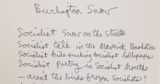
This was just as true in 1986, when Allen Ginsberg wrote a poem in praise of Sanders, then mayor of Burlington, Vermont. Ginsberg playfully draws on the loose associations we have with the word, hammering it home with tongue-in-cheek repetition, then turning reflective.
Socialist snow on the streets
Socialist talk in the Maverick bookstore
Socialist kids sucking socialist lollipops
Socialist poetry in socialist mouths
—aren’t the birds frozen socialists?
Aren’t the snowclouds blocking the airfield
Social Democratic Appearances?
Isn’t the socialist sky owned by
the socialist sun?
Earth itself socialist, forests, rivers, lakes
furry mountains, socialist salt
in oceans?
Isn’t this poem socialist? It doesn’t
belong to me anymore.
Calling it "Burlington Snow," Ginsberg composed the poem—equal parts goofy and sincere—on a visit to the city, one of many pilgrimages made by left-wing writers and artists after Sanders’ string of attempted foreign policy interventions. You can read all about the optimistic socialist—or democratic socialist, or whatever—in Paul Lewis’ Guardian portrait.
via Mother Jones
Related Content:
Allen Ginsberg & The Clash Perform the Punk Poem "Capital Air," Live Onstage in Times Square (1981)
‘The Ballad of the Skeletons': Allen Ginsberg’s 1996 Collaboration with Philip Glass and Paul McCartney
The First Recording of Allen Ginsberg Reading "Howl" (1956)
Josh Jones is a writer and musician based in Durham, NC. Follow him at @jdmagness
Allen Ginsberg’s Handwritten Poem For Bernie Sanders, "Burlington Snow" (1986) is a post from: Open Culture. Follow us on Facebook, Twitter, and Google Plus, or get our Daily Email. And don't miss our big collections of Free Online Courses, Free Online Movies, Free eBooks, Free Audio Books, Free Foreign Language Lessons, and MOOCs.
http://www.openculture.com/2015/07/allen-ginsbergs-handwritten-poem-for-bernie-sanders-burlington-snow-1986.html is a post from: Open Culture. Follow us on Facebook, Twitter, and Google Plus, or get our Daily Email. And don't miss our big collections of Free Online Courses, Free Online Movies, Free eBooks, Free Audio Books, Free Foreign Language Lessons, and MOOCs.
The post Allen Ginsberg’s Handwritten Poem For Bernie Sanders, "Burlington Snow" (1986) appeared first on Open Culture.
Open Culture
.
Blog
.
<span class='date ' tip=''><i class='icon-time'></i> Aug 26, 2015 02:16pm</span>
|
|
Stewart Brand came onto the cultural scene during the 1960s, helping to stage the Acid Tests made famous by Ken Kesey and the Merry Pranksters, and later launching the influential Whole Earth Catalog (something Steve Jobs described as "Google in paperback form, 35 years before Google came along"). He also vigorously campaigned in 1966 to have NASA release a photograph showing the entirety of Earth from space — something we take for granted now, but fired humanity’s imagination back then.
During the 1970s and beyond, Brand founded CoEvolution Quarterly, a successor to the Whole Earth Catalog; The WELL ("Whole Earth ‘Lectronic Link"), "a prototypical, wide-ranging online community for intelligent, informed participants the world over;" and eventually The Long Now Foundation, whose work we’ve highlighted here before. When not creating new institutions, he has poured his creative energies into books and films.
Above you can watch How Buildings Learn, Brand’s six-part BBC TV series from 1997, which comes complete with music by Brian Eno. Based on his illustrated book sharing the same title, the TV series offers a critique of modernist approaches to architecture (think Buckminster Fuller, Frank Gehry, and Le Corbusier) and instead argues for "an organic kind of building, based on four walls, which is easy to change and expand and grow as the ideal form of building."
Brand made the series available on his Youtube channel, with these words: "Anybody is welcome to use anything from this series in any way they like… Hack away. Do credit the BBC, who put considerable time and talent into the project." And he added the noteworthy footnote: "this was one of the first television productions made entirely in digital— shot digital, edited digital."
Find the first three parts above, and the remaining parts below:
Part 1: Flow
Part 2: The Low Road
Part 3: Built for Change
Part 4: Unreal Estate
Part 5: The Romance of Maintenance
Part 6: Shearing Layers
You can find How Buildings Learn added to our list of Free Documentaries, a subset of our collection, 700 Free Movies Online: Great Classics, Indies, Noir, Westerns, etc..
Related Content:
The History of Western Architecture: From Ancient Greece to Rococo (A Free Online Course)
The Acid Test Reels: Ken Kesey & The Grateful Dead’s Soundtrack for the 1960s Famous LSD Parties
Ken Kesey’s First LSD Trip Animated
Watch Stewart Brand’s 6-Part Series How Buildings Learn, With Music by Brian Eno is a post from: Open Culture. Follow us on Facebook, Twitter, and Google Plus, or get our Daily Email. And don't miss our big collections of Free Online Courses, Free Online Movies, Free eBooks, Free Audio Books, Free Foreign Language Lessons, and MOOCs.
http://www.openculture.com/2015/07/watch-stewart-brands-6-part-series-how-buildings-learn-with-music-by-brian-eno.html is a post from: Open Culture. Follow us on Facebook, Twitter, and Google Plus, or get our Daily Email. And don't miss our big collections of Free Online Courses, Free Online Movies, Free eBooks, Free Audio Books, Free Foreign Language Lessons, and MOOCs.
The post Watch Stewart Brand’s 6-Part Series How Buildings Learn, With Music by Brian Eno appeared first on Open Culture.
Open Culture
.
Blog
.
<span class='date ' tip=''><i class='icon-time'></i> Aug 26, 2015 02:16pm</span>
|
|
If you think of the most respected science communicators today, the name Neil deGrasse Tyson — probably the only man alive, after all, who could successfully make a new Cosmos — has to come to mind. His skillset as an astrophysicist, cosmologist, and planetarium director with a high public profile lends itself particularly well to this 21st-century media landscape where the curious not only possess but demand the ability to pull up audiovisual materials clearly explaining things to them, whenever they want to know about them, and where they can take full length massive open online courses (MOOCs).
You’ve definitely heard of Tyson, and you’ve almost as surely heard of The Great Courses, the company that has produced a wide variety of college-level classes and sold them on video since the early 1990s - getting into the business of MOOCs, in some sense, before MOOCs existed. But they’ve kept up with the times, so if you want to learn from their Great Courses, you no longer have to buy a boxful of VHS tapes; you can just download their videos on demand. They have a reputation for premium quality that sometimes comes at a premium price: for instance, The Inexplicable Universe: Unsolved Mysteries, hosted by none other than Neil deGrasse Tyson, goes for $94.95.
But wait! For now, The Great Courses will let you access Tyson’s Great Course for free, including all of its downloadable audio and video lectures, as long as you make an account at their site — a process which, we can report, entails only a reasonable hassle factor. (Make sure to check your spam folder for the confirmation e-mail they send, in case it ends up there.) If the zero price point hasn’t quite convinced you, have a look at the sample clip at the top of the post featuring a short discussion of the much-discussed incompatibility between quantum physics and general relativity, which you’ll have to know about if you want to understand this universe of ours. Much about it may remain inexplicable, sure, but if anyone can explicate the inexplicable, Neil deGrasse Tyson can.
Note: you can find Great Courses that are currently on sale here. Some are up to 70% off. And just to let you know, we have a relationship with the Great Courses. So if you make any purchases, it helps keep Open Culture going strong.
Related Content:
Neil deGrasse Tyson Lists 8 (Free) Books Every Intelligent Person Should Read
Free Online Physics Courses
Neil deGrasse Tyson Ponders the Big Question "Does the Universe Have a Purpose" in a Simple Animation
The Origins Project Brings Together Neil DeGrasse Tyson, Richard Dawkins, Lawrence Krauss, Bill Nye, Ira Flatow, and More on One Stage
Neil deGrasse Tyson Delivers the Greatest Science Sermon Ever
Free Online Astronomy Courses
Colin Marshall writes on cities, language, Asia, and men’s style. He’s at work on a book about Los Angeles, A Los Angeles Primer, and the video series The City in Cinema. Follow him on Twitter at @colinmarshall or on Facebook.
Free: Download Neil deGrasse Tyson’s Short Course, The Inexplicable Universe, in Audio or Video Format is a post from: Open Culture. Follow us on Facebook, Twitter, and Google Plus, or get our Daily Email. And don't miss our big collections of Free Online Courses, Free Online Movies, Free eBooks, Free Audio Books, Free Foreign Language Lessons, and MOOCs.
http://www.openculture.com/2015/07/free-download-neil-degrasse-tysons-6-lecture-course-the-inexplicable-universe.html is a post from: Open Culture. Follow us on Facebook, Twitter, and Google Plus, or get our Daily Email. And don't miss our big collections of Free Online Courses, Free Online Movies, Free eBooks, Free Audio Books, Free Foreign Language Lessons, and MOOCs.
The post Free: Download Neil deGrasse Tyson’s Short Course, The Inexplicable Universe, in Audio or Video Format appeared first on Open Culture.
Open Culture
.
Blog
.
<span class='date ' tip=''><i class='icon-time'></i> Aug 26, 2015 02:15pm</span>
|
|
Heavy Metal owes many debts, though it doesn’t always acknowledge them—debts to classical music, through guitarists like Yngwie Malmsteen, to the blues, through Led Zeppelin and Deep Purple, and to jazz, through a host of players, including Black Sabbath’s guitarist Tony Iommi. But while other players have picked up techniques from the jazz idiom like blast beats and sweep picking, Iommi found something else: the motivation to relearn to play the guitar after losing three of the fingertips on his right hand in an industrial accident, on his last day on the job, right before he was to embark on a European tour. He was only 17 years old. Iommi narrates the story himself above in "Fingers Bloody Fingers," a powerful animated short by illustrator Paul Blow and animator Kee Koo.
After the gruesome accident, Iommi, "extremely depressed," tragically resigned himself to never play the guitar again — that is, until his factory manager visited him in the hospital and told him the story of Django Reinhardt, the Belgian-Romani swing guitarist who lost two fingers in a terrible fire at age 18, himself just on the verge of stardom and highly sought after by the greatest bandleaders of the day. In the clip above from the French documentary Trois doigts de genie (Three Fingers of Genius), learn how Reinhardt overcame his disability to become one of the most famous guitarists of his day, and see why Iommi was so inspired by his story. "A lesser musician would have given up," wrote Mike Springer in a previous post, "but Reinhardt overcame the limitation by inventing his own method of playing." Iommi, of course, did the same, also along the way introducing a lighter gauge of string, which millions of rock guitarists now use.
Reinhardt toured and recorded with his own ensembles and with Duke Ellington and others. Unfortunately precious little footage of him exists, but you can see him above with violinist Stephane Grappelli in their Quintette du Hot Club and in a few other short clips in this post. Once you hear Django’s story of overcoming adversity, and once you hear him play, you’ll understand why he inspired Iommi to push through his own pain and limitations to become one of the most influential guitarists of his generation.
Related Content:
Django Reinhardt and the Inspiring Story Behind His Guitar Technique
Django Reinhardt Demonstrates His Guitar Genius in Rare Footage From the 1930s, 40s & 50s
Heavy Metal: BBC Film Explores the Music, Personalities & Great Clothing That Hit the Stage in the 1980s
Josh Jones is a writer and musician based in Durham, NC. Follow him at @jdmagness.
Open Culture
.
Blog
.
<span class='date ' tip=''><i class='icon-time'></i> Aug 26, 2015 02:14pm</span>
|
|
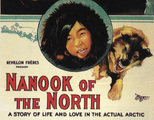
A rudimentary difference between fiction narratives and documentary film is supposed to be that one is created out of the imagination, and the other is a recorded document of real events. Yet if we go right back to the very first feature length documentary, Robert J. Flaherty’s Nanook of the North (Archive.org - YouTube), we see that the line between fact and fiction was just as wobbly then as now.
A popular success when it was released in 1922, Nanook brought its heroic title character to an audience who knew nothing about the Native tribes of the north. The film shows a way of life that was disappearing as Flaherty, originally an explorer and prospector, began to document it. We see the hardy Inuit Nanook hunting with spears, pulling up to a trading station in a kayak and trading with the white owner. We see his wife and kids, the family building an igloo and bedding down for the night. The film emphasizes as much his self-reliance as it does Nanook’s naivety. And it fully cemented the idea of the Eskimo in popular culture. Nanook became a name as synonymous with the Inuit as Pierre is to the French. Frank Zappa even wrote a song suite about Nanook.
Flaherty was not trained in film, and learned what he could quickly about photography when he decided to shoot footage up north while working for the Canadian Pacific Railway. He accidentally destroyed all of his original footage when he dropped a cigarette on the flammable nitrite film and set about raising money for a reshoot. Without precedent, Flaherty rethought his doc into what we now recognize as classic form: Instead of trying to capture the culture, he chose one man as his main character, an entry into an unknown world.
And in those reshoots we find the line between fiction and fact blurred. Nanook’s real name was Allakariallak, and though he was a hunter, he and his tribe had long ditched the spear for the much more effective gun. Flaherty wanted to represent Inuit life before the European influence, and Allakariallak played along, not just hunting with his spear, but pretending at the trade outpost not to recognize a gramophone.
The scenes inside the igloo were staged for good reason: the camera was too big and the lighting needed would have melted the walls. So Allakariallak and the crew built a cutaway igloo where the family could pretend to bed down for the night. (Oh, and the two women we see were actually Flaherty’s common law wives.)
Flaherty’s legacy was in combining ethnography, travelogue, and showing how people live and work, none of which had been done before in film. Flaherty continued to make documentaries into 1950, including Man of Aran (about life on the Irish isle of the same name) and Tabu, a Polynesian island tale directed by F.W. Murnau, best known for Nosferatu. But none had the impact of this film. When the Library of Congress first started listing films in 1989 for preservation, specifying ones that were "culturally, historically, or aesthetically significant," Nanook was in the first selection of 25.
The idea of building a living habitat in order to control the action still happens in nature documentaries, and humans readily playing a version of themselves to tell a certain kind of narrative is the basis of all reality TV. Flaherty bent boring truth to get to a different, "essential" truth. Is it better that we believe that Nanook died out on the ice, a victim of the harsh reality of survival on the ice, or to know that he actually died at home from tuberculosis? The qualities that caused controversy upon Nanook’s release aren’t the opposite of documentary, they *are* documentary.
You can purchase your own copy of Nanook of the North from Criterion here.
It will also be added to our list of Free Documentaries, a subset of our collection, 700 Free Movies Online: Great Classics, Indies, Noir, Westerns, etc..
Related Content:
The 10 Greatest Documentaries of All Time According to 340 Filmmakers and Critics
Watch Luis Buñuel’s Surreal Travel Documentary A Land Without Bread (1933)
Watch Dziga Vertov’s Unsettling Soviet Toys: The First Soviet Animated Movie Ever (1924)
Ted Mills is a freelance writer on the arts who currently hosts the FunkZone Podcast. You can also follow him on Twitter at @tedmills, read his other arts writing at tedmills.com and/or watch his films here.
Watch the Very First Feature Documentary: Nanook of the North by Robert J. Flaherty (1922) is a post from: Open Culture. Follow us on Facebook, Twitter, and Google Plus, or get our Daily Email. And don't miss our big collections of Free Online Courses, Free Online Movies, Free eBooks, Free Audio Books, Free Foreign Language Lessons, and MOOCs.
http://www.openculture.com/2015/07/watch-the-very-first-feature-documentary-nanook-of-the-north-by-robert-j-flaherty-1922.html is a post from: Open Culture. Follow us on Facebook, Twitter, and Google Plus, or get our Daily Email. And don't miss our big collections of Free Online Courses, Free Online Movies, Free eBooks, Free Audio Books, Free Foreign Language Lessons, and MOOCs.
The post Watch the Very First Feature Documentary: Nanook of the North by Robert J. Flaherty (1922) appeared first on Open Culture.
Open Culture
.
Blog
.
<span class='date ' tip=''><i class='icon-time'></i> Aug 26, 2015 02:14pm</span>
|
|
On the off chance that this kind of thing interests you, Boing Boing is making available a free audio download of Tim Ferriss’ book, The 4-Hour Chef. The book pitches itself as follows:
You’ll train inside the kitchen for everything outside the kitchen. Featuring tips and tricks from chess prodigies, world-renowned chefs, pro athletes, master sommeliers, super models, and everyone in between, this "cookbook for people who don’t buy cookbooks" is a guide to mastering cooking and life.
The 4-Hour Chef is a five-stop journey through the art and science of learning:
1. META-LEARNING. Before you learn to cook, you must learn to learn. META charts the path to doubling your learning potential.
2. THE DOMESTIC. DOM is where you learn the building blocks of cooking. These are the ABCs (techniques) that can take you from Dr, Seuss to Shakespeare.
3. THE WILD. Becoming a master student requires self-sufficiency in all things. WILD teaches you to hunt, forage, and survive.
4. THE SCIENTIST. SCI is the mad scientist and modernist painter wrapped into one. This is where you rediscover whimsy and wonder.
5. THE PROFESSIONAL. Swaraj, a term usually associated with Mahatma Gandhi, can be translated as "self-rule." In PRO, we’ll look at how the best in the world become the best in the world, and how you can chart your own path far beyond this book.
You can download it here.
If this isn’t your cup of tea, feel free to dive into our meta collection, 630 Free Audio Books: Download Great Books for Free.
Or explore the Free Trial Programs offered by Audible.com and Audiobooks.com, both of which give you the chance to download an audiobook for free while trying out their programs.
Follow us on Facebook, Twitter, Google Plus and LinkedIn and share intelligent media with your friends. Or better yet, sign up for our daily email and get a daily dose of Open Culture in your inbox.
Download The 4-Hour Chef by Tim Ferriss as a Free Audio Book is a post from: Open Culture. Follow us on Facebook, Twitter, and Google Plus, or get our Daily Email. And don't miss our big collections of Free Online Courses, Free Online Movies, Free eBooks, Free Audio Books, Free Foreign Language Lessons, and MOOCs.
http://www.openculture.com/2015/07/download-the-4-hour-chef-by-tim-ferriss-as-a-free-audio-book.html is a post from: Open Culture. Follow us on Facebook, Twitter, and Google Plus, or get our Daily Email. And don't miss our big collections of Free Online Courses, Free Online Movies, Free eBooks, Free Audio Books, Free Foreign Language Lessons, and MOOCs.
The post Download The 4-Hour Chef by Tim Ferriss as a Free Audio Book appeared first on Open Culture.
Open Culture
.
Blog
.
<span class='date ' tip=''><i class='icon-time'></i> Aug 26, 2015 02:13pm</span>
|
|
Les Paul, known primarily for the iconic guitar that bears his name, also invented most of the recording technology we still use today, including the use of reverb as a studio effect. But of course he didn’t invent reverberation anymore than he invented the guitar; he just turned both of them electric. Reverb has existed as long as there have been soundwaves, obstacles for them to hit, and ears to hear what happens when they do. In every possible space—landscape, cityscape, and architectural formation—the effect announces itself differently, though we’re seldom aware of it unless we’re in grand, cavernous spaces like a cathedral or mountain gorge.
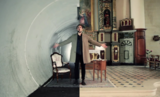
But musicians and audio engineers like Les Paul have always paid special attention to the way sound manifests in space, as have singers like the gent above, who calls himself the Wikisinger, real name Joachim Müllner. With "no artificial reverb added," Müllner demonstrates how much environment contributes to the quality of what we hear with a montage of sound and video clips from several—very aesthetically pleasing—locations. In each place, Müllner sings the same strange song: in a tunnel, an attic, a field before an oil derricks, the nave of a cathedral, and an anechoic chamber—which resembles the interior of an alien spacecraft and produces no reflections whatsoever. Sometimes the effect is subtle, inviting you to lean in and listen more closely; sometimes it’s outsized and operatic.
The filmmaker’s claim to "no artificial reverb" sounds a little slippery after viewing the Wikisinger’s performance since one of the most dramatic clips features his voice, and person, reduplicated several times. And we should keep in mind that no recording technology is perfectly transparent. Microphones and other equipment always add, or subtract, something to the sound. As slick as an advertisement, the short video uses a heavily mediated form to convey the simple idea of natural reverberation. You may, in fact, have seen something just like this not long ago. Before the Wikisinger, there was the Wikidrummer. In another "no reverb added" video above, he snaps, cracks, booms, and crashes through the same beat in garages, open fields, and underpasses. With each abrupt shift in location comes an abrupt shift in the frequency and duration of the sounds, as the full spectrum collides with metal, concrete, asphalt, and open air.
The ways in which sound and space interact can determine the shape of a musical form. This subject has given musician, artist, and theorist of music and art, David Byrne much to think about. As he puts in in a TED talk above, the "nature of the room"—the quality of its reverb—guides the evolution of musical genres and styles. Beginning with the example of CBGBs and like dive bars around the country, he describes how the art punk pioneered by his band the Talking Heads depended on such spaces and "didn’t sound all that great" in places strictly designed for music, like Carnegie Hall. His talk then takes us to some fascinating architectural environments, such as the kinds of rooms Mozart composed and played in. Byrne speaks to the neophytes as well as to the audiophiles among us, and his talk works as a perfect intellectual complement to the sonic and visual adventure on offer in the Wikisinger and -drummer’s videos. Both approaches equally persuade us of the prime significance of that intangible wonder called reverb.
Related Content:
David Byrne: How Architecture Helped Music Evolve
What Ancient Greek Music Sounded Like: Hear a Reconstruction That is ‘100% Accurate’
Listen to the Oldest Song in the World: A Sumerian Hymn Written 3,400 Years Ago
Josh Jones is a writer and musician based in Durham, NC. Follow him at @jdmagness.
The Same Song Sung in 15 Places: A Wonderful Case Study of How Landscape & Architecture Shape the Sounds of Music is a post from: Open Culture. Follow us on Facebook, Twitter, and Google Plus, or get our Daily Email. And don't miss our big collections of Free Online Courses, Free Online Movies, Free eBooks, Free Audio Books, Free Foreign Language Lessons, and MOOCs.
http://www.openculture.com/2015/07/the-same-song-sung-in-15-places.html is a post from: Open Culture. Follow us on Facebook, Twitter, and Google Plus, or get our Daily Email. And don't miss our big collections of Free Online Courses, Free Online Movies, Free eBooks, Free Audio Books, Free Foreign Language Lessons, and MOOCs.
The post The Same Song Sung in 15 Places: A Wonderful Case Study of How Landscape & Architecture Shape the Sounds of Music appeared first on Open Culture.
Open Culture
.
Blog
.
<span class='date ' tip=''><i class='icon-time'></i> Aug 26, 2015 02:12pm</span>
|
|
Fans of Twin Peaks, the early-1990s television series co-created and in large part directed by David Lynch, have had a lot to get excited about recently. Most prominently, we’ve heard a lot of will-he-or-won’t-he talk about whether Lynch will participate in the show’s much-discussed 21st-century reboot. That has no doubt stoked public interest in Twin Peaks (available on Hulu here), which in some sense has never really died away, even though it went off the air 24 years ago (and by all accounts got pretty lackluster in its second season); some of us, while we wait for the new series, have even engaged in all manner of Twin Peaks-themed writing, art, and even music projects.
Many Australian Twin Peaks fans, while they wait for the new series, made it over to Queensland’s Gallery of Modern Art earlier this year for the exhibition David Lynch: Between Two Worlds. If they went on April 18th, they saw experimental post-punk band Xiu Xiu perform their own interpretation of the Twin Peaks score. "The music of Twin Peaks is everything that we aspire to as musicians and is everything that we want to listen to as music fans," says Xiu Xiu leader Jamie Stewart. "It is romantic, it is terrifying, it is beautiful, it is unnervingly sexual. The idea of holding the ‘purity’ of the 1950s up to the cold light of a violent moon and exposing the skull beneath the frozen, worried smile has been a stunning influence on us."
Xiu Xiu, since Stewart formed it in San Jose in 2002, has steadily gained a reputation as, in the words of Vice, "the weirdest band you know." Part of that has to do with the formal adventurousness of their music itself, and part to do with their invariably disturbing music videos. No wonder, then, that they would feel such an affinity with David Lynch, no stranger to getting called "weird" by audiences and the maker of some unsettling music and music videos himself. Given the potential overlap in their followings, and given that nobody seems to know how many production decisions the new Twin Peaks has yet made, perhaps someone can check and see whether Xiu Xiu might have the time to record its score?
via Welcome to Twin Peaks
Related Content:
David Lynch’s Twin Peaks Title Sequence, Recreated in an Adorable Paper Animation
Play the Twin Peaks Video Game: Retro Fun for David Lynch Fans
David Lynch’s Music Videos: Nine Inch Nails, Moby, Chris Isaak & More
David Lynch’s New ‘Crazy Clown Time’ Video: Intense Psychotic Backyard Craziness (NSFW)
David Lynch’s Surreal Commercials
David Lynch Presents the History of Surrealist Film (1987)
Colin Marshall writes on cities, language, Asia, and men’s style. He’s at work on a book about Los Angeles, A Los Angeles Primer, and the video series The City in Cinema. Follow him on Twitter at @colinmarshall or on Facebook.
Experimental Post-Punk Band Xiu Xiu Plays the Music from David Lynch’s Twin Peaks is a post from: Open Culture. Follow us on Facebook, Twitter, and Google Plus, or get our Daily Email. And don't miss our big collections of Free Online Courses, Free Online Movies, Free eBooks, Free Audio Books, Free Foreign Language Lessons, and MOOCs.
http://www.openculture.com/2015/07/experimental-post-punk-band-xiu-xiu-plays-the-music-from-david-lynchs-twin-peaks.html is a post from: Open Culture. Follow us on Facebook, Twitter, and Google Plus, or get our Daily Email. And don't miss our big collections of Free Online Courses, Free Online Movies, Free eBooks, Free Audio Books, Free Foreign Language Lessons, and MOOCs.
The post Experimental Post-Punk Band Xiu Xiu Plays the Music from David Lynch’s Twin Peaks appeared first on Open Culture.
Open Culture
.
Blog
.
<span class='date ' tip=''><i class='icon-time'></i> Aug 26, 2015 02:11pm</span>
|
|
A quick heads up, Wilco just released its ninth studio album, Star Wars. And right now you can download it for free via Wilco’s website. But don’t dilly dally, the free download will only be available for 30 days. On the band’s Instagram account, Jeff Tweedy gave a simple explanation for the unexpected giveaway: "Well, the biggest reason, and I’m not sure we even need any others, is that it felt like it would be fun." Indeed.
Last week: we highlighted a couple more downloads that will be free for a limited time. Find them below.
Follow us on Facebook, Twitter, Google Plus and LinkedIn and share intelligent media with your friends. Or better yet, sign up for our daily email and get a daily dose of Open Culture in your inbox.
Related Content:
Free: Download Neil deGrasse Tyson’s Short Course, The Inexplicable Universe, in Audio or Video Format
Download The 4-Hour Chef by Tim Ferriss as a Free Audio Book
Free: Download Wilco’s Brand New Album, Star Wars, Free for a Limited Time is a post from: Open Culture. Follow us on Facebook, Twitter, and Google Plus, or get our Daily Email. And don't miss our big collections of Free Online Courses, Free Online Movies, Free eBooks, Free Audio Books, Free Foreign Language Lessons, and MOOCs.
http://www.openculture.com/2015/07/free-download-wilcos-brand-new-album-star-wars-free-for-a-limited-time.html is a post from: Open Culture. Follow us on Facebook, Twitter, and Google Plus, or get our Daily Email. And don't miss our big collections of Free Online Courses, Free Online Movies, Free eBooks, Free Audio Books, Free Foreign Language Lessons, and MOOCs.
The post Free: Download Wilco’s Brand New Album, Star Wars, Free for a Limited Time appeared first on Open Culture.
Open Culture
.
Blog
.
<span class='date ' tip=''><i class='icon-time'></i> Aug 26, 2015 02:09pm</span>
|
|
Noted cartoon personality Bugs Bunny has warbled his way through Wagnerian opera, played every defensive position known to baseball, styled a monster’s hair…is there anything that wascally wabbit cannot do?
Yes, in fact. According to his long time director, animator Chuck Jones, Bugs could never pick a fight. Unlike his hair trigger Looney Tunes colleague, Daffy Duck, the bunny had to be provoked before entering the fray. That applies whether he’s a boxer, a gangster, or impersonating the biggest movie stars of his day.
Abiding by the strong rules he established for the characters in the Looney Tunes stable was critical to his comic approach, as Jones explains in the above video essay, a bit of a departure for Tony Zhou’s celebrated cinema series, Every Frame a Picture. Rather than examine the framing and timing of "one of the all-time masters of visual comedy," this time Zhou delves into the evolution of his subject’s artistic sensibilities.
Like all good directors, Jones learned from his actors-in this case, animated, and not all of them his babies. Bugs and Daffy were the brainchildren of the great Tex Avery. Friz Freleng created Yosemite Sam and everyone’s favorite stuttering pig, Porky.
Jones teased out the desires that became the primary engines for those characters’ physicality as well as their behavior. Daffy comes off as an unhinged lunatic in his early appearances. His comic potential grew once Jones reframed him as a conniver who’d do anything in pursuit of wealth and glory.
Once the characters’ motivations were clear, Jones could mess around with the ol’ one-two punch. It’s a classic comic structure, wherein reality wreaks havoc on the audience’s expectations about how things should unfold. Then again, a child can tell you what drives Jones’ creation, the passionate French skunk, Pepé Le Pew, as well as how those amorous ambitions of his are likely to work out. Funny! Dependably so!
Zhou also draws attention to the evolution of the characters’ expressions, from the antic to the economical. John Belushi was not the only comic genius to understand the power of a raised eyebrow.
Related Content:
Chuck Jones’ 9 Rules For Drawing Road Runner Cartoons, or How to Create a Minimalist Masterpiece
How to Draw Bugs Bunny: A Primer by Legendary Animator Chuck Jones
The Strange Day When Bugs Bunny Saved the Life of Mel Blanc
Ayun Halliday is an author, illustrator, and Chief Primatologist of the East Village Inky zine. Follow her @AyunHalliday
Open Culture
.
Blog
.
<span class='date ' tip=''><i class='icon-time'></i> Aug 26, 2015 02:09pm</span>
|