Blogs
|
What happens when the Prince of Darkness covers the King of Pop?
Miles Davis’ decision to record a studio version of Michael Jackson’s 1983 hit, "Human Nature," caused Al Foster, his friend and drummer, to walk out mid-session, thus putting an end to their longtime collaboration. Davis chalked it up to Foster’s unwillingness to "play that funky backbeat," and brought in his nephew, Vince Wilburn, Jr., to finish the job.
Foster must’ve really hated that song.
Say what you will, "Human Nature" is-like most Jackson hits-an ear worm.
Depending on who you talk to, Davis’ studio track, above, is a either a straightforward homage in which his horn recreates "Jackson’s breathy intimacy" or "flat, schmaltzy elevator music."
People’s feelings for it tend to echo their response to Jackson’s original, to which Davis cleaved pretty closely.
"Human Nature" was written by Toto’s keyboardist Steve Porcaro, the son of a jazz musician who idolized Davis. He was understandably honored that his dad’s hero chose to cover his work along with Cyndi Lauper’s "Time after Time," on 1985’s You’re Under Arrest, one of the prolific artist’s final albums.
Davis’ association no doubt contributes to the tune’s ongoing popularity. Those who want to compare and contrast, can take their pick of reggae, hip-hop, electronica and funked up New Orleans brass versions.
But back to "Human Nature" as rendered by Miles Davis. Most critics prefer the live version, below, captured July 7, 1988, at Montreux. Slate’s Fred Kaplan described it as "an upbeat rouser" through which Davis "prances."
As Davis himself explained in a 1985 interview with Richard Cook:
On a song like "Human Nature," you have to play the right thing. And the right thing is around the melody. I learned that stuff from Coleman Hawkins. Coleman could play a melody, get ad-libs, run the chords - and you still heard the melody. I play "Human Nature," varies every night. After I play the melody, that tag on the end is mine to have fun with. It’s in another key … uh, D natural. Move up a step or so to F natural. Then you can play it any way you want to.
Another remark from the same interview proved prescient:
You don’t have to do like Wynton Marsalis and play "Stardust "and that shit… Why can’t "Human Nature" be a standard? It fits. A standard fits like a thoroughbred. The melody and everything is just right, and every time you hear it you want to hear it some more. And you leave enough of it to know what you want to hear again. When you hear it again, the same feeling comes over you.
Related Content:
The Night When Miles Davis Opened for the Grateful Dead in 1970: Hear the Complete Recordings
Miles Davis Opens for Neil Young and "That Sorry-Ass Cat" Steve Miller at The Fillmore East (1970)
Watch Miles Davis Improvise Music for Elevator to the Gallows, Louis Malle’s New Wave Thriller (1958)
Ayun Halliday is an author, illustrator, and Chief Primatologist of the East Village Inky zine. Follow her @AyunHalliday
http://www.openculture.com/2015/07/miles-davis-covers-michael-jacksons-human-nature-1983.html is a post from: Open Culture. Follow us on Facebook, Twitter, and Google Plus, or get our Daily Email. And don't miss our big collections of Free Online Courses, Free Online Movies, Free eBooks, Free Audio Books, Free Foreign Language Lessons, and MOOCs.
%%POST_LINK%% is a post from: Open Culture. Follow us on Facebook, Twitter, and Google Plus, or get our Daily Email. And don't miss our big collections of Free Online Courses, Free Online Movies, Free eBooks, Free Audio Books, Free Foreign Language Lessons, and MOOCs.
Open Culture
.
Blog
.
<span class='date ' tip=''><i class='icon-time'></i> Aug 26, 2015 01:55pm</span>
|
|
"You can’t have Bach, Beethoven, and Mozart as your favorite composers," said conductor and San Francisco Symphony music director Michael Tilson Thomas. "They simply define what music is!" True enough, though it doesn’t seem to have stopped anyone from, when asked to name their classical music of choice, unhesitatingly respond with the names of Bach, Beethoven, or Mozart — and Mozart most often. So why does the man who composed, among other works, the Piano Concerto No. 24 in C minor, the Symphony No. 40 in G minor, and Don Giovanni still command such instinctive allegiance nearly 225 years after his death?
"Mozart did not come from nowhere," writes New Yorker music critic Alex Ross. "He was the product of a society that was avid for music on every level, that believed in the possibility of an all-encompassing musical genius. The society we live in now believes otherwise; we divide music into subcultures and subgenres, we separate classical music from popular music, we locate genius in the past." But as past geniuses go, we’ve picked a good one in Mozart to carry forward with us into our technological age: the kind of age where you can listen to an 18th-century composer’s collected works with the simple click of a mouse.
The simple click of a mouse, that is, onto this Spotify playlist of the complete Chronological Mozart, brought to you by the same folks who put together the playlists we’ve previously featured of 68 hours of Shakespeare and the classical music in Stanley Kubrick’s films. (If you don’t yet have the free software needed to listen, download it here.) A few tracks have vanished since the playlist’s creation (such are the vicissitudes of Spotify) but it still offers about 127 hours of the (mostly) complete works of Wolfgang Amadeus Mozart, the aforementioned famous pieces and well beyond. Listen and you’ll not only understand why Mozart defines what music is, but — apologies to Michael Tilson Thomas — why you, too, should number him among your favorites.
Related Content:
Leck Mich Im Arsch ("Kiss My Ass"): Listen to Mozart’s Scatological Canon in B Flat (1782)
German String Quartet Performs Vivaldi & Mozart in Delightfully Comical & Acrobatic Routine
Newly Discovered Piece by Mozart Performed on His Own Fortepiano
Read an 18th-Century Eyewitness Account of 8-Year-Old Mozart’s Extraordinary Musical Skills
The Recycled Orchestra: Paraguayan Youth Play Mozart with Instruments Cleverly Made Out of Trash
The Classical Music in Stanley Kubrick’s Films: Listen to a Free, 4 Hour Playlist
Colin Marshall writes on cities, language, Asia, and men’s style. He’s at work on a book about Los Angeles, A Los Angeles Primer, and the video series The City in Cinema. Follow him on Twitter at @colinmarshall or on Facebook.
http://www.openculture.com/2015/07/hear-all-of-mozart-in-a-free-127-hour-playlist.html is a post from: Open Culture. Follow us on Facebook, Twitter, and Google Plus, or get our Daily Email. And don't miss our big collections of Free Online Courses, Free Online Movies, Free eBooks, Free Audio Books, Free Foreign Language Lessons, and MOOCs.
%%POST_LINK%% is a post from: Open Culture. Follow us on Facebook, Twitter, and Google Plus, or get our Daily Email. And don't miss our big collections of Free Online Courses, Free Online Movies, Free eBooks, Free Audio Books, Free Foreign Language Lessons, and MOOCs.
Open Culture
.
Blog
.
<span class='date ' tip=''><i class='icon-time'></i> Aug 26, 2015 01:54pm</span>
|
|
If you follow music news, you’ll have read of late more than a couple stories about two former members of two highly influential bands—Jackie Fox of the Runaways and Kim Gordon of Sonic Youth. Fox’s story of exploitation and sexual assault as a sixteen year-old rock star comes with all the usual public doubts about her credibility, and sadly represents the experience of so many women in the music business. Gordon’s numerous stories in her memoir Girl in a Band document her own struggles in punk and alt rock scenes that fostered hostility to women, in the band or no. The discussion of these two musicians’ personal narratives is compelling and necessary, but we should not lose sight of their significant contributions as musicians, playing perhaps the least appreciated instrument in the rock and roll arsenal—the bass.
Members of bands that routinely become the subject of petitions to the Rock and Roll Hall of Fame, Fox and Gordon represent just two of hundreds of women bass players, many thumping away in obscurity and no small number achieving success in indie, punk, metal, and jazz bands, as solo artists, or as sessions musicians. Gordon’s low end helped drive the sound of nineties alt-rock (see her with Sonic Youth at the top), and Fox’s basslines underscored seventies hard rock (with the Runaways above).
Before either of them picked up the instrument, another hugely influential bassist, Carol Kaye, played on thousands of hits as a member of L.A.’s top flight session musicians, the Wrecking Crew. A trained jazz guitarist, Kaye’s discography includes Nancy Sinatra’s "These Boots Were Made for Walking," the Beach Boy’s "California Girls," the Monkees "I’m a Believer," Joe Cocker’s "Feelin’ Alright"… and that’s just a tiny sampling. (See Kaye give Kiss’s Gene Simmons a bass lesson, above, and don’t miss a lengthy interview with her here.)
Kaye could, and did, play almost anything; she is an exceptional—and exceptionally gracious—musician. And while few bass players can match her when it comes to musical range and ability, many share her talent for writing simple, yet unforgettable basslines that define genres and eras. Alongside Kim Gordon’s aggressively melodic bass playing in Sonic Youth, Kim Deal of the Pixies gave us massive 90s alt-rock hooks and, like Gordon, shared or took over vocal duties on some of the band’s biggest songs. (See them do "Gigantic" live in 1988 above.) Although they may not seem to have much in common, both Deal and Kaye mastered the art of simplicity, paring down what could have been overly busy basslines to only the most essential notes and rhythmic accents. (Deal discusses her approach in an interview here.)
Like Kim Deal’s playing in the Pixies, Tina Weymouth’s bass in Talking Heads worked as both a rhythmic anchor and a propulsive engine beneath the band’s angular guitars and synths. (See her awesome interplay above with the band and guest guitarist Adrian Belew during the Remain in Light tour in Rome.) Weymouth not only comprised one half of the funkiest art rock rhythm section in existence, but she wrote what is perhaps the funkiest bassline in rock history with her own project Tom Tom Club’s "Genius of Love." It’s almost impossible to imagine what the 80s would have sounded like without Weymouth’s bass playing (though we could have lived without her dancing).
No list of classic female bass players will ever be complete—there’s always one more name to add, one more bass riff to savor, one more argument to be had over who is over- and underrated. But it should provoke no argument whatsoever to point toward Meshell Ndegeocello as not only one of the most talented bass players, but one of the most talented musicians period of her generation. See her and band above play "Dead End" live on KCRW. Unlike most of the players above (except perhaps Carol Kaye), Ndegeocello is a highly technical player, but also a very tasteful one. Much of her music flies under the radar, but most people will be familiar with her cover of Van Morrison’s "Wild Nights" with John Cougar Mellencamp and her neosoul hit "If That’s Your Boyfriend."
Again, this is only the briefest, smallest sampling of excellent female bass players—in rock, jazz, soul, etc. An expanded list would include players like Melissa Auf der Maur, Esperanza Spalding, and many more names you may or may not have heard before. One you probably haven’t, but should, is the name Tal Wilkenfeld, an Australian prodigy who has played with Herbie Hancock, Chick Corea, the Allman Brothers, and Jeff Beck. (See her absolutely kill it in a performance with Beck above from 2007.) Like Carol Kaye many decades before her, Wilkenfeld made her name at a very young age, playing guitar in jazz clubs, and quickly became a highly in-demand player called—at age 21—"the future of bass." Are there any other women players out there deserving of the title, or of inclusion in a bass playing Hall of Fame? Let us know in the comments, and include a link to your favorite live performance.
Related Content:
Meet Carol Kaye, the Unsung Bassist Behind Your Favorite 60s Hits
Four Female Punk Bands That Changed Women’s Role in Rock
Hear Isolated Tracks From Five Great Rock Bassists: McCartney, Sting, Deacon, Jones & Lee
The Story of the Bass: New Video Gives Us 500 Years of Music History in 8 Minutes
Josh Jones is a writer and musician based in Durham, NC. Follow him at @jdmagness
http://www.openculture.com/2015/07/7-female-bass-players-who-helped-define-modern-music.html is a post from: Open Culture. Follow us on Facebook, Twitter, and Google Plus, or get our Daily Email. And don't miss our big collections of Free Online Courses, Free Online Movies, Free eBooks, Free Audio Books, Free Foreign Language Lessons, and MOOCs.
%%POST_LINK%% is a post from: Open Culture. Follow us on Facebook, Twitter, and Google Plus, or get our Daily Email. And don't miss our big collections of Free Online Courses, Free Online Movies, Free eBooks, Free Audio Books, Free Foreign Language Lessons, and MOOCs.
Open Culture
.
Blog
.
<span class='date ' tip=''><i class='icon-time'></i> Aug 26, 2015 01:53pm</span>
|
|
Harper Lee wrote To Kill a Mockingbird in 1960. More than a half decade later, the novel remains one of the most widely-read books in American classrooms. And students still write the 89-year-old author, requesting photographs and autographs.
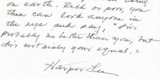
Occasionally, they get a little more than they bargained for. Take, for example, a student named "Jeremy," who wrote Lee in 2006 and requested a photo. In return, he got something more valuable and enduring: some pithy life advice. The letter Harper sent to Jeremy reads as follows:
06/07/06
Dear Jeremy
I don’t have a picture of myself, so please accept these few lines:
As you grow up, always tell the truth, do no harm to others, and don’t think you are the most important being on earth. Rich or poor, you then can look anyone in the eye and say, "I’m probably no better than you, but I’m certainly your equal."
(Signed, ‘Harper Lee’)
Lee’s second novel, Go Set a Watchman, was just released last week — 55 years after her debut. You can read the first chapter (and also hear Reese Witherspoon read it aloud) here.
via Letters of Note
Follow us on Facebook, Twitter, Google Plus and LinkedIn and share intelligent media with your friends. And if you want to make sure that our posts definitely appear in your Facebook newsfeed, just follow these simple steps.
Related Content:
Stephen King Writes A Letter to His 16-Year-Old Self: "Stay Away from Recreational Drugs"
Harper Lee on the Joy of Reading Real Books: "Some Things Should Happen On Soft Pages, Not Cold Metal"
74 Essential Books for Your Personal Library: A List Curated by Female Creatives
http://www.openculture.com/2015/07/harper-lees-important-life-advice.html is a post from: Open Culture. Follow us on Facebook, Twitter, and Google Plus, or get our Daily Email. And don't miss our big collections of Free Online Courses, Free Online Movies, Free eBooks, Free Audio Books, Free Foreign Language Lessons, and MOOCs.
%%POST_LINK%% is a post from: Open Culture. Follow us on Facebook, Twitter, and Google Plus, or get our Daily Email. And don't miss our big collections of Free Online Courses, Free Online Movies, Free eBooks, Free Audio Books, Free Foreign Language Lessons, and MOOCs.
Open Culture
.
Blog
.
<span class='date ' tip=''><i class='icon-time'></i> Aug 26, 2015 01:53pm</span>
|
|
Once upon a time, Joe Strummer wrote and directed Hell W10, a silent black & white film featuring the music of The Clash. And the Pixies’ Black Francis created a driving, jangling soundtrack for one of Weimar Germany’s finest silent films, The Golem: How He Came into the World (1920).
If the melding of vintage and modern aesthetics appeals, then get ready for Gutterdämmerung. Directed by the Belgian-Swedish visual artist Björn Tagemose, Gutterdämmerung promises to be "the loudest silent movie on earth," with Iggy Pop, Grace Jones and Henry Rollins playing starring roles. BEAT describes the premise of the film as follows:
The film is set in a alternate reality where God has saved the world from sin by taking from mankind the Devil’s Evil Guitar. As a result the Earth has been cleansed into a puritan world with no room for sex, drugs and rock ‘n’ roll (boo). [Queue] Iggy Pop as the punk angel Vicious, who secretly sends the Evil Guitar back to Earth, unleashing all manner of sin upon mankind.
Things get even crazier when Henry Rollins, as the puritan priest, coerces a girl to destroy the guitar, a quest that see’s her face the most evil rock ‘n’ roll bastards on the planet. Grace Jones plays the only person capable of controlling all the testosterone of all the no good rock ‘n’ rollers - obviously.
The director and cast set the scene a little more in the "launch video" above. To be honest, the video feels a bit like a spoof, making me wonder whether this is all a big put on. But they’ve certainly set up a respectable web site where, each week, they’ll announce other personalities starring in the film. So, stay tuned…
via Pitchfork
Follow us on Facebook, Twitter, Google Plus and LinkedIn and share intelligent media with your friends. And if you want to make sure that our posts definitely appear in your Facebook newsfeed, just follow these simple steps.
Related Content:
Watch the German Expressionist Film, The Golem, with a Soundtrack by The Pixies’ Black Francis
The Clash Star in 1980’s Gangster Parody Hell W10, a Film Directed by Joe Strummer
101 Free Silent Films: The Great Classics
http://www.openculture.com/2015/07/iggy-pop-henry-rollins-grace-jones-to-star-in-gutterda%cc%88mmerung-the-loudest-silent-movie-on-earth.html is a post from: Open Culture. Follow us on Facebook, Twitter, and Google Plus, or get our Daily Email. And don't miss our big collections of Free Online Courses, Free Online Movies, Free eBooks, Free Audio Books, Free Foreign Language Lessons, and MOOCs.
%%POST_LINK%% is a post from: Open Culture. Follow us on Facebook, Twitter, and Google Plus, or get our Daily Email. And don't miss our big collections of Free Online Courses, Free Online Movies, Free eBooks, Free Audio Books, Free Foreign Language Lessons, and MOOCs.
Open Culture
.
Blog
.
<span class='date ' tip=''><i class='icon-time'></i> Aug 26, 2015 01:52pm</span>
|
|
I try to catch the Noir City film festival whenever it comes through Los Angeles, not just because it uses the Egyptian, one of my favorite theaters in town, but because it comes curated by the experts. You’d have a hard time finding any group more knowledgeable about film noir than the Film Noir Foundation, who put Noir City on, and anyone in particular more knowledgeable than its founder and president, "noirchaeologist" Eddie Muller. The talks he sometimes gives before screenings give a sense of the depth and scope of his knowledge of the genre; you can sample it in a video clip where he introduces Ida Lupino’s The Hitch-Hiker (above) at last year’s Noir City Seattle.
You may remember Muller’s name from our post featuring his list of the 25 noir films that will stand the test of time. I do recommend Noir City as the finest context in which to watch any of them, but you don’t have to wait until the festival comes to your town to see a few, such as Fritz Lang’s Scarlet Street and Edgar G. Ulmer’s Detour. (2nd and 3rd on this page.) They and various other important pieces of the film noir canon have fallen into the public domain, making them easily and legally viewable free online. Watch The Hitch-Hiker that way after you’ve seen Muller’s introduction, and you can replicate a little of the Noir City experience in the comfort of your own home.
Other public-domain noirs of note include Orson Welles’ The Stranger, a subject of controversy among Welles fans but one about which Noir of the Week says "you couldn’t make a better choice if you’re looking for a conventional, fantastic looking film noir thriller."
And as the name of the festival implies, when we talk about such a highly urban storytelling tradition as noir, we very often talk about the city as well. Rudolph Maté’s D.O.A. includes as a particularly vivid depiction of 1940s Los Angeles and one of the more dramatic uses of the beloved Bradbury Building in cinema history. These five pictures should put you well on your way to a stronger grasp of film noir, and no doubt get you ready to explore our list of 60 free noir films online.
Related Content:
25 Noir Films That Will Stand the Test of Time: A List by "Noirchaelogist" Eddie Muller
The 5 Essential Rules of Film Noir
Roger Ebert Lists the 10 Essential Characteristics of Noir Films
Colin Marshall writes on cities, language, Asia, and men’s style. He’s at work on a book about Los Angeles, A Los Angeles Primer, and the video series The City in Cinema. Follow him on Twitter at @colinmarshall or on Facebook.
http://www.openculture.com/2015/07/the-5-best-noir-films-in-the-public-domain.html is a post from: Open Culture. Follow us on Facebook, Twitter, and Google Plus, or get our Daily Email. And don't miss our big collections of Free Online Courses, Free Online Movies, Free eBooks, Free Audio Books, Free Foreign Language Lessons, and MOOCs.
%%POST_LINK%% is a post from: Open Culture. Follow us on Facebook, Twitter, and Google Plus, or get our Daily Email. And don't miss our big collections of Free Online Courses, Free Online Movies, Free eBooks, Free Audio Books, Free Foreign Language Lessons, and MOOCs.
Open Culture
.
Blog
.
<span class='date ' tip=''><i class='icon-time'></i> Aug 26, 2015 01:52pm</span>
|
|
Smashing Pumpkins’ leader—and sole remaining original member—Billy Corgan is a man of many opinions, most of which I find easy to ignore. But in one of his recent made-for-headlines quotes, he referred to fellow nineties alt-rock superstars Radiohead as "the last band that did anything new with the guitar." It is, of course, impossible to quantify this not-especially controversial statement, but I haven’t found it easy to dismiss either. After Radiohead’s first three albums, we had maybe a solid decade of musicians looking back to a time before electric guitars to find an alternate path forward (as Radiohead themselves largely traded guitars for synthesizers). That said, in the years since Pablo Honey, The Bends, and OK Computer, Thom Yorke and band’s breakout song, "Creep," has successfully translated to so many unplugged arrangements that they deserve credit for writing a universally beloved new standard as well as reinventing rock guitar—even if they’d prefer we all forget their first, angst-ridden hit.
There’s Mexican actor Diego Luna’s powerful rendition, as the animated troubadour Manolo in Jorge Gutierrez’s Book of Life. There’s Tori Amos’ characteristically intense, live voice and piano version; there’s Amanda Palmer on ukulele, Damien Rice on acoustic guitar, and Korn—believe it or not—in a very tasteful acoustic cover. Now we can add to these the bring-down-the-house swing arrangement at the top of the post, with jazz singer Haley Reinhart, who slides from playful vamp to an almost gospel crescendo, and all, we’re told, on a first take. This jazz-age cover comes to us from pianist Scott Bradlee’s Postmodern Jukebox, a touring collection of ensemble musicians that Bradlee assembles to re-interpret famous pop songs. He previously recorded a sweet, classic soul cover of "Creep" with Karen Marie, above. The list of other Postmodern Jukebox covers ranges from a "Sad Clown with a Golden Voice" version of Lorde’s "Royals" to a klezmer take on Jason Derulo’s club anthem "Talk Dirty" (with the song’s 2 Chainz rap in Yiddish). We previously featured a New Orleans jazz rendition of "Sweet Child O’ Mine," with stage actress and singer Miche Braden. As Ayun Halliday wrote of the Guns n’ Roses’ reimagining, the Radiohead covers above are "not without gimmick, but it’s a winning one."
Related Content:
Guns N’ Roses "Sweet Child O’ Mine" Retooled as 1920s New Orleans Jazz
Patti Smith’s Passionate Covers of Jimi Hendrix, Nirvana, Jefferson Airplane & Prince
Listen to a New Album Featuring Tom Waits Songs in Hebrew (2013)
Hear 38 Versions of "September Song," from James Brown, Lou Reed, Sarah Vaughan and Others
Josh Jones is a writer and musician based in Durham, NC. Follow him at @jdmagness
http://www.openculture.com/2015/07/radioheads-creep-performed-in-a-vintage-jazz-age-style.html is a post from: Open Culture. Follow us on Facebook, Twitter, and Google Plus, or get our Daily Email. And don't miss our big collections of Free Online Courses, Free Online Movies, Free eBooks, Free Audio Books, Free Foreign Language Lessons, and MOOCs.
%%POST_LINK%% is a post from: Open Culture. Follow us on Facebook, Twitter, and Google Plus, or get our Daily Email. And don't miss our big collections of Free Online Courses, Free Online Movies, Free eBooks, Free Audio Books, Free Foreign Language Lessons, and MOOCs.
Open Culture
.
Blog
.
<span class='date ' tip=''><i class='icon-time'></i> Aug 26, 2015 01:51pm</span>
|
|
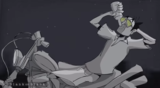
Blank on Blank returns with an animation of another lost interview from the Studs Terkel Radio Archive. This time, they’re breathing new life into a conversation Terkel had with Hunter S. Thompson in 1967 — soon after HST published his groundbreaking piece of Gonzo journalism: Hell’s Angels: The Strange and Terrible Saga of the Outlaw Motorcycle Gangs. The book, built upon the foundations of a 1965 article Thompson wrote for The Nation (read it online here) gave us a glimpse inside "a world most of us would never dare encounter," wrote The New York Times in its original review. Thompson tells Terkel what he learned from that (sometimes harrowing) experience above. You can hear the complete Terkel-Thompson interview here.
Related Content
Hunter S. Thompson Gets Confronted by The Hell’s Angels
Free Online: Hunter S. Thompson’s Fear and Loathing in Las Vegas
Read 18 Lost Stories From Hunter S. Thompson’s Forgotten Stint As a Foreign Correspondent
http://www.openculture.com/2015/07/new-animation-hunter-s-thompson-talks-with-studs-terkel-about-the-hells-angels-the-outlaw-life.html is a post from: Open Culture. Follow us on Facebook, Twitter, and Google Plus, or get our Daily Email. And don't miss our big collections of Free Online Courses, Free Online Movies, Free eBooks, Free Audio Books, Free Foreign Language Lessons, and MOOCs.
%%POST_LINK%% is a post from: Open Culture. Follow us on Facebook, Twitter, and Google Plus, or get our Daily Email. And don't miss our big collections of Free Online Courses, Free Online Movies, Free eBooks, Free Audio Books, Free Foreign Language Lessons, and MOOCs.
Open Culture
.
Blog
.
<span class='date ' tip=''><i class='icon-time'></i> Aug 26, 2015 01:49pm</span>
|
|
The exponential democratization of digital technology every year has led to a wealth of video essays and fan films from bedroom auteurs, the likes of which would have been unimaginable even five years ago To wit: this beautiful tribute to the works of Hayao Miyazaki, Japan’s anime god, and his Studio Ghibli. A typical fan video would have edited together a "best of" clip show, using a song to link the scenes. But a Paris-based animator named "Dono" has gone one step further and created a tribute where scenes and characters from Miyazaki all frolic about a 3-D modeled world, where the bathhouse from Spirited Away is rendered in all of its glory, and Totoro’s catbus is only a few blocks away from Kiki’s Delivery Service, and next door to Porco Rosso’s favorite hangout. Even Lupin III, not Miyazaki’s original creation, but who starred in the director’s first feature, gets a look in.
It’s very charming, and judging from Dono’s other work on his Vimeo channel, a huge step up and no doubt a labor of love. And here’s the other thing about this seamless work of fan art. In the past, the software and the computing power needed to make such a film would have been both prohibitively expensive and the domain of a design company. For this tribute, three of the four software programs named in its creation-Gimp, Blender, and Natron-are free and open-source, and run on a laptop. (The fourth, Octane, costs a little bit of money.)
via Vice
Related Content:
French Student Sets Internet on Fire with Animation Inspired by Moebius, Syd Mead & Hayao Miyazaki
The Simpsons Pay Wonderful Tribute to the Anime of Hayao Miyazaki
The Delightful TV Ads Directed by Hayao Miyazaki & Other Studio Ghibli Animators (1992-2015)
Ted Mills is a freelance writer on the arts who currently hosts the FunkZone Podcast. You can also follow him on Twitter at @tedmills, read his other arts writing at tedmills.com and/or watch his films here.
http://www.openculture.com/2015/07/hayao-miyazakis-universe-recreated-in-a-wonderful-cgi-tribute.html is a post from: Open Culture. Follow us on Facebook, Twitter, and Google Plus, or get our Daily Email. And don't miss our big collections of Free Online Courses, Free Online Movies, Free eBooks, Free Audio Books, Free Foreign Language Lessons, and MOOCs.
%%POST_LINK%% is a post from: Open Culture. Follow us on Facebook, Twitter, and Google Plus, or get our Daily Email. And don't miss our big collections of Free Online Courses, Free Online Movies, Free eBooks, Free Audio Books, Free Foreign Language Lessons, and MOOCs.
Open Culture
.
Blog
.
<span class='date ' tip=''><i class='icon-time'></i> Aug 26, 2015 01:49pm</span>
|
|
There’s no way around it, German philosopher George Wilhelm Friedrich Hegel is incredibly difficult to understand. And yet, his work, like few others since Plato, has been reduced over and over again to one idea—the "Hegelian dialectic" of "thesis, antithesis, synthesis." As a 1996 beginner’s guide to Hegel phrases it, this "triadic structure" is the "organic, fractal form" of the effusive thinker’s logic. The formula is what most lay people learn of Hegel, and often no more. So it may come as a surprise to learn that Hegel himself never used these terms in this way. As Gustav E. Mueller has written of this "most vexing and devastating legend," Hegel "does not use this ‘triad’ once" in all twenty volumes of his complete works, nor "does it occur in the eight volumes of Hegel texts, published for the first time in the twentieth century." So where does the idea come from?
From Hegel’s interpreters, who—baffled by his "obscurity" and "peculiar terminology and style"—have imposed all sorts of clarifying (or distorting) concepts on his work. In his animated School of Life video introduction above, Alain de Botton begins with the problem of Hegel’s famous difficulty. Hegel’s writing has generally been thought of as "horrible"—obscure, overstuffed, tangled, "confusing and complicated when it should be clear and direct." I can’t speak to his German, but this certainly seems to be the case in English. Yet, whether anyone can say what a philosopher’s work "should be" seems like a matter of interpretive bias. How can we, after all, separate a thinker’s ideas from his or her prose, as though these things can exist independently of each other? De Botton continues with another should:
He tapped into a weakness of human nature: to be trustful of grave-sounding, incomprehensible prose. This has made philosophy much weaker in the world than it should be, and it’s made it much harder to hear the valuable things that Hegel has to say to us.
The video goes on to make a short list of "a small number of lessons" we can take from Hegel. I’ll leave it to you to find out what de Botton thinks those are. Some may find in his tidy summations a useful guide to Hegel’s thought, others a further oversimplification of a philosophy that deliberately resists easy reading. No doubt, whatever we make of Hegel, we need to disabuse ourselves of the notion that his thinking easily boils down to a "Hegelian dialectic."
For those seeking to understand why his work has been so influential despite, or because of, its legendary difficulty, there are numerous resources online. One might start with "Hegel by Hypertext," a huge compendium of introductory and biographical material, analysis, discussion, links, and Hegel’s own writing. Hegel.net collects excerpts and full texts of the philosopher’s work in both German and English, as well as "works of Hegel’s 19th century followers" on both the right and left. Hegel’s most famous interpreter was of course Karl Marx, and you will find in every archive a number of commentaries and critiques from Marx himself and several Marxist thinkers.
The Hegel Society of America also gives us articles on Hegel from a range of thinkers across the political spectrum. Finally, we should attempt, as best we can, to grapple with Hegel’s own words, and we can do so with all of his major work on line in translation at the University of Adelaide’s eBooks library. For two very different ways of reading Hegel, see professor Rick Roderick’s lecture on "Hegel and Modern Life" and Slavoj Žižek’s lecture on "The Limits of Hegel," above. And should you feel that any or all of these interpreters misrepresent the formidable German philosopher, have a listen to the lecture below by Dr. Justin Burke entitled, appropriately, "Everything You Know About Hegel is Wrong."
Find courses on Hegel in our collection of 140 Free Online Philosophy Courses, and texts by the philosopher on our list of 135 Free Philosophy eBooks.
Related Content:
6 Political Theorists Introduced in Animated "School of Life" Videos: Marx, Smith, Rawls & More
Nietzsche, Wittgenstein & Sartre Explained with Monty Python-Style Animations by The School of Life
Download Walter Kaufmann’s Lectures on Nietzsche, Kierkegaard, Sartre & Modern Thought (1960)
Josh Jones is a writer and musician based in Durham, NC. Follow him at @jdmagness
http://www.openculture.com/2015/07/an-animated-intro-to-g-w-f-hegel.html is a post from: Open Culture. Follow us on Facebook, Twitter, and Google Plus, or get our Daily Email. And don't miss our big collections of Free Online Courses, Free Online Movies, Free eBooks, Free Audio Books, Free Foreign Language Lessons, and MOOCs.
%%POST_LINK%% is a post from: Open Culture. Follow us on Facebook, Twitter, and Google Plus, or get our Daily Email. And don't miss our big collections of Free Online Courses, Free Online Movies, Free eBooks, Free Audio Books, Free Foreign Language Lessons, and MOOCs.
Open Culture
.
Blog
.
<span class='date ' tip=''><i class='icon-time'></i> Aug 26, 2015 01:48pm</span>
|