Blogs
|
Google Announces New Features In Google Classroom
by TeachThought Staff
At TeachThought, while we love Apple’s products, app ecology, and general aesthetic, we tend towards recommending Google for most classrooms. Though they’re not mutually exclusive, rare is the classroom that has the budget for Chromebooks and iPads. 1:1 is rare; 2:1 is rarer still.
Google Classroom is the result of Google bundling Google Calendar, Google Drive, Gmail, and other services into something simpler for teachers to use. We recently shared 60 ways to use google classroom, and it’s likely we’ll need to follow that post up with an updated version as Google continues to iterate their academic side.
Will Phan, a Google Classroom Software Engineer, released a blog post that reviewed some new changes to Google Classroom for the 2015-2016 school year, which excerpted from for the post below.
7 Changes To Google Classroom
1. Post Questions
Phan explains, "You can post questions to your class and allow students to have discussions by responding to each other’s answers (or not, depending on the setting you choose). For example, you could post a video and ask students to answer a question about it, or post an article and ask them to write a paragraph in response."
2. Reuse Assignments
If you reuse curricula year after year-or at least reuse documents, there is an update you might like. Phan explains, "Now you can reuse assignments, announcements or questions from any one of your classes — or any class you co-teach, whether it’s from last year or last week. Once you choose what you’d like to copy, you’ll also be able to make changes before you post or assign it."
3. Improved Calendar Integration
We love changes that improve workflow. Phan: "In the next month, Classroom will automatically create a calendar for each of your classes in Google Calendar. All assignments with a due date will be automatically added to your class calendar and kept up to date. You’ll be able to view your calendar from within Classroom or on Google Calendar, where you can manually add class events like field trips or guest speakers."
4. Bump a post
Sticking posts on blogs, tweets, or facebook updates has long been a thing. Now you can do it on Google Classroom as well by moving any post to the top.
5. Due dates optional
Project-based learning, Self-directed learning? Maker ed? If you use long-term projects or other due-date-less assignments, you can now create assignments without due dates in Google Classroom.
6. Attach a Google Form to a post
If you’re a fan of Google Forms (here’s a post on using Google Forms to create a self-graded exam), this is a change you’ll appreciate. Phan explains, "Many teachers have been using Google Forms as an easy way to assign a test, quiz or survey to the class. Coming in the next few weeks, teachers and students will soon be able to attach Google Forms from Drive to posts and assignments, and get a link in Classroom to easily view the answers."
7. YouTube Functionality
Love YouTube, but concerned with objectionable content? Google hears you. "Because it also contains content that an organization or school might not consider acceptable, last month we launched advanced YouTube settings for all Google Apps domains as an Additional Service. These settings give Apps admins the ability to restrict the YouTube videos viewable for signed-in users, as well as signed-out users on networks managed by the admin. Learn more here."
You can read more over at the Official Google For Education Blog.
The post 7 New Features Added To Google Classroom appeared first on TeachThought.
TeachThought Blog
.
Blog
.
<span class='date ' tip=''><i class='icon-time'></i> Dec 04, 2015 04:40am</span>
|
|
"What’s My Name, Fool?" Why You Must Remember Your Students Now!
by Dawn Casey-Rowe
Ernie Terrell didn’t get Muhammad Ali’s name right. Terrell repeatedly called Ali by his former name, Cassius Clay, in the days leading up to their 1967 heavyweight fight. He even sang a song using Ali’s birth name on Hollywood Squares, something that pushed Ali over the edge.
Ali took this personally, telling announcer Howard Cosell that Terrell would announce Ali’s Muslim name publicly at the press conference, or in the center of the ring after Ali defeated him in the fight. Ali won the fifteen-round contest, peppering Terrell with shot after shot after shouting, "What’s my name?" It’s what most boxing lovers remember about Terrell-that he didn’t get Ali’s name right.
The First Days Of School
It’s the first day of school. Six periods of twenty to thirty kids are about to march in my room and stare me down. Most of them tell me they hate school-I always ask. It’s my job, in the first couple minutes of class, to make them realize they will not. It’s a combination of caring, marketing, and teaching.
I welcome students. I introduce myself. My name is on the board. Their names are not. I’ve got a lot to memorize.
I had a professor in college who always knew names. He was famous for this. I thought he had superhuman powers. I was nothing special in his class. Though his class was one of the most influential I ever took, I wasn’t majoring in his area. Still, he’d remember my name far into the future. He knew all of our names, almost instantly, like magic. That was important to me. That lesson stuck.
Building relationships is important in education-and in life. We go the extra mile for people we know and like — it’s human nature. Learning a name, pronouncing it right, and matching the right name with the right kid is critical-it’s the first courtesy we extend to our students. The quicker we learn the names the more each kid knows we care.
It’s not only important for teachers to learn student names, it’s important for kids to learn each other’s names as well. I want students to know each other and to feel comfortable working together. Community matters, and learning names is the first block in community building.
One thing I hate is "roll call." If I have to call out attendance every day, I do not know my kids, and they know I don’t. I want to be able to scan through the room almost instantly and know who’s in class. I want to know each name by day one or two, a personal detail by the end of the second or third class, and have a solid community structure in place by the end of the first week.
I never want students to feel I don’t know them. It all starts with a name.
Here are some strategies and activities use to remember names quickly so I can move on to the next things-building community and teaching valuable lessons.
6 Strategies For Teachers To Learn Student Names Quickly
1. Start with introductions.
Some experts feel introductions put kids on the spot. They do, but so does life-that’s something I’m honest about. I make introductions and public speaking a day-one skill, telling students it’s a money-making skill-a gift I plan to give them even if they aren’t comfortable speaking right now. They always thank me later. I give a reward: "Introduce yourself. You get 100 on your first quiz, and all you have to do is get your name right." I work hard to learn a few names during this activity. I tell an amusing story or two about myself to put the class at ease.
2. Ask students to complete info sheets.
I’m working toward paperless, but for this activity, I use a paper form. It has basic student info, and a couple questions about things they like, how they feel about school, plans for life. It’s just enough information for me to use, but I also walk around peeking at their names and memorizing the first few. I collect the papers personally from each student, studying names in the process and associating some of the info with the names. As I collect papers, I have a brief side conversation with each student. This helps me learn names and connect with students.
3. Make it a game.
I have some rewards on hand. The first person to get all of our names correctly gets a prize. Someone will usually have all the names down, but as the contest progresses, we get to hear the names over and over. We’re secretly trying to win in our minds-a case of healthy competition helping to build the community.
4. Use names when possible.
I make it a point to speak with everyone individually during the course of each class, and I use names when possible. Truth is, there are always a few names I don’t get the first time around, but if I’m using names constantly, it seems like I know them all-to the students. That buys me the time I need to work hard and learn each and every one.
5. Shuffle kids around.
I quiz myself constantly during the first days of school. I say the names in my mind as the kids come in, leave, and get off busses. It’s easy to memorize kids’ names when they’re in assigned seats, but I don’t have assigned seats. As soon as students move, change styles or don’t have that red soccer shirt on… Do I still know the names? That’s the challenge. When I know names in any setting-then I’ve done my homework well.
6. Have kids create something.
Author Dave Burgess suggests a first-day activity involving Play Doh in his bestseller "Teach Like a Pirate." This is a fun activity, I’ve tried it. I do something different every year. This year, I’m having kids find and create mini quote posters and personal goal infographics. I’ll use them for decorating the room, and refer to them for inspiration. While they’re going crazy with the research and Sharpies, I’ll have down time to talk to each student, which helps me connect and learn names quickly.
The best way to get off to a good start to the school year is by taking enough time to learn students’ names and build a positive classroom community. So many of us feel rushed to dive into the curriculum, but taking a quick beginning of the year pause to organize, learn names, and build community pays off in amazing results throughout the year!
Dawn Casey-Rowe is a teacher and author. Her book, "Don’t Sniff the Glue: A Teacher’s Misadventures in Education Reform" talks about what really goes on in the classroom, including the first day of school.
6 Strategies For Teachers To Learn Student Names Quickly
The post "What’s My Name, Fool?" appeared first on TeachThought.
TeachThought Blog
.
Blog
.
<span class='date ' tip=''><i class='icon-time'></i> Dec 04, 2015 04:40am</span>
|
|
Promoting STEM Critical Thinking Using Post-it® Super Sticky Notes
by TeachThought Staff
We were recently contacted by Post-it® Brand to see if we could help teachers understand how Post-it Products could be used to promote critical thinking. The result is the strategy below.
Recently we talked about how teaching and learning in the STEM (Science, Technology, Engineering, and Math) fields can benefit from new approaches in pedagogy. And not ironically, we also called for a new push for truly teaching kids to think critically.
According to a recent Back-to-School STEM Research Study conducted by the Post-it® Brand, 62% of parents have used memory games to help their students with STEM subjects. They’ve also used flashcards (58%), study guides (48%) and note taking (41%). One takeaway? Taking a diverse approach to how we teach-and how students learn-might be worth taking a closer look at, especially in the STEM content areas. STEM is ripe with complexity, nuance, alien ideas, and emerging trends that will topple existing paradigms and for us to reconceive preconceived notions students have about the world.
We previously suggested Concept Attainment as a useful teaching strategy to provide students with a more full and contextual meaning for these kinds of concepts and ideas. Below, we look at another way to promote critical thinking using Post-it® Super Sticky Notes from the Post-it® Brand World of Color, Rio de Janeiro collection. The goal of this activity is to promote metacognition, specifically helping students understand how to ask better questions but providing a basic framework of tiering through four levels.
A Step-By-Step Process For Promoting Critical Thinking Using Post-it® Super Sticky Notes
Step 1. Choose a standard and a topic.
For our example, we’ve selected from the Next Generation Science Standards, HS-LS2-5. Develop a model to illustrate the role of photosynthesis and cellular respiration in the cycling of carbon among the biosphere, atmosphere, hydrosphere, and geosphere. (NGSS)
From this standard, we chose photosynthesis.
Step 2. Brainstorm questions around the topic.
Next, students will brainstorm questions around that topic. Simply explain to the students that they are to ask questions about the topic-things that confuse them or make them curious, for starters. Depending on the grade and ability level of the students, you may encourage them to ask "good questions," but doing so may paralyze their thinking as they strive to "perform" rather than demonstrate curiosity.
Step 3. Introduce!
In step 3, students will be introduced to the idea of "levels" of questions. Identify these "levels" of questions by color coding using Post-it® Super Sticky Notes from the Post-it® Brand World of Color, Rio de Janeiro collection. Explain that Simple questions aren’t inherently "bad," nor are "Abstract" questions "good." Different kinds of questions serve different purposes, and oftentimes asking and answering the less complex questions can lead to more complex thinking.
We can’t ask great questions about things we don’t understand!
Pink Post-it® Super Sticky Notes = Simple questions: Usually "closed" questions with one answer, based on facts and "nuggets" of information and data. Often begin with "What…", "Which…" "Where…" and "When…."
Yellow Post-it® Super Sticky Notes = Average questions: These questions may be open-ended or closed, and may require connecting multiple information points. Often begin with "How…" and "Why…"
Green Post-it® Super Sticky Notes = Complex questions: At this level, questions are always open-ended, and answering them requires in-depth explanations, as well as predicting, inferring, and deductive reasoning.
Blue Post-it® Super Sticky Notes = Abstract questions: At the most complex, questions are open-ended, but require extended thinking and explanation. It is often necessary to answer these kinds of questions with advanced media forms (documentaries, music, poetry, blogs, books, etc.) They also require a transfer of thinking or understanding, as shown in the example below.
Step 4: Categorize!
In step 4, students will categorize their questions brainstormed in step 2, and write them on the respective color Post-it® Super Sticky Note.
You may need to model the differences in the questions, ideally providing multiple examples for each, and maybe allowing students with advanced understanding the chance to come up with their own example, quickly and on the fly.
Refine!
In this final step, students will refine their questions on different colored Post-it® Super Sticky Notes by doing the following:
Making sure they have at least 8 questions.
Revising those 8 (or more) questions to either fit one of the categories precisely or…
Change the color of the Post-it® Super Sticky Note category to accurately reflect the correct question category.
Variations
The big idea of this Post-it® Super Sticky Note activity is to promote critical thinking by helping students see questions in terms of levels and fluidity-from simple to abstract, and capable of changing based on learning and understanding.
A few variations are possible:
Have students categorize questions you provide on corresponding colored Post-it® Super Sticky Notes. This helps them focus on the categories without having to develop the questions. This can be a differentiation point for students in the process above as well.
Have students brainstorm questions as a class, then categorize in groups of students based on category and color on Post-it® Super Sticky Notes.
Use a write-around strategy so students can ask questions in writing while building off one another’s thinking.
Create "distractor" Post-it® Super Sticky Notes that are incorrectly categorized, and have students correct the level by changing the color or revising the question.
How do you help students learn and understand complex STEM concepts?
More Information
For additional information on Post-it products, or to purchase, visit Post-it.com
For more information on how to help students excel in STEM education visit the Post-it® Brand website. You can also connect with Post-it® Brand on Twitter, Facebook, Pinterest and Instagram.
The post Promoting STEM Critical Thinking Using Post-it® Super Sticky Notes appeared first on TeachThought.
TeachThought Blog
.
Blog
.
<span class='date ' tip=''><i class='icon-time'></i> Dec 04, 2015 04:39am</span>
|
|
3 Lasting Lessons For Teachers From Grant Wiggins
by Jay McTighe
Ed note: If you’re interested in hearing a (podcast) conversation between Jay McTighe and Grant’s wife, Denise Wilbur, along with ASCD Faculty member Donnell Gregory, head over to ASCD.
The start of the new school year offers the perfect opportunity to reflect on the life and work of Grant Wiggins, an extraordinary educator who died unexpectedly at the end of the last school year (on May 26, 2015). Although I am an only child, I considered Grant my brother as well as an intellectual partner and best friend. I think of Grant every day and miss him terribly.
While Grant is no longer with us, his spirit and ideas live on. Indeed, we can honor and celebrate his life’s work by acting on the sage advice that he offered to teachers over the years. As we prepare to meet our new students, let us consider three of Grant’s sensible and salient lessons for teachers.
What Grant Would Want You To Know
Lesson #1: Always Keep the End in Mind
Grant always reminded teachers of the value of designing curriculum, assessment, and learning experiences "backwards," with the end in mind. While the idea of using "backward design" to plan curriculum units and courses is certainly not new, the Understanding by Design® framework underscores the value of this process for yielding more clearly defined goals, more appropriate assessments, more tightly aligned lessons, and more purposeful teaching.
Grant pointed out that "backward design" of curriculum means more than simply looking at all of the content and standards you plan to "cover" and mapping out your day-to-day lessons. The idea is to plan backward from worthy goals—the transferable concepts, principles, processes, and questions that enable students to apply their learning in meaningful and authentic ways. Grant knew that in order to transfer their learning, students need to understand "big ideas." Rote learning of discrete facts and skills will simply not equip students to apply their learning to novel situations. Thus, he advised teachers to plan backward from desired transfer performances and "uncover" the necessary content needed for those performances.
Here are several curriculum-planning tips that Grant offered:
Consider long-term transfer goals when planning curriculum. What do you want students to be able to do with their learning when they confront new challenges, both within and outside of school?
With transfer goals in mind, ask yourself these questions: What will students need to understand in order to apply their learning? What specific knowledge and skills will enable effective performance?
Frame your teaching around essential questions. Think of the content you teach as the "answers." What are the questions that led to those answers?
Grant noted that teaching for understanding and transfer will develop the very capabilities identified in the Common Core State Standards and Next Generation Science Standards, which are necessary to prepare learners for success in college and careers.
Lesson #2: Feedback is Key to Successful Learning and Performance
However, Grant cautioned against thinking that grades (B+) and exhortations ("try harder") are feedback.
To be effective, Grant pointed out that feedback must meet several criteria:For years, Grant reminded teachers that providing learners with feedback was a key to effective learning and improvement. His insights have been confirmed by research (from educators like Dylan Wiliam, John Hattie, and Robert Marzano) that demonstrates conclusively that classroom feedback is one of the highest-yielding strategies to enhance achievement.
Feedback must be timely. Making students wait two weeks or more to find out how they did on a test will not help their learning.
Feedback must be specific and descriptive. Effective feedback highlights explicit strengths and weaknesses (e.g., "Your speech was well-organized and interesting to the audience. However, you were speaking too fast in the beginning and did not make eye contact with the audience.").
Feedback must be understandable to the receiver. Sometimes a teacher’s comment or the language in a rubric is lost on a student. Using student-friendly language can make feedback clearer and more comprehensible. For instance, instead of saying, "Document your reasoning process," a teacher could say, "Show your work in a step-by-step manner so others can follow your thinking."
Feedback must allow for self-adjustment on the student’s part. Merely providing timely and specific feedback is insufficient; teachers must also give students the opportunity to use it to revise their thinking or performance.
Here’s a straightforward test for classroom feedback: Can learners tell specifically from the given feedback what they have done well and what they could do next time to improve? If not, then the feedback is not yet specific enough or understandable for the learner.
Grant also reminded us that classroom feedback should work reciprocally—that is, teachers should not only provide feedback for learners but also seek and use feedback to improve their own practice. Here are four ways that teachers can obtain helpful feedback:
Ask your students. Periodically, teachers can elicit student feedback using "exit cards" or questionnaires. Here are a few sample prompts: What do you really understand about ____? What questions do you have? When were you most engaged? When were you least engaged? What is working for you? What could I do to help you learn better? Response patterns from such questions can provide specific ideas to help teachers refine their teaching.
Ask your colleagues. It is easy for busy teachers to get too close to their work. Having another set of eyes can be invaluable. You can ask fellow teachers to review your unit plans, inspect the alignment of your assessments to your goals, and check your essential questions and lesson plans to see if they are likely to engage students
Use formative assessments and act on their results. Grant often used analogies to make a point. He likened formative assessment to tasting a meal while cooking it. Waiting until a unit test or final exam to discover that some students haven’t "got it" is too late. Effective teachers, like successful cooks, sample learning along the way through formative assessments and adjust the "ingredients" of their teaching based on results.
Regularly analyze student work. By closely examining the work that students produce on major assignments and assessments, teachers gain valuable insight into student strengths as well as skill deficiencies and misunderstandings. Grant encouraged teachers to analyze student work in teams, whenever possible. Just as football coaches review game film together and then plan next week’s practices, teachers gain insight into needed curriculum and instructional adjustments based on results.
For more reading, here is Grant on providing better feedback for learning.
Lesson #3: Have Empathy for the Learner
In our writings on Understanding by Design, Grant and I described six facets of understanding: a person shows evidence of understanding when they can explain, interpret, apply, shift perspective, empathize, and self-assess. These facets serve as indicators of understanding and guide the development of assessments and learning experiences.
Grant pointed out that the facets have value beyond their use as a frame for curriculum and assessment design. They can be applied to teachers and teaching as well. As one example, he described the phenomenon that he labeled the Expert Blind Spot: "Expressed in the language of the six facets, experts frequently find it difficult to have empathy for the novice, even when they try. That’s why teaching is hard, especially for the expert in the field who is a novice teacher. Expressed positively, we must strive unendingly to be empathetic to the learner’s conceptual struggles if we are to succeed."
Grant reminded us of the value of being sensitive to learners who do not have our expertise (and sometimes not even an interest) in the subject matter that we know so well. He pointed out that "what is obvious to us is rarely obvious to a novice—and was once not obvious to us either, but we have forgotten our former views and struggles." He cautioned us against confusing teaching for understanding with simply telling. He encouraged teachers to remember that understandings are constructed in the mind of the learner, that understanding must be "earned" by the learner, and that the teacher’s job is to facilitate "meaning making," not simply present information.
Grant encouraged teachers to develop empathy for students by "shadowing" a student for a day and reflecting on the experience. Recently, a high school teacher took his suggestion and described what it was like to walk in the shoes of a student. Her account, summarized in a blog post with over a million hits, should be required reading for all teachers, especially at the start of a new year. Maybe you will be inspired to engage in this action research in your school.
These are but a few of the many lessons that Grant offered us. Although he is no longer with us, his brilliance lives on in his thought-provoking blog posts, articles, and books. His advice elevates our profession, and our students deserve the benefits of his wisdom.
Jay McTighe leads ASCD’s Understanding by Design® cadre and brings a wealth of experience that he developed during a rich and varied career in education. He served as director of the Maryland Assessment Consortium, a state collaboration of school districts working together to develop and share formative performance assessments. McTighe is an accomplished author, having coauthored 14 books, including the best-selling Understanding by Design series with Grant Wiggins.
This post originally appeared on ASCD’s Inservice blog; image attribution flickr user sparkfunelectronics
The post 3 Lasting Lessons For Teachers From Grant Wiggins appeared first on TeachThought.
TeachThought Blog
.
Blog
.
<span class='date ' tip=''><i class='icon-time'></i> Dec 04, 2015 04:38am</span>
|
|
How To Teach With The Concept Attainment Model
by TeachThought Staff
In 1956, psychologist Jerome Bruner published a book called "A Study of Thinking."
Being a psychologist, Bruner was interested in cognitive processing-how people think, and how those tendencies might be used to inform teaching and learning processes. He developed a new way of introducing learners to new concepts called Concept Attainment.
What Is Concept Attainment?
The image above from this document via Beyond Monet/Barrie Bennet/Carol Rolheiser is a useful example of how Concept Attainment works.
It can be thought of as game of "find the rule." Concept Attainment is a "backwards conceptualizing" approach to making sense of new ideas. It is a teaching strategy characterized (in terms of thinking patterns of the learner) by "a pattern of decisions in the acquisition, retention, and utilization of information that serves to meet certain objectives" (Bruner et al 1956).
Linda Neff at Northern Arizona University adds that Concept Attainment is a "close relative to inductive thinking (Joyce and Weil 1967:15), (and) focuses on the decision-making and categorization processes leading up to the creation and understanding of a concept."
Neff also explains that there are several advantages to this approach, including learning "how to examine a concept from a number of perspectives, learning how to sort out relevant information", the benefit of seeing multiple examples of ideas, and maybe most importantly, moving beyond mere concept-definition association. This allows for the idea to be seen in its native context, and a more authentic and fuller definition to emerge.
How Does Concept Attainment Work?
In the concept attainment process, new ideas are introduced-and defined by students-inductively through the "act(s) of categorization" (Bruner, Goodnow, and Austin 1956:244). Students see attributes, examples and non-examples, form theories, and then test those theories against the data given until they are able to able to name the idea.
This reverses the typical process of introducing an idea (e.g., gravity) by narrowly defining it (e.g., the force that attracts a body toward another physical body having mass). The Concept Attainment process requires learners to focus on attributes, categories, and relationships rather than simply mirroring an idea with a definition. In the STEM field-one marked by change, uncertainty, and new (and often unfamiliar) ideas-this conceptual approach is a tidy fit for teaching.
What Are The Benefits Of Concept Attainment?
California Lutherhan University explains the benefits of Concept Attainment:
"Concept attainment is designed to clarify ideas and to introduce aspects of content. It engages students into formulating a concept through the use of illustrations, word cards or specimens called examples. Students who catch onto the idea before others are able to resolve the concept and then are invited to suggest their own examples, while other students are still trying to form the concept. For this reason, concept attainment is well suited to classroom use because all thinking abilities can be challenged throughout the activity. With experience, children become skilled at identifying relationships in the word cards or specimens. With carefully chosen examples, it is possible to use concept attainment to teach almost any concept in all subjects."
Examples Of Concept Attainment
Also from California Lutherhan University, the following is an example of Concept Attainment in math.
"First the teacher chooses a concept to developed. (i.e. Math facts that equal 10)
Begin by making list of both positive "yes" and negative " no" examples: The examples are put onto sheets of paper or flash cards.
Positive Examples: (Positive examples contain attributes of the concept to be taught) i.e. 5+5, 11-1, 10X1, 3+4+4, 12-2, 15-5, (4X2)+2, 9+1
Negative Examples: (for examples choose facts that do not have 10 as the answer) i.e. 6+6, 3+3, 12-4, 3X3, 4X4, 16-5, 6X2, 3+4+6, 2+(2X3), 16-10
Designate one area of the chalkboard for the positive examples and one area for negative examples. A chart could be set up at the front of the room with two columns - one marked YES and the other marked NO.
Present the first card by saying, "This is a YES." Place it under the appropriate column. i.e. 5+5 is a YES
Present the next card and say, "This is a NO." Place it under the NO column. i.e. 6+6 is a NO
Repeat this process until there are three examples under each column.
Ask the class to look at the three examples under the YES column and discuss how they are alike. (i.e. 5+5, 11-1, 2X5) Ask "What do they have in common?"
For the next tree examples under each column, ask the students to decide if the examples go under YES or NO.
At this point, there are 6 examples under each column. Several students will have identified the concept but it is important that they not tell it out loud to the class. They can however show that they have caught on by giving an example of their own for each column. At this point, the examples are student-generated. Ask the class if anyone else has the concept in mind. Students who have not yet defined the concept are still busy trying to see the similarities of the YES examples. Place at least three more examples under each column that are student-generated.
Discuss the process with the class. Once most students have caught on, they can define the concept. Once they have pointed out that everything under the YES column has an answer of 10, then print a new heading at the top of the column (10 Facts). The print a new heading for the NO column (Not 10 Facts)."
More soon on this extraordinarily versatile teaching strategy.
image attribution Beyond Monet/Barrie Bennet/Carol Rolheiser; How To Teach With The Concept Attainment Model; What Is Concept Attainment?
The post How To Teach With The Concept Attainment Model appeared first on TeachThought.
TeachThought Blog
.
Blog
.
<span class='date ' tip=''><i class='icon-time'></i> Dec 04, 2015 04:37am</span>
|
|
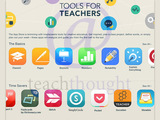
Organization Apps? Here Are 15 Essential Apps For The Organized Teacher
by TeachThought Staff
There is no single way to effectively organize a classroom.
The big idea behind organization is systematic accessibility. When there is a clear system that allows the parts of that system to be accessible to those who need it, that’s organization. Indicators of organization may might be outward orderliness and neat and tidy packaging, but it’s possible for organization to tend towards clinical aesthetics, where things are difficult to find and use, but boy doesn’t it all look lovely?
Because organization is a subjective idea, what works for one teacher may not work for another. With that in mind, we’ve collected what we see as essential apps for the organized teacher and organized classroom.
These are apps that allow teachers to store files, manage class rosters, share student work, and consolidate everything into a single, synced calendar for all parents. (This might be a good time to recommend tagging your curriculum as well.)
SimplyCircle asked us to check out their app, and if we thought it was worth sharing, share it. We did, and we do. You can check out the SimplyCircle site here and use the web version of their app, as well as the iPhone version of SimplyCircle, and the Android version as well. We’ve curated the best apps for organized teaching and learning that we know of, which you can find below.
15 Essential Apps For The Organized Teacher
Terry Heick
Owner
15
items
796
views
15 Essential Apps For The Organized Teacher
Listly by Terry Heick
15 Essential Apps For The Organized Teacher
Follow List
Embed List
1
SimplyCircle - Group Communication
With a focus on communication and attention to data privacy, SimplyCircle allows you to use a single, synced calendar for all parents, use group messaging or one-on-one, use one-click volunteer signups, and, in short, run a more efficient, organized, and productive classroom. With SimplyCircle, you can communicate with the entire group, or have individual conversations with parents as needed, all in a secure and private environment. In short, SimplyCircle is Remind, SignUpGenius and Facebook all rolled into one - so parents and teachers can ditch the burden of planning and remembering, and instead focus on doing.
0
2
Google Drive - free online storage from Google
Perhaps the most essential tool here, Google Drive is a cloud-based digital locker to save, share, collaborate with documents and related files for Google Docs, Sheets, Slides, and more.
0
3
YouTube
Create a channel for your classroom--flipped or not--where you aggregate lesson extensions, upload student work, or store digital content for lessons and units. All in one place.
0
4
Evernote Scannable
Evernote is great, but what about Evernote Scannable? Scan and store documents, images, drawings, pictures, project-based learning artifacts, and more.
0
5
Dropbox
Store files, backup media, create shared folders for students to send and receive work, and more. It often ties in nicely with Apple's native interface as well for easier sharing.
0
6
Paperless Assignments with Dropbox and Google Drive | SubmitBox
Use Dropbox or Google Drive to collect, annotate, and grade your students' documents with a simple paperless workflow Tired of collecting your students' documents with email attachments or via a learning management system? SubmitBox harnesses the power of cloud storage apps like Dropbox and Google Drive to make collecting documents super easy.
0
7
Pocket: Save Articles and Videos to View Later
Save and tag essential media--documents, books, blog posts, social media posts, and more--for your curriculum and classroom application.
0
8
Newsify: Your News, Blog & RSS Feed Reader
Read and share your favorite websites, blogs, and other digital content with students in a newspaper-like layout. Easy skimming, reading, saving, and sharing of news-style digital content.
0
9
Allcal - Social Planning App
Google Calendar is great. Another possibility is Allcall, a unique social planning calendar for projects, academic coursework, or parent-teacher interaction.
0
10
Remind: Safe Classroom Communication
Remind (formerly Remind101) offers teachers a free, safe and simple way to instantly text students & parents. Teachers, coaches, or administrators can send reminders, assignments, homework, assessments, or motivational messages directly to students' & parents' phones.
0
11
Microsoft OneNote - lists, photos, and notes, organized in a notebook
Capture your thoughts, discoveries, and ideas with OneNote, your very own digital notebook. With OneNote you can seize that moment of inspiration, take your class notes, or track that list of errands that are too important to forget.
0
12
TeacherKit - Class Organizer, Teacher Planner, Gradebook, Assignment List, Attendance and Student 's Grade
TeacherKit helps you organize classes and students easily. Create a seating chart, record attendance, log behavior, and track grades all with few taps.
0
13
Seesaw: The Learning Journal
Seesaw is a student-driven digital portfolio that empowers students of all ages to independently document and share what they are learning at school.
0
14
Nearpod
The Nearpod platform enables teachers, schools and districts, to use their iPads to manage content on students' iPads, iPhones, iPods or Macs. It seamlessly combines interactive presentation, collaboration, and real-time assessment tools into one integrated solution.
0
15
Socrative Teacher
Engage, assess and personalize your class with Socrative! Educators can initiate formative assessments through quizzes, quick question polls, exit tickets and space races all with their Socrative Student app.
0
View more lists from
Terry Heick
15 Essential Apps For The Organized Teacher; Best Apps For Teacher Organization; Organization Apps? Here Are 15 Essential Apps For The Organized Teacher
The post 15 Essential Apps For The Organized Teacher appeared first on TeachThought.
TeachThought Blog
.
Blog
.
<span class='date ' tip=''><i class='icon-time'></i> Dec 04, 2015 04:36am</span>
|
|
50 Of The Best Podcasts For High School Students
by Dennis Lee, StudyPug.com
This post is the first part to a 3-part series entitled "250 things any high school student must learn".
High school is perhaps one of the biggest turning points of a person’s life. Sure, there’s still college after that, but not everyone gets the chance to move that stage forward.
So while you’re all in the stage where you go wonder what you really want to be like in the years to come, why not try listening to Podcasts to give yourself some insights about life. There are scores of podcasts that you could find all over the internet. Topics range from Academic Related stuff where you could be able to extend your knowledge in any particular class that you like, to inspirational ones which would give you some great things to think about how to live your life and how to enjoy what you have.
So here’s a collection of 50 Podcasts that any high school student should listen to, categorized into the four general topics would help you focus on what you might choose to become in the years to come.
Academic Related Podcasts
Not everyone can be a History Buff, a Grammar Nazi, a Science Geek, or a Poetry enthusiast, but a person could try listening to one of these podcasts to have a bit more of new things learned from among every classes like Science, Math, English, History and Literature.
There are things that we can’t just learn in a four walled classroom, which is why these podcasts could offer you more practical applications of the theories they discuss to you. Apart from that is you get to know more advance stuff that could help you appreciate learning these classes more.
60 Seconds Health
60 Seconds Science
A Way with Words
Classic Poetry Aloud Index
Grammar Girl
Hubblecast HD
Math For Primates
Stuff you Missed in History Class
The Naked Scientist
The Podcast History of our World
General and Special Interest Podcasts
Everyone has their own sets of hobbies and interests. Some might be more of into arts (in all sorts of forms) or perhaps photography, or knitting and crocheting. Others might be interested in the latest innovations in technology. Others are superbly curious of how things work so they could make videos of it on YouTube. There are those out there who like stuff about Animals, the Universe, the Mind, Documentaries and Conspiracy Theories and so on and so forth.
So for the sake of having a lot of youngsters out there who are into several things, here’s a list of podcasts for those various hobbies and interests.
Art Podcast
Astronomy 161
Documentaries
Dummies.com
Good Job, Brain!
How to do Everything
Lore
Practical Defense
Radio Lab
StarTalk Radio
Stash and Burn
Stuff You Should Know
Talking Animals
Tips and Tricks Photography
Witness
Stuff to Blow your Mind
Mindset Zone
Killer Innovations
How Stuff Works
Math Mutation
Entrepreneurship
Isn’t there a saying about starting up a business while you are young?
Whether you’re into selling things for auction at eBay, or having garage sale on weekends, making homemade cookies and cupcakes for deliveries, it’s about time you get to learn more on the techniques on how to make your business flourish into something bigger. Who knows if you could make your business your career if you decide not to go further into college.
Since it’s never just about learning the theories about business, but having the ability to be quick and efficient in decision making, why not invest a bit of your time listening to pros on how they handle their business?
Ambitious Entrepreneur Show
Creative Living with Jaime
eBay Radio
Entrepreneurial Thought Leaders
Founder’s Talk
John Lee Dumas’ Entrepreneur on Fire
Practical Money Skills
Rise to the Top
Start up Nation
The Internet Business Mastery
Inspirational & Motivational
There are plenty of days we feel down. High School is probably among those days when you feel like everything isn’t going how you want them and that you feel like there’s no point to all the things happening around you. Now remember that people around you are having the same struggles too. Some of them have worse things to think and feel about themselves but they still push themselves to go on with their lives. Get to know their heartwarming stories that would tug on your heart strings. Live by their examples and inspire others like how they inspired you.
Back to Work
TED Talks
Daily Boost
On Being
Benjamen Walker’s Theory of Everything
Personal Growth Podcasts
Radio Diaries
This I believe
What It Takes
Here Be Monsters
Dennis Lee is the lead teacher at StudyPug - where they provide hundreds of video lessons and tutorials for any kinds of maths, including Algebra, Geometry, Trigonometry, Pre-Calculus and more.
The post 50 Of The Best Podcasts For High School Students appeared first on TeachThought.
TeachThought Blog
.
Blog
.
<span class='date ' tip=''><i class='icon-time'></i> Dec 04, 2015 04:34am</span>
|
|
Program Invites High School Students To France For 10 Day WWII Immersion
From a press release
WASHINGTON, D.C. - The Albert H. Small Student Teacher Institute is providing a fully funded learning experience taking fifteen student-teacher pairs to Normandy, France to tell the story of those who made the ultimate sacrifice.
National History Day is now accepting applications for the 2016 Normandy: Sacrifice for Freedom Albert H. Small Student and Teacher Institute. This highly competitive program accepts 15 student and teacher pairs for an immersive experience of learning both in Washington, D.C. and on the beaches of Normandy. The institute is funded through a generous donation from Mr. Albert H. Small. The institute covers all expenses for European travel, visits to historic sites, and lodging in both Europe and Washington, D.C.
Normandy Sacrifice for Freedom: Albert H. Small Student Teacher Institute seeks to teach a new generation about the sacrifices and challenges faced by U.S. service members during World War II. Student and teacher pairs select a service member from their home state or territory who died in the line of duty. After conducting months of research participants travel to Washington, D.C. for a ten day immersion in World War II history.
"At National History Day we strive to bring history to life, and few things do that better than the narratives about these silent heroes," said National History Day Executive Director Dr. Cathy Gorn. "By learning about the stories behind each of these Silent Heroes, the students and teachers truly come to understand the magnitude of the sacrifice made by these brave service members."
After a reception at the White House, sponsored by the White House Historical Association, participants embark on a journey of research and discovery. Historians and archivists guide the students and teachers through primary source material from World War II at the National Archives. Guest historians and speakers teach them about the importance of D-Day and Operation Overlord to the outcome of the war. Then the participants fly to France where each pair walks the beaches of Normandy in the footsteps of their silent hero.
Throughout their time in France, the students give briefings from their extensive research on various aspects of the War. On the final day the group heads to the American Cemetery in Normandy, France where the fifteen students honor their silent hero with a graveside eulogy.
Applications for this competitive program are due by November 30, 2015 at midnight. All participants must apply as one team. The adult must be a middle or high school teacher or librarian. The student must be a sophomore or junior in high school as of fall 2015. All applications must be fully completed and submitted as a single PDF document. The application, and more information, can be found online at http://bit.ly/NormandyInstitute.
National History Day (NHD) is a non-profit education organization in College Park, MD. Established in 1974, NHD offers year-long academic programs that engage more than half a million middle- and high-school students around the world in conducting original research on historical topics of interest. The keystone of NHD is the annual Kenneth E. Behring National History Day Contest held each June at the University of Maryland at College Park. NHD also seeks to improve the quality of history education by providing professional development opportunities and curriculum materials for educators. NHD is sponsored in part by Kenneth E. Behring, Patricia Behring, HISTORY®, Jostens, the National Endowment for the Humanities, the National Park Service, Southwest Airlines, the Joe Weider Foundation, and the WEM 2000 Foundation of the Dorsey & Whitney Foundation. For more information, visit nhd.org.
Image attribution flickr user Surreal Name Given
The post Program Invites High School Students To France For 10 Day WWII Immersion appeared first on TeachThought.
TeachThought Blog
.
Blog
.
<span class='date ' tip=''><i class='icon-time'></i> Dec 04, 2015 04:34am</span>
|
|
Using Post-it® Super Sticky Notes To Promote Critical Thinking
by TeachThought Staff
How can Post-it® Super Sticky Notes be used to promote critical thinking in the STEM high school classroom? Quite effectively, it turns out-especially if you’re familiar with Concept Attainment as a teaching and learning strategy.
The Post-it® Brand recently conducted a Back-to-School STEM Research Study which found that parents with middle and high school-aged students rank math and science as the subjects that will prepare their students the most for the job market - and yet, they are the subjects their students struggle with the most. This suggests a new approach to teaching in the STEM classroom-maybe one focused on engaging critical thinking and compelling anchoring concepts (as opposed to the classic approach of distribution of facts and information).
Whether you’re introducing a key idea, revisiting a concept, or clarifying misconceptions students have about complex ideas, Concept Attainment (link back to previous post on Concept Attainment) can be a useful tool in your teacher toolbox.
In our examples from the STEM field of Science (Biology), we’re using Post-it® Super Sticky Notes from the Post-it® Brand World of Color, Rio de Janeiro collection to illustrate what this might look like in your classroom.
The Steps of Teaching with Concept Attainment
Select and define a concept
Select the attributes
Develop examples and non-examples
Introduce the process to the students
Present the examples and list the attributes
Develop a concept definition
Give additional examples
Discuss the process with the class
Evaluate
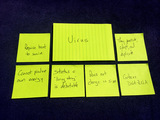
This is all done ahead of time before the lesson is delivered. In short, there isn’t a lot of prep work. You choose a concept, then choose crucial Examples or Non-Examples, Characteristics, and Non-Characteristics, and create using the Post-it® Super Sticky Notes as shown below. You then reveal the information one step at a time in hopes of promoting inferencing, theory development and revision, and other hallmarks of critical thinking.
The step-by-step process we’ve provided is meant to support how the students would encounter the information in a classroom lesson. Note, though we focused on text only, you can substitute any of the below with visuals-a diagram, drawing, or symbol to represent meaning. According to the Back-to-School STEM Research Study conducted by the Post-it® Brand, 86% of parents think the best way for their students to learn STEM-subjects is through visual learning, like reading or seeing pictures, and 54% of parents think their students learn most easily by touching or participating in a hands on activity. Using different colored Post-it® Super Sticky Notes that can also get students up and out of their desks is a simple, effective way to address both possibilities.
An Example Of Concept Attainment In The Science Classroom
Step 1
The first step is to choose a concept from your curriculum map or content area-ideally this would be a critical idea or term for the students to understand. This concept should be written on a 4in x 6in Post-it® Super Sticky Note. In this example, we chose Virus.
Explain to the class: They are trying to think like a detective to infer what concept is being implied or described. If they think they have it, they are not to shout it out, but contribute to the process by offering other Examples or Non-Examples, Characteristics or Non-Characteristics in order to form and revise theories, narrowing their thinking until they "get it."
Step 2
After choosing the concept, students need to identify those attributes that most accurately and compellingly characterize that idea. Recall, the point of the activity is to introduce the true nature of the concept, rather than to simply define it. We used the same color Post-it® Super Sticky Notes in 3in x 3in size to represent the Characteristics.
You would then place these Super Sticky Notes in groups at the front of the class in the center, where students can visualize them as clues. (Depending on your classroom arrangement, you may need to use the larger Post-it® Super Sticky Notes.)
The students wouldn’t see the 4in x 6in Post-it® Super Sticky Note with the concept, "Virus", written on it, but rather only the smaller 3in x 3in Post-it® Super Sticky Notes around it.
Step 3
Next, you’ll need to identify both Examples and Non-Examples. From the Post-it® Brand World of Color Rio de Janeiro collection, we chose blue Post-it® Super Sticky Notes for Examples and pink Post-it® Super Sticky Notes for Non-Examples. You would place these in another area marked Examples and Non-Examples so that students understand the nature of the clues.
Step 4
Next, you reveal or identify 2-3 more characteristics or examples written on Post-it® Super Sticky Notes of the concept one at a time, and then ask students to place them in the correct categories-either Examples or Non-Examples, Characteristics or Non-Characteristics.
Step 5
At this point, more students should have a sense of what the concept is (but still can’t shout it out). Instruct students that think they "get it" to begin calling out more Examples or Non-Examples, Characteristics or Non-Characteristics on their own. This has the benefit of helping to differentiate the learning across the students that "get it" and the students that are still trying to figure it out, as some students can deepen their learning, while the others use their peer’s ideas to build upon.
How do you promote STEM critical thinking in the classroom or at home?
For more information on how to help students excel in STEM education visit Post-it.com. You can also connect with Post-it® Brand on Twitter, Facebook, Pinterest and Instagram.
The post Using Post-it® Super Sticky Notes To Promote Critical Thinking appeared first on TeachThought.
TeachThought Blog
.
Blog
.
<span class='date ' tip=''><i class='icon-time'></i> Dec 04, 2015 04:33am</span>
|
|
7 Teachers Explain How Students Show Kindness In The Classroom
by Lisa Currie, ripplekindness.org
Some children spend more of their time awake at school than they do in their own homes. That’s a big thing when you’re still growing and learning. It’s a big thing too for parents to entrust their precious ones to others, sometimes strangers, during these vital years. Especially as much of a child’s developing personality and morals can easily be influenced by those around them.
During the early years of my own children’s education, I worried about the role models they would encounter at school. It concerned me that my hard work instilling good values may be lost if character education wasn’t a priority in the classroom. Fortunately, these days, educators are more aware of the need to prioritize social and emotional learning at school. They realize the important role that kindness and empathy have in nurturing happiness and self-esteem.
"It’s no secret that kindness sparks kindness. The secret is that kindness takes wings when it is modeled and taught with passion and purpose. When we intentionally help and encourage our students to put kindness into action through their thoughts, words, and deeds, then the world will truly be a gentler, more peaceful place. Simply put, we’ll be better.
Kindness in schools can look like a smile, feel like a hug, sound like a sweet greeting or a sincere compliment. A genuine inquiry about how someone is doing can mean so much. And when we have created that climate of kindness and caring inside our school walls, the natural next step is to take it home to our families, out into our community and then beyond our borders into our global world. And when kindness ripples, prepare to bathe in a tsunami of goodness. "
Barbara Gruener, Counsellor, Westwood-Bales Elementary, Friendswood, Texas, USA
"As students are often stereotyped for bad behaviour and bullying, it’s heartening to hear about the kindness and compassion they can have for others. Oftentimes, it’s students who are the greatest teacher of kindness, surprising their parents and teachers with small things that come so naturally from the heart.
"Over the years I have learned so many important things about kindness from my students. I have seen students come together during the most difficult of situations. They’ve shown how much more effective they are when they work together to serve in the community. But I think one of the most beautiful things I have learned from my students is how to take the everyday things and make them special when a friend is hurting.
I can remember seeing one of my first-grade students share a "magic crystal" with a friend who was crying. The friend was immediately cheered and wasted no time in coming to show me the crystal and tell me of her friend’s gesture of kindness. Upon examination, I discovered that the "magic crystal" was a grain of rock salt that had made its way into the building on the bottom of someone’s snow covered boot. However, that ordinary piece of rock salt became a way to spread cheer in that classroom for days to come as it was passed along to others who needed its "magic" power. I learned never to underestimate the power of the ordinary."
Tracy Kiso, K-1 Counselor, Barretts Elementary, St. Louis, Missouri, USA
"A few years ago, we started focusing on kindness at George Waters Middle School rather than bullying and other negative behaviours. It has transformed how staff and students respond to the negative things that may happen.
Students have delighted me with a variety of different things since we changed our focus. Our new goal is to accept responsibility for one’s own behaviour, control one’s own response, and at all times respond kindly. I have seen young people find ingenious ways to respond to others to help brighten their day. From a simple high five, opening a door, writing a kind note or making a pledge to be kind and sharing it by creating a video.
"I have also learned from students that some are extremely uncomfortable, in the beginning when we have discussions around kindness. In some cases, it is an idea that is foreign to them and in the lives they lead, as well as the people around them. In the beginning, it can bring out behaviours we are trying to avoid. From this, though, they show me that the art of being kind and learning that kindness matters is something all children easily pick up.
Some children just need the opportunity to be kind, to be shown what it is to be kind and how to be kind. The benefits of focusing on kindness far outweigh the negative. It may be uncomfortable for some in the beginning, but kindness lead to happier kids, adults and school culture that focuses on learning."
Andrew Mead, Principal, George Waters Middle School, Winnipeg, Canada
"I work with students with special needs, particularly behavioral. At lunchtime one day, a student had a tiny container with the smallest slice of homemade brownie inside. He didn’t have much for himself in many areas of his life, yet I watched him break the brownie in half. He crossed the room to the student I was working with, who was struggling that day, and gave him that half of the brownie. The significance of the offering was not lost on anyone. No words were exchanged, just the only gift he could give, completely unselfish."
Lisa VanEngen, Special Education Paraprofessional, Michigan, USA
"Education is a very personal endeavor. The better we get to know our students, the more effective we are. This is why it is very difficult when children cross the line and attack us verbally and physically. We feel violated and we feel wronged. Oftentimes we lash back. Or at the very least, we expect some sort of punishment for the misbehavior.
Punishment and lashing back are not the best options. I learned this first hand this year by witnessing just how forgiving and loving children can be. On numerous occasions, I witnessed children forgive each other quickly and almost without a second’s thought. We are the adults who have experience with these types of situations. We know we are not supposed to take them personally, and yet we do. More than anything, the students that I had the fortune of serving this year taught me how to forgive without any strings attached."
Jon Harper, Assistant Principal, Sandy Hill Elementary School, Maryland, USA
"Through my counselling sessions, I’m frequently amazed by the compassion and strength from teenagers who have experienced difficulties growing up. You might think that adversity could lead to bitterness and negative emotions - and in many cases they do exist. But underneath these uncomfortable feelings is often a deep compassion for others.
One student I worked with was struggled with self-confidence. After some exercises to help her identify a sense of purpose, she decided she wasn’t going to let her difficulties get in the way. She realised she could find a sense of purpose by helping others. She began a volunteer program with her older sister to spend time with a person with high-level disability in their home. She visited them one evening every week after school. This teenager told me that it made her feel strong and helpful. It allowed for her to feel empowered knowing that she was making such a difference to someone else’s life."
Elizabeth Neal, Psychologist, Elizabeth Neal Psychology, Sydney, Australia
"As a support teacher of 9 years, there have been many times where children’s natural instinct to be kind has amazed and delighted many adults. At a recent sporting event, three boys, all with additional needs (ASD) began running but dropped back to all be in line with each other so they could cross the line together for a joint first. There wasn’t a dry eye around the track.
At our swimming carnival, a student who uses a wheelchair was only able to participate in a few modified events. The student leaders began a conga line so everyone could have some fun. They gave this student the house flag (usually a special honour for captains). She proudly held it as they pushed her as the leader of the conga line.
Kids do this naturally and it’s the adults who are touched and learn by their kindness. In the early years, children are amazingly accepting of student’s with additional needs. They offer to give them extra turns, the first worksheet, to be their partner and to carry their belongings or help them when needed. They are a great reminder to some adults about the compassion and understanding we should extend to our friends."
Shirley James-Sharry, Support Teacher: Inclusive Education, St Flannan’s School Zillmere, Queensland, Australia
"As an advocate for Teaching SEL, I’m thrilled to see so many schools actively participating in programs that promote kindness within their community, who are quite obviously reaping tremendous rewards."
How has a student’s kindness touched the lives of those in your school, and what have you personally learned from their good deeds?
7 Teachers Explain How Students Show Kindness In The Classroom; image attribution flickr user usarmycerdec
The post 7 Teachers Explain How Students Show Kindness In The Classroom appeared first on TeachThought.
TeachThought Blog
.
Blog
.
<span class='date ' tip=''><i class='icon-time'></i> Dec 04, 2015 04:32am</span>
|