Blogs
|
6 Tips For Creating Effective Student Groups
by TeachThought Staff
Grouping students is easy; creating effective student groups is less so.
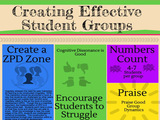
The following infographic from Mia MacMeekin seeks to provide some ideas to help make group work easier in your classroom. The strength of this particular graphic is in the range of the ideas. The first tip refers teachers to Vygotsky’s Zone of Proximal development, which frames student ability in terms of a range: what they can do unassisted, what they can do with the support of a More Knowledgeable Other (MKO), and what they cannot do even with support. This is different for each student, and understanding these ranges for students can help inform grouping decisions, whether you’re using a peer instruction model, ability grouping, or another approach.
MackMeekin’s suggestion to consider problem-based learning in a group setting is especially useful in that it also provides a link to the design of curriculum and instruction as well, rather than merely being a grouping strategy. Students engaging in problem-based learning will themselves make unique demands on the curriculum rather than the other way around. That is, the curriculum will have to be adapted to fit the problem-based learning approach, as will the instruction and then, ultimately, the grouping itself. This highlights the ecology of teaching and learning; changes here necessitate adaptations there.
6 Tips For Creating Effective Student Groups
Create a ZPD Zone
Cognitive Dissonance is Good
Numbers Count
Praise
Give Them Something to Do
Facilitate
image attribution Mia Mackmeekin; This work by Mia MacMeekin is licensed under a Creative Commons Attribution-NonCommercial-NoDerivs 3.0 Unported License; 6 Tips For Creating Effective Student Groups
The post 6 Tips For Creating Effective Student Groups appeared first on TeachThought.
TeachThought Blog
.
Blog
.
<span class='date ' tip=''><i class='icon-time'></i> Dec 04, 2015 04:46am</span>
|
|
What Vonnegut Might Say About Your Teaching
by Terry Heick because who else would write something like this?
I’m in the middle of "Breakfast of Champions" by Kurt Vonnegut, and just finished reading "Trout Fishing in America" by Richard Brautigan, and I stumbled on a magic secret about teaching I want to share with you. It’s also about physical fitness.
Okay, listen.
There are countless reasons to be physically fit; there are just as many ways to be physically fit.
There are a lot of indicators of fitness; there are many ways that being fit can improve your life. Most people understand this, even if they don’t do anything about it.
They run for so many miles, and check their Fitbits to see how well it all went. Some download apps that help them pretend they’re running from zombies because they need that kind of motivation and that’s what works for them and can you imagine an ibex needing that kind of technology? They call this jogging.
They scamper up and down tall, angled earth covered in lilac and clover and soil too sloped to grow anything but lilacs and clover. They call this mountain climbing.
They get together and swing their arms around in large elliptical patterns that make everyone say ooh and ahh, then they agree to meet every Tuesday night at rec center and do it again. They call this martial arts.
They lift weights that are heavy-metal bars with plates on the end that are filled with collapsed stars and carbon and just enough dark matter to make them struggle, and watch their muscles swell like water balloons that are shaped like arms and legs. They call this lifting weights.
They get in cars made in other countries (that were shipped there on boats made in other countries still), and drive down paved pathways that connect (in right angles) with other paved pathways (they call these roads) until their GPS tells them they’ve arrived, then they get out, carry their rolled up mats into hot studios and bend their bodies into shapes named after serpents and chairs and sweat out all their crazy in the same room so they can leave it there and go back home without it. They call this yoga.
There are lots of ways to become physically fit. But being fit is only valuable insofar as it enables other things. If you’re fit you might live longer. Or feel better. Or spend less in health care. Or your back might hurt less. Or you might fit into clothes that make you feel good. Or play team sports. Or with your children when the WiFi goes out.
Or lift carts of harvest in the fields when the donkey needs a smoke break.
The yoga studio or muay Thai facility or gym help you live. You go to the gym and lift weights so you have more energy, or you look and feel attractive, or you might live long enough to see your great grandchildren.
But did you know that some people go into those gyms just to make their muscles big-like giant flesh golems? And that’s it. They’re not taking that strength to lift cabbage, or push linebackers, or be a barrel-chested lumberjacks. They want puffy pectoral muscles that give the illusion of athletic potential, but they just use them in order to get better at lifting more collapsed stars.
They lift weights to get better at lifting weights.
And did you know that in some schools, teachers ladle ideas from content areas into long wooden troughs so that students might feed from them? The feed is Common Core, and all the students eat the same thing because it’s packed full of nutrients and fiber and is gluten free and free range. And when the students feed, they comment to one another about the taste and say things like "This tastes good," or "What is this? I can’t place the flavor," but they keep chewing because one day they want to be big and strong like the teachers, or their parents, or the donkeys when they’re actually working.
These schools have been gamified out the wazoo, so students learn to seek the points and the letters and badges instead of questions and critical literacy and wisdom because there are no points or badges for them and besides, games are fun. Students become trained to "get good at school." To stop resisting. We push our teacher fingers against our teacher lips and say shhhhhh and so they do.
They master academic content of dubious value in order to fulfill the form of a student, just as those flesh golems go to the gym just to get bigger muscles to lift more weight, those muscles never leaving the gym, and those big, beautiful minds pressing against the windows of the classrooms, dying to know something about the world on the other side.
And that’s how we ran schools in the early 21st century.
The post What Vonnegut Might Say About Your Teaching appeared first on TeachThought.
TeachThought Blog
.
Blog
.
<span class='date ' tip=''><i class='icon-time'></i> Dec 04, 2015 04:45am</span>
|
|
I Don’t Keep Teaching Because Of Kids
by Paul Barnwell, mindfulstew.org
Ask most teachers why they teach, and you’ll hear iterations of the same theme: I want to make a difference in student lives. I love interacting with kids. I have an chance to change their trajectories.
I agree with the above, and it certainly applies to me too.
As a hybrid educator, my job entails teaching sophomore English and social media literacy courses for half a day; the other half I work to raise money, design, and implement new systems for networked collaborative learning. It’s a challenging blend of tasks. Despite the variety of authentic work I’m engaged in, the most fulfilling aspects of my role are still interacting with, teaching, and mentoring students.
When one of my English II lessons goes well and participation is as active as a whack-a-mole board (without the swatting of students, of course:), I have a bounce in my step as I head to the faculty parking lot after school. When a student seeks advice because I’ve written a note of encouragement for him or her, it provides fulfillment that writing grant proposals fails to do. When I have an opportunity to laugh and learn with students, I feel contentment with my work as a classroom teacher.
But without sustained, purposeful and engaging interaction with other professionals, I’d probably walk away from the classroom.
Given how fast many high-quality educators accrue degrees and certifications to move on to non-classroom posts, we must acknowledge that teaching as a profession has a void to fill.
There’s a void of authentic leadership opportunities and time for classroom teachers to work with other adults, without it being another thing on the to-do list. There’s a void of encouragement for teachers to pursue intellectual work with colleagues, whether it be face-to-face or networked collaboration. The lack of emphasis on adult collaboration and ongoing learning isn’t the only reason why teachers leave the classroom, of course, but it plays a large role for those of us who desire new challenges beyond being a full-time classroom teacher.
I think about why I’ve remained at least a half-time teacher for 12 years running-far beyond the average five-year tenure for new teachers-and it largely boils down to the boost I’ve gotten through different experiences working with other teachers.
Last year, my Fern Creek colleagues proved to be been invaluable. I dreaded third period last year. You name the challenge, and I faced it. Disengagement. Disruptions. Persistent teasing bordering on bullying. All issues that seeped into the classroom and eroded my sense of efficacy. I had two students removed by administration and enrolled in an alternative school for behavior-related issues. Through her writing, I learned another student was a rape victim, and two others spent stints in an in-patient care facility for mental illness. Two others had had family members die from drug overdoses, and another student’s brother committed suicide last summer.
My English colleagues provided a lifeline during our weekly PLC meetings, a chance to reflect, collaborate, and the encouragement to not give up in reaching such a challenging group of students. This is just one example about how meaningful learning and interaction with adults has kept me returning to room 146.
For five summers between 2007-2013, I attended Middlebury College’s Bread Loaf School of English. The graduate program entered me into an international network of educators, and course work inspired me to create digital storytelling and social media literacy classes.
During the summer of 2012, I participated in the Louisville Writing Project, one of many institutes sponsored by the National Writing Project. Again, working with fired-up teachers-this time a cohort of Louisville-area folks, fueled my pedagogy and connected me with like-minded folks. I began that fall with a new network, fresh literacy strategies, and conference presentations lined up.
During 2014, I participated in Center for Teaching Quality’s VOICE training to learn more about facilitating virtual learning communities. Even though we never met face-to-face, the experience challenged me to think about how teachers in disparate geographic areas can collaborate using a variety of online tools.
What did these experiences have in common? The chance to improve my craft, learn from and with others, and enjoy a level of discourse that sometimes isn’t available when we shut our doors and focus solely on students without seeking support from colleagues.
Most of us don’t continue teaching for the amazing compensation, that’s for sure. We don’t continue teaching for recognition. Many of us continue teaching, however, because we’ve either sought out opportunities or have been encouraged to lead and learn with other adults.
The kids are still most important in my daily work, but they aren’t only reason why I do what I do. If teacher retention is to improve, then the profession must be treated as such, with more pathways for classroom teachers to participate in collegial activity that reenergizes and inspires them year after year.
I Don’t Keep Teaching Because Of Kids; adapted image attribution flickr user sparkfunelectronics
The post I Don’t Keep Teaching Because Of Kids appeared first on TeachThought.
TeachThought Blog
.
Blog
.
<span class='date ' tip=''><i class='icon-time'></i> Dec 04, 2015 04:45am</span>
|
|
We Have An Idea About Using Tactile Feedback In The Classroom
by TACTonics
A student begins a difficult final exam during her first year in college. While she listens to the instructions and worries about her final grade, she detects a gentle nudge sent by her mom. This sensory message reminds her to be confident and that she is loved. Despite the distance, she is encouraged from her mom’s message, and is able to finish the exam with self-assurance.
Across town at a nearby elementary school, a 3rd grader on a behavior plan receives his TACTpuck. For every positive behavior he exhibits, it lights up green; for every behavior that needs correcting, it lights up red. To congratulate him on a correct answer in class discussion, he receives a vibration or a nudge, which emulates a high five. The student’s behavior has improved tremendously since the beginning of the school year, all thanks to the implementation of the TACTpuck in his behavior plan.
The commonality in these instances is the need for communication. Communication is the way we express our feelings, thoughts, and desires. TACTspace is a new dimension of digital communication. With TACTspace, you can start a conversation without speaking, hearing, reading or writing.
In our examples, the undergrad taking the final exam needs to know that she can conquer any task, and that her mom is her biggest cheerleader. The elementary school student finds technology and gadgets interesting, so the TACTpuck purchased by his school is the perfect solution to both help him learn positive behaviors and feed his love of technology.
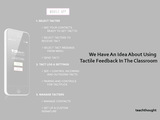
Sensory messaging is a tactile message, sent discretely and received and interpreted not by reading, or even viewing, but through other senses like hearing, touch and even smell. These sensory messages, called TACTS, are sent wirelessly to a friend or loved one, who receives the message through their senses. The TACTs are delivered through a TACTpuck by vibrating rhythmically, perhaps, or by warming up. The stimuli are endless.
New users download the TACTspace app, which has a pre-programmed menu. The app can be customized to create personal TACTs. To bring the TACTpuck to market, founder Eddie Bugg, has announced a crowdfunding campaign on Indiegogo.com. This campaign will provide the first opportunity to experience the technology in a beta testing environment. TACTspace will use the feedback from early adopters for the first production run and is seeking to raise $200,000 in 60 days.
To support the crowdfunding campaign, visit http://bit.ly/1IYNdRr. Check out our award: tactspace.com/news/wtinnovationworldcup. To learn more, please check out tactspace.com and follow us on Instagram, Facebook, and Twitter.
The post We Have An Idea About Using Tactile Feedback In The Classroom appeared first on TeachThought.
TeachThought Blog
.
Blog
.
<span class='date ' tip=''><i class='icon-time'></i> Dec 04, 2015 04:44am</span>
|
|
Free K-2 Earth Environmental Education Curriculum Now Available
by TeachThought Staff
From a Press Release
The Think Earth Environmental Education Foundation, a leading non-profit provider of environmental education for primary and secondary schools, is making its award-winning curriculum available free online. Kindergarten through second grade teachers can now access free Think Earth materials at www.thinkearth.org to teach students about the environment and the everyday behaviors that can help protect it. Updated Think Earth units for third grade will be available in September 2015, and grades four through eight are in development and will be available online in 2015 and 2016.
The Think Earth Curriculum was originally launched as a print-based program, which has been used by more than 60,000 teachers nationwide. Each of the behavior-based instructional units provides teachers with everything they need to teach five to eight environmental lessons. Materials include a teacher’s guide, posters, handouts, practice exercises, videos, and songs. Each lesson helps students think about the environment and then take action to conserve natural resources, reduce waste, and minimize pollution. Students also receive Family Activity Sheets that educate parents about the program and encourage students to share Think Earth behaviors at home.
"Environmental education is vital to stemming the effects of climate change around the world," said Joseph Haworth, Chairman of the Think Earth Foundation. "Our curriculum makes it easy for teachers to show students that small everyday behaviors, such as turning off unused lights, putting trash in trash cans, carpooling to school, and recycling can have a big impact on the health of our planet. If we help young people establish positive environmental habits while they are young, they’ll carry them into adulthood and pass them on to the next generation."
Core concepts explored in the Think Earth curriculum by grade level include:
• Kindergarten: Jay’s Tree: Students learn the benefits of trees and the importance of conserving natural resources.
• Grade 1: Bernie and the School Bus: Students learn that everything comes from the environment and how to use water, paper, electricity, and natural gas wisely.
• Grade 2: The Rascals: Students learn to reduce, reuse, or recycle products to conserve natural resources and minimize pollution.
• Grade 3: Trashbot: Students learn that waste from the production, distribution, consumption, and disposal of products can pollute our land, water, and air.
The Think Earth curriculum was developed by Educational Development Specialists, Inc. Each unit is aligned with Common Core State Standards, Next Generation Science Standards, and the McREL Standards Compendium. It is supported by: Edison International, Sanitation Districts of Los Angeles County, South Coast Air Quality Management District, Water Replenishment District of Southern California, Conrad N. Hilton Foundation, and Southern California Gas Company, along with others.
The curriculum has received a number of honors, including the President’s Environment and Conservation Challenge Award, and the Governor’s Environmental and Economic Leadership Award in the Children’s Environmental Education category from the State of California. A complete list of awards is available at http://thinkearth.org/about-us/#Awards.
About Think Earth Education Foundation
Established in 1988 and incorporated as a non-profit organization in 1995, the Think Earth Environmental Education Foundation is committed to helping communities create and maintain a sustainable environment through education. At the core of Think Earth is an award-winning environmental curriculum that is now available for free online (for K-3 teachers, presently). For more information please visit www.thinkearth.org. Follow Think Earth on Facebook (thinkearthfoundation), Twitter (@thinkearthed), and Pinterest (thinkearthed).
The post Free K-2 Earth Environmental Education Curriculum Now Available appeared first on TeachThought.
TeachThought Blog
.
Blog
.
<span class='date ' tip=''><i class='icon-time'></i> Dec 04, 2015 04:44am</span>
|
|
Should Teachers Use Twitter? This Flowchart Says Probably
by TeachThought Staff
Should you use twitter?
That’s a loaded question with a lot of assumptions. But for digitally-inclined teachers in the 21st century, the answer is increasingly, yes. At least light use of twitter semi-regularly can increase
We’ve featured graphics from Sylvia Duckworth in the past. Teachers love her simple, colorful, and bright sketch notes. She’s even turned some of our content into these visuals, including our 12 Rules Of Great Teaching.
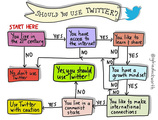
With this visual, she takes on the social network that is continuing to gain momentum on the ground in classrooms, and even for professional development purposes (see 8 Steps To Teacher-Led Digital PD). Though the graphic doesn’t make an insightful breakthroughs, it doesn’t seem to be designed to. Rather, it works better as a "pinnable" love letter to twitter, providing a colorful set of boxes-as-bullet points that sketch out the benefits of using twitter in education.
Do you like to learn? To share? Do you have a growth mindset? Do you like to make international connections? Then twitter may be for you. There’s even a bit of tongue-in-cheek political activism. "Live in a communist state? Use twitter with caution."
Well played, Sylvia. Well played.
Should Teachers Use Twitter? This Flowchart Says Probably
The post Should Teachers Use Twitter? This Flowchart Says Probably appeared first on TeachThought.
TeachThought Blog
.
Blog
.
<span class='date ' tip=''><i class='icon-time'></i> Dec 04, 2015 04:44am</span>
|
|
Less Tech, More Talk: Moving To A Discussion-Based Classroom
by Emily Long
Sometimes I feel like the integration of new technology in the classroom is being pushed on me from all sides.
And though I may not fall into the "neo-luddite" category, I don’t believe that new technology is the answer to keeping students engaged in their education. I think that stems from a genuine love of learning. Of course therein lies the real question: how do you get students to love learning? While I certainly don’t claim to have figured out the entire answer, I have noticed several things that seem to consistently boost students’ engagement.
For instance, incorporating discussion-based learning has made a considerable difference in how students at my school view their time in the classroom. I hear kids say that they wish all of their classes used this style of teaching because they get so much out of it. Here is a look at how we have implemented the Harkness method in our school and the impact it has had on the students.
What is the Harkness Method?
The Harkness method of teaching and learning is a discussion-based education method involving small groups of students (usually 8-12) seated around an oval table to share thoughts and ideas and to learn good reasoning and discussion skills. These discussions involve minimal interjection from instructors in order to encourage student engagement.
The challenges for each participant in a Harkness discussion will vary. For example, students who are naturally outgoing and comfortable speaking in front of their peers are challenged to listen more and encourage introverted students to share their thoughts. This educational method requires students to share their unique insights while listening to the insights of others and treating each other with respect.
Outcomes from the Harkness Table
The Harkness table offers many valuable benefits for both students and teachers. Here are just a few of the outcomes I have witnessed at our school as a result of discussion-based learning.
Improves communication skills: Students learn to articulate their thoughts as part of a larger discussion with their peers and instructors.
Boosts confidence: Students are encouraged to put forth their ideas in a supportive and engaging environment. This is particularly beneficial for students who are naturally introverted.
Builds mutual respect: No one person is in a position to govern the conversation; students learn to listen to their peers and offer their own insights without dismissing opposing viewpoints.
Requires independent preparation: Students must come to class ready to discuss the assigned topic. If a student is unprepared, it will be very apparent to his instructor, and he will get far less out of the discussion than his peers.
Encourages critical thinking: Because students must play an active role in learning through discussion, they are required to exercise more critical thinking than is typically needed in a traditional lecture setting.
Incorporating the Harkness Method in Your Classroom
So far I’ve mentioned how the Harkness Method requires students to keep up with their reading and come prepared to class. But discussion-based learning also requires considerable effort from you, the educator.
Chances are, your students are not accustomed to this style of learning and may not take to it naturally, so it’s very important that you guide them through the process until they have a clear understanding of what is expected of them and how they can succeed in a discussion-based classroom. Here are some tips for preparing your students to learn around the Harkness table.
Get your administration on board: Explain how and why you are integrating the Harkness method into your classroom so administrators can be confident fielding any phone calls from concerned parents or students.
Lay out a few key guidelines for discussion: Provide students with a handout of important discussion tips such as "engage with peers rather than addressing everything to the instructor."
Create a discussion schedule: Design discussions around a few central ideas or questions so students have time to form their thoughts and prepare for class. This schedule should not be too granular so as to avoid limiting a student’s thoughts on a given topic.
Let the students lead: Allow students to present their ideas and questions to their peers, interjecting if necessary to guide the discussion.
Consistency is Key
While some classes will benefit greatly by using the Harkness method every day, others will experience the most overall success through a combination of discussion-based and lecture-based teaching. The important thing to remember when incorporating the Harkness method along with a lecture schedule is to remain consistent. If you hold these roundtable discussions sporadically or with several weeks in between sessions, students will struggle to get comfortable engaging in this type of learning.
If you have ever used a Harkness table in your classroom and have some advice regarding this teaching method, or if you have questions about discussion-based learning, please feel free to leave a comment below. I know there is much more that can be said about this method, and I’d love to hear what some of the thoughts are from the TeachThought community.
Emily Long is proud to be a part of Lancaster Country Day School. LCDS is an independent, college-preparatory school serving Lancaster, PA along with Hershey, York and Reading from preschool through 12th grade.
The Harnkess Method: What Happened When I Created A Discussion-Based Classroom; Less Tech, More Talk: Moving To A Discussion-Based Classroom
The post Less Tech, More Talk: Moving To A Discussion-Based Classroom appeared first on TeachThought.
TeachThought Blog
.
Blog
.
<span class='date ' tip=''><i class='icon-time'></i> Dec 04, 2015 04:43am</span>
|
|
The Mind Trust: A National Innovation Symposium To Explore New School Models
by TeachThought Staff
From A Press Release
The Mind Trust today launched Talent Matters, an effort to recruit talented innovators and entrepreneurs to take part in two transformative efforts to improve public education in Indianapolis:
Charter School Design Challenge. The Mind Trust created its Charter School Incubator in 2011 to launch or expand excellent public charter schools in Indianapolis. During the first round of awards, The Mind Trust supported the launch or expansion of four charter school networks in Indianapolis. The Design Challenge represents the second phase and is seeking to seed four transformative, "break-the-mold" charter school models.
Innovation School Fellowship, Round 3. The Mind Trust created the fellowship, in partnership with the Indianapolis Public Schools (IPS) and the City of Indianapolis, in 2014 to help launch high-quality and autonomous Innovation Network Schools in IPS, the city’s largest school district. The Mind Trust is now recruiting for its third class of fellows.
"Indianapolis is among the most exciting cities in the nation to develop and launch a new, autonomous charter or district school, and The Mind Trust’s Innovation School Fellowship and Charter School Design Challenge provide unique opportunities to do so," said David Harris, founder & CEO of The Mind Trust. "We are seeking talented, innovative entrepreneurs and educators who want to be on the cutting edge of transforming public education in Indianapolis and across the nation."
Charter School Design Challenge. Through this challenge, The Mind Trust seeks to create the next wave of charter schools by identifying the nation’s most innovative social entrepreneurs and encouraging them to design transformational, new charter school models that have never before been tried.
To generate interest in the Design Challenge, The Mind Trust will host a national innovation symposium in Indianapolis in April 2016 to explore new school models. Among the activities will be a preliminary design competition where innovators will present ideas for new school models. The winner will receive a $50,000 grant to be used to further develop a plan to submit to the Charter School Design Challenge. The Mind Trust will offer planning grants of $10,000 to up to 10 teams of entrepreneurs to develop ideas for the preliminary competition. To apply to participate in the symposium or for the planning grant, please visit: themindtrust.org.
Then, The Mind Trust will award four $250,000 grants through the full Charter School Design Challenge. Other supports from The Mind Trust include visits to world-class schools across the country; expert consulting on school design, school startups and management; and other consulting and research support.
The Mind Trust will begin accepting applications for this fellowship immediately on a rolling basis.
Innovation School Fellowship, Round 3. Innovation Network Schools are new, autonomous public schools that were made possible by recent state laws giving IPS and other school districts the authority to convert any existing school in the districts to a new Innovation Network School.
At each site, IPS enters into an agreement with a school operator (e.g. a nonprofit) to run the school under contract with the district. Operators also have access to district buildings, eliminating a typical barrier to launching a new school. What’s more, they are exempt from IPS’s administrative practices, collective bargaining agreement, and many state regulations, giving them the freedom to hire staff, design their own curriculum and extend the school day and/or year to best serve the needs of students. In exchange for this freedom, the schools are held to the highest academic standards.
Through the fellowship, The Mind Trust selects prospective school leaders to receive salary, benefits, office space and technical assistance from local and national experts while they spend up to two years developing their school model. Applicants may be current principals and educators, leaders of charter school networks and other innovators who have the ability to launch and run a successful school.
IPS and The Mind Trust have an agreement to convert at least 15% of IPS’ schools, or at least nine schools, into Innovation Network Schools over the next several years. One such school incubated during The Mind Trust’s first round of fellowships, PLA@103, opened in 2015 on the city’s far eastside. Earlier this year, four 2015 fellowships were awarded to launch three new schools.
Statements of intent for this third round of fellowships are due by January 17, 2016 and full applications are due February 7, 2016.
For more information on both fellowships, please visit: themindtrust.org.
The Mind Trust: A National Innovation Symposium To Explore New School Models
The post A National Innovation Symposium To Explore New School Models appeared first on TeachThought.
TeachThought Blog
.
Blog
.
<span class='date ' tip=''><i class='icon-time'></i> Dec 04, 2015 04:43am</span>
|
|
Don’t Buy That! How To Survive Back To School Season Without Going Broke
by Dawn Casey-Rowe, Author of Don’t Sniff the Glue: A Teacher’s Misadventures in Education Reform
Parents and teachers-you’re about to go broke! It’s back to school season.
Parents-you’re looking at The List sent from school. You want to cry. Teachers, you see your empty classroom and your credit card statements from last year. You can’t cry because you haven’t stocked up on tissues yet.
According to the National Retail Federation, there’s some good news-the American public is getting a little more frugal. After a record breaking 2014 Back to School season, we’ll spend slightly less this fall-only $68 billion down from $74 billion. This still breaks down to $630.36 per family, about thirty bucks less than last year. Americans spend more on Back-to-School than any other period except Christmas, where we go through over $600 billion. That keeps Santa’s elves employed.
We’re spending a little less than normal this year. I guess we figured enough is enough-our kids have plenty of pencils. Although overall spending for Back to School has increased 42% over the last decade, it hasn’t kept pace with college tuition increases, which makes me wonder about the point of buying all these pencils if nobody can afford to use them in college. That’s a topic for another day. Perhaps more pencils equals more scholarship applications? Someone should do a study on that.
We’ll spend $68 billion sending our kids back to school this year. As a mom, it’s a small price to pay to get the "I’m bored" out of my living room, but as a teacher it’s approximately $67.99999999999 billion more than I am allocated for my classroom. The good news is marketing research shows students are cracking open their own wallets for Back to School, much like teachers. The average high school student will spend $33 on his or her school supplies. The average teacher, though, spends $500-$1000 annually on classroom and teaching supplies not furnished by work.
Kids spend more on sneakers than they do notebooks. I don’t judge, I just report the numbers. Sneakers are important-they’ll help graduates run faster as they work two and three jobs to get ahead and pay off their loans. Debt and extra jobs-that’s where we’re all headed, not just teachers. It’s why getting a good education is so important in a shifting economy.
A Story
I ran into one mom who was upset about sneakers. She was stressed that the new Jordans were releasing-she had two boys and was working double shifts to keep up. Two pairs of Jordans is roughly a car payment and a half for me. I told her, "The answer is ‘no’ or ‘get a job.’"
We are a consumption society, but we have to be conscious of our spending-both parents and teachers. Every penny adds up at a time when many of us are squeezed pretty tight.
I used to go store to store for the doorbusters and to stock up my class. I’d go to a teen cashier and say, "Look, I’ll come back ten times today for the ‘limit 8,’ so can we cut right to the chase?" The teen, who probably asked his teacher for forty-two pencils last year, always let me buy what I wanted. It’s the unwritten teacher-student code. We help each other out when we can.
I’d see parents in the stores with scroll-sized lists for their kids. There’s an amazing amount of pressure on students to have the latest stuff when they walk into school on the first day, especially by middle school. That can be tough.
As a teacher, I’m grateful when parents prepare their kids so I don’t have to spend my paycheck on notebooks and pens for two hundred kids, but I feel parents’ stress. Some school lists seem a little outlandish, or certainly not well-considered. I only have one kid, so it’s not a big deal for me, but some parents have three or four lists to contend with.
Does a kid really need a flash drive when we all have Google? Will a twenty-dollar tabbed notebook get that kid past the Common Core? Do students need scientific calculators when schools could let them use apps on their phones?
"Miss, we always get these lists of things to buy that we never use!" say students. It’s a valid point.
If you’re wondering whether to choose between buying school supplies or groceries, stop right now! Here are some tips to avoid breaking the bank whether you are a parent, teacher, or kid.
Back To School Spending Tips For Parents
1. Go through your kid’s drawers and see what they really need.
Kids confuse Back to School with winning the lottery or being runway models on Fashion Avenue. Before shopping, I cleaned out the dark spots in my son’s room-the parts no mom dares enter-closet corners, under the bed, "laundry" pile. I gave away the too-smalls, tossed the ripped clothes, then took inventory.
I only had to buy a couple "cool kid" t-shirts and replace the shoes he lost at camp. I saved a ton of money. Have your young fashionista learn to combine wardrobe basics with a few new outfits. Adding a patch, sparkle, some fabric, or a new-to-him (hand-me-down) pair of jeans can go a long way toward helping family finances.
2. Give kids a set budget.
There are things kids want. Then, there are things they need. I wanted a Trapper Keeper notebook-all the cool kids had them. They cost a ton and it didn’t make me cool. Go through sale fliers together. Prioritize and let them make some decisions, but when the pre-determined amount is gone, the spending stops-or is done by them.
3. Learn to earn!
Let your student earn a back to school clothing or supply budget. Younger kids can do chores. Teens and tweens can start to find their own small jobs like yardwork or babysitting. Kids value money they earn and you won’t have to say "no" since you’re giving them an action plan to "yes." It’s parenting with an entrepreneurship twist. Kids who learn money management skills early bring it with them into life.
4. Look carefully at "The List."
You’ll be sent a list from your child’s teacher. Buy the reasonable things, but don’t be afraid to ask questions if the list looks excessive, overly brand specific, or you’re wondering how your child will use the items. I’ve seen expensive wishlists with things that never get used.
Back To School Spending Tips For Teachers
5. Set a budget.
The IRS deduction for classroom expenses is $250. That doesn’t mean you’re being reimbursed $250, rather it’ll look like you made $250 less income and you’ll save a couple bucks on taxes.
It’s a good number to stay under, but if you have a tight budget in your family, do not spend a ton on your class. Although I’m firmly of the camp that your job should supply what you need, many teachers crowdfund, use Craigslist, or get things from the community. Put out the word on social media. Ask, and you will often receive.
6. Never set up your classroom on your credit card.
I use my credit card to itemize and record expenses. It’s helpful. If you can’t pay off your credit card that month, don’t charge things for classroom. You might say "That’s easier said than done," but when I stopped my excessive spending, I became more creative and no student loved me less. I was able to pay down my debt rather than accruing debt because of my job. Look at your classroom spending as donating to a good cause. If you wouldn’t have the money to donate to a charity, don’t spend it on your classroom.
7. Consider what you’re asking parents to buy.
I’m a frugal parent and teacher. As a teacher, I send the following list. "You need something to write with, something to write on, and your brain." I have some things to share, but if students want specific things, I ask them to bring what they like to use. I never require expensive organization systems or equipment. There’s always a frugal option.
8. Use free tech.
Why should students buy and lose flash drives when Google’s free? By learning to use standard, free technology, teachers provide a richer experience-without breaking the bank. Using platforms like Google, Asana, Slack, Dropbox, and Evernote gives students access to professional productivity and collaboration tools, giving them a distinct advantage in the workplace. Free tech doesn’t stop there-you can make PDFs that replace textbooks or create Facebook or webpage to involve families and the community in your class.
9. Encourage student responsibility.
My classroom isn’t Pencil Christmas.
I give away a thousand pencils a year, gift notebooks, feed kids, and create lessons that require me to buy things out of my household budget. Sometimes, students begin to expect this. There’s a fine line between students being in need and students being unprepared because I’ll bail them out. Have these conversations with students, and teach them to respect classroom materials as well as the supplies their parents work hard to buy.
Think about Back to School season as the season for savings, not spending, and you’ll soon begin to remove yourself from the madness, concentrating on what’s really important. For parents and teachers, that’s getting the September routine in order so each of your kids does their best.
If you still feel tempted to buy in to the crazy spending, take a moment and a deep breath, use the tips above, then ask yourself "Is this expense critical?" If it is not, walk away, and save your money for another day.
Dawn Casey-Rowe is a teacher and author. Her book, "Don’t Sniff the Glue: A Teacher’s Misadventures in Education Reform" will make you think twice about teacher spending, school reform, and the day-to-day happenings in the classroom; adapted image attribution flickr user nwabr
The post 8 Back To School Spending Tips For Parents & Teachers appeared first on TeachThought.
TeachThought Blog
.
Blog
.
<span class='date ' tip=''><i class='icon-time'></i> Dec 04, 2015 04:42am</span>
|
|
How To Teach Empathy
by Terry Heick
Right near the core of education, just past tolerance and just short of affectionate connectivity, is the idea of empathy.
University of California at Berkley’s Greater Good: The Science of a Meaningful Life explains empathy. "The term "empathy" is used to describe a wide range of experiences. Emotion researchers generally define empathy as the ability to sense other people’s emotions, coupled with the ability to imagine what someone else might be thinking or feeling."
Empathy is often confused with sympathy, which is a pretty extraordinary error depending on how tightly wound you are about these things (and whose definitions you stand behind). According to Dr. Brene Brown offers a divisive take on the difference. "Empathy fuels connections, sympathy drives disconnection."
This contrasts with dictionary.com, which explains "Both empathy and sympathy are feelings concerning other people. Sympathy is literally ‘feeling with’ - compassion for or commiseration with another person. Empathy, by contrast, is literally ‘feeling into’ - the ability to project one’s personality into another person and more fully understand that person." dictionary.com marks just a slight discrepancy between the two—sympathy requiring less movement and merging of emotions, while empathy is entirely that.
The chemistry and subjectivity and nuance of language aside, there is a clear handle for us as teachers. However large you see the distinction, they certainly have very different tones. Empathy is based in compassion, while sympathy is based in analysis.
UC Berkley continues clarifying:
"Contemporary researchers often differentiate between two types of empathy: "Affective empathy" refers to the sensations and feelings we get in response to others’ emotions; this can include mirroring what that person is feeling, or just feeling stressed when we detect another’s fear or anxiety. "Cognitive empathy," sometimes called "perspective taking," refers to our ability to identify and understand other peoples’ emotions. Studies suggest that people with autism spectrum disorders have a hard time empathizing."
Ideally, empathy would be the net effect of experience, which in classrooms is both a matter of process and knowledge. Students would learn to empathize rather than be taught to empathize, as a symptom of what they know. Why this is important is a matter of implication and language. Teaching someone to feel what others feel and sit with emotions that aren’t their own couldn’t be any further from the inherent pattern of academics, which is always decidedly other. Teaching always begins with detachment—learn this skill or content strand that is now apart from you. Empathy is the opposite; it starts in the other, and finishes there without leaving.
In your classroom, there are dozens of natural sources of empathy. But what about authenticity? There’s nothing worse than "schoolifying" something a child actually needs to know. So much of great teaching is about packaging content so that students recognize it as something they need to know and can actually use, rather than something to do because I said so and you don’t want a zero do you?
Teaching Without Empathy
One way to consider it? Without empathy, you’re teaching content instead of students. The concept of teachers as primarily responsible with content distribution is a dated one, but even seeking to "engage" students misses the calling of teaching. To teach a child is to miss the child. You must understand them for who they are where they are, not for what you hope to prepare them for. "Giving knowledge" and "engaging students" in pursuit of pre-selected knowledge both are natural processes of formal education-and both make empathy hard to come by.
So then, where to start doing something different? How should you "teach it"? How will you know it when you see it? Is it different for different content areas, grade levels, genders, socioeconomic background, nationality, or other "thing"? Is this new-age mumbo jumbo, or a precise tool for a progressive teacher? How has the push of digital and social media into learning spaces emphasized the need for empathy-or naturally reduced it?
Is empathy a skill that can even be taught? A "competency" you should bullet point in your lesson plan and pre-assess for? Or is it something more full and persistent and whole? "Expressing care for another is not an innate ability present more naturally in some people than others, but rather a skill that can be taught and nurtured through a supportive educational environment" (McLennan, 2008, p. 454). McLennan’s research suggests it is a skill.
But pushed further, empathy it’s not hard to see that empathy is both a cause and effect of understanding, a kind of cognitive and emotional double helix that can create a bridge between classroom learning and "real life" application. Getting started with empathy in the classroom is a matter of first grasping it as a concept, strategy, and residual effect of knowledge and perspective. Heading over to teachingtolerance.org (great resource, by the way) and ordering a bunch of posters and DVDs may be unnecessary-at least at first. Internalizing how the idea of empathy can reframe everything that happens in your classroom-your reason for teaching-is a shift that will suggest a world of possibility for teaching lessons, activities, and strategies.
More than anything else though, empathy is a tone. Broken into parts, it is about self, audience, and purpose. It helps students consider:
Who am I?
Who is "other"? Other how? How do we relate? What do we share? What do they need from me, and I from them? This leads to a staggering, and often troubling, question for all of us: What should I do with what I know?
Teaching empathy, then, is a matter of both affective and cognitive empathy-feeling with, alongside, and through others. This is a huge undertaking. It’s a process that resists labels-human genres of race, sexuality, class, and other grotesque aesthetics-and requires scrutiny. You have to exchange what you think you know for what you don’t. At it’s core, it’s a matter of seeing the world with fresh eyes unburdened with "belief." To get a person to look at another person as a matter of beautiful symmetry.
Want to teach empathy? Help students ask not "How am I unique?" but rather "How are we the same?"
A version of this post was written by Terry Heick and originally published on edutopia; image attribution flickr user BoudewijnBerends
The post How To Teach Empathy appeared first on TeachThought.
TeachThought Blog
.
Blog
.
<span class='date ' tip=''><i class='icon-time'></i> Dec 04, 2015 04:41am</span>
|