Blogs
|
Every Classroom Matters Episode 191
What is the secret to effective online project based learning? How can we get kids excited about writing? Nancy White shares how. She reflects upon two big projects. Nancy had one that worked well. She had another one that floundered. What was the difference? Apply Nancy’s principles and have better online writing today.
Important Takeaways- Project Based Learning: Teaching Students to Be Great Curators
How an army of retired educators made an enormous difference in student writing.
The importance of the first few days of student blogging.
How students can be curators.
The secret of inquiry-based learning.
Something Nancy says that confirms Vicki’s same experience with student blogging.
Nancy White’s candid reflections on student writing apply to all online student projects. The audience is a vital part of online work. What you do in the first few days makes a big difference.
Nancy’s reflection about audience aligns with my own. Building a writing community is so important. Take a moment to check out my book Reinventing Writing. I dedicate a whole chapter to building writing communities. Building an audience is a vital part of building a community. Perhaps some retired educators could help volunteer and fill a huge need for online student work.
Educator Resources and Links from the Show
@NancyW
Students as Curators Blog Post by Nancy White
Ronald Bonstetter’s Student Inquiry Paper and Chart
Great quotes from the show you can share…
Improve student writing by helping them become curators.
You can subscribe to the podcast on iTunes or elsewhere, get the RSS feed, or listen via the media player above.
Join the Every Classroom Matters Awesome Educators Network on Facebook
The post Project Based Learning: Teaching Students to Be Curators appeared first on Cool Cat Teacher Blog by Vicki Davis @coolcatteacher helping educators be excellent every day. Meow!
Vicki Davis
.
Blog
.
<span class='date ' tip=''><i class='icon-time'></i> Dec 04, 2015 05:07am</span>
|
|
Every Classroom Matters Episode 193 How should we be talking to children about terrorism? Did you know children under six shouldn’t be watching the news? Do you know the biggest worries of high schoolers when they hear of terrorism? Child trauma expert Dr. Steven Berkowitz helps parents and teachers understand how we talk to kids of various ages about terrorism.
Now is the time to listen to and share this show before Thanksgiving family dinner conversations.
Important Takeways: What the Experts Say About Talking to Children About Terrorism
Recommendations for watching the news with children
The biggest worries of high schoolers and how to talk to them
What to say when kids ask "Will this happen to me?"
How the news can cause trauma in children
How teachers can help children through tough times
Dr. Berkowitz is a widely quoted expert in child trauma. His advice is simple but important for all teachers to understand right now. What you say to kids matters, especially when they are upset.
This past week, I used what Dr. Steven Berkowitz taught me in this show as I talked to some upset children. I received a grateful email from a precious parent thanking me because now her child has her mind at ease. You might not think this is important, but if kids are talking, they want to talk with adults. As always, get traumatized kids help.
Educator Resources and Links from the Show
The National Child Traumatic Stress Network
Great quotes from the show you can share…
You can subscribe to the podcast on iTunes or elsewhere, get the RSS feed, or listen via the media player above.
Join the Every Classroom Matters Awesome Educators Network on Facebook
The post WHAT THE EXPERTS SAY about Talking to Children About Terrorism appeared first on Cool Cat Teacher Blog by Vicki Davis @coolcatteacher helping educators be excellent every day. Meow!
Vicki Davis
.
Blog
.
<span class='date ' tip=''><i class='icon-time'></i> Dec 04, 2015 05:06am</span>
|
|
November 2015 November has been a busy month. Not only are teachers using new tools, but they are struggling with burnout and old-fashioned interpersonal skills. We are needing inspiration and simple edtech advice as shown by the top blog posts here on the Cool Cat Teacher Blog and shows this month.
Top 10 Blog Posts of November 2015: The Cool Cat Teacher Blog
10 Ways to Flip a Kid and Turn Their Day Around
Note Taking Skills for 21st Century Students
Why Teachers Need to Keep Going Even When It’s Hard
5 Ways to Teach Gratitude in Your Classroom
15 Best Google Drive Add-Ons for Education
How to Use Padlet: A Fantastic Tool for Teaching
10 Inspirational Videos for Teachers
What To Do When Someone Hates You
6 Reading Comprehension Problems and What To Do About Them
8 Great Ways to Level Up Game Based Learning in the Classroom
Top Shows of November 2015: Every Classroom Matters
Every Classroom Matters continues to have more than 110K downloads each month and growing (November stats aren’t in yet.) Thank you to all of you who listen, share, and share your ideas for guests on the show.
Alec Couros’ Epic Educational Truths - Alec reflects on his career as a teacher and Sylvia Duckworth draws an amazing sketchnote to go with it.
My Lesson Plan is Not Working, The Kids Are Not Learning, I’m Freaking Out with Alicia Roberts
Throwing Students Across the Room Doesn’t Work, This Does Classroom Management expert Steve Miletto reflects with me what could have been done differently in Spring Hill.
How We Can Stop Teaching to the Test and Start Learning (For a Change) with Eric Sheninger about his new book Uncommon Learning
Kid President: Kids Inspiring Kids to Change the World - This was an October Show with Brad Montague, founder of Kid President but it continued to be widely shared in November.
6 Learning Experiences You Should Give to Every Student with David Jakes as we reflect upon classroom design
How Teachers Can Self-Publish Books with David Hopkins from the UK gives us a simple how-to on self publishing
Improving Teaching through Student Reflections with Dean Shareski who reflects honestly about how we should have students reflect as we improve our lessons.
How I Motivated my Autistic Students to Publish 63 books with Jon Smith
Hip Hop Language Education: Using Rap to Teach, Really? with Jason Levine
November has been a great month! We have several weeks of very hard work left in December and then we have a little break. Yahoo! I know it is silly that I’m still tired after Thanksgiving break, but that is the truth. It is the end of the grading period and final exams at my school. These are stressful times and keeping up with everything is just nuts!
Thank you to the sponsors of Every Classroom Matters!
We’ve had some fantastic sponsors for the show recently! If you haven’t checked them out, take a moment to look at these amazing sponsors:
VIF Learning Center has fantastic lesson plans and ways for educators to connect.
Lesley University has wonderful online education classes for busy teachers.
Bloomz - how I’m connecting with parents this year! I love it and continue to share this one everywhere I go!
Volunteer Spot - An awesome tool to connect parents, teachers, and volunteers and easily set up parent teacher conferences.
Help Teaching - has a free, fantastic test maker and lots of Common Core and standards aligned resources to help you create and make resources to use in your classroom
Staples - I loved doing back to school work with them. This is where I shop! (Just today I picked up my planner paper.)
These organizations have support Every Classroom Matters and the mission of helping every teacher level up every day! I hope you’ll click the links, try their services, and support those who support the show! Remember, your classroom matters! Thank you to all of you who are listening! I have some new sponsors I’ll be announcing soon who are supporting the show and this blog! Thank you for making this work possible.
My Blog Birthday is This Week!
This week I’ll be celebrating 10 years of blogging! Time has flown and so much has happened in 10 years. I’d love to tell your stories. If you have a favorite blog post or something that helped you that should be shared, will you please share by sending me an email at vicki at coolcatteacher dot com!
If you started blogging, did something cool, or had something great happen - shoot me a picture of it or share a blog post. I’m not sure what I’m going to do to celebrate and thank you all for ten great years, but I’m looking forward to hearing your suggestions!
The post Top Blog Posts on the Cool Cat Teacher Blog appeared first on Cool Cat Teacher Blog by Vicki Davis @coolcatteacher helping educators be excellent every day. Meow!
Vicki Davis
.
Blog
.
<span class='date ' tip=''><i class='icon-time'></i> Dec 04, 2015 05:05am</span>
|
|
Great teachers self-assess. Poor teachers change nothing. Test yourself. Is your teaching solid? Don’t take for granted that students are learning. Give yourself a regular check up. Great teachers learn. They learn about their pupils. They understand their classroom. They make it better. Great teachers become a better educator every day.
I can tell a great teacher with one question.
"What is the next thing you want to do in your classroom?"
The great ones will immediately talk about the lessons that didn’t work. They’ll share their student’s struggles. They’ll reveal their weaknesses as a teacher. By listening to them, you might be tempted to think that they are an ineffective teacher. You’d be wrong.
Ineffective teachers are some of the most self-confident ones you’ll meet. They have few things they’d change. So, they languish in mediocrity.
Effective teachers are always improving, so they’re always setting their sights on new goals. They are always leveling up and trying new things.
8 Ways to Become a Better Educator Every Day
1. Take the time to reflect.
Journal. Write down areas of weakness. Brainstorm ways to improve. Good practices become best practices with reflection.
2. Ask your students.
Dean Shareski asks his students to give him feedback on each assignment. You can get student feedback at any point in the year. Capture all feedback in the journal where you’ll reflect. (Dean also learns a great deal from their self-assessment, even if it is more questions.)
3. Look at your results.
Administrators don’t like surprises. Good teachers don’t like them either. When your class average drops rapidly — you should be figuring out why. Ask questions. Look at what you did. Figure out what students don’t know.
4. Know who you want to be.
Great teachers make a "to be" list before making a "to do" list. Examine your values. Examine your behavior. How do you line up? What can you do to improve?
5. Know who you don’t want to be.
You can reboot any day you choose. Most teachers have a bad day sometimes.
Great teachers never make bad days a habit. Yelling. A lesson plan that failed. A disciplinary problem. It is your classroom. It is your determination to act that will make it better. Your job is to know when you’re not measuring up. Take action.
6. Seek answers, don’t find fault.
You can take action. Improve your classroom. I had a class one year that became chatty in March. They would not quiet down. I told them that we’d reboot tomorrow with a new seating chart. (UK Teacher Tom Bennett gets the credit for helping me realize this.)
Although students were not happy about their new seats at first, I reminded them that we were there to learn. I’d rather be happy with learning than have students happy with me. With a new seating chart, we picked up the pace. In the end, we were all happier because we were making progress. And we made great strides.
7. Choose to change.
In this podcast, Michael Hyatt talks about goals. He said that goals should not be inside your comfort zone, but in your discomfort zone. He also mentioned staying out of the "delusional zone."
Greatness lies outside our comfort zone. But you’re delusional if you think there’s a perfect classroom. Yours is not. Mine is not. But the risk is usually not that we shoot too high. The problem is that some teachers don’t aim to change at all.
8. Face Your Fears
I love what teacher Jon Smith says,
"As teachers, we have to not be fearful of what could happen but focus on what this idea could become."
I’ve heard that FEAR stands for "False Evidence Appearing Real." We fear change and trying new things, but we shouldn’t. Instead, we should fear complacency. We should fear a mindset that refuses to change. Because when we refuse to change, we refuse to learn. We give up our role as a lead learner when we refuse to change.
The kids in our room are fearful every day because they are asked to learn every day. They have to see us learning too!
Grow, Don’t Rot.
Some teachers get tired. They think that it is easier to stay the same than to change. If you think you can stay the same, that is a lie. You can’t. You’re either getting better or getting worse. You can’t stay the same. It isn’t possible. Nature abhors a vacuum. In the South we say,
"When you’re green, you’re growing. When you’re ripe, you rot."
Don’t rot, dear friends. Grow.
Growth is a slow, steady thing. When you learn and apply a little bit consistently, you look back and realize what a big difference it has made. Become a better educator every day. When you do, it means that you’ll be an incredible teacher after a pretty short period. All that growth adds up!
One thing is sure: to not grow is to die slowly. Level up a little bit every day. Your students will be glad you did.
The post 8 Ways to Become a Better Educator Every Day appeared first on Cool Cat Teacher Blog by Vicki Davis @coolcatteacher helping educators be excellent every day. Meow!
Vicki Davis
.
Blog
.
<span class='date ' tip=''><i class='icon-time'></i> Dec 04, 2015 05:04am</span>
|
|
Trends and topics on Twitter November was a busy month. Out of 758 tweets, these are the top 10 based on your retweets, shares, and click-throughs on Twitter Analytics. If you haven’t checked out Twitter analytics yet, head on over to http://analytics.twitter.com
Top Education Tweets: November 2015
1. A graphic created by @ASTsupportAAli to help kids reflect on their learning
Some people love this plenary review grid and are using this with classes. Although, I was tweeted by an educator yesterday who said this was another way to "put more pressure on kids." Of course, the point is well taken.
Any tool can be used well or not so well, in my opinion. I’ve seen poor teachers take a great idea and completely botch it with their students. Likewise, I’ve seen great teachers make magic with a mediocre lesson plan. It comes down to the teacher. The most innovative "technology" in education today isn’t a device, it is a teacher.
What a great way to have kids reflect on their learning.: https://t.co/RBtO6J2Sf3 pic.twitter.com/caObF6DBE9
— Vicki Davis (@coolcatteacher) November 7, 2015
2. Alec Couros’ 6 Epic Educational Truths with a Sketchnote from Sylvia Duckworth
Alec’s show was listed yesterday as the top show on Every Classroom Matters in November. If you’re traveling this November, you definitely want to download this one and listen.
I appreciate Alec’s transparency as he reflects on the mistakes of his early teaching career and what he is still learning. Sylvia Duckworth added her magic to Alec’s work and the result has turned into a helpful conversation about great teaching.
Alec Couros' 6 Epic Educational Truths @courosa Sketchnote by @sylviaduckworth https://t.co/ssWFJ3nzdI #edchat pic.twitter.com/G0zNpY0Al4
— Vicki Davis (@coolcatteacher) November 23, 2015
3. 10 Ways to Flip a Kid and Turn Their Day Around with Sketchnote from Sylvia Duckworth
Inspired by a comment by Kevin Honeycutt on Every Classroom Matters, this post was enhanced with a rocking sketchnote by Sylvia Duckworth.
This blog post was the top post of the month here on Cool Cat Teacher. It buoys my hope and thrills me that so many teachers are realizing their power to positively impact kids with their actions. Make it your goal to #flipakid every single day!
10 Ways to Flip a Kid and Turn Their Day Around https://t.co/dW6lF6evQA
— Vicki Davis (@coolcatteacher) November 4, 2015
4. Read News Quickly with Feedly
I updated this blog post about how I read the news with Feedly. This is the lesson I also use with my ninth graders. When I tweaked it, I also added a cute graphic I made in Canva.
UPDATED! Read News Quickly with Feedly https://t.co/W4Dpk9C1Vq #edtech pic.twitter.com/vZJPWJHnla
— Vicki Davis (@coolcatteacher) November 24, 2015
5. We need students to create, not be controlled by technology
Made this with Pablo, a cool tool from Buffer that lets you make a graphic with a click. I highlighted some profound text from this article, turned it into a graphic and linked to the article. Just install the Pablo extension. As you can see from the tweets so far, people tend to share tweets with graphics more than those with just text. Pablo helps you do that.
Technology should assist student learning & creation rather than to control learning… https://t.co/JR3DmiIm0x pic.twitter.com/5SdgChYFp5
— Vicki Davis (@coolcatteacher) November 9, 2015
6. Note taking Skills for 21st Century Students
This blog post was my second most popular of November. So many teachers hann Chromebooks or iPads to kids and say "take notes" but don’t understand the best way to help kids take notes. Here’s a lesson with videos I use with my students.
Note Taking Skills for 21st Century Students https://t.co/u5zoR1QYNx #edtech pic.twitter.com/g2aLfnVRhv
— Vicki Davis (@coolcatteacher) November 5, 2015
7. George Couros’ rocked his keynote at Miami Device. Here was the most popular tweet from that session
"Social media is like water. You can either let us drown, or teach us to swim." a student of @gcouros #miamidevice
— Vicki Davis (@coolcatteacher) November 13, 2015
8. Nancy White reflects on her students as curators
Quite a bit of discussion has been surrounding Nancy’s "army of retired educators" comment as she reflected on one project that worked well and another that didn’t. Again, transparency and authenticity surround the comments that tend to trend on Twitter and educator circles.
NEW! Project-Based Learning: Teaching Students to Be Great Curators https://t.co/wmimUv8qVY with @NancyW #edchat
— Vicki Davis (@coolcatteacher) November 20, 2015
9. 10 Strategies to Make Learning More Like a Game from TeachThought
Game based learning has been a hot topic in education circles. I had a blog post in the top 10 on this topic. This tweet features a fantastic graphic from TeachThought.
10 Strategies To Make Learning Feel More Like A Game https://t.co/GcGXP9rvnQ pic.twitter.com/dVxQUKt2F6
— Vicki Davis (@coolcatteacher) November 24, 2015
10. Maker Websites that are Great for Makerspaces
Maker spaces rock. Many schools are building and creating them.
Maker Websites That Are Great For Makerspaces https://t.co/rCIjgIe6OH
— Vicki Davis (@coolcatteacher) November 29, 2015
Thank you, dear friends for teaching me so much. I may not respond to every tweet (it depends on the craziness of the day) but I read every single one of them. You make this list and you have chosen well!
The post Top Education Tweets of November 2015 appeared first on Cool Cat Teacher Blog by Vicki Davis @coolcatteacher helping educators be excellent every day. Meow!
Vicki Davis
.
Blog
.
<span class='date ' tip=''><i class='icon-time'></i> Dec 04, 2015 05:03am</span>
|
|
Sue and Mrs. Scruggs Sue’s lunch pail slung back and forth as she waited for the bus. She fingered a rip in her homemade skirt and thought it was time for another patch. Another patch?
Sue looked longingly over at two of the most popular girls in her class. They were dressed stylishly as they threw their bags in the convertible and jumped in for a ride home with their boyfriends. Wishing for the life of a popular girl was a waste of time. Sue knew that. She turned her attention back to waiting for the bus so she could go home, change clothes, and feed the cows. If she was lucky, she might have time to read before the sun went down.
Sue heard the clicking of heels behind her. Turning around, Sue looked into the eyes of Mrs. Velma Scruggs, her literature teacher.
"Sue, I need to speak with you in my room for a moment."
Sue looked towards the empty bus line wondering what would happen if she missed her bus.
"It won’t take long,"
Mrs. Scruggs said as she took Sue’s arm and they went into the classroom just down the hall.
As they eyed each other across Mrs. Scruggs’ wooden desk, Sue thought she was in trouble.
"Sue, I’ve been thinking about you. I think you are a leader. You should run for student government," said Mrs. Scruggs. "I think you can win."
Sue was taken aback. When they announced the elections over the intercom, Sue didn’t dream that she could even run. You only followed people you wanted to be like and no one wanted to be poor. Sue fingered the hole in her skirt again. Poor kids as leaders just wasn’t done.
"I’ll think about it, Mrs. Scruggs," whispered Sue, head down. "I’ll let you know tomorrow."
As she lay awake in bed that night after her prayers, Sue wondered if she should even try. Sue thought about the girl who was running for that spot - beautiful, wealthy, and always wearing the latest fashions. (Not to mention the convertible-driving boyfriend who was to die for.) The popular kids would never vote for Sue. Wasn’t this what an election was, a popularity contest? But Mrs. Scruggs thought Sue could win. And Sue thought Mrs. Scruggs was very smart.
So then, instead of counting sheep, Sue started counting friends. She knew the six kids who lived under an overturned bus out of town. Their dirt floor was swept clean by their Mom every night. Sue knew kids who had fleas but couldn’t help it. Sue knew lots of country boys who would miss school to hunt rabbits or raccoons if their families didn’t have enough to eat. More than knowing them, these kids were her friends, and she respected them - every single one of them.
Sue’s friends might not have money, but they each had a vote.
So, the next morning as soon as the bus dropped her off, with lunch pail in hand, Sue stood in front of Mrs. Scrugg’s desk.
"I’ll run," said Sue breathlessly. Then, with more confidence and a strength she didn’t know she had, she met Mrs. Scrugg’s eyes (something she couldn’t do the day before) and said loudly, "I’ll run for student government."
The day was full of whispers, sideways glances, and giggles from the well-dressed crowd in Sue’s direction. But Sue’s friends supported her. They campaigned for her. And all of them came to school the day of the election even if their cupboards were bare and their cows needed tending. They wanted her to win.
And Sue won. She not only won the election, but she also won in her own mind. Sue now saw that she could set goals and achieve them. Sue was no longer limited by poverty. The voice of a society that had told her that her worth was determined by the balance (or lack thereof) in her parent’s bank account was silenced. Sue began listening to the voice of her dreams.
That one conversation with Mrs. Scruggs changed everything. After saving every dime, Sue went on to Auburn University and became a teacher.
In her classroom, Sue continued to have across the desk conversations with her own students, helping them see their hidden strengths and talents.
During those years of teaching, Sue took a break to have three girls. Sue’s oldest daughter is me. Sue is my Mom.
We could reach deep and say that my very existence is due to Mrs. Velma Scruggs tapping that teenage girl on the shoulder in the bus line all those years ago. Mom met my Dad through friends at Auburn. I am here writing these words because Mrs. Scruggs talked to Mom about running for student government.
How many times does one conversation between a student and teacher change everything?
As many senses as we have, we often don’t sense our own strengths - particularly when we are teenagers, and we only see that nasty pimple or the clothes we don’t have in our closet. We stack all of our have nots up against the haves of everyone else and think we’re nothing.
A child who thinks he or she is nothing has missed everything beautiful and valuable about life. And that is who we are. We are teachers, and we can give children everything if we help them find themselves.
Few things are more important than having these conversations with kids. Do it every day and you’ll inherit a wealth of significance. Notice things. Put yourselves into the lives of students.
Teachers everywhere! Recapture your importance!
The post The Power of One Conversation appeared first on Cool Cat Teacher Blog by Vicki Davis @coolcatteacher helping educators be excellent every day. Meow!
Vicki Davis
.
Blog
.
<span class='date ' tip=''><i class='icon-time'></i> Dec 04, 2015 05:02am</span>
|
|
Get into Nature to Nurture
"The sky is the daily bread of the eyes." Ralph Waldo Emerson
One of the most beautiful things about living in the country is being able to see all the stars. You can enjoy the sky even more when you ‘ve got the right apps.
9 Super Apps for Stargazers
Augmented Stargazing
Augmented Stargazing is looking at the stars through a cell phone as the phone overlays constellations, stars, planets, satellites and more. Most require GPS and cellular data to work and many are quite large apps.
1 - Starwalk
This is my favorite star app. I love pulling this app out at night when traveling.
iOS, Google Play, Kindle Fire ($2.99) http://vitotechnology.com/
2- Star Chart
Very similar to Starwalk.
iOS, Google Play (Free) http://www.escapistgames.com/apps.html
3 - Sky Guide
A star track and time lapse to show you where everything will move later in the night.
iOS ($2.99) http://fifthstarlabs.com/
4- Night Sky
This app also lets you know when the forecast is for clear skies.
Night Sky 2 on iOS ($.99) Night Sky Lite Google Play (Free)
http://www.icandiapps.com/icandiapps/apps/
5 - Sky Safari 4
For Serious Stargazers. The upgraded versions of this app will control special wired or wired telescopes as they focus on the stars or events you’re trying to watch. You can see the night sky backwards or forwards a million years. The app also gets you a subscription to Sky Magazine.
Sky Safari 4 ($2.99) with higher end versions available. http://www.southernstars.com/products/skysafari/
"Planetarium" Software
All three software programs give you the option to create overlays of planets, stars, satellites and more from anywhere in the world. Use a projector and shine the sky on the ceiling to make your own planetarium.
6 - Stellarium
Stellarium is a free app that you can download onto your computer. A favorite with kids.
PC, Mac, Linux (Free) http://www.stellarium.org/
7 - Google Sky
Google Sky is a browser-based search engine that lets you search the sky. You can also use Google Earth and travel into other galaxies.
Browser based https://www.google.com/sky/ Google Earth - http://www.google.com/earth/ (Free)
8 - Microsoft Worldwide Telescope
This app is a powerhouse largely because of the academic databases that they used to create it. It also has set up instructions for creating your own planetarium using a projector and inexpensive building supplies.
Windows http://www.worldwidetelescope.org/ (Free)
We need to raise a generation of kids whose dreams aren’t earthbound and here’s one way to start. When we go back into space, it won’t be an app, it will be us.
The post 9 Super Apps For Stargazers appeared first on Cool Cat Teacher Blog by Vicki Davis @coolcatteacher helping educators be excellent every day. Meow!
Vicki Davis
.
Blog
.
<span class='date ' tip=''><i class='icon-time'></i> Dec 04, 2015 05:02am</span>
|
|
The Changing Role Of The Teacher In Personalized Learning Environments
by Amy Moynihan, Ph.D. Candidate at The University of Virginia via Hanover Research
Today’s students are studying and learning differently - a change confirmed by the widespread adoption of digital studying. Our recent study found that 81% of college students use mobile devices (such as smartphones and tablets) to study, the second most popular device category behind laptops and up 40 percent in usage since 2013.
Further, research validates the use of mobile technology in education. In fact, our same study found that 77% of college students feel the use of adaptive technology helped them improve their grades. As education technology proliferates, research supports the notion that overall student achievement will improve as students gain the ability to learn at their own pace with a variety of teaching styles and formats available to them.
Our research on college students presents many technology implications for districts as they prepare students to succeed in their collegiate careers - where technology is confirmed to play an integral role. As the growth of mobile technology in studying is anticipated to continue, schools, districts, and institutions need to strategize how to adapt their infrastructure, while teachers will want to consider ways to incorporate mobile learning into their curriculum.
Technologically-based tools provide opportunities for students to learn both in and out of the classroom. The use of technological innovations such as cloud computing, mobile learning, bring‐your‐own‐device (BYOD) policies, learning analytics, open content, and remote or virtual laboratories provide flexibility in the personalization of learning, while also expanding learning capabilities beyond the classroom walls.
Teaching our Next Generation of Learners: Innovations and Strategies
Several representative examples of these innovations are highlighted below.
Learning anywhere: Transforming the action of learning into a 24/7 activity through the widespread adoption of education resources available via smart phones, tablets, adaptive learning tools, virtual reality platforms, and video games.
ePortfolios: Creating an electronic continuum of work that captures student performance on traditional types of assessments, as well as evidence of project-based learning, and the development of 21st century skills.
Gaming to learn: Integrating play-based learning concepts to benefit cognitive development, increase students’ attention spans, and improve overall engagement.
Research-based technology investments: Prioritizing data-driven evaluations of past and future technology investments by
Developing front- and back-end data capture mechanisms to gather information regarding the impact of technologies on teacher effectiveness and student achievement;
Using data to rigorously evaluate technology investments; and
Holding vendors accountable for the teaching and learning outcomes they promote.
Through the ability to mimic and improve upon in-person classroom instruction, adaptive learning platforms provide individualized instruction and assessment to each student - a feat that would be extremely difficult for teachers to accomplish in a class of 20 or more learners. Adaptive learning platforms provide instruction that is specific to individual students’ needs in a cost-effective manner.
The personalized learning loop to which adaptive platforms adhere uses student data to adjust content to individuals’ specific needs, assess students to ascertain learning growth, and then use this feedback to further inform instruction. Research shows this allows classroom teachers to devote their time to subjects and students in need of additional attention. Other benefits include the frequent provision of formative evaluation, effective feedback, concept mapping, and mastery-based learning.
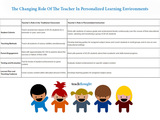
The changing uses of technology require that teachers adapt their methods of instruction as a result of student-directed learning. In response, teachers must shift from being holders and distributors of knowledge to becoming instructional facilitators who encourage students to direct their own learning.
Components of Teachers’ Shifting Roles
Of comparable importance, though, are the benefits that the implementation of new technologies can have on teachers themselves. Several tools are explicitly designed to support teachers. Social learning networks, e‐portfolios, and cloud computing platforms allow teachers to virtually collaborate to discuss best practices among teachers. For example, learning analytics might help teachers assess students’ instructional needs; teachers may gather instructional content from open content sources; and personal learning networks may help teachers combine and exchange instructional strategies.While the recent changes to the K-12 education landscape are primarily technological in nature, successful implementation of these tools is dependent upon teachers.
Hanover Research’s 2014 trends in K-12 education reiterate this emerging focus not just on educational technology, but also on the need to provide support systems to help teachers adopt and implement technology within the classroom. This trends analysis illuminates the rising focus on selecting and evaluating learning assessment tools to confirm their impact on student achievement. It also indicates the increasing need for benchmarking strategies to provide teachers with appropriate carve outs for collaboration time and professional development.
As the Next Generation Movement continues, teachers will continue to play a critical role in the implementation and success of new and emerging technologies. The effective application of adaptive technology hinges on the ability of teachers to adapt to and thrive in these changing times.
Learn more about new developments in the Next Generation Learning movement and trends in EdTech by viewing Hanover’s 2014 K-12 Education Market Leadership Report, or let us know your thoughts in the comments section below.
Amy Moynihan, a Content Manager at Hanover Research, is currently a Ph.D. candidate in Higher Education at The University of Virginia, Curry School of Education. She also holds a M.Ed. in Social Foundations from The University of Virginia, Curry School of Education and a B.A. from Columbia University, majoring in American History. Amy’s work experience includes serving as a Graduate Research Fellow at The Federal Executive Institute (FEI), the leading leadership development center in the federal government and Fight Crime: Invest in Kids, a national bi-partisan nonprofit organization focused on improving the lives of children. Connect with Amy via email at amoynihan@hanoverresearch.com; The Changing Role Of The Teacher In Personalized Learning Environments; image attribution pixabay
The post The Changing Role Of The Teacher In Personalized Learning Environments appeared first on TeachThought.
TeachThought Blog
.
Blog
.
<span class='date ' tip=''><i class='icon-time'></i> Dec 04, 2015 04:54am</span>
|
|
Cultural Exchange Program Seeks Young Adults
by TeachThought Staff and Hostelling International USA
Experiential learning. Cultural competency. The transformative power of travel.
These are probably concepts you’re familiar with, but for 18-23 year olds from Egypt, France, Germany, Lebanon, Tunisia, and the United States, these ideals will take on a whole new meaning this summer. Through a program called IOU Respect, four individuals from each of the countries listed above will be selected to participate in an intensive two-week program dedicated to exploring one another’s cultures, worldviews, and ways of life.
Held July 25-August 8, at the Yves Robert HI Hostel in Paris, France, the program is comprised of facilitated dialogue sessions, team-building projects, and group outings designed to increase participants’ knowledge of other cultures. At the same time, delegates are developing skills for intercultural communication and building lasting relationships on a foundation of appreciation, respect, and understanding.
Throughout the program, participants will be facing difficult topics head-on, including religion, stereotyping, international conflict, identity, discrimination, and privilege. "IOU Respect provided a safe environment for honest and candid dialogues," explained Gina Song, a 2014 IOU Respect participant. "We discussed topics that are normally viewed as contentious for everyday conversation. We agreed, we argued, we questioned, we reflected, but throughout it all, we learned to respect."
Participants are selected based on a competitive application process, in which applications are accepted through May 15. All program costs are covered for participants, including accommodations in Paris. To qualify, candidates must be a citizen from one of the six countries listed above and 18-23 years old.
This program is sponsored by Hostelling International (HI), a nonprofit organization with a global collection of more than 4,000 hostels in more than 80 countries. Interested candidates can apply through Hostelling International USA (HI USA), the US affiliate of HI. HI USA is a national nonprofit with a mission to create a more tolerant world, and programs like IOU Respect bring this mission to life.
Cultural Exchange Program Seeks Young Adults
The post Cultural Exchange Program Seeks Young Adults appeared first on TeachThought.
TeachThought Blog
.
Blog
.
<span class='date ' tip=''><i class='icon-time'></i> Dec 04, 2015 04:53am</span>
|
|
15 Ways To Make Testing Fun-Or At Least To Keep Your Sanity While It’s Happening
by TeachThought Staff
Right, so, testing. Bleh.
Let’s get through this together.
In most public, private, elementary school, middle school, high school, or higher education institutions, there is some form of formal assessment-a testing window that changes the climate of the school and the tone of your day from whatever it was before, to something a bit more rigid, focused, and probably stressed.
With that in mind, we thought a few tips might help get you through the testing period and ready to ease into those looming long summer mornings, afternoons, and nights. How much fun or relaxation these represent depend on who the fun and relaxation is for-students or teachers.
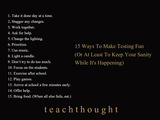
15 Ways To Make Testing Fun-Or At Least To Keep Your Sanity While It’s Happening
Take it done day at a time. This one sounds simple, but it can help. Feel free to keep a "X days left" countdown going on in your head, but try to teach and test and administer and lead students in the moment, one day at a time.
Stagger any changes. Too many changes at once-or even single changes with big impacts-can distract students, which stresses everyone, no?
Work together. Every teacher has a sweet spot-food, leadership, humor, games, planning-work closely together with other teachers to make the testing window as relaxing as possible for you and for your students.
Ask for help. (See above.)
Change the lighting. Turn the lights off. This can be relaxing for some. Too relaxing? Hang some holiday lights. Too gimmicky? Bring in some lamps. Depending on your students, this one may not work. Changing routine-or reducing visibility-may not be a good idea. That doesn’t mean that you can’t turn off the lights yourself when the students are out of the room and turn on some Mumford & Sons.
Prioritize. You may have a lot you want to do, but for the testing window, reprioritize for a smooth experience. If your principal or superintendent won’t let you, well, better to ask forgiveness than permission.
Use music. Speaking of Mumford & Sons, music can focus, relax, distract, energize-whatever you need to manipulate the little guys and gals. From Gregorian Chants to meditation sounds to, well, whatever it is the kids are listening to these days, music can help.
Light a candle. Cranberry, lavender can be relaxing, citrus energizing, and vanilla mood enhancing. (See more here.)
Don’t try to do too much. See also, "Prioritize."
Focus on the students. It’s not about you, or the school, or even the testing results; it’s about students. Education is for them, not us.
Exercise after school. Or do yoga. Or Zumba. Or kickboxing. Or Xbox Fitness, Sounds crazy, but try it. Being in shape-or just getting your heart rate up every day with something other than
Play games. This one can be touchy though-depending on your class, school, or other relevant circumstance, games can also be loud, distracting, and take away from assessment performance if poorly implemented. That said, done well Smart board, iPads, board games, chess, and other gizmos can go a long way to alleviate the pressure for students.
Arrive at school a few minutes early. Gather your materials, arrange any necessary testing or post-testing recreational supplies, or just do your "other stuff" that testing encourages you to otherwise backburner.
Offer help. (See above.)
Bring food. When all else fails, eat. Pot lucks, Jimmy John’s delivery-whatever it takes, food always wins.
And don’t forget-testing usually means summer is nearly here. No matter how much you love teaching, the school can exact a brutal toll on your body and spirit. The summer is a welcome respite to hone your craft, and refocus what you do and why you do it.
15 Ways To Make Testing Fun-Or At Least To Keep Your Sanity While It’s Happening
The post 15 Simple Tips To Keep Your Sanity During Testing appeared first on TeachThought.
TeachThought Blog
.
Blog
.
<span class='date ' tip=''><i class='icon-time'></i> Dec 04, 2015 04:53am</span>
|