Blogs
|
by Terry Heick Preventing bullying is just as likely as preventing poverty, racism, or violence. If we can start from this kind of humility, we may be able to...
The post The Definition Of Bullying In 2016 appeared first on TeachThought.
TeachThought Blog
.
Blog
.
<span class='date ' tip=''><i class='icon-time'></i> Dec 04, 2015 04:52am</span>
|
|
The Characteristics Of A Good School
by Terry Heick
When a society changes, so then must its tools.
Definitions of purpose and quality must also be revised continuously. What should a school "do"? Be? How can we tell a good school from a bad one?
This really starts at the human level, but that’s a broader issue. For now, let’s consider that schools are simply pieces of larger ecologies. The most immediate ecologies they participate in are human and cultural. As pieces in (human) ecologies, when one thing changes, everything else does as well. When it rains, the streams flood, the meadows are damp, the clovers bloom, and the bees bustle. When there’s drought, things are dry, and stale, and still.
When technology changes, it impacts the kinds of things we want and need. Updates to technology change what we desire; as we desire new things, technology changes to seek to provide them. The same goes for-or should go for-education. Consider a few of the key ideas in progressive education. Mobile learning, digital citizenship, design thinking, collaboration, creativity, and on a larger scale, digital literacy,1:1, and more are skills and content bits that every student would benefit from exposure to and mastery of. As these force their way into schools and classrooms and assignments and the design thinking of teachers, this is at the cost of "the way tings were."
When these "things" are forced in with little adjustment elsewhere, the authenticity of everything dies. The ecology itself is at risk.
The Purpose Of School In An Era Of Change
What should schools teach, and how? And how do we know if we’re doing it well? These are astoundingly important questions-ones that must be answered with social needs, teacher gifts, and technology access in mind. Now, we take the opposite approach. Here’s what all students should know, now let’s figure out how we can use what we have to teach it. If we don’t see the issue in its full context, we’re settling for glimpses.
How schools are designed and what students learn-and why-must be reviewed, scrutinized, and refined as closely and with as much enthusiasm as we do the gas mileage of our cars, the downloads speeds of our phones and tablets, or the operating systems of our watches. Most modern academic standards take a body-of-knowledge approach to education. This, to me, seems to be a dated approach to learning that continues to hamper our attempts to innovate.
Why can’t education, as a system, refashion itself as aggressively as the digital technology that is causing it so much angst? The fluidity of a given curriculum should at least match the fluidity of relevant modern knowledge demands. Maybe a first step in pursuit of an innovative and modern approach to teaching and learning might be to rethink the idea of curriculum as the core of learning models?
Less is more is one way to look at it, but that’s not new-power standards have been around for years. In fact, in this era of information access, smart clouds, and worsening socioeconomic disparity, we may want to consider whether we should be teaching content at all, or rather teaching students to think, design their own learning pathways, and create and do extraordinary things that are valuable to them in their place?
Previously we’ve assumed that would be the effect-that if students could read and write and do arithmetic and compose arguments and extract the main idea and otherwise master a (now nationalized) body of knowledge, that they’d learn to think and play with complex ideas and create incredible things and understand themselves in the process. That the more sound and full their knowledge background was, the greater the likelihood that they’ll create healthy self-identities and be tolerant of divergent thinking and do good work and act locally and think globally and create a better world.
A curriculum-first school design is based on the underlying assumption that if they know this and can do this, that this will be the result. This hasn’t been the case. We tend to celebrate school success instead of people success. We create "good schools" that graduate scores of students with very little hope for the future. How can that possibly be? How can a school call itself "good" when it produces students that don’t know themselves, the world, or their place in it?
So then, here’s one take on a new definition for a "good school."
The Characteristics Of A Good School
A good school will improve the community it is embedded within and serves.
A good school can adapt quickly to human needs and technology change.
A good school produces students that not only read and write, but choose to.
A good school sees itself.
A good school has diverse and compelling measures of success-measures that families and communities understand and value.
A good school is full of students that don’t just understand "much," but rather know what’s worth understanding.
A good school knows it can’t do it all, so seeks to do what’s necessary exceptionally well.
A good school improves other schools and cultural organizations it’s connected with.
A good school is always on and never closed. (It is not a factory.)
A good school makes certain that every single student and family feels welcome and understood on equal terms.
A good school is full of students that not only ask great questions, but do so with great frequency and ferocity.
A good school changes students; students change great schools.
A good school understands the difference between broken thinking and broken implementation.
A good school speaks the language of its students.
A good school doesn’t make empty promises, create noble-but-misleading mission statements, or mislead parents and community-members with edu-jargon.
A good school values its teachers and administrators and parents as agents of student success.
A good school favors personalized learning over differentiated learning.
A good school teaches thought, not content.
A good school makes technology, curriculum, policies, and its other "pieces" invisible. (Ever go to a ballet and see focus on individual movements?)
A good school is disruptive of bad cultural practices. These include intolerance based on race, income, faith, and sexual preference, aliteracy, and apathy toward the environment.
A good school produces students that know themselves in their own context, one that they know and choose. This includes culture, community, language, and profession.
A good school produces students that have personal and specific hope for the future that they can articulate and believe in and share with others.
A good school produces students that can empathize, critique, protect, love, inspire, make, design, restore, and understand almost anything-and then do so as a matter of habit.
A good school will erode the societal tendency towards greed, consumerism, and hording of resources we all need.
A good school is more concerned with cultural practices than pedagogical practices-students and families than other schools or the educational status quo.
A good school helps student separate trivial knowledge from vocational knowledge from academic knowledge from applied knowledge from knowledge-as-wisdom.
A good school will experience disruption in its own patterns and practices and values because its students are creative, empowered, and connected, and cause unpredictable change themselves.
A good school will produce students that can think critically-about issues of human interest, curiosity, artistry, craft, legacy, husbandry, agriculture, and more-and then do so.
A good school will help students see themselves in terms of their historical framing, familial legacy, social context, and global connectivity.
The Characteristics Of A Good School; image attribution flickr user usarmy
The post The Characteristics Of A Good School appeared first on TeachThought.
TeachThought Blog
.
Blog
.
<span class='date ' tip=''><i class='icon-time'></i> Dec 04, 2015 04:52am</span>
|
|
How Technology Changed My Social Studies Classroom
by Thomas Stanley
One of the greatest experiences I have had in teaching World History is to create a blended-learning class that is based on using technology with thematic learning, in-class activities, and world projects. When students can physically and intellectually wrap themselves around a subject doing real-world and simulated activities it helps them take their learning a mile deep.
The use of technology to do blended thematic learning is a great example of this type of teaching. To do this a teacher would teach all or part of their course based on the impact of such things as how technology, science, etc impacted the development of civilizations. This impact would be based on a student’s analysis of the social, economic, political, religious, family, and educational institutions in each area of the world or time period of history. You might also approach thematic learning by helping students learn to investigate how each region of the world developed based on a study of their art, literature, and music.
Another idea is to have traditional "class activities" can be made to come alive in each time period. For example, activities that are group-based can be scaffolded into interesting critical thinking exercises. An activity might ask the students to create their own civilizations along the early river valleys (a 2-person activity) and build into larger group activities such as whether the castles or cathedrals were the most powerful institutions during a countries middle ages. Other examples would include asking students questions like: "Did colonization drive the nation’s states or vice versa?," or "Can war be avoided?" or "How can we make a lasting peace, "What is the nature of modern warfare and how does it impact a civilization?" Any of these types of activities can be developed to create in-depth studies into certain time periods of history and include a plethora of amazing presentations and discussions using technology. In these cases, technology allows:
Collaborating in projects
Curation of content
Publishing of both learning products and learning process
Connecting globally
Finally, creating a global project that spans the entire semester or year that takes the place of the old Friday current events activity. For example, a teacher might ask students to study ancient issues that become modern problems and come up with solutions. Some exciting topics might include: the child soldier, refugees, ocean acidification, or other debatable issues.
The chance to discuss or collaborate with other nations or international organizations on any of these topics is a true project-based learning activity In each of these areas there are real world outcomes at can be presented at the end of the semester. An example of this was when some of my students studied the refugee issue, selected organizations to support, and created a "Rock for Refugees" project that raised money for international organizations they selected. There are many places to find such projects that include: the UN Julie Lindsay’s, Global School, Tracy Hanson’s NGGE or Yvonne Andres’s Global School net. Each of these methods are challenging ways to teach but, amazingly fun especially if you include the use of all the resources now available to the classroom. It can even include activities with other teachers or outside experts.
Thanks to the proliferation of technology the teaching of World History does and should not be centered exclusively around lecture and reading, but rather around questions and collaboration, and that’s a significant change. Done well, technology and students and inquiry and history and begin to come together to form a more powerful-and authentic-whole.
With technology in the Social Studies classroom the possibilities are endless, and the real challenge comes in knowing where to begin.
image attribution flickr user lefteris
The post How Technology Changed My Social Studies Classroom appeared first on TeachThought.
TeachThought Blog
.
Blog
.
<span class='date ' tip=''><i class='icon-time'></i> Dec 04, 2015 04:51am</span>
|
|
We’re Beta-Testing A Mobile Design During July
by TeachThought Staff
If you haven’t noticed, it’s July and kind of quiet around here as we gear up for the 2015-2016 school year and you get a bit of respite.
(In fact, you’re probably not even reading this, but we need to an ideal reader to write with in mind, so, you being the 33 year-old experienced teacher with 8 years of teaching experience and an interesting in new ways of teaching and learning in a connected society that you are, thanks for leaning in, here.)
While we have a few changes upcoming we’re hopeful about, most immediately we began beta-testing a mobile version of our site on July 1st. On a desktop, you won’t notice any differences, but you should have already have noticed if you’re on a mobile device. Or perhaps not-depends on your device, browser, and settings.
Our primary goals are speed and functionality. This beta-test addresses the former while we work on the latter. We’re in the process of curating our learning models and related visuals, making teaching tools easier to find, and in general index our content better with improved search and suggested search results. For now, hopefully it scales well to your device, and loads quickly.
Note, if you prefer the classic version (which is responsive, by the way), you can find the "Classic Version" link at the bottom. Click, and you’ll be swept away again to 2013.
So if you love it, hate it, or are indifferent email us and let us know. Who has the time, am I right? We get it. It’s July.
Do your thing.
The post We’re Beta-Testing A Mobile Design During July appeared first on TeachThought.
TeachThought Blog
.
Blog
.
<span class='date ' tip=''><i class='icon-time'></i> Dec 04, 2015 04:51am</span>
|
|
The Learning Innovation Cycle: How Disruption Creates Lasting Change
by Terry Heick
Disruption is an interesting topic for the same reason that cowboys, gangsters, and villains are interesting. It’s unpredictable. Problematic. Against the grain.
It’s kind of aging as a buzzword in the "education space," but it’s other-worldly powerful, and there are few things education needs more. How exactly it produces change is less clear, but I thought I’d create a model to think about. First, a quick preface. The iconic vision of disruptive innovation comes from Clayton Christensen, who uses the term to "describe a process by which a product or service takes root initially in simple applications at the bottom of a market and then relentlessly moves up market, eventually displacing established competitors."
"Companies pursue these "sustaining innovations" at the higher tiers of their markets because this is what has historically helped them succeed: by charging the highest prices to their most demanding and sophisticated customers at the top of the market, companies will achieve the greatest profitability. However, by doing so, companies unwittingly open the door to "disruptive innovations" at the bottom of the market. An innovation that is disruptive allows a whole new population of consumers at the bottom of a market access to a product or service that was historically only accessible to consumers with a lot of money or a lot of skill."
I usually think of disruption as any change that forces itself substantially on existing power sets. This force causes transfer-a redistribution of something-market share, money, credibility, knowledge, or something we collectively value. Here, in this literal re-vision (seeing again) and neo-vision (seeing new), is where enduring learning innovation can be born.
In education, most of the talk around disruptive innovation revolves around education technology, owing to the potential scale of these technologies, and desperation of education to revise itself. But innovation doesn’t necessarily have to be a matter of economics, as Christensen originally thought of the term, nor of technology, which is the most tempting angle. It can, but there are other disruptors that can lead to innovation that have little to do with either. What might be more interesting than the disruptors, then, might be the process itself. (See also, trends in education for 2015.)
Consider the following:
Disruptive Innovations In The Classroom
Disruptive innovations in the classroom should, ideally, obliterate the classroom. Make the classroom "be" something else entirely-a physical gathering space in preparation for something else, for example. I’ve written about in the past, mostly in terms of teaching forms, trends, technology, or teaching disruptively. By design (as I see it anyway), education should be inherently disruptive. That is, the ability to think critically should theoretically change both the systems and its parts.
Education and disruption share many connections. One relationship is cause-effect. Education should cause disruption of existing social paradigms, for example. And disruption of existing social paradigms should both need and create opportunity for new forms of education. It’s also a symptom. When there’s continuous disruption downstream-a classroom, for example-it can be traced upstream to something else. One goal for disruption in education should be the persistent emergence of new ideas-new learning models, new content, new strategies and thinking.
Okay, enough context. To visualize this cycle below, at each stage I’ll use the idea of electricity to better illustrate what’s (theoretically) happening.
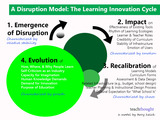
A Disruption Model: The Learning Innovation Cycle
1. EMERGENCE OF DISRUPTION
So, the electricity analogue-electricity has changed significantly over the last several hundred years, with many important developments-from DC power and batteries and generators and transformers, etc.-changing it in both form and function. To better understand how disruptive innovations in the classroom occur at this early "Emergence" stage, consider how ineffective and inaccessible electricity was from its early forms in the 1800s until as recently as the 1920s and 1930s. While exciting, only a very narrow minority saw its enormous potential, because really, how could you? Seeing the way electricity would change the world required you to "re-see" the world in light of electricity (as opposed to simply shoe-horning it in to one’s existing perception of things).
The big idea here is that, while potent, electricity didn’t change much for the average person from Alessandro Volta’s first battery in 1800, to 1920s and 1930s. Consider that the electric refrigerator was created in 1913, and it wasn’t until 1935 that the first nighttime baseball game was played in the United States.
The initial emergence of the disruptive innovation (you could think of it simply as the ‘thing that causes change’) is usually quiet and has its ultimate scale obscured (which is why, in the graphic, the circle is small and grey). Not everyone notices the disruption, or its significance. The duration of this stage of the process is inherently short because we’re talking about the initial emergence, not the full reality of.
This stage is characterized by relative stability, a fixed mindset of majority, and disruptive thinking by few. It is the inattention, inaction, or misunderstanding of the disruption by the majority that begins to lead to a shift in power, as those that respond (and respond "correctly") to the disruption can grow. For a company, this could mean rapidly increasing market share. For a school district, this could mean anything from confused parents to national significance as other schools and districts look to you for leadership.
At this stage, very little changes for most, and the ultimate success of any "innovation" is uncertain. As an additional analogue, you can consider mutations in the evolutionary process. The "success" of a mutation isn’t in its outward appearance, but whether it leads to a biological advantage that can be passed on. That takes time to play itself out.
2. IMPACT
The electricity analogue: Furthering the analogy of electricity consider how, after an initial period of relatively quiet emergence, there was soon to be some noise. While the impact really begins occurring right away, noise is the theme of this stage of the cycle of innovation. Almost every known every industry was deeply changed by electricity, including manufacturing, urban planning, medical care, transportation, and architecture. Each of these industries had to either adjust to new circumstances, or face obsolescence. If you’re a candle maker, and you just saw your first light bulb, how do you respond?
In general, the "Impact" stage of the learning innovation cycle is a bit more chaotic and exciting. At this stage, the disruption has created a mess of things-shifted perspectives, advantages, applications, resources, etc. A few examples in a school or district?
Effectiveness of Existing Tools
Learner & Teacher Roles
Credibility of Curriculum
Stability of Infrastructure
Emotion of Users
Pattern & Rhythm of Learning Ecologies
This stage is characterized by increased emotion-excitement, hyperbole, fear, uncertainty, and binary thinking. Because of the rapidly changing circumstances, the disruption is hard to understand. It’s not clear the way that iPads will change a classroom, or adaptive learning apps should change a curriculum-or the idea of a curriculum, for example. This uncertainty can be polarizing, creating a sense of enthusiasm and new possibility in some, while others see cause for concern.
This stage can also be characterized by reduced efficiency and overall stability of contexts (assessments, data, classrooms, etc.) The learning innovations that endure aren’t simply "born," but rather evolve over time as they are understood, reach tipping points, pivot themselves, or connect with other innovations to find new energy and application.
3. RECALIBRATION
After Emergence and Impact, Recalibration occurs for those left standing. Those that invested in (and around the possibility of) electricity would begin to see payoff here, but this stage is less about precise design and more about broad shifting. (See 7 Shifts To Create A Classroom Of The Future, for example.) While this stage has many possible indicators, progress and potential may be its defining examples.
Most significantly, the weaknesses of old thinking and tools and systems and approaches have been revealed to those paying attention. It is in this part of the cycle that the innovations and their potential become more visible than ever. As the circumstances around the innovation adapt to it, and vice-versa, any progress made can provide credibility, which encourages additional resources to be added, which can create more progress and credibility, and so on.
So what might this mean for your classroom? What kinds of recalibrations? Those related to:
Learning Models
Curriculum Forms
Assessment & Data Design
Related Infrastructure (e.g., budget, school design, learning spaces, learning feedback, function of education technology)
Teacher Planning & Instructional Design Process
Shared Concept Of for "What School Is"
4. EVOLUTION
At the final stage of learning innovation comes a period marked by intense evolution. This occurs not only as existing technologies enable subsequent discoveries, but also a growth mindset from individuals who, after seeing what’s now possible, can’t see the world any other way and insist on something different. Notice that in the model above, this circle is the biggest not only because of the length of time this stage in the cycle requires, but because the evolution is the most critical for innovation to endure.
This stage might be thought of as the payoff for all of the shifting and revision and angst. It is from these previous stages that broader vision can develop, which ultimately leads to more innovation. What exactly "evolves"? A few ideas are below. Note the shift from the initial Emergence and Impact stages, from tools and individuals and emotions to systems and vision and purpose.
How, Where, & Why People Learn
Vision & Self-Criticism as an Industry
Capacity for Imagination
Human Knowledge Demands
Expectation for Innovation
Purpose of Education
A Disruption Model: The Learning Innovation Cycle; The Learning Innovation Cycle: How Disruption Creates Lasting Change
The post The Learning Innovation Cycle: How Disruption Creates Lasting Change appeared first on TeachThought.
TeachThought Blog
.
Blog
.
<span class='date ' tip=''><i class='icon-time'></i> Dec 04, 2015 04:50am</span>
|
|
6 Factors Of Classroom Gamification
by Nellie Mitchell
I was 11 the year my summer camp director transformed the regular schedule, procedures, and lingo that we were used to—into the most memorable, enriching experience I had ever encountered at that point in my life.
I had no idea that he had ‘gamified’ the week; I just knew that it was the best summer ever. Instead of grouping us by numbers, we were named after the Greek alphabet. We competed daily against the other groups in volleyball, softball, kickball, and on the final night —a chariot and Olympic flame opened an epic Olympic Game contest at midnight.
The director, or ‘game master’ as we were inclined to call him, even made everyone reset the clocks and watches—so we never knew what the real time was, the entire schedule was set on some sort of crazy alternate schedule. Now I realize that it probably allowed him to sleep in and us to stay up later, but we were none the wiser.
Daily we played games, wrote skits, went swimming, and competed for cleanest cabins. We did all the regular stuff, but it was more fun because there were rules and boundaries and points and collaboration and competition and a clear, mutual understanding of goals and performance and criteria for success.
As a student, I got to learn more about the power of ‘gamifying’ something, and what effect it had on learners.
Gamification is about transforming the environment and regular activities into a kind of game. It is about creating a game out of things that are not normally thought of that way.
Gamification reinforces content, but also has the potential to profoundly impact classroom management.
Gamification is about collaboration and teamwork. Sometimes students are battling each other, and sometimes they are working together, but they are always learning!
Gamification is a long-term, consistent series of events that require quite a bit of prep work by the teacher, but has the potential to reinforce content and engage all learners in new ways.
Getting Started With Gamification
I have no doubt that the camp director spent hours analyzing the schedule, creating the concept, and modifying our basic procedures to meet the needs of the game. I hope he knows how worth it his effort was. That camp experience has been in the back of my mind ever since I started teaching middle school. I teach art and I’m always looking for ways to make it more relevant, current and enriching for every student, not just the gifted artists.
When the technology integration coach in my school district handed me a copy of The Multiplayer Classroom: Designing Coursework as a Game by Lee Sheldon, I was enthralled. The book was an easy read— cover to cover in just a few days. Lee Sheldon’s students are learning content through game play. College level coursework with students enrolled in a class devoted to designing video games.
In the book, Lee initiates game play in the syllabus. He analyzes how he made changes to the game through trial and error over the course of many semesters. Most of the ‘gaming’ was fantasy, special terminology used to jazz up regular coursework, with plenty of buy-in from students who were interested in gaming of all kinds, from athletic competition to board games to mobile, PC, and console-based video games.
After reading the book fairly quickly, and taking lots of notes, I developed some ideas for how to transform my own classroom into a gamified space in order to develop cross-curricular learning. I realized that my old game master was onto something brilliant—but it was no easy feat. (As a preface, you can read more about the difference between gamification and game-based learning here.)
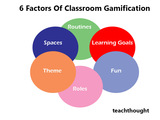
6 Factors Of Success In Gamification
1. Space
Think about how to transform your learning space into something that is conducive to collaboration. In my classroom, I created special zones, and rearranged the tables. Lee Sheldon suggests moving each team or group of students each week if your classroom is set up in rows instead of tables. Simple signage and clever names can help with this transformation.
2. Routines
Think about classroom jobs, procedures for tardies, restroom, library, drinking fountain, pencil sharpener, etc. Figure out how to inject those basic procedures into the game. Award ‘health points’ or take them away for tardies. Rotate roles. Make them characters. Make them good or evil, or steeped in historical or mythical lore, or give them creative backstories.
3. Learning Goals
No matter how engaging things are or transformative your approach, learning still matters. In fact, it is the habits students form while internalizing content that can create the most enduring change. What will they learn, and how?
You don’t have to start with learning goals, but you’ll obviously need to have them to keep curricular priorities straight, and to guide any assessment processes you depend on. This is obviously a key theme of any kind of instructional design process, including the following three driving questions:
What content or standards will be targeted?
How they can be assessed, ideally within the gamification framework?
How can you create flexible learning goals that strive to meet the needs of students of varying "content readiness," literacy levels, and background knowledge?
4. Fun
Instead of using research, send your students on quests. Make it competitive. Students love to compete against each other. Look at your content from a new perspective—could two or four groups ‘battle’ over the information by presenting and quizzing each other? You can also group students for cooperative competition, or simply cooperative learning journeys.
Leave no stone unturned. Create random events that impact XP or HP (experience or health points) in order to keep your students on their toes. You are the game master and you can change the rules at any time.
5. Roles
Plan to have your students develop some part of the gamification, or have clear and accessible roles within the framework you’ve designed-roles that have credibility with the student. They must buy into it, or else they will never fully commit. Allow them to choose their own team names or help establish some of the random events so that they have ownership over the game.
6. Theme
Gamification works because everything fits together in a way that makes sense. Use a theme related to your content, or a use a theme has terminology that reinforces vocabulary. The game master in my summer camp used Greek mythology and it was brilliant. Unforgettable!
One Tool To Consider
Once I had the basic idea for what I wanted to do, I realized that I would need a little help. I went in search of an online or app-based system to help me manage all of my ideas in order to implement them in a stream lined, successful, organized way.
When I found Class Craft, I was thrilled. Class Craft is an incredible program that helped me transform my summer school art enrichment program into an action packed game. 5th and 6th grade boys were begging me to do more research at home—-because it was part of the battle quests I had designed.
Class Craft allowed me to turn basic learning tasks into a real-world role-playing adventure. My students loved seeing their warrior or healer Avatar change as they unlocked new powers throughout the course. And they really, really loved having a pet!
In a few weeks, summer school will be over and I plan to reflect on the pros and cons of the system that I designed, so that I can tweak the things that worked or did not work in my classroom. This is definitely something that could work for me during the regular school year, but thankfully, I had the chance to try it out in a short-term, smaller scale program. Reflection and modification are a big part of the gamification process.
If you are considering implementing gamification into your classroom, but you do not know where to start, you might grab the book I mentioned above, or check out Class Craft. As the game master, you have the power to transform the regular schedule, procedures, and lingo that your students are used to—into a memorable, enriching experience, which just might be their best year ever.
Edited by Terry Heick (which explains any persisting needs for revision and editing); 6 Factors Of Classroom Gamification
The post 6 Factors Of Classroom Gamification appeared first on TeachThought.
TeachThought Blog
.
Blog
.
<span class='date ' tip=''><i class='icon-time'></i> Dec 04, 2015 04:49am</span>
|
|
4 Questions Every Teacher Should Ask About Mobile Learning
by Justin Chando, Founder & CEO, Chalkup
Untethered from desks, a tablet represents personalized learning potential for a student in ways we’re just catching up to. Truly; the promise of mobile is extraordinary.
With every historical date ever needed for World History 101 suddenly contained in the back pocket of your average American eighth grader, we find ourselves in a new environment for learning. And an awesome one.
As I see an increase in creative ways to keep learning alive after class, I’m interested in thinking about what we should be doing to ensure schools can reap the full benefits of mobile. Put simply, how do we do mobile learning programs right? How do we fully tap the potential of a device in the hands of a student?
I’m not interested in seeing the same classes and materials we had a decade ago (but now with Chromebooks!) I’m interested in learning from classes where the introduction of a device offers a level of personalized learning and connection to school that elevates a student’s experience in ways we couldn’t without technology.
On the front end of this conversation, what I’ve come up with are questions. Specifically, questions I think we should be asking at the beginning of mobile learning initiatives related to learning gains and learning culture. Here’s what I came up with.
4 Questions Teachers Should Ask About Mobile Learning In Their School
What can we do with a device that we couldn’t previously?
My instinct is to first talk out the basics. What do we get by adding devices to a learning environment?
This is the litmus test for ensuring we’re not adding technology just because we can. This question envisions what learning gains we can make with a device that we couldn’t without. The same assignment, activity, or exam on paper - done instead with an iPad - doesn’t seem like reaching new heights to me. Does it?
How will mobile increase learning gains for students?
Question number two is about learning gains. What I want to know is if we can actually create experiences with technology that will see students walk away with more knowledge applicable to the real world than they could have otherwise.
With a tremendous amount of rich content available to achieve this end, I wonder where the value is in digitizing the paper versions of assignments from years past. I’d imagine to make real learning gains, we must start thinking about new types of content better suited for this vastly different educational terrain.
How will devices pair with our current class culture?
Closely related to learning gains is examining class culture: as we adopt devices, we adopt the ability to access dates, equations, and definitions in seconds.
This isn’t an argument for doing away with exams or learning key skills, it’s acknowledging that if you or I wanted to know what year Richard Nixon was born, we’d probably pull out our phone and Google it. Why would we want a student to memorize that information? And what should we be doing instead of asking them to do that?
The one thing we can’t Google are authentic experiences and meaningful discussions. I would imagine that prior to starting a mobile learning program, we’d want to consider how to balance the power and potential of new devices against the supremely important role of the educator, asking ourselves how we’ll build these experiences, devices in tow.
What will be our key indicators of success?
This is a tough one. What really are the indicators of a successful mobile program? Test scores? Levels unlocked in the gamification of a lesson plan? Fluency across a range of programs? Discuss!
While I might not have answers to all of these questions yet, I like where the conversation is going. These are the topic areas we need to poke at if we want to build more impactful mobile learning initiatives. Look forward to learning more from everybody.
Justin Chando is the Founder and CEO of Chalkup, the world’s first class collaboration platform. Their new app for iOS is now available; 4 Questions Every Teacher Should Ask About Mobile Learning; adapted image attribution flickr user flickeringbrad
The post 4 Questions Every Teacher Should Ask About Mobile Learning appeared first on TeachThought.
TeachThought Blog
.
Blog
.
<span class='date ' tip=''><i class='icon-time'></i> Dec 04, 2015 04:49am</span>
|
|
30 Companies That Offer Teacher Discounts In 2016
by RetailMeNot.com
It’s no secret that back-to-school shopping gets crazy expensive for teachers. If they’re not shelling out money for art supplies and paper, they’re off buying fresh clothes and shoes. Luckily, the 30 retailers below want to help. From Apple to J.Crew, these companies offer exclusive discounts on just about everything a teacher could possibly need for the new semester!
As with any promo, do confirm that the deal is still in place before you order. But don’t be shy, either! If you don’t see your favorite big retailer, movie chain, museum or more listed here, give a call and ask if they participate in any teacher discounts.
30 Companies That Offer Teacher Discounts In 2016
Adobe
Whether you need Photoshop or Creative Cloud, Adobe offers education discounts you should totally take advantage of.
Aerosoles
All that standing takes a toll on your feet. Luckily, Aerosoles will give you 15% off super-comfy shoes priced at $39.99 or higher.
Apple
Apple offers an educator discount. An example? You can upgrade your Mac and save up to $200, or cut up to $20 off the price of a new iPad.
AT&T Wireless
Check to see if you’re one of the many eligible educators that can get discounts on your cellular plan. (All cell providers offer some teacher discounts, so ask yours if you’re not an AT&T customer.)
Banana Republic
Show your valid teacher ID in stores to get 15% off.
Barnes & Noble
Take part in the B&N Educators program to receive 20% off the publisher’s list price on all purchases for the classroom. Bonus: On Educator Appreciation Days, you’ll get up to 25% off.
The Container Store
Join the Organized Teacher program to get special discounts throughout the year. Keep that classroom contained!
Dick Blick Art Materials
With a free Dick Blick Preferred Card, you receive 10% off full-price purchases from Blick and Utrecht stores as well as discounts on bulk orders.
FedEx Office
Apply online for FedEx’s National Educators Discount Program, and you’ll receive 15% off most products and services at many FedEx Office locations.
Half Price Books
Get an Educator Discount Card to save 10% off all purchases at Half Price.
Hertz
Are you a member of the National Education Association (NEA)? Then you’ll save up to 25% when you’re renting a car, plus get some other perks if you book ahead.
J.Crew
Show a valid school ID at any J.Crew or J.Crew Factory Stores to get 15% off your purchase.
Jo-Ann
Get a Jo-Ann Teacher Rewards Discount Card and save 15% off your purchases.
Kennedy Space Center
Florida and Georgia K-12 teachers get free admission to the Visitor Complex and the Kennedy Space Center’s Educator Resource Center. Not from those states? Many museums and science centers across the country offer discounts to educators in the community, so ask!
Lakeshore Learning
Join the Teacher’s Club to get 15% off hundreds of in-store items.
Lenovo
Find discount laptops, tablets and desktop computers for your school!
The Limited
Flash your school ID to get 15% off.
LOFT
The LOFT Loves Teachers program gets you 15% off full-price purchases, special teachers-only sweepstakes opportunities and fun teacher appreciation nights!
Madewell
Teachers get 15% off. Just make sure to show your faculty ID!
Michaels
Need supplies for classroom crafts? Michaels will give you 15% off your in-store purchases every day.
NEA Magazine Service
If you’re a member of the National Education Association, you have the opportunity to receive more than 900 magazines at up to 85% off the cover price.
New York Times
Get online access to The Gray Lady for 99 cents for four weeks, then 50% off your subscription after that. (Home delivery discounts are available, too!)
Office Depot
Through September 1, get 25% off qualifying purchases and a free calendar filled with savings.
Pets in the Classroom
This awesome organization offers grants to pre-K through eighth-grade classes to help buy and support pets or aquariums in the classroom "for the purposes of teaching children to bond with and care for their pets responsibly." Just apply for a grant to get this lovely experience in your school.
Redbox
Get a free rental once a month with your International Teacher Identity Card.
Staples
With Staples Teacher Rewards, teachers earn 5% back for all purchases and 10% for teaching and art supplies. Free shipping is always included.
Target
If you have an International Teacher Identity Card, you get $5 off $50 and free shipping on select items at Target.com.
Theatre Development Fund
Hey, theater nerds, get your play on at great rates. Full-time teachers can join the Theatre Development Fund and get access to discount tickets ($9 to $47) to a ton of plays, musicals and dance performances in New York City.
Walt Disney World Swan and Dolphin Resort
Take that must-deserved vacation! Book online or call 1-888-828-8850 to ask for the teacher rate at Orlando’s Swan and Dolphin Resort.
West Elm
With a valid teacher ID, you’ll receive 15% off your purchases.
Don’t forget to add National Teacher Day to your calendar. It will be May 3, 2016!
30 Companies That Offer Teacher Discounts In 2016
The post 30 Companies That Offer Teacher Discounts In 2016 appeared first on TeachThought.
TeachThought Blog
.
Blog
.
<span class='date ' tip=''><i class='icon-time'></i> Dec 04, 2015 04:48am</span>
|
|
The First 6 Weeks: Strategies For Getting To Know Your Students
by Mike Anderson
One of our primary goals at the beginning of the school year is to get to know our students.
This is important for several reasons. First, the better we know our students, and the more they know we know them, the more invested they become in school. Also, a dynamic and vigorous learning environment is built on relationships. When we create strong connections with our students, we create a learning environment where risk-taking and collaborative learning can take place. Finally, the better we know our students, the better we can help craft learning experiences that match who they are. Knowing our students is fundamental to real differentiation.
Several of the ideas that follow are shared in my book, The First Six Weeks of School (2nd edition). A few others come from an upcoming webinar for teachers that I am presenting on August 27th. A couple of ideas are unique to this post. I’ve offered six different ideas for getting to know our students, one for each of the first six weeks of school, but once you get past the first one, there’s no magic to the order. Consider each as an idea that might help during this foundational time of the year.
Week 1: Learn Names
Is there anything more important and basic than learning students’ names early in the year? Make it your goal to have all names learned by the end of the first week. There are lots of practical strategies for learning names: wear name tags, play name games, use students’ names frequently, and of course, practice-practice-practice.
Week 2: Share Goals
What do your students hope to gain from this school year? Have them share their academic and social goals for the year. They might all fill in a questionnaire for you to read, or you might create a bulletin board where each student shares one personal hope or dream for the year.
Week 3: Get to Know Families
The more we know our students’ families, the better we understand our students, and the more connected our students are with school. Make it a goal to call each family in the first few weeks of school. Share a positive observation of their student, and then ask parents/guardians what you should know about their child to best teach them. You might also consider having families fill out a hopes and goals questionnaire about their children for the school year. I’ve done this many times, and it’s incredible how much you can learn!
Week 4: Birthday Cluster Activity
In his incredible book about child development in the classroom, Yardsticks, Chip Wood suggests an activity to get a sense of the developmental tone of your class. Make a list of your students in order of their birthdays (from youngest to oldest) and look for the cluster of students who all have birthdays within a few months of each other—almost every class has one. This group will often set the developmental tone for the room. If the cluster is on the young side, for example, your class will likely feel young. Knowing this about your class can help you better match your instruction to the class as a whole.
Week 5: Share Personal Artifacts
Invite students to share simple personal artifacts that help show their interests and passions. This might happen on an "All About Us" bulletin board, in a class scrap book, or on personal wall spaces—places where each student can post work, pictures, or other small items which help share who they are. These artifacts can serve as inspirations for writing personal narrative pieces, or, if displayed around the classroom, can be a fun way to play a personal scavenger hunt game. Of course, you will learn all kinds of great information that will help you tailor units and lessons to students’ interests!
Week 6: Don Graves Activity
I was lucky enough to attend a workshop once with Don Graves, an educator who helped reshape the teaching of literacy, and he did this activity with us. It is a great litmus test for how well we knew our students. Week 6 is a great time to try it yourself! Here’s how it works.
Create a three-columned chart on a piece of paper or on a simple table/spreadsheet on the computer.
In the left column, write your students’ names in the order in which you remember them. (Just this alone is interesting. Who do you remember first? Who do you struggle to remember?)
In the middle column, write down one positive thing about each student that doesn’t have anything to do with school work. (Jenny likes horses. Matt skateboards. Maria lives with her grandmother.)
In the third column, put a checkmark if you have talked with each student about this piece of knowledge. This helps us recognize how well we know our students, and—perhaps more importantly—how well they know we know them!
For students you struggled to remember, or for ones you didn’t know as much about, make a commitment to connect with them in the next few days.
These are, of course, just a few ideas. There are lots of other ways to get to know our students and build positive relationships with them. What are some other ideas you have tried? Share in the comments on this post so others can learn from you!
Have a great start to the year!
To learn more about the beginning of the school year, consider checking out The First Six Weeks of School or attending my upcoming webinar, The First Weeks of School: Best Practices for Teacher.
Mike Anderson is an award-winning educator (National Milken Educator Award and New Hampshire Teacher of the Year finalist) and author, whose books include The Well-Balanced Teacher: How to Work Smarter and Stay Sane Inside the Classroom and Out (ASCD, 2010) and The First Six Weeks of School, 2nd Edition. After 15 years as a classroom teacher and over six years as a consultant for a non-profit educational organization, Mike is now working as an independent consultant. To learn more about Mike and his work visit www.leadinggreatlearning.com; The First 6 Weeks: Strategies For Getting To Know Your Students; image attribution flickr user sparkfunelectronics
The post The First 6 Weeks: Strategies For Getting To Know Your Students appeared first on TeachThought.
TeachThought Blog
.
Blog
.
<span class='date ' tip=''><i class='icon-time'></i> Dec 04, 2015 04:47am</span>
|
|
"We shouldn’t assume people know what digital citizenship is."
by David Ryan Polgar and Marialice B.F.X. Curran, DigcitSummit.com
Digital Citizenship is huge.
Or so it seems by the countless articles we read on the topic each week. As plugged-in educators who are putting together the first annual Digital Citizenship Summit, we are swimming in a sea of amazing advice concerning cyberbullying, empathy online, public shaming, tech balance, digital tattoos, and more. To us, it often seems like everyone is well-versed in digital citizenship and everything it entails. They’re not.
Planning the Digital Citizenship Summit has provided us with a great deal of insight into how the digital citizenship community, and education world at large, can better promote the concept of digital citizenship. We have been able to see firsthand the major gap in understanding between digital citizenship evangelists and the general masses, and have discovered some potential ways to decrease the gap.
We can no longer assume students know what digital citizenship is.
It is easy to get caught up in "echo chamber effect" online, where we are constantly surrounded by the topic of digital citizenship and then have our impression reinforced by other equally invested individuals. During our outreach, it has become apparent that the understanding level towards digital citizenship is highly concentrated in academic circles. One of our goals with planning the Digital Citizenship Summit is to increase overall awareness topic: what we have learned is that the community may need to focus more attention on adequately explaining what digital citizenship is.
Why is this a challenge? The very broadness of the term digital citizenship sometimes presents an issue. Terms such as cyberbullying, tech etiquette, or public shaming are self-explanatory in nature. Digital Citizenship, on the other hand, requires a certain level of background. The definition that we have been using is from Mike Ribble/DigitalCitizenship.net: "Digital Citizenship is the norms of appropriate, responsible tech use." (Ed note: Here is another definition for digital citizenship.)
The communication breakdown that often occurs revolves around taking that abstract language and turning it into something more concrete. The general public is widely supportive of digital citizenship once they understand what it is, but that requires quick, concrete examples that can be visualized and appreciated.
The popularity surrounding Monica Lewinsky’s recent TED talk offers an illustration for the potential of digital citizenship. Everything she is discussing deals with "appropriate, responsible tech use." The more that we can connect those issues with digital citizenship, the more the general public will understand its very significance.
There is an incredibly passionate community waiting to be brought together.
The outpouring of support, advice, and collaboration after we announced the Digital Citizenship Summit has been incredibly heartening. People have seemingly come out of the woodwork. Which begs an important question: why were they in the woodwork?
What we learned is that the the community still operates around a few particular circles (often with an influencer at the center). It is easy to think that you know the entire community when in fact you just know your entire circle. There are a tremendous amount of untapped circles that can offer their voice in shaping the digital citizenship conversation.
Our goal with the Digital Citizenship Summit was to bring together those silos digitally through outreach, along with the #digcit chat (every Wednesday at 7 pm EST), and then physically on October 3rd at the University of Saint Joseph (West Hartford, CT).
There should also be ways to build upon best practices. By and large, the digital citizenship community is highly collaborative and looking to share material. An educator is Florida should be able to build upon the work of an educator in North Dakota. There is a still ways to go towards working in a more collective fashion.
It’s time to bring in other stakeholders.
There are a wide variety of stakeholders who have an important role to play in shaping the conversation around digital citizenship. What we have learned in planning our event is that they are often not in direct contact. How do we bring together educators, parents, students, organizations, and industry? The dialogue between parents and educators, in particular, has been a major source of frustration and dispute around appropriate tech use.
One lesson we have learned is that we can increase the level of understanding amongst stakeholders by doing a better job communicating the value of digital citizenship with more approachable language. We also see a need to have the different groups come together in the same location. There will be massively different opinions, but we should embrace the diversity of thought as we shape the conversation.
Lastly, we have learned that there is still a significant need to bring together educators and industry. A common criticism of tech companies is that they often push out their products without adequately considering the societal impact. The digital citizenship community could offer a great deal of insight and advice towards what safe, savvy, and ethical tech use entails. Mr. Zuckerberg, tear down that digital wall.
Digital Citizenship really is huge. What we’ve noticed from our struggles and successes so far with the Digital Citizenship Summit is that with increased clarity and collaboration it will only get bigger.
"We shouldn’t assume people know what digital citizenship is."; adapted image attribution flickr user sparkfunelectronics
The post "We shouldn’t assume people know what digital citizenship is." appeared first on TeachThought.
TeachThought Blog
.
Blog
.
<span class='date ' tip=''><i class='icon-time'></i> Dec 04, 2015 04:46am</span>
|