Blogs
|
Teacher Wish Lists: Because School Supply Shopping Goes Year-Round
by Tim Sullivan, TeacherLists.com
The New York Times recently published a story about back-to-school spending in 2015 with a simple irony at its core: While parents are spending less overall on the necessary supplies, back-to-school lists sent home every year keep getting longer.
Items on a basic back-to-school list don’t change that much each year, so why are school supply lists getting longer? What millions of parents are seeing is the addition of items used by the entire classroom. While pencils, paper and a good old-fashioned calculator are still common back-to-school hallmarks, increasingly these lists are populated with paper towels, tissues, hand sanitizer and art supplies, as well as requests for extra pencils, pens, markers and crayons so that students lacking these items still can participate in classroom activities.
It’s not just parents feeling the burden. A study published last year showed that teachers are spending an average of $400 out-of-pocket on extra supplies as well. Many teachers are parents themselves, meaning they can end up footing a $400 bill for their classrooms in addition to the estimated $600 a typical family spends on school supplies, backpacks and clothing.
The good news is that the beneficiaries of longer school supply lists are always children. In some cases, particularly in large metropolitan areas, those supplies are used by students who are homeless or living in extreme poverty to give them the same quality of education their classmates receive. Parents grumble when asked to provide extra pencils and sanitary wipes every year, but most understand it’s because increasing student needs run simultaneously with decreased classroom funding. It’s a shared burden, but it still begs the question:
What’s the solution? The Times piece stops short of providing one, and with good reason. Any school funding discussion inevitably becomes political, and unfortunately, there are very few in the education industry creating solutions and contingency plans in the face of limited resources.
The need for a contingency plan is what inspired us to develop the Wish Lists function at TeacherLists. Though we already host over 1,000,000 school supply lists, which can be updated, sent and accessed anytime online, we’re very much in touch with what both teachers and parents go through during the back-to-school season. Instead of asking for a major investment up front, we’re helping both teachers and parents pace themselves.
Wish Lists are free to use, and allow teachers to organize those extra supply requests into a separate list that can be updated anytime year-round. If a classroom is running low on art supplies or sanitary items in, say, November, teachers create a Wish List that sends an email to parents asking them to pitch in instead of just sticking them with a one-time burden (and bill) every August.
It’s important to remember that as parents, educators or both, we are in the business of putting students first. To use a sports analogy, "we’re all on the same team." How can you help ensure that every student receives the same educational opportunities despite the challenges in our industry? How can you help a teammate today? Pick up a box of tissues when you get a Wish List request in November instead of buying 10 in late August. That isn’t just a start — it’s a solution.
Tim Sullivan is the founder and president of TeacherLists- the first and only digital platform modernizing the school supply list process for all schools, all teachers and all parents. Completely free-of-charge for schools, the TeacherLists platform ends the days of mailing paper lists, endless and ineffective photocopies in plastic bins in store aisles and never-ending phone calls to the school office about lost lists; Teacher Wish Lists: Because School Supply Shopping Goes Year-Round
The post Teacher Wish Lists: Because School Supply Shopping Goes Year-Round appeared first on TeachThought.
TeachThought Blog
.
Blog
.
<span class='date ' tip=''><i class='icon-time'></i> Dec 04, 2015 04:21am</span>
|
|
2,589 Classic MS-DOS Video Games You Can Play From Your Browser
by TeachThought Staff
If you’re of the correct vintage, you probably remember a game called Oregon Trail. It was a video game that let you drown, starve to death, and suffer from dysentery while depending on a wagon with wheels apparently made of glass. It made Social Studies teachers feel good about video games (how could it not?), and instantly became a kind of early icon for what could be considered a learning simulation.
Before Windows (and to a degree, Macintosh) became the standard for desktop computer user interfaces, there was DOS and its command line that refused to do anything it wasn’t scripted to do by the user. And before the original Nintendo (released in the United States in 1985), there were MS-DOS Games. Scores of the game of widely varying degrees of quality, tone, and execution. Drug Wars or Donkey Kong, it was all there.
And the MS DOS-game era (as it was) continued for much longer than you might’ve thought. The presciently-named Beneath Apple Manor was published in 1978, but MS-DOS releases within the archive continued until 1999, even as console systems from Sega, Sony, Microsoft, and more found mass appeal. SimCity. Wolfenstein. Paperboy 2, Joust. Ghosts N’ Goblins. Master of Orion. Civil War. Where in the World Is Carmen Sandiego Deluxe?. All available, with scores of others you’ve never heard of.
And all available to play right from a web browser through the miracle of software emulation. This is the Internet Archives collection for MS-DOS video games.
"Software for MS-DOS machines that represent entertainment and games. The collection includes action, strategy, adventure and other unique genres of game and entertainment software. Through the use of the EM-DOSBOX in-browser emulator, these programs are bootable and playable. Please be aware this browser-based emulation is still in beta - contact Jason Scott, Software Curator, if there are issues or questions. Thanks to eXo for contributions and assistance with this archive."
You can also find a curated version of the same collection-the Showcase-here. For that matter, the idea and execution behind the Internet Archives in general is worth a look.
Doom-The Roguelike! Swoon!
MS-DOS Games: A Stunning Classic Video Game Library; 2,589 Classic MS-DOS Video Games You Can Play From Your Browser
The post 2,589 Classic MS-DOS Video Games You Can Play From Your Browser appeared first on TeachThought.
TeachThought Blog
.
Blog
.
<span class='date ' tip=''><i class='icon-time'></i> Dec 04, 2015 04:21am</span>
|
|
Preparing Students For A Modern Economy
by Terry Heick
Doing some reading (and listening) on competency-based education recently, I was both intrigued and concerned. The concern came recently after listening to a higher ed chancellor celebrate the source of his university’s curriculum. It was during a panel discussion on Competency Based Learning, where he explained the research for the prioritized competencies began with "federal skills databases."
This sounds innocent enough. Even efficient. Among the benefits of this approach? Less "educational waste." Learn the skills that companies want you to have. Produce more "hire-able" graduates. Slow the production of "employees" with $60,000 in debt while working retail and fast food and drowning in debt.
It’s difficult to argue against precise curriculum that produces graduates that can better support themselves in a modern economy. The difficulty lies in the terms-who creates them, and the language used as their description.
The Characteristics Of Competency-Based Education
Competency-based education is individualized-or should be. The focus is on students mastering given competencies. It’s clear, adjustable for unique student needs, and efficient. Characteristics of competency-based education include:
Competency-based education is no longer time-bound: Focus on mastery rather than time; asynchronous
Competency-based education makes it simpler to prioritize specific content.
Competency-based education reduces "curriculum clutter."
Competency-based education values performance-based assessments over more academic forms (e.g., multiple choice exams).
Mastery is valued over grades (which is hard to argue against)
Deb Everhart at Blackboard explains.
"The pressure to make higher education more accessible and affordable also comes at a time when there is a huge mismatch between what employers need and what traditional education is providing. A recent Lumina Foundation/Gallup study yielded this startling finding: 96% of chief academic officers rate their institutions as effective in preparing students for the world of work, while only 14% of Americans agree, and only 11% of business leaders agree that graduates have the skills and competencies their businesses need.
And it’s not just a difference of opinion. Even in this time of stubborn unemployment, 40% of U.S. employers report difficulty in filling jobs due to a lack of applicants with appropriate skills, with the talent shortage most acute in skilled trades. More than half of employers state that this gap has a significant impact on their businesses."
The American Enterprise Institute is even more direct, advising that "Institutions offering CBE programs should partner closely with employers to help students attain the general and specific skills they need to succeed in the labor market."
And I get it. When universities graduate students with "non-marketable skills," that’s a problem. The caricature here is the Humanities graduate working retail or fast food (maybe both), while the MBAs run the world. The goal of K-12 can’t be "career prep." But what about college? Isn’t that the point of college-to hone generalized knowledge into something "useful"?
Errr, kind of.
There is some frustration, and even loss, in gathering seemingly loosely connected skills and understandings (from the various classes in a traditional undergraduate program) into a credible, hire-able aesthetic employers will respond to when the students become employees. Yes, you could have Apple, Uber, Amazon, and Ford "collaborate" on a "curriculum" that would produce-like a widget-filled conveyor belt-employees ready to make those companies some dough.
But schools don’t graduate employees, they graduate human beings. And just as universities haven’t been "job training facilities," more immediately, neither has K-12. The rub comes when universities seek to revise themselves. The more connected K-12 is to university goals and aspirations, the more K-12 is on the hook here as well to "tighten the curriculum" to make it "more efficient."
To straighten and shorten the path from student to "job."
Jobs Are Gross; Work Is Love
A job is to work as a single instrument is to a symphony.
A job is a single episode of Seinfeld in a 9 year run.
A job is a mold that a person either fits or does not.
A job is granular; one’s life’s work is whole.
The "loss" embedded within a Humanities or Engineering degree is only a loss judged by the mold itself. The person entering the mold will likely leave it again, and that previous loss can be re-evaluated.
Jobs are gross-at times necessary, but mostly molds created by industry that dehumanize people while doing untold damage to communities, ecologies, and fundamental human aspiration. They stunt the vision a person might have to create a life, and make their work a part of it. Their episodic nature stifles intellectual momentum, and a sense of self.
Work is different. Work is what a person bears upon the world with their own hands, with creativity, vision, and affection. Work is love-natural extensions of the person in their native place. Education should, at least in part, prepare students for that. But in thinking like this, we’re lowering our sights from person and place to job and market. When we seek to train students, we have to ask ourselves what we’re training them for, and make sure we can live with the consequences.
Competency-based education doesn’t demand narrow job training, but it is absolutely a shift from people to companies. So where’s the light here? Consider a different scale; the best education will transcend notions of job and career and profession and work; it will prepare students for any of these scenarios and more, while requiring none to inform their design.
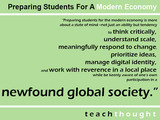
Preparing students for the modern economy isn’t about streamlining job-training, especially for jobs that will not only change often, but disappear more quickly than any generation in history. Skills matter, but preparing students for the modern economy is more about a state of mind-one that can, among other tendencies, think critically, understand scale, meaningfully respond to change, prioritize ideas, manage digital identity, and work with reverence in a local place while being keenly aware of one’s own participation in a newfound global society.
The post Preparing Students For A Modern Economy appeared first on TeachThought.
TeachThought Blog
.
Blog
.
<span class='date ' tip=''><i class='icon-time'></i> Dec 04, 2015 04:20am</span>
|
|
60 Things Students Can Create To Demonstrate What They Know
by Ryan Schaaf, Notre Dame of Maryland University
When I was a high school student, I had the privilege of having a wonderful English teacher. She was kind, often helped her students, and created a wonderful classroom environment that was rare in my high school experience. To this day, I regard her as a great educator; one of the very best. Due to her help, I improved my writing abilities to the point I moved ahead to an Honors course the very next year.
As I now reflect upon her and my learning experiences fondly, I had only one criticism - I did the same type of work day in and day out. Although repetition is a tried and true method for learning, performing the same academic exercises over and over again really left a great deal to be desired. I wanted to express myself in new and different ways. After all, variety is the spice of life.
Nowadays, many educators use the same methods over and over again in their lessons for students to express themselves and demonstrate their new knowledge. Today’s students want to express themselves in a variety of different ways. They want their academic work to be relevant, engaging and fun.
Below is a diverse list adapted from resources found at fortheteachers.org of potential student products or activities learners can use to demonstrate their mastery of lesson content. The list also offers several digital tools for students to consider using in a technology-enriched learning environment.
60 Things Students Can Create To Demonstrate What They Know
Audio Recording (try Vocaroo)
Acceptance Speech
Advertisement
Avatar (try Voki)
Blog (try Edublogs)
Book Jacket
Brochure
Bulletin Board
Cartoon
Class Book
Collage (digital and non-digital)
Comedy
Comic Strip (try BitStrip)
Commercial
Dance
Debate
Demonstration
Discussion (try Voicethread)
Diorama
Drawing
Experiment
Flow Chart
Games (digital and non-digital)
Google Earth Tour
Graph
Graphic Organizer
Infomerical
Interview
Photo
Portfolio (try Evernote)
Puppet Show
Learning Log
Literature Circle
Magazine
Maps
Mind Map (try bubbl.us)
Mural
Music
News Report (try Fodey)
Poetry
Reenactment
Role Play
Scavenger Hunt (try QR codes)
Scrapbook
Sculpture
Show & Tell
Simulation (digital and non-digital)
Slideshow
Socratic Discussion
Song
Story Map
Speech
Tag Cloud (try Wordle)
Theatrical Play
Timeline (try Timegrinder)
Video
Webpage (try Weebly)
Word Splash
Word Wall
Wiki (try Wikispaces)
60 Things Students Can Create To Demonstrate Understanding
The post 60 Things Students Can Create To Demonstrate What They Know appeared first on TeachThought.
TeachThought Blog
.
Blog
.
<span class='date ' tip=''><i class='icon-time'></i> Dec 04, 2015 04:20am</span>
|
|
Transgender Teacher? That’s Me
by Sophie E. Gilbert
I heard about One Teacher in Ten in the New Millennium through a Facebook group for transgender professionals.
It was the summer of 2014 and I was fully transitioned in my personal life, with my workplace transition still to come. I wrote my essay "There is Uncertainty, but There is Also Hope" about the concern I had that the rural high school where I worked might reject me for being transgender.
A couple of months later, I revealed my plan to transition to my principal. He seemed somewhat amused at first, but he quickly assured me of his support. Within a few days, the superintendent informed the school board of my plan in closed session, and then he held meetings to create a plan of action. During the week before Thanksgiving. I was to tell teachers and staff in a meeting after school that Monday, with a letter informing parents mailed out the following day. On Friday I was to say a few words to my students in my classes. After Thanksgiving, I would show up to school as my true self.
I began the week of the big revelation by speaking of the urgency I felt in making this transition as I watched my colleagues’ solemn faces. After the meeting, many came over to offer their support.
By Wednesday, the entire school knew. As the mail came to the homes of my students, parents began texting their kids. My principal said he could see the message spread across the school commons during lunch, one kid getting a text and then telling others, who then told even more. He peeked into my afternoon classes to make sure I was okay. If my students knew, they showed no sign of it.
Since we assumed the students already knew, I felt it was best to have my talk with them on Thursday. The superintendent wanted to wait until every single parent had the letter, but he reluctantly allowed me to move forward. I was to wait until near the end of each class period. The principal would enter and make opening remarks on the subject. Then, I was to tell a greatly abbreviated version of the speech I gave the faculty. Afterwards, the biggest concern that students expressed to me was that I might not be their teacher anymore. I assured them that I would be their teacher at least for the rest of the school year. I kept that promise.
That evening, the principal informed me that a parent had sent the letter to a local news station, which was sending a crew out the next day. Initially I refused to be interviewed or filmed, but I relented when I realized that they were going to out me on television with or without me. I told my story to the entire county on my last day as the gender I was assigned at birth.
When I saw the news story later that evening, I wondered if it had been the district that alerted the media. It was too neat. The piece cast the best possible light on the district’s handling of my transition.
In my first week as a female teacher, parents expressed concerns that I was going to use the girl’s restroom, that the students would be too distracted by my appearance, that I was doing this to indoctrinate my students with liberal views. Two families pulled their children from my class. Both students sat in the office to complete assignments that I sent for them.
Since I was to have no direct contact with either student, I was unable to monitor them and check for understanding. Both students had not turned in work I sent for them. When I submitted final grades for the first semester, the principal pulled me into his office to question me on why the grades of both students dropped after they left my class.
After winter break, the superintendent insisted that he examine all of my students’ papers to satisfy the families of the two students. They were claiming that I was biased against them for taking the students from my class. Of course, they had no problem showing bias against me by pulling those students in the first place. I was pressured about every instructional choice I made after that, until they informed me that they intended to non re-elect me. After it was official that I was not coming back, the administration ignored me for the remainder of the school year.
In the previous year, the same principal expressed how pleased he was with my teaching, and how thankful he was that I signed my letter of intent to return. In my fifteen prior years as a teacher, I never had a bad evaluation. Ever.
After numerous interviews this past summer, I accepted an offer to teach at a continuation school in San Jose. My new students are good kids who have been through many trials in their young lives, and my recent struggle only makes me better able to relate to them. I feel completely accepted on campus. If I had somehow survived at my previous school, I doubt I would have ever felt the acceptance I now feel.
I am a teacher who happens to be transgender, and I will continue to teach for as long as I choose. There will always be uncertainty in life, but now I know that hope can lead me through darkness and help me find the light.
Transgender Teacher? That’s Me
The post Transgender Teacher? That’s Me appeared first on TeachThought.
TeachThought Blog
.
Blog
.
<span class='date ' tip=''><i class='icon-time'></i> Dec 04, 2015 04:19am</span>
|
|
Blog Your Way To Connected Professional Development
by Mike Fisher
Professional learning, even 15 years into the 21st Century, still tends to lean toward a "one size fits all" model.
Educators go to workshops, participate in local PD, or read professional books. While the information gained may be valuable, it isn’t always completely relevant to contemporary teachers who need solutions and actions that are just in time rather than just in case.
One way to approach just in time professional learning and to get connected to other educators that care about the same issues you care about is to start reading and writing blogs. Blogs represent an opportunity for educators to not only connect to others and but also to personalize their professional development based on what is relevant and specific to their instructional practices and professional needs.
Blogging represents opportunities to start conversations, share professional stories, share new ideas, take a stand on an issue, or carve out a professional niche. When you write blogs, you share unique perspectives on your experiences. When you read blogs, you discover unique ways to improve your professional practice. When you respond to blogs you’ve read or interact with respondents on blogs you wrote, you open up a whole new world of professional communication and collaboration opportunities.
Reading, Writing, and Responding to blogs leads to conversations, other writings and professional resources, and sometimes, even real life meetings. This level of connectivity isn’t dependent on anything external that one might have to wait on: published books, future scheduled workshops, year-end assessment data, etc. You only need a little bit of time and a device to plug into this already available network.
If you’re looking to get started with professional learning through reading blogs that are relevant to your interests or subject areas, look to ASCD EDge, Jerry Blumengarten’s CybraryMan Resources, Smartblogs on Education, TeachThought, Teach100, and Curriculum 21’s Clearinghouse.
You could also consider writing your own blog using a variety of services: Blogger, WordPress, Edublogs, or ASCD EDge. Reading and writing blogs gives educators fresh opportunities for relevant information and connections to other professionals who have similar interests. As we begin Connected Educator Month, blogs are a wonderful way to connect, interact, learn, and share as a Networked Contemporary Educator.
Download a free copy of Mike Fisher’s book, Digital Learning Strategies: How do I assign and assess 21st century work?, courtesy of Mike and ASCD as a limited-time offer for Connected Educator Month (CEM) 2015. ASCD is leading the CEM theme, "Innovations in Professional Learning," and will be sharing free and discounted resources all month.
Mike Fisher is a former teacher who is now a full-time author, consultant, and instructional coach. He is the author of Digital Learning Strategies: How do I assign and assess 21st Century Work? and the co-author of Upgrade Your Curriculum: Practical Ways to Transform Units and Engage Students, both published by ASCD. He works with schools around the country, helping to sustain curriculum upgrades, design curriculum, and modernize instruction in immersive technology. His website is The Digigogy Collaborative and he can also be found on Twitter as @fisher1000
Blog Your Way To Connected Professional Development; Image attribution flickr user vancouverfilmschool
The post Blog Your Way To Connected Professional Development appeared first on TeachThought.
TeachThought Blog
.
Blog
.
<span class='date ' tip=''><i class='icon-time'></i> Dec 04, 2015 04:19am</span>
|
|
by TeachThought Staff
Want to hear an amazing story involving 3D printers, hikers, the atmosphere, and more than a little bit of luck? From the original reddit post:
The whole project took myself and four friends a couple months of planning. We almost canceled the whole thing because helium cost 4x more than we were budgeting. As for the communications and attempted recovery (warning, about to get technical):
We used GPS on a smartphone to continuously log the phone’s location on its memory card. The standard GPS receiver these days can track your phone well above 100,000 ft - there used to be a limitation of 60,000 ft but that was recently lifted. The harder issue was to figure out how the phone can communicate to us. We used an app (myTracks or something similar, I forgot) to have the phone text us its GPS location once it got signal as it was returning to Earth (about ~3000 ft altitude).
We planned our June 2013 launch at a specific time and place such that the phone was projected to land in an area with cell coverage. The problem was that the cell service coverage maps we were relying on were not accurate, so the phone never got signal as it came back to Earth, and we never heard from it. We didn’t know this was the problem at the time - we thought our trajectory model was far off and it landed in a signal dead zone (turns out the model was actually quite accurate). The phone landed ~50 miles away from the launch point, from what I recall. It’s a really far distance considering there’s hardly any roads over there!
TWO YEARS LATER, in a twist of ironic fate, a woman who works at AT&T was on a hike one day and spotted our phone in the barren desert. She brings it to an AT&T store, and they identify my friend’s SIM card. We got the footage and data a few weeks later!
And a few more tidbits from their YouTube video description,
In June 2013, a group of friends launched a weather balloon a few miles from Tuba City, Arizona. The amazing footage was found two years later by an Arizona hiker. Enjoy the video of our launch preparations, video footage, and some data analysis of the flight.
Max altitude: 98,664 ft (30.1 km)
Time of flight: 1 hour, 38 minutes
Payload: GoPro Hero3, Sony Camcorder, Samsung Galaxy Note II phone. The GoPro and camcorder were recording video footage, while the phone was taking still images. More photos to come, shortly!
Team members: Bryan Chan, Ved Chirayath, Ashish Goel, Tyler Reid, Paul Tarantino
Special thanks to Broadcom
Find more about the science here: High altitude GPS: http://www.stanford.edu/~tyreid/balloons Fluid Lensing: http://www.vedphoto.com/balloon
Amazing!
The post They Put A GoPro On A Balloon That Went To The Stratosphere appeared first on TeachThought.
TeachThought Blog
.
Blog
.
<span class='date ' tip=''><i class='icon-time'></i> Dec 04, 2015 04:18am</span>
|
|
Blogging Your Way To Connected Professional Development
by Mike Fisher
Professional learning, even 15 years into the 21st Century, still tends to lean toward a "one size fits all" model. Educators go to workshops, participate in local PD, or read professional books. While the information gained may be valuable, it isn’t always completely relevant to contemporary teachers who need solutions and actions that are just in time rather than just in case.
One way to approach just in time professional learning and to get connected to other educators that care about the same issues you care about is to start reading and writing blogs. Blogs represent an opportunity for educators to not only connect to others and but also to personalize their professional development based on what is relevant and specific to their instructional practices and professional needs.
Blogging represents opportunities to start conversations, share professional stories, share new ideas, take a stand on an issue, or carve out a professional niche. When you write blogs, you share unique perspectives on your experiences. When you read blogs, you discover unique ways to improve your professional practice. When you respond to blogs you’ve read or interact with respondents on blogs you wrote, you open up a whole new world of professional communication and collaboration opportunities.
Reading, Writing, and Responding to blogs leads to conversations, other writings and professional resources, and sometimes, even real life meetings. This level of connectivity isn’t dependent on anything external that one might have to wait on: published books, future scheduled workshops, year-end assessment data, etc. You only need a little bit of time and a device to plug into this already available network.
If you’re looking to get started with professional learning through reading blogs that are relevant to your interests or subject areas, look to ASCD EDge, Jerry Blumengarten’s CybraryMan Resources, Smartblogs on Education, TeachThought, Teach100, and Curriculum 21’s Clearinghouse. You could also consider writing your own blog using a variety of services: Blogger, WordPress, Edublogs, or ASCD EDge.
Reading and writing blogs gives educators fresh opportunities for relevant information and connections to other professionals who have similar interests. As we begin Connected Educator Month, blogs are a wonderful way to connect, interact, learn, and share as a Networked Contemporary Educator.
Download a free copy of Mike Fisher’s book, Digital Learning Strategies: How do I assign and assess 21st century work?, courtesy of Mike and ASCD as a limited-time offer for Connected Educator Month (CEM) 2015. ASCD is leading the CEM theme, "Innovations in Professional Learning," and will be sharing free and discounted resources all month.
Mike Fisher is a former teacher who is now a full-time author, consultant, and instructional coach. He is the author of Digital Learning Strategies: How do I assign and assess 21st Century Work? and the co-author of Upgrade Your Curriculum: Practical Ways to Transform Units and Engage Students, both published by ASCD. He works with schools around the country, helping to sustain curriculum upgrades, design curriculum, and modernize instruction in immersive technology. His website is The Digigogy Collaborative and he can also be found on Twitter as @fisher1000
The post Blogging Your Way To Connected Professional Development appeared first on TeachThought.
TeachThought Blog
.
Blog
.
<span class='date ' tip=''><i class='icon-time'></i> Dec 04, 2015 04:18am</span>
|
|
They Put A GoPro On A Balloon That Went To The Stratosphere
by TeachThought Staff
Want to hear an amazing story involving 3D printers, hikers, the atmosphere, and more than a little bit of luck? From the original reddit post:
"The whole project took myself and four friends a couple months of planning. We almost canceled the whole thing because helium cost 4x more than we were budgeting. As for the communications and attempted recovery (warning, about to get technical):
We used GPS on a smartphone to continuously log the phone’s location on its memory card. The standard GPS receiver these days can track your phone well above 100,000 ft - there used to be a limitation of 60,000 ft but that was recently lifted. The harder issue was to figure out how the phone can communicate to us. We used an app (myTracks or something similar, I forgot) to have the phone text us its GPS location once it got signal as it was returning to Earth (about ~3000 ft altitude).
We planned our June 2013 launch at a specific time and place such that the phone was projected to land in an area with cell coverage. The problem was that the cell service coverage maps we were relying on were not accurate, so the phone never got signal as it came back to Earth, and we never heard from it. We didn’t know this was the problem at the time - we thought our trajectory model was far off and it landed in a signal dead zone (turns out the model was actually quite accurate). The phone landed ~50 miles away from the launch point, from what I recall. It’s a really far distance considering there’s hardly any roads over there!
TWO YEARS LATER, in a twist of ironic fate, a woman who works at AT&T was on a hike one day and spotted our phone in the barren desert. She brings it to an AT&T store, and they identify my friend’s SIM card. We got the footage and data a few weeks later!"
And a few more tidbits from their YouTube video description,
In June 2013, a group of friends launched a weather balloon a few miles from Tuba City, Arizona. The amazing footage was found two years later by an Arizona hiker. Enjoy the video of our launch preparations, video footage, and some data analysis of the flight.
Max altitude: 98,664 ft (30.1 km)
Time of flight: 1 hour, 38 minutes
Payload: GoPro Hero3, Sony Camcorder, Samsung Galaxy Note II phone. The GoPro and camcorder were recording video footage, while the phone was taking still images. More photos to come, shortly!
Team members: Bryan Chan, Ved Chirayath, Ashish Goel, Tyler Reid, Paul Tarantino
Special thanks to Broadcom
Find more about the science here: High altitude GPS: http://www.stanford.edu/~tyreid/balloons Fluid Lensing: http://www.vedphoto.com/balloon
Amazing!
They Put A GoPro On A Balloon That Went To The Stratosphere
The post They Put A GoPro On A Balloon That Went To The Stratosphere appeared first on TeachThought.
TeachThought Blog
.
Blog
.
<span class='date ' tip=''><i class='icon-time'></i> Dec 04, 2015 04:17am</span>
|
|
What Happens When Teachers Connect
by Terry Heick
Digital and social media have replaced the landscape for education. This isn’t a case of mere impact or transformation-it’s all different now. Everything-the tools, the audiences, the access to content, the data, the opportunity.
And this is a displacing and replacing that will only accelerate as re-conceptualizing of the craft of teaching in light of emerging technologies and global distinctions increases. This doesn’t mean that every classroom and school and district is suddenly forward-thinking, but rather that education-and most critically, it’s students-have already changed, forever altering the tone and context for that education.
Eventually, the systems of education will catch up to this shift-will realize the world’s already changed and that no matter how iconic "School" is, nothing waits for change, It’s kind of like an old Looney Tunes episode, where Wile E. Coyote runs off the cliff and keeps running until he looks down and realizes that he’s running on air and the ground is no longer beneath his feet. Full of enthusiasm, he’s lighter than air; his realization makes him fall.
Teachers As Drivers Of Change
One of the primary movers in the new context for education is technology, and the human element behind the technology that’s behind the new context? Teachers.
When teachers connect, a lot happens, subtle and overt. New pressures. New enthusiasm. New workflows. New challenges. In physics, one thing affects another. When one thing connects with another thing, something happens. In chemistry, this can be even more spectacular. Baking soda and vinegar. Fizz.
When people connect, there are also effects, and though they’re not always positive, they make the alternative-not connecting-seem like a ridiculous possibility.
What Happens When Teachers Connect
They consider new ideas.
What is that teacher doing? What are they using? Why do they believe this? Why do they use that? What can I learn from there? What can they learn from me? What do we share in common?
They have to understand.
When they meet another teacher, their brain can’t help but make sense of this person and their approach and their tools and their ways of thinking. These artifacts may or may not make their way into their own teaching, but the observation and analysis are foregone conclusions.
Further, connecting with other teachers also keeps you honest. You may be able to fool a few teachers that your students practice digital citizenship, or self-direct their own learning, or are doing amazing projects in the community. But you can’t fool them. A connected teacher has to understand-has to walk the walk, or be really good at faking it.
They’re forced to confront the limits of their own knowledge.
A teacher might think they understand project-based learning, but a single tweet or 3 minute YouTube video might help them to see that "doing projects" and learning through projects are two different things entirely. When teachers practice in isolation, this kind of self-criticism is rarely necessary.
They can learn from people with specialized knowledge.
You may be the expert on mobile technology or inquiry-based learning in your building, but then you meet Jamie Casap or realize you know less than you thought you did. Which is good. Now you can grow.
They can choose the terms of the connection.
Is it permanent? Online only? Friendly? Dialogic? Self-serving? Whimsical? When teachers connect, it makes sense that they can control the terms of nature of that connection.
They can practice empathy.
Connected teachers can benefit from empathy for the same reasons students can-making sense of another human being can only happen when you surrender your own agenda, and feel alongside and through another person and their thinking.
They can give back.
Ideally, connections go both ways; they distribute and accept. A connected teacher can give back-and the more powerful their connections and networks, the more powerful their ability to help other teachers.
They have less of an excuse to not change.
A connected teacher can’t say they "didn’t know" or "weren’t aware of" a trend, tool, or idea. (If they do, they may need to re-evaluate the quality of their connectivity.) They may or may not be more willing to rethink their own practice, but ignorance is harder to come by.
They have new knowledge demands.
When teachers connect, their ability to survey, evaluate, curate, and use that information is tested. Their ability to establish an online identity is centered. The tools and practices necessary to establish and grow their professional learning network are suddenly as important as making phone calls to parents or grading parents.
They learn to socialize their thinking.
Or at least see and hear others do so. Connected teachers have an immediate need to socialize their thinking for different audiences for different reasons. Interactions become less about talking your department members into a new idea for improving digital literacy, and more about joining an ongoing conversation that never ends.
They’ll have their thinking pushed.
They may experience peer pressure-to adapt their thinking to "the status quo." This is neither good nor bad in and of itself (depends on what they’re thinking was, and how the "status quo" impacts it). But this is a kind of ideological peer pressure, where it nothing else, teachers have to think carefully about what they believe and why they believe it.
They adapt, assimilate, reject, or absorb a constant flow of perceptions and possibilities.
Their classrooms can become learning laboratories.
Where else do all these new ideas go?
What Happens When Teachers Connect; image attribution flickr user woodleywonderworks
The post What Happens When Teachers Connect appeared first on TeachThought.
TeachThought Blog
.
Blog
.
<span class='date ' tip=''><i class='icon-time'></i> Dec 04, 2015 04:17am</span>
|