Blogs
|
60 Things Students Can Create To Demonstrate What They Know
by Ryan Schaaf, Notre Dame of Maryland University
When I was a high school student, I had the privilege of having a wonderful English teacher. She was kind, often helped her students, and created a wonderful classroom environment that was rare in my high school experience. To this day, I regard her as a great educator; one of the very best. Due to her help, I improved my writing abilities to the point I moved ahead to an Honors course the very next year.
As I now reflect upon her and my learning experiences fondly, I had only one criticism - I did the same type of work day in and day out. Although repetition is a tried and true method for learning, performing the same academic exercises over and over again really left a great deal to be desired. I wanted to express myself in new and different ways. After all, variety is the spice of life.
Nowadays, many educators use the same methods over and over again in their lessons for students to express themselves and demonstrate their new knowledge. Today’s students want to express themselves in a variety of different ways. They want their academic work to be relevant, engaging and fun.
Below is a diverse list adapted from resources found at fortheteachers.org of potential student products or activities learners can use to demonstrate their mastery of lesson content. The list also offers several digital tools for students to consider using in a technology-enriched learning environment.
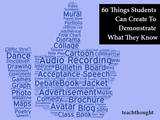
60 Things Students Can Create To Demonstrate What They Know
Audio Recording (try Vocaroo)
Acceptance Speech
Advertisement
Avatar (try Voki)
Blog (try Edublogs)
Book Jacket
Brochure
Bulletin Board
Cartoon
Class Book
Collage (digital and non-digital)
Comedy
Comic Strip (try BitStrip)
Commercial
Dance
Debate
Demonstration
Discussion (try Voicethread)
Diorama
Drawing
Experiment
Flow Chart
Games (digital and non-digital)
Google Earth Tour
Graph
Graphic Organizer
Infomerical
Interview
Photo
Portfolio (try Evernote)
Puppet Show
Learning Log
Literature Circle
Magazine
Maps
Mind Map (try bubbl.us)
Mural
Music
News Report (try Fodey)
Poetry
Reenactment
Role Play
Scavenger Hunt (try QR codes)
Scrapbook
Sculpture
Show & Tell
Simulation (digital and non-digital)
Slideshow
Socratic Discussion
Song
Story Map
Speech
Tag Cloud (try Wordle)
Theatrical Play
Timeline (try Timegrinder)
Video
Webpage (try Weebly)
Word Splash
Word Wall
Wiki (try Wikispaces)
60 Things Students Can Create To Demonstrate Understanding
The post 60 Things Students Can Create To Demonstrate What They Know appeared first on TeachThought.
TeachThought Blog
.
Blog
.
<span class='date ' tip=''><i class='icon-time'></i> Dec 04, 2015 04:16am</span>
|
|
50 Of The Best Free Apps For Teachers
by TeachThought Staff
What are the best free apps for teachers?
That’s a pretty general and subjective idea. The best for them as human beings-health, finances, and entertainment? The best for them in the classroom? To connect with other educators? To stay on top of emerging tools and trends in education? To use with students?
For iOS, Android, or Windows Phone? Can we assume there’s WiFi access? Is data use an issue? What about data privacy? And what do we mean by "free" Truly free? Are in-app purchases available? Necessary? Is it a free version that has hideous banners everywhere?
To say that there is a lot to consider is an understatement.
That said, we’ve taken a wide-lens view of the modern teacher and taken a stab at what might be considered 50 of the best really, truly actually free apps available for iOS. They may have some paid options, but they’re each entirely useful without spending a penny.
While we do look at music, health tracking apps, and other teachers-as-a-human-being apps, we focus mostly on the kinds of digital content that will help you teach more effectively to a wider range of students in more compelling and dynamic ways than ever before. All free.
50 Of The Best Free Apps For Teachers
Terry Heick
Owner
50
items
62
views
50 Of The Best Free Apps For Teachers
Listly by Terry Heick
From TeachThought, the best free apps for teachers, from iOS, Android, and Windows Mobile.
Follow List
Embed List
1
Coursmos
Added by Olga Matveeva on Jan 15, 2014
2
Shadow Puppet for iPhone & iPad
Shadow Puppet is a digital storytelling app for iPad designed for kids. Students record mini-movies or presentations that combine photos and their voice. See examples of Shadow Puppet in the classroom.
Added by Emily Voigtlander on Mar 06, 2014
3
Evernote
Evernote for iPhone, iPad, and Apple Watch gets you effortlessly organized with notes that sync between all your devices. Be productive anywhere.
4
Duolingo - Learn Languages for Free
Learn another language from your phone in your spare time.
5
Google Drive - free online storage from Google
All your files in Drive - like your videos, photos, and documents - are backed up safely so you can’t lose them. Easily invite others to view, edit, or leave comments on any of your files or folders.
6
Dropbox
Dropbox is the place for your photos, docs, videos, and other files. Files you keep in Dropbox are safely backed up and you can get to them from all your devices. It’s easy to send large files to anyone, even if they don’t have a Dropbox account.
7
OneDrive - Cloud storage for files & photos
Google Drive and Dropbox not your thing? The OneDrive app for iOS lets you easily work with your personal and work files when you’re on the go.
8
Microsoft Word
The core Word experience is free, including viewing, creating and editing documents.
9
Storehouse - Photo & Video Collages, Stories, Albums
Turn a collection of photos and videos into a shareable story.
10
Pocket: Save Articles and Videos to View Later
Don’t lose track of the interesting things you find by emailing yourself links or letting tabs pile up in your browser. Just save them to Pocket.
View more lists from
Terry Heick
50 Of The Best Free Apps For Teachers
The post 50 Of The Best Free Apps For Teachers appeared first on TeachThought.
TeachThought Blog
.
Blog
.
<span class='date ' tip=''><i class='icon-time'></i> Dec 04, 2015 04:15am</span>
|
|
Moving Students From Digital Citizenship To Digital Leadership
by TeachThought Staff
Digital Citizenship has become one of the more symbolic phrases that represents the significant impact technology has made on our behavior and interactions.
What is the definition of digital citizenship? A couple of years ago, Terry Heick offered that digital citizenship is "The quality of habits, actions, and consumption patterns that impact the ecology of digital content and communities." In short, it’s taking care of the "things" we depend on in digital spaces.
This isn’t an easy concept for many students to wrap their head around, as it involves aspects of scale, permanence, and credibility that they are just beginning to wrestle with. Citizenship as an idea of its own is both crucial and crucially misunderstood, often reduced to political notions (Be heard-Vote!) or those ecological (Always Recycle!). Consider how infrequently many adults consider how the work they do, the things they buy, or the food they eat affects national or global citizenship.
This is all big picture thinking that is, somehow, easy to miss.
The Visual
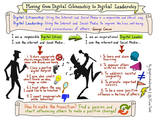
Which brings us to the visual above. Sylvia Duckworth recently got together with Jennifer Casa-Todd (you can also check out her blog) to illustrate an interesting twist on this idea-moving from mere "citizenship" to inspired leadership in digital spaces, using two definitions from George Couros (who has better hair than Terry Heick, so we get it).
Digital Citizenship: Using the internet and social media in a responsible and ethical way
Digital Leadership: Using the internet and social media to improve the lives, well-being, and circumstances of others.
The idea behind the shift? A kind of empathy-moving beyond see one’s self, and moving towards seeing one’s self in the physical and digital company of others. As digital technology and social media become more deeply embedded in our lives, and more nuanced in their function, this is a shift whose time has come. The question becomes, then, what’s the next evolution of this idea?
Moving Students From Digital Citizenship To Digital Leadership; image attribution Sylvia Duckworth
The post Moving Students From Digital Citizenship To Digital Leadership appeared first on TeachThought.
TeachThought Blog
.
Blog
.
<span class='date ' tip=''><i class='icon-time'></i> Dec 04, 2015 04:15am</span>
|
|
So I Think I Figured Out The Source Of All Human Suffering
by Terry Heick
I was driving down Shelbyville Road yesterday, pulling down the visor to block the golden, blinding light from the setting sun, and I figured out the primal source of all human suffering. Not the moment by moment thinking mistakes that create suffering in a Zen-killing way. Rather, a kind of flaw in our collective condition.
It goes something like this:
Imagine a universe so vast that the size is inconceivable-so incredible that our language and spatial reasoning and capacity for understanding are entirely insufficient to see, describe, or truly make sense of it. What we exist within and make sense from overwhelms our frame for existing, and our capacity to make sense of anything. It’s a kind of broken loop.
That’s only a problem of perception though. Imagine within that chaos, there is a large boulder moving silently in sweeping ellipses around a huge furnace of hydrogen (that is the only source of warmth for billions of miles). And on that boulder were living things (the ones that can’t conceive where they are and what they’re doing there) in a sea of limitlessness.
Among the living things on this boulder was a species whose members looked remarkably similar. Almost identical. But something got crossed in the way these creatures see and think and believe: though these living things were nearly identical, they were infatuated with their differences. Here they all were, huddled together on this boulder hurtling through space at 45,000 miles per hour. That’s mortifying. In response, they wanted badly to connect and huddle closer and make each other smile. To see what that the other person was thinking and feeling and curious about and was afraid of-to see what they thought about being on this cosmically random boulder. (There was an agreement between this species and the boulder, and then the boulder and the sun called gravity that kept them from flying off into the abyss.)
This species, in their evolution, ultimately formed systems-of government and business and communicating and the like. But these systems pit one against one another under this illusion of competition. They were designed all wrong by the species due to their limitations. These systems were designed to emphasize differences, instead of encouraging one person to lean on the person next to them. These living things were programmed to love and comfort, but participated in systems that made them judge and compete.
The living creatures never did figure out that at any time they could stop competing. Design new systems driven by love. They could send robots to Mars, after all; they could compose symphonies and write novels and and make one another laugh. (Even had some creatures whose job it was to make other creatures laugh.) They could create new systems. They could. But the people that could had too much to lose, so they didn’t. They just stood on the rock and hurtled through space and finished out their existence with their eyes closed.
The vastness of the universe troubled the creatures, so they stopped looking up; the differences between the living creatures troubled them, so they stopped looking left and right. Their own mortality troubled them too, so they stopped thinking abstractly. After that, they mostly looked down, only interrupting this pattern when they had to greet another living creature. They learned to do this efficiently by simply moving their lips into a kind of semi-circle that meant "Hello. I won’t hurt you." Then they kept walking.
Eventually, they got practical. Real practical. Jobs and television and such. Most relationships were reduced to, "Are you a threat to me? If not, what can you do for me?" They invented time to mark their days on the rock. Created something called a year to mark trips around that hydrogen furnace.
They had wars. Lots of them. Wars were when these living creatures grouped themselves into geographical gangs, each with their symbols clarifying their differences called flags. Then they used their intellectual affection and creative genius and capacity for design and created things called guns and bombs so that they would no longer have to stare at their differences. They erased them with gunpowder.
It could be said that the differences were to blame; some creatures in fact blamed the differences. Others just wanted off the boulder. Still others thought a little bit longer about it, and thought maybe it was a lack of tolerance for difference. Some of these living creatures wanted to make the other stop existing, and to be efficient about this went onto school campuses (where people packed themselves together for learning and personal growth) with guns and started ending as many differences as they could.
(While elsewhere on the boulder, some of the creatures were having weddings, where they promised to love forever without understanding what that meant.)
The rest realized they were on a boulder traveling through space at 45,000 miles per hour, destined for death without exception (death was programmed into their code-something the creatures called DNA), and thought that love was the only thing that made sense. But when they tried to love others they found it difficult and troublesome and sometimes painful, so they stopped trying so much. They saved the love for the creatures that looked and sounded the most like them; those closest to them. To hell with the others. (They never said this; their behavior and thinking and racism and economic systems all implied it loudly enough.)
The poor living creatures were coded to love and dream and hope and play, but one day, they (mostly) stopped. They came to see that unless everyone was in it for love, it didn’t work; those that weren’t in it for love broke the game-had the very best in living arrangements and work and power and potential. Those that abandoned love had an insurmountable advantage in terms of the things people collect, like gold and credit cards and Apple Watches.
(Some people even used to collect people; they called them slaves.)
In response, the living creatures learned to use distraction to cope, and medicated themselves endlessly with spirits and sports and gadgets and pills and stories told by liars (called movies) that quieted their minds-anything to avoid having to love one another as they hurtled through space. It was all very absurd.
So the short version goes like this: Due to the perilous cosmic context of a very fragile human condition, the living creatures instinctively wanted to huddle together-to love one another. But self-designed systems encouraged them to be competitive and confrontational and mostly anonymous.
In their marrow, they creatures wanted to love and be loved, but were tricked into thinking they were supposed to compete, scampering across the surface of the boulder in increasingly ridiculous patterns-thinking about their place on the boulder rather than the boulder’s place in the galaxy, and the galaxy’s place in the universe. They missed the point. They never realized that there was no such thing as a depressed astronomer.
This was the primal source of all suffering.
The post So I Think I Figured Out The Source Of All Human Suffering appeared first on TeachThought.
TeachThought Blog
.
Blog
.
<span class='date ' tip=''><i class='icon-time'></i> Dec 04, 2015 04:14am</span>
|
|
A Common Language: 30 Public Education Terms Defined
by TeachThought Staff
Communication depends on a common language.
In any field, knowing what a colleague means when they use a term or phrase is the difference between talking about ideas and exchanging ideas. So the following list of public education terms is useful not so much for the definitions, but for the credibility (or at least authority) of the definitions, as they are sourced from the Department of Education itself, in this case in regards to clarify Race to the Top language and meaning.
For us, they’re informative for other reasons:
To see language and patterns is to see priority and thought. Put another way, you can’t discuss and likely don’t value what you haven’t identified and named.
To see how many factors impact a child’s education
To clarify your own misconceptions
To prioritize your own work
To share with colleagues
We’ve included most of the definitions they provided, but left a few out that were only narrowly useful. You can find the full list here.
A Common Language: 30 Public Education Terms Defined
1. Achievement gap
The difference in the performance between each ESEA subgroup (as defined in this document) within a participating LEA or school and the statewide average performance of the LEA’s or tate’s highest achieving subgroups in reading/language arts and mathematics as measured by the assessments required under the ESEA.
2. College and career-ready graduation requirements
Minimum high school graduation expectations (e.g., completion of a minimum course of study, content mastery, proficiency on college- and career-ready assessments, etc.) that include rigorous, robust, and well-rounded curriculum aligned with college- and career-ready standards (as defined in this document) that cover a wide range of academic and technical knowledge and skills to ensure that students leave high school ready for college and careers.
3. College- and career-ready standards
Content standards for kindergarten through 12th grade that build towards college- and career-ready graduation requirements (as defined in this document) by the time of high school graduation. A State’s college- and career-ready standards must be either (1) standards that are common to a significant number of States; or (2) standards that are approved by a State network of institutions of higher education, which must certify that students who meet the standards will not need remedial course work at the post-secondary level.
4. College enrollment
The enrollment in college of students who graduate from high school consistent with 34 CFR 200.19(b)(1) and who enroll in an institution of higher education (as defined in section 101 of the Higher Education Act, P.L. 105-244, 20 U.S.C. 1001) within 16 months of graduation.
Core educational assurance areas:
Adopting standards and assessments that prepare students to succeed in college and the workplace and to compete in the global economy;
Building data systems that measure student growth and success, and inform teachers and principals about how they can improve instruction;
Recruiting, developing, rewarding, and retaining effective teachers and principals, especially where they are needed most; and
Turning around our lowest-achieving schools.
5. Digital learning content
Learning materials and resources that can be displayed on a digital device and shared electronically with other users. Digital learning content includes both open and or commercial content. In order to comply with the requirements of the Americans with Disabilities Act and Section 504 of the Rehabilitation Act, any digital learning content used by grantees must be accessible to individuals with disabilities, including individuals who use screen readers. For additional information regarding their application to technology, please refer to www.ed.gov/ocr/letters/colleague-201105-ese.pdf and www.ed.gov/ocr/docs/dcl-ebook-faq-201105.pdf.
6. Educators
All education professionals and paraprofessionals working in participating schools (as defined in this document), including principals or other heads of a school, teachers, other professional instructional staff (e.g. staff involved in curriculum development, staff development, or operating library, media and computer centers), pupil support services staff (e.g. guidance counselors, nurses, speech pathologists, etc.), other administrators (e.g. assistant principals, discipline specialists.), and paraprofessionals (e.g. assistant teachers, instructional aides).
7. Graduation rate
The four-year or extended-year adjusted cohort graduation rate as defined by 34 CFR 200.19(b)(1).
8. High-needs students
Students at risk of educational failure or otherwise in need of special assistance and support, such as students who are living in poverty, who attend high-minority schools (as defined in the Race to the Top application), who are far below grade level, who have left school before receiving a regular high school diploma, who are at risk of not graduating with a diploma on time, who are homeless, who are in foster care, who have been incarcerated, who have disabilities, or who are English learners.
9. Interoperable data system
System that uses common, established structure such that data can easily flow from one system to another and in which data are in a non-proprietary, open format.
10. Local educational agency
As defined in ESEA, a public board of education or other public authority legally constituted within a State for either administrative control or direction of, or to perform a service function for, public elementary schools or secondary schools in a city, county, township, school district, or other political subdivision of a State, or for a combination of school districts or counties that is recognized in a State as an administrative agency for its public elementary schools or secondary schools.
11. Low-performing schools
Schools that are in the bottom 10 percent of performance in the State, or who have significant achievement gaps, based on student academic performance in reading/language arts and mathematics on the assessments required under the ESEA or graduation rates (as defined in this document).
12. Metadata about content alignment
Information about how digital learning content assesses, teaches, and depends on (requires) common content standards such as State academic standards.
13. On-track indicator
A measure, available at a time sufficiently early to allow for intervention, of a single student characteristic (e.g., number of days absent, number of discipline referrals, number of credits earned), or a composite of multiple characteristics, that is both predictive of student success (e.g., students demonstrating the measure graduate at an 80 percent rate) and comprehensive of students who succeed (e.g., of all graduates, 90 percent demonstrated the indicator). Using multiple indicators that are collectively comprehensive but vary by student characteristics may be an appropriate alternative to a single indicator that applies to all students.
14. Participating schools
Schools that are identified by the LEA or consortium and choose to work with the LEA to implement the LEA(s)’ Race to the Top plan, either in a specific grade span or subject area or in the entire school.
15. Participating students
Students enrolled in a participating school (as defined in this document), grades, or subject areas and directly served by a Race to the Top District plan.
16. Persistently lowest-achieving schools
As determined by the State, consistent with the requirements of the School Improvement Grants program authorized by section 1003(g) of the ESEA,
Any Title I school in improvement, corrective action, or restructuring that (a) Is among the lowest-achieving five percent of Title I schools in improvement, corrective action, or restructuring or the lowest-achieving five Title I schools in improvement, corrective action, or restructuring in the State, whichever number of schools is greater; or (b) Is a high school that has had a graduation rate as defined in 34 CFR 200.19(b) that is less than 60 percent over a number of years; and
Any secondary school that is eligible for, but does not receive, Title I funds that (a) Is among the lowest-achieving five percent of secondary schools or the lowest-achieving five secondary schools in the State that are eligible for, but do not receive, Title I funds, whichever number of schools is greater; or (b) Is a high school that has had a graduation rate as defined in 34 CFR 200.19(b) that is less than 60 percent over a number of years.
To identify the lowest-achieving schools, a State must take into account both (i) The academic achievement of the "all students" group in a school in terms of proficiency on the State’s assessments under section 1111(b)(3) of the ESEA in reading/language arts and mathematics combined; and (ii) The school’s lack of progress on those assessments over a number of years in the "all students" group.
17. Personalized learning plan
A formal document, available in digital and other formats both in and out of school to students, parents, and teachers, that, at a minimum: establishes student learning goals based on academic and career objectives and personal interests; sequences content and skill development to achieve those learning goals and ensure that a student can graduate on-time college- and career-ready; and is updated based on information about student performance on a variety of activities and assessments that indicate progress towards goals.
18. Principal evaluation system
A system that: (1) will be used for continual improvement of instruction; (2) meaningfully differentiates performance using at least three performance levels; (3) uses multiple valid measures in determining performance levels, including as a significant factor data on student growth(as defined in this document) for all students (including English learners and students with disabilities), and other measures of professional practice (which may be gathered through multiple formats and sources, such as observations based on rigorous leadership performance standards, teacher evaluation data, and student and parent surveys); (4) evaluates principals on a regular basis; (5) provides clear, timely, and useful feedback, including feedback that identifies needs for and guides professional development; and (6) will be used to inform personnel decisions.
19. School board evaluation
An assessment of the LEA school board that both evaluates performance and encourages professional growth. This evaluation system rating should reflect both (1) the feedback of many stakeholders, including but not limited to educators and parents; and (2) student outcomes performance in order to provide a detailed and accurate picture of the board’s performance.
20. School leadership team
A team that is composed of the principal or other head of a school, teachers and other educators, and, as applicable, other school employees, parents, students, and other community members, and leads the implementation of improvement and other initiatives at the school. In cases where statute or local policy, including collective bargaining agreements, call for such a body, that body shall serve the school leadership team for the purpose of this program.
21. Student attendance
During the regular school year, the average percentage of days that students are present for school. Students should not be considered present for excused absences, unexcused absences, or any period of time that they are out of their regularly assigned classrooms due to discipline measures (i.e., in- or out-of-school suspension).
22. Student survey
Measures students’ perspectives on teaching, learning, and related supports in their classrooms and schools. The surveys must be research-based, valid, and reliable. Over time these results should be predictive of rates of student growth.
23. Student Growth
The change in student achievement for an individual student between two or more points in time, defined as—
For grades and subjects in which assessments are required under ESEA section 1111(b)(3): (1) a student’s score on such assessments and (2) other measures of student learning, such as those described in the second bullet, provided they are rigorous and comparable across schools within an LEA.
For grades and subjects in which assessments are not required under ESEA section 1111(b)(3): alternative measures of student learning and performance, such as student results on pre-tests, end-of-course tests, and objective performance-based assessments; performance against student learning objectives; student performance on English language proficiency assessments; and other measures of student achievement that are rigorous and comparable across schools within an LEA.
24. Student-level data
Demographic, performance, and other information that pertains to a single student but cannot be attributed to a specific student.
25. Student performance data
Information about the academic progress of a single student, such as formative and summative assessment data, coursework, instructor observations, information about student engagement and time on task, and similar information.
26. Subgroup
Each category of students identified under ESEA section 1111(b)(2)(C)(v)(II).
27. Superintendent evaluation
Rigorous, transparent, and fair annual evaluation for the LEA superintendent that provides an assessment of performance and encourages professional growth. This evaluation rating should reflect (1) the feedback of many stakeholders, including but not limited to educators, principals, and parents; and (2) student outcomes performance in order to provide a detailed and accurate picture of the superintendent’s performance.
28. Teacher attendance
During the regular school year, the average percentage of days that teachers are present when they would otherwise be expected to be teaching students in an assigned class. Teachers should not be considered present for days taken for sick leave and/or personal leave. Personal leave includes voluntary absences for reasons other than sick leave.
29. Teacher evaluation system
System that: (1) will be used for continual improvement of instruction; (2) meaningfully differentiates performance using at least three performance levels; (3) uses multiple valid measures in determining performance levels, including as a significant factor data on student growth (as defined in this document) for all students (including English learners and students with disabilities), and other measures of professional practice (which may be gathered through multiple formats and sources, such as observations based on rigorous teacher performance standards, teacher portfolios, and student and parent surveys); (4) evaluates teachers on a regular basis; (5) provide clear, timely, and useful feedback, including feedback that identifies needs and guides professional development; and (6) will be used to inform personnel decisions.
30. Turnaround strategy
As defined by the School Improvement Grant (SIG) regulations, published in the Federal Register on October 28, 2010 (75 FR 66363), turnaround model, restart model, school closure, or transformational model.
image attribution data source ed.gov
The post A Common Language: 30 Public Education Terms Defined appeared first on TeachThought.
TeachThought Blog
.
Blog
.
<span class='date ' tip=''><i class='icon-time'></i> Dec 04, 2015 04:13am</span>
|
|
4 Tips For Smarter Collaboration With Resource Teachers
by Dan Henderson, Author of That’s Special: A Survival Guide To Teaching
It was an arranged work marriage spurred on by the ceremonial job fair.
Two principals were swapping teachers as casually as goats in a dowry. This was the last job fair before the school year, and these teachers were either inexperienced or lemons. The lemon dance squeezed out Paul to our elementary school. Eliza, an experienced teacher, was weary of this arranged marriage when Paul’s first question to ignite their foray was "When is lunch?"
Eliza stares at her countdown till summer calendar in her classroom. The dismal number 163 taunts her in blood red ink. Eliza witnesses her first graders dare each other to lick their names on the table. The first grader laughed as Todd’s lips open making a smacking sound. The tip of his tongue makes first contact with the table. Mumbling and laughing simultaneously he writes, Todd on the table. Eliza asks Todd to repent, but the saliva has already melted through the first two floors of the school. Carefully crafted ham and cheese sandwiches from loving moms are garnished with Todd’s saliva.
This was not the condiment of choice.
Collaborating With Resource Teachers Isn’t Rocket Science
This gross dare has one positive outcome. Eliza recently bought stock in Clorox wipes. Eliza’s post teaching career was to be a spokesperson for Clorox. Buy Clorox wipes, because no one ever told you that being a mom involves cleaning saliva off your furniture.
Eliza looks at the clock, 1:30pm. "Where is my inclusion teacher? Where is Paul?" Eliza thought.
Eliza hears Paul running up the stairwell. He bursts open the door disturbing all the busy bees working hard at their desks.
"Am I late?" Paul asks sheepishly. Looking at the clock, Paul starts to blush. Eliza got the short end of the dowry.
"Late, Late, it’s 1:30! You were suppose to be hear at 1pm. Not only did you miss the center with your students but don’t you have to get to your next class?" Eliza pauses hoping this newbie understands the importance of timeliness.
Paul looks down at the ground in shame.
"Well, why were you so late?" Eliza demands.
"The deli six blocks away has really good pastrami sandwiches."
Eliza realizes that falling test scores in the U.S. are not because of lack of funding or adequate education but because of the power of the pastrami on rye.
4 Tips For Collaboration With Resource Teachers
1. Use A Schedule
And try to stick to it.
Yes, resource teachers have meetings and paperwork through the yin yang, but the students come first. Actually, by law, the hours agreed upon per week or month are a legal binding document. Special education teachers who habitually miss hours of instruction can only make up so much time in the week. This sacred instructional time needs to be honored, and all efforts must be made to protect the special education instructional time with their students.
You also may need to make up time. The special education teacher will be late. They may be dealing with a student in crisis or just be out sick. When setting up the schedule, plan for extra hours in the week in case you have to make up hours. If the special education teacher does not need them, they can use them for extra planning time.
The give and take of your arranged marriage has to work for you. Respecting each others time is the cornerstone. If the principal can throw in a llama to the dowry, then your inclusion marriage will be that much sweeter.
2. Clarify The IEP Items & Goals
The special education teacher should provide an IEP to the general education teacher (among other staff). The program should list goals and rubrics for how each of the goals is to be measured. The general education teacher and the special education teacher need to work together to accomplish the student’s IEP goals. But how?
3. Actually Collaborate
Collaboration is not a pointless meeting. Many times students with learning disabilities need the material presented in a different way. A simplification of the steps and the appropriate re-arrangement of the curriculum can only be done though collaboration. How can you adapt a lesson on long division if the special education teacher has not seen the lesson plans?
4. Focus on the student’s strengths
Far too often, the special education student’s strengths are not being used.
Self-esteem is as foundational to teaching as food and water. I always start a lesson off with a topic or problem the student will be guaranteed to get correct. Motivating the students by positive re-direction of what they can do builds up momentum for them to tackle difficult problems ahead. Instead of seeing the child as a concern, talk to your students about their strengths. Find the positive attributes in your students instead of labeling them a problem. To sum it up…
"Everybody is a genius. But if you judge a fish by its ability to climb a tree, it will live its whole life believing that it is stupid." Anonymous
You can find more about the book That’s Special: A Survival Guide To Teaching on facebook ; 4 Tips For Collaboration With Resource Teachers; 4 Tips For Smarter Collaboration With Resource Teachers
The post 4 Tips For Smarter Collaboration With Resource Teachers appeared first on TeachThought.
TeachThought Blog
.
Blog
.
<span class='date ' tip=''><i class='icon-time'></i> Dec 04, 2015 04:12am</span>
|
|
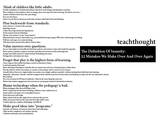
Insanity In Education: 52 Mistakes We Make Over And Over Again
by Terry Heick
The context for this one is simple enough-what mistakes do we constantly make in education that hold us back from the best versions of ourselves? From realizing our collective potential as a construct, field, and industry? What mistakes do we make over and over and over again, expecting a different result each time?
Probably a lot, but 52 is enough for now.
Forget learning should be fun.
Stigmatize failure.
Think of children like little adults.
Gamify compliance to institutional policies instead of social change and disruptive creativity.
Place students on the periphery when we design, plan, and respond to their learning. (It’s theirs, not ours.)
Assume all kids need to know the same things.
Fail to meaningfully involve-or better yet, require-community involvement in every layer of our system of teaching and learning.
Fail to recruit African American and Latino teachers with forward thinking. (Teach for America isn’t it.)
Plan backwards from standards.
Start school at 7 o’clock in the morning.
Build big schools and expect personalization.
Collect those big schools into big districts and expect innovation.
Prioritize uniformity and expect creativity.
Teach content instead of thinking.
Put the "best teachers" in the "worst schools."
Misunderstand concepts and models (e.g., personalized learning, inquiry, PBL) that could change everything.
Reduce understanding to letters and numbers.
Talk about ideas instead of the effects of those ideas.
Value answers over questions.
Say we value depth over breadth, but then have policies and systems in place that imply the opposite.
Fail to protect, optimize, support, innovate, and otherwise increase teacher planning time.
Design curriculum based on content instead of thinking and action.
Package that curriculum into units.
Forget that play is the highest form of learning. (We come to understand through play; we can’t "play" with what we don’t understand; we can’t fail to improve our understanding when we play.)
Seem to ignore that mobile learning is central to education’s future.
Look back instead of forward.
Resist allowing technology to radically alter our classrooms and ways of doing business within them.
Plan the delivery of that curriculum as a matter of chronology-that is, treat it as if it is linear.
Actually believe that every single student can master every single academic standard-without making them think they hate learning.
Stigmatize "alternative schools," and fail to support them with the same level of innovation and thinking we expect for the non-alternative schools.
Believe that vertical alignment is possible to do consistently.
Teach reading like a skill instead of a knowledge-seeking, pleasurable activity.
Bus students.
Pay a lot of money for PD that is ineffective. Then do the same thing the next year.
Believe that student engagement and curiosity are merely goals instead of absolutely mandatory.
Blame technology when the pedagogy is bad.
Blame pedagogy when the technology is bad.
Fail to compensate for the heart-breaking conditions some students live in.
Under-utilize and under-serve truly gifted learners. (Actually, we under-utilize and under-serve the gifts of all learners, but we have downright brilliant students in our schools just eking out an academic existence instead of changing the world.)
Paint classroom walls beige.
Make schools look less like Apple Stores and more like prisons.
Make classrooms look less like cafes and more like stuffy rooms.
Confuse rigorous, complex, challenging, and difficult.
Make good ideas into "programs," then wonder why teachers roll their eyes at good ideas.
Separate curriculum, assessment, instruction, and technology.
Value teacher compliance over teacher capacity.
Celebrate uniformity and teachers being on the "same page," but expect great teaching.
Let teachers talk more than students.
Dehumanize teachers with pressure, then wonder why they quit.
Drag students kicking and screaming through lessons and units. (Instead of figuring out another way.)
Under-value relationships with students (including formal mentoring programs).
Think of school as "college and career prep."
The Definition Of Insanity In Education: 52 Mistakes We Make Over And Over Again
The post Insanity In Education: 52 Mistakes We Make Over And Over Again appeared first on TeachThought.
TeachThought Blog
.
Blog
.
<span class='date ' tip=''><i class='icon-time'></i> Dec 04, 2015 04:11am</span>
|
|
Is 2016 The Year That Progressive Education Returns?
by Robert Sun
The 1920’s were a high point in the Progressive Education movement. Developed in response to the rigid pedagogy of 19th Century industrial society—methods that stressed uniform learning largely defined by social class—Progressive Education sought to break the mold with a more enlightened approach to public schooling.
While Progressive Education had many elements, it essentially followed three teaching strategies. First was an emergent curriculum that responded to children’s enthusiasms, recognizing that students are most motivated to learn something they are already interested in. Second was an integrated curriculum wherein children learn thematically, rather than through compartmentalized subject matter. Third was the notion of experiential education, learning by doing. Experiential education requires students to get out of their chairs, work with their hands, and actively cooperate with others on a shared goal.
Despite its promise and a number of early successes, Progressive Education eventually lost momentum in the United States. Much of decline was due to the cultural conservatism of the 1940’s and 50’s, a time when national identity was highly valued and common approaches to things like education were emphasized. In that era, a good citizen was one who fit into "the system." The ensuing Cold War caused political and educational leaders to stress outcomes rather than process—a philosophy that in many ways persists today.
As America comes to grips with the 21st Century world, however, the precepts of Progressive Education are once again finding favor. Why? Mainly because the human skills needed in this century are very different from those in the last. A recent World Economic Forum research study, "New Vision for Education: Unlocking the Potential of Technology," identified the skills and traits students will need for future success including critical thinking, creativity, communications, curiosity, initiative, persistence and adaptability. These skills, the report states, will be as important as language arts, mathematics and science.
Progressive Education also mirrors the priorities of contemporary American society—the need to accept diversity—particularly an individual’s skills, preferences, responsibilities and rights. It values socially-engaged thinkers who can evaluate complex issues and come to independent conclusions that benefit the common good.
As much as this modern version of Progressive Education owes its existence to innovators of long ago, it has been re-shaped by 21st Century instructional thinking:
Emergent curriculum has become Passion-Based Learning, so that skills are tailored to contemporary interests.
Integrated curriculum is now known as Theme-Based Learning, using topics that not only activate a diverse array of subjects, but also allow students to see how each plays its part in solving a larger challenge.
Experiential education has been enabled—even transformed—by technology that gives kids hands-on, interactive knowledge. Through creative use of technology, critical thinking, persistence, communication and collaboration are all enabled.
Finland has been a leader in the neo-progressive movement. Music, physical education and art are not only required but prized, as is time for self-directed activities throughout the school day. Finnish schools are shifting to teaching by topic rather than subject; moreover, students are free to choose topics that can span a number of traditional "subjects." Both Finland and U.S. score in the top 10 in the 2015 Global Innovation Index, but Finland ranks 12th in the PISA study (mean score) of performance in mathematics, reading and science, while U.S. is 36th—indicating that a progressive strategy can achieve both the foundational and "soft" skills needed for success in this century.
Technology is playing a major role in the re-examination of Progressive Education. Game-based learning programs are becoming highly valued at elementary and intermediate levels because they’re child-centered and playful, allowing kids to explore complex subjects at will. Games support collaboration and the free exchange of views and ideas. Used in conjunction with interactive white boards and touchscreens, students work together to propose solutions, explain ideas, and engage in close cooperation to acquire knowledge.
Today’s form of experiential education is often referred as "project-based learning." A similar, though shorter-format version is "program-based learning" in which students are focused on specific challenges. Game-based learning excels at these program-based situations because they allow students to grow comfortable in their new roles as collaborators. Soon they can move on to larger, project-based initiatives.
One need only look at the state of education in the U.S. today to realize people are looking for answers. The pushback over high-stakes testing isn’t abating; in New York state alone, 20% of all public school students—more than 200,000 in all—have opted out of such tests. In Pennsylvania the opt-out movement has grown by more than 300%.
As a nation, we need to take advantage of each child’s innate passion for learning, but as long as school districts see compliance as a number-one priority, they can never properly support and nurture students. Without a more enlightened approach to education, we’re viewing our children through a mere single lens.
It is important that we look at the bigger picture and find new ways to motivate our children to master skills on their own. Progressive Education, as a philosophy for improving our schools, has been debated for more than a century. Hopefully this is the year that we will finally embrace it and bring a sense of joy to learning.
ROBERT SUN is the CEO of Suntex International and inventor of First In Math, an online program designed for deep practice in mathematics.
The post Is 2016 The Year That Progressive Education Returns? appeared first on TeachThought.
TeachThought Blog
.
Blog
.
<span class='date ' tip=''><i class='icon-time'></i> Dec 04, 2015 04:11am</span>
|
|
Video Games Can Teach Your Students
by Andrew Ross, Language Teacher in Japan
Ed note: The post below is part 1 in a 3-part series on the reality of teaching with video games.
Learning a new language isn’t easy.
I know. I live in Japan but I still can’t speak Japanese very well. Oh, I can understand some important words (the word for "deported" is important to know!), but I rarely have to say much in Japanese in my everyday life. Japanese people don’t really speak English. Their education doesn’t emphasize it. The classes are mostly taught in Japanese!
Instead, students are taught to translate so they can understand. The same goes for my online "classes," in that I’m mostly asked to do multiple choice questions based on my ability to translate what I read or hear. That means that most of my conversations end up looking like a scene from Star Wars, where my conversation partner and I are both speaking in different languages but apparently can understand each other just fine. When everything’s translated, it’s hard to stay motivated.
This applies to the US as well. Why learn a foreign language when one of the two countries we share borders with mostly speaks English? Everything gets translated into English anyway, right? And on a daily basis, we don’t usually have to use a foreign language. In Japan, the situation’s basically the same, except there’s a sense of shame about being monolingual when your government constantly tells you it’s important and mandates you learn the language for six years (or longer with the new generation).
Motivation & Learning
Just being told a subject is important isn’t enough. If so, I’d be much better at math, my weakest subject. Aside from the basics, the only time I remember using more advanced math was when I was playing a Pokemon game in high school. Despite the cute appearance of the monsters, the mechanics involved in raising the digital creatures use some slightly difficult algebra. I didn’t get the formulas on the test, but I went back to the books long after so I could raise the best digital blood-sport-beasts possible. That’s the power of motivation.
This isn’t anything new though. We know inherently that motivation helps, and there’s been a lot of studies on the subject. In fact, I did an interview with to two researchers, Dr. Liss Kerstin Sylvén from the University of Gothenburg and Dr. Pia Sundqvist from Karlstad University, about language acquisition. Their focus was on "extramural English"; English used outside the classroom for non-academic purposes. That is, students using English for fun, and naturally, students who did this outperformed students who didn’t. Their activities ranged from television to games to social media, and games seemed to most strongly correlate with language improvement.
When writing another article on Dr. Rachel Kowert and Dr. Thorsten Quandt’s The Video Game Debate, education and games once again popped up, with motivation once again being a central idea in their chapter on education and games. It’s not perfect, but one thing games can do that many other media can’t is to simulate another activity. For example, in Oregon Trail, through text, you experience what it was like to cross the country with, to be polite, less modern conveniences.
We’d read the dry descriptions and a few journal entries, but it wasn’t as engaging as the simple simulation the game presented. My sister nearly always died of dysentery, a word I never looked up in class until the teacher let us play the game to experience the harsh reality of the situation. I can’t actually fix a wagon, but I learned the names of several parts and how they functioned because, in order to best enjoy the game, I was motivated to learn about what was going on. This is also why, mostly due to the popular perception of all games being violent, people fear that games are damaging to children.
Let’s give the harshest critics against games their biggest argument though: games can teach kids to become soldiers. It’s crazy since games rarely take into account something like the kick of a gun and how to load ammunition, both of which can make using the firearm potentially lethal for the user, but that’s fine, because here’s the thing we can’t argue then: it teaches. In fact, Dr. Kowert and Dr. Quandt’s book even notes that games that explicitly point out to players when they perform a morally reprehensible action, they tend to at least feel bad, if not avoid that action in the future. That is, games can also teach morality. The recent popularity of a game called Undertale, in which you can choose not to kill anyone for a happy ending or kill everything and experience a tragedy, shows that not only can a non-violent game can teach players to "play nice," but it can be highly enjoyable as well.
If students can learn shooting and morals, why not math? My algebra skills actually improved a bit due to a summer of pokemon. Why not mythology? I learned a lot of names and places from various RPGs. Why not language? I learned to read two of the Japanese writing systems because I imported a Japanese game and spent about two months glued to the screen and a dictionary so I could understand it long before amateur translators would disseminate their scripts.
There are some problems with this however, which we will get into tomorrow in Part 2.
Video Games Can Teach Your Students
The post Video Games Can Teach Your Students appeared first on TeachThought.
TeachThought Blog
.
Blog
.
<span class='date ' tip=''><i class='icon-time'></i> Dec 04, 2015 04:10am</span>
|
|
The Mistakes That Quality Assessments Avoid
by Daniel R. Venables, Founding Director of the Center for Authentic PLCs
It’s that time of the school year when teachers are facing writing their first or second wave of unit tests and assessments. The following list of items are things best avoided in designing quality teacher-made assessments.
1. Too many multiple-choice questions
Sure, they are easy to correct and reduce the time it takes teachers to correct several classes of tests, but they generally reveal very little about a student’s knowledge or understanding if she gets a question wrong. (This is true also for a question a student answered correctly in so far as we have no idea if the student’s answer was a random guess.)
To know how a student was thinking or where her confusion might lie, we need questions that give her a chance to say more than "B". More, in the words of the late, great educator Dr. Ted Sizer, "How can we assess if a student is using her mind well if we ask her questions that have answers to choose from?"
2. Including ‘spoiler-alert’ questions
By these I mean questions that tell the student how to answer the question in the question itself. For example, on a math test containing a section on applying logarithms, don’t say "Use logs to solve each the following," instead say "Solve each of the following."
3. Using questions with no identifiable purpose
It’s so easy for us as educators to put a question on an assessment we’re writing that seemed like a good one but, upon further examination, has no real purpose. For each question item included on your assessment ask: What is the purpose of this question? What specific knowledge will I gain about my students’ levels of mastery of a standard or substandard by their answers to this question?
4. Unintentional question redundancy
It may be the case that you’re deliberately asking a question that tests the same skill or understanding at the same level of cognition as another question, but very often we include several question items that may look different or have different window dressing surrounding them that tests the exact understanding or skill as a previous question. Ask yourself: Do I need another question testing this or have I covered this standard sufficiently by previous questions at previous levels of depth?
Remember all the correcting you had to do in #1? Less is more.
5. Using unweighted rubrics
If the assessment you’re designing has a component that is to be scored with a rubric, weight the various dimensions in the rubric according to their significance. For example, if one dimension is Writing Mechanics and another is Source Citing, decide if these should hold the same weight in the overall grade on this assessment and, if not, weight them accordingly. It is a rare case when it is sensible for every dimension of a rubric to have the same weight. Don’t do so by default because it hadn’t occurred to you to give them different weights.
6. Rubric dimensions that address what students did
The purpose of the rubric is to discern levels of mastery of various standards addressed by the assessment and not a checklist of whether or not the student included things she was supposed to do in the manner you requested. For example, a rubric dimension Use of Text as Evidence addresses a learning standard or substandard being assessed but a rubric dimension Completion of Portfolio Requirements addresses something the student did and not something the student learned.
Let the rubric reflect students’ level of learning; let a separate checklist denote what she did in the demonstration of that learning. [Bonus tip: For the Checklist, I always include one like "Use of Class Time"]
7. Using a single grade to reflect mastery of multiple standards
This may be a time-honored tradition, but it really makes no sense. We are interested in our students’ mastery against a standard or several standards and in that regard, there should be a separate score/grade assigned for each. If this is too bold a break from tradition for you and you insist on an overall score for every assessment, avoid thinking in terms of percentages (another time-honored tradition that really makes no sense).
Score the component parts of the assessment as you will and if you’re going to use an overall score, make it one that is sensible based on the amount of mastery evidenced and not on what percentage of the assessment items the student answered correctly.
Daniel R. Venables is Founding Director of the Center for Authentic PLCs and author of How Teachers Can Turn Data Into Action (ASCD, 2014), The Practice of Authentic PLCs: A Guide to Effective Teacher Teams (Corwin, 2011), and Facilitating Authentic PLCs: The Human Side of Leading Teacher Teams (ASCD, forthcoming). He can be contacted at dvenables@authenticplcs.com.
This post is aligned with two themes from Connected Educator Month 2015: "Innovations in Professional Learning," led by ASCD, and "Innovations in Assessment," led by NCTE. Click the following links to find ASCD resources for professional learning or assessment; The Mistakes That Quality Assessments Avoid; image attribution flickr us nickamostcato
The post The Mistakes That Quality Assessments Avoid appeared first on TeachThought.
TeachThought Blog
.
Blog
.
<span class='date ' tip=''><i class='icon-time'></i> Dec 04, 2015 04:09am</span>
|